
Research article · 2025 · Full text
International Journal of Geography Geology and EnvironmentAvifaunal survey of Chitrakoot forest division, Uttar Pradesh
Volume 7(9) · Pages 29–34 · DOI: 10.22271/27067483.2025.v7.i9a.406 ↗
Research areasRangeland Management and Livestock EcologyWildlife Ecology and Conservation
Abstract
Author-writtenA systematic summer survey (May-Aug 2025) of the Chitrakoot Forest Division (Uttar Pradesh) documented 234 bird species (+4 sp./genera) across multiple habitats. Using line transects, point counts, and opportunistic records (logged on eBird), the study quantified habitat-specific richness and identified key taxa of conservation concern. Species richness was highest in dry deciduous forests (native teak-dhaora forests) and least in village-edge scrub (Table 1). Notable records included several globally threatened vultures and waterbirds, illustrating the division’s high conservation value. We summarize habitat-wise diversity (Table 1), tabulate threatened and legally protected species (Table 2), and highlight rare or seasonal migrants. Findings underscore the importance of safeguarding diverse habitats in the Vindhyan plateau ecosystem.
Summary
Source-checkedPlain-language reading of the full paper, prepared with AI and checked against the text. Each point links to the authors' own words.
Why it matters
- The Chitrakoot Forest Division in southern Uttar Pradesh covers approximately 3,234 km² of dry deciduous landscape within the Vindhya Range. View evidence ↗
- The region's vegetation is primarily tropical dry deciduous forest dominated by teak and dhaora, along with scrub, ravines, and seasonal wetlands. View evidence ↗
- The area provides large contiguous habitats because it includes protected tracts and buffer zones next to the Ranipur Tiger Reserve. View evidence ↗
The question
- Because no comprehensive inventory previously existed for the entire division, the study aimed to create a full species list, evaluate richness across habitats, and identify birds of conservation concern. View evidence ↗
What they did
- The survey was conducted over 60 days between May and July 2025 by an intern supported by local foresters. View evidence ↗
- Data collection involved walking line transects (counting birds within 50m), fixed point counts (5-10 minutes with a 50m radius), and opportunistic records. View evidence ↗
- Observations were categorized into six habitat types: dry deciduous forest, open scrubland/rocky hills, wetlands, agricultural margins, forest edge/settlement interface, and riparian corridors. View evidence ↗
What they found
- The survey documented 234 bird species and 4 additional unidentified taxa within the division. View evidence ↗
- Species richness varied by habitat, with the highest diversity in dry deciduous forests (~150 species) and the lowest in agricultural margins and village-edge habitats (~50-60 species). View evidence ↗
- Riparian corridors and wetlands each supported approximately 70-90 species, while open scrub and rocky hills supported approximately 60-80 species. View evidence ↗
- The survey recorded several critical vulture species, including the Indian, Red-headed, and White-rumped vultures. View evidence ↗
- Globally Vulnerable species were present, specifically the lesser adjutant stork in wooded wetlands and the sarus crane in riverine marshlands. View evidence ↗
What it means
- The authors recommend establishing vulture-safe zones (including a diclofenac ban) and maintaining a network of sacred groves and protected forest blocks as refuges. View evidence ↗
- The authors suggest managing wetlands as bird sanctuaries by seasonally drawing down water to create mudflats for waders. View evidence ↗
- The authors state that continued systematic monitoring across different seasons is necessary to track trends for species of concern. View evidence ↗
Visual summary
1 visualsIllustrations explain the paper; they do not show study data.
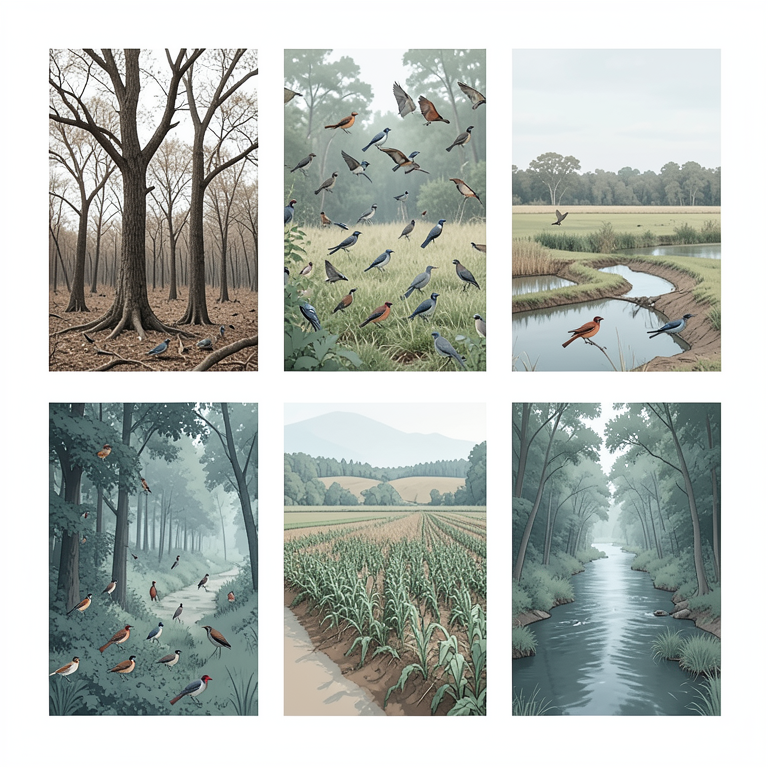
Habitat Diversity and Species Richness
AI-generated conceptual illustration (Various bird species in the Chitrakoot forest division habitats). It explains the idea and does not show study data.
View source evidence ↗Figures & tables
From the original paper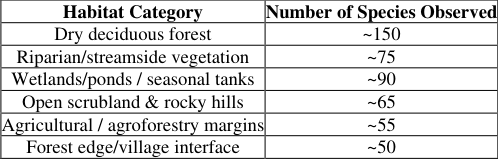 Table 1
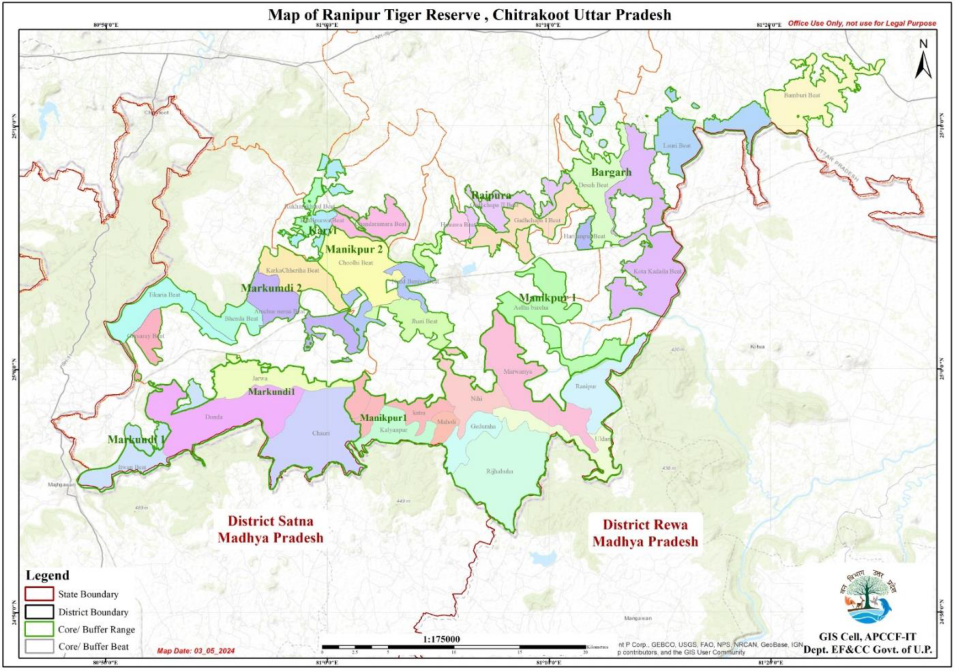 Figure 1
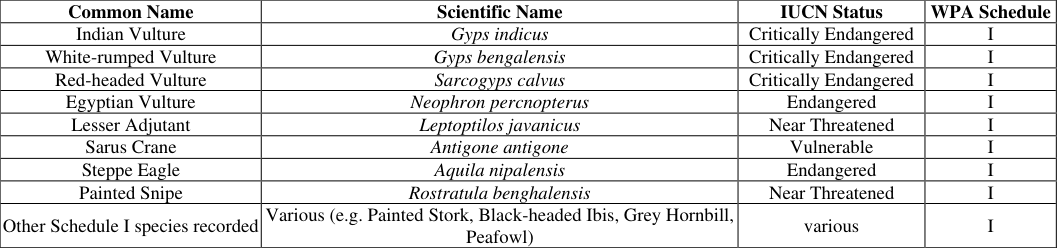 Table 2
Introduction
The Chitrakoot Forest Division (southern Uttar Pradesh, Bundelkhand) occupies ca. 3,234 km² of dry deciduous country in the Vindhya Range (25°N, 81°E). It is characterized by tropical dry deciduous vegetation (Forest Type 5A/C1) dominated by teak Tectona and dhaora Anogeissus, interspersed with scrub, ravines, and seasonal riverine wetlands. Elevations range ~150-400 m, and the climate is hot and dry with monsoon rains (July-Sept). The Division includes protected tracts and buffer zones adjacent to Ranipur Tiger Reserve, providing large contiguous habitats. Historically, even small surveys have found rich avifauna. E.g., Chaturvedi et al. (2017) [4] recorded 103 species in one subdistrict of Karwi, and earlier expeditions (government censuses) noted a variety of woodland and wetland birds. Given this diversity of forest, scrub, and wetland habitats, Chitrakoot is expected to harbor a broad suite of resident and migratory birds. To date, no comprehensive inventory has covered the whole division, so our objective was to compile a full species list, assess habitat-wise richness, and identify species of conservation concern. We conducted extensive fieldwork under Divisional Forest Department guidance, aiming to support management planning by providing baseline biodiversity data.
Study Area
The survey spanned all major ranges of Chitrakoot Division (Manikpur Range 1, Manikpur Range 2, Markundi Range 1, Markundi Range 2, Bargarh Range, Raipura Range, Karwi Range). Habitats ranged from intact teak-mixed forests and dense riparian corridors to open scrub-rocky hills, agricultural edges, temple groves, and seasonal wetlands (see Habitat Descriptions below). Parts of the Division overlap the buffer of Ranipur Tiger Reserve, offering relatively undisturbed forest cover for sensitive species. Protected "sacred" groves and village woodlots also occur near temples (noted in forest-edge habitat). Given this mosaic of ecosystems, Chitrakoot was expected to support insectivores, frugivores, waterbirds, and raptors.
Habitats surveyed:
We classified each observation into six broad habitat types, following departmental categories: i) Dry Deciduous Forest blocks (open-canopy teak-dhaora woodlands with mixed understorey). ii) Open scrubland & rocky hills (patchy thorn-scrub on sandstone outcrops). iii) Wetlands/water bodies (perennial and seasonal tanks, jheels, river pools with emergent vegetation). iv) Agricultural & agroforestry margins (crop fields with scattered trees/hedgerows). v) Forest edge & settlement interface (village gardens, temple groves adjoining forests). vi) Riparian corridors/streamside zones (dense green strips along seasonal streams and riverbanks).
These categories capture the main vegetation zones used by local birds. Sample site notes and GPS references were recorded (Appendix 1 contains checklist only; full field notes archived with DFO). [6] and Ali & Ripley field guides. All checklists (species, counts, GPS location, date/time, weather) were logged via the eBird mobile app to ensure standardized data. Verifications were aided by Merlin Bird ID for difficult calls. No birds were captured or handled; surveys were conducted with permission of the DFO and under his guidance. Surveyed habitats were explicitly noted for each observation to allow habitat-level analysis. At the end of the study, all checklists were aggregated and validated (photographs and calls were used to confirm rare sightings). Species richness (number of species) was tallied overall and for each habitat category. Threatened status was cross-checked against IUCN Red List and India's Wildlife Protection Act (WPA) schedules for relevant species.
Results
Results
Overall Diversity
Overall Diversity
Habitat-wise richness
Species richness was highest in the main forested areas and lowest along human-dominated edges. Dry deciduous forests harbored the most diverse assemblage (~150 species recorded) due to canopy insectivores, woodpeckers, drongos, parakeets and arboreal raptors. Riparian stream corridors (dense gallery forest) and wetlands each supported ~70-90 species, including migrants like waders, bitterns, and waterfowl. Open scrub and rocky hills yielded ~60-80 species (larks, shrikes, pipits, sandgrouse, falcons, etc.). Agricultural margins and village-edge habitats hosted ~50-60 species (weavers, munias, sparrows, bulbuls, parakeets, crows, etc.). Table 1 summarizes species counts per habitat. Threatened and Protected Species Among the 234 species, several are of high conservation concern (Table 2). Notably, vultures comprised a critical component: Indian Vulture Gyps indicus, Red-headed Vulture Sarcogyps calvus, and White-rumped (Oriental White-backed) Vulture were all recorded. Indian Vulture is listed as Critically Endangered by IUCN, with catastrophic declines from veterinary diclofenac. All three Gyps vultures carry Schedule I legal protection in India. The endangered Egyptian Vulture Neophron percnopterus and the Endangered steppe eagle Aquila nipalensis were also seen. The lesser adjutant stork (Leptoptilos javanicus) -a globally Vulnerable species -occurred in wooded wetlands (NW corner of division). The sarus crane (Antigone antigone, Vulnerable) was observed in riverine marshlands. Nearthreatened taxa like Lesser Adjutant and Black-necked Stork were regular at large ponds, and migratory Painted Snipe was noted in low numbers. Several other schedule-I birds were recorded (e.g., Painted Stork, Black-headed Ibis, Oriental White-backed Vulture).
| Common Name | Scientific Name | IUCN Status | WPA Schedule |
|---|---|---|---|
| Indian Vulture | Gyps indicus | Critically Endangered | I |
| White-rumped Vulture | Gyps bengalensis | Critically Endangered | I |
| Red-headed Vulture | Sarcogyps calvus | Critically Endangered | I |
| Egyptian Vulture | Neophron percnopterus | Endangered | I |
| Lesser Adjutant | Leptoptilos javanicus | Near Threatened | I |
| Sarus Crane | Antigone antigone | Vulnerable | I |
| Steppe Eagle | Aquila nipalensis | Endangered | I |
| Painted Snipe | Rostratula benghalensis | Near Threatened | I |
| Other Schedule I species recorded | Various (e.g. Painted Stork, Black-headed Ibis, Grey Hornbill, Peafowl) | various | I |
Table text extracted from the original PDF; superscript letters are shown inline. The original table image is below.
View original table image
| Habitat Category | Number of Species Observed |
|---|---|
| Dry deciduous forest | ~150 |
| Riparian/streamside vegetation | ~75 |
| Wetlands/ponds / seasonal tanks | ~90 |
| Open scrubland & rocky hills | ~65 |
| Agricultural / agroforestry margins | ~55 |
| Forest edge/village interface | ~50 |
Table text extracted from the original PDF; superscript letters are shown inline. The original table image is below.
View original table image
Figures and tables from the paper
References
6 in the original paper- Ali S, Ripley SD. Handbook of the birds of India and Pakistan. Compact ed. Oxford University Press; 1987.
- BirdLife International. Species factsheets. 2023. Available from: https://datazone.birdlife.org
- Champion HG, Seth SK. A revised survey of the forest types of India. 2nd ed. Government of India Press; 1968.
- Chaturvedi SK, Nigam S, Dwivedi A. Preliminary survey of bird fauna in Karwi Tehsil, District Chitrakoot, U.P., India. International Journal of Science and Research. 2017;6(8):1585-90.
- eBird. Bird observations for Chitrakoot Forest Division, Uttar Pradesh [Data accessed via user profile: shivamtiwari9902]. Cornell Lab of Ornithology. 2025. Available from: https://ebird.org/profile/MTk1NTE1NQ/world
- Grimmett R, Inskipp C, Inskipp T. Birds of the Indian subcontinent. 3rd ed. Christopher Helm; 2011.