
Research article · 2025 · Full text
International Journal of Agriculture and Food ScienceImpact of socio-economic factors on employment generation, local economy, and sustainable practices through agrotourism and agritechnological parks in Varanasi district of Uttar Pradesh
Volume 7(9) · Pages 205–208 · DOI: 10.33545/2664844x.2025.v7.i9c.745 ↗
Research areasInnovation and Socioeconomic Development
Abstract
Author-writtenThe study examined the role of agro-tourism and agro-technology parks as innovative approaches to rural development in Varanasi district of Uttar Pradesh, focusing on their potential to integrate agriculture with tourism and modern technology for enhancing economic and social outcomes. Agro-tourism was observed to provide a platform for visitors to experience agricultural activities, rural lifestyles, and farm-based recreation, thereby generating supplementary income for farmers, promoting cultural exchange, reducing rural migration, and supporting local handicrafts and cuisines. Agro-technology parks functioned as hubs for demonstrating modern agricultural practices, advanced machinery, and sustainable technologies, which facilitated skill development, research dissemination, and adoption of eco-friendly methods for long-term agricultural growth. Together, these initiatives were found to play a significant role in strengthening rural economies, promoting sustainable agriculture, and linking farming with education, technology, and tourism. The findings revealed that socio-economic factors such as education and income had the most significant positive impact on the progress of these initiatives, while landholding size and age showed mixed effects due to differences in adaptability and resource accessibility. The initiatives were widely perceived as beneficial, particularly in terms of employment creation, economic development, infrastructure improvement, promotion of e-tourism, and encouragement of sustainable agricultural practices. Employment opportunities emerged not only in agriculture but also in hospitality, marketing, technical services, and allied sectors, thereby diversifying rural livelihoods. Despite their transformative potential, the progress of these initiatives was constrained by inadequate initial capital, bureaucratic complexities, weak market linkages, insufficient technical support, and land accessibility issues.
Summary
Source-checkedPlain-language reading of the full paper, prepared with AI and checked against the text. Each point links to the authors' own words.
Why it matters
- Agro-tourism blends recreation and education by allowing visitors to experience traditional rural lifestyles and farming activities. View evidence ↗
- Agro-technology parks act as innovation centers that demonstrate sustainable technologies and advanced machinery to farmers. View evidence ↗
- Combining agro-tourism and agro-technology parks can strengthen rural economies and promote sustainable agricultural growth. View evidence ↗
The question
- The study aimed to examine how agro-tourism and agro-technology parks in the Varanasi district of Uttar Pradesh could integrate agriculture, tourism, and technology to improve social and economic outcomes. View evidence ↗
What they did
- The researchers used a purposive-cum-random sampling technique, specifically selecting the Varanasi district and a block with high farming potential and government scheme exposure. View evidence ↗
- A total of 100 farmers were selected using proportionate random sampling to ensure balance across different landholding categories. View evidence ↗
- Primary data for the 2024-2025 agricultural year were collected via structured, pre-tested interview schedules. View evidence ↗
What they found
- Education was a strong positive driver for these initiatives, with 76% of respondents reporting it as a contributing factor. View evidence ↗
- Income level was another significant positive driver, identified by 72% of participants. View evidence ↗
- Landholding size had mixed effects, with 68% reporting a positive impact and 22% reporting a negative effect. View evidence ↗
- The most common jobs created were in support staff (25%) and marketing and sales (22%). View evidence ↗
- Lack of initial capital was the most significant challenge, affecting 35% of respondents. View evidence ↗
- Administrative barriers, including bureaucratic delays and licensing complexities, affected 20% of respondents. View evidence ↗
What it means
- The authors conclude that maximizing the impact of these ventures requires better financial support, policy facilitation, market connectivity, and technical assistance. View evidence ↗
- The study concludes that agro-tourism and agro-technology parks are promising drivers for sustainable agricultural development, employment, and rural economic growth. View evidence ↗
Visual summary
3 visualsIllustrations explain the paper; charts are replotted from the paper's own table values.
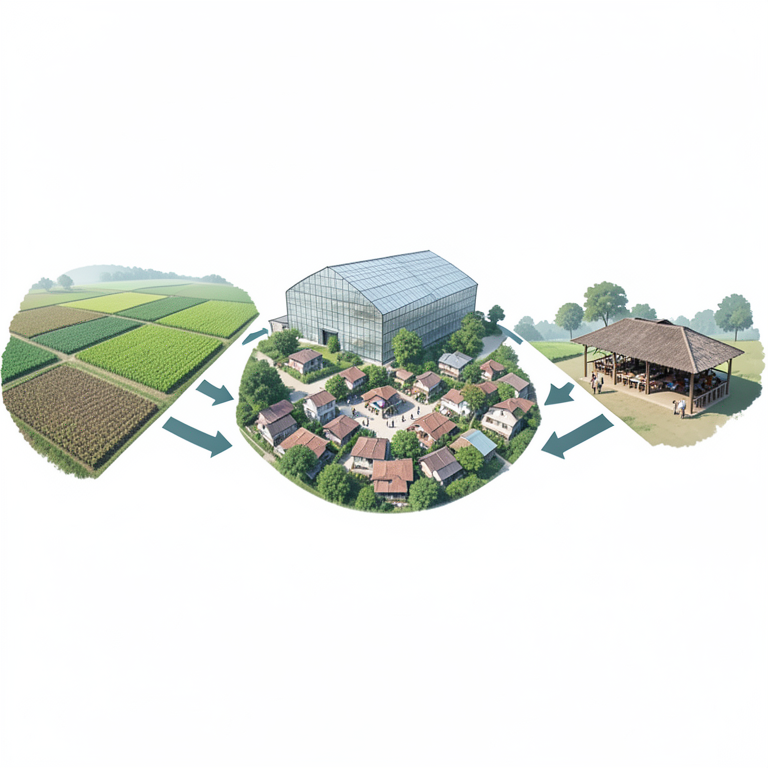
Conceptual Framework of Rural Development
AI-generated conceptual illustration (Rural farmland in Varanasi, India, featuring traditional crops, a tourist visitor center, and a modern agritechnological). It explains the idea and does not show study data.
View source evidence ↗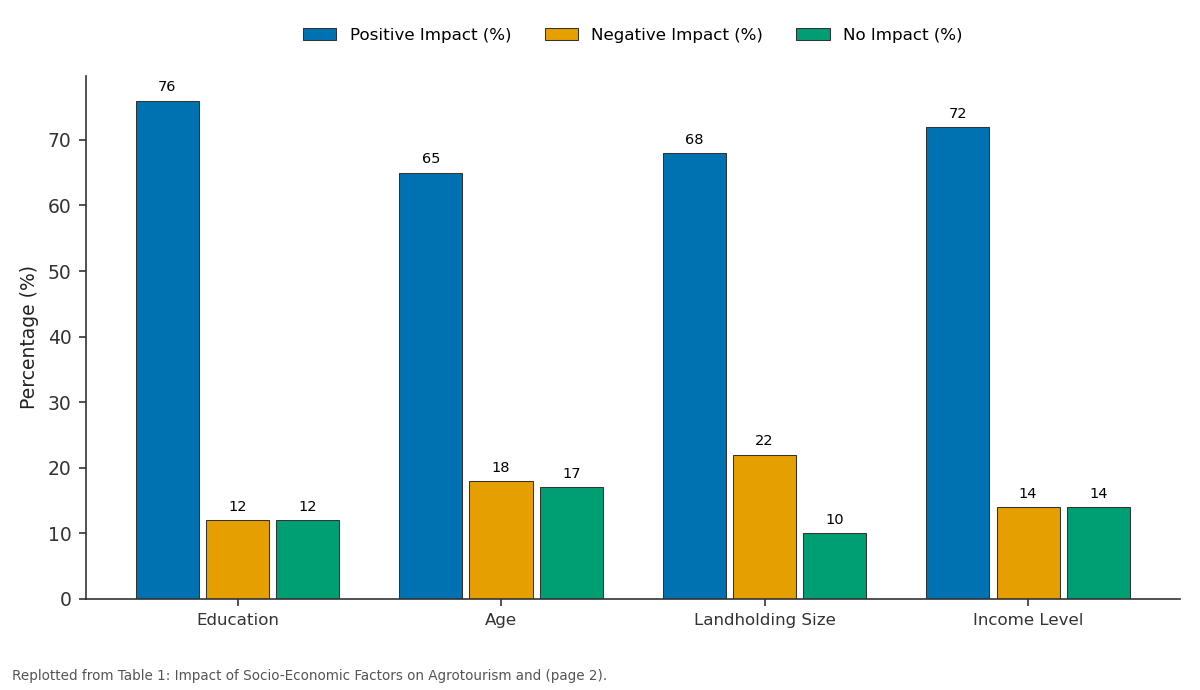
Positive Impact (%) and Negative Impact (%) and more: Education vs Age vs Landholding Size vs Income Level
Replotted from Table 1 (page 2) of the original paper. Every bar is the paper's own table value.
View source evidence ↗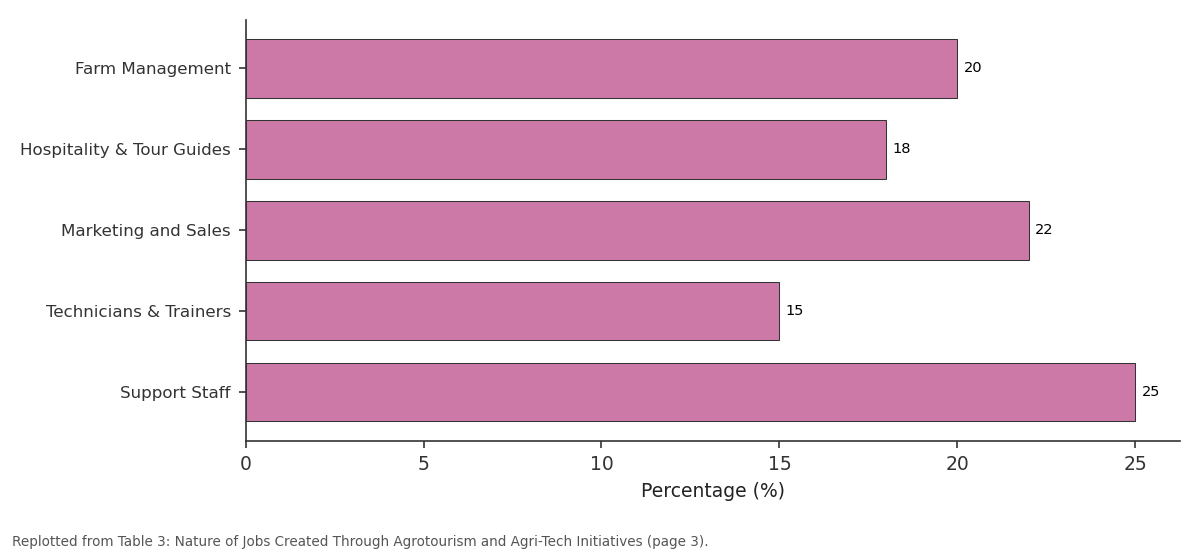
Percentage (%): Farm Management vs Hospitality & Tour... vs Marketing and Sales vs Technicians & Trainers vs Support Staff
Replotted from Table 3 (page 3) of the original paper. Every bar is the paper's own table value.
View source evidence ↗Figures & tables
From the original paper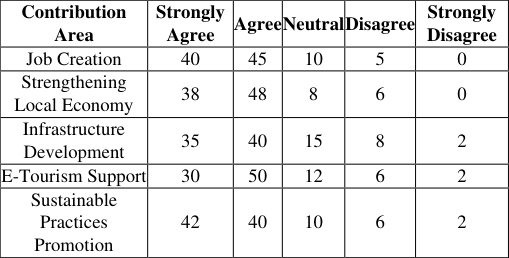 Table 2
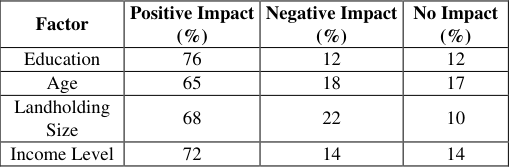 Table 1
 Table 3
Introduction
Agro-tourism and agro-technology parks were regarded as progressive initiatives that combined agriculture, tourism, and modern technology to promote rural development and sustainable livelihoods. Agro-tourism had provided an opportunity for visitors to engage directly with farming activities, traditional practices, and rural lifestyles, thereby creating a unique blend of recreation and education. It not only enhanced awareness about the importance of agriculture but also generated supplementary income for farmers, encouraged the preservation of local traditions, and reduced the dependence of rural households solely on farming. It played a vital role in generating employment, particularly for rural youth and women, while also supporting local businesses, handicrafts, and cuisines. On the other hand, agro-technology parks had served as centers of innovation where advanced farming techniques, modern machinery, and sustainable technologies were showcased and demonstrated to farmers. They acted as platforms for knowledge dissemination, training, and skill development, which empowered farmers to adopt improved practices for enhancing productivity and resource efficiency. These parks promoted eco-friendly methods such as organic farming, water conservation, renewable energy use, and waste recycling, thereby contributing to sustainable agricultural growth. Furthermore, the integration of agro-tourism with agro-technology parks created a synergy that not only attracted tourists but also improved infrastructure, market linkages, and rural connectivity. Together, they had contributed significantly to strengthening rural economies, creating awareness about sustainable practices, and ensuring inclusive development by bridging the gap between traditional farming and modern technological innovations, while simultaneously linking agriculture with education, culture, and tourism.
Research Methodology
The study entitled "Impact of Socio-Economic Factors on Employment Generation, Local Economy, and Sustainable Practices through Agrotourism and Agritechnological Parks in Varanasi District of Uttar Pradesh" was conducted using a purposive-cum-random sampling technique to ensure both relevance and representativeness of respondents. Varanasi district was purposively selected due to its agricultural significance and convenience for investigation, while a block with high potential in farming activities and greater exposure to government schemes was chosen to capture a diverse farming population. A list of villages within the selected block was prepared, from which 5 percent of the villages were randomly chosen, and from each selected village 10 percent of farmers were randomly drawn. Farmers were categorized into five groups on the basis of landholding, namely marginal (less than 1 hectare), small (1-2 hectares), semi-medium (2-4 hectares), medium (4-10 hectares), and large (above 10 hectares). From the total list, 100 farmers were selected through proportionate random sampling to achieve statistical balance across categories. Primary data were obtained through a structured and pretested interview schedule, while secondary data were collected from books, journals, government publications, and official records of district and block offices. Data collection was carried out through direct personal interviews to ensure reliability and completeness, and the information corresponded to the agricultural year 2024-2025. Appropriate analytical tools and statistical methods were applied for systematic analysis and presentation of the results.
Analytical Tools Likert scale
Likert scale (2, 4, 5, or 7) is a common classification format used in studies. Respondents rank a product or service's quality (data) from highest to lowest, and from better to worse. Table 1: The analysis of socio-economic factors revealed that education had the most significant positive influence on the progress of agrotourism and agritechnological parks in Varanasi district, as 76 percent of respondents reported education as a contributing factor, while only 12 percent observed it as having a negative or no impact. Age also played an important role, with 65 percent of farmers perceiving it as a positive factor, although 18 percent considered it a hindrance and 17 percent felt it had no effect. Landholding size emerged as another critical determinant, as 68 percent of respondents acknowledged its positive impact, while 22 percent reported a negative effect, suggesting that smaller landholders might face constraints in adopting such ventures. Income level also influenced outcomes significantly, with 72 percent identifying it as a positive driver of participation in agrotourism and technology-based initiatives, though 14 percent each indicated either a negative or no impact. Overall, the findings suggested that education and income levels were the strongest positive enablers, while variations in age and landholding size created mixed outcomes for farmers engaging in agrotourism and agritechnological park activities.
Results and Discussion
Results and Discussion
Table 2:
The results of the study showed that respondents largely recognized the positive contributions of agrotourism and agritechnological parks across multiple dimensions of rural development. In terms of job creation, 40 percent strongly agreed and 45 percent agreed that such initiatives generated employment, while only 5 percent disagreed and none strongly disagreed, indicating overwhelming acceptance. Strengthening of the local economy was also widely acknowledged, with 38 percent strongly agreeing and 48 percent agreeing, while just 6 percent disagreed.
Infrastructure development was similarly viewed as a major benefit, with 35 percent strongly agreeing and 40 percent agreeing, although 15 percent remained neutral and a small proportion (10 percent) expressed disagreement. Regarding e-tourism support, 30 percent strongly agreed and 50 percent agreed that it was facilitated through these ventures, though 12 percent were neutral and 8 percent disagreed. Promotion of sustainable practices emerged as the most strongly endorsed contribution, with 42 percent strongly agreeing and 40 percent agreeing, while only 8 percent expressed disagreement. Overall, the findings indicated that the majority of respondents perceived these initiatives as highly beneficial in generating employment, strengthening the rural economy, supporting e-tourism, developing infrastructure, and advancing sustainable agricultural practices.
Conclusion
The study concluded that socio-economic factors played a decisive role in shaping the progress and effectiveness of agrotourism and agritechnological parks in Varanasi district of Uttar Pradesh. Education and income levels emerged as the strongest enablers, as they enhanced awareness, adoption capacity, and willingness to participate in innovative agricultural ventures. Age and landholding size demonstrated mixed effects, with younger and larger farmers being more adaptive, while older and marginal farmers faced certain constraints. The initiatives were widely perceived to have generated substantial benefits across multiple dimensions, as a majority of respondents strongly agreed that they contributed significantly to employment creation, strengthening of the local economy, development of infrastructure, promotion of e-tourism, and advancement of sustainable agricultural practices. These findings emphasized that the integration of agrotourism with agritechnological parks not only diversified livelihood opportunities but also fostered knowledge dissemination, rural entrepreneurship, and community development. At the same time, several challenges were identified that hindered smooth functioning, with lack of initial capital being the most critical, followed by bureaucratic delays, weak market linkages, limited technical support, and issues of land accessibility. Such constraints highlighted the systemic and institutional barriers that restricted the potential of these initiatives despite their proven benefits. Overall, the study suggested that strengthening financial support mechanisms, improving policy facilitation, enhancing market connectivity, and providing regular technical assistance would be essential for maximizing the long-term sustainability and impact of agrotourism and agritechnological parks. Hence, these ventures were concluded to be promising drivers of rural economic growth, employment, and sustainable agricultural development.
Figures and tables from the paper
| Job Category | No. of Respondents Employed | Percentage (%) |
|---|---|---|
| Farm Management | 20 | 20% |
| Hospitality & Tour Guides | 18 | 18% |
| Marketing and Sales | 22 | 22% |
| Technicians & Trainers | 15 | 15% |
| Support Staff | 25 | 25% |
Table text extracted from the original PDF; superscript letters are shown inline. The original table image is below.
View original table image
References
23 in the original paper- Bodake M, Shinde S. Pollution-free tourism and its benefits to farmers and local businesses. Sustainable Tourism Rev. 2021;5(3):104-112.
- Bose S. The economic impact of agrotourism in India: Opportunities and challenges. Indian J Rural Dev. 2019;32(4):87-94.
- Dangi R. Challenges faced by farmers in promoting agrotourism: A study on funding, knowledge, and marketing. Agric Tourism J. 2018;10(2):45-50.
- Dey P, Rauniyar M. The role of agrotourism in improving farmers' livelihoods and sustainable tourism development. Agric Sustain J. 2022;19(1):55-61.
- Dreamwork Network. Overcoming challenges in agrotourism through digital platforms and sustainable practices. Tourism Sustain J. 2023;11(4):78-86.
- Drishti IAS Analysis. Challenges and opportunities in India's agritourism sector. Drishti IAS Rep. 2023;7(2):22-29.
- Gaikwad M, Bansal R, Sharma V. Benefits of agrotourism: Economic, social, and environmental perspectives. Int J Tourism Stud. 2017;5(3):154-160.
- Hashim S, Singh N. Profile of agripreneurs and the role of agro-tourism in Varanasi. J Agripreneurship. 2020;8(4):152-160.
- Kanse R, Kanse S. The transformative role of agrotourism in enhancing farmers' income and social status. Int J Rural Dev. 2017;10(2):120-128.
- Karthik P, Gajanand S. Agro-tourism as a significant component of rural tourism in India: Economic benefits and growth potential. J Rural Tourism Stud. 2017;15(2):112-125.
- Kothari S, Parwej S. Agro-tourism: A sustainable development approach to tourism and rural economy. Agric Econ Tourism. 2021;16(4):202-210.
- Kothari S, Parwej S. Agrotourism: A cost-effective form of tourism promoting sustainability and rural growth. Tourism Sustain J. 2021;11(3):215-228.
- Mandi N, Gupta R, Kumar A. Sustainable agro-tourism: A key to rural development and income generation. Int J Sustain Rural Dev. 2019;7(2):76-82.
- Patil S, Deore M. The role of agro-tourism in enhancing rural entrepreneurship and economic opportunities. J Agric Entrepreneurship. 2020;18(1):98-105.
- Pawar S. Agro-tourism's impact on local businesses and rural development. 2021.
- Reddy A, Sharma P. Challenges faced by agricultural graduates in establishing agri-ventures in Andhra Pradesh. J Agri-Entrepreneurship. 2022;17(1):115-123.
- Sathe D, Randhave S. Agro-tourism as a sustainable development model: Enhancing rural economies. Rural Econ Dev J. 2019;9(3):120-130.
- Singh A, Patel M, Verma P. Socio-economic variables influencing agro-tourism among vegetable growers in Varanasi. Indian Agric Econ J. 2022;18(2):123-131.
- Singh R, Mishra P. Agro-tourism as an educational tool for urban children: A unique learning experience. Agric Educ Rev. 2016;22(1):45-50.
- Surabhi S, Patil V, Kumar P. Challenges and strategies in agro-tourism development. Rural Dev Agri-Tourism. 2022;14(3):60-68.
- Talekar S, Potdar P. The economic potential of agrotourism in transforming traditional agriculture. J Rural Dev. 2012;8(1):25-32.
- Vishwanath N, Shukla R, Rao K. Challenges in the development of agrotourism centers: Insights from farmers. Indian J Agri-Tourism. 2022;13(2):78-84.
- Vishwanath S, Kumar R, Rao M. Challenges in agrotourism promotion: A study in Karnataka. AgroTourism Dev J. 2022;16(1):90-98.