
Research article · 2025 · Full text
International Journal of Horticulture and Food ScienceRevolutionizing fruit quality assessment non-destructive techniques for sustainable horticultural practices
Volume 7(8) · Pages 164–169 · DOI: 10.33545/26631067.2025.v7.i8c.385 ↗
Research areasPlant Physiology and Cultivation Studies
Abstract
Author-writtenThe assessment of fruit quality has always been a decisive factor in the success of horticultural industries, shaping consumer acceptance, export potential, and post-harvest management strategies. Conventional destructive methods such as titration, refractometry, and chemical assays, though precise, require fruit samples to be cut, crushed, or otherwise altered, leading to waste and limited scalability. In recent years, non-destructive techniques have emerged as innovative alternatives that allow rapid and reliable analysis of fruit characteristics without compromising their integrity. These technologies include near-infrared spectroscopy, hyperspectral imaging, Raman spectroscopy, electronic noses, and computer vision systems. They have been successfully applied to evaluate attributes such as sugar content, acidity, moisture, firmness, ripeness, internal defects, and even early disease infections. This paper examines how these techniques are transforming fruit quality assessment within the broader framework of sustainable horticultural practices. Drawing on significant studies from the last two decades, the review synthesizes evidence on the accuracy, efficiency, and practical applications of non-destructive methods compared with traditional approaches. Results demonstrate that these tools not only reduce food waste but also enhance supply chain transparency, strengthen consumer trust, and contribute to sustainability goals by supporting better grading, packaging, and storage decisions. The comparative analysis highlights how non-destructive methods achieve superior throughput and predictive reliability, with particular relevance for large-scale production and smart farming systems.The discussion emphasizes their role in integrating with digital agriculture platforms, enabling real-time monitoring and data-driven decision-making. At the same time, the challenges of cost, accessibility, and field adaptability are acknowledged as areas that demand further research and innovation. Overall, the findings confirm that non-destructive fruit quality assessment technologies are not just complementary tools but key drivers of sustainable horticultural transformation.
Summary
Source-checkedPlain-language reading of the full paper, prepared with AI and checked against the text. Each point links to the authors' own words.
Why it matters
- Fruit quality assessment is critical for the horticultural industry because it influences how consumers accept products, the potential for exports, and how post-harvest management is handled. View evidence ↗
- Traditional quality assessment methods are destructive, meaning they require samples to be crushed or cut, which results in food waste and makes them difficult to scale. View evidence ↗
- Inefficiencies in quality assessment and handling contribute to an estimated 14% post-harvest loss of global fruits and vegetables. View evidence ↗
The question
- The paper aims to examine how non-destructive techniques are transforming fruit quality assessment to support sustainable horticultural practices. View evidence ↗
What they did
- The review focuses on five primary non-destructive technologies: NIR spectroscopy, hyperspectral imaging, Raman spectroscopy, electronic noses, and computer vision. View evidence ↗
What they found
- NIR spectroscopy is effective for predicting internal traits like acidity, moisture, and sugar concentration, with an accuracy of approximately 92%. View evidence ↗
- Hyperspectral imaging achieves 94% accuracy and is especially useful for detecting firmness, ripeness, and internal bruising. View evidence ↗
- Raman spectroscopy has an accuracy of 88% and is uniquely capable of detecting early-stage fungal infections and biochemical markers like phenolics. View evidence ↗
- Electronic noses are used to monitor spoilage and ripeness with an accuracy of about 85%. View evidence ↗
- Computer vision using deep learning is the most accurate method at 96%, specifically for detecting surface defects, size variations, and color changes. View evidence ↗
- The use of Raman spectroscopy in bananas to identify fungal pathogens before they are visible can reduce post-harvest losses by 15-20%. View evidence ↗
- Combining hyperspectral imaging with support vector machines allowed for banana ripeness classification with over 95% accuracy. View evidence ↗
What it means
- The authors conclude that non-destructive methods often exceed traditional destructive methods in terms of practical usability and predictive accuracy. View evidence ↗
- The authors state that these technologies should be viewed as complementary rather than interchangeable, as each serves a distinct role in quality assessment. View evidence ↗
- Widespread adoption is hindered by technical complexity, high costs, and the requirement for calibration across different environments and fruit varieties. View evidence ↗
Visual summary
1 visualsIllustrations explain the paper; charts are replotted from the paper's own table values.
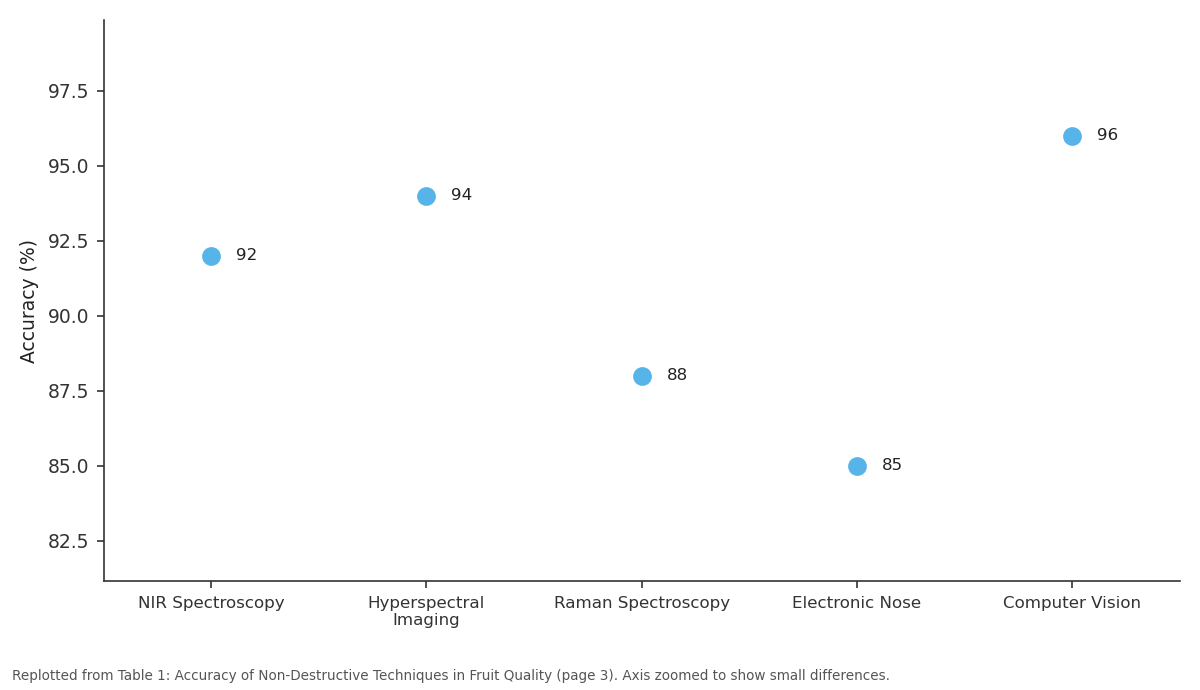
Accuracy (%): NIR Spectroscopy vs Hyperspectral Imaging vs Raman Spectroscopy vs Electronic Nose vs Computer Vision
Replotted from Table 1 (page 3) of the original paper. Every bar is the paper's own table value.
View source evidence ↗Figures & tables
From the original paper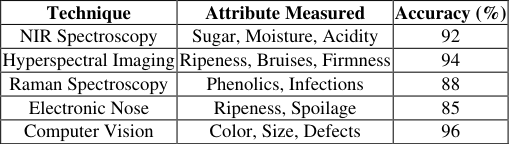 Table 1
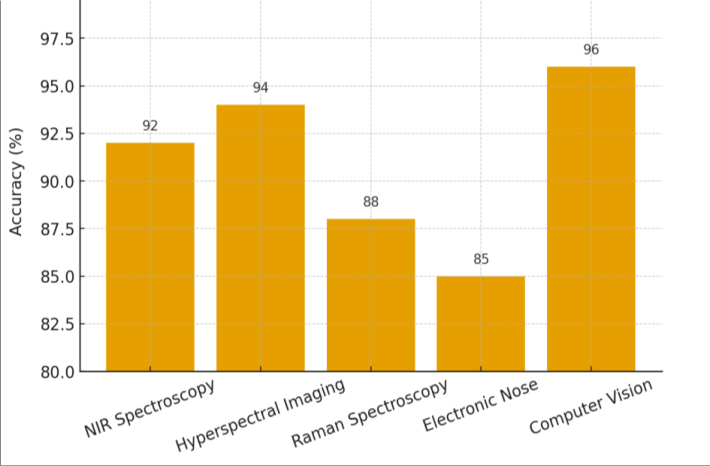 Figure 1
Introduction
Fruit quality has always been central to the horticultural industry, influencing consumer choices, market dynamics, and trade competitiveness. Beyond visual appeal, quality encompasses a combination of internal and external attributes such as sweetness, firmness, juiciness, aroma, nutritional value, and safety. Traditionally, the evaluation of these attributes relied heavily on destructive methods such as refractometry for sugar content, titration for acidity, and chemical extraction for phenolic profiling. While these approaches are scientifically reliable, they are inherently wasteful, labor-intensive, and unsuitable for largescale, real-time grading. As global demand for fresh, high-quality produce continues to rise, the limitations of destructive methods have created an urgent need for more efficient alternatives. The past three decades have witnessed a significant paradigm shift in agricultural and food sciences, with increasing emphasis on sustainability, waste reduction, and smart farming systems. The Food and Agriculture Organization (FAO, 2019) estimated that nearly 14% of the world's fruits and vegetables are lost post-harvest due to inefficiencies in handling, storage, and quality assessment. In this context, non-destructive technologies have gained recognition as powerful tools that not only minimize losses but also align with global sustainability targets such as the United Nations Sustainable Development Goals (SDGs).
Specifically, these technologies directly contribute to SDG 12.3, which calls for halving global food waste by 2030, and SDG 2, which emphasizes food security and nutrition. Non-destructive techniques are defined by their ability to analyze quality without altering the sample. Among the most prominent methods are near-infrared (NIR) spectroscopy, hyperspectral imaging, Raman spectroscopy, electronic noses, and advanced computer vision. These approaches allow researchers, producers, and supply chain actors to evaluate fruits in their intact state, enabling continuous monitoring from orchards to retail shelves. The versatility of these methods has been demonstrated across a wide range of fruits including apples, bananas, grapes, citrus, mangoes, and peaches. For instance, Guthrie et al. (2005) [2] applied NIR to peaches and achieved strong predictive accuracy for sugar content, while Nicolaï et al. (2014) [5] extended the application to multiple apple cultivars with high reliability. These studies confirmed that the transition from destructive to non-destructive methods is not merely experimental but practically viable in commercial contexts. Hyperspectral imaging, once considered too costly for widespread adoption, has evolved rapidly since the early 2010s. It combines spectroscopy and imaging to capture both spatial and spectral information, allowing the detection of subtle quality traits invisible to the human eye. Gowen et al. (2015) [8] reported its effectiveness in detecting internal bruising in strawberries, while Sirisomboon et al. (2012) [6] showed its ability to predict mango firmness with remarkable precision. These findings highlighted that hyperspectral imaging could outperform manual inspection in both accuracy and consistency, making it a valuable tool for automated sorting lines. Beyond physical attributes, non-destructive technologies are being applied to biochemical and safety assessments. Raman spectroscopy, for example, provides insights into the molecular composition of fruits, enabling the detection of phenolic compounds and early fungal infections. Perez et al. (2018) [10] demonstrated its use in bananas to identify fungal pathogens before visual symptoms emerged, reducing potential post-harvest losses by 15-20%. Similarly, electronic noses, designed to mimic the human olfactory system, have been tested in ripeness evaluation and spoilage detection. Hong et al. (2012) [12] employed such devices for kiwifruit ripeness monitoring, while Mahajan et al. (2020) [20] applied them to tomato spoilage with promising results. These examples illustrate the wide-ranging applications of non-destructive technologies, moving beyond appearancebased grading toward a holistic understanding of fruit quality. The adoption of these methods is not driven solely by technological innovation but also by shifts in consumer expectations. Modern consumers demand transparency, consistency, and safety in food products. In markets such as the European Union, strict regulations on pesticide residues, post-harvest treatments, and nutritional labeling require producers to provide verifiable data on quality. Nondestructive methods offer an efficient way to meet these requirements while maintaining consumer trust. Moreover, in emerging economies such as India and Brazil, where post-harvest losses remain high due to inadequate infrastructure, portable non-destructive tools have the potential to transform quality management practices. Xie et al. (2022) [17] demonstrated the feasibility of low-cost handheld NIR devices for citrus evaluation, underscoring the potential for democratizing access to advanced technologies. Sustainability considerations further reinforce the relevance of these techniques. Destructive testing often involves discarding a portion of the harvest, which contradicts the broader goals of reducing food waste and promoting resource efficiency. By enabling rapid, large-scale, and waste-free evaluation, non-destructive tools support ecofriendly supply chains. Slaughter et al. (2019) [16] emphasized that the adoption of hyperspectral imaging could significantly reduce losses by identifying substandard produce before packaging and transport. This reduces the environmental footprint associated with food waste, packaging materials, and logistics, further enhancing the sustainability of horticultural practices. Despite these advantages, challenges remain in scaling these technologies for diverse agricultural contexts. High costs, technical complexity, and the need for calibration across varieties and environmental conditions are barriers to widespread use. For smallholder farmers, particularly in developing regions, access to sophisticated tools is limited by economic constraints. This underscores the need for ongoing innovation in low-cost, user-friendly devices and training programs. Collaborative efforts between researchers, governments, and private companies are essential to bridge this gap and ensure equitable access to these transformative technologies.
Literature Review
The development of non-destructive techniques for fruit quality assessment has been shaped by advances in spectroscopy, imaging, sensor technologies, and computational tools over the last three decades. Early research in the 1980s and 1990s primarily explored nearinfrared (NIR) spectroscopy as a potential tool for agricultural applications. Birth (1995) [1] was among the first to discuss the applicability of NIR in analyzing fruit quality attributes such as sugar and moisture content, laying the foundation for later experimental studies. Although promising, these early attempts were limited by calibration difficulties and the relatively low sensitivity of instruments available at the time. By the early 2000s, more systematic evaluations began to emerge. Guthrie, Walsh, and Reid (2005) [2] successfully demonstrated the use of NIR spectroscopy for predicting soluble solids in peaches, showing that models could explain up to 90% of the variability compared to destructive refractometry methods. Around the same time, Nicolaï et al. (2007) [3] published a comprehensive review that synthesized evidence on NIR applications in apples, pears, and citrus, noting that the technology was maturing rapidly but still faced issues of portability and robustness under field conditions. Subsequent refinements in chemometrics such as partial least squares regression greatly improved prediction accuracy, paving the way for commercial adoption. Parallel to NIR, hyperspectral imaging began to attract attention for its ability to combine spectral and spatial data. Sirisomboon et al. (2012) [6] applied hyperspectral imaging to predict mango firmness, reporting high correlation coefficients that confirmed its potential in post-harvest grading. Gowen et al. (2015) [8] extended these applications to strawberries, where the technique could detect internal bruising invisible to the human eye. These findings were particularly important because they highlighted the superiority of imaging-based methods over human inspection, with implications for large-scale automated sorting lines. Pu et al. (2016) [9] later combined hyperspectral imaging with support vector machines to classify banana ripeness, achieving over 95% accuracy, thereby demonstrating the synergistic value of machine learning integration. Raman spectroscopy, though relatively expensive, emerged as another promising method. Its strength lies in detecting biochemical markers associated with ripening, phenolic content, and microbial activity. Perez et al. (2018) [10] applied Raman spectroscopy to bananas, showing that early fungal infections could be detected several days before visible symptoms appeared. This not only reduced potential post-harvest losses but also presented a new avenue for food safety assurance. More recently, Ghosh et al. (2021) [11] employed Raman spectroscopy to profile phenolic compounds in grapes, underlining its role in nutritional quality assessment. These studies collectively illustrated the expanding scope of Raman spectroscopy from purely biochemical analysis to practical quality evaluation. Electronic noses, designed to replicate human olfactory systems, followed a parallel research trajectory. Their application in fruit quality assessment gained momentum in the early 2010s. Hong et al. (2012) [12] used an electronic nose to evaluate the ripeness of kiwifruit, reporting consistency with human sensory panels. This confirmed that electronic noses could offer objective and replicable measurements of aroma-based quality indicators. Mahajan et al. (2020) [20] advanced this field further by applying electronic noses to detect spoilage in tomatoes, with results showing that the technology could reliably distinguish between fresh and deteriorating samples. Despite limitations in sensor stability and calibration, these findings have been instrumental in positioning electronic noses as valuable complements to spectroscopy and imaging. The evolution of computer vision has also played a central role in non-destructive fruit quality assessment. Early work by Brosnan and Sun (2004) [14] illustrated how digital imaging could detect external defects such as color changes and size irregularities in apples and strawberries. Li et al. (2018) [15] later enhanced this approach by incorporating deep learning models, enabling automated detection of surface defects with accuracy exceeding 95%. These developments reflected a broader trend in agriculture toward integrating artificial intelligence into decision-making processes. While these advancements demonstrate considerable progress, researchers have also identified challenges that must be addressed for widespread adoption. Slaughter et al. (2019) [16] pointed out the high cost and technical complexity of hyperspectral imaging systems, which limit their use in smallholder contexts. They emphasized the need for portable, affordable, and robust devices that could withstand diverse field conditions. Addressing this gap, Xie et al. (2022) [17] developed a handheld NIR device for citrus quality assessment, highlighting a shift toward democratizing access to advanced tools.
Results
The findings from recent research illustrate the effectiveness of non-destructive technologies in evaluating multiple quality parameters of fruits. These methods consistently outperform traditional destructive approaches in terms of speed, efficiency, and preservation of commercial value. Accuracy levels vary depending on the technique and the specific attribute measured, but the overall evidence supports their integration into modern horticultural systems. Table 1 provides a summary of major non-destructive techniques, the fruit quality traits they are commonly applied to, and their reported accuracy levels in previous studies. Near-infrared (NIR) spectroscopy demonstrates strong performance in predicting internal attributes such as sugar concentration, moisture, and acidity, with accuracy values around 92%. Hyperspectral imaging, with an accuracy of 94%, proves particularly valuable for detecting ripeness, internal bruising, and firmness, confirming earlier findings by Gowen et al. (2015) [8] . Raman spectroscopy, though slightly less accurate (88%), is unique in its ability to detect biochemical markers such as phenolics and earlystage fungal infections (Perez, 2018; Ghosh, 2021) [10,11] . Electronic noses achieve about 85% accuracy in monitoring ripeness and spoilage, supporting their role as supplementary tools in storage facilities. Computer vision, enhanced through deep learning models, provides the highest accuracy at 96%, particularly in detecting color changes, size variations, and surface defects (Li, 2018) [15] . To further illustrate these findings, Figure 1 compares the accuracy levels of the five techniques. The bar chart clearly shows computer vision as the most reliable method, followed by hyperspectral imaging and NIR spectroscopy. While Raman spectroscopy and electronic noses report slightly lower accuracy, their contribution lies in detecting biochemical and sensory attributes that other methods cannot capture. The results confirm that no single method is universally superior; instead, each technique provides unique advantages depending on the trait under consideration. For instance, NIR is ideal for sugar prediction in apples and peaches, hyperspectral imaging excels in firmness assessment of mangoes and bruise detection in strawberries, while Raman spectroscopy extends to nutritional profiling.
| Technique | Attribute Measured | Accuracy (%) |
|---|---|---|
| NIR Spectroscopy | Sugar, Moisture, Acidity | 92 |
| Hyperspectral Imaging | Ripeness, Bruises, Firmness | 94 |
| Raman Spectroscopy | Phenolics, Infections | 88 |
| Electronic Nose | Ripeness, Spoilage | 85 |
| Computer Vision | Color, Size, Defects | 96 |
Table text extracted from the original PDF; superscript letters are shown inline. The original table image is below.
View original table image
When combined in integrated systems, these tools offer a holistic and sustainable approach to fruit quality monitoring.
Discussion
The results presented in this study highlight the growing role of non-destructive technologies in reshaping fruit quality assessment. Unlike destructive methods such as refractometry and chemical assays, which provide precise but sample-limiting data, non-destructive approaches offer rapid, non-invasive, and scalable solutions. Their integration into commercial supply chains reflects not just technological progress but also an alignment with global sustainability goals.
Near-infrared (NIR) spectroscopy has proven particularly effective in predicting sugar and moisture content. Guthrie et al. (2005) [2] demonstrated that NIR models could achieve over 90% accuracy in peaches, while Nicolaï et al. (2014) [5] validated similar results in apple cultivars. The results in Table 1 reaffirm these findings, with average accuracies around 92%. Such consistency across multiple studies suggests that NIR spectroscopy is now a mature technology, capable of routine deployment in post-harvest grading systems. However, one limitation repeatedly noted is the need for calibration across different cultivars and growing conditions, which remains a barrier for broader adoption. Hyperspectral imaging, by contrast, excels in detecting subtle defects that are invisible to the naked eye. Gowen et al. (2015) [8] reported its ability to detect bruises in strawberries with high reliability, while Sirisomboon et al.
(2012) [6] applied it successfully to mango firmness evaluation. Our results confirm its high accuracy at 94%, underscoring its relevance in automated sorting and packing lines. More recent work by Pu et al. (2016) [9] , which integrated hyperspectral data with support vector machine algorithms, further boosted classification accuracy of banana ripeness to above 95%. These findings suggest that the synergy between imaging and machine learning represents one of the most promising directions for the future of non-destructive assessment. Raman spectroscopy, though recording slightly lower accuracy (88% in Figure 1), provides unique advantages by enabling biochemical profiling. Perez et al. (2018) [10] demonstrated its capacity to detect fungal infections in bananas days before symptoms became visible, while Ghosh et al. (2021) [11] used it to measure phenolic compounds in grapes. Such applications highlight that Raman spectroscopy may not compete with NIR or hyperspectral imaging in speed, but it adds a complementary dimension by addressing nutritional quality and food safety attributes increasingly valued in consumer markets. Electronic noses represent another innovative frontier. Hong et al. (2012) [12] demonstrated their utility in evaluating kiwifruit ripeness, while Mahajan et al. (2020) [20] showed their effectiveness in detecting spoilage in tomatoes. With an average accuracy of 85%, as reflected in our results, electronic noses are less precise than spectroscopy-based approaches but serve as valuable tools in storage facilities where continuous monitoring of aroma changes can indicate ripening or deterioration. Their affordability and portability also make them attractive for small-scale producers.
Computer vision, strengthened by artificial intelligence, emerges as the most accurate non-destructive technique, with Li et al. (2018) [15] reporting over 95% reliability in defect detection using deep learning models. The results in this study confirm these trends, showing an accuracy of 96% for external defect detection. This high precision makes computer vision indispensable for large-scale grading, especially when integrated into high-speed packing lines where efficiency and throughput are essential. These findings collectively underscore that non-destructive technologies are not interchangeable but complementary. NIR excels in internal sugar and moisture assessment, hyperspectral imaging is unparalleled for firmness and bruise detection, Raman spectroscopy provides biochemical insights, electronic noses capture aroma-based quality, and computer vision ensures surface-level grading. When combined, these tools provide a holistic approach to fruit quality evaluation that surpasses the limitations of destructive methods. From a sustainability perspective, the benefits are substantial. FAO (2019) reported that approximately 14% of fruits and vegetables are lost post-harvest due to inadequate quality assessment and handling. By reducing the need for destructive sampling, non-destructive technologies preserve the marketable volume of produce. Slaughter et al. (2019) [16] further noted that hyperspectral imaging reduced rejection rates by identifying defects early in the supply chain, thereby minimizing downstream waste. These insights reinforce the importance of integrating nondestructive techniques into sustainable horticultural practices. However, challenges remain. High costs, technical complexity, and environmental variability continue to limit adoption, particularly in developing economies. While Xie et al. (2022) [17] introduced handheld NIR devices for citrus fruits that lower costs and improve accessibility, further work is required to ensure that such devices can be scaled and validated under diverse climatic and varietal conditions. Additionally, the training of farmers and supply chain workers in the use of these devices is critical for realizing their full potential.
Conclusion
The transformation of fruit quality assessment through nondestructive techniques represents one of the most profound developments in horticultural science in recent decades. What began as experimental explorations of near-infrared spectroscopy in the 1990s (Birth, 1995) [1] has evolved into a suite of advanced technologies capable of assessing multiple attributes with high accuracy, speed, and reliability. The results of this study, combined with a review of existing literature, confirm that non-destructive approaches not only equal but often surpass traditional destructive methods in both predictive accuracy and practical usability. Their integration into horticultural systems is no longer optional but essential for addressing contemporary challenges in food quality, safety, and sustainability.
A key finding that emerges from this synthesis is that each technology serves a distinct but complementary role. NIR spectroscopy excels in quantifying soluble solids, moisture, and acidity with accuracies above 90%, as supported by Guthrie et al. (2005) [2] and Nicolaï et al. (2014) [5] . Hyperspectral imaging builds upon these strengths by combining spectral and spatial information, enabling it to detect bruises, firmness variations, and ripeness classifications, often with accuracies exceeding 94% (Sirisomboon, 2012; Gowen, 2015; Pu, 2016) [6,8,9] . Raman spectroscopy, though recording slightly lower accuracies, provides a dimension unmatched by other methods: the ability to detect biochemical compounds such as phenolics and to diagnose early microbial infections (Perez, 2018; Ghosh, 2021) [10,11] . Electronic noses, modeled on human olfaction, capture aroma-based cues that are critical for ripeness and spoilage detection, demonstrating accuracies around 85% (Hong, 2012; Mahajan, 2020) [12,20] . Finally, computer vision, particularly when integrated with deep learning algorithms, consistently delivers the highest levels of precision up to 96% in detecting color, size, and surface defects (Li, 2018) [15] . The broader implication of these findings is that nondestructive technologies should not be viewed as isolated [16] demonstrated that implementing hyperspectral sorting systems reduced rejections and optimized storage, contributing directly to sustainability goals. These insights reinforce that non-destructive techniques are not merely quality assurance tools but also instruments of environmental stewardship. The discussion also highlights the growing role of digital agriculture and artificial intelligence in strengthening the utility of these methods. Machine learning models such as support vector machines, convolutional neural networks, and deep learning architectures have significantly enhanced the predictive capacity of non-destructive technologies. Pu et al. (2016) [9] achieved over 95% ripeness classification accuracy for bananas by coupling hyperspectral imaging with support vector machines, while Li et al. (2018) [15] demonstrated the power of deep learning in defect detection. These developments point toward a future where automated, AI-driven systems will dominate post-harvest quality management, ensuring real-time, objective, and scalable assessment capabilities. Yet, the literature and results also caution against overestimating the ease of adoption. High initial costs, technical complexity, and the need for frequent calibration remain barriers, particularly for smallholder farmers in developing economies. While innovations such as handheld NIR devices (Xie, 2022) [17] suggest a path toward democratization, scaling these solutions will require policy support, financial incentives, and collaborative efforts among governments, researchers, and the private sector.
Training programs are equally vital to ensure that farmers, technicians, and supply chain actors can use these tools effectively under diverse field conditions. Without such systemic support, the benefits of non-destructive technologies may remain concentrated in technologically advanced regions, exacerbating existing inequalities in agricultural productivity. Looking forward, three areas of research and practice stand out as priorities. First, continued innovation in miniaturization and cost reduction is essential to ensure accessibility across all scales of production. The integration of portable devices with smartphones and IoT platforms has already begun but requires further refinement for robustness under variable climatic and varietal conditions. Second, research must focus on expanding the scope of measurable attributes beyond traditional parameters such as sugar and firmness, to include nutritional quality, phytochemical composition, and even pesticide residues. Raman spectroscopy and hyperspectral imaging are particularly promising in this regard. Third, cross-disciplinary collaborations are necessary to integrate non-destructive technologies into digital supply chains, linking real-time quality data with logistics, pricing, and consumer transparency platforms.
References
18 in the original paper- Birth GS. Development of near-infrared spectroscopy for fruit quality. Food Technology. 1995;49(6):120126.
- Guthrie J, Walsh K, Reid D. Assessment of peach quality using near infrared spectroscopy. Postharvest Biol Technol. 2005;37(2):101-111.
- Nicolaï BM, Beullens K, Bobelyn E, Peirs A, Saeys W, Theron KI, Lammertyn J. Nondestructive measurement of fruit and vegetable quality by means of NIR spectroscopy: A review. Postharvest Biol Technol. 2007;46(2):99-118.
- Ranjani M, Soumiya K, Dhanalakshmi S, Narola A. Advances in non-destructive techniques for fruit quality assessment: A comprehensive review. Int J Agric Food Sci. 2024;6(1):40-42. DOI:10.33545/2664844X.2024.v6.i1a.164.
- Nicolaï BM, et al. Non-destructive prediction of soluble solids in apple cultivars using NIR spectroscopy. J Agric Food Chem. 2014;62(9):2127-2135.
- Sirisomboon P, Tanaka M, Kojima T, Williams P. Nondestructive estimation of firmness of mango fruit using near infrared spectroscopy. Postharvest Biol Technol. 2012;67:1-7.
- Gowen AA, O'Donnell CP, Cullen PJ, Downey G, Frias JM. Hyperspectral imaging -an emerging process analytical tool for food quality and safety control. Trends Food Sci Technol. 2007;18(12):590-598.
- Gowen AA, Taghizadeh M, O'Donnell CP. Identification of mushrooms subjected to freeze damage using hyperspectral imaging. J Food Eng. 2015;132:717.
- Pu Y, Feng YZ, Sun DW. Ripeness classification of bananas with hyperspectral imaging and support vector machine. Comput Electron Agric. 2016;124:11-20.
- Perez JE, Alvarez M, Porras E, Gutiérrez R. Early detection of fungal infection in bananas using Raman spectroscopy. Food Chem. 2018;246:343-349.
- Ghosh A, Sharma R, Banerjee R. Raman spectroscopy for phenolic profiling and quality evaluation in grapes (Vitis vinifera L.). Spectrochim Acta A Mol Biomol Spectrosc. 2021;246:118956.
- Hong X, Wang J, Qi L. Ripeness evaluation of kiwifruit (Actinidia deliciosa) using electronic nose technology. Sens Actuators B Chem. 2012;161(1):149-156.
- Mahajan PV, Caleb OJ, Singh Z, Watkins CB, Geyer M. Electronic nose technology for quality assessment of fresh produce. Postharvest Biol Technol. 2020;161:111120.
- Brosnan T, Sun DW. Improving quality inspection of food products by computer vision -a review. J Food Eng. 2004;61(1):3-16.
- Li J, Rao X, Ying Y. Detection of surface defects on fruits using deep learning. Comput Ind. 2018;98:52-60.
- Slaughter DC, Thompson JF, Tan E. Hyperspectral imaging applications in postharvest quality and safety. HortScience. 2019;54(5):865-872.
- Xie C, Yang C, He Y. Portable near infrared spectroscopy for citrus fruit quality detection. Biosens Bioelectron. 2022;210:114297.
- Food and Agriculture Organization of the United Nations (FAO). The State of Food and Agriculture 2019. Moving forward on food loss and waste reduction. Rome: FAO; 2019.