
Research article · 2025 · Full text
International Journal of Agriculture and Food ScienceEntrepreneurial challenges and solutions in backyard poultry farming among rural women: A study under the ICAR farmer first
Volume 7(9) · Pages 121–123 · DOI: 10.33545/2664844x.2025.v7.i9b.739 ↗
Research areasLivestock and Poultry Management
Abstract
Author-writtenThe study was carried out in four villages of Rahuri tehsil, Ahilyanagar district of Maharashtra under the ICAR Farmer FIRST Programme implemented by MPKV, Rahuri. Using an ex-post-facto research design, data were collected from 200 purposively selected rural women entrepreneurs engaged in backyard poultry farming through personal interviews with a structured schedule. The findings revealed that women faced multiple challenges in poultry management, including predator attacks, seasonal fluctuations in egg prices, high feed costs, labor constraints, market instability, chick mortality, cannibalistic behavior, crop damage, disease outbreaks and theft. To overcome these issues, respondents suggested practical interventions such as government support for predator-proof housing, provision of healthy chicks at affordable rates, promotion of alternative feed resources and reliable electricity supply to reduce stress-related behavior in birds. Other recommendations included the adoption of low-cost automatic feeders and waterers to ease management and the establishment of poultry houses at the taluka level for assured markets. Overall, the study emphasizes the importance of predator control, disease prevention, feeding innovations and market infrastructure as critical interventions to strengthen backyard poultry as a sustainable livelihood option for rural women.
Summary
Source-checkedPlain-language reading of the full paper, prepared with AI and checked against the text. Each point links to the authors' own words.
Why it matters
- Women entrepreneurs are vital for inclusive development because they generate income, create jobs, and improve the well-being of their communities. View evidence ↗
- In rural India, backyard poultry farming has become a practical way for women to engage in agricultural entrepreneurship. View evidence ↗
- Backyard poultry is particularly suitable for women because it involves low investment and can be balanced with household duties. View evidence ↗
The question
- The study aimed to identify the entrepreneurial challenges rural women face in backyard poultry farming and to record their suggested solutions. View evidence ↗
What they did
- The study used a purposive sample of 200 rural women entrepreneurs, with 50 participants selected from each of the four villages. View evidence ↗
- Researchers gathered data using structured personal interviews and direct observations. View evidence ↗
What they found
- Predator attacks from dogs, snakes, and birds of prey were the most common challenge, reported by 86.50% of the women. View evidence ↗
- Seasonal price drops for eggs during the summer were reported as a constraint by 82.50% of respondents. View evidence ↗
- High feed costs were identified as a significant barrier by 78.00% of the participants. View evidence ↗
- High mortality rates among chicks were reported by 72.00% of the women entrepreneurs. View evidence ↗
- Cannibalism among birds, linked to overcrowding and irregular electricity, was reported by 54.00% of respondents. View evidence ↗
- The most endorsed solution (83.50%) was for the government to provide subsidized shelters elevated one foot off the ground to prevent predator attacks. View evidence ↗
- To reduce chick mortality, 79.50% of respondents suggested providing one-month-old birds at affordable prices. View evidence ↗
- Using alternative feed sources like rice bran and kitchen waste was suggested by 68.00% of the women to lower costs. View evidence ↗
- To reduce labor intensity, 56.50% of respondents recommended installing low-cost automatic feeders and waterers. View evidence ↗
What it means
- The authors conclude that targeted policy and extension support are necessary to make backyard poultry a sustainable and profitable business for rural women. View evidence ↗
Visual summary
3 visualsIllustrations explain the paper; charts are replotted from the paper's own table values.
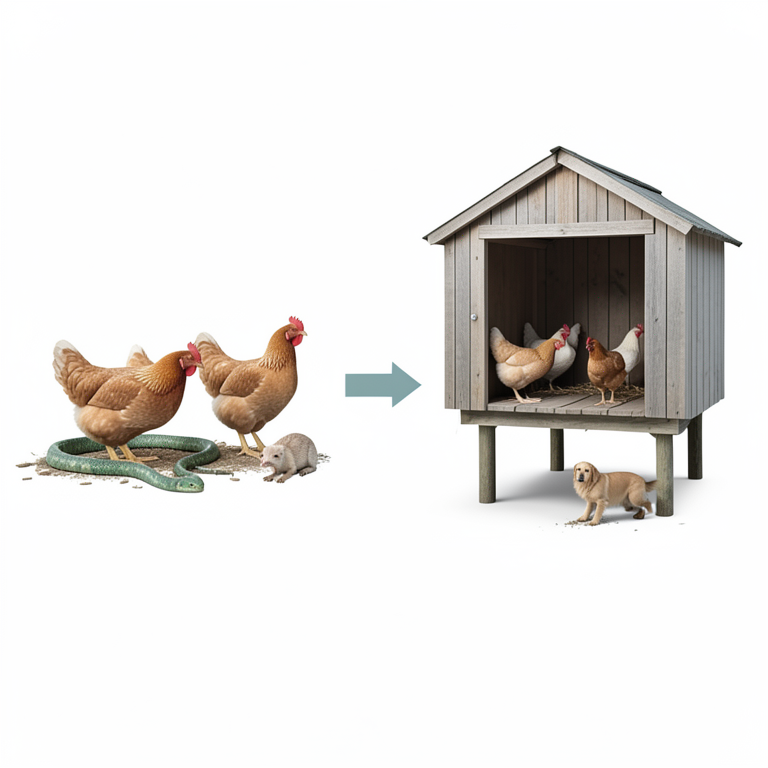
Predator Protection Concept
AI-generated conceptual illustration (backyard poultry chickens and an elevated wooden coop). It explains the idea and does not show study data.
View source evidence ↗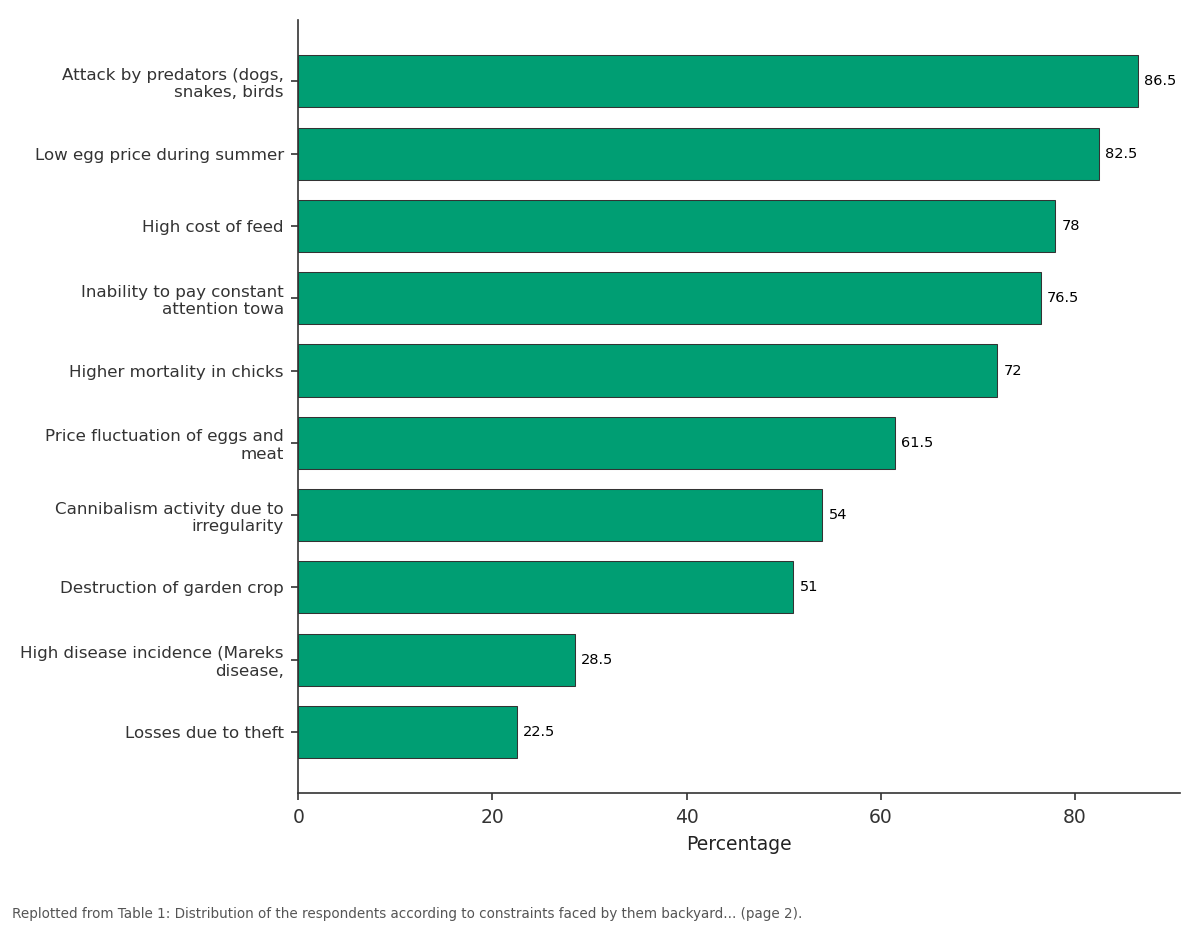
Percentage: Attack by predators... vs Low egg price during... vs High cost of feed vs Inability to pay... vs Higher mortality in...
Replotted from Table 1 (page 2) of the original paper. Every bar is the paper's own table value.
View source evidence ↗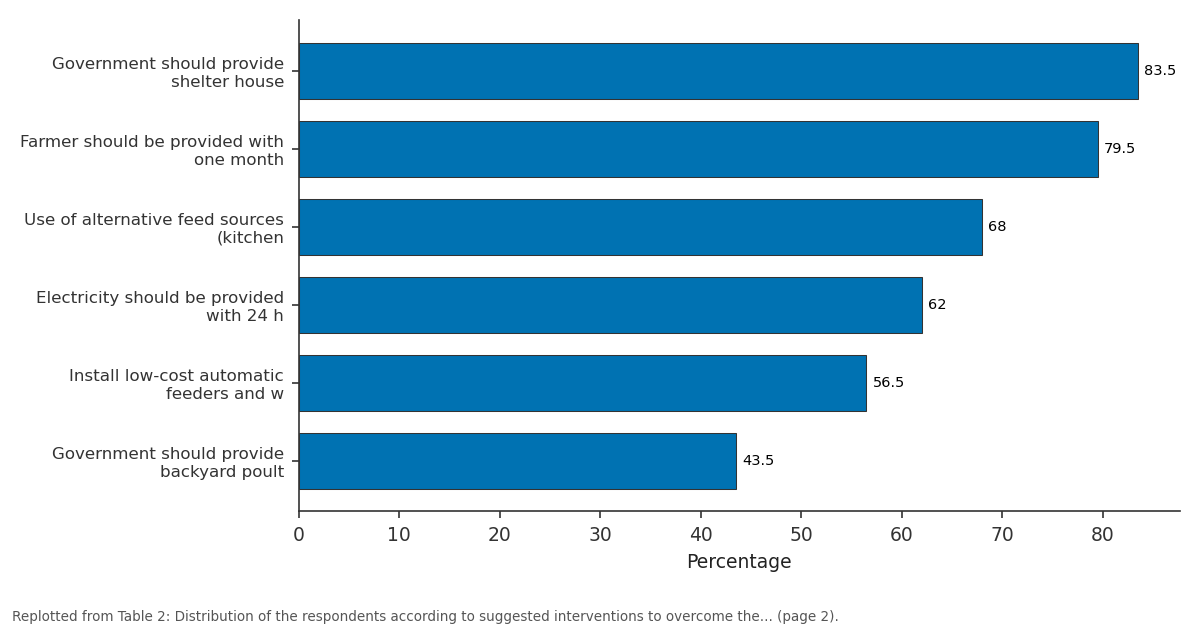
Percentage: Government should... vs Farmer should be... vs Use of alternative feed... vs Electricity should be... vs Install low-cost...
Replotted from Table 2 (page 2) of the original paper. Every bar is the paper's own table value.
View source evidence ↗Figures & tables
From the original paper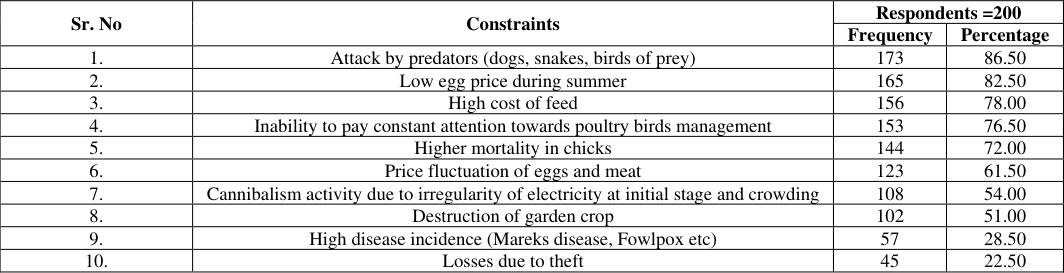 Table 1
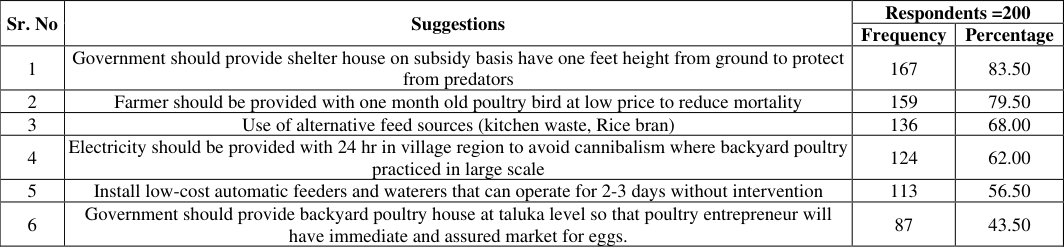 Table 2
Introduction
Entrepreneurship is widely recognized as a driver of innovation, risk-taking, and wealth creation, with small and medium enterprises increasingly serving as engines of growth in modern economies (Kuratko & Hodgetts, 2001) [7] . Women entrepreneurs, in particular, play a crucial role in fostering inclusive development by generating income, creating employment, and enhancing community well-being. In developing economies, even smallscale ventures offer women a pathway to socio-economic empowerment, improved household welfare, and greater participation in decision-making (Gupta, 2025) [3] . Despite persistent structural barriers, rural women continue to demonstrate resilience and innovation through micro-enterprises that integrate livelihood generation with household responsibilities. Agriculture remains central to women's entrepreneurship in rural India, where backyard poultry farming has emerged as a viable livelihood strategy. Poultry meat and eggs provide affordable protein, addressing nutritional insecurity, while poultry husbandry supports rural employment and income diversification (Rath et al., 2015; Islam et al., 2021) [11,4] . Backyard poultry is especially significant for women, as it requires minimal investment, relies on household labor, and can be managed alongside domestic tasks (Ogunlade et al., 2013) [8] . Recent evidence highlights its contributions to women's economic independence and decision-making power (Ruchi et al., 2024) [12] . However, widespread challenges persist, including high chick mortality, predator attacks, feed costs, disease outbreaks, and market fluctuations, which limit profitability and discourage long-term engagement (Jahanara et al., 2023; Rajini & Senthilkumar, 2022) [6,10] . Addressing these barriers through training, infrastructure support, and market linkages is essential to unlock the full potential of womenled backyard poultry enterprises. Against this backdrop, the present study was conducted under the ICAR Farmer FIRST Project to examine the entrepreneurial challenges faced by rural women engaged in backyard poultry farming and to document their practical solutions. By capturing women's lived experiences and their context-specific recommendations, the study seeks to inform targeted interventions that strengthen backyard poultry as a sustainable livelihood option and enhance the role of women in rural entrepreneurship.
Methodology
The study was conducted in four villages Chinchvihire, Kangar, Tambhere, and Kanadgaon of Rahuri tehsil, Ahilyanagar district, Maharashtra, where the ICAR Farmer FIRST Programme has been implemented by MPKV, Rahuri since 2016-17. An ex-post-facto research design was adopted. This design was considered appropriate for examining the factors influencing entrepreneurial challenges and solutions in backyard poultry farming. A purposive sample of 200 rural women entrepreneurs was drawn, comprising 50 respondents from each selected village. Data were collected through personal interviews using a structured interview schedule, supplemented with direct observations to ensure accuracy and reliability of responses. Form the table 1 data reveals that majority of respondents (86.50%) reported predator attacks (dogs, snakes, birds of prey) as a major constraint. This finding is consistent with earlier studies highlighting the absence of proper poultry housing or fencing systems, which makes birds highly vulnerable to outdoor threats (Prashant & Kumar, 2021) [9] . 82.50 per cent of the respondents mentioned that egg prices drop significantly in summer, reducing profitability. This seasonal market fluctuation affects income stability and discourages sustained efforts in poultry farming. Feed expenses were another critical constraint, as feed constitutes the largest component of poultry production costs, and any increase in prices directly reduces profitability, particularly for small and marginal farmers. 76.50 per cent of respondents indicated difficulty in continuously managing poultry birds. This could be due to competing household responsibilities or lack of labour assistance, leading to mismanagement and poor bird health. Fluctuating market prices were noted by 72.00 per cent respondents. This inconsistency creates uncertainty in returns and may reduce motivation for entrepreneurship among rural women. 61.50 per cent of respondents experienced high chick mortality. This is likely caused by inadequate brooding facilities, poor hygiene, or lack of timely vaccinations. While 54.00 per cent of respondents reported cannibalistic behavior among poultry birds, attributed to lack of light during early stages and overcrowding often caused by irregular electricity supply or poor housing design. 51.00 per cent of respondents faced crop loss due to poultry roaming freely, highlighting the need for better fencing and separation of farming zones. Attack of Marek's and Fowlpox disease reported by 28.50 per cent of respondents, while 22.50 per cent reported theft of poultry, indicating weak security measures at household or farm level. These findings are consistent with Thomas and Balamurugan (2020) [13] , who noted theft and poor farm security as common issues in backyard poultry systems. Localized markets can strengthen income security by ensuring assured and immediate sale of eggs, while also reducing dependence on intermediaries (AESA, 2020).
| Sr. No | Constraints | Respondents =200 | — |
|---|---|---|---|
| Frequency | Percentage | ||
| 1. | Attack by predators (dogs, snakes, birds of prey) | 173 | 86.50 |
| 2. | Low egg price during summer | 165 | 82.50 |
| 3. | High cost of feed | 156 | 78.00 |
| 4. | Inability to pay constant attention towards poultry birds management | 153 | 76.50 |
| 5. | Higher mortality in chicks | 144 | 72.00 |
| 6. | Price fluctuation of eggs and meat | 123 | 61.50 |
| 7. | Cannibalism activity due to irregularity of electricity at initial stage and crowding | 108 | 54.00 |
| 8. | Destruction of garden crop | 102 | 51.00 |
| 9. | High disease incidence (Mareks disease, Fowlpox etc) | 57 | 28.50 |
| 10. | Losses due to theft | 45 | 22.50 |
Table text extracted from the original PDF; superscript letters are shown inline. The original table image is below.
View original table image
Results and Discussion
Results and Discussion
Conclusion
The study highlights that backyard poultry is an important livelihood source for rural women but is constrained by predator attacks, high feed costs, chick mortality, labor shortages, and market instability. Women suggested solutions such as predator-proof shelters, affordable healthy chicks, alternative feed use, reliable electricity, automatic feeders, and local markets. These findings emphasize the need for targeted policy and extension support to strengthen backyard poultry as a sustainable and profitable enterprise for rural women.
Figures and tables from the paper
| Sr. No | Suggestions | Respondents =200 | — |
|---|---|---|---|
| Frequency | Percentage | ||
| 1 | Government should provide shelter house on subsidy basis have one feet height from ground to protect from predators | 167 | 83.50 |
| 2 | Farmer should be provided with one month old poultry bird at low price to reduce mortality | 159 | 79.50 |
| 3 | Use of alternative feed sources (kitchen waste, Rice bran) | 136 | 68.00 |
| 4 | Electricity should be provided with 24 hr in village region to avoid cannibalism where backyard poultry practiced in large scale | 124 | 62.00 |
| 5 | Install low-cost automatic feeders and waterers that can operate for 2-3 days without intervention | 113 | 56.50 |
| 6 | Government should provide backyard poultry house at taluka level so that poultry entrepreneur will have immediate and assured market for eggs. | 87 | 43.50 |
Table text extracted from the original PDF; superscript letters are shown inline. The original table image is below.
View original table image
References
13 in the original paper- Agricultural Extension in South Asia (AESA). Empowering rural women through backyard poultry in Mizoram [Internet]. 2020 [cited 2025 Sep 7]. Available from: https://www.aesanetwork.org
- Frontiers in Sustainable Food Systems. Backyard poultry farming: a sustainable livelihood option for rural women [Internet]. 2022 [cited 2025 Sep 7]. Available from: https://www.frontiersin.org/journals/sustainable-foodsystems
- Gupta A. Assessing women's time allocation and empowerment in rural India. arXiv [Preprint]. 2025. Available from: https://arxiv.org/abs/2504.03202
- Islam R, Nath BG, Choudhury P. Backyard poultry farming: a tool for nutritional security and women empowerment in rural India. Indian J Poult Sci. 2021;56(1):1-6. doi:10.5958/0974-8180.2021.00001.4
- Indian Council of Agricultural Research (ICAR). Backyard poultry for sustainable rural livelihoods [Internet]. 2020 [cited 2025 Sep 7]. Available from: https://ebook.icar.gov.in
- Jahanara S, Rajini S, Senthilkumar R. Entrepreneurial constraints faced by rural women in small enterprises of Tamil Nadu. J Ext Educ. 2023;35(2):52-9. Available from: https://www.extensioneducation.org/index.php/jee/articl e/view/1653
- Kuratko DF, Hodgetts RM. Entrepreneurship: a contemporary approach. Orlando (FL): Harcourt College Publishers; 2001.
- Ogunlade I, Adebayo SA, Fayeye TR. Scope and common diseases of rural poultry production by rural women in selected villages of Kwara State, Nigeria. Int J Poult Sci. 2013;12(3):126-9.
- Prashant K, Kumar P. Constraints faced by backyard poultry farmers in India: a field study. Indian J Poult Sci [Internet]. 2021;56(2):183-8. Available from: https://epubs.icar.org.in/index.php/IJPS/article/view/98 765
- Rajini S, Senthilkumar R. Challenges and opportunities in women-led enterprises: a case of poultry and handicrafts. Indian J Ext Educ. 2022;58(1):66-71.
- Rath PK, Manda KD, Panda P. Backyard poultry farming in India: a call for skill upliftment. Res J Recent Sci. 2015;4(IVC-2015):1-5.
- Ruchi S, Mondal S, Ghosh S. Women empowerment through backyard poultry farming in tribal villages of West Bengal. Indian J Poult Sci [Internet]. 2024;59(1):123-8. Available from: https://epubs.icar.org.in/index.php/IJPS/article/view/16 5933
- Thomas R, Balamurugan V. Socio-economic constraints in backyard poultry rearing: evidence from rural households in Kerala. J Community Mobil Sustain Dev [Internet]. 2020;15(2):321-6. Available from: https://www.jcmsd.net/article/socio-economicconstraints-in-backyard-poultry
Cited by 1
From OpenAlex, OpenCitations and reference lists read by Scinovex
- Rural women entrepreneurship for strengthening livelihood: Evidence from Odisha, India
S. Tanuja, Lipi Das, AK Panda, Biswanath Sahoo, Mridula Devi · International Journal of Advanced Biochemistry Research · 2026
Rural women’s entrepreneurship is a powerful driver of economic growth, contributing to capital formation, balanced regional development, employment generation, and enhanced self-reliance. Micro-and small-scale enterprises (MSEs), due to their affordability and ease of management, present viable pathways for rural women to engage in income-generating activities. However, to effectively realize the transformative potential of entrepreneurship in rural settings, there is a need for context-specific and sustainable development models. In this context, the present study introduces and validates th