
Research article · 2025 · Full text
International Journal of Biology SciencesComparative growth and reproductive phenology of two ethnomedicinal Curcuma species from Assam: Implications for conservation and domestication
Volume 7(9) · Pages 14–17 · DOI: 10.33545/26649926.2025.v7.i9a.471 ↗
Research areasPharmacological Effects of Medicinal PlantsEthnobotanical and Medicinal Plants StudiesPhytochemicals and Medicinal Plants
Abstract
Author-writtenThe family Zingiberaceae comprises numerous ethnomedicinal plants of immense therapeutic value, many of which remain underexplored scientifically. Curcuma caesia and C. amada, two threatened species of Zingiberaceae, are widely utilized in traditional and Ayurvedic medicinal systems yet face increasing conservation concerns. The present study undertakes a comparative phenological investigation of these species under the prevailing climatic conditions of Jorhat, Assam. Rhizomes collected from local villages were cultivated in the Botanical Garden of Jagannath Barooah University, and phenophases including shoot initiation, leaf development, inflorescence emergence, flowering period, flower longevity, and vegetative growth parameters were recorded over three consecutive years. Results indicate that both species exhibit broadly similar early-stage growth, but significant differences in plant height and leaf size become evident at later stages, with C. amada showing slightly greater growth values. Leaf number remained statistically similar across all growth stages, while flowering occurred during June-July in both species, producing short-lived flowers. No fruit set was recorded. The observed phenological variations highlight the ecological strategies of these taxa and provide baseline information critical for their domestication, sustainable harvesting, and conservation. Overall, this study underscores the role of comparative phenological research in safeguarding threatened medicinal resources and ensuring consistent bioactive compound availability.
Summary
Source-checkedPlain-language reading of the full paper, prepared with AI and checked against the text. Each point links to the authors' own words.
Why it matters
- The Zingiberaceae family contains many plants with significant therapeutic value, though many have not been scientifically explored. View evidence ↗
- Curcuma caesia and C. amada are threatened species used in Ayurvedic and traditional medicine that require conservation. View evidence ↗
- Curcuma rhizomes are traditionally used to treat a wide range of ailments, including asthma, cancer, and inflammation. View evidence ↗
The question
- The study aims to compare the phenology of C. caesia and C. amada under the climatic conditions of Jorhat, Assam. View evidence ↗
What they did
- Observations were conducted over three consecutive years at the Botanical Garden of Jagannath Barooah University. View evidence ↗
- Rhizomes collected from local villages were monitored for shoot initiation, leaf growth, inflorescence development, and flowering traits. View evidence ↗
- Plant height and leaf number were measured at four specific intervals: 60, 100, 140, and 180 days after planting. View evidence ↗
What they found
- At 180 days, C. amada reached a maximum height of 86.3 ± 0.21 cm, which was slightly higher than C. caesia at 84 ± 0.52 cm. View evidence ↗
- Plant height did not differ significantly between species at 60 and 100 days, but became significantly different at 140 and 180 days. View evidence ↗
- There was no statistically significant difference in the number of leaves between the two species at any of the measured growth stages. View evidence ↗
- Both species flowered from June to July with short-lived flowers (1-3 days), though C. amada produced more flowers (10-16) than C. caesia (9-12). View evidence ↗
- Neither C. caesia nor C. amada produced fruit during the study period. View evidence ↗
What it means
- The authors conclude that the lack of fruit formation indicates these species rely on vegetative propagation. View evidence ↗
- The authors state that phenological monitoring is essential for the conservation, domestication, and sustainable harvesting of these threatened medicinal plants. View evidence ↗
Visual summary
1 visualsIllustrations explain the paper; they do not show study data.
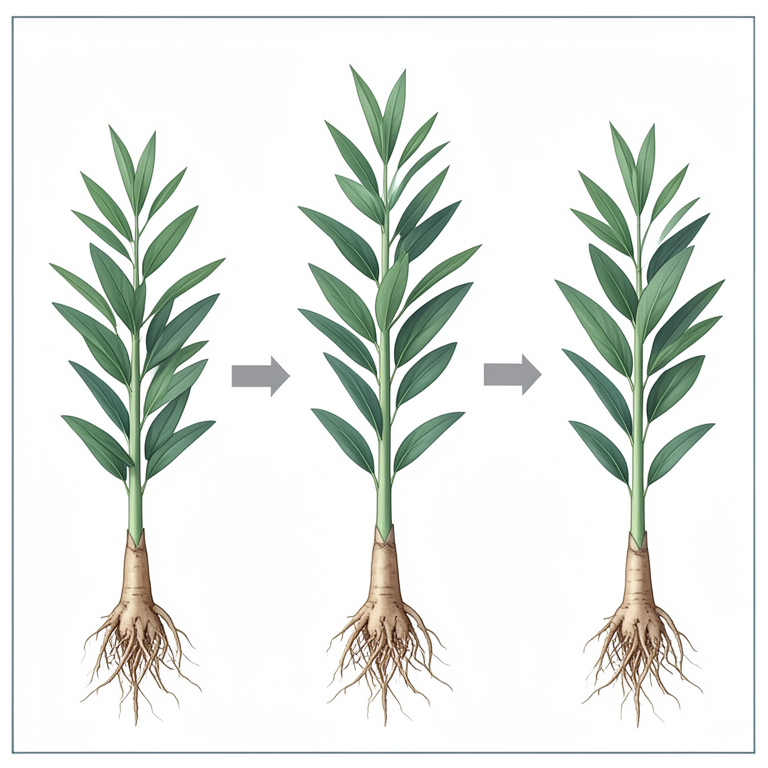
Growth Divergence Concept
AI-generated conceptual illustration (Curcuma amada and Curcuma caesia plants). It explains the idea and does not show study data.
View source evidence ↗Figures & tables
From the original paper Table 1
 Table 2
 Table 3
 Table 4
 Table 5
 Table 6
Introduction
Family Zingiberaceae consists of the large number of medicinal plants and is well-known for its use in ethnomedicine and play a major role in the Indian System of Medicine, Ayurveda (Kumar et al., 2013) [2] . The Zingiberaceae family constitutes a large number of rhizomatous medicinal and aromatic plants. The family Zingiberaceae is well known for its immense medicinal values and is distributed widely throughout the tropics, particularly in Southeast Asia (Rasool and Maqbool, 2019) [4] . North eastern India is one of the richest sources of Zingiberene with about 19 genera and 90 species. Most of the Zingiberaceae members are found here in wild states, and many of them lack scientific investigation. Traditionally, the rhizomes of the various species under the genus Curcuma are used in the treatment of various common ailments, including hemorrhoids, leprosy, asthma, cancer, epilepsy, fever, wounds, vomiting, menstrual disorder, anthelmintic, aphrodisiac, inflammation, gonorrheal discharges, etc. The present work deals with study about a comparative phonological study of two important Zingiberaceae plant C caesia and C. amada. Phenology is the study of periodic phenomena in organisms and how these are influenced by seasonal and interannual variations in climate, as well as habitat factors. The study of phenological aspects of plants involves the observation, recording, and interpretation of the timing of their life history events (Fenner, 1998) [1] . The study of plant phenology provides knowledge about the pattern of plant growth and development as well as the effects of environment and selective pressures on flowering and fruiting behaviour (Zhang et al.,2006) [7] . The knowledge of the timing of phenological events and their variability can provide valuable data for planning, organizing, and timely execution of certain standard and special agricultural activities that require advanced information on the dates of specific stages of crop development (Rumi and Vulic).
Plant Phenological study provides valuable information about the pattern of vegetative growth and development of plants, which helps set priorities and conservation strategies for the conservation of rare and endangered plant species. C. caesia and C. amada are the threatened species of Curcuma from this region. Hence, detailed phenological observations of these widely used ethnomedicinal plants from North-East India are crucial for their conservation, particularly through domestication and cultivation supported by modern breeding techniques.
Materials and Methods
About the study site: Jorhat is a major urban centre of the Upper Brahmaputra valley zone of Assam and lies near 26°45′ N, 94°12′ E. The Jorhat district covers about 2,851 km². The climate is humid subtropical, with an average annual temperature of 23.7 °C and an annual precipitation of 2,700 mm. Relative humidity is consistently high, peaking above 80-85% during the monsoon months.
Methods of the study:
To study the life cycle events of plants under the prevailing climatic conditions of the study area, phenological observations were conducted over three consecutive years by maintaining the plants in the Botanical Garden of Jagannath Barooah University, Jorhat. Planting material, i.e., rhizomes, was collected from villages across the study site, and the observations focused on key phenophases, such as the initiation of shoots from rhizomes, leaf growth and measurements, inflorescence development, the number of flowers, flowering period, and flower longevity. In addition, plant height and leaf number were recorded at 60, 100, 140, and 180 days after planting. The rhizomes were planted during the first week of May, 2022, and subsequent observations were systematically documented.
Results and Discussion
C. caesia is a perennial rhizomatous herb with externally brownish rhizomes that are bluish-black inside. The plant reaches a height of about 84 ± 0.52 cm after 180 days of plantation. Mature leaves measure up to 17 × 45 cm, and are lanceolate, oblong-elliptic, or oblong-lanceolate in shape. The inflorescence arises from the base of the rhizome, bearing pale yellow flowers with reddish margins. Leaves usually appear after the emergence of flowers. The green foliage dries in late autumn, and the rhizomes remain dormant during winter. C. amada is also a perennial leafy rhizomatous herb, growing up to 86.3 ± 0.21 cm after 180 days. Its rhizomes are stout, finger-like, branched, and with a raw mango flavour. Mature leaves, similar, 16 × 45 cm, and are oblonglanceolate, tapering at both ends. Inflorescences arise from the rhizome base, producing greenish-white flowering bracts and coma bracts tinged with pink or red. Flowers are unisexual and are pink in color. Like C. caesia, the foliage dries in late autumn, and the rhizomes remain dormant in winter.
Growth Parameters
Plant height: Maximum height was recorded at 180 days, 84 ± 0.52 cm in C. caesia and 86.3 ± 0.21 cm in C. amada. No significant difference was observed at 60 and 100 days (p > 0.05). However, plant height differed significantly at 140 and 180 days (p < 0.05), indicating divergence in growth during later stages.
Petiole height: Maximum petiole height was recorded after 180 days, 67.8 ± 1.4 cm in C. caesia and 68.7 ± 2.9 cm in C. amada. No significant difference was found at 140 days (p > 0.05), whereas significant variation occurred at 60, 100, and 180 days (p < 0.05).
Leaf size: Leaf dimensions increased gradually, reaching maximum size at 180 days. In C. caesia, leaf length and breadth measured 44.2 ± 1.1 cm and 16.6 ± 0.27 cm, respectively. In C. amada, the corresponding measurements were 45.2 ± 0.46 cm and 17.1 ± 0.78 cm. No significant differences were observed at 60 days, but significant variation was noted at 100, 140, and 180 days (p < 0.05).
Leaf number:
The number of leaves increased initially but decreased at later growth stages. Statistical analysis revealed no significant difference between the two species at any of the four stages (60, 100, 140, and 180 days), with p > 0.05 throughout.
Reproductive Phenology Inflorescence development:
In C. caesia, inflorescence appeared 80 -90 days after sprouting (third year of plantation), whereas in C. amada it appeared 78 -85 days after sprouting (second year).
Floral traits: C. caesia produced 9-12 flowers, while C. amada produced 10 -16 flowers. Flowering occurred between June and July in both species, with individual flowers lasting only 1-3 days.
Fruit formation: No fruit formation was observed in either species during the study period. C. caesia and C. amada display largely uniform aerial growth characteristics in the initial stages of development; detailed statistical analysis reveals that differences in plant height and leaf size become significant during later growth phases. Specifically, while no significant differences in plant height and leaf dimensions were observed at 60 and 100 days post-planting (p > 0.05), both traits showed statistically significant divergence at 140 and 180 days (p < 0.05), suggesting that C. amada may outpace C. caesia in later-stage growth. In contrast, leaf number remained statistically similar between the species throughout all four growth phases (60, 100, 140, and 180 days; p > 0.05), indicating comparable foliage density. Understanding phenological differences between related medicinal species guides sustainable harvesting, ensures consistent bioactive compound yield, and aids in incorporating Indigenous knowledge systems (Kumar et al., 2011) [3] . By comparing phenological traits across species, researchers can identify which ones are more resilient or adaptable to domestication and conservation efforts (Varban et al., 2021). Various studies confirmed that the plant phenological studies can guide us to select which wild plants are suitable for cultivation, help breeders select uniform and adaptable varieties, and ensure successful integration into the agricultural system (Zhang et al., 2005; Varban et al., 2021) [7] .
Figures and tables from the paper
| Species | Days after Plantation | — | — | — | Days after Plantation | — | — | — |
|---|---|---|---|---|---|---|---|---|
| 60 | 100 | 140 | 180 | 60 | 100 | 140 | 180 | |
| Plant height in cm | Petiole Height in cm | |||||||
| C. caesia | 25.8±0.31 | 51.4±0.32 | 72.2±2.11 | 84± 0.52 | 19±0.3 | 42.3±0.6 | 63.2±0.6 | 67.8± 1.4 |
| C. amada | 26.3±0.12 | 51.9± 1.4 | 73.6±0.31 | 86.3± 0.21 | 20 ±0.31 | 43.2±2.1 | 64.1±1.3 | 68.7± 2.9 |
Table text extracted from the original PDF; superscript letters are shown inline. The original table image is below.
View original table image
| Species | Days after Plantation | — | — | — | Days after Plantation | — | — | — |
|---|---|---|---|---|---|---|---|---|
| 60 | 100 | 140 | 180 | 60 | 100 | 140 | 180 | |
| Size of leaf in cm | Leaf Number | |||||||
| C. caesia | L-14±0.93 B-7±1.2 | L-28±2.2 B-12±0.7 | L-39.1±0.34 B-15±1.8 | L- 44.2 ± 1.1 B-16.6 ± 0.27 | 1-3 | 5-9 | 7-10 | 8-10 |
| C. amada | L-16.1±2.3 B-7±0.46 | L-29.02±1.3 B-12.4±0.21 | L-39.6±02 B-16.1±0.4 | L- 45.2 ± 0.46 B- 17.1 ± 0.78 | 1-4 | 5-10 | 8-10 | 8-12 |
Table text extracted from the original PDF; superscript letters are shown inline. The original table image is below.
View original table image
| Days after plantation | Between Species | t-test | P-value | Decision |
|---|---|---|---|---|
| 60 | C. caesia and C. amada | 1.564 | 0.156 | Not significant |
| 100 | C. caesia and C. amada | 1.241 | 0.242 | Not significant |
| 140 | C. caesia and C. amada | 4.321 | 0.002 | Significant |
| 180 | C. caesia and C. amada | 4.432 | 0.002 | Significant |
Table text extracted from the original PDF; superscript letters are shown inline. The original table image is below.
View original table image
| Days after plantation | Between Species | t-test | P-value | Decision |
|---|---|---|---|---|
| 60 | C. caesia and C. amada | 4.121 | 0.003 | Significant |
| 100 | C. caesia and C. amada | 4.567 | 0.001 | Significant |
| 140 | C. caesia and C. amada | 1.341 | 0.220 | Not significant |
| 180 | C. caesia and C. amada | 5.128 | 0.001 | Significant |
Table text extracted from the original PDF; superscript letters are shown inline. The original table image is below.
View original table image
| Days after plantation | Between Species | t-test | P-value | Decision |
|---|---|---|---|---|
| 60 | C. caesia and C. amada | 1.769 | 0.116 | Not Significant |
| 100 | C. caesia and C. amada | 1.312 | 0.230 | Not Significant |
| 140 | C. caesia and C. amada | 2.431 | 0.042 | Significant |
| 180 | C. caesia and C. amada | 0.864 | 0.416 | Not Significant |
Table text extracted from the original PDF; superscript letters are shown inline. The original table image is below.
View original table image
References
7 in the original paper- Fenner M. The phenology of growth and reproduction in plants. Perspect Plant Ecol Evol Syst. 1998;1(1):7889.
- Kumar KM, Asish GR, Sabu M, Balachandran I. Significance of gingers (Zingiberaceae) in Indian system of medicine-Ayurveda: An overview. Anc Sci Life. 2013;32(4):253-61. DOI:10.4103/0257-7941.131989
- Kumar M, Sheikh MA, Bussmann RW. Ethnomedicinal and ecological status of plants in Garhwal Himalaya, India. J Ethnobiol Ethnomed. 2011;7(1):32. DOI:10.1186/1746-4269-7-32
- Rasool S, Maqbool M. An overview about Hedychium spicatum: A review. J Drug Deliv Ther. 2019;9(1s):476-80. DOI:10.22270/jddt.v9i1-s.2429
- Ruml M, Vulić T. Importance of phenological observations and predictions in agriculture. J Agric Sci. 2005;50(2):217-25.
- Varban R, Ona A, Stoie A, Vârban D, Crișan I. Phenological assessment for agronomic suitability of some Agastache species based on standardized BBCH scale. Agronomy. 2021;11(11):2280. DOI:10.3390/agronomy11112280
- Zhang G, Song Q, Yang D. Phenology of Ficus acemosa in Xishuangbanna, Southwest China. Biotropica. 2006;38(3):334-9.
Cited by 1
From OpenAlex, OpenCitations and reference lists read by Scinovex
- Phytochemical screening and growth stage–dependent modelling of curcumin content variation in rhizomes of Curcuma caesia Roxb. ↗
Victor Thingujam, Ongmu Lachungpa, Animesh Ghosh Bag, Umalaxmi Thingujam, Banhisikha Roy, Suman Dutta et al. · Discover Plants. · 2026
Black turmeric ( Curcuma caesia Roxb.) belonging to the family of Zingiberaceae is an industrially significant species listed as a critically endangered plant. The present experiment emphasizes on giving more insight on the phytochemical screening and variation of Curcumin content with plant growth and development. The relationship between curcumin content with the plant age and rhizome biomass was studied from…
❝ 1PDF