
Research article · 2025 · Full text
International Journal of Agriculture and NutritionEffect of bioregulators on growth, yield, and economics of wheat (Triticum aestivum L.)
Volume 7(9) · Pages 29–32 · DOI: 10.33545/26646064.2025.v7.i9a.283 ↗
Research areasAgricultural Science and FertilizationCrop Yield and Soil Fertility
Abstract
Author-writtenWheat (Triticum aestivum L.) is one of the most important cereal crops globally, serving as a staple food for millions of people. The productivity of wheat is often constrained by environmental stress, poor nutrient uptake, and limited photosynthetic efficiency. Bioregulators such as thiourea and kinetin have emerged as promising tools to modulate physiological and biochemical processes in plants, thereby improving growth, yield, and economic returns. The present investigation was carried out during the rabi season with nine treatments, including seed soaking and foliar application of bioregulators at tillering and flowering stages. Growth traits (plant height, dry matter accumulation, chlorophyll content), yield attributes (effective tillers, spike length, grains per spike, test weight), yields (grain, straw, biological yield, harvest index), and economics (net returns and benefit-cost ratio) were evaluated. The results revealed significant differences among treatments. Foliar application of thiourea (500 ppm) at tillering and flowering (T6) and combined seed soaking + foliar spray of thiourea (T8) showed maximum improvements in plant height (89.90 cm), dry matter accumulation (250.14 g/m row), chlorophyll content (2.29%), and yield attributes. These treatments also recorded the highest grain yield (4732 kg/ha), biological yield (11,442 kg/ha), and harvest index (41.36%). Net returns (Rs. 80,786/ha) and benefit-cost ratio (2.35) were also superior under thiourea foliar spray compared to control (Rs. 52,740/ha; 1.34 B:C). Kinetin application (T5, T7, T9) also improved growth and productivity but was slightly inferior to thiourea treatments. The study concluded that thiourea, particularly in foliar application or in combination with seed soaking, is a highly effective bioregulator in wheat for enhancing physiological traits, productivity, and profitability. These findings support the integration of plant bioregulators into wheat production strategies to optimize resource use efficiency and improve food security
Summary
Source-checkedPlain-language reading of the full paper, prepared with AI and checked against the text. Each point links to the authors' own words.
Why it matters
- Wheat is a critical global cereal crop that serves as a primary food source for millions. View evidence ↗
- Wheat productivity is frequently limited by factors such as environmental stress, inefficient photosynthesis, and poor nutrient uptake. View evidence ↗
- Bioregulators like kinetin and thiourea are used to modify plant biochemical and physiological processes to enhance yield, growth, and profit. View evidence ↗
The question
- The study aimed to evaluate the effects of nine different treatments involving seed soaking and foliar applications of bioregulators during the tillering and flowering stages of wheat. View evidence ↗
What they did
- The field experiment took place during the 2024-25 rabi season at the Vivekananda Global University Research Farm in Jaipur. View evidence ↗
- The study used a Randomized Block Design with 27 plots (9 treatments across 3 replications), testing 500 ppm thiourea and 10 ppm kinetin via seed soaking, foliar sprays, or combinations. View evidence ↗
- Researchers measured growth parameters, yield attributes, yield components, and quality traits, including protein and nutrient content. View evidence ↗
What they found
- The combination of seed soaking and foliar thiourea spray (T8) produced the maximum plant height at 89.90 cm, compared to 72.62 cm in the control group. View evidence ↗
- T8 (combined thiourea) achieved the highest dry matter accumulation (250.14 g/m row) and chlorophyll content (2.29%). View evidence ↗
- Thiourea treatments T8 and T6 significantly increased effective tillers per plant to 74.25 and 74.00, respectively, over the control's 59.95. View evidence ↗
- Grain yield was highest in the T8 treatment at 4732 kg/ha, while the control (T1) was the lowest at 3312 kg/ha. View evidence ↗
- The harvest index improved to 41.36% under T8 compared to 38.85% in the control group. View evidence ↗
- Net returns were highest for T8 (Rs. 80,786/ha), and T6 achieved the best benefit-cost ratio (2.35), both significantly outperforming the control (Rs. 52,740/ha; 1.34 B:C). View evidence ↗
- While kinetin treatments (T5, T7, T9) improved productivity, they were less effective than the thiourea treatments. View evidence ↗
What it means
- The authors state that multi-location trials are necessary to validate the findings across different agro-ecological conditions. View evidence ↗
Visual summary
2 visualsIllustrations explain the paper; charts are replotted from the paper's own table values.
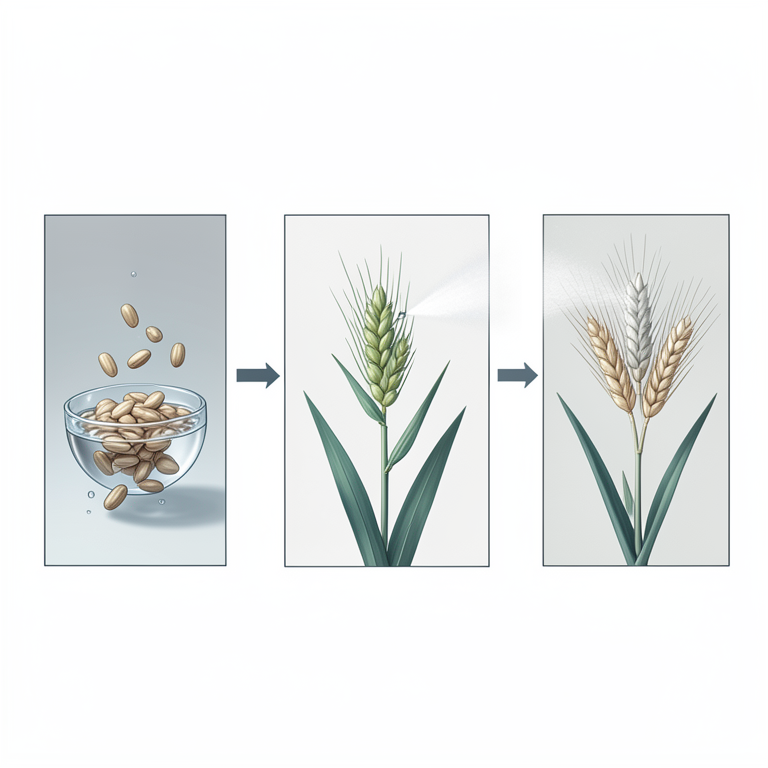
Experimental Treatment Layout
AI-generated conceptual illustration (wheat plants (Triticum aestivum L.)). It explains the idea and does not show study data.
View source evidence ↗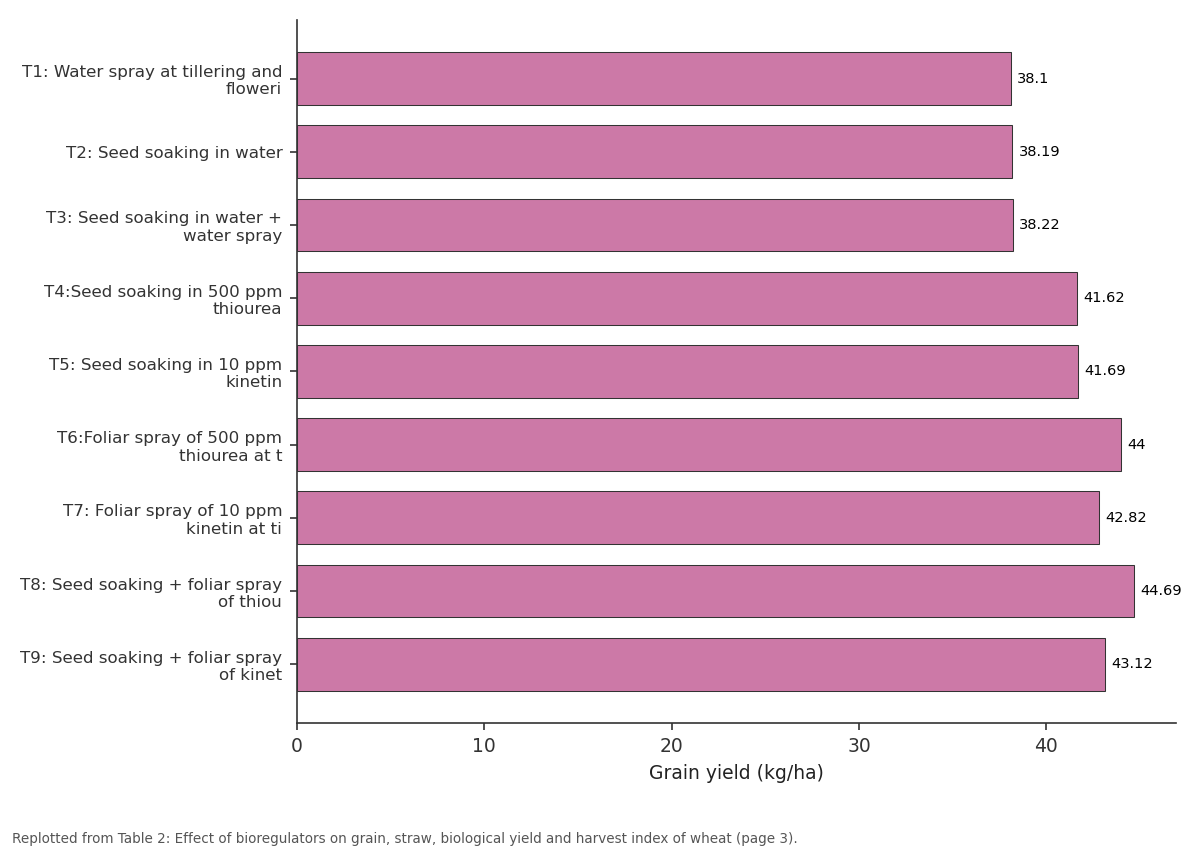
Test weight (g): T1: Water spray at... vs T2: Seed soaking in... vs T3: Seed soaking in... vs T4:Seed soaking in 500... vs T5: Seed soaking in 10...
Replotted from Table 2 (page 3) of the original paper. Every bar is the paper's own table value.
View source evidence ↗Figures & tables
From the original paper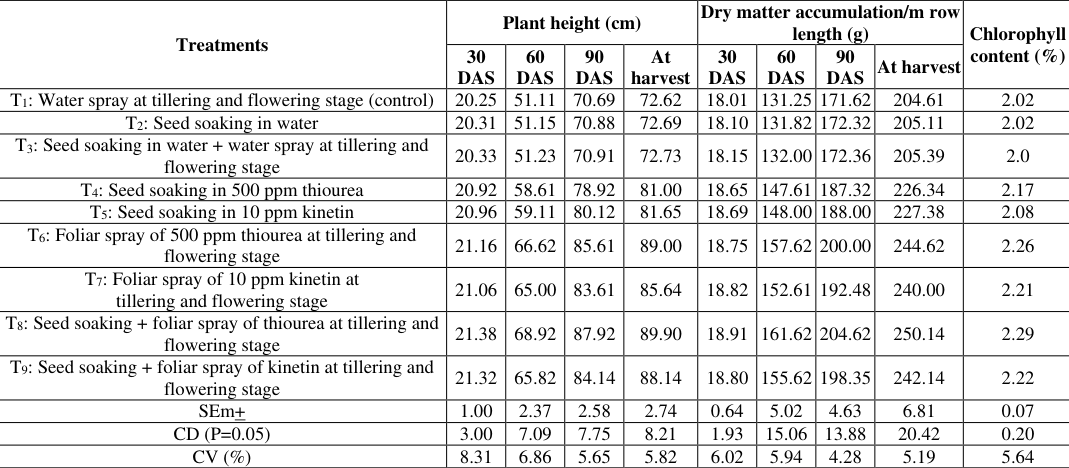 Table 1
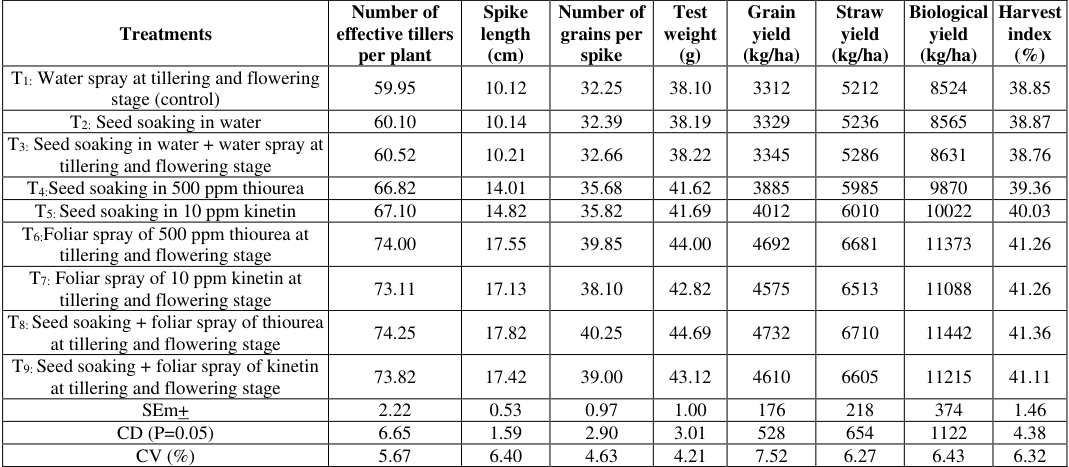 Table 2
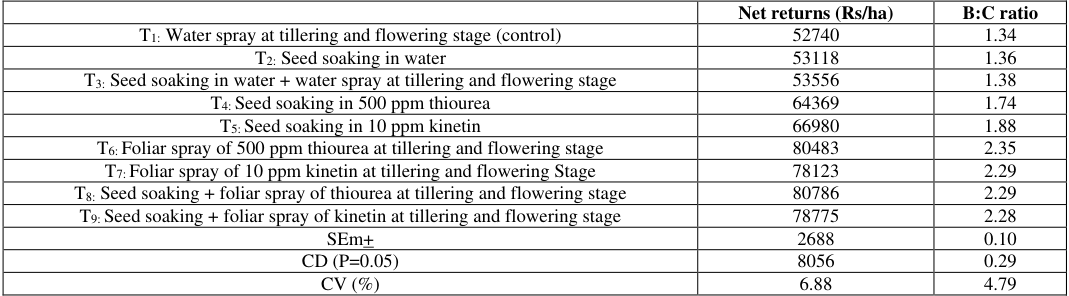 Table 3
Introduction
Wheat (Triticum aestivum L.) is a major cereal crop grown worldwide, occupying about 220 million hectares with a production of over 770 million tonnes annually [1] . In India, it ranks second after rice, with an area of 30 million hectares and production around 110 million tonnes [2] . As a staple crop, wheat contributes significantly to food and nutritional security. However, yield stagnation in wheat due to abiotic stresses (drought, heat, salinity) and biotic constraints has become a major concern [3] . Improving wheat productivity under such conditions requires innovative agronomic practices, including the use of plant bioregulators. Bioregulators (plant growth regulators or PGRs) are organic compounds, other than nutrients, that modify physiological processes in plants at very low concentrations [4] . They influence cell division, elongation, photosynthesis, flowering, and grain filling. Two commonly studied bioregulators are thiourea (an organosulfur compound with anti-oxidative and osmoprotective properties) and kinetin (A cytokinin promoting cell division and chlorophyll retention). Thiourea has been reported to improve stress tolerance, enhance photosynthetic activity, and increase yield in wheat under both normal and stress conditions [5,6] . Its application as seed soaking or foliar spray stimulates early seedling vigor, enhances dry matter partitioning, and improves spike and grain formation [7] . Similarly, kinetin delays leaf senescence, increases chlorophyll retention, and promotes assimilate partitioning towards reproductive organs [8,9] . Previous studies have demonstrated significant improvements in wheat productivity with thiourea and kinetin.
For instance, Sahu et al. [10] reported increased grain yield by 15-20% with thiourea sprays at critical growth stages. Kinetin application has also shown positive effects on spike length and grains per spike [11] . However, comparative studies evaluating both thiourea and kinetin under combined seed soaking and foliar application are limited.
Materials and Methods
A field experiment entitled was conducted during the rabi season of 2024-25 at the Research Farm, Vivekananda Global University, Jaipur (26°05ʹ N, 75°28ʹ E, 427 m AMSL). The site falls under Agro-climatic Zone IIIA (Semi-Arid Eastern Plains). The region experiences a semiarid climate with extreme summer and winter temperatures (1-46 °C), annual rainfall of 400-500 mm, mostly from the southwest monsoon, and relative humidity ranging between 0-69%. During the experimental period, 78.3 mm rainfall was received. Soil samples (0-15 cm depth) collected before sowing indicated a loamy sand texture, bulk density of 1.23 Mg/m³, field capacity of 13.92%, organic carbon of 0.44%, and moderate fertility status (N: 121.7 kg/ha, P₂O₅: 15.12 kg/ha, K₂O: 142.25 kg/ha) with pH 7.25 and EC 1.42 dS/m.
The cropping history revealed previous rotations of mungbean, chickpea, bajra, and methi, with wheat as the experimental crop in 2024-25. The trial was conducted in a Randomized Block Design with 9 treatments and 3 replications (27 plots). Treatments included water spray (control), seed soaking, foliar sprays, and combinations of 500 ppm thiourea and 10 ppm kinetin. Each plot measured 15 m² (gross) with a net harvested area of 10.4 m². Wheat was sown on 17th November 2024 at 20 cm row spacing using 100 kg/ha seed rate. Standard agronomic practices were followed, including disc ploughing, irrigation (five times by check basin method), hoeing and weeding, and plant protection measures. Fertilizer application comprised basal DAP and split nitrogen (urea) applications. Harvesting was done on 4th April 2025, followed by threshing and winnowing. Treatment applications were made as seed soaking in respective solutions or foliar sprays at tillering and flowering stages using a knapsack sprayer. Observations recorded included growth parameters (plant height, dry matter accumulation, chlorophyll content), yield attributes (effective tillers, spike length, grains/spike, test weight), yield components (grain, straw, biological yield, harvest index), and quality traits (nutrient content, protein content, and protein yield). Nutrient analyses were conducted following standard protocols: N by colorimetric method, P by vanadomolybdate method, and K using flame photometry. Protein content was derived by multiplying nitrogen percentage with a factor of 6.25. Economic analysis was carried out by computing cost of cultivation, gross returns, net returns, and benefit-cost ratio. Data were statistically analyzed using ANOVA as per Panse and Sukhatme (1985), with significance tested at 5% probability level, and results expressed with SEm+ and CD values.
Results and Discussion
Results and Discussion
Growth traits
Plant height showed significant response to bioregulators. At harvest, maximum height (89.90 cm) was recorded with seed soaking + foliar spray of thiourea (T8), followed by foliar spray of thiourea alone (T 6 : 89.00 cm). Control (T 1 ) remained lowest (72.62 cm). Similar trends were observed for dry matter accumulation and chlorophyll content. Thiourea enhanced photosynthetic efficiency and assimilate partitioning, consistent with findings of Chaturvedi et al. [12] . Kinetin treatments (T 5 , T 7 , T 9 ) also improved growth but were slightly inferior to thiourea.
Yield attributes and yield
Effective tillers per plant were significantly higher under T 8 (74.25) and T 6 (74.00), compared to control (59.95). Spike length was maximum under T 8 (17.82 cm) followed by T 6 (17.55 cm). Grains per spike (40.25) and test weight (44.69 g) were also highest with thiourea application. Improvement in yield attributes can be attributed to better nutrient uptake, delayed senescence, and improved assimilate partitioning under thiourea. Similar positive effects of thiourea on spikelet fertility were reported by Singh et al. [13] . Grain yield ranged from 3312 kg/ha (T 1 ) to 4732 kg/ha (T 8 ). Straw yield was maximum in T 8 (6710 kg/ha), followed by T 6 (6681 kg/ha). Biological yield exceeded 11,000 kg/ha under T 6 and T 8 . Harvest index was also improved (41.36% in T 8 vs 38.85% in control). These findings corroborate earlier results of Yadav et al. [14] , who observed 20-25% yield increase in wheat with thiourea sprays.
Economic
Economic analysis revealed that net returns were highest in T8 (Rs. 80,786/ha) and T 6 (₹80,483/ha), with B:C ratio of 2.35 under T 6 . This was substantially higher than control (₹52,740/ha; 1.34 B:C). Kinetin-based treatments also improved profitability but were less effective than thiourea. These results indicate that thiourea application is not only agronomically effective but also economically viable.
Discussion with literature suppor
The superiority of thiourea may be attributed to its role as a hydrogen donor and free radical scavenger, improving stress tolerance and enzyme activity [15] . Foliar application at tillering and flowering ensures better uptake and utilization during critical growth phases. Kinetin, being a cytokinin, enhanced spike length and chlorophyll content, corroborating the findings of Sharma and Srivastava [16] . The combined seed soaking and foliar spray treatments provided cumulative benefits by enhancing early vigor and sustaining growth during reproductive stages.
Conclusion
The study demonstrated that bioregulators significantly improved growth, yield attributes, productivity, and profitability of wheat. Among the treatments, foliar spray of thiourea at tillering and flowering stage (T6) and seed soaking + foliar spray of thiourea (T 8 ) were most effective, recording highest plant growth, yield, and net returns. Kinetin treatments also enhanced performance but were slightly inferior. Thus, the application of thiourea, particularly as foliar spray at critical stages, is recommended
Acknowledgement
International Journal of Agriculture and Nutrition https://www.agriculturejournal.net for sustainable wheat production. Further multi-location trials are needed to validate these results under diverse agroecological conditions.
Figures and tables from the paper
| Treatments | Plant height (cm) | — | — | — | Dry matter accumulation/m row length (g) | — | — | — | Chlorophyll content (%) |
|---|---|---|---|---|---|---|---|---|---|
| 30 DAS | 60 DAS | 90 DAS | At harvest | 30 DAS | 60 DAS | 90 DAS | At harvest | ||
| T1: Water spray at tillering and flowering stage (control) | 20.25 | 51.11 | 70.69 | 72.62 | 18.01 | 131.25 | 171.62 | 204.61 | 2.02 |
| T2: Seed soaking in water | 20.31 | 51.15 | 70.88 | 72.69 | 18.10 | 131.82 | 172.32 | 205.11 | 2.02 |
| T3: Seed soaking in water + water spray at tillering and flowering stage | 20.33 | 51.23 | 70.91 | 72.73 | 18.15 | 132.00 | 172.36 | 205.39 | 2.0 |
| T4: Seed soaking in 500 ppm thiourea | 20.92 | 58.61 | 78.92 | 81.00 | 18.65 | 147.61 | 187.32 | 226.34 | 2.17 |
| T5: Seed soaking in 10 ppm kinetin | 20.96 | 59.11 | 80.12 | 81.65 | 18.69 | 148.00 | 188.00 | 227.38 | 2.08 |
| T6: Foliar spray of 500 ppm thiourea at tillering and flowering stage | 21.16 | 66.62 | 85.61 | 89.00 | 18.75 | 157.62 | 200.00 | 244.62 | 2.26 |
| T7: Foliar spray of 10 ppm kinetin at tillering and flowering stage | 21.06 | 65.00 | 83.61 | 85.64 | 18.82 | 152.61 | 192.48 | 240.00 | 2.21 |
| T8: Seed soaking + foliar spray of thiourea at tillering and flowering stage | 21.38 | 68.92 | 87.92 | 89.90 | 18.91 | 161.62 | 204.62 | 250.14 | 2.29 |
| T9: Seed soaking + foliar spray of kinetin at tillering and flowering stage | 21.32 | 65.82 | 84.14 | 88.14 | 18.80 | 155.62 | 198.35 | 242.14 | 2.22 |
| SEm+ | 1.00 | 2.37 | 2.58 | 2.74 | 0.64 | 5.02 | 4.63 | 6.81 | 0.07 |
| CD (P=0.05) | 3.00 | 7.09 | 7.75 | 8.21 | 1.93 | 15.06 | 13.88 | 20.42 | 0.20 |
| CV (%) | 8.31 | 6.86 | 5.65 | 5.82 | 6.02 | 5.94 | 4.28 | 5.19 | 5.64 |
Table text extracted from the original PDF; superscript letters are shown inline. The original table image is below.
View original table image
| — | Net returns (Rs/ha) | B:C ratio |
|---|---|---|
| T1: Water spray at tillering and flowering stage (control) | 52740 | 1.34 |
| T2: Seed soaking in water | 53118 | 1.36 |
| T3: Seed soaking in water + water spray at tillering and flowering stage | 53556 | 1.38 |
| T4: Seed soaking in 500 ppm thiourea | 64369 | 1.74 |
| T5: Seed soaking in 10 ppm kinetin | 66980 | 1.88 |
| T6: Foliar spray of 500 ppm thiourea at tillering and flowering stage | 80483 | 2.35 |
| T7: Foliar spray of 10 ppm kinetin at tillering and flowering Stage | 78123 | 2.29 |
| T8: Seed soaking + foliar spray of thiourea at tillering and flowering stage | 80786 | 2.29 |
| T9: Seed soaking + foliar spray of kinetin at tillering and flowering stage | 78775 | 2.28 |
| SEm+ | 2688 | 0.10 |
| CD (P=0.05) | 8056 | 0.29 |
| CV (%) | 6.88 | 4.79 |
Table text extracted from the original PDF; superscript letters are shown inline. The original table image is below.
View original table image
References
16 in the original paper- Food and Agriculture Organization of the United Nations (FAO). FAOSTAT statistical database. Rome: FAO; 2023.
- Government of India. Agricultural statistics at a glance 2022. New Delhi: Ministry of Agriculture and Farmers' Welfare; 2023.
- Reynolds MP, Braun HJ. Wheat improvement: food security in a changing climate. Cham: Springer; 2019.
- Davies PJ. Plant hormones: physiology, biochemistry and molecular biology. Dordrecht: Springer Science & Business Media; 2010.
- Sahu MP, Solanki NS, Dashora LN. Effects of thiourea, thiamine and ascorbic acid on growth and yield of wheat. Indian J Plant Physiol. 1993;36(1):35-9.
- Kaya C, Tuna AL, Higgs D. Effect of thiourea on plant growth, chlorophyll content and nitrogen metabolism in wheat under drought stress. J Plant Nutr. 2006;29(9):1789-803.
- Patel JR, Singh D, Jat RS. Role of thiourea in improving productivity of wheat under abiotic stresses. Int J Curr Microbiol Appl Sci. 2017;6(9):1199-210.
- Mok DWS, Mok MC. Cytokinins: chemistry, activity, and function. Boca Raton: CRC Press; 2001.
- Taiz L, Zeiger E, Møller IM, Murphy A. Plant physiology and development. 6th ed. Sunderland: Sinauer Associates; 2015.
- Sahu MP, Solanki NS. Performance of thiourea in wheat under different irrigation schedules. Indian J Agron. 1991;36(4):571-4.
- Bhosale SU, Patil JV, Jadhav AS. Influence of kinetin on yield attributes of wheat. J Maharashtra Agric Univ. 2014;39(2):265-8.
- Chaturvedi GS, Tripathi P, Singh D. Effect of thiourea sprays on photosynthetic activity and yield of wheat. Ann Agric Res. 2015;36(1):47-52.
- Singh P, Meena RS, Gautam R. Impact of thiourea and kinetin on yield traits of wheat under semi-arid conditions. J Cereal Res. 2019;11(1):39-45.
- Yadav OP, Singh R, Sharma P. Thiourea-mediated enhancement of wheat yield under late-sown conditions. Indian J Plant Physiol. 2018;23(3):455-61.
- Gupta NK, Agarwal S, Agarwal VP. Physiological role of thiourea in plants under stress. Plant Stress Physiol. 2013;9:99-118.
- Sharma A, Srivastava S. Role of kinetin in chlorophyll retention and delayed senescence in wheat. Indian J Plant Physiol. 2012;17(4):336-41.