
Research article · 2025 · Full text
International Journal of Horticulture and Food ScienceStrategies for mitigating supply chain risks in horticultural products: Red chilli production case study
Volume 7(7) · Pages 142–144 · DOI: 10.33545/26631067.2025.v7.i7b.382 ↗
Research areasInnovation and Socioeconomic Development
Abstract
Author-writtenHorticultural products are particularly vulnerable to supply chain disruptions due to their perishable nature, seasonality, and susceptibility to environmental conditions. The effectiveness of strategies aimed at mitigating risks in the supply chain of these products is crucial for maintaining their quality, availability, and market competitiveness. This critical review examines the key risks in the horticultural supply chain, such as production uncertainties, transportation challenges, demand variability, and market fluctuations. Furthermore, it assesses various strategies that have been employed to mitigate these risks, including technological advancements, sustainable practices, risk-sharing mechanisms, and the adoption of resilient logistical frameworks. The review concludes by providing a comprehensive overview of effective approaches that can enhance the stability and efficiency of horticultural supply chains, thus ensuring the sustainability of this critical sector.
Summary
Source-checkedPlain-language reading of the full paper, prepared with AI and checked against the text. Each point links to the authors' own words.
Why it matters
- Horticultural products are highly susceptible to supply chain disruptions because they are seasonal, perishable, and sensitive to the environment. View evidence ↗
- Many losses in these supply chains stem from inefficiencies in storage, transportation, packaging, and post-harvest handling. View evidence ↗
- Risks in the production and distribution of horticultural goods lead to market volatility, inefficiencies, and significant losses. View evidence ↗
The question
- The paper aims to critically review risk-mitigation techniques used in horticultural supply chains to improve their sustainability, efficiency, and resilience. View evidence ↗
What they did
- The authors conducted a critical review examining key risks including market fluctuations, demand variability, transportation challenges, and production uncertainties. View evidence ↗
- The review assesses mitigation strategies such as resilient logistical frameworks, risk-sharing mechanisms, sustainable practices, and technological advancements. View evidence ↗
What they found
- Environmental factors, specifically diseases, pests, and climate variability, are the primary drivers of production risks in horticulture. View evidence ↗
- Poor transportation infrastructure and inadequate cold storage facilities contribute to high levels of food waste in perishable supply chains. View evidence ↗
- The 'bullwhip effect' causes small changes in consumer demand to create amplified variability upstream, leading to increased costs and inefficiencies. View evidence ↗
- IoT sensors provide real-time data on soil moisture, humidity, and temperature, allowing for adjustments in harvesting, pest management, and irrigation to optimize quality and yield. View evidence ↗
- Blockchain technology reduces risks of waste, fraud, and contamination by allowing stakeholders to verify product handling and origin. View evidence ↗
- Crop diversification and agroforestry (agroecological practices) can mitigate the risk of total crop loss caused by pests, diseases, or climatic events. View evidence ↗
- Contract farming provides a risk-sharing mechanism that guarantees a steady supply for buyers and a market for farmers. View evidence ↗
- Producers can protect themselves from market fluctuations via price hedging and from extreme weather losses via crop insurance. View evidence ↗
What it means
- The authors conclude that integrating blockchain, IoT sensors, and precision agriculture effectively reduces waste, ensures quality, and enhances production efficiency and predictability. View evidence ↗
- The authors recommend scaling these mitigation strategies, especially in regions with logistical constraints and climatic uncertainties. View evidence ↗
- Challenges to implementing these strategies include market volatility, inadequate regional infrastructure, and the high cost of technology. View evidence ↗
Visual summary
1 visualsIllustrations explain the paper; they do not show study data.
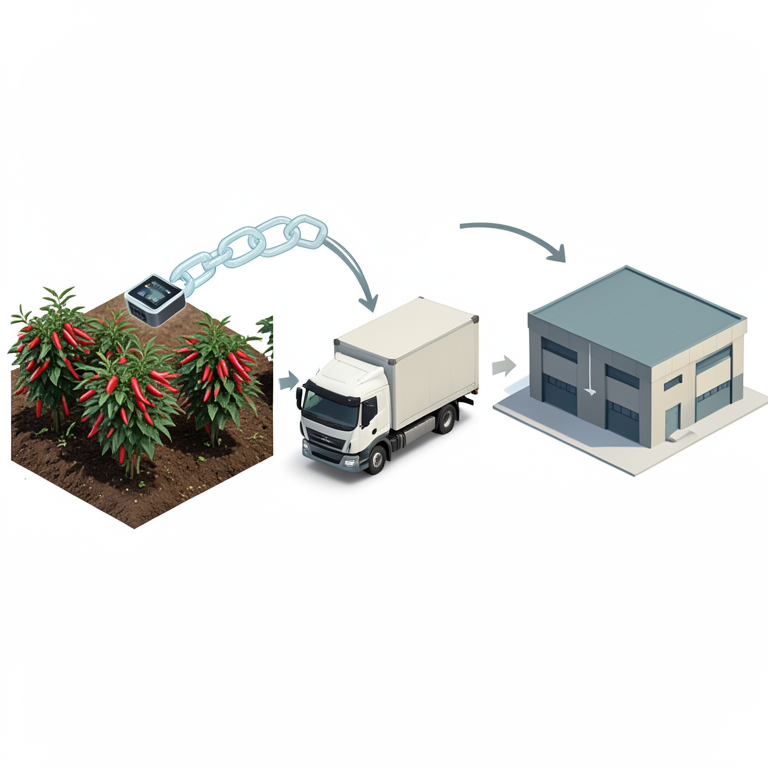
Integrated Risk Mitigation Framework
AI-generated conceptual illustration (Red chilli plants and supply chain logistics). It explains the idea and does not show study data.
View source evidence ↗Introduction
Horticultural products, ranging from fruits and vegetables to ornamental plants, are essential components of global food systems and markets. However, they face unique challenges within supply chains due to their high perishability, sensitivity to environmental conditions, and complexity in handling. The risks associated with the production and distribution of horticultural goods can result in substantial losses, inefficiencies, and market volatility. These risks are influenced by factors such as climatic variations, globalization, transportation bottlenecks, supply-demand imbalances, and market fluctuations. A significant portion of the losses in horticultural supply chains is attributed to inefficiencies in post-harvest handling, packaging, transportation, and storage. Additionally, the seasonal nature of many horticultural products means that supply chains must manage demand fluctuations, which often lead to either oversupply or supply shortages. Given the increasing pressure on food systems, mitigating supply chain risks in horticultural products has become an urgent priority for stakeholders at every level from producers and suppliers to consumers and policymakers. This paper critically reviews the various strategies employed in horticultural supply chains to address these challenges. Specifically, it focuses on risk-mitigation techniques that have been proven effective in improving supply chain resilience, efficiency, and sustainability.
Identifying risks in horticultural supply chains
Horticultural supply chains are inherently complex and susceptible to various risks due to the perishable nature of the products, environmental factors, and market dynamics. Understanding these risks is crucial for developing effective mitigation strategies. This section delves into the primary risks identified in the literature, supported by relevant studies. Production risks in horticulture are primarily influenced by environmental factors such as climate variability, pests, and diseases. According to Tchonkouang, climate change exacerbates the vulnerability of food supply chains, including horticultural products, to extreme weather events, leading to reduced yields and quality. Additionally, pests and diseases can cause significant crop losses, further destabilizing supply.
The transportation and storage of perishable horticultural products pose significant challenges. Kumar (2020) [1] highlights that inefficiencies in logistics, such as inadequate cold storage facilities and poor transportation infrastructure, contribute to high levels of food waste in perishable supply chains. These logistical shortcomings can lead to spoilage and increased costs, impacting the overall efficiency of the supply chain. Fluctuations in consumer demand and market prices are prevalent in horticultural supply chains. The bullwhip effect, as described by Lee et al. (1997) [2] , illustrates how small changes in consumer demand can lead amplified variability upstream in the supply chain, resulting in inefficiencies and increased costs. Additionally, market risks such as price volatility and changing consumer preferences can affect the stability and profitability of horticultural businesses. Post-harvest losses are a significant concern in horticultural supply chains. According to the Food and Agriculture Organization (FAO), losses can occur at various stages, including harvesting, handling, storage, and transportation, due to factors like poor handling practices and inadequate infrastructure. These losses not only waste resources but also reduce the availability of produce in the market. Changes in agricultural policies, trade regulations, and environmental laws can introduce uncertainties in horticultural supply chains. For instance, the implementation of new trade tariffs or environmental regulations can disrupt established supply routes and increase operational costs, affecting the competitiveness of horticultural products in global markets. Identifying and understanding the risks in horticultural supply chains is essential for developing strategies to enhance resilience and efficiency. By addressing production, logistical, demand, post-harvest, and policyrelated risks, stakeholders can mitigate potential disruptions and ensure a stable supply of horticultural products. The subsequent sections will explore various strategies to mitigate these identified risks.
Strategies for mitigating supply chain risks
Mitigating supply chain risks in horticultural products requires the adoption of integrated strategies that address both short-term disruptions and long-term vulnerabilities. Given the perishable nature of these products and the uncertainty surrounding factors such as weather, demand, and logistics, an array of strategies has been employed globally to enhance supply chain resilience. These strategies encompass technological advancements, sustainable practices, collaboration, and risk-sharing mechanisms that collectively work to stabilize supply chains, reduce losses, and improve overall efficiency. A significant strategy in mitigating risks within horticultural supply chains is the adoption of technology. The integration of smart agricultural technologies such as the Internet of Things (IoT), drones, and big data analytics has revolutionized the way risks are managed in production and logistics. For instance, IoT sensors placed in fields and warehouses can provide real-time data on environmental factors like temperature, humidity, and soil moisture. This allows farmers and supply chain managers to adjust processes such as irrigation, pest management, and harvesting to ensure optimal yield and quality. Drones and satellite imagery help monitor crop health, while big data allows for accurate predictions of yields, reducing the uncertainty of production outputs and facilitating better demand forecasting. By using such technology, precision agriculture not only improves resource use efficiency but also minimizes waste and loss. Furthermore, blockchain technology has been increasingly utilized to increase transparency and traceability in the supply chain, ensuring product quality and preventing fraud or contamination. Blockchain allows all stakeholders in the supply chain, from growers to consumers, to verify the origin and handling of products, which can greatly reduce the risks of contamination, fraud, and waste. Another key strategy is sustainable practices in production and logistics. Sustainability in horticultural supply chains ensures that risks related to environmental degradation, resource depletion, and climate change are mitigated. Agroecological practices, such as agroforestry and crop diversification, can reduce the risk of total crop loss from climatic events, pests, or diseases. These practices not only provide a buffer against the environmental risks but also enhance soil fertility and promote biodiversity, leading to more resilient farming systems. Additionally, sustainable logistics practices, such as reducing the carbon footprint through energy-efficient transportation and optimizing packaging materials, help address the environmental risks associated with supply chain operations. Companies are increasingly turning to circular economy models, where packaging materials and waste from production are reused or recycled, thus reducing waste and resource consumption. The role of collaboration and partnerships cannot be overstated in mitigating supply chain risks. Supply chain management in horticulture is not only the responsibility of producers but also of logistics providers, distributors, retailers, and even governments. Public-private partnerships have become increasingly common in improving infrastructure, promoting investment in technology, and developing efficient logistics systems. Collaboration through contract farming arrangements between producers and buyers can provide risk-sharing mechanisms where farmers are assured of a market for their products, while buyers are guaranteed a steady supply. Cooperatives in the horticultural sector, where smallholder farmers come together to share resources and risk, have also been effective in reducing the financial burden on individual producers and improving access to market information and technology. Risk-sharing mechanisms are also an integral component of effective supply chain strategies. Insurance and hedging mechanisms have been used to mitigate the impact of unforeseen disruptions in horticultural supply chains. For example, crop insurance protects producers against losses caused by extreme weather events, while price hedging ensures that producers can lock in prices for their products in advance, protecting them from market fluctuations. Furthermore, contingency planning and the development of emergency response strategies, such as having alternative suppliers or transport routes, can help reduce the impacts of disruptions when they occur. In conclusion, mitigating risks in horticultural supply chains requires a multifaceted approach that combines technology, sustainability, collaboration, and risk management tools. By adopting these strategies, stakeholders in the horticultural sector can create more resilient, efficient, and sustainable supply chains that are better equipped to handle the complex challenges of production, logistics, and market dynamics.
The increasing use of technology and innovation in the sector presents significant opportunities for risk reduction, while collaborations and risk-sharing mechanisms ensure that the entire supply chain benefits from these advancements.
Conclusion
Mitigating risks in horticultural supply chains is essential for ensuring the consistent and efficient delivery of highquality products to consumers while minimizing losses and inefficiencies. Given the complex nature of horticultural supply chains, which are to a variety of risks including environmental, logistical, market, and policyrelated uncertainties the adoption of targeted risk-mitigation strategies is crucial. The integration of technology, including precision agriculture, IoT sensors, and blockchain, has proven effective in enhancing the predictability and efficiency of production, reducing waste, and ensuring product quality. These advancements empower stakeholders to make informed decisions based on real-time data, minimizing risks such as crop losses, spoilage, and market fluctuations. Sustainable practices also play a pivotal role in building resilient supply chains. Agroecological methods, crop diversification, and environmentally friendly logistics help mitigate risks related to environmental degradation and resource scarcity. Furthermore, collaborative strategies, including public-private partnerships and risk-sharing mechanisms like contract farming and cooperatives, strengthen the overall stability of the supply chain. By fostering cooperation among producers, distributors, and retailers, these strategies ensure that risks are shared, and resources are optimized across the supply chain. While challenges remain such as the high cost of technology implementation, inadequate infrastructure in some regions, and market volatility adopting these strategies offers significant potential for improving the resilience and efficiency of horticultural supply chains. Moving forward, the focus must be on scaling these strategies, particularly in regions vulnerable to climatic uncertainties and logistical constraints. With the growing demand for sustainable and efficient food systems, mitigating risks in horticultural supply chains is not only a necessity for ensuring food security but also an opportunity to enhance the sustainability and profitability of the entire sector.
References
12 in the original paper- Kumar A. Logistics and cold chain management in horticultural supply chains. J Agric Supply Chain Manag. 2020;9(1):45-57.
- Lee HL, Padmanabhan V, Whang S. The bullwhip effect in supply chains. Manag Sci. 1997;43(4):546558.
- Food and Agriculture Organization (FAO). Post-harvest losses in horticultural products: causes, impacts, and solutions. Rome: FAO; 2021.
- Tchankoni S, Nwachukwu CA. Supply chain resilience in horticultural produce: case studies from Africa. Agric Econ Policy Rev. 2021;34(3):121-136.
- Lee Y, Lee S, Kim J. Blockchain for transparency in agricultural supply chains. Technol Food Supply Chains. 2023;12(2):99-112.
- Food and Agriculture Organization (FAO). Global horticultural supply chains: Challenges and innovations. FAO Agric Food Rep. 2020.
- Jackson AP, Turner M. Supply chain risks in the fresh produce industry: An overview. Int J Agric Syst. 2022;38(5):245-258.
- Soni P, Mishra A. Risk-sharing mechanisms in agriculture: An exploration of contract farming and cooperative models. J Agric Econ. 2019;21(4):112-128.
- Solis SH, Iqbal M. Risk management strategies in the agricultural sector: A review of emerging trends. J Risk Manag Agric. 2021;10(2):53-69.
- Dewi RK, Parining N, Harsojuwono BA. Mitigation of red chilli supply chain risks in Bali, Indonesia. Int J Agric Food Sci. 2023;5(2):103-12.
- Kumar PR, Singh R. Advances in agroecological practices for sustainable horticultural production. Environ Sustain Hortic. 2021;6(1):74-89.
- P Dhamodharan, J Bhuvaneshwari, S Sowmiya, R Chinnadurai. Revitalizing fodder production: Challenges and opportunities. Int J Res Agron 2024;7(1):208-217.