
Research article · 2025 · Full text
International Journal of Horticulture and Food ScienceHorticultural techniques to mitigate the effects of climate change on rice cultivation
Volume 7(7) · Pages 204–207 · DOI: 10.33545/26631067.2025.v7.i7c.381 ↗
Research areasRice Cultivation and Yield ImprovementAgricultural Systems and Practices
Abstract
Author-writtenRice is the staple food for more than half of the global population, yet its cultivation faces unprecedented threats from climate change. Rising temperatures, irregular rainfall, salinity intrusion, and pest-disease surges undermine productivity and increase vulnerability in both irrigated and rainfed systems. Conventional responses such as breeding and chemical inputs are insufficient in isolation. Horticultural techniques—broadly understood as agronomic practices that manipulate soil, water, canopy, and ecological interactions—offer pragmatic and locally adaptable pathways for resilience. This paper examines a range of interventions including alternate wetting and drying (AWD), direct-seeded rice (DSR), the System of Rice Intensification (SRI), mulching, soil organic matter enrichment, biochar application, silicon and potassium nutrition, ecological engineering, rice-fish-duck integration, raised beds, and laser land leveling. Evidence indicates that these practices not only stabilize yields under climate stress but also generate co-benefits such as water savings, reduced methane emissions, improved soil health, and enhanced biodiversity [1-4]. Socio-economic considerations such as labor dynamics, gender roles, and service ecosystems strongly influence adoption [5, 6]. Policy reforms in water governance, subsidy realignment, and integration with climate finance are necessary to scale these innovations [7, 8]. By synthesizing agronomic research and field evidence, this paper positions horticultural techniques as central components of climate-smart rice cultivation strategies.
Summary
Source-checkedPlain-language reading of the full paper, prepared with AI and checked against the text. Each point links to the authors' own words.
Why it matters
- Rice serves as the primary food source for over half of the world's people, but climate change is creating significant threats to its production. View evidence ↗
- Rice cultivation is both a victim and a contributor to climate change, as continuously flooded fields produce nearly 10% of human-caused methane emissions. View evidence ↗
- Horticultural techniques provide a low-cost and immediate way to mitigate climate stress at the farm level, complementing longer-term genetic improvements. View evidence ↗
The question
- The study aims to identify climate-induced challenges in rice production, review mitigating horticultural techniques, and discuss the policy and socio-economic factors needed to scale their use. View evidence ↗
What they did
- The author synthesized existing agronomic research and field evidence to evaluate horticultural techniques for climate-smart rice cultivation. View evidence ↗
What they found
- Rising night temperatures negatively impact productivity, with every 1°C increase in minimum night temperature potentially reducing yields by up to 10%. View evidence ↗
- Alternate Wetting and Drying (AWD) maintains yields while reducing irrigation water use by 15-30% and cutting methane emissions by up to 48% compared to continuous flooding. View evidence ↗
- Laser land leveling improves crop establishment and can lower irrigation requirements by 20-25% through more uniform water distribution. View evidence ↗
- The System of Rice Intensification (SRI) can increase yields by 20-50% by promoting enhanced tillering and stronger root growth. View evidence ↗
- Using wider spacing in rice cultivation reduces canopy humidity, which in turn lowers the risk of bacterial blight and blast. View evidence ↗
- Direct-Seeded Rice (DSR) saves water and labor by removing the need for transplanting and puddling, and allows for earlier sowing to avoid heat stress at the end of the cycle. View evidence ↗
- The adoption of these techniques is influenced by gender; while mechanization reduces the drudgery of tasks often managed by women, it may shift control to men if equipment access is unequal. View evidence ↗
What it means
- To mainstream horticultural innovations, the author recommends implementing extension reforms, changing water governance, realigning subsidies, and integrating carbon finance. View evidence ↗
- The author concludes that making horticultural techniques central to climate-smart rice cultivation is essential for protecting environmental health, farmer livelihoods, and global food security. View evidence ↗
Visual summary
1 visualsIllustrations explain the paper; they do not show study data.
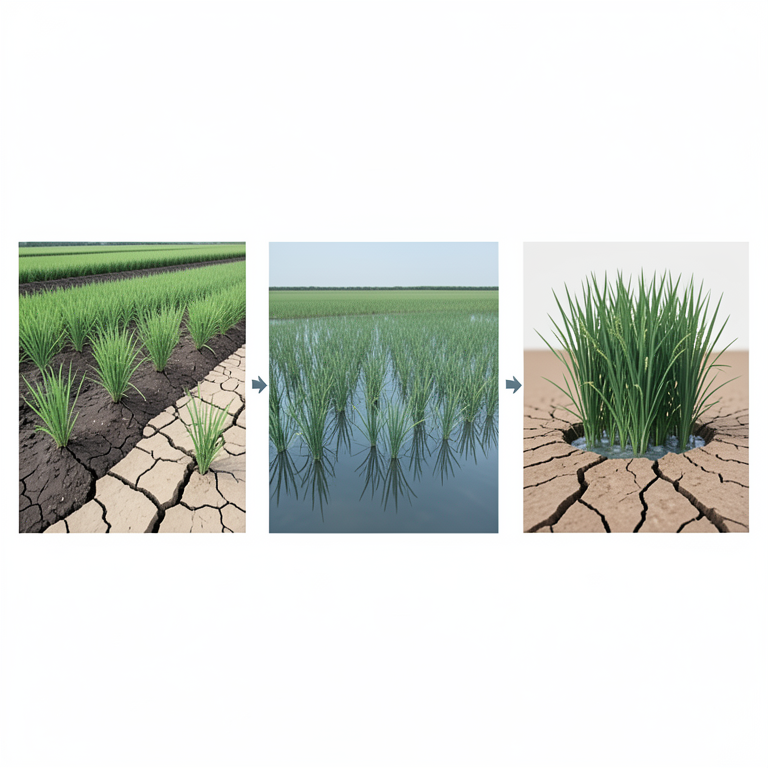
Water Management Techniques
AI-generated conceptual illustration (rice plants in paddy fields). It explains the idea and does not show study data.
View source evidence ↗Introduction
Rice (Oryza sativa L.) occupies about 165 million hectares globally and is vital for food security across Asia, Africa, and Latin America [9] . However, climate change has introduced multiple stressors that threaten this central role. Temperature increases shorten crop duration and increase spikelet sterility, particularly when flowering coincides with heat waves [10] . High night temperatures exacerbate respiration, reducing biomass partitioning to grain [11] . Erratic rainfall creates both droughts and floods, complicating transplanting and water management [12] . Coastal regions are increasingly affected by salinity intrusion due to sealevel rise and cyclonic events [13] . At the same time, pest and disease complexes such as blast (Magnaporthe oryzae) and bacterial blight (Xanthomonas oryzae) are intensifying under warmer and more humid conditions [14] . The urgency of adaptation is compounded by rice's contribution to greenhouse gas emissions. Continuously flooded paddy fields account for nearly 10% of global anthropogenic methane emissions [15] . This dual challenge-being both a victim and contributor to climate change-makes rice cultivation a priority for sustainable interventions. While genetic improvement provides longer-term solutions, horticultural techniques offer immediate, low-cost, and adaptable practices that can mitigate climatic stresses at the farm level [35] . Practices such as AWD, mulching, organic amendments, and ecological engineering function by improving microclimatic conditions, enhancing soil resilience, and conserving scarce resources [16,17] . This paper aims to (i) identify the major climate-induced challenges in rice production, (ii) review horticultural techniques that mitigate these challenges, and (iii) discuss socioeconomic and policy enablers for scaling adoption. By integrating agronomic evidence with socio-economic insights, it provides a comprehensive framework for climate-smart rice cultivation.
Climate Change Challenges in Rice Cultivation
Rainfed lowlands and uplands are highly vulnerable to rainfall variability. Delayed monsoon onset disrupts nursery establishment and transplanting schedules, while sudden downpours lead to erosion and nutrient leaching [18] . Prolonged droughts during tillering or panicle initiation severely reduce yield [19] . In irrigated systems, overextraction of groundwater intensifies vulnerability during dry years, particularly in the Indo-Gangetic Plains [20] . Thermal stress is equally damaging. Exposure to temperatures above 35°C during anthesis drastically reduces pollen viability and spikelet fertility [21] . Studies show that each 1°C rise in minimum night temperature can reduce yields by up to 10% [11] . This trend is now evident in tropical Asia, where yields have stagnated despite technological inputs. Coastal rice faces unique challenges of salinity and submergence. Sea-level rise and storm surges push saline water into deltas, degrading soils and impairing nutrient uptake [22] . Cyclonic floods not only destroy standing crops but also leave saline residues that persist across seasons [23] . Submergence-tolerant varieties such as 'Swarna-Sub1' offer partial relief, but require complementary management practices for full effectiveness [24] . Pest and disease pressures are shifting with climate. Warmer winters allow insect populations such as brown planthopper (Nilaparvata lugens) to survive and reproduce rapidly [25] . Higher humidity promotes fungal pathogens like blast, while excessive nitrogen fertilization exacerbates susceptibility [47] . These multiple stressors illustrate that climate change affects rice not through a single pathway but through interacting pressures. Hence, adaptation requires integrated horticultural practices that buffer crops against this complex risk environment.
Horticultural Techniques for Climate Resilience Water and Microclimate Management
AWD is among the most researched techniques for climatesmart rice. Meta-analyses show that AWD reduces irrigation water use by 15-30% while maintaining yields [1] . It also cuts methane emissions by up to 48% compared to continuous flooding [2] . Farmers monitor water levels using perforated tubes and irrigate only when the water table falls 12-15 cm below the surface. Mulching with rice straw or green manure residues reduces evaporation, suppresses weeds, and moderates soil temperature [26,27] . In drought-prone regions, mulching bridges moisture gaps during dry spells. In saline soils, it reduces capillary rise of salts to the root zone [28] . Laser land leveling ensures uniform water distribution and can reduce irrigation requirements by 20-25% while improving crop establishment [29] . Rainwater harvesting structures and small farm ponds further enhance resilience by storing excess runoff for use in dry spells [30] .
Soil Health and Amendments
Organic matter enrichment through compost, green manures, and farmyard manure improves water-holding capacity, microbial activity, and nutrient retention [31] . Biochar application enhances cation exchange capacity, sequesters carbon, and moderates salinity stress [32] . Silicon supplementation strengthens cell walls, improves leaf erectness, and enhances resistance to pests and abiotic stress [33] . Gypsum application in sodic soils improves structure and facilitates salt leaching [34] .
Crop Establishment and Spacing
DSR conserves labor and water by eliminating puddling and transplanting. It allows earlier sowing, enabling crops to avoid terminal heat stress [36] . Residue mulching and stale seedbed techniques are essential complements for weed control in DSR systems [37] . SRI emphasizes transplanting younger seedlings at wider spacing under intermittent irrigation and active soil aeration. Studies indicate yield increases of 20-50% under SRI management due to stronger root growth and enhanced tillering [38,39] . Wider spacing also reduces canopy humidity, lowering the risk of blast and bacterial blight [40] .
Nutrient Management
Site-Specific Nutrient Management (SSNM) aligns fertilizer application with soil status, crop needs, and growth stages [41] . Balanced potassium nutrition improves stomatal regulation and lodging resistance [42] . Silicon and zinc improve tolerance to salinity and temperature stress [33,43] . Deep placement of urea briquettes reduces nitrogen losses and enhances efficiency under AWD conditions [44] .
Ecological Engineering
Flowering strips and bund vegetation provide resources for natural enemies, enhancing biological control of pests [45] . Rice-fish-duck systems recycle nutrients, reduce weeds and pests, and diversify farm income [46] . These systems improve resilience to climate shocks by spreading risk across multiple outputs.
Socio-Economic and Gender Dimensions
Adoption of horticultural techniques depends on labor availability, cultural practices, and access to services. AWD adoption is higher in regions with reliable irrigation control but faces barriers where canal schedules are centrally managed. DSR appeals in labor-scarce regions but may be resisted where transplanting has cultural significance. Gender dynamics influence adoption significantly. Women often manage transplanting and weeding. Mechanical weeders and transplanters reduce drudgery but may shift control toward men if access to equipment is unequal. Ensuring inclusive training and financing can transform these technologies into opportunities for women's empowerment. Economic considerations are central. While mulching with crop residues is cost-effective, biochar production and laser land leveling require collective action or service providers. Government-supported custom hiring centers are critical in enabling access to these services. Market mechanisms such as climate-smart rice certification could further incentivize adoption by offering premium prices.
Policy Pathways
Policy frameworks must align incentives to support horticultural practices. Extension systems need to adopt participatory approaches such as farmer field schools that allow experiential learning [54] . Water governance reforms that decentralize irrigation scheduling improve feasibility of AWD [7] . Subsidy realignment toward soil health, biochar, and residue management rather than excessive fertilizer and electricity use can accelerate adoption. Climate finance mechanisms offer new opportunities. AWD and biochar reduce greenhouse gas emissions, making them eligible for carbon credits. Aggregating smallholder practices into verifiable units through cooperatives can unlock payments for ecosystem services. This requires robust measurement and digital verification systems.
Conclusion
Climate change poses complex and interacting threats to rice cultivation. Rising temperatures, erratic rainfall, salinity intrusion, and pest-disease shifts demand integrated solutions. Horticultural techniques ranging from AWD and mulching to ecological engineering and agroforestry offer a pragmatic toolbox for resilience. They enhance soil, water, and microclimate conditions while reducing greenhouse gas emissions and diversifying livelihoods. However, technical efficacy alone is insufficient. Adoption depends on labor, gender, economic incentives, and supportive policy environments. Extension reforms, water governance changes, subsidy realignment, and integration with carbon finance are necessary to mainstream these innovations. By situating horticultural techniques at the core of climate-smart rice cultivation, societies can safeguard food security, farmer livelihoods, and environmental health in the face of accelerating climate change.
References
47 in the original paper- Carrijo DR, Lundy ME, Linquist BA. Rice yields and water use under alternate wetting and drying irrigation: a meta-analysis. Field Crops Res. 2017;203:173-180.
- Richards M, Sander BO. Alternate wetting and drying in irrigated rice: Implementation guidance for policymakers. Paris: Climate and Clean Air Coalition; 2014.
- Sander BO, Wassmann R. Climate-smart rice technologies: mitigation potential and barriers to scaling. CAB Rev. 2014;9:1-12.
- Lampayan RM, Rejesus RM, Singleton GR, Bouman BAM. Adoption and economics of AWD water management for irrigated rice. Field Crops Res. 2015;170:95-108.
- Gathorne-Hardy A, Reddy DN, Venkatanarayana M, Harriss-White B. System of Rice Intensification provides environmental and economic gains but at the expense of social sustainability. Agric Syst. 2016;143:159-168.
- Humphreys E, et al. Halting groundwater decline in north-west India-Which crop technologies will be winners? Adv Agron. 2010;109:155-217.
- Bouman BAM, Lampayan RM, Tuong TP. Water management in irrigated rice: coping with water scarcity. Los Baños: International Rice Research Institute (IRRI); 2007.
- Pathak H, Bhatia A, Jain N, Aggarwal PK. Greenhouse gas emission and mitigation in Indian agriculture. Indian J Agric Sci. 2010;80:199-208.
- Food and Agriculture Organization (FAO). Rice Market Monitor. Rome: FAO; 2020.
- Wassmann R, Jagadish SVK, Sumfleth K, Pathak H, Howell G, Ismail A, et al. Regional vulnerability of climate change impacts on Asian rice production. Adv Agron. 2009;102:91-133.
- Peng S, Huang J, Sheehy JE, Laza RC, Visperas RM, Zhong X, et al. Rice yields decline with higher night temperature from global warming. Proc Natl Acad Sci USA. 2004;101(27):9971-9975.
- Turner NC. Drought resistance: advances in understanding and management. Adv Agron. 2018;161:317-372.
- Raju RAK, et al. Small water bodies for agricultural resilience: evidence from eastern India. Water Policy. 2018;20(5):991-1008.
- Savary S, et al. Rice pest constraints in tropical Asia: quantification of yield losses due to pests in a range of production situations. Plant Dis. 2000;84(3):357-369.
- Intergovernmental Panel on Climate Change (IPCC). Climate Change and Land. Geneva: IPCC; 2019.
- Pretty J, Bharucha ZP. Sustainable intensification in agricultural systems. Ann Bot. 2014;114(8):1571-1596.
- Timsina J, Connor DJ. Productivity and management of rice-wheat systems: issues and challenges. Field Crops Res. 2001;69:93-132.
- Devkota KP, et al. Conservation agriculture based sustainable intensification in South Asia. J Integr Agric. 2018;17(6):1239-1250.
- Neeraja CN, et al. Improving drought tolerance in rice: from genetics to field management. J Exp Bot. 2017;68(8):1951-1972.
- Bhatt R, Kukal SS, Busari MA, Arora S, Yadav M. Sustainability issues on rice-wheat cropping system. Int Soil Water Conserv Res. 2016;4(1):64-74.
- Jagadish SVK, Craufurd PQ, Wheeler TR. High temperature stress and spikelet fertility in rice. J Exp Bot. 2007;58(7):1627-1635.
- Ismail AM, et al. Physiological basis of tolerance to flooding during germination and early seedling growth in rice. Ann Bot. 2009;103(2):197-209.
- Krishnan P, Ramakrishnan B, Reddy KR, Reddy VR. High-temperature effects on rice growth, yield, and grain quality. Adv Agron. 2011;111:87-206.
- Xu K, Mackill DJ. A major locus for submergence tolerance mapped on rice chromosome 9. Mol Breed. 1996;2:219-224.
- Way MJ, Heong KL. The role of biodiversity in the dynamics and management of insect pests of tropical irrigated rice. Bull Entomol Res. 1994;84(4):567-587.
- Patel M, Raj A, Devi MA, Singh SD, Patel VK. Crop residues management: a sustainable approach for rice and wheat production in Indo-Gangetic plains. Int J Res Agron. 2024;7(6):24-32.
- Chauhan BS, Johnson DE. Row spacing and weed control timing affect yield of aerobic rice. Field Crops Res. 2011;121:226-231.
- Das S, Choudhury BU, et al. Effect of biochar on soil properties and crop yield in rice-based systems. Arch Agron Soil Sci. 2015;61(2):165-180.
- Jat ML, et al. Laser land leveling: A precursor technology for resource conservation. New Delhi: RiceWheat Consortium; 2006.
- Cabangon RJ, Tuong TP. Water management in rainfed rice. Agric Water Manage. 2000;48(3):191-206.
- Kögel-Knabner I, et al. Role of soil organic matter in sustainable intensification of agriculture. Nat Sustain. 2018;1:329-337.
- Lehmann J, Joseph S. Biochar for environmental management. London: Routledge; 2015.
- Ma JF, Yamaji N. Silicon uptake and accumulation in higher plants. Trends Plant Sci. 2006;11(8):392-397.
- Sumner ME. Sodic soils: Distribution, properties, management, and environmental consequences. Oxford: Oxford University Press; 1993.
- Munywoki GN, Ekapolon JE, Munywoki JM. Transforming livelihoods through irrigation and wateruse efficiencies in semi-nomadic agropastoral system: A case of Kalobeyei community, Turkana County, Kenya. Int J Agric Extension Social Dev. 2022;5(1):5458. DOI:10.33545/26180723.2022.v5.i1a.126
- Pandey S, Velasco L. Economics of direct seeding in rice. Los Baños: IRRI; 2002.
- Rao AN, Wani SP, Ramesha MS, Ladha JK. Weed management in direct-seeded rice. Adv Agron. 2017;144:97-134.
- Thakur AK, Rath S, Roychowdhury S, Uphoff N. Comparative performance of rice with SRI and conventional management using SSR markers. Plant Soil. 2010;335:371-387.
- Ijachi C, Sennuga SO, Bankole OL, Okpala EF, Preyor TJ. Assessment of climate variability and effective coping strategies used by rice farmers in Abuja, Nigeria. Int J Agric Food Sci. 2023;5(1):137-143.
- Uphoff N, Kassam A, Harwood R. SRI as a methodology for raising crop and water productivity. Paddy Water Environ. 2011;9(1):3-11.
- Zhao L, et al. Influence of spacing on rice canopy microclimate and disease incidence. Plant Pathol J. 2013;29(1):82-90.
- Ladha JK, Pathak H, Krupnik TJ, Six J, van Kessel C. Efficiency of fertilizer nitrogen in cereal production. Adv Agron. 2005;87:85-156.
- Yang XE, et al. Potassium nutrition of rice. J Plant Nutr. 2004;27(6):993-1012.
- Fageria NK, Baligar VC. Enhancing nitrogen use efficiency in crop plants. Adv Agron. 2005;88:97-185.
- Islam MS, et al. Urea supergranules application for increasing N efficiency in flooded rice. Nutr Cycl Agroecosyst. 2012;93(1):43-54.
- Gurr GM, et al. Ecological engineering for pest management: habitat manipulation. Cambridge: CABI; 2012.
- Savary S, Willocquet L, Elazegui FA, Teng PS. Rice pest constraints and global warming. In: Oerke EC, et al., editors. Crop production and global climate change. Wallingford: CABI; 2012. p. 83-101.