
Research article · 2025 · Full text
International Journal of Horticulture and Food ScienceFloriculture: Trends, challenges, and opportunities
Volume 7(8) · Pages 155–159 · DOI: 10.33545/26631067.2025.v7.i8c.379 ↗
Research areasFlowering Plant Growth and CultivationBotany and Plant Ecology Studies
Abstract
Author-writtenFloriculture, an important segment of horticulture, has emerged as a rapidly growing sector of agriculture worldwide. It contributes significantly to employment generation, rural income diversification, foreign exchange earnings, and environmental sustainability. Globally valued at USD 52-55 billion (2023), the industry is expanding at a CAGR of 6-7%, with the Netherlands, Kenya, Ethiopia, and Colombia leading the trade. India, with 3.24 lakh hectares under flower cultivation and exports worth ₹771 crore (USD 95 million) in 2022-23, has shown remarkable progress but contributes only 0.6% to global exports, indicating untapped potential. This review highlights global and Indian trends, identifies major challenges such as post-harvest losses, infrastructure gaps, and limited technology adoption, and explores opportunities in exports, value addition, e-commerce, agro-tourism, and sustainability. With focused investments, advanced technologies, and policy support, India’s floriculture industry can emerge as a high-value enterprise contributing substantially to rural development and global trade by 2030.
Summary
Source-checkedPlain-language reading of the full paper, prepared with AI and checked against the text. Each point links to the authors' own words.
Why it matters
- Floriculture is a fast-growing global agricultural sector that supports rural income, employment, and environmental sustainability. View evidence ↗
- As of 2023, the global floriculture industry is valued between USD 52-55 billion and is growing at a compound annual growth rate (CAGR) of 6-7%. View evidence ↗
- India has significant growth potential in floriculture, as it currently contributes only 0.6% to global exports despite having 3.24 lakh hectares of cultivation. View evidence ↗
The question
- The paper aims to review global and Indian floriculture trends, identify key challenges like infrastructure and post-harvest losses, and explore growth opportunities. View evidence ↗
What they found
- The cut flower industry makes up nearly 75% of global floriculture trade, valued at USD 40 billion, with roses holding a 40% share. View evidence ↗
- India suffers significant post-harvest losses, estimated between 25% and 40% of total production, due to poor handling and lack of cold chain infrastructure. View evidence ↗
- There is a large gap in technology adoption; only 15% of India's flower-growing area uses protected cultivation, whereas the Netherlands uses over 90%. View evidence ↗
- Annual crop losses of 15-20% are caused by pest and disease outbreaks, specifically leaf blight in marigold and powdery mildew in roses. View evidence ↗
- E-commerce is expanding rapidly, with projections that 25-30% of urban flower sales in India will occur through online channels by 2025. View evidence ↗
- Sustainability integration is low in India, with less than 5% of floriculture exports being eco-certified. View evidence ↗
- With investments in logistics and certification, India's exports could potentially increase from ₹771 crore in 2023 to ₹1,500 crore by 2030. View evidence ↗
What it means
- The authors conclude that the future of the industry depends on adopting advanced technologies, improving supply chains, and integrating digital marketing and global certifications. View evidence ↗
- The authors suggest that with the right policy and investment, India's floriculture industry could become a USD 2-3 billion enterprise by 2030. View evidence ↗
- A significant limitation is the skill gap, as only 25% of growers have access to professional training in export standards and advanced cultivation. View evidence ↗
Visual summary
1 visualsIllustrations explain the paper; they do not show study data.
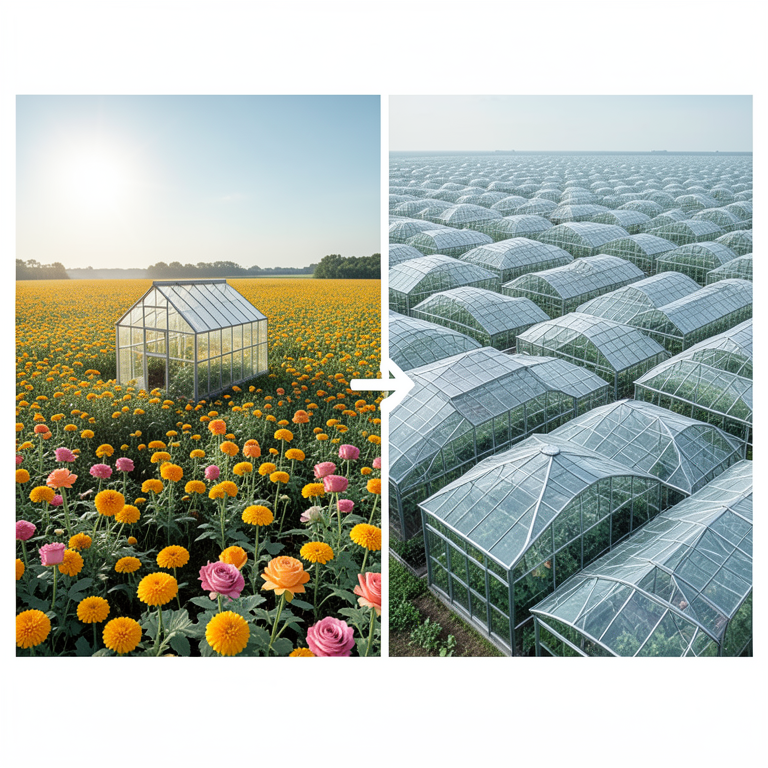
Technology Adoption Gap
AI-generated conceptual illustration (commercial flower greenhouses in India and the Netherlands). It explains the idea and does not show study data.
View source evidence ↗Figures & tables
From the original paper Table 1
Text
the absence of standardized grading, certification, and branding systems limits India's competitiveness in the premium international markets dominated by countries like the Netherlands, Kenya, and Colombia.
Global Trends in Floriculture 1. Growing Cut Flower Industry
The global cut flower industry is valued at around USD 40 billion, accounting for nearly 75% of the global floriculture trade. Roses dominate with nearly 40% share, followed by chrysanthemums, carnations, tulips, lilies, and orchids (FAO, 2022) [2] . The Netherlands continues to be the hub of international flower auctions, particularly through the Aalsmeer Flower Auction, which handles more than 12 billion flower stems annually.
India's Position
India has emerged as a significant supplier of roses, carnations, and orchids. In 2022-23, India exported about 6,500 metric tonnes of cut flowers, valued at approximately ₹458 crore (USD 56 million) (APEDA, 2023) [1] . Major export destinations for Indian cut flowers include USA (28%), Netherlands (19%), and Germany (7%).
Emergence of Developing Countries
Countries like Kenya, Ethiopia, Colombia, and Ecuador have emerged as global leaders in cut flower exports due to favorable agro-climatic conditions, abundant labor, and proximity to European and American markets. For example, Kenya alone supplies about 38% of cut flowers to the EU market, valued at USD 1.1 billion annually (ITC, 2022) [4] .
India's Position India's production is primarily concentrated in Karnataka, Tamil Nadu, Maharashtra, West Bengal, and Andhra Pradesh. With 3.24 lakh hectares under floriculture, India is among the top 10 flower-producing nations (NHB, 2023) [6] . However, India contributes only about 0.6% of global cut flower exports, indicating untapped potential.
Diversification into Value-Added Products
Globally, value-added floriculture products such as dry flowers, essential oils, floral teas, perfumes, and natural colors are gaining prominence. The dry flower trade alone is valued at USD 2 billion, with major markets in the USA, Europe, and Japan.
India's Position
India is one of the world leaders in dry flower exports, accounting for over 70% of India's total floriculture exports. In 2022-23, India's dry flower exports were valued at ₹310 crore (USD 38 million) (APEDA, 2023) [1] . West Bengal, Odisha, and Uttarakhand are the leading states for dry flower production and processing.
Technological Integration
Advanced technologies such as tissue culture, hydroponics, greenhouse farming, and vertical farming are revolutionizing floriculture globally. Controlled environment agriculture ensures year-round production, higher yields, and better quality for exports. For instance, greenhouse cultivation in the Netherlands covers more than 10,000 hectares dedicated to floriculture.
India's Position
India has adopted protected cultivation (polyhouses, greenhouses, shade nets) on only 15% of its flowergrowing area, compared to over 90% in the Netherlands. Karnataka leads with over 3,500 hectares under polyhouse floriculture, mainly for roses and orchids. Tissue culture is expanding for crops like orchids, gerbera, and anthuriums, supported by biotech firms and research institutions.
Sustainability Concerns
Globally, there is increasing focus on eco-labeling, organic cultivation, biodegradable packaging, and carbon footprint reduction. The European market, in particular, demands flowers certified under schemes such as Fairtrade, Rainforest Alliance, and Florverde.
India's Position
India is gradually moving towards organic floriculture, especially in states like Sikkim, Uttarakhand, and Himachal Pradesh. The use of biodegradable floral packaging and solarpowered greenhouses is being promoted under government schemes such as the Mission for Integrated Development of Horticulture (MIDH). Despite progress, less than 5% of Indian floriculture exports are eco-certified, highlighting a need for greater sustainability integration to tap premium markets.
Floriculture in India: Current Scenario
India ranks among the top 10 flower-producing countries, and floriculture has become one of the most dynamic components of horticulture. As per the National Horticulture Board (NHB, 2023) [6] . Area under floriculture: ~3.24 lakh hectares Production: ~3.2 million tonnes of loose flowers and ~9,000 million stems of cut flowers annually Exports (2022-23): ₹771 crore (~USD 95 million) (APEDA, 2023) [1] Major markets: Netherlands, USA, UK, UAE, Germany Share in global exports: ~0.6% (showing untapped potential)
Key Producing States & Crops
Karnataka: Roses, orchids, gerbera (under polyhouses, ~3,500 ha) Tamil Nadu: Jasmine, tuberose, marigold (largest jasmine producer) West Bengal: Chrysanthemum, gladiolus, and dry flowers (largest dry flower exporter) Maharashtra: Roses, marigold, aster Andhra Pradesh: Jasmine, tuberose, chrysanthemum The floriculture export sector in India has shown a steady increase over the last decade. Exports rose from about ₹460 crore in 2015 to approximately ₹771 crore in 2023 (APEDA, 2023) [1] . Despite fluctuations due to global trade disruptions and the COVID-19 pandemic, the sector has demonstrated resilience and is expected to grow further with increased adoption of protected cultivation, value addition, and e-commerce-driven retail expansion.
Challenges in Floriculture 1. Production Constraints India's floriculture is still largely unorganized, with over 85% of flower growers being small and marginal farmers (NHB, 2023) [6] . Seasonal fluctuations reduce the year-round supply of high-value cut flowers like roses and orchids. Limited access to quality planting material (certified seeds, tissue culture plants) reduces productivity. Pest and disease outbreaks, such as powdery mildew in roses and leaf blight in marigold, cause 15-20% crop losses annually.
Post-Harvest Losses
Estimated 25-40% of total flower production is lost post-harvest due to inadequate handling, lack of precooling, and poor packaging (APEDA, 2023) [1] . For perishable flowers like roses and gladiolus, poor cold chain management reduces shelf life from 10-12 days (global standard) to just 4-5 days in India. Absence of refrigerated transport means flowers lose freshness during long-distance domestic and export shipments.
Infrastructure Gaps
Only 15% of India's floriculture area is under protected cultivation (polyhouses, greenhouses), compared to 90% in the Netherlands. Cold storage facilities are limited, with less than 20% of districts having specialized floriculture pack-houses. High input costs for greenhouse installation (₹800-1,000 per sq.m) discourage small farmers despite subsidies under MIDH/NHM.
Market and Trade Issues
Domestic trade is highly fragmented and dominated by middlemen, who capture 30-40% of the price share, leaving farmers with low returns. Lack of organized flower auctions and wholesale markets reduces transparency compared to the Dutch auction system. On the global stage, India faces stiff competition from Kenya, Ethiopia, and Colombia, which have established logistics and trade agreements with EU and USA. India's share in global floriculture exports is only 0.6%, highlighting competitiveness issues.
Environmental Challenges
Excessive use of chemical fertilizers and pesticides in cut flower production degrades soil and water quality. Water scarcity is a major issue, as flower crops like roses require up to 8,000-10,000 m³ water/ha/year.
Climate change (erratic rainfall, heatwaves, unseasonal frosts) increasingly disrupts flowering cycles and quality. Carbon footprint concerns are rising in export markets, with EU customers demanding eco-labeled and certified flowers.
Skill & Knowledge Gaps
Limited technical training: Only about 25% of flower growers have access to professional training in advanced cultivation, post-harvest handling, and export standards (ICAR-DFR, 2022) [3] . Lack of awareness about grading, certification, and quality protocols reduces India's export competitiveness. Farmers are not fully integrated with digital marketing platforms (e-commerce, B2B exports), which limits direct-to-consumer opportunities.
Opportunities in Floriculture Export Potential
The global floriculture trade is valued at USD 55 billion, with strong demand in Gulf, European, and Asian markets. India exported floriculture products worth ₹771 crore (~USD 95 million) in 2022-23 (APEDA, 2023) [1] . Dry flowers constitute over 70% of India's floriculture exports, with the USA, Netherlands, and Germany as key buyers. With better logistics and certification, India could capture a larger share of the USD 10 billion cut flower segment, where its current share is only 0.6% globally.
Value Addition
Value-added products such as dry flowers, floral teas, essential oils, perfumes, dyes, and nutraceuticals offer high export margins. India already earns ₹310 crore (40% of floriculture export earnings) from dry flowers. Global demand for natural fragrances and herbal cosmetics is growing at 8-10% annually, offering huge scope for floriculture-based raw materials.
Urbanization and Landscaping
Rapid growth of real estate, hotels, corporate offices, malls, and smart cities is boosting ornamental plant demand. The Indian landscaping industry is projected to grow at ~15% annually, with floriculture supplying indoor plants, vertical gardens, and rooftop gardens. Public sector initiatives like urban beautification drives (e.g., Delhi, Bengaluru, Chandigarh flower shows) further increase demand.
Agro-Tourism and Floriculture Parks
Linking floriculture with rural/agro-tourism can generate additional income for farmers. Successful examples include the Kashmir Tulip Garden (Asia's largest), which attracts 2.5-3 lakh tourists annually. Flower valleys, exhibitions, and seasonal festivals (rose shows, chrysanthemum shows) can significantly boost local economies.
Digital Marketing & E-Commerce
The online flower delivery market in India is expected to grow at ~20% CAGR, with platforms like FernsnPetals, FlowerAura, and BigBasket driving demand. By 2025, nearly 25-30% of urban flower sales are projected to happen through online channels. Direct-to-consumer e-commerce reduces middlemen involvement, ensuring better returns for growers.
Research & Development
Research & Development
Future Outlook
The floriculture industry is expected to witness sustained growth in the coming decade, driven by shifting consumer preferences, technological innovations, and global trade opportunities. According to FAO (2023) [2] , the global floriculture market is projected to grow at a CAGR of 6-7%, reaching nearly USD 80 billion by 2030. India, with its favorable agro-climatic diversity and expanding domestic market, is positioned to emerge as a major player.
Export
Export
Figures and tables from the paper
| Major Flowers | Leading Producing States | Export Destinations | Export Value (2022-23) |
|---|---|---|---|
| Roses | Karnataka, Maharashtra, Tamil Nadu | Netherlands, USA, UAE, UK | ~₹320 crore (41% of total exports) |
| Jasmine | Tamil Nadu, Karnataka, Andhra Pradesh | Middle East (Saudi Arabia, UAE), Europe | ~₹65 crore (8%) |
| Marigold | Maharashtra, West Bengal, Tamil Nadu | UK, Germany, Nepal, Bangladesh | ~₹45 crore (6%) |
| Gladiolus | West Bengal, Himachal Pradesh, Uttarakhand | USA, UAE, Europe | ~₹70 crore (9%) |
| Chrysanthemum | Karnataka, West Bengal, Maharashtra | Netherlands, Japan, Singapore | ~₹55 crore (7%) |
| Dry Flowers | West Bengal, Odisha, Uttarakhand | USA, Netherlands, Japan, Germany | ~₹310 crore (40%) |
Table text extracted from the original PDF; superscript letters are shown inline. The original table image is below.
View original table image
References
15 in the original paper- APEDA. Floriculture Export Statistics 2015-2023. Agricultural and Processed Food Products Export Development Authority, Government of India; 2023.
- FAO. The State of Horticulture and Floriculture. Food and Agriculture Organization of the United Nations, Rome; 2022.
- ICAR-DFR. Annual Report: Directorate of Floricultural Research, Pune. Indian Council of Agricultural Research; 2022.
- ITC. Trade Map: International Trade Statistics for Global Cut Flowers. International Trade Centre, Geneva; 2022.
- ICRA. Industry Outlook: Retail and E-Commerce in Floriculture Sector. Investment and Credit Rating Agency of India; 2023.
- NHB. Indian Horticulture Database. National Horticulture Board, Ministry of Agriculture & Farmers Welfare, Government of India; 2023.
- Rathore DS, Singh B, Sharma V. Challenges and opportunities in floriculture sector. Int J Agric Sci. 2019;11(2):115-123.
- Kumar R, Sharma V. Value addition in floriculture: Emerging trends. J Appl Hortic. 2020;22(1):12-18.
- Singh A, Patel R. Trends in floriculture: Opportunities for sustainable development in India. Indian J Agric Econ. 2021;76(3):451-460.
- Chauhan K, Bhattacharya P. Floriculture supply chain management in India: Issues and prospects. J Agric Mark. 2020;12(4):33-42.
- Sharma R, Meena H. Protected cultivation and its role in Indian floriculture. Hortic Sci J. 2022;17(2):97-108.
- Ministry of Agriculture & Farmers Welfare. Horticultural Statistics at a Glance. Government of India; 2022.
- Kapoor S, Rani P. Dry flower industry in India: A potential export opportunity. Asian J Hortic. 2021;16(1):56-63.
- Floriculture Today. Market trends in Indian floriculture industry. Floriculture Today. 2022;34(6).
- Pandey D, Kumar A. Impact of e-commerce on the floriculture sector in India. Int J Rural Dev Manag Stud. 2020;4(2):22-31.
Cited by 2
From OpenAlex, OpenCitations and reference lists read by Scinovex
- Remunerative Floriculture ↗
Ashna Acharya, Chaudhary Dixit, C. S. Chaitra · Springer eBooks · 2026
❝ 0 - Comparative Effects of Cytokinins and Spermidine on In Vitro Organogenesis of Ruscus hypoglossum L. and Rooting of Regenerated Shoots ↗
Ibrahim Halil HATİPOGLU, Ö. Karagüzel · Plants · 2026
Ruscus hypoglossum L. is an evergreen ornamental species valued as cut foliage, but its commercial production is constrained by slow vegetative propagation and limited availability of uniform planting material. This study aimed to develop an efficient in vitro propagation protocol for R. hypoglossum by evaluating the effects of different cytokinins and spermidine on shoot organogenesis and subsequent rooting. Thidiazuron (TDZ),…
❝ 0PDF