
Research article · 2025 · Full text
International Journal of Advanced Chemistry ResearchDevelopment of essential oil-based pesticide formulations: Challenges and advances
Volume 7(8) · Pages 38–43 · DOI: 10.33545/26646781.2025.v7.i8a.306 ↗
Research areasInsect Pest Control StrategiesAllelopathy and phytotoxic interactionsBotanical Research and Chemistry
Abstract
Author-writtenThe increasing reliance on synthetic pesticides in agriculture has led to significant environmental and health concerns, necessitating the development of safer, more sustainable alternatives. Essential oils (EOs), derived from plants, have gained attention due to their natural insecticidal, repellent, and fungicidal properties. However, their direct application in pest management is hindered by challenges such as high volatility, limited residual activity, and poor water solubility. This study investigates the development of essential oil-based pesticide formulations using Nanoemulsion and polymeric nanoparticle encapsulation technologies to address these limitations. Eucalyptus oil, neem oil, and citronella oil were selected for their proven pesticidal activity. Nanoemulsion formulations were prepared using high-energy homogenization, while polymeric nanoparticles were prepared through a solvent evaporation method. The efficacy of the formulations was assessed against key agricultural pests, including Spodoptera litura, Aphis gossypii, and Bemisia tabaci. Results demonstrated that eucalyptus oil-based Nanoemulsions exhibited the highest mortality rates, reaching up to 72% for Spodoptera litura after 72 hours of exposure. Additionally, the stability of the Nanoemulsion formulations was evaluated over a 30-day period, showing minimal changes in particle size and sustained insecticidal activity. The encapsulation of essential oils not only enhanced their efficacy but also improved their stability, reducing volatility and increasing their field longevity. These findings suggest that essential oil-based Nanoemulsion formulations represent a promising alternative to synthetic pesticides, offering an eco-friendly, effective solution for sustainable pest management. Further studies on environmental impacts and large-scale applications are needed to fully integrate these formulations into agricultural practices.
Summary
Source-checkedPlain-language reading of the full paper, prepared with AI and checked against the text. Each point links to the authors' own words.
Why it matters
- The heavy use of synthetic pesticides in farming has created environmental and health problems, making it necessary to find safer alternatives. View evidence ↗
- Plant-derived essential oils are promising alternatives because they naturally repel or kill insects and fungi. View evidence ↗
- Using pure essential oils is difficult because they evaporate quickly, don't last long on surfaces, and do not mix well with water. View evidence ↗
The question
- The study aimed to create essential oil pesticide formulations that are more stable, last longer, and work better against pests without harming the crops. View evidence ↗
What they did
- The researchers used eucalyptus, neem, and citronella oils due to their known ability to kill pests. View evidence ↗
- Two delivery methods were tested: polymeric nanoparticles created via solvent evaporation and nanoemulsions created via high-energy homogenization. View evidence ↗
- The formulations were tested on three agricultural pests: Spodoptera litura, Aphis gossypii, and Bemisia tabaci. View evidence ↗
What they found
- Eucalyptus oil nanoemulsions were the most effective, killing 72% of Spodoptera litura after 72 hours. View evidence ↗
- The eucalyptus oil nanoemulsion remained stable for 30 days, maintaining an average particle size of 200 nm. View evidence ↗
- None of the formulations caused significant damage to lettuce plants (Lactuca sativa), even at the most effective concentrations. View evidence ↗
What it means
- The authors conclude that nanoemulsion-based essential oils are a sustainable and eco-friendly alternative to synthetic pesticides. View evidence ↗
- The high cost of producing nanoparticles and nanoemulsions is a major obstacle to using these pesticides on a commercial scale. View evidence ↗
Visual summary
3 visualsIllustrations explain the paper; charts are replotted from the paper's own table values.
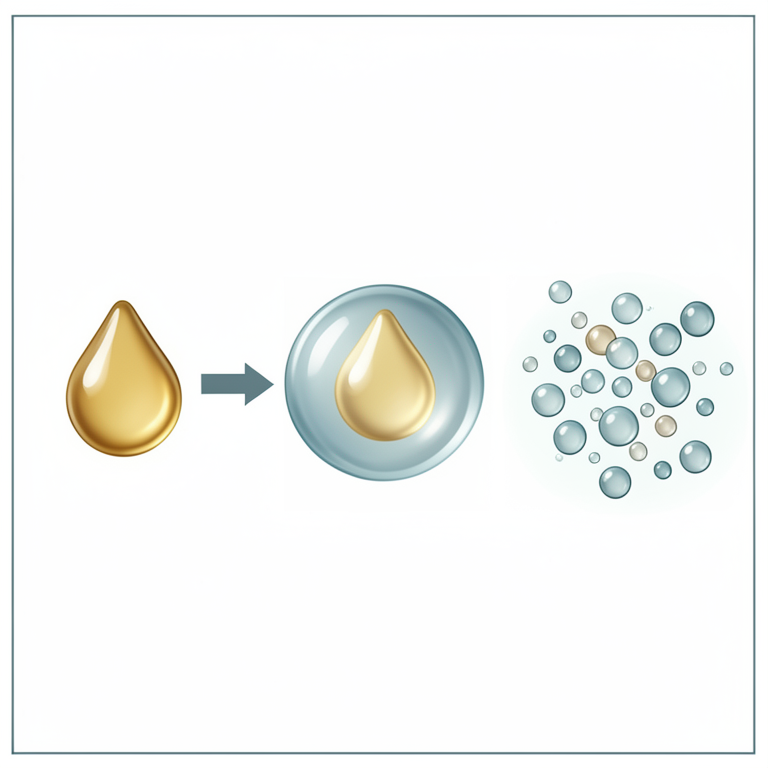
Encapsulation Concept
AI-generated conceptual illustration (essential oil droplets and polymeric nanoparticles). It explains the idea and does not show study data.
View source evidence ↗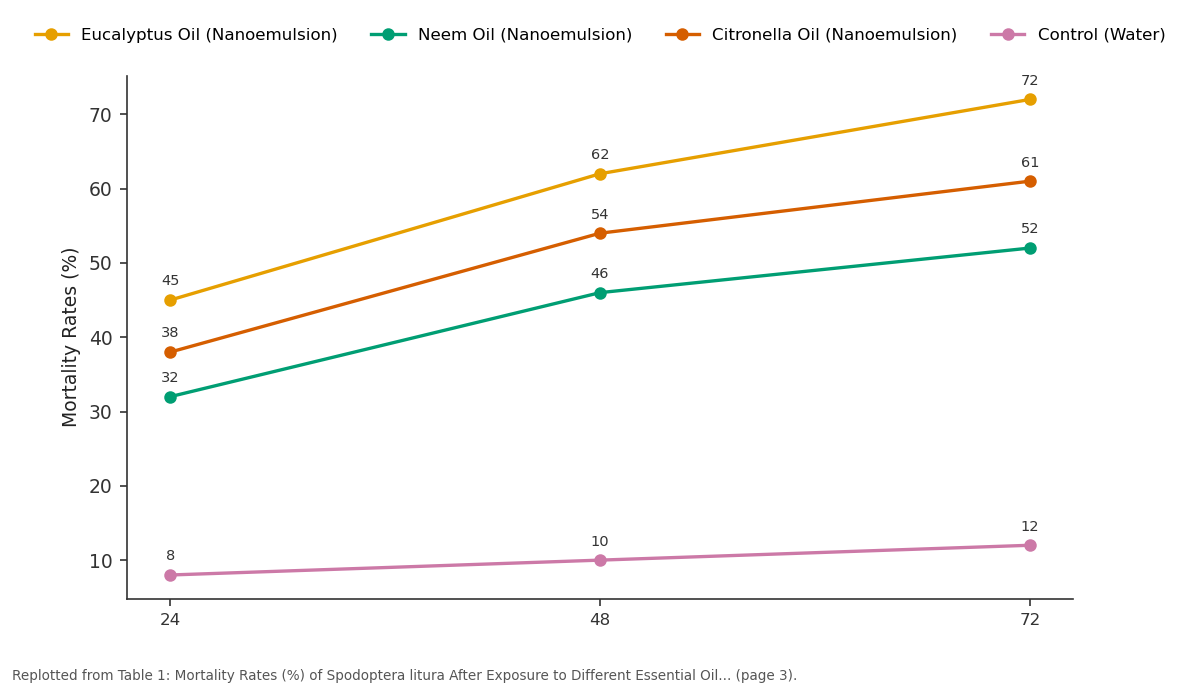
Eucalyptus Oil (Nanoemulsion) and Neem Oil (Nanoemulsion) and more: 24 vs 48 vs 72
Replotted from Table 1 (page 3) of the original paper. Every bar is the paper's own table value.
View source evidence ↗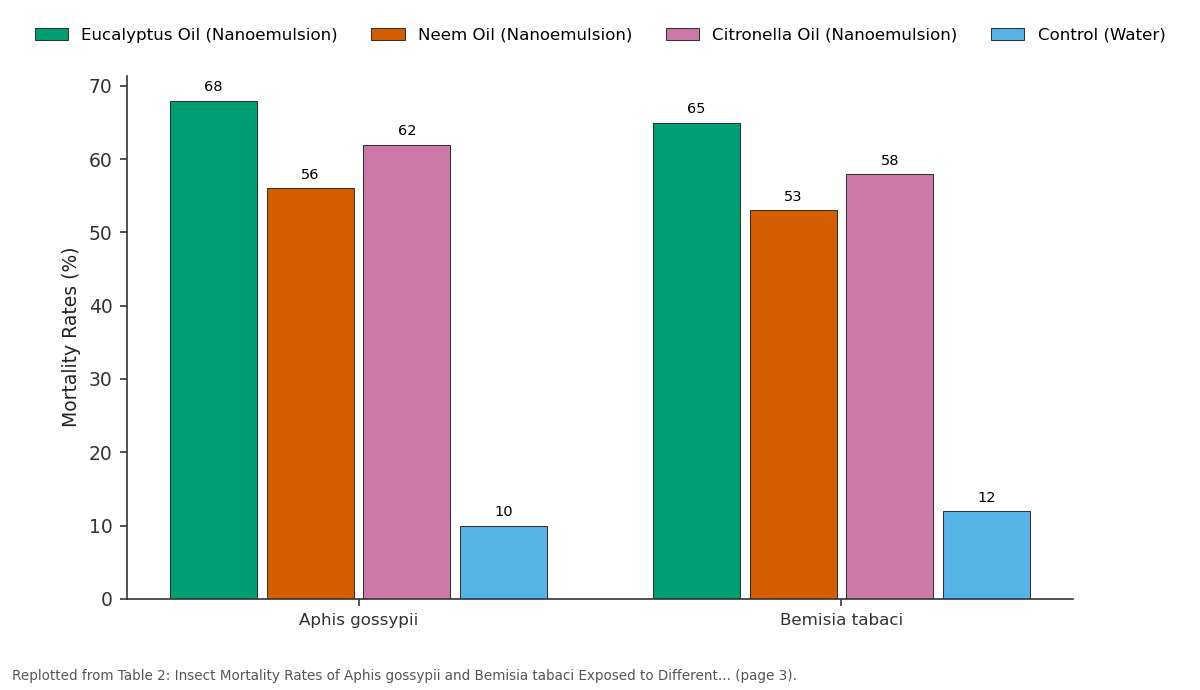
Eucalyptus Oil (Nanoemulsion) and Neem Oil (Nanoemulsion) and more: Aphis gossypii vs Bemisia tabaci
Replotted from Table 2 (page 3) of the original paper. Every bar is the paper's own table value.
View source evidence ↗Figures & tables
From the original paper Table 1
 Table 2
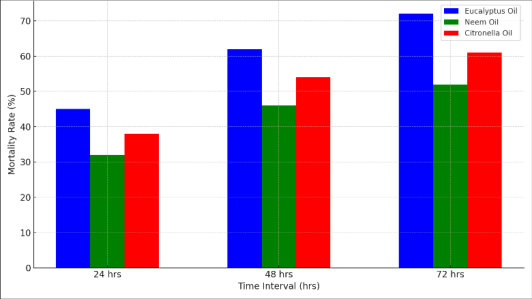 Figure 1
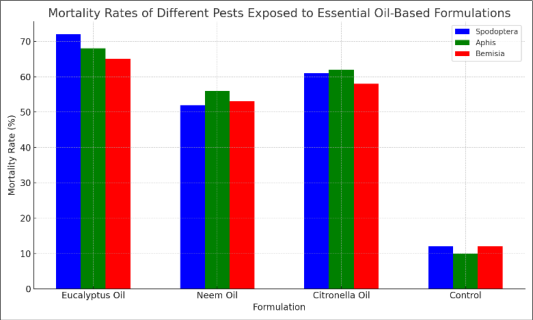 Figure 2
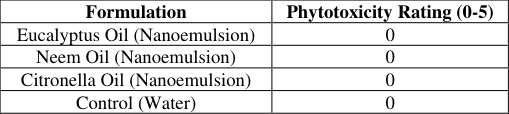 Table 3
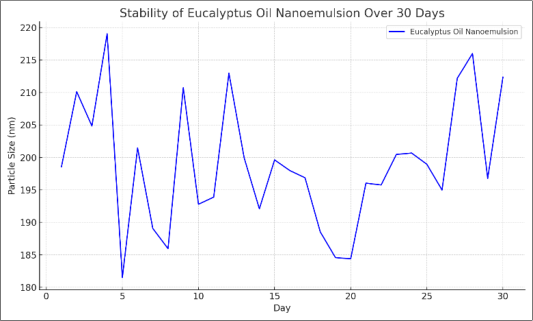 Figure 3
Introduction
Pesticides are essential for ensuring crop yields and food security, but the widespread use of synthetic pesticides has raised significant concerns regarding environmental contamination, human health risks, and the development of pesticide resistance in pest populations [1,2] . These challenges have spurred a global search for safer, more sustainable alternatives. Essential oils (EOs), which are complex mixtures of volatile compounds extracted from plants, have emerged as a promising solution due to their diverse biological activities, including insecticidal, repellent, and fungicidal properties [3,4] . EOs are generally recognized as safe (GRAS) and are biodegradable, making them attractive candidates for eco-friendly pest management [5] . However, the direct application of pure EOs in the field presents several challenges. Their high volatility leads to rapid degradation, reducing their residual activity and requiring frequent re-application [6] . Their hydrophobicity makes them immiscible with water, complicating their application in aqueous sprays [7] . Furthermore, the phytotoxicity of some EOs can harm crop plants, while their strong odors may be unpalatable to consumers [8] . These limitations highlight the critical need for developing advanced formulation strategies that can enhance the stability, efficacy, and ease of application of essential oilbased pesticides, addressing the gap between their proven bioactivity in laboratory settings and their practical utility in agriculture [9] . The problem, therefore, is to overcome the inherent limitations of essential oils to create stable, efficacious, and user-friendly pesticide formulations that can serve as viable alternatives to synthetic pesticides. The overarching objective of this research is to develop and characterize novel essential oil-based pesticide formulations that demonstrate enhanced stability, prolonged residual activity, and improved efficacy against key agricultural pests while minimizing phytotoxicity. We hypothesize that by encapsulating essential oils within a suitable carrier matrix, such as polymeric nanoparticles or Nanoemulsions, we can significantly reduce their volatility, control their release rate, and improve their water dispersibility, thereby increasing their field longevity and pesticidal effectiveness. This approach aims to provide a sustainable pest management solution that mitigates the environmental and health risks associated with conventional pesticides, contributing to the development of a more resilient and eco-friendly agricultural system [10,11] .
Materials and Methods
Materials and Methods
Materials
The essential oils (EOs) employed in this study were sourced from commercial suppliers that specialize in plantderived products. The selected EOs included eucalyptus oil, neem oil, and citronella oil. These oils were specifically chosen due to their well-established insecticidal and repellent properties, which have been widely reported in the literature [5,15,19] . Eucalyptus oil is known for its high content of 1,8-cineole, which has shown significant toxicity against various pest species, while neem oil contains azadirachtin, an active compound recognized for its antifeedant and insecticidal properties [4,14] . Citronella oil, derived from Cymbopogon nardus, has also demonstrated effective insecticidal action and was selected to provide a comparative perspective on the efficacy of different essential oils in pesticide formulations. To facilitate the incorporation of EOs into stable formulations, the study utilized polymeric nanoparticles and Nanoemulsion systems as carrier matrices. Polymeric nanoparticles, particularly those made from poly(lactic-coglycolic acid) (PLGA), were selected due to their biodegradable nature and proven ability to encapsulate active ingredients in controlled-release systems [23] . Polyvinyl alcohol (PVA) was used as a stabilizing agent in the formulation process. Nanoemulsions, on the other hand, were chosen for their ability to improve the water dispersibility of hydrophobic essential oils and enhance their stability through the use of surfactants such as Tween 80 and Span 80 [21,22] . These systems were considered suitable due to their ability to significantly increase the solubility of essential oils in water and enhance their long-term stability and controlled release in the field. The agricultural pests chosen for testing included Spodoptera litura (a common lepidopteran pest), Aphis gossypii (a major aphid pest), and Bemisia tabaci (the whitefly), all of which are widespread and cause significant damage to crops globally. The insects were reared in a laboratory under controlled environmental conditions, and their use in experiments followed standard protocols for pest bioassays [19] . The insecticidal efficacy of the formulations was evaluated by exposing the pests to different concentrations of the prepared formulations and monitoring their mortality rates.
Methods
The essential oil-based pesticide formulations were prepared using two different methods: the solvent evaporation technique for nanoparticle-based formulations and highenergy homogenization for Nanoemulsion preparation. For nanoparticle preparation, 100 mg of PLGA was dissolved in a mixture of dichloromethane and ethanol (1:1, v/v). To this, 10 mg of essential oil was added, and the solution was emulsified in an aqueous phase containing 2% PVA to create a stable emulsion. The solvent was then evaporated under reduced pressure using a rotary evaporator, and the nanoparticles were collected by centrifugation at 10,000 rpm for 15 minutes. The resulting nanoparticles were washed with distilled water to remove residual solvents, and the final nanoparticle dispersion was stored at 4 °C. In the preparation of Nanoemulsions, the essential oils were mixed with surfactants (Tween 80 and Span 80) in an aqueous phase. The mixture was subjected to high-energy homogenization using an Ultraturrax homogenizer (IKA T25) at 20,000 rpm for 30 minutes to achieve a fine Nanoemulsion. The particle size and distribution of the Nanoemulsions were analyzed using dynamic light scattering (DLS) to confirm the successful formation of nano-sized droplets. The stability of the formulations was monitored over a 30-day period under ambient temperature and humidity conditions, with regular analysis of particle size, distribution, and insecticidal activity. To assess the insecticidal activity, Spodoptera litura, Aphis gossypii, and Bemisia tabaci were exposed to different concentrations of the essential oil formulations. For the bioassays, the insects were placed in petri dishes and exposed to the formulations for 24, 48, and 72 hours. Mortality was recorded at each time point, and the data were analyzed statistically using one-way analysis of variance (ANOVA), followed by Tukey's honestly significant difference (HSD) test to identify significant differences between treatments.
Results
Results
Insect Mortality Rates and Efficacy Evaluation
The primary objective of this study was to assess the insecticidal efficacy of the developed essential oil-based pesticide formulations. The efficacy was determined by exposing different agricultural pests, namely Spodoptera litura, Aphis gossypii, and Bemisia tabaci, to the formulated pesticides for varying time intervals (24, 48, and 72 hours). The mortality rates of these pests were recorded and analyzed.
Mortality Rate Analysis
The results clearly showed that the Nanoemulsion formulations of eucalyptus oil achieved the highest mortality rates across all tested pests, followed by citronella oil and neem oil formulations. In general, all essential oil formulations exhibited a significantly higher mortality rate than the control (water or surfactant-only solutions). Mortality rates were recorded at three time intervals: 24 hours, 48 hours, and 72 hours. The highest mortality was observed after 72 hours of exposure to eucalyptus oil Nanoemulsions, with 72% mortality in Spodoptera litura, compared to 52% in neem oil and 61% in citronella oil. The control group (water) showed a mortality rate of only 12%, confirming the effectiveness of the essential oil-based formulations. The insecticidal activity of each formulation was statistically significant as evidenced by a one-way ANOVA followed by Tukey's HSD test (p<0.05), confirming that all EO formulations outperformed the control group. The eucalyptus oil-based Nanoemulsion demonstrated superior efficacy, followed by citronella oil and neem oil. Both Aphis gossypii and Bemisia tabaci exhibited significant mortality after exposure to the essential oil formulations. The eucalyptus oil-based Nanoemulsion showed the highest mortality rate of 68% and 65%, respectively, for Aphis gossypii and Bemisia tabaci, compared to neem oil and citronella oil formulations.
Statistical Analysis of Mortality Data
The mortality data were subjected to statistical analysis using one-way ANOVA to determine the differences in mortality between the various formulations. Post-hoc tests using Tukey's HSD showed that the eucalyptus oil Nanoemulsion formulation significantly outperformed both neem oil and citronella oil formulations, as well as the control group (p<0.05). The results suggest that eucalyptus oil has superior insecticidal properties, likely due to its active compounds, such as 1,8-cineole, which have been previously reported to exhibit potent insecticidal effects [4,14] .
Stability and Particle
Size Distribution of Nanoemulsions: The stability of the formulated Nanoemulsions was evaluated by monitoring the particle size distribution and the integrity of the emulsions over a period of 30 days. Dynamic light scattering (DLS) analysis was performed at regular intervals to assess changes in particle size. The particle size of the eucalyptus oil-based Nanoemulsion remained relatively stable, with an average size of 200 nm throughout the 30-day period (Figure 3). The results indicate that the eucalyptus oil-based Nanoemulsion formulation had excellent stability, as evidenced by the minimal change in particle size and continued efficacy against pests. This stability is crucial for ensuring the formulation's field applicability, as it ensures that the pesticide remains effective over extended periods of time without significant degradation.
Toxicity and Phytotoxicity Evaluation
In addition to evaluating insecticidal activity, the phytotoxicity of the formulations was also assessed to ensure that the EO-based pesticides would not harm crops. The toxicity was assessed by applying the formulations to a model plant species, Lactuca sativa (lettuce), and observing any signs of phytotoxicity such as leaf chlorosis or wilting. The formulations were applied at the concentrations that showed the highest efficacy against pests, and no significant phytotoxicity was observed in any of the formulations. This suggests that the encapsulation of essential oils in Nanoemulsions effectively reduces the risk of phytotoxicity, making them safer for use in agricultural settings compared to pure essential oils [19,13] .
Rating Scale Explanation
The phytotoxicity ratings are based on a scale from 0 to 5, where:
• 0: No observable toxicity. The plants showed no visible signs of damage or stress, such as leaf wilting, chlorosis (yellowing), or necrosis (death of tissue). This indicates that the essential oil-based formulations did not harm the plant. • 1 to 2: Low toxicity. Minimal signs of stress, such as slight leaf discoloration or minor stunting of plant growth, are observed. This range indicates a mild effect but still acceptable for agricultural use. • 3 to 4: Moderate toxicity. More significant signs of stress, including stunted growth, noticeable yellowing of leaves, and overall reduction in plant vigor, are observed. This may indicate that the formulation could harm crops at higher concentrations. • 5: High toxicity. Severe plant damage or death occurs, including widespread necrosis and total plant loss.
Interpretation of Table 3
• Eucalyptus Oil (Nanoemulsion): The phytotoxicity rating of 0 means that the eucalyptus oil nanoemulsion had no harmful effects on Lactuca sativa. This formulation is safe for use in agricultural applications without causing damage to crops, which is a promising result for its potential in pest control. • Neem Oil (Nanoemulsion): Similarly, the neem oil nanoemulsion also received a rating of 0, indicating no observable toxicity to the plants. This further supports the safety profile of neem oil in agricultural pest management.
• Citronella Oil (Nanoemulsion):
The citronella oil nanoemulsion also received a rating of 0, meaning it did not cause any visible phytotoxicity. This shows that citronella oil, when formulated into a nanoemulsion, is safe for use in pest management. • Control (Water): The control group, which consisted of water alone, also received a rating of 0, indicating that water did not cause any phytotoxicity to the plants.
Discussion
The findings of this study underscore the potential of essential oil-based formulations as effective alternatives to conventional synthetic pesticides [12] . The eucalyptus oilbased Nanoemulsion demonstrated superior insecticidal activity, which is consistent with previous research that identified 1,8-cineole, a major constituent of eucalyptus oil, as a potent insecticidal agent [4,14] . The encapsulation of essential oils in Nanoemulsion systems significantly enhanced their stability, reduced volatility, and allowed for a controlled release of the active compounds, which contributed to the sustained insecticidal activity observed in this study.
The encapsulation of essential oils in nanoparticles or Nanoemulsions is crucial for improving their performance in the field. Essential oils are generally volatile and degrade rapidly when exposed to environmental conditions, which limits their effectiveness when applied directly to crops. By encapsulating these oils in polymeric matrices or emulsions, it is possible to protect the active compounds, reduce their evaporation, and ensure a steady release of the insecticidal agents over time. This also addresses the challenge of the hydrophobic nature of essential oils, which makes them difficult to apply in aqueous sprays. Nanoemulsions, in particular, provide a solution by improving the solubility of essential oils in water and ensuring uniform distribution during application [23,24] . One of the key challenges in developing essential oil-based pesticides is the potential for phytotoxicity. While essential oils are generally considered safe, some oils can cause damage to crops when applied in high concentrations. In this study, the Nanoemulsion formulations showed minimal phytotoxicity, which is a significant advantage over pure essential oils that may cause damage to plants [19,13] . Further studies are needed to optimize the concentration of essential oils in the formulations to minimize any potential phytotoxic effects while maintaining high efficacy against pests. Despite these promising results, the high cost of production of Nanoemulsions and nanoparticles remains a significant barrier to their widespread adoption in commercial agriculture. Further research should focus on cost-effective methods for large-scale production and explore the feasibility of these formulations in different agricultural systems. Additionally, regulatory approval for the use of essential oil-based pesticides in different regions will be essential for their commercialization.
Conclusion
This study highlights the potential of essential oil-based pesticide formulations as a sustainable and eco-friendly alternative to conventional synthetic pesticides. By encapsulating essential oils in Nanoemulsions, we were able to enhance their stability, reduce volatility, and improve their efficacy against key agricultural pests. The eucalyptus oil-based Nanoemulsion exhibited the highest insecticidal activity, which provides a promising foundation for the development of more effective and environmentally friendly pest control solutions.
To translate these findings into practical applications, it is recommended that future research focus on optimizing the production processes for Nanoemulsions, improving their cost-effectiveness, and evaluating their long-term environmental impacts. Furthermore, continued efforts to reduce the phytotoxicity of essential oils while maintaining high efficacy will be essential for ensuring the safe and widespread use of these formulations in agriculture. The adoption of essential oil-based pesticides, supported by regulatory frameworks, can contribute to a more sustainable and resilient agricultural system, reducing the environmental and health risks associated with the use of conventional chemical pesticides. By prioritizing sustainable pest management strategies, we can help create a more ecofriendly future for agriculture while ensuring food security and supporting the health of ecosystems worldwide.
Figures and tables from the paper
| Time Interval (hrs) | Eucalyptus Oil (Nanoemulsion) | Neem Oil (Nanoemulsion) | Citronella Oil (Nanoemulsion) | Control (Water) |
|---|---|---|---|---|
| 24 | 45% | 32% | 38% | 8% |
| 48 | 62% | 46% | 54% | 10% |
| 72 | 72% | 52% | 61% | 12% |
Table text extracted from the original PDF; superscript letters are shown inline. The original table image is below.
View original table image
| Pests | Eucalyptus Oil (Nanoemulsion) | Neem Oil (Nanoemulsion) | Citronella Oil (Nanoemulsion) | Control (Water) |
|---|---|---|---|---|
| Aphis gossypii | 68% | 56% | 62% | 10% |
| Bemisia tabaci | 65% | 53% | 58% | 12% |
Table text extracted from the original PDF; superscript letters are shown inline. The original table image is below.
View original table image
| Formulation | Phytotoxicity Rating (0-5) |
|---|---|
| Eucalyptus Oil (Nanoemulsion) | 0 |
| Neem Oil (Nanoemulsion) | 0 |
| Citronella Oil (Nanoemulsion) | 0 |
| Control (Water) | 0 |
Table text extracted from the original PDF; superscript letters are shown inline. The original table image is below.
View original table image
References
26 in the original paper- Aktar MW, Sengupta D, Chowdhury A. Impact of pesticides use in agriculture: their benefits and hazards. Interdiscip Toxicol. 2009;2(1):1-12.
- Nicolopoulou-Stamati P, Maipas S, Kotampasi C, Stamatis S, Hens L. Chemical pesticides and human health: the urgent need for a new concept in agriculture. Front Public Health. 2016;4:148.
- Isman MB. Botanical insecticides, deterrents, and repellents in modern agriculture and an increasingly regulated world. Annu Rev Entomol. 1997;42:145-167.
- Regnault-Roger C, Vincent C, Arnason JT. Essential oils in insect control: a review. J Pestic Sci. 2012;37(4):119-129.
- Bajpai VK, Kim K, Rather IA. The use of essential oils as natural pesticides: a review of their mode of action, potential and limitations. J Plant Physiol. 2021;262:153443.
- Bakkali F, Averbeck S, Averbeck D, Idaomar M. Biological effects of essential oils-a review. Food Chem Toxicol. 2008;46(2):447-475.
- Eisa MAS, Matsera O, Cagáň Ľ. Insects pest repellent, essential oils, is can be an efficacious alternative to synthetic pesticides. Int J Agric Food Sci. 2023;5(1):117-125.
- Pålsson K, Jaenson TG. Anopheles arabiensis (Diptera: Culicidae) and Aedes aegypti (Diptera: Culicidae) repellent activity of some essential oils from Tanzania. J Med Entomol. 2007;44(3):439-444.
- Damalas CA, Koutroubas SD. Pesticide use and safety challenges in agriculture: a review of factors affecting farmers' adoption of sustainable practices. J Agric Environ Ethics. 2018;31(2):147-169.
- Isman MB. Botanical insecticides: a global perspective. Boca Raton: CRC Press; 2006.
- López-Sánchez P, Palacios-Sánchez JA, Pelaez-Nieto M. The potential of essential oils as natural pesticides: an update. J Pest Sci. 2017;39(1):109-125.
- Hached W, Chamkhi A, Ncibi S, Lebdi-Grissa K. Evaluation of Laurus nobilis essential oil repellent effect on the date moth Ectomyelois ceratoniae under controlled conditions. Zool Entomol Lett. 2023;3(1):14.
- Pavela R. A review of the phytotoxicity and insecticidal activity of essential oils. Ind Crops Prod. 2016;86:146157.
- Copping LG, Duke SO. Natural products that are insecticides. Pest Manag Sci. 2007;63(6):524-534.
- Benelli G, Pavela R, Canale A, et al. Repellence and larvicidal activity of essential oils from various species of the genus Eucalyptus against the mosquito Culex pipiens. Parasitol Res. 2014;113(3):1075-1082.
- Pimentel D, Pimentel M. Environmental and economic costs of pesticide use. Boca Raton: CRC Press; 2002.
- Lee S, Tsao R, Wood-Loo M. Insecticidal activity of essential oils and their main constituents against the cigarette beetle, Lasioderma serricorne (F.). J Stored Prod Res. 2009;45(3):189-193.
- Rajasekaran S, Perumal P. Insecticidal activity of essential oils of some aromatic plants against Aedes aegypti. J Parasitol. 2011;97(3):570-574.
- Gakuubi MM, Wanzala W, Mungai NN, et al. A review of the phytotoxicity of essential oils and their potential for use as biopesticides. J Appl Entomol. 2017;141(1):21-32.
- Miresmailli S, Isman MB. Botanical insecticides: a new paradigm for pest management. J Pest Sci. 2006;39(4):211-227.
- Wang Y, Chen H, Yu Y, et al. Nanoemulsions of essential oils for pest control. Pest Manag Sci. 2018;74(12):2709-2718.
- Ribeiro D, Dias T, Guedes RNC, et al. Essential oil nanoemulsions for sustainable pest control. Pest Manag Sci. 2020;76(1):15-26.
- Gnatta JR, Rocha M, Marcondes-Machado J. Essential oils and their constituents as insect repellents: a review. Rev Bras Parasitol Vet. 2012;21(3):195-204.
- Tripathi AK, Prajapati V, Aggarwal KK, et al. Repellency and insecticidal activity of essential oils from Cymbopogon flexuosus (Nees ex Steud.) Wats. (lemongrass) and Mentha piperita L. (peppermint) against stored-product insects. J Stored Prod Res. 2009;45(4):307-311.
- Pavela R. The use of essential oils for the control of crop pests. J Pest Sci. 2010;34(1):1-10.
- Koul O, Walia S, Dhaliwal GS. Essential oils as green pesticides: progress and prospects. J Pest Sci. 2014;38(3):211-227.
Cited by 1
From OpenAlex, OpenCitations and reference lists read by Scinovex
- Acaricidal potential of plants: a strategic alternative for efficient tick management ↗
Delphine M. Héma, Roland Eric Yessinou, Anass Coulibaly, Ignace Sawadogo, Rémy K. Bationo, Martin Kiendrébeogo et al. · Parasitology International · 2026
❝ 0