
Research article · 2025 · Full text
International Journal of Biology SciencesComparative analysis of risk factors associated with foot-and-mouth disease occurrence in hilly and plain regions
Volume 7(8) · Pages 187–190 · DOI: 10.33545/26649926.2025.v7.i8c.463 ↗
Research areasAnimal Disease Management and Epidemiology
Abstract
Author-writtenFoot-and-Mouth Disease (FMD) remains one of the most economically devastating livestock diseases worldwide, particularly in endemic regions where diverse ecological and management practices complicate control efforts. This study aimed to identify and compare the key risk factors associated with FMD occurrence in hilly and plain regions to inform geographically tailored intervention strategies. A cross-sectional study was conducted involving 707 cattle farms 250 located in hilly regions and 457 in plain regions. Structured questionnaires were used to collect data on farm demographics, animal husbandry practices, housing conditions, and herd health management. Multivariate logistic regression was applied to assess associations between potential risk factors and FMD occurrence, with results presented as odds ratios (OR) and 95% confidence intervals (CI). Significant risk factors for FMD occurrence included frequent interaction with other herds (OR = 2.07, 95% CI: 1.27-3.35, p = 0.001), recent FMD history in neighbouring farms (OR = 1.68, 95% CI: 0.73-3.12, p = 0.01), and the use of concrete housing (OR = 1.71, 95% CI: 1.08-2.74, p = 0.015). Farms in plain regions more frequently reported the use of intensive systems, commercial feed, and piped water factors that were positively associated with increased FMD risk. Male animals had significantly higher odds of FMD infection compared to females (OR = 1.67, 95% CI: 1.23-2.67, p = 0.031). Other factors such as deworming practices and cleaning frequency showed trends but were not statistically significant. FMD risk is influenced by both ecological and management-related factors. High herd interaction, farm clustering, and intensive housing conditions contribute to greater disease occurrence. These findings underscore the importance of developing region-specific biosecurity measures and control programs that consider local topography, resource use, and livestock movement dynamics.
Summary
Source-checkedPlain-language reading of the full paper, prepared with AI and checked against the text. Each point links to the authors' own words.
Why it matters
- Foot-and-Mouth Disease (FMD) is a highly economically damaging livestock disease, and its control is made difficult in endemic areas by varying management and ecological factors. View evidence ↗
- FMD causes significant challenges in endemic regions through production losses, trade restrictions, and the high cost of control. View evidence ↗
- Topographical features like terrain and altitude can affect how herds interact and access resources, which in turn influences the risk of disease exposure. View evidence ↗
The question
- The study aimed to identify and compare risk factors for FMD in hilly versus plain regions to help create intervention strategies tailored to specific geographies. View evidence ↗
What they did
- A cross-sectional study was performed from 2022 to 2025 in the hilly and plain zones of the Kashmir valley in India. View evidence ↗
- The study sampled 707 cattle farms, with 250 farms in hilly regions and 457 in plain regions. View evidence ↗
- Regions were classified as 'Hilly' if they were above 5,200 feet above sea level (ASL) and 'Plains' if they were below 5,200 feet ASL. View evidence ↗
- The researchers used multivariate logistic regression to determine the association between risk factors and FMD, reporting the results as odds ratios (OR) and 95% confidence intervals (CI). View evidence ↗
What they found
- Frequent interaction with other herds was a significant risk factor, more than doubling the odds of FMD occurrence (OR = 2.07, 95% CI: 1.27-3.35, p = 0.001). View evidence ↗
- A recent history of FMD in neighboring farms significantly increased the risk of occurrence (OR = 1.68, 95% CI: 0.73-3.12, p = 0.01). View evidence ↗
- The use of concrete housing was significantly associated with a higher risk of FMD (OR = 1.71, 95% CI: 1.08-2.74, p = 0.015). View evidence ↗
- Male animals were significantly more likely to be infected with FMD than female animals (OR = 1.67, 95% CI: 1.23-2.67, p = 0.031). View evidence ↗
- Farms using commercial feed as their primary source were at a higher risk of FMD (OR = 1.34, 95% CI: 0.91-2.23, p = 0.03). View evidence ↗
- Farms in plain regions more often used intensive systems, commercial feed, and piped water, all of which were positively associated with increased FMD risk. View evidence ↗
What it means
- The authors conclude that FMD spread can be mitigated by limiting herd interaction, improving the hygiene of housing, and increasing surveillance in regions where outbreaks cluster. View evidence ↗
- The study's cross-sectional design prevents the establishment of causal relationships, and the use of farmer-reported data may have introduced recall bias. View evidence ↗
Visual summary
3 visualsIllustrations explain the paper; charts are replotted from the paper's own table values.

Study Geography
AI-generated conceptual illustration (cattle in hilly and plain landscapes). It explains the idea and does not show study data.
View source evidence ↗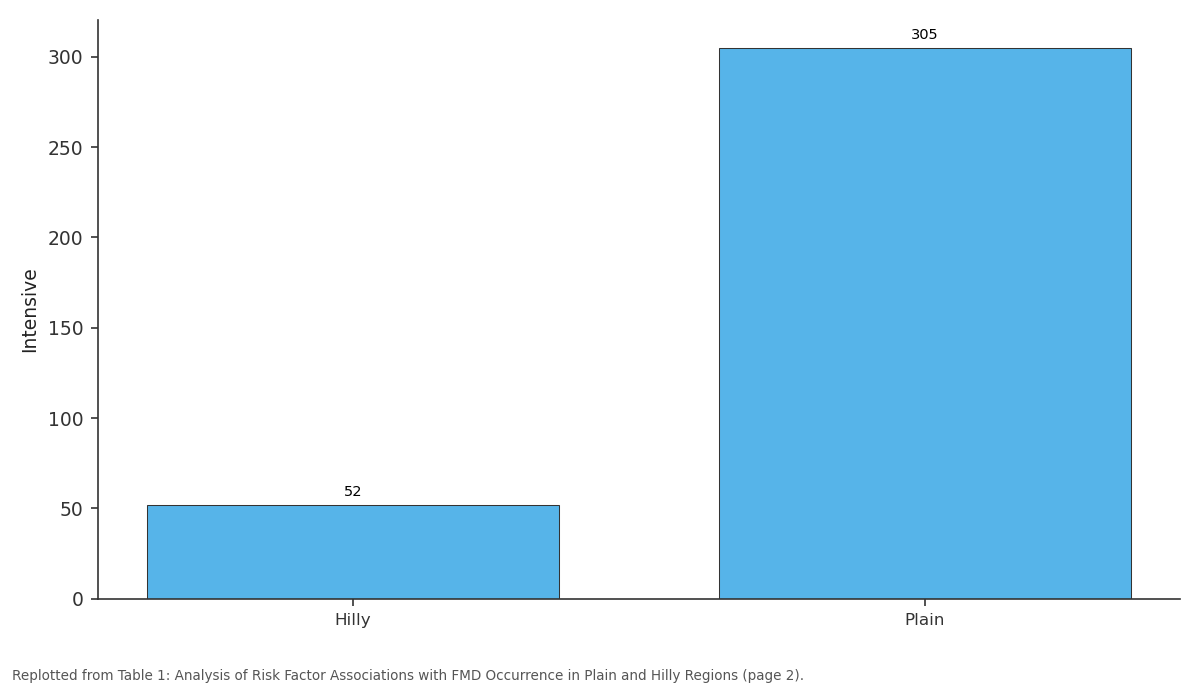
Intensive: Hilly vs Plain
Replotted from Table 1 (page 2) of the original paper. Every bar is the paper's own table value.
View source evidence ↗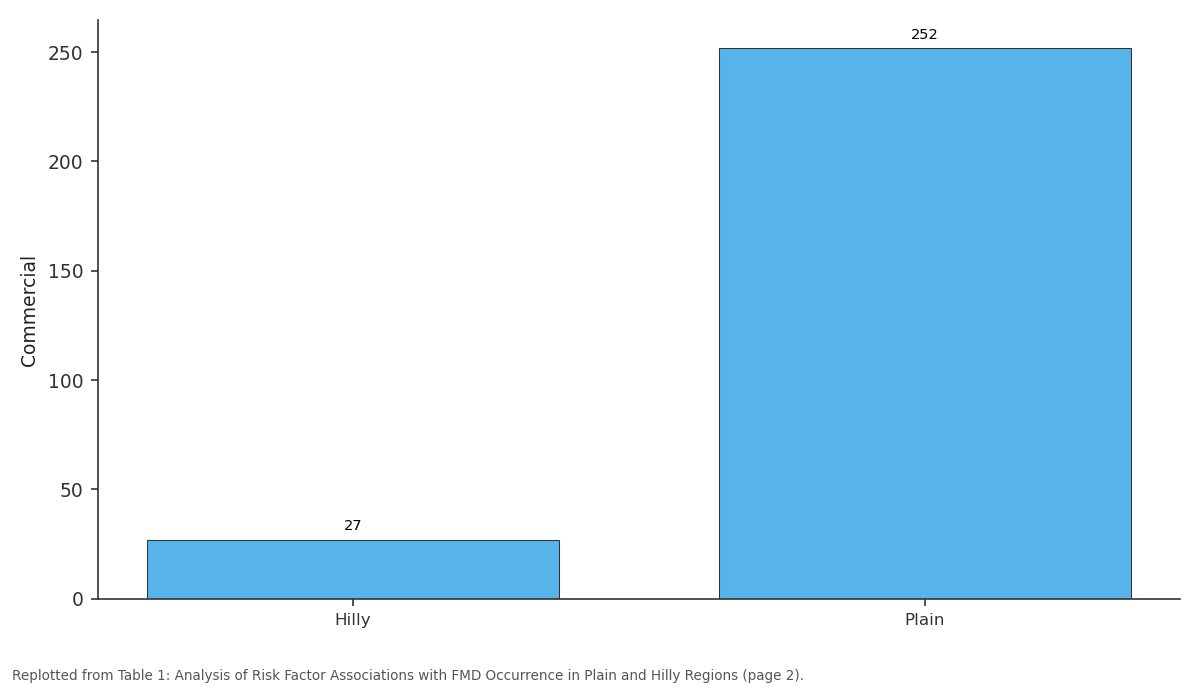
Commercial: Hilly vs Plain
Replotted from Table 1 (page 2) of the original paper. Every bar is the paper's own table value.
View source evidence ↗Figures & tables
From the original paper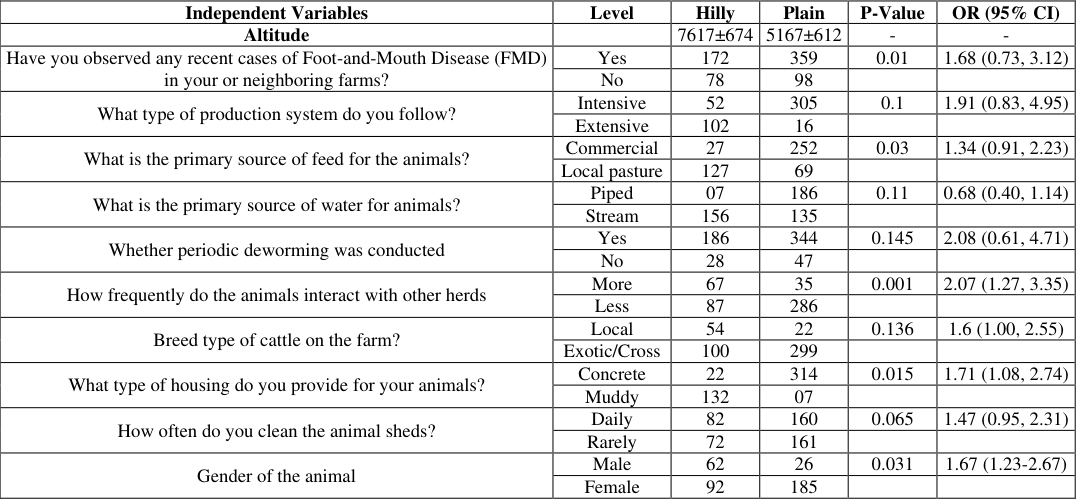 Table 1
Introduction
Foot-and-Mouth Disease (FMD) is a transboundary viral disease that affects cloven-hoofed animals and is known for its high contagiousness and economic consequences in livestock dependent communities (Donaldson et al., 2001; Knight-Jones & Rushton, 2013) [3,10] . The disease leads to production losses, trade restrictions, and increased control costs, posing significant challenges in endemic regions, particularly in countries with varying agroecological settings. A variety of risk factors contribute to the occurrence and spread of FMD, including environmental conditions, herd management practices, and the level of interaction among herds. Communal grazing and watering practices have been consistently linked with higher FMD transmission, especially in areas where multiple herds converge at the same resources (Kebede et al., 2020; Balinda et al., 2009) [8,1] . Similarly, extensive production systems and poor biosecurity are major contributors to outbreaks (Jemberu et al., 2023; Kitching et al., 2007) [6,9] . Farm-level management practices also play a critical role in influencing FMD dynamics. Factors such as housing conditions, frequency of cleaning, and animal movement patterns impact exposure risk (Young et al., 2018; Sulayeman et al., 2023) vulnerable due to intensive management practices and higher contact rates (Kitching et al., 2007) [9] . Despite substantial research on FMD risk factors, there remains a gap in understanding how these factors vary between different topographical regions, such as hilly versus plain areas. Altitude and terrain can influence farm accessibility, herd interaction frequency, resource distribution, and overall exposure risk (Kebede et al., 2020) [8] . Recognizing these geographical differences is vital for developing targeted control strategies. The present study investigates the association of key epidemiological and management-related risk factors with FMD occurrence in hilly and plain regions.
Materials and Methods
Study Area and Design: This cross-sectional study was conducted between 2022 to 2025 across two ecologically distinct regions hilly and plain zones within Kashmir valley of India. These areas were selected based on differences in topography and livestock management systems. The classification into Hilly and Plain zones was based on altitude, with areas above 5,200 feet above sea level (ASL) categorized as Hilly, and those below 5,200 feet ASL as Plains (Mohiuddin, 2013) [15] . A multistage sampling technique was used to select districts, villages, and farms. Farms with cattle were included, and herds were sampled based on accessibility and consent from owners. The sample size was determined using standard prevalence estimation methods for cross-sectional studies (Thrusfield, 2018) [12] . Data Collection: Data were collected using structured questionnaires administered to livestock owners and farm managers. The questionnaire captured information on Recent history of FMD outbreaks in the farm or neighbouring farms, Production system (intensive vs. extensive). Sources of feed (commercial vs. local pasture) and water (piped vs. natural streams), Frequency of herd interaction with other animals, Periodic deworming practices, Housing type (concrete vs. muddy floors), Cleaning frequency of animal sheds, Breed types (local vs. exotic/crossbred), Gender distribution of the herd. Field investigators were trained prior to data collection to ensure consistency and minimize interviewer bias (Dohoo, Martin, & Stryhn, 2010) [2] .
Data Analysis: Data were coded and analysed using SPSS (IBM Corp. 2010). Descriptive statistics were used to summarize the variables. Univariate analysis was conducted to identify potential associations between independent variables and FMD occurrence. Variables showing p-values ≤ 0.20 in the univariate analysis were included in the multivariable logistic regression model to estimate adjusted odds ratios (OR) and 95% confidence intervals (CI), Statistical significance was declared at p<0.05.
Results
A total of 707 respondents were surveyed, comprising 250 from hilly regions and 457 from plain regions. The mean altitude of farms in the hilly regions was significantly higher (7617±674 ft) compared to those in the plains (5167±612 ft), as expected based on geographic delineation. Risk Factor Analysis Table 1 presents the comparative analysis of selected risk factors associated with the occurrence of Footand-Mouth Disease (FMD) in hilly and plain regions. Several factors showed statistically significant associations with FMD presence. Farms that reported recent FMD cases in their own or neighbouring farms had significantly higher odds of disease occurrence (OR = 1.68, 95% CI: 0.73-3.12; p=0.01), suggesting the importance of localized transmission dynamics and proximity-related exposure risks. Production system although not statistically significant (p=0.
| Independent Variables | Level | Hilly | Plain | P-Value | OR (95% CI) |
|---|---|---|---|---|---|
| Altitude | 7617±674 | 5167±612 | - | - | |
| Have you observed any recent cases of Foot-and-Mouth Disease (FMD) in your or neighboring farms? | Yes | 172 | 359 | 0.01 | 1.68 (0.73, 3.12) |
| No | 78 | 98 | |||
| What type of production system do you follow? | Intensive | 52 | 305 | 0.1 | 1.91 (0.83, 4.95) |
| Extensive | 102 | 16 | |||
| What is the primary source of feed for the animals? | Commercial | 27 | 252 | 0.03 | 1.34 (0.91, 2.23) |
| Local pasture | 127 | 69 | |||
| What is the primary source of water for animals? | Piped | 07 | 186 | 0.11 | 0.68 (0.40, 1.14) |
| Stream | 156 | 135 | |||
| Whether periodic deworming was conducted | Yes | 186 | 344 | 0.145 | 2.08 (0.61, 4.71) |
| No | 28 | 47 | |||
| How frequently do the animals interact with other herds | More | 67 | 35 | 0.001 | 2.07 (1.27, 3.35) |
| Less | 87 | 286 | |||
| Breed type of cattle on the farm? | Local | 54 | 22 | 0.136 | 1.6 (1.00, 2.55) |
| Exotic/Cross | 100 | 299 | |||
| What type of housing do you provide for your animals? | Concrete | 22 | 314 | 0.015 | 1.71 (1.08, 2.74) |
| Muddy | 132 | 07 | |||
| How often do you clean the animal sheds? | Daily | 82 | 160 | 0.065 | 1.47 (0.95, 2.31) |
| Rarely | 72 | 161 | |||
| Gender of the animal | Male | 62 | 26 | 0.031 | 1.67 (1.23-2.67) |
| Female | 92 | 185 |
Table text extracted from the original PDF; superscript letters are shown inline. The original table image is below.
View original table image
Discussion
This study assessed risk factors associated with the occurrence of Foot-and-Mouth Disease (FMD) in two ecologically distinct settings hilly and plain regions. The findings highlight that both environmental and farm-level management practices significantly influence FMD epidemiology, emphasizing the need for region-specific control strategies. One of the most significant predictors identified was herd interaction frequency, where farms reporting frequent contact with other herds had more than twice the odds of FMD occurrence (OR = 2.07, p=0.001). This aligns with previous studies showing that communal grazing, livestock markets, and water points facilitate direct and indirect transmission of FMD (Kebede et al., 2020; Balinda et al., 2009) [8,1] . In rural settings, unrestricted animal movement is often driven by resource availability and cultural practices, making control efforts challenging without coordinated community-level interventions (Jemberu et al., 2016) [6] . The presence of recent FMD cases in nearby farms was another significant factor, indicating strong spatial clustering of FMD outbreaks. This reflects the contagious nature of FMD and the importance of prompt outbreak reporting and quarantine measures. Similar spatialtemporal clustering has been observed in outbreaks in East Africa and South Asia, where proximity to infected farms significantly increased risk (Wekesa et al., 2015; Young et al., 2018) [15,14] . Interestingly, concrete housing was associated with a higher risk of FMD (OR = 1.71, p=0.015), which may seem counterintuitive. However, concrete housing often reflects intensive farming systems where animals are kept in close proximity, creating conditions conducive to virus survival and transmission (Sulayeman et al., 2023) [11] . This finding is supported by Kitching et al. (2007) [9] , who emphasized that intensive operations, without appropriate biosecurity, may elevate disease risk due to higher stocking densities and limited airflow. Male animals were found to have significantly higher odds of FMD occurrence (OR = 1.67, p=0.031), potentially due to increased mobility. Males are often moved for breeding, trade, or labor, increasing their exposure to external herds. Balinda et al. (2009) [1] similarly noted the role of animal movement in the spread of FMD, particularly in areas where males are frequently traded or loaned for draft purposes. While breed type did not reach statistical significance, local breeds showed higher odds of infection. This may reflect their predominance in extensive systems or in resource-poor farms where biosecurity is limited. On the contrary, exotic breeds are often reared in controlled environments with better management, although some studies have found exotic breeds to be more clinically susceptible (Knight-Jones & Rushton, 2013) [10] . Feed and water sources also played notable roles. Farms relying on commercial feed had higher odds of disease, possibly due to shared procurement and handling points, which may act as fomites. Similarly, piped water showed a protective trend, though not statistically significant. In contrast, natural streams often serve as communal watering sites, heightening exposure (Kebede et al., 2020) [8] . Though deworming appeared to correlate with increased odds, the association was not significant. This may reflect reverse causality, where farms experiencing disease become more proactive in health interventions. Likewise, shed cleaning showed a near-significant trend toward reduced risk, supporting the established role of hygiene in limiting environmental persistence of the virus (Wekesa et al., 2015) [13] .
Conclusion
The results underscore the multifactorial nature of FMD risk and the importance of tailoring control measures to local contexts. Strategies focusing on limiting herd interaction, improving housing hygiene, and enhancing outbreak surveillance in clustered regions may help mitigate the spread of FMD. Future studies should explore longitudinal patterns and include molecular diagnostics to validate fieldbased observations.
Limitations
This study is limited by its cross-sectional nature, which restricts causal inference. Additionally, the reliance on farmer-reported data may introduce recall bias. Nevertheless, the findings offer valuable insights into how ecological and management differences shape FMD risk in diverse topographies.
Conflict of interest
Authors does not bear any conflict of interest
References
15 in the original paper- Balinda SN, Tjørnehøj K, Muwanika VB, Sangula AK, Mwiine FN, Ayebazibwe C, et al. Prevalence estimates of antibodies towards foot-and-mouth disease virus in small ruminants in Uganda. Transbound Emerg Dis. 2009;56(8):362-371. DOI:10.1111/j.18651682.2009.01091.x
- Dohoo I, Martin W, Stryhn H. Veterinary epidemiologic research. 2nd ed. Charlottetown: VER Inc.; 2010. p.1-865.
- Donaldson AI, Alexandersen S, Sørensen JH, Mikkelsen T. Relative risks of the uncontrollable (airborne) spread of foot-and-mouth disease by different species. Vet Rec. 2001;148(19):602-604. DOI:10.1136/vr.148.19.602
- Hosmer DW, Lemeshow S. Applied logistic regression. 2nd ed. New York: Wiley-Interscience; 2000. p.1-373.
- IBM Corp. IBM SPSS Statistics for Windows, Version 19.0. Armonk (NY): IBM Corp.; 2010.
- Jemberu WT, Molla W, Almaw G. Epidemiological and economic significance of foot-and-mouth disease: a comprehensive review. Vet Med Sci. 2023;9(2):457468. DOI:10.1002/vms3.974
- Jemberu WT, Mourits MC, Woldehanna T, Hogeveen H. Estimation of the economic impact of foot-andmouth disease outbreaks in Ethiopia. Prev Vet Med. 2016;132:49-58. DOI:10.1016/j.prevetmed.2016.08.008
- Kebede AS, Mamo HH, Ayelet G, Gelaye E. Risk factors for foot-and-mouth disease in cattle in selected districts of Ethiopia. BMC Vet Res. 2020;16:94. DOI:10.1186/s12917-020-02610-1
- Kitching RP, Hutber AM, Thrusfield MV. A review of foot-and-mouth disease with special consideration for the clinical and epidemiological factors relevant to predictive modelling of the disease. Vet J. 2007;173(2):293-309. DOI:10.1016/j.tvjl.2005.11.014
- Knight-Jones TJD, Rushton J. The economic impacts of foot-and-mouth disease -what are they, how big are they and where do they occur? Prev Vet Med. 2013;112(3-4):161-173. DOI:10.1016/j.prevetmed.2013.07.013
- Sulayeman M, Yimer M, Fekadu A. Prevalence and risk factors of foot-and-mouth disease in southern Ethiopia. Vet Med Int. 2023;2023:6690132. DOI:10.1155/2023/6690132
- Thrusfield M. Veterinary epidemiology. 4th ed. Oxford: Wiley Blackwell; 2018. p.1-888.
- Wekesa SN, Muwanika VB, Siegismund HR, Namatovu A, Balinda SN. Analysis of recent serotype O foot-and-mouth disease viruses from East Africa suggests evidence of four separate introductions of the virus into the region. Transbound Emerg Dis. 2015;62(5):479-493. DOI:10.1111/tbed.12178
- Young JR, Suon S, Andrews CJ, Henry LA, Windsor PA. Assessment of financial impact of foot-and-mouth disease outbreaks on smallholder cattle farms in southern Cambodia. Transbound Emerg Dis. 2018;65(2):e250-e262. DOI:10.1111/tbed.12648
- Mohiuddin M, Paulus R, Mitchell E, Hanna N, Yuen A, Nichols R, Yalavarthi S, Hayostek C, Willett C. Neoadjuvant chemoradiation for distal rectal cancer: 5year updated results of a randomized phase 2 study of neoadjuvant combined modality chemoradiation for distal rectal cancer. International Journal of Radiation Oncology* Biology* Physics. 2013 Jul 1;86(3):523-8.