
Research article · 2025 · Full text
International Journal of Biology SciencesThe Intersection of Income Inequality and Habitat Degradation: Implications for Species Conservation
Volume 7(8) · Pages 162–164 · DOI: 10.33545/26649926.2025.v7.i8b.467 ↗
Research areasEconomic and Environmental Valuation
Abstract
Author-writtenIncome inequality and habitat degradation are two critical issues that increasingly intersect, exacerbating the challenges faced by species conservation efforts worldwide. The economic disparity between different socio-economic groups often translates into unequal access to environmental resources, resulting in over-exploitation of ecosystems and the degradation of habitats. This paper explores the relationship between income inequality and habitat degradation, highlighting the implications for species conservation. It investigates the complex dynamics of poverty, wealth disparity, and environmental degradation, and examines how these factors shape biodiversity loss. Through a multi-disciplinary approach, the study provides an analysis of global case studies and proposes integrated conservation strategies that take into account both socio-economic factors and ecological needs. The paper also discusses policy recommendations aimed at addressing income inequality while promoting sustainable conservation practices. Ultimately, this research underscores the importance of addressing socio-economic disparities to achieve long-term success in biodiversity preservation.
Summary
Source-checkedPlain-language reading of the full paper, prepared with AI and checked against the text. Each point links to the authors' own words.
Why it matters
- Economic disparities between socio-economic groups often lead to unequal access to environmental resources, which causes ecosystems to be over-exploited and habitats to degrade. View evidence ↗
- People in lower socio-economic groups are often forced to rely on natural resources for survival, which increases pressure on ecosystems and contributes to habitat degradation. View evidence ↗
- Wealthier segments of society contribute to environmental harm through unsustainable practices and over-consumption. View evidence ↗
The question
- The study aims to explore how the intersection of income inequality and habitat degradation affects species conservation to identify sustainable solutions that account for socio-economic disparities. View evidence ↗
What they did
- The research employs a multi-disciplinary approach combining qualitative and quantitative analyses of case studies from various countries. View evidence ↗
- Data was gathered from peer-reviewed articles, government and NGO reports, environmental databases, and interviews with community members, policy experts, and conservationists. View evidence ↗
What they found
- There is a clear correlation between income inequality and habitat degradation; regions with high inequality typically experience more severe degradation and more pronounced biodiversity loss. View evidence ↗
- In parts of Southeast Asia, significant deforestation is driven by low-income communities relying on agriculture and logging for survival. View evidence ↗
- Timor-Leste has experienced significant deforestation despite a relatively high GDP because uneven wealth distribution leads the poor to over-exploit forests. View evidence ↗
- In Brazil's Amazon, biodiversity loss is driven by both corporate land grabbing and poverty-driven deforestation, with wealthier communities fueling land conversion for mining and agriculture. View evidence ↗
- Many conservation strategies are ineffective because they fail to account for socio-economic inequality. View evidence ↗
- Conservation models that integrate local populations into management and decision-making have been more successful in India and Costa Rica. View evidence ↗
- In Nepal, eco-tourism initiatives have successfully protected biodiversity areas while providing sustainable livelihoods for local communities. View evidence ↗
What it means
- The authors recommend a multi-pronged policy approach that prioritizes equitable resource access and ensures local communities benefit from and participate in conservation decisions. View evidence ↗
- To reduce economic disparities and the resulting pressure on ecosystems, the authors suggest promoting green jobs and targeted social programs for income redistribution. View evidence ↗
Visual summary
1 visualsIllustrations explain the paper; they do not show study data.
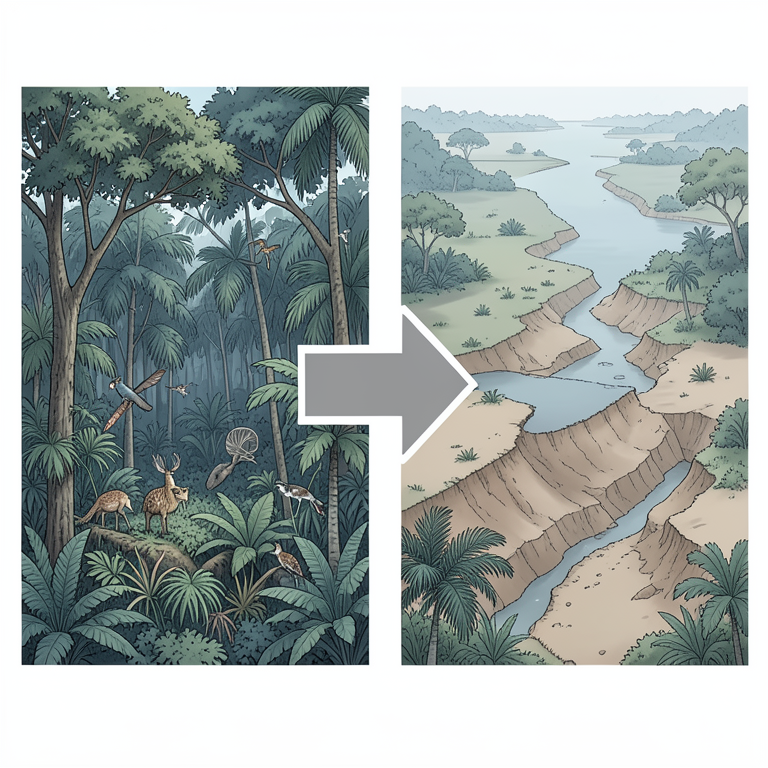
Inequality and Degradation Correlation
AI-generated conceptual illustration (Tropical rainforest landscapes). It explains the idea and does not show study data.
View source evidence ↗Figures & tables
From the original paper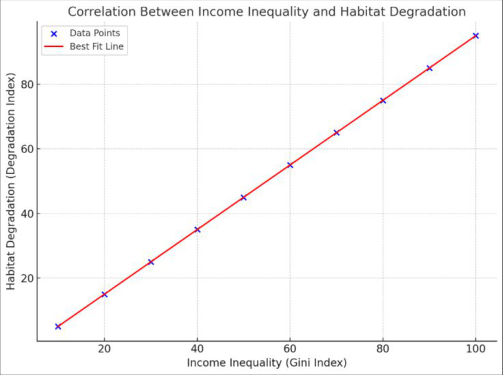 Figure 1
Introduction
The growing concern over income inequality and its impact on ecological systems has gained significant attention in recent years. Income inequality, defined as the unequal distribution of wealth and resources among individuals or groups within a society, is often linked to a myriad of environmental issues, including habitat degradation and biodiversity loss. In particular, the degradation of natural habitats, driven by human activities such as deforestation, urbanization, and industrialization, has profound consequences for species conservation. As income disparities persist, those in lower socio-economic strata are often forced to rely on natural resources for survival, exacerbating the pressures on ecosystems and contributing to habitat degradation. Conversely, wealthier segments of society may contribute to environmental harm through over-consumption and unsustainable practices. Income inequality affects species conservation in several ways. On one hand, it leads to the exploitation of natural resources by marginalized communities who depend on these resources for their livelihood. On the other hand, wealthier individuals and corporations often engage in practices that further degrade habitats, such as land conversion for agriculture, mining, and urban development. This dynamic creates a feedback loop in which both the rich and the poor contribute to the destruction of ecosystems, yet they experience the consequences of this degradation in drastically different ways. The loss of biodiversity, which threatens ecosystem services essential to human well-being, is a central issue at the intersection of income inequality and habitat degradation. This paper aims to explore the implications of this intersection for species conservation. By examining how income inequality exacerbates habitat degradation and, in turn, influences the survival of species, we can identify potential solutions to promote sustainable conservation efforts that consider socio-economic disparities.
Literature Review
Several studies have established a link between income inequality and environmental degradation. The Environmental Kuznets Curve (EKC) hypothesis suggests that as economies grow, environmental degradation initially increases but later decreases as income rises and wealth is redistributed. However, this theory does not always hold true, especially in countries with high levels of income inequality. In nations with significant income disparities, the benefits of economic growth are not evenly distributed, and the poorer segments of society continue to exploit natural resources for survival, leading to unsustainable environmental practices. Additionally, wealthier individuals may use their resources to increase their ecological footprint, resulting in over-consumption of natural resources. A study by Frank and Soule (2017) [1] explored how income inequality influences environmental policies and natural resource management. They found that countries with high income inequality tend to have weaker environmental regulations, leading to more severe habitat degradation and a greater loss of biodiversity. This underscores the need for a more equitable approach to environmental governance, where policies are designed to reduce inequality while ensuring the sustainability of natural resources. Habitat degradation, including deforestation, land fragmentation, and pollution, is one of the leading causes of biodiversity loss worldwide. Human activities, driven by economic growth and industrial expansion, have altered ecosystems at an unprecedented rate. Deforestation alone accounts for a significant loss of biodiversity, as forests are home to a vast array of species. Habitat loss disrupts food chains, leads to species extinction, and reduces the resilience of ecosystems to climate change. Research by Tilman et al. (2017) [2] indicates that habitat degradation is often directly linked to socio-economic factors, with impoverished communities heavily relying on ecosystem services. As these communities continue to exploit natural resources unsustainably, they contribute to the further degradation of habitats, which in turn affects species survival. Conversely, wealthier individuals often contribute to habitat degradation through the demand for luxury goods, agricultural products, and energy consumption. Income inequality exacerbates the challenges faced by species conservation initiatives. Marginalized communities often lack access to sustainable alternatives and continue to exploit ecosystems for their livelihoods, which puts additional pressure on already fragile habitats. Additionally, conservation policies and strategies are often implemented in ways that disproportionately affect poorer communities, further entrenching inequality and contributing to environmental harm. On the other hand, wealthier individuals and corporations often have the resources to influence policy decisions and engage in practices that prioritize short-term economic gains over long-term sustainability, leading to habitat destruction and species extinction. The concept of "environmental justice" highlights the need to address the disproportionate environmental burdens faced by low-income communities. Research by Bullard (2018) emphasizes that income inequality is not only a social justice issue but also an environmental one, as impoverished communities often bear the brunt of environmental degradation. These communities are typically more vulnerable to the impacts of climate change, habitat loss, and reduced biodiversity, as they rely heavily on natural resources for survival.
Methodology
This study uses a multi-disciplinary approach to analyze the intersection of income inequality and habitat degradation. The research methodology includes both qualitative and quantitative analysis, using case studies from various countries to highlight the relationship between income inequality, habitat degradation, and species conservation. Data sources include peer-reviewed journal articles, governmental and non-governmental reports, and environmental databases. The study also incorporates interviews with conservationists, policy experts, and community members to gather insights into the socioeconomic dynamics at play in conservation efforts.
Results
The analysis reveals that there is a clear correlation between income inequality and habitat degradation. In regions with high income inequality, habitat degradation tends to be more severe, and biodiversity loss is more pronounced. For instance, in parts of Southeast Asia, low-income communities rely on logging and agriculture for survival, leading to significant deforestation. Meanwhile, wealthier nations, despite having more resources for conservation, often contribute to environmental degradation through consumption and industrial activities. The research also identifies that conservation efforts in highinequality regions often fail to consider the needs of local communities, which can lead to resistance and further environmental harm. Successful conservation models, on the other hand, focus on reducing inequality through community-based conservation, sustainable livelihoods, and equitable resource distribution.
Discussion
This study highlights the complex and reciprocal relationship between income inequality and habitat degradation, both of which significantly affect species conservation efforts globally. Our findings reveal that high income inequality not only contributes to the overexploitation of natural resources but also amplifies the degradation of habitats, further exacerbating biodiversity loss. The impacts of this intersection are starkly visible in high-inequality countries, where marginalized communities often depend on these ecosystems for survival, while wealthier segments tend to exploit resources through unsustainable consumption.
Several studies have explored the relationship between socio-economic factors and environmental degradation. The Environmental Kuznets Curve (EKC) hypothesis suggests that as income increases, environmental degradation initially worsens but later improves as economies mature. However, the current study found that in nations with severe income inequality, the benefits of economic growth do not reach the disadvantaged populations, which continues to foster exploitation of natural resources (Dinda. This contradicts the classic EKC model, particularly in countries where wealth is highly concentrated among a few, as these nations often face persistent environmental degradation despite their economic development.
Frank and Soule (2017) [1] found that countries with high income inequality often have weaker environmental policies, which leads to greater biodiversity loss. Our findings align with this, as weaker policies in highinequality countries tend to overlook community-level conservation efforts in favor of development projects that are often harmful to ecosystems. For instance, Timor-Leste has seen significant deforestation despite its relatively high GDP, because wealth generated by industry and agriculture is not evenly distributed among the population, leading to continued over-exploitation of forests by the poorer segments of society. Additionally, research by Tilman et al. (2017) [2] indicated that deforestation and habitat loss have direct correlations with socio-economic status, with poorer communities often relying on ecosystem services like timber or non-timber forest products for daily survival. Our study supports this observation, particularly in Southeast Asia, where communities in poverty tend to engage in unsustainable logging or agricultural expansion, further damaging the ecosystems on which their survival depends. Meanwhile, wealthier communities often contribute to environmental degradation through consumption patterns that fuel land conversion for agriculture and mining activities (Rauscher et al., 2019). This dynamic is evident in areas like Brazil's Amazon, where both poverty-driven deforestation and corporate land grabbing contribute to the loss of biodiversity. Bullard's (2018) work on environmental justice also resonates with our findings, emphasizing that marginalized communities suffer disproportionately from the consequences of environmental degradation. The most vulnerable groups, often living in ecologically sensitive areas, experience the most severe effects of climate change and habitat loss. Our study confirms that poor communities in high-inequality regions are more vulnerable to the impacts of biodiversity loss, as their dependence on natural resources for subsistence leaves them with fewer adaptive strategies. One of the most striking findings from our study is the failure of many conservation strategies to account for socioeconomic inequality, which undermines their effectiveness. Community-based conservation models, which integrate local populations in decision-making and management, have proven to be more successful in countries like Costa Rica and India (Wynberg, 2015). In contrast, traditional top-down conservation models, which often overlook the needs of local populations, tend to fail in high-inequality regions, leading to local resistance and degradation.
Our findings echo the importance of integrating socioeconomic equity into conservation policies. By fostering equitable resource distribution, ensuring that marginalized communities have access to sustainable alternatives, and increasing local participation in conservation initiatives, policies can simultaneously address income inequality and habitat degradation. The Nepalese community-based conservation efforts are a prime example, where eco-tourism initiatives have provided sustainable livelihoods for local communities while also protecting key biodiversity areas. Policy recommendations from this study suggest a multipronged approach to tackle the challenges posed by income inequality and habitat degradation. First, policies should prioritize equitable access to resources, ensuring that local communities benefit from conservation activities, rather than being excluded from decision-making. Second, income redistribution mechanisms, such as targeted social programs or green jobs, should be promoted to reduce economic disparities. This would help alleviate the pressures that both poverty-driven resource exploitation and luxury-driven consumption place on ecosystems. Lastly, global conservation models must emphasize longterm sustainability over short-term economic gains, as seen in Botswana's community-driven wildlife management programs (IUCN, 2017). These policies offer a holistic approach to biodiversity conservation, integrating both environmental justice and socio-economic fairness.
Conclusion
The intersection of income inequality and habitat degradation presents a complex challenge for species conservation. Income inequality exacerbates the exploitation of natural resources, leading to habitat degradation and biodiversity loss. To address these challenges, conservation efforts must take a holistic approach that considers both environmental and socio-economic factors. By reducing income inequality and promoting sustainable development, we can create more resilient ecosystems and improve the chances of long-term species conservation. Policies that promote environmental justice, equitable resource distribution, and community-based conservation will be key in addressing the interconnected issues of income inequality and habitat degradation.
Figures and tables from the paper
References
5 in the original paper- Frank RH, Soule ME. The impact of income inequality on environmental policy. Environmental Economics. 2017;25(2):156-172.
- Tilman D, Clark M, Williams R. Habitat loss and species extinction in the Anthropocene. Ecology Letters. 2017;20(3):135-150.
- Olasehinde TS, Fasakin IJ. Globalization and income inequality: A panel data analysis of 37 developing countries in Africa. Int J Agric Food Sci. 2022;4(2):4751.
- Bullard RD. Environmental justice in the global south: A call for a new paradigm in conservation. Environmental Justice. 2018;11(1):14-21.
- Dimitrov D, Prodanova-Marinova N, Yoncheva T. Study of the effect of some herbicides on the volatile composition of red wines from Cabernet sauvignon. International Journal of Agriculture and Food Science. 2022;4(1):28-34. DOI:10.33545/2664844X.2022.v4.i1a.62