
Research article · 2025 · Full text
International Journal of Agriculture and NutritionRole of nano-urea in enhancing growth and productivity of hybrid maize (Zea mays L.)
Volume 7(8) · Pages 113–116 · DOI: 10.33545/26646064.2025.v7.i8b.277 ↗
Research areasCrop Yield and Soil Fertility
Abstract
Author-writtenA field experiment was conducted during the kharif season of 2024 at the Agricultural Research Farm, Vivekananda Global University, Jaipur, Rajasthan, to assess the role of nano-urea in improving growth, productivity, nutrient-use efficiency, and economics of hybrid maize (Zea mays L.) variety SMH-5. The study employed a randomized complete block design with 10 treatments, including control and combinations of recommended dose of nitrogen (RDN, 120 kg/ha as prilled urea) with foliar sprays of nano-urea at varying rates and timings. Results indicated that the treatment with 50% RDN as basal + 2 sprays of nano-urea @ 4 ml L⁻¹ (at 30 and 60 days after sowing, DAS) significantly enhanced plant population (up to 32.38% increase at 30 DAS), plant height (up to 31.23% at harvest), dry matter accumulation (up to 33.01% at harvest), yield attributes (e.g., 57.85% more grains/cob), grain yield (87.85% increase to 74.84 q/ha), nutrient-use efficiencies (highest agronomic efficiency of 154.3 kg grain/kg N), and economic returns (net return of ₹105,204.6/ha, B:C ratio 1.81). This approach reduced nitrogen losses, improved soil nutrient status, and promoted sustainable maize production under semi-arid conditions.
Summary
Source-checkedPlain-language reading of the full paper, prepared with AI and checked against the text. Each point links to the authors' own words.
Why it matters
- While maize requires significant nitrogen for growth, traditional urea application is inefficient, with recovery rates often below 50% due to environmental losses. View evidence ↗
- Nano-urea is a liquid fertilizer with 4% nitrogen and particles sized 20–50 nm that can achieve over 80% efficiency through foliar absorption. View evidence ↗
The question
- The study aimed to evaluate how nano-urea affects the growth, yield, nutrient-use efficiency, quality, and economic viability of hybrid maize. View evidence ↗
What they did
- The research was a field experiment conducted during the 2024 kharif season in Jaipur, Rajasthan, using the hybrid maize variety SMH-5. View evidence ↗
- The experiment used a randomized complete block design with 10 treatments, comparing a control and various combinations of recommended nitrogen (120 kg/ha prilled urea) and nano-urea foliar sprays. View evidence ↗
- Plots of 25.2 m² were used with a planting density of 30 cm x 60 cm, and all received basal doses of 50 kg P₂O₅/ha and 40 kg K₂O/ha. View evidence ↗
What they found
- Applying 50% of the recommended nitrogen as basal and two nano-urea sprays (4 ml L⁻¹) increased the plant population by up to 32.38% at 30 days after sowing. View evidence ↗
- The highest dry matter accumulation at harvest (up to 33.01%) was observed in treatments T5 and T6. View evidence ↗
- Treatment T6 produced the best yield attributes, including 14.69 rows/cob (20.31% increase), 34.68 grains/cob (57.85% increase), and a cob length of 22.62 cm (15.76% increase). View evidence ↗
- The grain yield reached 74.84 q/ha under the best treatment, representing an 87.85% increase over the control group. View evidence ↗
- Nutrient efficiency varied by treatment: T8 had the highest agronomic efficiency (154.3 kg/kg N) and apparent recovery (116.1%), T6 had the highest physiological efficiency (97.4 kg/kg uptake), and T7 had the highest partial factor productivity (144.2 kg/kg N). View evidence ↗
- Protein content in the maize was increased to 11.58% under treatments T6 and T7. View evidence ↗
- Treatment T6 maximized economic returns, with gross returns of ₹163,401.2 (78% over control), net returns of ₹105,204.6 (175% over control), and a B:C ratio of 1.81 (153% over control). View evidence ↗
What it means
- The authors conclude that integrating nano-urea reduces nitrogen losses and improves soil nutrient status, promoting sustainable maize production in semi-arid regions. View evidence ↗
Visual summary
2 visualsIllustrations explain the paper; charts are replotted from the paper's own table values.
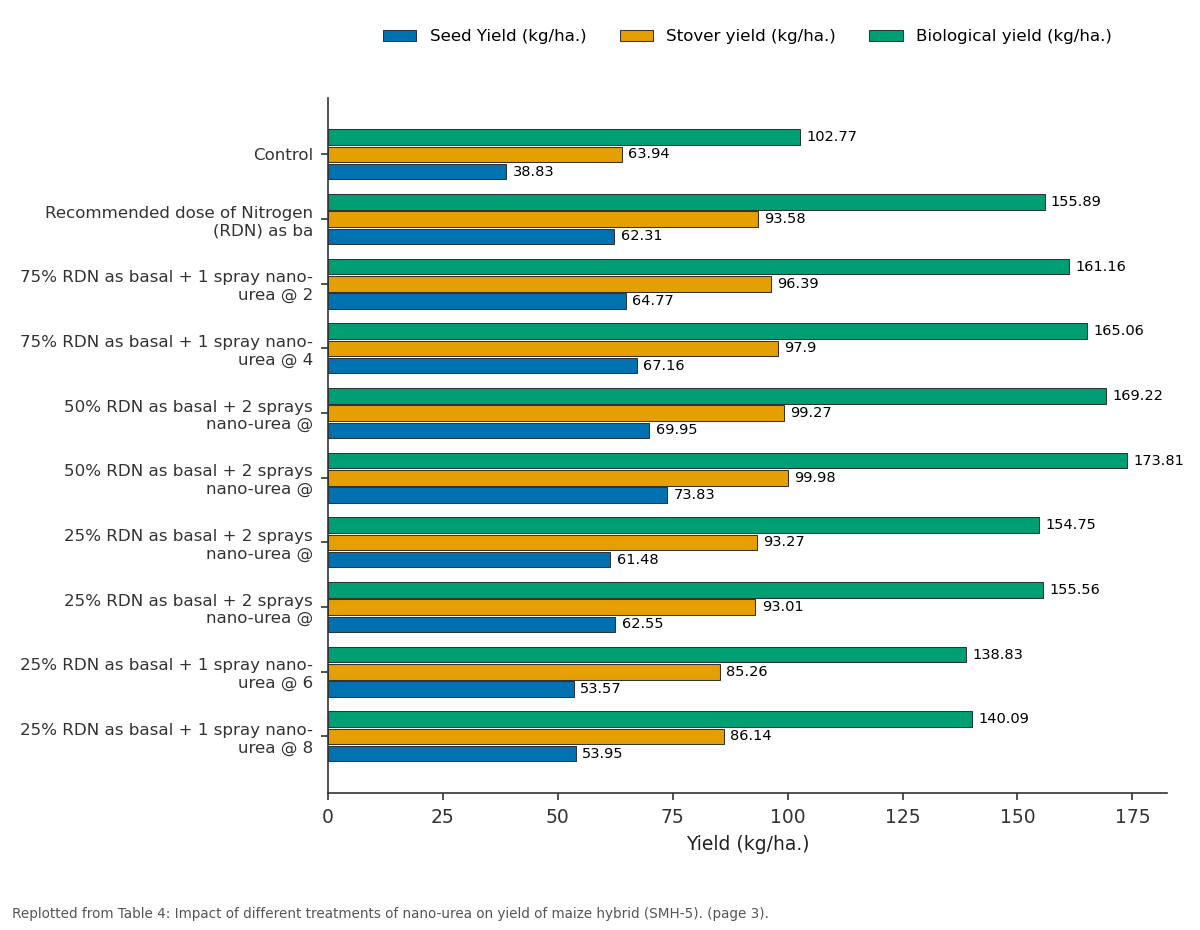
Seed Yield (kg/ha.) and Stover yield (kg/ha.) and more: Control vs Recommended dose of... vs 75% RDN as basal + 1... vs 75% RDN as basal + 1... vs 50% RDN as basal + 2...
Replotted from Table 4 (page 3) of the original paper. Every bar is the paper's own table value.
View source evidence ↗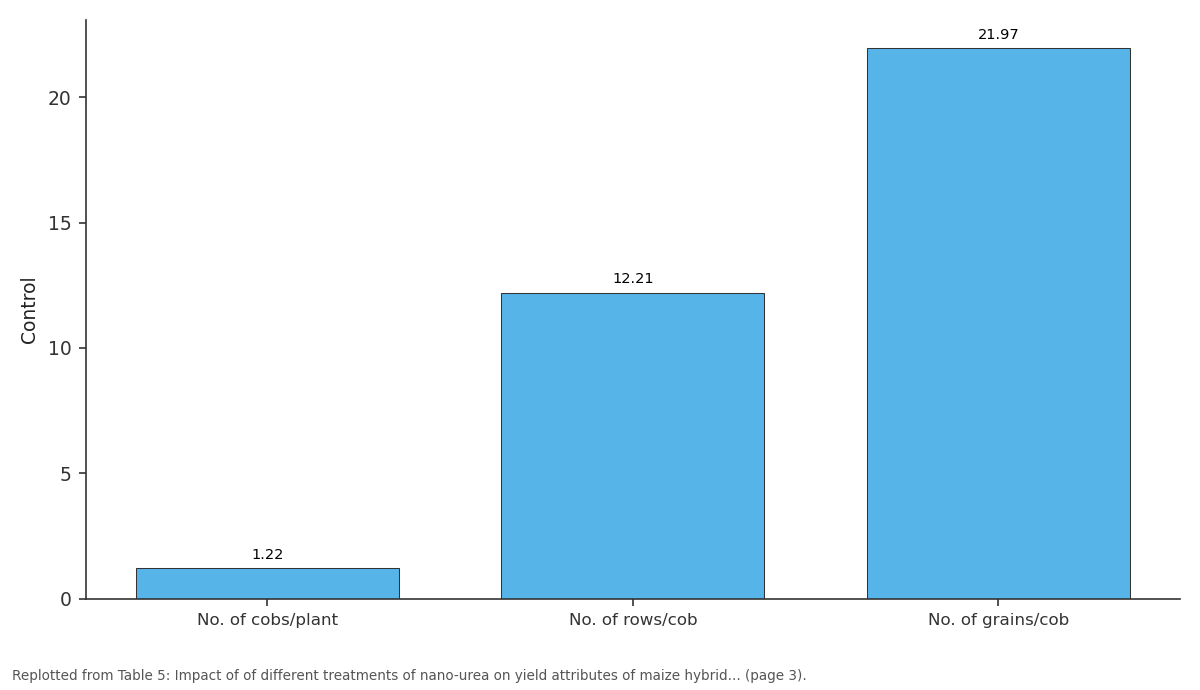
Control: No. of cobs/plant vs No. of rows/cob vs No. of grains/cob
Replotted from Table 5 (page 3) of the original paper. Every bar is the paper's own table value.
View source evidence ↗Figures & tables
From the original paper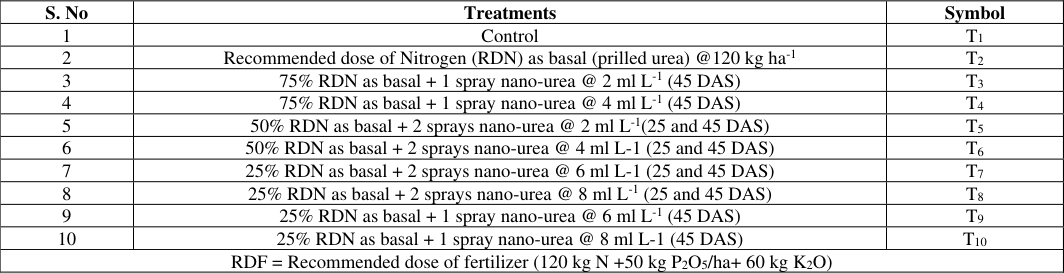 Table 1
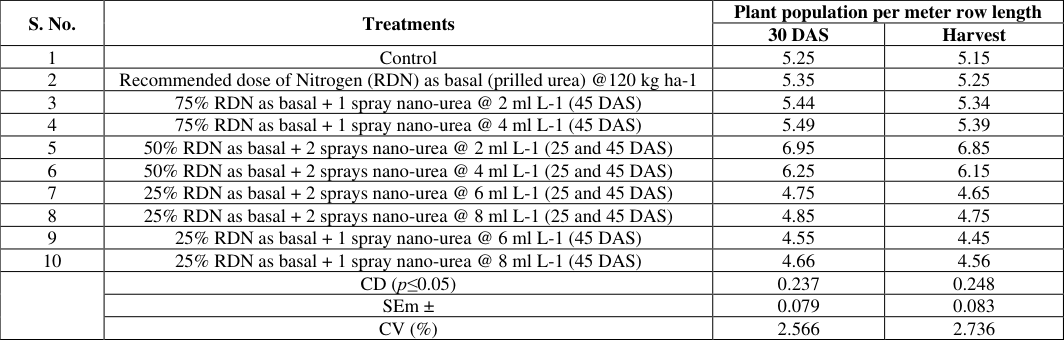 Table 2
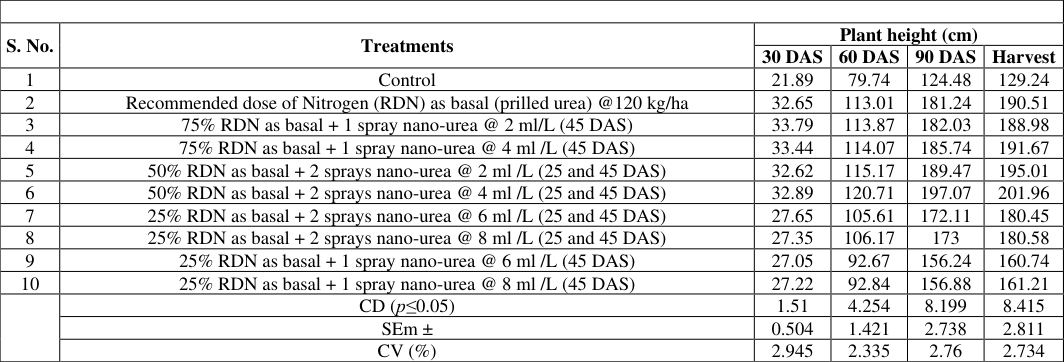 Table 3
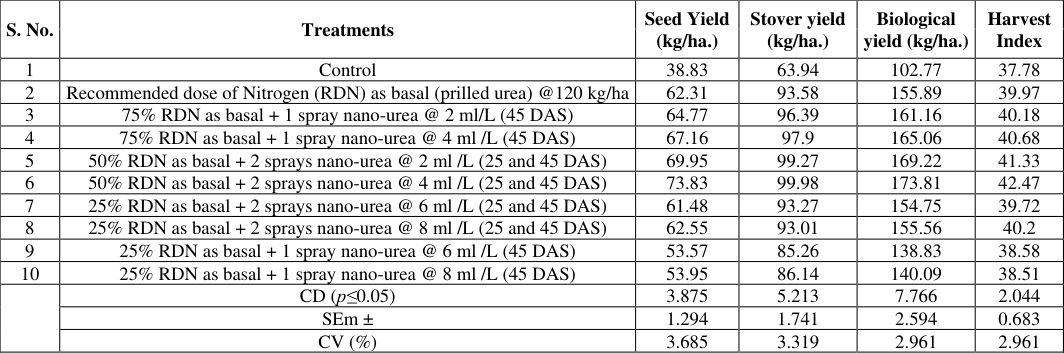 Table 4
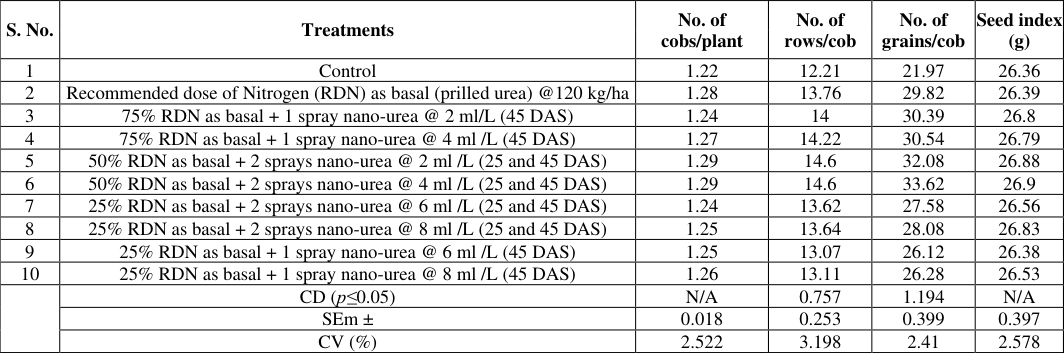 Table 5
Introduction
Maize (Zea mays L.), known as the "queen of cereals," is a versatile crop with wide adaptability, serving as a staple food, animal feed, and industrial raw material. In India, it ranks third after rice and wheat, covering 9.7 million ha with a production of 31 million tons and productivity of 3.19 t/ha (Anonymous, 2020b) [5] . Globally, production reaches 1147.7 million tons from 193.7 million ha (Anonymous, 2020a) [4] . Maize demands high nitrogen (N) for growth, but conventional urea application leads to losses via leaching, volatilization, and runoff, with recovery rarely exceeding 50% (Conant et al., 2013) [7] . Overuse skews NPK ratios, increases pest susceptibility, and causes lodging (Dahiya et al., 2018) [8] . Nano-urea, a nanotechnology-based liquid fertilizer with 4% N (w/v) in 20-50 nm particles, offers higher efficiency (>80%) through foliar uptake via stomata and phloem translocation (Kumar et al., 2020a; Wang et al., 2013) [10,19] . It minimizes environmental losses and stores unused N in plant vacuoles for gradual release (Kumar et al., 2020b) [11] . This study aimed to: (1) evaluate nano-urea's impact on maize growth and yield; (2) assess nutrient-use efficiency and quality; and (3) analyze economic viability.
Materials and Methods
Materials and Methods
Experimental Site
The experiment was carried out during the kharif season of 2024 at the Agricultural Research Farm, Vivekananda Global University, Jaipur, Rajasthan (Agro-climatic zone III A, semiarid Eastern Plain Zone). The region features a semi-arid climate with summer highs of 48 °C, winter lows of 1 °C, and annual rainfall of 450-550 mm, mainly in July-August. During the crop period, maximum temperatures ranged from 30.2 °C to 40.9 °C, minimum from 14.3 °C to 25.4 °C, relative humidity 15-85%, and sunshine hours 1.8-9.3. Soil was loamy sand, alkaline (pH 8.2), low in organic carbon (0.32%), available N (185 kg/ha), and P (12.5 kg/ha), and medium in K (245 kg/ha).
Variety and Cropping History
The hybrid maize variety Shalimar Maize Hybrid-5 (SMH-5), a medium-duration (90-100 days) cultivar with high yield potential (80 q/ha) and tolerance to diseases, was used. The field had mung bean and fallow in 2023-24, followed by maize in kharif 2024.
Treatments and Design
Ten treatments were arranged in a randomized complete block design with three replications (30 plots): T 1 (Control), T2 (RDN as basal prilled urea @ 120 kg/ha), T 3 (75% RDN basal + 1 spray nano-urea @ 2 ml L⁻¹ at 45 DAS), T4 (75% RDN basal + 1 spray @ 4 ml L⁻¹ at 45 DAS), T 5 (50% RDN basal + 2 sprays @ 2 ml L⁻¹ at 25 & 45 DAS), T 6 (50% RDN basal + 2 sprays @4 ml L⁻¹ at 25 & 45 DAS), T7 (25% RDN basal + 2 sprays @6 ml L⁻¹ at 25 & 45 DAS), T 8 (25% RDN basal + 2 sprays @8 ml L⁻¹ at 25 & 45 DAS), T9 (25% RDN basal + 1 spray @ 6 ml L⁻¹ at 45 DAS), T 1 0 (25% RDN basal + 1 spray @ 8 ml L⁻¹ at 45 DAS). Uniform basal doses of 50 kg P₂O₅/ha and 40 kg K₂O/ha were applied via DAP and MOP. Plot size was 4.2 m × 6 m (25.2 m²), with planting density of 30 cm × 60 cm. Recommended dose of Nitrogen (RDN) as basal (prilled urea) @120 kg ha -1 T2 3 75% RDN as basal + 1 spray nano-urea @ 2 ml L -1 (45 DAS) T3 4 75% RDN as basal + 1 spray nano-urea @ 4 ml L -1 (45 DAS) T4 5 50% RDN as basal + 2 sprays nano-urea @ 2 ml L -1 (25 and 45 DAS) T5 6 50% RDN as basal + 2 sprays nano-urea @ 4 ml L-1 (25 and 45 DAS) T6 7
25% RDN as basal + 2 sprays nano-urea @ 6 ml L-1 (25 and 45 DAS) T7 8 25% RDN as basal + 2 sprays nano-urea @ 8 ml L -1 (25 and 45 DAS) T8 9
25% RDN as basal + 1 spray nano-urea @ 6 ml L -1 (45 DAS) T9 10 25% RDN as basal + 1 spray nano-urea @ 8 ml L-1 (45 DAS) T10 RDF = Recommended dose of fertilizer (120 kg N +50 kg P2O5/ha+ 60 kg K2O)
Cultural Practices
The field was prepared with two tractor ploughings, harrowing, and planking for fine tilth. Seeds (25 kg/ha) were treated with Bavistin + Captan (2 g/kg) and Metalaxyl (4 g/kg), sown at 60 cm × 20 cm. Thinning was done at 15 DAS. Irrigation was via check basin during critical stages. Weeds were controlled manually at 15-20 DAS and with Tembotrione (150 g a.i./ha) at 30 DAS. Pests were managed with Chlorpyriphos (0.05%). Harvesting was manual, with grain yield adjusted to 15% moisture.
Observations
Growth: Plant population (plants/m row at 30 DAS and harvest), height (cm at 30, 60, 90 DAS, harvest), dry matter (q/ha at 30, 60, 90 DAS, harvest), phenological stages (days to knee-high, tasseling, silking, maturity). Yield attributes: Cobs/plant, rows/cob, grains/cob, seed index (g), cob length/diameter (cm with/without husk), grain/ stover/biological yield (q/ha), harvest index (%). Nutrient analysis: N (Kjeldahl), P, K content/uptake in grain/stover; protein (%) = N × 6.25. Efficiencies: Agronomic (kg grain/kg N), physiological (kg grain/kg N uptake), apparent recovery (%), partial factor productivity (kg grain/kg N applied). Economics: Gross/net returns, B:C ratio based on market prices.
Statistical Analysis
Data were subjected to ANOVA, with significance at p ≤ 0.05.
Results and Discussion
Results and Discussion
Growth Parameters
Plant population at 30 DAS ranged from 4.55 (T9) to 6.95 plants/m row (T5, 32.38% increase over control), and at harvest from 4.45 to 6.85 (T 5 , 33.01%). T 6 showed consistent performance (19.05-19.42% increase). Nanourea's efficient N delivery enhanced seedling vigor (Rathnayaka et al., 2018) [12] . Plant height increased significantly under T 6 (up to 31.23% at harvest), due to N's role in cell division and photosynthesis (Ren et al., 2021) [14] . Dry matter accumulation peaked in T 5 /T 6 (up to 33.01% at harvest), reflecting improved assimilate production (Reddy et al., 2022). Phenological stages were delayed under T 6 (e.g., 10.74% to maturity), extending vegetative growth (El-Ghobashi and Ismail, 2022) [9] . [15,16] . [2,17] .
Economics
Gross returns peaked at ₹163,401.2 (T 6 , 78% over control), net returns ₹105,204.6 (175%), and B:C 1.81 (153%).
Integrated nano-urea maximized profitability (Samui et al., 2022) [18] .
Acknowledgement
Acknowledgement
Figures and tables from the paper
| S. No | Treatments | Symbol |
|---|---|---|
| 1 | Control | T1 |
| 2 | Recommended dose of Nitrogen (RDN) as basal (prilled urea) @120 kg ha-1 | T2 |
| 3 | 75% RDN as basal + 1 spray nano-urea @ 2 ml L-1 (45 DAS) | T3 |
| 4 | 75% RDN as basal + 1 spray nano-urea @ 4 ml L-1 (45 DAS) | T4 |
| 5 | 50% RDN as basal + 2 sprays nano-urea @ 2 ml L-1(25 and 45 DAS) | T5 |
| 6 | 50% RDN as basal + 2 sprays nano-urea @ 4 ml L-1 (25 and 45 DAS) | T6 |
| 7 | 25% RDN as basal + 2 sprays nano-urea @ 6 ml L-1 (25 and 45 DAS) | T7 |
| 8 | 25% RDN as basal + 2 sprays nano-urea @ 8 ml L-1 (25 and 45 DAS) | T8 |
| 9 | 25% RDN as basal + 1 spray nano-urea @ 6 ml L-1 (45 DAS) | T9 |
| 10 | 25% RDN as basal + 1 spray nano-urea @ 8 ml L-1 (45 DAS) | T10 |
| RDF = Recommended dose of fertilizer (120 kg N +50 kg P2O5/ha+ 60 kg K2O) |
Table text extracted from the original PDF; superscript letters are shown inline. The original table image is below.
View original table image
| S. No. | Treatments | Plant population per meter row length | — |
|---|---|---|---|
| 30 DAS | Harvest | ||
| 1 | Control | 5.25 | 5.15 |
| 2 | Recommended dose of Nitrogen (RDN) as basal (prilled urea) @120 kg ha-1 | 5.35 | 5.25 |
| 3 | 75% RDN as basal + 1 spray nano-urea @ 2 ml L-1 (45 DAS) | 5.44 | 5.34 |
| 4 | 75% RDN as basal + 1 spray nano-urea @ 4 ml L-1 (45 DAS) | 5.49 | 5.39 |
| 5 | 50% RDN as basal + 2 sprays nano-urea @ 2 ml L-1 (25 and 45 DAS) | 6.95 | 6.85 |
| 6 | 50% RDN as basal + 2 sprays nano-urea @ 4 ml L-1 (25 and 45 DAS) | 6.25 | 6.15 |
| 7 | 25% RDN as basal + 2 sprays nano-urea @ 6 ml L-1 (25 and 45 DAS) | 4.75 | 4.65 |
| 8 | 25% RDN as basal + 2 sprays nano-urea @ 8 ml L-1 (25 and 45 DAS) | 4.85 | 4.75 |
| 9 | 25% RDN as basal + 1 spray nano-urea @ 6 ml L-1 (45 DAS) | 4.55 | 4.45 |
| 10 | 25% RDN as basal + 1 spray nano-urea @ 8 ml L-1 (45 DAS) | 4.66 | 4.56 |
| CD (p≤0.05) | 0.237 | 0.248 | |
| SEm ± | 0.079 | 0.083 | |
| CV (%) | 2.566 | 2.736 |
Table text extracted from the original PDF; superscript letters are shown inline. The original table image is below.
View original table image
| — | — | — | — | — | — |
|---|---|---|---|---|---|
| S. No. | Treatments | Plant height (cm) | |||
| 30 DAS | 60 DAS | 90 DAS | Harvest | ||
| 1 | Control | 21.89 | 79.74 | 124.48 | 129.24 |
| 2 | Recommended dose of Nitrogen (RDN) as basal (prilled urea) @120 kg/ha | 32.65 | 113.01 | 181.24 | 190.51 |
| 3 | 75% RDN as basal + 1 spray nano-urea @ 2 ml/L (45 DAS) | 33.79 | 113.87 | 182.03 | 188.98 |
| 4 | 75% RDN as basal + 1 spray nano-urea @ 4 ml /L (45 DAS) | 33.44 | 114.07 | 185.74 | 191.67 |
| 5 | 50% RDN as basal + 2 sprays nano-urea @ 2 ml /L (25 and 45 DAS) | 32.62 | 115.17 | 189.47 | 195.01 |
| 6 | 50% RDN as basal + 2 sprays nano-urea @ 4 ml /L (25 and 45 DAS) | 32.89 | 120.71 | 197.07 | 201.96 |
| 7 | 25% RDN as basal + 2 sprays nano-urea @ 6 ml /L (25 and 45 DAS) | 27.65 | 105.61 | 172.11 | 180.45 |
| 8 | 25% RDN as basal + 2 sprays nano-urea @ 8 ml /L (25 and 45 DAS) | 27.35 | 106.17 | 173 | 180.58 |
| 9 | 25% RDN as basal + 1 spray nano-urea @ 6 ml /L (45 DAS) | 27.05 | 92.67 | 156.24 | 160.74 |
| 10 | 25% RDN as basal + 1 spray nano-urea @ 8 ml /L (45 DAS) | 27.22 | 92.84 | 156.88 | 161.21 |
| CD (p≤0.05) | 1.51 | 4.254 | 8.199 | 8.415 | |
| SEm ± | 0.504 | 1.421 | 2.738 | 2.811 | |
| CV (%) | 2.945 | 2.335 | 2.76 | 2.734 |
Table text extracted from the original PDF; superscript letters are shown inline. The original table image is below.
View original table image
| S. No. | Treatments | Seed Yield (kg/ha.) | Stover yield (kg/ha.) | Biological yield (kg/ha.) | Harvest Index |
|---|---|---|---|---|---|
| 1 | Control | 38.83 | 63.94 | 102.77 | 37.78 |
| 2 | Recommended dose of Nitrogen (RDN) as basal (prilled urea) @120 kg/ha | 62.31 | 93.58 | 155.89 | 39.97 |
| 3 | 75% RDN as basal + 1 spray nano-urea @ 2 ml/L (45 DAS) | 64.77 | 96.39 | 161.16 | 40.18 |
| 4 | 75% RDN as basal + 1 spray nano-urea @ 4 ml /L (45 DAS) | 67.16 | 97.9 | 165.06 | 40.68 |
| 5 | 50% RDN as basal + 2 sprays nano-urea @ 2 ml /L (25 and 45 DAS) | 69.95 | 99.27 | 169.22 | 41.33 |
| 6 | 50% RDN as basal + 2 sprays nano-urea @ 4 ml /L (25 and 45 DAS) | 73.83 | 99.98 | 173.81 | 42.47 |
| 7 | 25% RDN as basal + 2 sprays nano-urea @ 6 ml /L (25 and 45 DAS) | 61.48 | 93.27 | 154.75 | 39.72 |
| 8 | 25% RDN as basal + 2 sprays nano-urea @ 8 ml /L (25 and 45 DAS) | 62.55 | 93.01 | 155.56 | 40.2 |
| 9 | 25% RDN as basal + 1 spray nano-urea @ 6 ml /L (45 DAS) | 53.57 | 85.26 | 138.83 | 38.58 |
| 10 | 25% RDN as basal + 1 spray nano-urea @ 8 ml /L (45 DAS) | 53.95 | 86.14 | 140.09 | 38.51 |
| CD (p≤0.05) | 3.875 | 5.213 | 7.766 | 2.044 | |
| SEm ± | 1.294 | 1.741 | 2.594 | 0.683 | |
| CV (%) | 3.685 | 3.319 | 2.961 | 2.961 |
Table text extracted from the original PDF; superscript letters are shown inline. The original table image is below.
View original table image
| S. No. | Treatments | No. of cobs/plant | No. of rows/cob | No. of grains/cob | Seed index (g) |
|---|---|---|---|---|---|
| 1 | Control | 1.22 | 12.21 | 21.97 | 26.36 |
| 2 | Recommended dose of Nitrogen (RDN) as basal (prilled urea) @120 kg/ha | 1.28 | 13.76 | 29.82 | 26.39 |
| 3 | 75% RDN as basal + 1 spray nano-urea @ 2 ml/L (45 DAS) | 1.24 | 14 | 30.39 | 26.8 |
| 4 | 75% RDN as basal + 1 spray nano-urea @ 4 ml /L (45 DAS) | 1.27 | 14.22 | 30.54 | 26.79 |
| 5 | 50% RDN as basal + 2 sprays nano-urea @ 2 ml /L (25 and 45 DAS) | 1.29 | 14.6 | 32.08 | 26.88 |
| 6 | 50% RDN as basal + 2 sprays nano-urea @ 4 ml /L (25 and 45 DAS) | 1.29 | 14.6 | 33.62 | 26.9 |
| 7 | 25% RDN as basal + 2 sprays nano-urea @ 6 ml /L (25 and 45 DAS) | 1.24 | 13.62 | 27.58 | 26.56 |
| 8 | 25% RDN as basal + 2 sprays nano-urea @ 8 ml /L (25 and 45 DAS) | 1.25 | 13.64 | 28.08 | 26.83 |
| 9 | 25% RDN as basal + 1 spray nano-urea @ 6 ml /L (45 DAS) | 1.25 | 13.07 | 26.12 | 26.38 |
| 10 | 25% RDN as basal + 1 spray nano-urea @ 8 ml /L (45 DAS) | 1.26 | 13.11 | 26.28 | 26.53 |
| CD (p≤0.05) | N/A | 0.757 | 1.194 | N/A | |
| SEm ± | 0.018 | 0.253 | 0.399 | 0.397 | |
| CV (%) | 2.522 | 3.198 | 2.41 | 2.578 |
Table text extracted from the original PDF; superscript letters are shown inline. The original table image is below.
View original table image
References
14 in the original paper- Abdel-Salam MA. Response of lettuce (Lactuca sativa L.) to foliar spray using nano-urea combined with mycorrhiza. J Soil Sci Agric Eng. 2018;9(10):467-472.
- Ajithkumar K, Kumar Y, Savitha AS, Ajayakumar MY, Narayanaswamy C, Raliya R, et al. Effect of IFFCO nanofertilizer on growth, grain yield and managing Turcicum leaf blight disease in maize. Int J Plant Soil Sci. 2021;33(16):19-28.
- Al-Mafrajee WMA, El-Rubaee FAH. Effect of spraying organic emulsion (appetizer) and nano NPK with urea on some growth characteristics of three synthetic cultivars of maize. Iraqi J Market Res Consumer Prot. 2022;14(1):108-117.
- Conant RT, Berdanier AB, Grace P. Patterns and trends in nitrogen use and nitrogen recovery efficiency in world agriculture. Glob Biogeochem Cycles. 2013;27(2):558-566.
- Dahiya S, Sihag S, Chaudhary C. Lodging: significance and preventive measures for increasing crop production. Int J Chem Stud. 2018;6(1):700-705.
- El-Ghobashi YE, Ismail MR. Effect of mineral and nano-nitrogen fertilizers on yield and its components of soybean and maize hybrids under intercropping system. J Plant Prod. 2022;13(8):621-628.
- Rathnayaka RMNN, Mahendran S, Iqbal YB, Rifnas LM. Influence of urea and nano-nitrogen fertilizers on the growth and yield of rice (Oryza sativa L.) cultivar 'Bg250'. Int J Res Publ. 2018;5(2):156-162.
- Reddy BM, Elankavi S, Kumar MS, Sai MV, Vani BD. Effects of conventional and nano fertilizers on growth and yield of maize (Zea mays L.). Bhartiya Krishi Anusandhan Patrika. 2022;500:1-4.
- Ren H, Jiang Y, Zhao M, Qi H, Li C. Nitrogen supply regulates vascular bundle structure and matter transport characteristics of spring maize under high plant density. Front Plant Sci. 2021;11:602739.
- Sahu TK, Kumar M, Kumar N, Chandrakar T, Singh DP. Effect of nano-urea application on growth and productivity of rice (Oryza sativa L.) under midland situation of Bastar region. Pharma Innov J. 2022;11(6):185-187.
- Saitheja V, Senthivelu M, Prabukumar G, Prasad VBR. Maximizing the productivity and profitability of summer irrigated green gram (Vigna radiata L.) by combining basal nitrogen dose and foliar nutrition of nano and normal urea. Int J Plant Soil Sci. 2022;34(22):109-116.
- Samanta S, Maitra S, Shankar T, Gaikwad D. Comparative performance of foliar application of urea and nano-urea on finger millet (Eleusine coracana L. Gaertn). Crop Res. 2022;57(3):166-170.
- Samui S, Sagar L, Sankar T, Manohar A, Adhikary R, Maitra S, Praharaj S. Growth and productivity of rabi maize as influenced by foliar application of urea and nano-urea. Crop Res. 2022;57(3):136-140.
- Wang WN, Tarafdar JC, Biswas P. Nanoparticle synthesis and delivery by an aerosol route for watermelon plant foliar uptake. J Nanopart Res. 2013;15:1417.