
Research article · 2025 · Full text
International Journal of Horticulture and Food SciencePhosphate-solubilizing bacteria from agricultural soils of Western Maharashtra: Isolation, characterization, and potential for sustainable phosphorus management
Volume 7(8) · Pages 112–113 · DOI: 10.33545/26631067.2025.v7.i8b.375 ↗
Research areasBanana Cultivation and ResearchWastewater Treatment and Nitrogen RemovalPhosphorus and nutrient management
Abstract
Author-writtenPhosphorus is a critical macronutrient for plant growth, yet much of it in soil exists in insoluble forms, rendering it unavailable to plants. Phosphate-solubilizing bacteria (PSB) are recognized as a sustainable alternative to chemical fertilizers, capable of mobilizing fixed soil phosphorus through acid production, enzymatic activity, and other biochemical processes. This study systematically collected 42 agricultural soil samples from Satara and Sangli districts of Western Maharashtra, representing diverse soil types and cropping patterns. Forty-two PSB isolates were screened qualitatively using Pikovskaya’s agar and quantitatively in Pikovskaya’s broth. Ten high-performing isolates were characterized for cultural, morphological, and biochemical traits, pH reduction, titrable acidity, and phosphatase enzyme activity. Among these, isolates Tas-1, Pal-1, and Pal-2 exhibited superior phosphate solubilization efficiency, with Tas-1 showing the highest solubilization index (4.08), phosphate solubilization efficiency (308.06%), and soluble phosphorus (180.5 mg/L). These isolates also demonstrated robust acid production (pH reduction to 3.7-3.9; titrable acidity up to 1.7%) and high phosphatase activity, highlighting their potential for biofertilizer development. The findings are consistent with earlier reports on Bacillus and Pseudomonas spp., and reinforce the promise of PSB for sustainable phosphorus management in agriculture.
Summary
Source-checkedPlain-language reading of the full paper, prepared with AI and checked against the text. Each point links to the authors' own words.
Why it matters
- Phosphorus is essential for plant growth, but it often remains trapped in the soil in insoluble forms that plants cannot use. View evidence ↗
- Chemical phosphate fertilizers are the standard way to address phosphorus deficiency, but they are expensive, inefficient due to soil fixation, and harm the environment. View evidence ↗
- Phosphate-solubilizing bacteria (PSB) offer a sustainable alternative by using acids and enzymes to make fixed soil phosphorus available to plants. View evidence ↗
The question
- The researchers aimed to isolate and characterize PSB from the Satara and Sangli districts of Western Maharashtra to evaluate their potential as sustainable biofertilizers. View evidence ↗
What they did
- The study collected 42 agricultural soil samples from various cropping patterns and soil types in the Satara and Sangli districts. View evidence ↗
- Bacteria were isolated using Pikovskaya’s agar medium, and their ability to solubilize phosphate was identified by the appearance of halo zones around the colonies. View evidence ↗
- Ten of the most effective isolates were further analyzed for their morphology, biochemical traits, acid production, and phosphatase enzyme activity. View evidence ↗
What they found
- Isolate Tas-1 was the most effective, with a solubilization index of 4.08, a phosphate solubilization efficiency of 308.06%, and a halo zone of 19.1 mm. View evidence ↗
- In quantitative tests, Tas-1 produced the most soluble phosphorus at 180.5 mg/L, followed by Pal-1 (174.6 mg/L) and Pal-2 (160.3 mg/L). View evidence ↗
- The isolates were divided into Gram-positive and Gram-negative groups, suggesting they belong to the Bacillus and Pseudomonas genera. View evidence ↗
- After 9 days, the broth pH dropped from 6.8 to between 3.7 and 3.9 for isolates Tas-1 and Pal-1, demonstrating their ability to acidify the medium. View evidence ↗
- Tas-1 exhibited the highest titrable acidity at 1.7%, with Pal-1 following at 1.4%. View evidence ↗
- Tas-1 showed high phosphatase activity, recording 12.76 µg PNP/ml/hr for acid and 17.87 µg PNP/ml/hr for alkaline phosphatase, allowing it to work in different soil pH levels. View evidence ↗
What it means
- The authors conclude that Tas-1, Pal-1, and Pal-2 are promising strains for biofertilizer use due to their strong phosphate-solubilizing abilities and other beneficial traits. View evidence ↗
- The authors state that future research is needed for molecular identification of the strains, creating large-scale formulations, and validating the results in the field. View evidence ↗
Visual summary
1 visualsIllustrations explain the paper; they do not show study data.
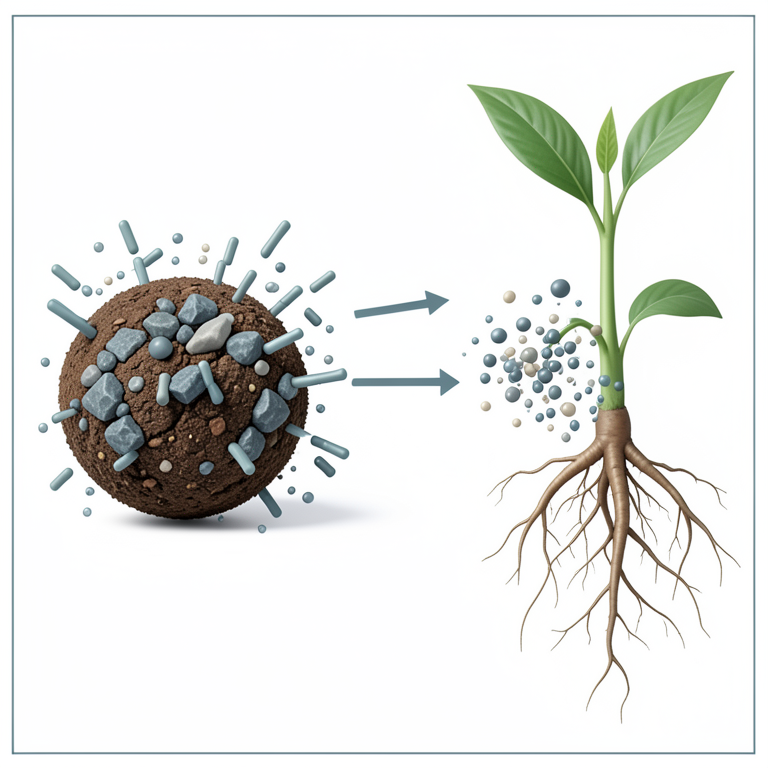
Mechanisms of Phosphorus Solubilization
AI-generated conceptual illustration (soil particles, phosphate-solubilizing bacteria, and plant roots). It explains the idea and does not show study data.
View source evidence ↗Introduction
Phosphorus (P) is an essential element for plant growth, playing a vital role in energy transfer, photosynthesis, and signal transduction. However, in most soils, a substantial portion of phosphorus exists in insoluble mineral complexes bound with calcium, iron, or aluminum, making it inaccessible to plants. Conventional management of phosphorus deficiency relies heavily on chemical phosphate fertilizers. While effective in the short term, such fertilizers are costly, often inefficient (due to fixation in the soil), and environmentally detrimental. Phosphate-solubilizing bacteria (PSB) represent an eco-friendly alternative, mobilizing soil phosphorus through organic acid production, chelation, and enzymatic activity (Sharma et al., 2013; Alori et al., 2017) [10,1] . Several genera, particularly Bacillus and Pseudomonas, have been identified for their ability to improve phosphorus availability and contribute to overall soil health. In India, PSB-based biofertilizers have shown promise in increasing crop yield and reducing dependence on synthetic fertilizers (Kumar et al., 2014) [5] . Western Maharashtra, with its diverse agro-ecological zones and intensive agricultural practices, presents a unique opportunity for identifying efficient PSB strains adapted to local soils. This study aims to isolate, characterize, and evaluate PSB from Satara and Sangli districts, integrating findings with existing literature to assess their potential as sustainable biofertilizers.
Soil Sampling and Isolation of PSB
A total of 42 agricultural soil samples were collected from various cropping systems (sugarcane, wheat, gram, groundnut, jawar, etc.) across Satara and Sangli districts. Sampling covered both black and red soils, ensuring broad ecological representation.
Each sample was geo-tagged and coded. PSB isolation was performed on Pikovskaya's agar medium, where phosphate solubilization was detected by halo zone formation around bacterial colonies. This method remains a widely accepted preliminary screening tool due to its simplicity and correlation with actual solubilization potential (Karpagam & Nagalakshmi, 2014) [4] .
Qualitative and Quantitative Phosphate Solubilization Among the 42 isolates, 10 demonstrated exceptional phosphate-solubilizing abilities. The standout performer, Tas-1, achieved a solubilization index (SI) of 4.08 and phosphate solubilization efficiency (PSE) of 308.06%, producing a 19.1 mm halo zone. Pal-1 and Wa-2 also recorded high SI values (> 3.0) and PSE (> 200%). Quantitative estimation in Pikovskaya's broth showed Tas-1 producing 180.5 mg/L soluble P, followed closely by Pal-1 (174.6 mg/L) and Pal-2 (160.3 mg/L). This range is comparable to values reported by Panda et al. (2013) [7] , where high-efficiency PSB strains solubilized between 150-200 mg/L under in vitro conditions.
Morphological and Cultural Characterization
The 10 high-performing isolates exhibited diverse colony morphologies: sizes from 0.5-4.0 mm, shapes ranging from round to irregular, and colors including creamy white, dull white, white, and yellow. Gram staining classified them into Gram-positive (Pal-1, Pal-2, Tas1, Is-1, Pat-2, Ane-1) and Gram-negative (Kde-1, Wa-2, Sat-1, Kr-1) groups, suggesting affiliations with Bacillus and Pseudomonas. This aligns with earlier reports where these genera dominated PSB populations in agricultural soils (Jayamma et al., 2013) [3] .
Biochemical Characterization
All isolates tested positive for catalase, oxidase, and citrate utilization. Ammonia production a trait beneficial for plant nitrogen supply was observed in Tas-1, Is-1, Kr-1, Ane-1, and Kde-1. Motility was confirmed in eight isolates, enhancing their potential for rhizosphere colonization. Such traits contribute to their classification as plant growthpromoting rhizobacteria (PGPR), combining phosphorus solubilization with other growth benefits (Glick, 2012) [2] .
Mechanisms of Phosphate Solubilization Acidification of Growth Medium
Initial broth pH (6.8) decreased significantly in most isolates after 9 days, with Tas-1 and Pal-1 reaching pH 3.7-3.9. Organic acid production is a primary PSB mechanism, lowering pH and chelating cations bound to phosphate (Rodríguez & Fraga, 1999) [8] .
Titrable Acidity
Tas-1 showed the highest titrable acidity (1.7%), followed by Pal-1 (1.4%). High acid levels correlated with elevated phosphate solubilization, consistent with Sharma et al. (2021) [11] .
Phosphatase Enzyme Activity
Both acid and alkaline phosphatase activities were highest in Tas-1 and Pal-1. Tas-1 recorded 12.76 µg PNP/ml/hr. (acid) and 17.87 µg PNP/ml/hr (alkaline), indicating ability to mineralize organic phosphorus under varying soil pH conditions. This dual capability enhances versatility in different agricultural soils.
Conclusion
The study identifies Tas-1, Pal-1, and Pal-2 as promising PSB strains from Western Maharashtra, with robust in vitro phosphate-solubilizing abilities supported by multiple plantbeneficial traits. Their adaptability to local soils and potential for biofertilizer application could significantly enhance phosphorus use efficiency in agriculture. Future work should focus on molecular identification, large-scale formulation, and field validation.
References
11 in the original paper- Alori ET, Glick BR, Babalola OO. Microbial phosphorus solubilization and its potential for use in sustainable agriculture. Front Microbiol. 2017;8:971.
- Glick BR. Plant growth promoting bacteria: Mechanisms and applications. Scientifica. 2012;2012:963401.
- Jayamma N, Sivakumar PK, Sreenivasulu K. Isolation and characterization of phosphate solubilizing rhizobacteria from different crop soils of Southern Telangana Zone, India. Int J Curr Microbiol Appl Sci. 2013;2(11):160-7.
- Karpagam T, Nagalakshmi PK. Isolation and characterization of phosphate solubilizing microbes from agricultural soil. Int J Curr Microbiol Appl Sci. 2014;3(3):601-14.
- Kumar A, Maurya BR, Raghuwanshi R. Isolation and characterization of PGPR and their effect on growth, yield and nutrient content in wheat (Triticum aestivum L.). Biocatal Agric Biotechnol. 2014;3(4):285-91.
- Sanchez-Gonzalez ME, et al. Organic acid production by phosphate solubilizing bacteria and its role in soil phosphorus availability. Soil Biol Biochem. 2023;179:108030.
- Panda SK, Samantaray DP, Rout GR. Phosphate solubilizing bacteria from mangrove soil and their growth-promoting activities on rice. J Plant Nutr. 2013;36(7):1001-14.
- Rodríguez H, Fraga R. Phosphate solubilizing bacteria and their role in plant growth promotion. Biotechnol Adv. 1999;17(4-5):319-339.
- Roy S, Arunachalam K, Dutta BK, Arunachalam A, Khan ML. Variations in microbial activity and soil properties under different land use systems in Northeast India. Agric Ecosyst Environ. 2013;176:1-12.
- Sharma SB, Sayyed RZ, Trivedi MH, Gobi TA. Phosphate solubilizing microbes: sustainable approach for managing phosphorus deficiency in agricultural soils. Springer Plus. 2013;2(1):587.
- Sharma S, Kumar A, Thakur N, Sharma D. Mechanistic insights into phosphorus solubilization in soils: Role of phosphate solubilizing microorganisms. Ecol Indic. 2021;121:106939.