
Research article · 2025 · Full text
International Journal of Geography Geology and EnvironmentContribution of tribal people in sustainable resource use-a study of Narayangarh Block, Paschim Medinipur, West Bengal
Volume 7(8) · Pages 100–103 · DOI: 10.22271/27067483.2025.v7.i8b.398 ↗
Research areasIndian Economic and Social DevelopmentSocial and Economic Development in India
Abstract
Author-writtenThis research paper discusses the role of tribal society in environmental development through sustainable use of resources. The efforts of the tribal society to preserve the environment for future generations in a sustainable manner by using the various resources of the environment in a healthy manner and without harming the environment in any way are noticeable. Saving the environment is the biggest challenge of today's modern society. In this the people of the tribal community are always striving through their tireless efforts. They are always protecting forests, land and water bodies. There is an urgent need to give stronger and appropriate support and encouragement to this effort of the people. Development agendas, alternatives, joint ventures to empower tribal, protect their rights and involve them in decision-making processes. This study emphasizes the sustainable use of environmental resources by measuring the importance of using indigenous knowledge and strategies. Which is a significant approach and very necessary in the present day for the welfare of the entire country and the mankind in the larger perspective.
Summary
Source-checkedPlain-language reading of the full paper, prepared with AI and checked against the text. Each point links to the authors' own words.
Why it matters
- Preserving the environment is considered one of the most significant challenges facing modern society. View evidence ↗
- Tribal communities in India traditionally maintain their livelihoods by utilizing environmental resources in a healthy, non-damaging manner. View evidence ↗
- In West Bengal and across India, tribal livelihoods are hindered by financial exploitation from non-tribal individuals and forest contractors, contributing to high rates of poverty and illiteracy. View evidence ↗
The question
- The study aims to discuss how tribal societies contribute to environmental development through the sustainable use of resources. View evidence ↗
- The research focuses on the importance of indigenous knowledge and strategies in the sustainable use of environmental resources. View evidence ↗
What they did
- The study was conducted in the Narayangarh block of the Paschim Medinipur district in West Bengal, India. View evidence ↗
- Data collection involved three methods: interviews with educated individuals, group discussions with illiterate participants, and random sampling via questionnaires. View evidence ↗
What they found
- Based on 2011 census data, the study area has a total population of 302,620, with 68,080 (22.50%) belonging to the Scheduled Tribe (ST) community. View evidence ↗
- There is a significant literacy gap in the area; while the average literacy rate is 78.18%, the rate among tribal people is below 50%. View evidence ↗
- Work participation is heavily concentrated in the primary sector, which accounts for 89.23% (580 observations), compared to 10.46% (68) in the secondary sector and 0.31% (2) in the tertiary sector. View evidence ↗
- Tribal communities demonstrate environmental stewardship by worshiping ancient trees (such as Neem, Asasthya, Bot, and Sal) and planting new saplings annually during the monsoon. View evidence ↗
- The tribal population practices water conservation by minimizing groundwater extraction and avoiding waste. View evidence ↗
- Major problems identified include the persistence of ancient living standards, the destruction of forest land by outsiders, and a low-quality education system. View evidence ↗
What it means
- The authors conclude that combining technological progress with the preservation of traditional indigenous knowledge is the key to allowing tribal communities to thrive alongside modern society. View evidence ↗
- The authors recommend urgent support for tribal efforts through development agendas and joint ventures that empower them, protect their rights, and include them in decision-making. View evidence ↗
Visual summary
1 visualsIllustrations explain the paper; they do not show study data.
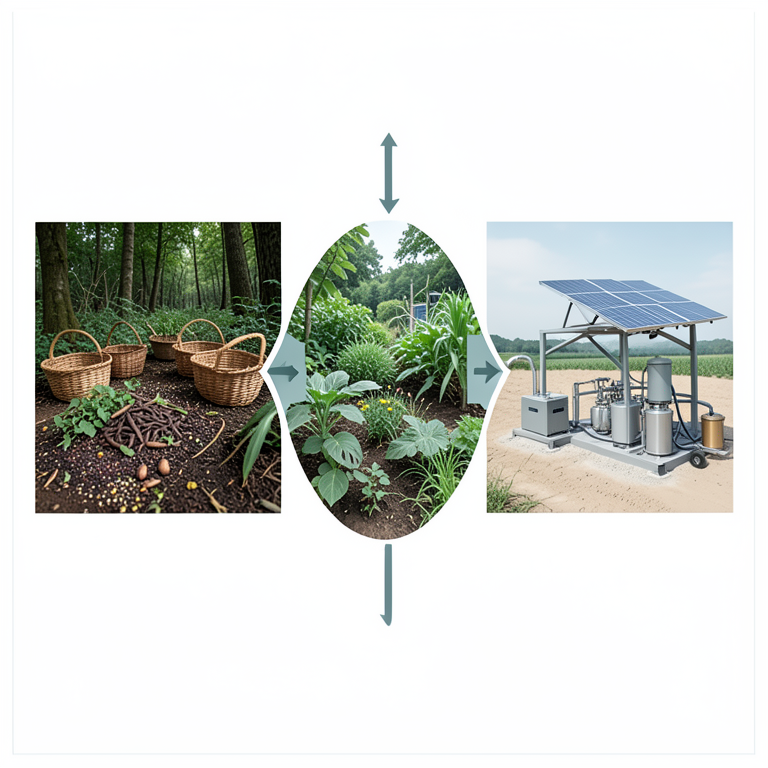
Integration of Knowledge Systems
AI-generated conceptual illustration (Tribal forest landscape in West Bengal featuring indigenous crops and modern sustainable irrigation tools). It explains the idea and does not show study data.
View source evidence ↗Figures & tables
From the original paper Table 1
 Table 2
Introduction
Tribal people in India have always been living their life and livelihood by using the environment and resources in a healthy way. They provide their food, clothing and shelter by gathering raw materials from the environment where they live. And does not cause any damage to the environment. Environmental resources such as forests, wetlands, agricultural land are used in such a way that there is almost no degradation of these areas. For example, they make a living by collecting dry branches, leaves, and honey from the forests. Again, they practice climate-dependent agriculture by applying organic fertilizers to farmland, and they make a living by collecting various animal products from wetlands. In this, they try to save all these resources for future generations without damaging them under any circumstances. At the beginning of the rainy season, the people of this tribe observe the practice of planting trees and worshiping trees, which is considered one of the efforts to save nature. But every tribal society has a different lifestyle and tradition. Relates to the use of particular natural resources and particular types of work. Collection of medicine and food from the forest by some tribal groups has a significant contribution. Again, their contribution to mineral collection is unacceptable. Financial exploitation of tribal's by non-tribes and forest contractors in India and particularly in West Bengal today is hampering their livelihoods, an exploitation that is visible in their widespread poverty and illiteracy rates.
Aims & Objects
The following other major objectives have been set for this research work: 1. To understand the status (social and economic) of women of the selected tribes in the study area. 2. To understand the role of women in income generation and economic sustenance of the family particularly in terms of her contribution through different aspect like agriculture and other related activity. 3. To analyzes the impact, change and consequences on the role of women particularly among the educated women.
4.
To analyze the prospect of self-employment for the progress in general and development of individual and community as a whole. 5. To find out the educational status of tribal people. 6. To analyzes the Major problems of tribal people.
Methods & Materials
First the representatives of various tribal communities were identified and they were assured that the aim of the present study is to inform the people of all walks of life about the beautiful relationship they have with the life style of their community and the resources of the environment. After some initial reactions, the representatives and the people of the area spontaneously started to respond with an open mind. Data was collected in 3 ways keeping in mind the people of the nation. Firstly, some primary data was collected by interview to educated people and group discussion from illiterate shy class and random sampling at all levels by questionnaire. About 350 males and 300 females have been spoken to.
About study area
Narayangarh block belongs to West Medinipur district in the Indian state of West Bengal. This is mainly located on the outskirts of Jangalmahal area of West Bengal. The National Highway NH-60 and the South Eastern Railway connect the area to the rest of India. The total population of this area (census 2011) is 302,620 of which about 68,080 belong to the ST community. Among them Santhal, Lodha, Munda and Sabar communities are the main ones. 22.50% of the total population of the area is tribal community. The block has a total land area of 49197 hectares, of which 4.5% (2152 hectares) is forested. Most of the places around this forest area are mainly inhabited by tribal communities. The average literacy rate of the area is 78.18% and this rate of tribal people is less than 50%.
Major Discussion
The tribal people of this area are very simple, calm and religious in nature. They strongly protect and love nature.
While doing the study, it has been observed that the importance of various elements of the environment such as water, forest and land is immense in their way of life. Livelihood Pattern: The main tribal communities of this area are Santhal, Lodha and Sabar. They mainly eat rice and millet. They catch crabs and fish from ponds, collect red ants from forests. They collect various kinds of fruits and wild vegetables and consume them as food. Besides, dry branches and leaves of the forest are used for cooking. They have very little agricultural land. Agricultural systems are mainly climate dependent. They carry out agriculture using organic fertilizers and animal power. Besides, they keep poultry along with cattle. They worship the animals used in agriculture. They love the land like a mother and protect it like a child. During the study it was found that the people of all these areas have a boundless love for the forest. They worship ancient trees of different types like Neem, Asasthya, Bot, and Sal etc. And the tribal people have a custom of planting new saplings almost every year at the onset of monsoon. They use its by-products without harming the forest. Among the tribal people of all these areas, one can see the immense effort to save the water from pollution. They basically draw very little ground water and almost do not waste water. Water from various reservoirs is used for daily use. Currently, several water bodies in all these areas have been rehabilitated through various government projects. By which water and stable use is being done in this area.
Occupation Status: In the study, some information about their livelihood is found in the tree. For example, among them the Sabar people collect leaves from forests, honey and wood and collect googly and snakes from water bodies, while the Santhals and other tribes live as daily laborers in agriculture except for collecting leaves and wood from the Sal forests. The tendency of women to work in agriculture is more noticeable than that of men. Many times they migrate to other states (Gujarat, Odissa, Telangana etc.) due to lack of work. At present, however, due to the slight increase in the education rate among the people of some tribes, especially the Santhals, a few families have also got government jobs. This has improved their life.
Customs & Rituals
Another significant aspect of the way of life of the people of this area is their rituals and customs which highlight the aspect of stable development of resources and environment. During the interview and group discussion, it is known that they worship the crop as an offering to God while harvesting the land, celebrating Mokorsankranti festival. By doing Cow rearing and worshiping animals and dancing with them is one of the customs of the tribes here. They worship the forest goddess to save the forest. This means that the tribal people here use every natural resource wisely.
Education Status
Education system: The education rate of the tribal class of the studied area is not very good. The data obtained by collecting the data of about 650 people through random sampling by questionnaire is presented through the following table. The table shows that the illiteracy rate of men and women is high. And their place in higher education is very small. These areas mainly have ICDS, government primary and secondary schools.
Problems & Prospects
The main problems that have been observed while studying this area are, 1. The indigenous people of this area still live in the ancient way. 2. Some unscrupulous businessmen are taking advantage of the simplicity of the tribe. 3. The forest land of this area is being destroyed by outsiders. 4. The agricultural work of the tribes of this area is still in the ancient way. 5. The education system of the tribal people of this area is of low quality. 6. There are a lot of professional problems here. 7. The problem of drinking water around the forest is another problem here. 8. Above all, the social and economic inequality of the tribes is also a feature of this area. Despite the above problems, it can be said that one has to admire the use of environmental resources by these tribal people.
Their urge to save the environment and protect resources for future generations is always visible. At present, however, various NGOs and governments have come forward to help them. Arrangements are being made to improve toilets, clean water system and government schools in the houses of tribal families. Besides, efforts are being made to provide government assistance to the tribal's to promote cooperative cottage industries (shawl making, honey collection, silk cultivation, basket making), which was revealed in the Group Discussion in this area. Finally, it can be said that the tribal people have been given the responsibility of protecting the forest and the right to use the by-products and emphasis is being placed on planting more trees, which will make the area healthier in the future.
Conclusion
Looking at the economic, political, social and environmental aspects of today's world, it can be understood that the overall environment has begun to deteriorate. In this situation, the concept of sustainable development is absolutely necessary in the world as a whole, especially in a country as diverse as India. In the degraded site we observed the sustainable use of the environment in the way of life of the tribal community. Who have always been committed to stable use of environmental resources mainly water and forest land and to avoid any pollution and degradation and to preserve them for the future. This hinders their social development and temporarily leaves them behind in society. But by embracing an approach that combines technological progress with the preservation of traditional knowledge, we can pave the way for a harmonious coexistence where rural and tribal communities thrive alongside the rapid progress of modern society.
Figures and tables from the paper
| Co-ordinate | 22°03' to 22°13'30" N(latitude) 87°15' to 87°28'E( longitude) |
|---|---|
| Country | India |
| State | West Bengal |
| District | Paschim Medinipur |
| Block | Narayangarh |
Table text extracted from the original PDF; superscript letters are shown inline. The original table image is below.
View original table image
References
13 in the original paper- Pradhan S. Problems of tribal education in India. Kurukshetra. 2011;59(7):26-31.
- Government of India. Statistical Profile of Scheduled Tribes in India. Ministry of Tribal Affairs; 2013.
- Nithya NR. Globalization and the plight of tribals: In the case of Kerala, India. The Dawn Journal. 2014;3(1):727-758.
- Panda BK. Education of girls among ethnic tribal groups in South Asia. Indian Anthropol. 2011;41(2):1532.
- Manna S, Ghosh A. Tribal health and sustainable development: Traditional knowledge practice and medicinal plant. In: Environment, Development and Sustainability in India: Perspectives, Issues, and Alternatives. Springer; 2020. p. 287-309. PMCID: PMC7972753.
- Debata MR. Globalization, green business, and sustainable livelihood: A study in the context of tribal women of Kandhamal district of Odisha. Jharkhand J Dev Manag Stud. 2018;16:7903-7918.
- Dutta S, Sivaramakrishnan L. Disparity in the literacy level among the scheduled and non-scheduled population: Indian scenario in the 21st century. Trans Inst Indian Geogr. 2013;35(2):185-200. Available from: https://scholar.google.com/scholar?hl=en&as_sdt=0%2 C5&q=Disparity+in+the+
- Inamdar S. Women and human rights. Int J Rev Res Soc Sci. 2016;4(2):77-79. Available from: https://ijrrssonline.in/AbstractView.aspx?PID=2016-42-6
- Rani UN. An empirical analysis of the socio-economic constraints and the success attained by women through education: A case study in Bengaluru. Int J Rev Res Soc Sci. 2016;4(3):129-152. Available from: https://ijrrssonline.in/AbstractView.aspx?PID=2016-43-1
- Hiwarkar YA, HB R. Impact of socio-demographic factors on reproductive health of married women in reproductive age group. Res J Pharmacol Pharmacodyn. 2013;5(3):197-201. Available from: https://rjppd.org/AbstractView.aspx?Journal=Research %20Journal%20of%20Pharmacology%20and%20Phar macodynamics&PID=2013-5-3-27
- Maharatna A. Fertility, mortality, and gender bias among tribal population: An Indian perspective. Soc Sci Med. 2000;50:1333-1351. Available from: https://www.elsevier.com/locate/socscimed
- Ghosh AK. The gender gap in literacy and education among the scheduled tribes in Jharkhand and West Bengal. Sociol Bull. 2017;56(1):109-125. Available from: https://doi.org/10.1177/0038022920070106
- Sarkar S, Mishra S, Dayal H, Nathan D. Development and deprivation of scheduled tribes. Econ Polit Wkly. 2006;41(46):4824-4827. Available from: https://www.jstor.org/stable/4418927?readnow=1&refreqid=excelsior:d33478dd67d0494602821d 39e8f66dc1&seq=1#page_scan_tab_contents