
Research article · 2025 · Full text
International Journal of Agriculture and Food ScienceEconomics of production and marketing of Kagzi lime in Ahilyanagar district of Maharashtra
Volume 7(8) · Pages 1120–1122 · DOI: 10.33545/2664844x.2025.v7.i8j.683 ↗
Research areasAgricultural Economics and PracticesFood Science and Nutritional Studies
Abstract
Author-writtenThe present investigation is carried out in Ahilyanagar district of Maharashtra state. Keeping in view the highest acreages under kagzi lime, Shrigonda and Karjat tahsils from Ahilyanagar district were purposively selected. from these two tahsils 6 villages were selected purposively on the basis of area under kagzi lime. from each village 15 sample cultivators were selected randomly i.e. small (upto 0.20 ha), medium (0.21 to 0.40 ha) and large (0.41 ha and above).Thus, final sample comprised of 90 kagzi lime growers. The primary data collected for the agriculture year 2023-24 were analyzed by using simple tabular approach and also functional analysis method. At overall level per hectare cost of production was 2,85,905.95. The per hectare cost of production was highest 3,10,681.97 in small size group followed by medium 2,86,489.05 and large group 260546.82 Kagzi lime is a profitable fruit crop with 2.52 B:C ratio. For large gardens cost was minimum Hence, the large gardens were more profitable than small gardens. According to financial indicators, the investment in lime cultivation has proven to be economically viable.
Summary
Source-checkedPlain-language reading of the full paper, prepared with AI and checked against the text. Each point links to the authors' own words.
Why it matters
- Fruit cultivation is generally more profitable for small and marginal farmers than many field crops because it generates higher earnings per unit of land. View evidence ↗
- The cultivation area for Kagzi lime in India grew from 245.2 thousand hectares in 2015-16 to 316.11 thousand hectares in 2024-25. View evidence ↗
The question
- The study aimed to analyze the economics of producing and marketing Kagzi lime within the Ahilyanagar district of Maharashtra. View evidence ↗
What they did
- The researchers purposively selected the Shrigonda and Karjat tahsils in Ahilyanagar district, and from there, six villages were chosen based on their Kagzi lime cultivation area. View evidence ↗
- A total of 90 growers were randomly sampled (15 per village), categorized by farm size: small (up to 0.20 ha), medium (0.21 to 0.40 ha), and large (0.41 ha and above). View evidence ↗
- Production costs were estimated using standard cost concepts, specifically calculating Cost 'A', Cost 'B', and Cost 'C'. View evidence ↗
What they found
- The overall average cost of production per hectare for Kagzi lime was ₹2,85,905.95. View evidence ↗
- Production costs per hectare were highest for small farms (₹3,10,681.97), followed by medium farms (₹2,86,489.05) and large farms (₹260,546.82). View evidence ↗
- Hired male labour was the largest expense within Cost 'A', costing ₹42,629.72 and representing 14.91% of the total cost (Cost 'C'). View evidence ↗
- The primary components of Cost 'B' were land rental value (₹1,10,080.52; 38.50% of Cost 'C') and amortization (₹21,523.14; 7.53% of Cost 'C'). View evidence ↗
- The overall benefit-cost ratios were 5.79 for Cost 'A', 2.52 for Cost 'B', and 2.33 for Cost 'C'. View evidence ↗
- At the total cost level (Cost 'C'), benefit-cost ratios increased with farm size: 2.16 for small, 2.35 for medium, and 2.52 for large farms. View evidence ↗
- Profits at the Cost 'C' level were ₹3,60,551.43 for small farms, ₹3,87,041.31 for medium farms, and ₹3,95,849.83 for large farms. View evidence ↗
What it means
- The authors conclude that Kagzi lime cultivation is economically viable and profitable for farmers in the Ahilyanagar district because the benefit-cost ratio is greater than one. View evidence ↗
- The authors state that large gardens are more profitable than small gardens due to having the minimum production costs. View evidence ↗
Visual summary
3 visualsIllustrations explain the paper; charts are replotted from the paper's own table values.
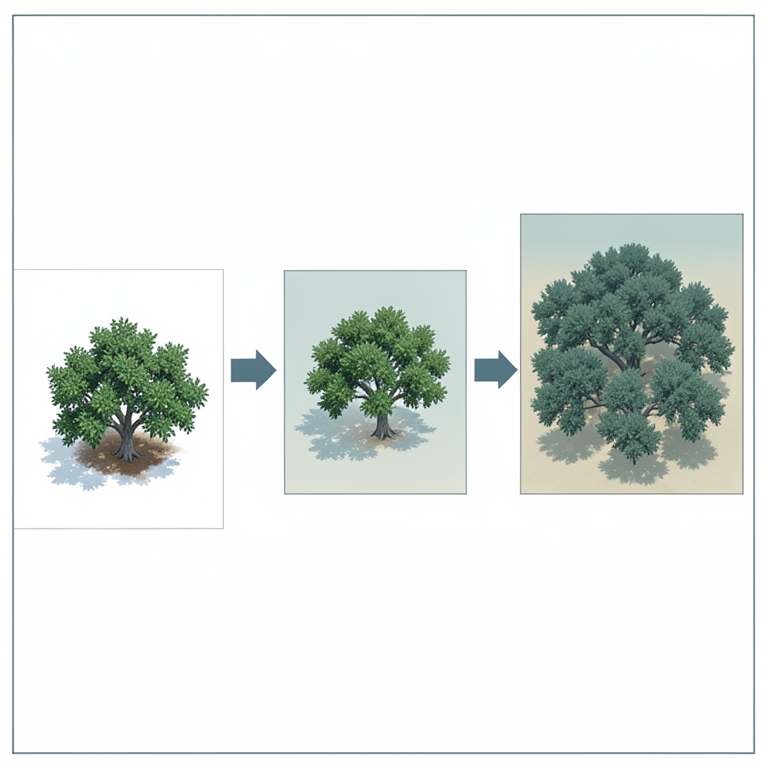
Farm Size vs. Economic Efficiency
AI-generated conceptual illustration (Kagzi lime trees in farm plots). It explains the idea and does not show study data.
View source evidence ↗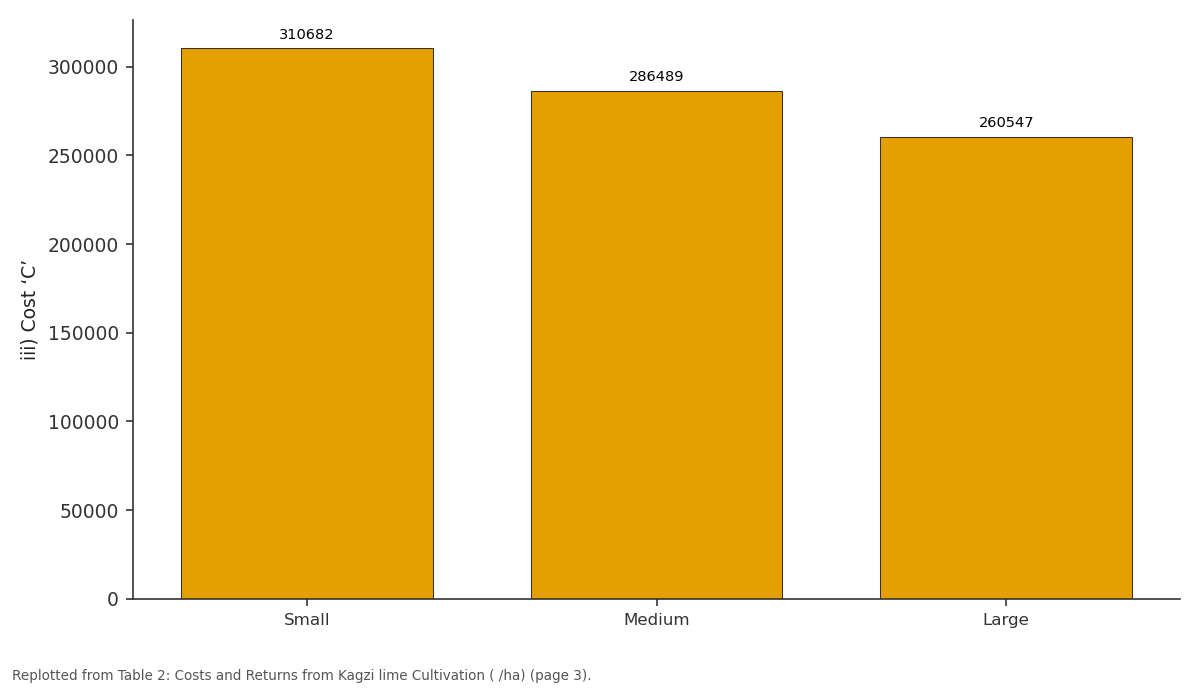
iii) Cost ‘C’: Small vs Medium vs Large
Replotted from Table 2 (page 3) of the original paper. Every bar is the paper's own table value.
View source evidence ↗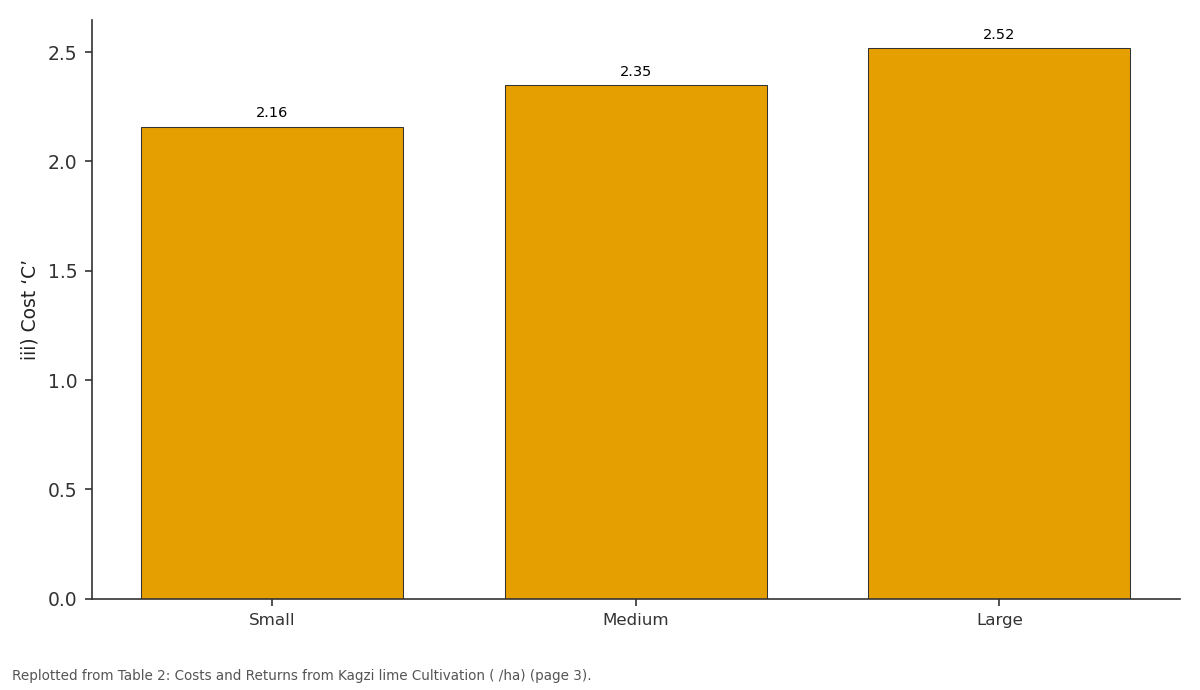
iii) Cost ‘C’: Small vs Medium vs Large
Replotted from Table 2 (page 3) of the original paper. Every bar is the paper's own table value.
View source evidence ↗Figures & tables
From the original paper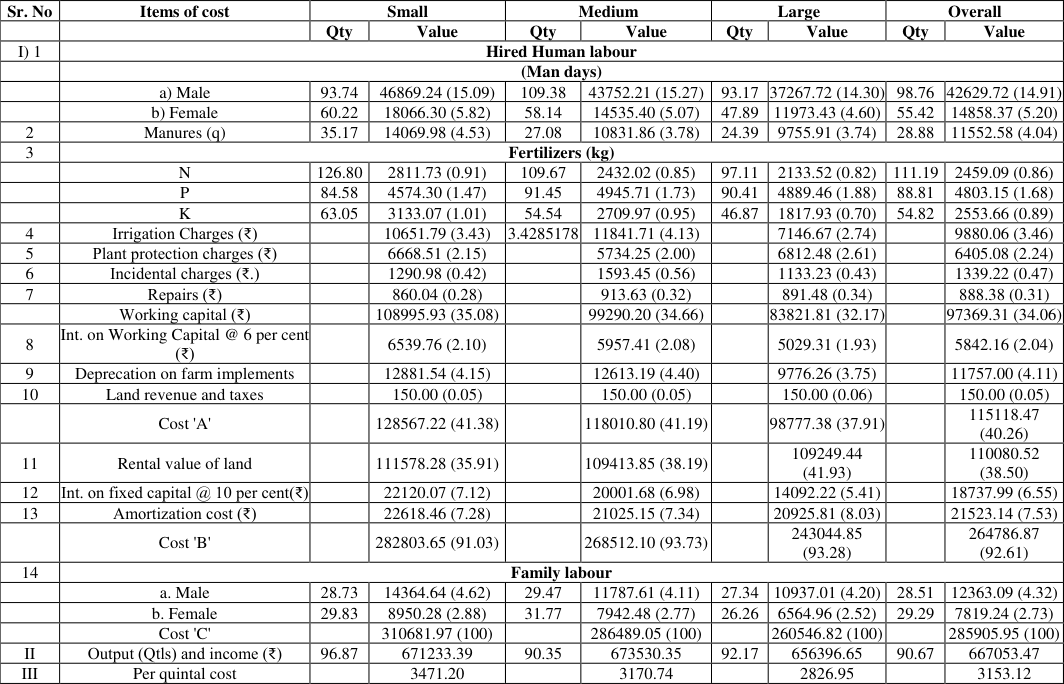 Table 1
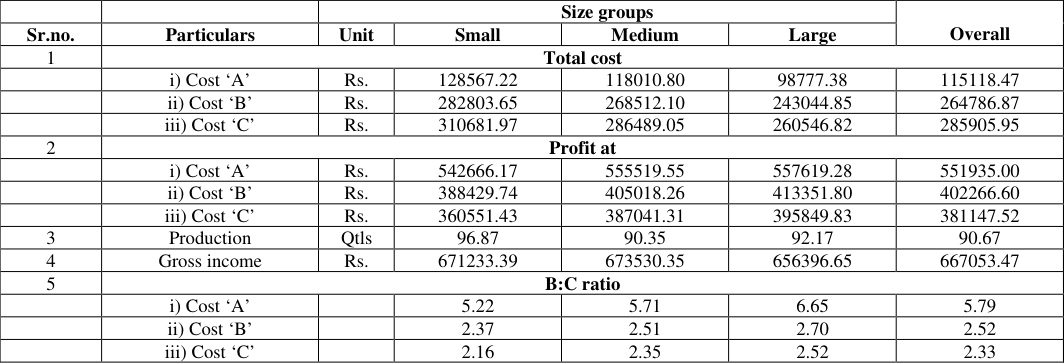 Table 2
Introduction
India, being the second-largest producer of fruits in the world, has a diverse Agro-climatic condition that supports the cultivation of a wide variety of fruit crops throughout the year. Fruits are rich sources of essential vitamins, minerals, antioxidants and dietary fiber. Economically, fruit cultivation provides more earnings per unit of cultivated land compared to many field crops, making it a profitable venture for small and marginal farmers. Programs such as National Horticulture Mission (NHM) and Mission for Integrated Development of Horticulture (MIDH) have been instrumental in promoting fruit production by providing financial and technical support to farmers for orchard development, improved planting material, post-harvest management and value addition.
Therefore, increasing fruit production is plays a key role in not only increasing dietary diversity and farmer livelihoods but also for advancing sustainable agricultural practices and enhancing the overall economy. The small-fruited kagzi lime, also known as "Mexican or key lime" worldwide and "Kagzi lime" in India, is one of the most common cultivars of lime of commercial importance. The most popular and affordable refreshing beverage, kagzi lime juice is thought to be the best source of vitamin C. Vitamin C (62.9 mg/100 ml), vitamin B1, vitamin B2 and minerals including calcium phosphorous and iron are all found in good amounts in limes.
In addition to its nutritional and healing properties, Kagzi lime is also highly regarded for its wide use in Indian culinary practices and in producing value-added products such as pickles, syrups, squash, cordials, citric acid, and cosmetics. The area under cultivation of kagzi lime in India incresed from 245.2 thousand hectares in 2015-16 to 316.11 thousand hectares in 2024-25, according to data released by the Department of Agriculture & Farmers Welfare in 2025. At the same time, production increased from 2437.6 thousand million tons to 3829.07 thousand tonnes. (Source: Department of Agriculture & Farmers Welfare). Maharashtra is referred to as India's most important fruit producing state.
Different parts of India cultivate different varieties of kagzi lime. In Maharashtra state, improved kagzi lime cultivars, including Pramalini, Vikram, Sai Sharbati, Phule Sarbati, PKM1 and Balaji, have been introduced. Maharashtra is home to the Phule sharbati kind of Kagzi lime. In Maharashtra, kagzi lime is a significant fruit crop.
It is NAAS Rating (2025): 4.97 IJAFS 2025; 7(8): 1120-1122 Karle NB Master Students Division of Agricultural economics, College of Agriculture, Pune, Maharashtra, India Deokate TB Assistant Professor, Division of Agricultural economics, College of Agriculture, Pune, Maharashtra, India Kumbhar JS Assistant Professor, Division of Agricultural economics, College of Agriculture, Pune, Maharashtra, India Kadam LD Master Students Division of Agricultural economics, College of Agriculture, Pune, Maharashtra, India Karle NB Master Students Division of Agricultural economics, College of Agriculture, Pune, Maharashtra, India https://www.agriculturaljournals.com villages were selected from these tahsils. Total 90 samples were selected for study. Tools of Analysis Estimation of Production Costs and Returns The production costs and returns of kagzi lime production were estimated on the basis of per hectare The standard cost concept were used and viz. cost ‘A’, cost ‘B’ and cost ‘C’ were worked out. The sample statistical tools viz. percentages and averages were used.
Results And Discussion
Cost of Cultivation of Kagzi Lime The per hectare cost of cultivating Kagzi lime for various farm size groups, as well as the overall average, is presented in Table 1. grown on 37.60 thousand hectares, yielding 429.41 thousand MT in total production and Productivity 11.42 MT/ha in 2023–24 (NHB, 2024). Kagzi lime is cultivated in Ahilyanagar district of Maharashtra State. Cultivated area under kagzi lime was 17.66 thousand hectares with production of 199.95 thousand MT and productivity was 11.32 tons per hectares during 2023-24. (DAO -2024 Ahilyanagar).
| Sr. No | Items of cost | Small | — | Medium | — | Large | — | Overall | — |
|---|---|---|---|---|---|---|---|---|---|
| Qty | Value | Qty | Value | Qty | Value | Qty | Value | ||
| I) 1 | Hired Human labour | ||||||||
| (Man days) | |||||||||
| a) Male | 93.74 | 46869.24 (15.09) | 109.38 | 43752.21 (15.27) | 93.17 | 37267.72 (14.30) | 98.76 | 42629.72 (14.91) | |
| b) Female | 60.22 | 18066.30 (5.82) | 58.14 | 14535.40 (5.07) | 47.89 | 11973.43 (4.60) | 55.42 | 14858.37 (5.20) | |
| 2 | Manures (q) | 35.17 | 14069.98 (4.53) | 27.08 | 10831.86 (3.78) | 24.39 | 9755.91 (3.74) | 28.88 | 11552.58 (4.04) |
| 3 | Fertilizers (kg) | ||||||||
| N | 126.80 | 2811.73 (0.91) | 109.67 | 2432.02 (0.85) | 97.11 | 2133.52 (0.82) | 111.19 | 2459.09 (0.86) | |
| P | 84.58 | 4574.30 (1.47) | 91.45 | 4945.71 (1.73) | 90.41 | 4889.46 (1.88) | 88.81 | 4803.15 (1.68) | |
| K | 63.05 | 3133.07 (1.01) | 54.54 | 2709.97 (0.95) | 46.87 | 1817.93 (0.70) | 54.82 | 2553.66 (0.89) | |
| 4 | Irrigation Charges (₹) | 10651.79 (3.43) | 3.4285178 | 11841.71 (4.13) | 7146.67 (2.74) | 9880.06 (3.46) | |||
| 5 | Plant protection charges (₹) | 6668.51 (2.15) | 5734.25 (2.00) | 6812.48 (2.61) | 6405.08 (2.24) | ||||
| 6 | Incidental charges (₹.) | 1290.98 (0.42) | 1593.45 (0.56) | 1133.23 (0.43) | 1339.22 (0.47) | ||||
| 7 | Repairs (₹) | 860.04 (0.28) | 913.63 (0.32) | 891.48 (0.34) | 888.38 (0.31) | ||||
| Working capital (₹) | 108995.93 (35.08) | 99290.20 (34.66) | 83821.81 (32.17) | 97369.31 (34.06) | |||||
| 8 | Int. on Working Capital @ 6 per cent (₹) | 6539.76 (2.10) | 5957.41 (2.08) | 5029.31 (1.93) | 5842.16 (2.04) | ||||
| 9 | Deprecation on farm implements | 12881.54 (4.15) | 12613.19 (4.40) | 9776.26 (3.75) | 11757.00 (4.11) | ||||
| 10 | Land revenue and taxes | 150.00 (0.05) | 150.00 (0.05) | 150.00 (0.06) | 150.00 (0.05) | ||||
| Cost 'A' | 128567.22 (41.38) | 118010.80 (41.19) | 98777.38 (37.91) | 115118.47 (40.26) | |||||
| 11 | Rental value of land | 111578.28 (35.91) | 109413.85 (38.19) | 109249.44 (41.93) | 110080.52 (38.50) | ||||
| 12 | Int. on fixed capital @ 10 per cent(₹) | 22120.07 (7.12) | 20001.68 (6.98) | 14092.22 (5.41) | 18737.99 (6.55) | ||||
| 13 | Amortization cost (₹) | 22618.46 (7.28) | 21025.15 (7.34) | 20925.81 (8.03) | 21523.14 (7.53) | ||||
| Cost 'B' | 282803.65 (91.03) | 268512.10 (93.73) | 243044.85 (93.28) | 264786.87 (92.61) | |||||
| 14 | Family labour | ||||||||
| a. Male | 28.73 | 14364.64 (4.62) | 29.47 | 11787.61 (4.11) | 27.34 | 10937.01 (4.20) | 28.51 | 12363.09 (4.32) | |
| b. Female | 29.83 | 8950.28 (2.88) | 31.77 | 7942.48 (2.77) | 26.26 | 6564.96 (2.52) | 29.29 | 7819.24 (2.73) | |
| Cost 'C' | 310681.97 (100) | 286489.05 (100) | 260546.82 (100) | 285905.95 (100) | |||||
| II | Output (Qtls) and income (₹) | 96.87 | 671233.39 | 90.35 | 673530.35 | 92.17 | 656396.65 | 90.67 | 667053.47 |
| III | Per quintal cost | 3471.20 | 3170.74 | 2826.95 | 3153.12 |
Table text extracted from the original PDF; superscript letters are shown inline. The original table image is below.
View original table image
Materials And Methods
Ahilyanagar district is one of the kagzi lime growing district of Maharashtra. The Ahilyanagar district was purposively selected for the study. Two tahsils Karjat and Shrigonda tahsils of Ahilyanagar district contributes major part of area under kagzi lime. Therefore these two tahsils selected for the study.
Three villages from each tahsil were selected on the basis of maximum area under kagzi lime. Thus, in all 6 Table 1: Cost and returns by farm size with input-wise breakdown ( / ha) Sr. No Items of cost Small Medium Large Overall Qty Value Qty Value Qty Value Qty Value I) 1 Hired Human labour (Man days) a) Male 93.74 46869.24 (15.09) 109.38 43752.21 (15.27) 93.17 37267.72 (14.30) 98.76 42629.72 (14.91) b) Female 60.22 18066.30 (5.82) 58.14 14535.40 (5.07) 47.89 11973.43 (4.60) 55.42 14858.37 (5.20) 2 Manures (q) 35.17 14069.98 (4.53) 27.08 10831.86 (3.78) 24.39 9755.91 (3.74) 28.88 11552.58 (4.04) 3 Fertilizers (kg) N 126.80 2811.73 (0.91) 109.67 2432.02 (0.85) 97.11 2133.52 (0.82) 111.19 2459.09 (0.86) P 84.58 4574.30 (1.47) 91.45 4945.71 (1.73) 90.41 4889.46 (1.88) 88.81 4803.15 (1.68) K 63.05 3133.07 (1.01) 54.54 2709.97 (0.95) 46.87 1817.93 (0.70) 54.82 2553.66 (0.89) 4 Irrigation Charges (₹) 10651.79 (3.43) 3.4285178 11841.71 (4.13) 7146.67 (2.74) 9880.06 (3.46) 5 Plant protection charges (₹) 6668.51 (2.15) 5734.25 (2.00) 6812.48 (2.61) 6405.08 (2.24) 6 Incidental charges (₹.) 1290.98 (0.42) 1593.45 (0.56) 1133.23 (0.43) 1339.22 (0.47) 7 Repairs (₹) 860.04 (0.28) 913.63 (0.32) 891.48 (0.34) 888.38 (0.31) Working capital (₹) 108995.93 (35.08) 99290.20 (34.66) 83821.81 (32.17) 97369.31 (34.06) 6539.76 (2.10) 5957.41 (2.08) 5029.31 (1.93) 5842.16 (2.04) 8 Int. on Working Capital @ 6 per cent (₹) 9 Deprecation on farm implements 12881.54 (4.15) 12613.19 (4.40) 9776.26 (3.75) 11757.00 (4.11) 10 Land revenue and taxes 150.00 (0.05) 150.00 (0.05) 150.00 (0.06) 150.00 (0.05) Cost 'A' 128567.22 (41.38) 118010.80 (41.19) 98777.38 (37.91) 115118.47 (40.26) 11 Rental value of land 111578.28 (35.91) 109413.85 (38.19) 109249.44 (41.93) 110080.52 (38.50) 12 Int. on fixed capital @ 10 per cent(₹) 22120.07 (7.12) 20001.68 (6.98) 14092.22 (5.41) 18737.99 (6.55) 13 Amortization cost (₹) 22618.46 (7.28) 21025.15 (7.34) 20925.81 (8.03) 21523.14 (7.53) Cost 'B' 282803.65 (91.03) 268512.10 (93.73) 243044.85 (93.28) 264786.87 (92.61) 14 Family labour a. Male 28.73 14364.64 (4.62) 29.47 11787.61 (4.11) 27.34 10937.01 (4.20) 28.51 12363.09 (4.32) b.
Female 29.83 8950.28 (2.88) 31.77 7942.48 (2.77) 26.26 6564.96 (2.52) 29.29 7819.24 (2.73) Cost 'C' 310681.97 (100) 286489.05 (100) 260546.82 (100) 285905.95 (100) II Output (Qtls) and income (₹) 96.87 671233.39 90.35 673530.35 92.17 656396.65 90.67 667053.47 III Per quintal cost 3471.20 3170.74 2826.95 3153.12 At the overall level, the per hectare maintenance cost for Kagzi lime orchards was ₹2,85,905.95. Of this, Cost ‘A’ amounted to ₹1,15,118.47, representing 40.26 per cent of the total cost (Cost ‘C’). Within Cost ‘A’, the largest expense was on hired male labour, which stood at ₹42,629.72, contributing 14.91 per cent to Cost ‘C’. Other significant costs included manure (₹11,552.58), irrigation charges (₹9,880.06) and plant protection (₹6,405.08), accounting for (4.04%), (3.46%) and 2.24 per cent, respectively.
In Cost ‘B’, the rental value of land and amortization were the major components, amounting to ₹1,10,080.52 and ₹21,523.14, respectively, contributing 38.50 per cent and 7.53 per cent to Cost ‘C’. For small farms, the per hectare maintenance cost was ₹3,10,681.97. Of this, Cost ‘A’ came to ₹1,28,567.22, which was 41.38 per cent of the total cost. The primary cost within this group was hired male labour at ₹46,869.24, contributing 15.09 per cent to the total cost.
The expenditure on manure was ₹14,069.98, comprising 4.53 per cent of Cost ‘C’. Under Cost ‘B’, the rental value of land and amortization represented 35.91 per cent and 7.28 per cent, respectively. In the medium-size group, the per hectare maintenance cost was ₹2,86,489.05, with Cost ‘A’ at ₹1,18,010.80, accounting for 41.19 per cent of Cost ‘C’. The main expense in Cost ‘A’ was hired human labour, amounting to ₹43,752.21 and contributing 15.27 per cent.
Manure expenses were ₹10,831.86, making up 3.78 per cent of the total cost. Under Cost ‘B’, the rental value of land accounted https://www.agriculturaljournals.com benefit-cost ratios from Kagzi lime cultivation are presented in Table 2 on an overall basis, the gross income generated per hectare was ₹6,67,053.47. The associated costs worked out to ₹1,15,118.47 for Cost ‘A’, ₹2,64,786.87 for Cost ‘B’ and ₹2,85,905.95 for Cost ‘C’. These figures translated into profits of ₹5,51,935.00, ₹4,02,266.60, and ₹3,81,147.52 at Cost ‘A’, Cost ‘B’ and Cost ‘C’ levels respectively.
| — | — | Size groups | — | — | — | Overall |
|---|---|---|---|---|---|---|
| Sr.no. | Particulars | Unit | Small | Medium | Large | |
| 1 | Total cost | |||||
| i) Cost ‘A’ | Rs. | 128567.22 | 118010.80 | 98777.38 | 115118.47 | |
| ii) Cost ‘B’ | Rs. | 282803.65 | 268512.10 | 243044.85 | 264786.87 | |
| iii) Cost ‘C’ | Rs. | 310681.97 | 286489.05 | 260546.82 | 285905.95 | |
| 2 | Profit at | |||||
| i) Cost ‘A’ | Rs. | 542666.17 | 555519.55 | 557619.28 | 551935.00 | |
| ii) Cost ‘B’ | Rs. | 388429.74 | 405018.26 | 413351.80 | 402266.60 | |
| iii) Cost ‘C’ | Rs. | 360551.43 | 387041.31 | 395849.83 | 381147.52 | |
| 3 | Production | Qtls | 96.87 | 90.35 | 92.17 | 90.67 |
| 4 | Gross income | Rs. | 671233.39 | 673530.35 | 656396.65 | 667053.47 |
| 5 | B:C ratio | |||||
| i) Cost ‘A’ | 5.22 | 5.71 | 6.65 | 5.79 | ||
| ii) Cost ‘B’ | 2.37 | 2.51 | 2.70 | 2.52 | ||
| iii) Cost ‘C’ | 2.16 | 2.35 | 2.52 | 2.33 |
Table text extracted from the original PDF; superscript letters are shown inline. The original table image is below.
View original table image
Consequently, the benefit-cost ratios were calculated as 5.79 for Cost ‘A’, 2.52 for Cost ‘B’ and 2.33 for Cost ‘C’. When examined across farm size categories, the total per hectare cost (Cost ‘C’) amounted to ₹3,10,681.97 for small farms, ₹2,86,489.05 for medium farms, and ₹2,60,546.82 for large farms. These cost structures resulted in corresponding profits of ₹3,60,551.43, ₹3,87,041.31, and ₹3,95,849.83, respectively. The gross returns obtained per hectare were ₹6,71,233.39 for small farms, ₹6,73,530.35 for medium farms and ₹6,56,396.65 for large farms.
Accordingly, the benefit-cost ratios at the total cost level were 2.16, 2.35, and 2.52 for small, medium and large farm groups, indicating that larger farms achieved relatively better economic efficiency in Kagzi lime cultivation. for 38.19 per cent and amortization for 7.34 per cent of the total cost. For the large size group, the per hectare maintenance cost was the lowest, at ₹2,60,546.82. Cost ‘A’ total ₹98,777.38, contributing 37.91 per cent to Cost ‘C’. The leading cost under this was hired male labour, which stood at ₹37,267.72 (14.30%).
Manure costs were ₹9,755.91, comprising 3.74 per cent of the total. In Cost ‘B’, the rental value of land contributed the highest share at 41.93 per cent, while amortization accounted for 8.03 per cent. The per hectare cost of cultivation for Kagzi lime orchards decreased with increasing farm size, from ₹3,10,681.97 on small farms to ₹2,60,546.82 on large farms, reflecting better cost efficiency. Hired male labour and rental value of land were the major cost components across all farm sizes, while manure and amortization contributed moderately to the total expenses.
Costs, Returns, Gross Income and B:C Ratio From Kagzi Lime cultivation The detailed estimates of per hectare costs namely Cost ‘A’, Cost ‘B’, and Cost ‘C’ along with returns, profits and Table 2: Costs and Returns from Kagzi lime Cultivation ( /ha) Size groups Overall Sr.no. Particulars Unit Small Medium Large 1 Total cost i) Cost ‘A’ Rs. 128567.22 118010.80 98777.38 115118.47 ii) Cost ‘B’ Rs. 282803.65 268512.10 243044.85 264786.87 iii) Cost ‘C’ Rs. 310681.97 286489.05 260546.82 285905.95 2 Profit at i) Cost ‘A’ Rs. 542666.17 555519.55 557619.28 551935.00 ii) Cost ‘B’ Rs. 388429.74 405018.26 413351.80 402266.60 iii) Cost ‘C’ Rs. 360551.43 387041.31 395849.83 381147.52 3 Production Qtls 96.87 90.35 92.17 90.67 4 Gross income Rs. 671233.39 673530.35 656396.65 667053.47 5 B:C ratio i) Cost ‘A’ 5.22 5.71 6.65 5.79 ii) Cost ‘B’ 2.37 2.51 2.70 2.52 iii) Cost ‘C’ 2.16 2.35 2.52 2.33 At the overall level, the benefit-cost ratio at Cost ‘C’ was recorded at 2.33, clearly reflecting that Kagzi lime cultivation is a financially rewarding and economically viable fruit crop.
Conclusions
The total per hectare cost of production (Cost 'C') for Kagzi lime was calculated to be ₹2,85,905.95, with Cost 'A' and Cost 'B' contributing (40.26%) and (92.61%), respectively. A major component of Cost 'A' was the cost of hired human labour. The Benefit-Cost (B:C) ratio of more than unity clearly demonstrated that Kagzi lime cultivation is economically viable and profitable for farmers in the Ahilyanagar district.
References
8 in the original paper- Bante R, Sarju P, Ravi S. Economics of orange production in Nagpur district of Maharashtra. Int Res J Agric Econ Stat. 2015;6(1):136–139.
- Jorwar RM, Ulemale DH, Sarap SM. Economics of production and marketing of tomato in Amravati district. 2017.
- Kumar S, Patel D. Economic viability of mango orchards in different farm sizes in Maharashtra. Indian J Hortic. 2020;77(4):625–631.
- Naik SS. Economics of production and marketing of coconut in Raigad district of Maharashtra [MSc thesis]. Rahuri (India): Mahatma Phule Krishi Vidyapeeth (MPKV); 2015. Unpublished.
- Purushottam BA. An economic analysis of production and marketing of mandarin orange in Maharashtra [doctoral dissertation]. Pusa (India): RPCAU; 2023.
- Rajale DK, Maurya MK, Dhangar DB, Dhivare RS. Kagzi lime orchard’s production costing in Dhule district of Maharashtra. J Res Agric Anim Sci. 2021;8(1):1–8.
- Raut HG. Economics of production and marketing of kagzi lime in Jalna district of Maharashtra [MSc thesis]. Rahuri (India): Mahatma Phule Krishi Vidyapeeth (MPKV); 2018. Unpublished.
- Sundar A, Selvi RG. Lime (Citrus aurantifolia) production in Tirunelveli district of Tamil Nadu: an economic analysis. Int J Agric Sci. 2019;11(5):876– 880.