
Research article · 2025 · Full text
International Journal of Horticulture and Food ScienceComparative evaluation of growth and yield in improved and local Radish varieties in Varanasi region
Volume 7(8) · Pages 98–101 · DOI: 10.33545/26631067.2025.v7.i8b.372 ↗
Research areasPost-Communist Economic and Political TransitionAgriculture and Biological StudiesAgricultural Development and Policies
Abstract
Author-writtenAn investigation was conducted to assess the performance of various radish varieties, focusing on growth, yield, and quality attributes. Statistical analysis of the data revealed significant varietal differences across all parameters. For growth, Kashi Mooli-40 demonstrated the highest leaf count (10.73), while Pusa Desi exhibited the greatest shoot length (6.73 cm). The shoot length was maximum (6.73 cm) in Pusa Desi. The variety Kashi Lohit has recorded maximum (1223.87 cm2) leaf area. The variety Kashi Hans required minimum (43.33) number of days for the edible size of root. The significant differences in yield parameters were observed. The root weight and shoot weight was maximum in variety Kashi Hans and Pusa Himani had the highest root-to-shoot ratio (4.45). Ultimately, Pusa Reshmi was identified as the superior variety for yield, producing the maximum root yield of 33.23 kg per plot.
Summary
Source-checkedPlain-language reading of the full paper, prepared with AI and checked against the text. Each point links to the authors' own words.
Why it matters
- Radish is a root vegetable grown worldwide and has been consumed by humans since approximately 400 BC. View evidence ↗
- The crop is an important nutritional source, providing fiber, minerals, and vitamin C. View evidence ↗
- Rising demand for salad vegetables creates a need for radish varieties that combine high yields with high quality. View evidence ↗
The question
- The study aims to evaluate how different improved and local radish varieties perform specifically within the Varanasi region. View evidence ↗
What they did
- The researchers used a Randomized Block Design with ten different variety treatments and three replications. View evidence ↗
- The ten varieties tested included improved varieties (Pusa Desi, Pusa Chetki, Pusa Himani, Pusa Reshmi, and Japanese White) and local cultivars (Kashi Mooli 40, Kashi Lohit, Kashi Sweta, Kashi Hans, and Kashi Andhra). View evidence ↗
- The experiment was conducted across 30 plots, each measuring 2.00 x 1.75 square meters. View evidence ↗
- The study measured growth parameters (leaf count, shoot length, leaf area, and days to edible size) and yield parameters (root weight, shoot weight, root-to-shoot ratio, and root yield per plot). View evidence ↗
What they found
- Kashi Mooli-40 had the highest leaf count at 10.73, while Japanese White had the lowest at 7.20. View evidence ↗
- The Pusa Desi variety achieved the maximum shoot length of 6.73 cm. View evidence ↗
- The maximum leaf area per plant was 1223.87 cm² in Kashi Lohit, compared to the minimum of 610.24 cm² in Kashi Aardra. View evidence ↗
- Kashi Hans reached edible size the fastest (43.33 days), while Pusa Himani took the longest (60.33 days). View evidence ↗
- The highest root weight was found in Kashi Hans (160.46 g) and the lowest in Pusa Reshmi (132.53 g). View evidence ↗
- Kashi Hans produced the maximum shoot weight (64.85 g), while Pusa Himani produced the minimum (29.98 g). View evidence ↗
- Pusa Himani had the highest root-to-shoot ratio (4.45), and Kashi Lohit had the lowest (2.34). View evidence ↗
- Pusa Reshmi produced the highest root yield at 33.23 kg per plot, while Kashi Aardra produced the lowest at 24.16 kg per plot. View evidence ↗
What it means
- The authors conclude that Pusa Desi, Kashi Hans, Pusa Reshmi, Pusa Himani, Japanese White, Kashi Mooli-40, and Kashi Sweta are well-suited for the Varanasi region due to their superior performance. View evidence ↗
- Among the local varieties tested, Kashi Mooli-40 was identified as the most favorable. View evidence ↗
Visual summary
3 visualsIllustrations explain the paper; charts are replotted from the paper's own table values.
Experimental Setup Overview
AI-generated conceptual illustration (Radish plants (Raphanus sativus)). It explains the idea and does not show study data.
View source evidence ↗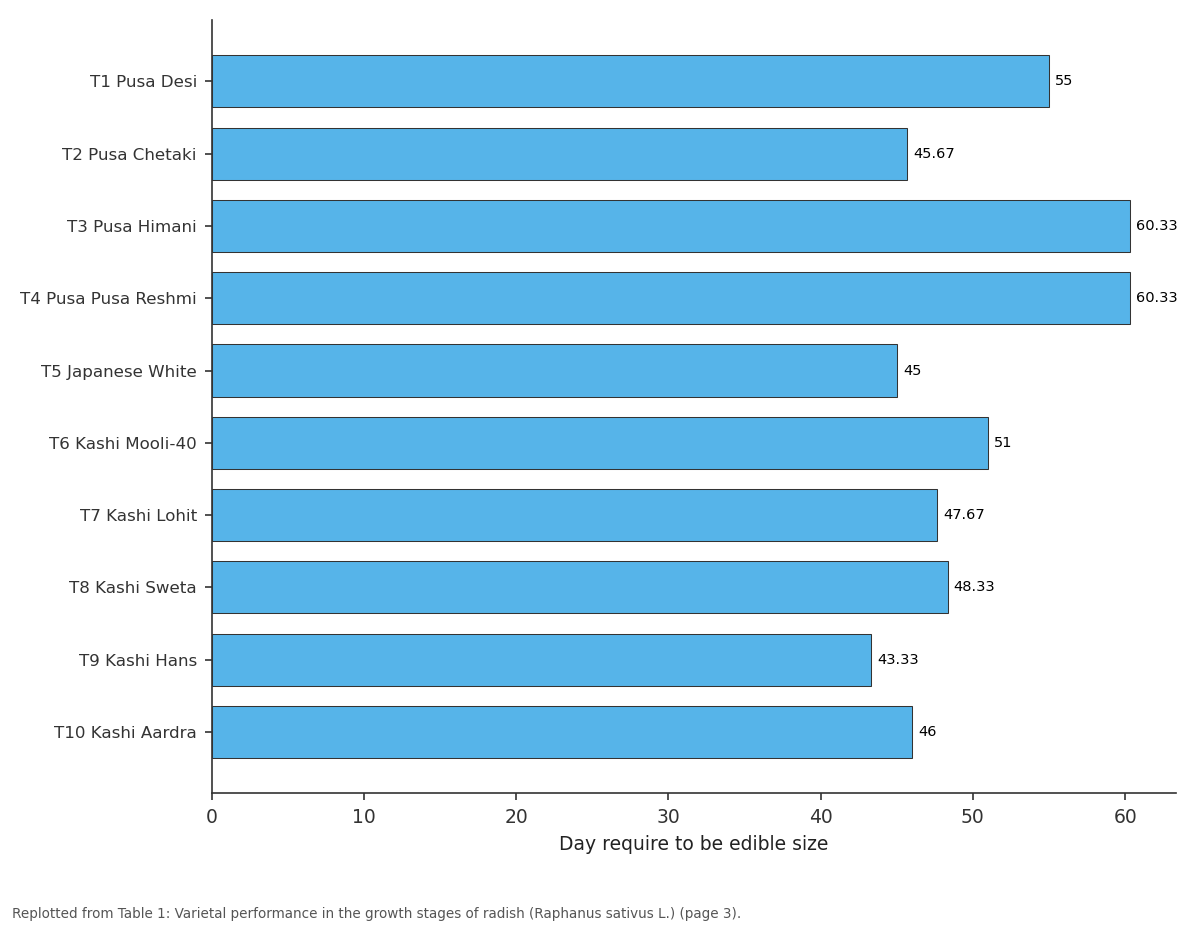
Day require to be edible size: T1 Pusa Desi vs T2 Pusa Chetaki vs T3 Pusa Himani vs T4 Pusa Pusa Reshmi vs T5 Japanese White
Replotted from Table 1 (page 3) of the original paper. Every bar is the paper's own table value.
View source evidence ↗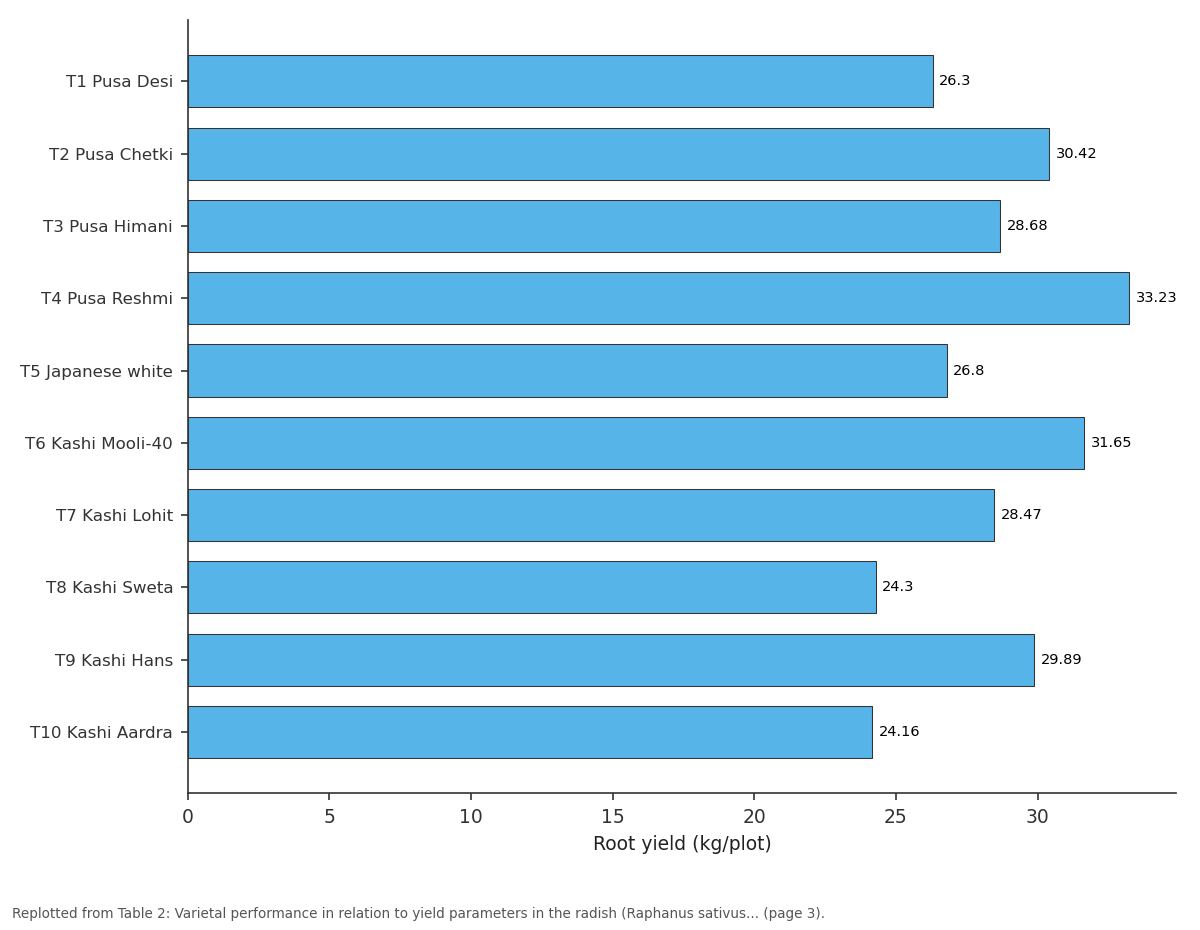
Root yield (kg/plot): T1 Pusa Desi vs T2 Pusa Chetki vs T3 Pusa Himani vs T4 Pusa Reshmi vs T5 Japanese white
Replotted from Table 2 (page 3) of the original paper. Every bar is the paper's own table value.
View source evidence ↗Figures & tables
From the original paper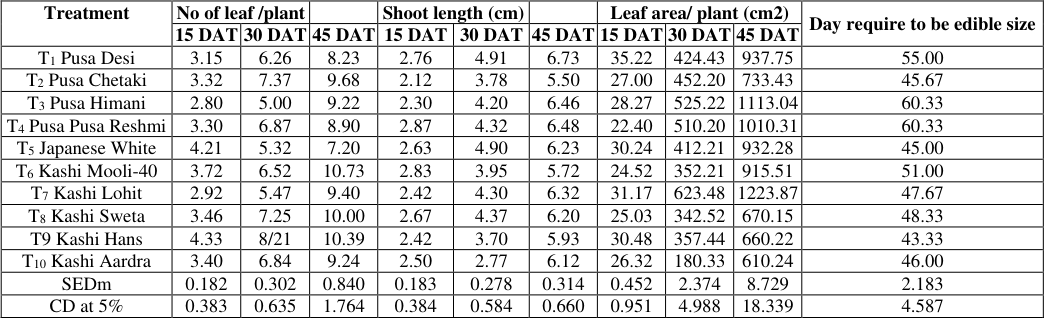 Table 1
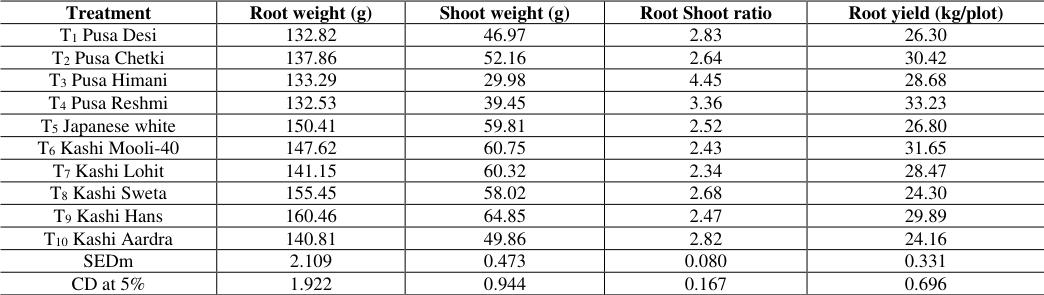 Table 2
Introduction
Radish (Raphanus sativus L.) is a globally cultivated root vegetable with a history of human consumption dating back to at least 400 BC. It was recorded for human consumption dates back to approximately 400 BC, indicating that it is an ancient domesticated species native to both the Eastern Mediterranean and Eastern Asia (Becker 1962; George and Evans 1981; Kaneks and Matsuzawa 1993) [3,10,11] . The Middle East and Eastern Asia are considered its centers of origin. Radish is a diploid, cross-pollinated brassicaceous crop with 2n=18 chromosomes. Varieties can be annual or biennial and are grown for their swollen tap roots, which can be globular, tapering, or cylindrical. It is a diploid organism possessing two sets of eighteen chromosomes (2n=18), (Richharia 1937) [18] . The ideal temperature for achieving optimal size, texture, and enhanced flavor ranges from 15 °C to 18 °C (Angell and Hillyer, 1962). Radish seeds exhibit superior germination at a temperature of 5 °C, with an optimal threshold of 15 °C to attain the highest germination percentage in radish (Abdel et al., 2016) [1] . It is predominantly a cool-season crop (optimum temperature: 15-18 °C), Asiatic varieties are known to tolerate higher temperatures. In India, it is sown from September to January in the northern plains, but can be grown year-round in the milder climate of peninsular India. Radish is a valuable source of vitamin C, minerals, and fiber. The USDA Nutrient Database (2007) notes that 100 g of edible radish contains 94.4 g moisture, 66kJ of energy, and 3.4g carbohydrates. In India, radish cultivation covered 0.212 million hectares in 2019-2020, with an annual production of 3.107 metric tons. This contributes to the national vegetable production, which stood at 191.76 million metric tons from an area of 10.35 million hectares during the same period. The seeds are also a source of fatty oil used for various purposes, including soap making. It is a vital part of agriculture, with India producing 3.107 metric tons of the crop from 0.212 million hectares in 2019-2020. The crop is a good source of vitamins, minerals, and fiber. Despite its importance and the availability of numerous varieties (such as Pusa Desi, Pusa Chetki, and Kashi Hans), the performance of these cultivars including their growth, yield, and quality varies significantly by location. The increasing demand for salad vegetables highlights the need for varieties that are not only high-yielding but also possess superior quality. This investigation, therefore, seeks to fill this knowledge gap by assessing the performance of various improved and local radish cultivars specifically in the Varanasi region. Beyond its agricultural significance, radish is also a nutrient-dense food, providing important vitamins, minerals, and fiber. The growing trend of urbanization and changing food habits has led to a sharp increase in the demand for quality salad vegetables. Growers and consumers alike are seeking varieties that not only offer higher yields but also better quality. The new trend in vegetable production is not only to obtain higher yields but also to have better quality produce. Among these factors variety is a predominant. Several varieties of radish are available in the market having varying length, size, colour, taste yield potential and quality parameters. As radishes constitute a vital component of salads, they remain in high demand throughout the year in metropolitan areas. The growth, yield, and quality of various radish cultivars exhibit considerable variation across different locales and regions. Additionally, certain indigenous varieties have been cultivated for an extended period. Radishes serve as effective companion plants for numerous other crops, likely due to their pungent aroma, which deters a range of insects and pests, including aphids, cucumber beetles, tomato hornworms, squash bugs, and ants. Furthermore, they can act as a trap crop, enticing insect pests away from the primary crops. The performance of a given radish variety is highly dependent on its specific growing environment. Therefore, a localized study is essential to identify the most suitable improved and local cultivars. This investigation was initiated to evaluate and compare the growth, yield, and quality characteristics of different radish varieties under the specific conditions of the Varanasi region. In light of these considerations, the present study is entitled "Comparative Evaluation of Growth and Yield in Improved and Local Radish Varieties in Varanasi region.
Methods and Materials
The experiments were designed using a Randomized Block Design, encompassing three replications and ten treatments, each featuring a single variety. The treatments within each replication were assigned randomly, specifically: T 1 Pusa Desi, T 2 Pusa Chetki, T 3 Pusa Himani, T 4 Pusa Reshmi, T 5 Japanese White, T 6 Kashi Mooli 40, T 7 Kashi Lohit, T 8 Kashi Sweta, T9 Kashi Hans, and T 10 Kashi Andhra. Seeds from five enhanced radish varieties namely Pusa Deshi, Pusa Chetaki, Pusa Reshami, and Japanese White Radish were procured from diverse sources. Additionally, seeds of five local cultivars, including Kashi Mooli 40, Kashi Lohit, Kashi Sweta, Kashi Hans, and Kashi Aardra, were gathered from farmers within their respective localities as well as from the authantic source in Varanasi. The land was brought to a fine tilth by ploughing, clod crushing, and two cross harrowing. An area was marked in 30 plots having 2.00×1.75 m2sizes. The distances of 0.5 m was kept between two plots & 1.0 between two replications.
Since as per ideal data the requirement of Nitrogen (N), Phosphorus (P) and Potassium (K) per hectare land for radish cultivation is 50 kg, 100 kg and 50 kg respectively. The observations were recorded on the different growth and yield parameter such as Growth (no. of leaves, shoot length, leaf area day required to be edible size), yield (root weight, shoot weight, root shoot ratio, root yield per plot). Test of significance for correlation coefficients at phenotypic level the estimated values were compared with the table value (statistical table by Fisher and Yates, 1963) at (n-1) degree of freedom at 5% level of significance, respectively.
Results and Discussion
Results and Discussion
Growth performance of different radish varieties
The results of the current investigations revealed that no significant differences were observed regarding the number of leaves, shoot length, leaf area, and the duration required to reach edible size among the various cultivars at distinct growth stages. The apex of leaf count (10.73) was recorded in the Kashi Mooli-40 variety, whereas the nadir (7.20) was noted in the Japanese White cultivar. Maximum shoot length was produced by Pusa Desi (6.73cm). Leaf area per plant was maximum in variety Kashi Lohit (1223.87cm2) and minimum in variety Kashi Aardra (610.24 cm2). The duration required to achieve an edible size ranged from 43.33 to 60.33 days. The minimum duration observed (43.33 days) was recorded for the variety Kashi Hans, whereas the maximum (60.33 days) was necessitated by the variety Pusa Himani. This might be due to the genetic makeup of the plant and its expression to the growing soil and environmental conditions. Similar result were found by Ponnuswami et al. (1980) [14] , Rabbani et al. (1998) [16] and Pujari et al. (1977) [15] in radish.
Yield and quality characters of different radish varieties
The results indicated that the root weight, shoot weight, root-to-shoot ratio, and root yield were significantly influenced across the various cultivars. Data pertaining to root weight revealed that the maximum was observed in the Kashi Hans variety (160.46 g). However, the minimum root weight (132.53 g) was recorded in variety Pusa Reshmi. The maximum shoot weight (64.85 g) was observed in variety Kashi Hans and the minimum (29.98g) in Pusa Himani. The maximum root: shoot ratio was obtained (4.45) in Pusa Himani and minimum (2.34) in Kashi Lohit. The maximum root yield, recorded at an impressive 33.23 kg per plot, was achieved by the variety Pusa Reshmi, whereas the minimum yield of 24.16 kg per plot was observed in the variety Kashi Aardra. The disparities in maturity periods can be ascribed to the inherent genetic differences among the cultivars, along with the ecological and climatic conditions influencing their growth. The variation in the root weight, shoot weight, root: shoot ratio and root yield might be due to genetic variation changes in climatic conditions and Management factors. Similar trend of result was also observed by Rajagopal et al. (1979) [17] , Dixit et al. (1980) [9] , Deotale et al. (1994) [7] .
Conclusion
The critical evaluation of the outcomes of the present investigation revealed that significant variations were observed in the growth and yield of the various radish cultivars examined. A positive correlation was identified between root yield and several growth and root characteristics, including shoot length, leaf area, edible size, and root girth. In summary, the radish varieties Pusa Desi, Kashi Hans, Pusa Reshmi, Pusa Himani, Japanese White, Kashi Mooli-40, and Kashi Sweta demonstrated markedly superior performance concerning most growth, yield, and quality parameters. Consequently, these varieties are wellsuited to the agro-climatic conditions of Varanasi. Among the local cultivars, the variety Kashi Mooli-40 yielded the most favorable results.
Figures and tables from the paper
| Treatment | No of leaf /plant | — | — | Shoot length (cm) | — | — | Leaf area/ plant (cm2) | — | — | Day require to be edible size |
|---|---|---|---|---|---|---|---|---|---|---|
| 15 DAT | 30 DAT | 45 DAT | 15 DAT | 30 DAT | 45 DAT | 15 DAT | 30 DAT | 45 DAT | ||
| T1 Pusa Desi | 3.15 | 6.26 | 8.23 | 2.76 | 4.91 | 6.73 | 35.22 | 424.43 | 937.75 | 55.00 |
| T2 Pusa Chetaki | 3.32 | 7.37 | 9.68 | 2.12 | 3.78 | 5.50 | 27.00 | 452.20 | 733.43 | 45.67 |
| T3 Pusa Himani | 2.80 | 5.00 | 9.22 | 2.30 | 4.20 | 6.46 | 28.27 | 525.22 | 1113.04 | 60.33 |
| T4 Pusa Pusa Reshmi | 3.30 | 6.87 | 8.90 | 2.87 | 4.32 | 6.48 | 22.40 | 510.20 | 1010.31 | 60.33 |
| T5 Japanese White | 4.21 | 5.32 | 7.20 | 2.63 | 4.90 | 6.23 | 30.24 | 412.21 | 932.28 | 45.00 |
| T6 Kashi Mooli-40 | 3.72 | 6.52 | 10.73 | 2.83 | 3.95 | 5.72 | 24.52 | 352.21 | 915.51 | 51.00 |
| T7 Kashi Lohit | 2.92 | 5.47 | 9.40 | 2.42 | 4.30 | 6.32 | 31.17 | 623.48 | 1223.87 | 47.67 |
| T8 Kashi Sweta | 3.46 | 7.25 | 10.00 | 2.67 | 4.37 | 6.20 | 25.03 | 342.52 | 670.15 | 48.33 |
| T9 Kashi Hans | 4.33 | 8/21 | 10.39 | 2.42 | 3.70 | 5.93 | 30.48 | 357.44 | 660.22 | 43.33 |
| T10 Kashi Aardra | 3.40 | 6.84 | 9.24 | 2.50 | 2.77 | 6.12 | 26.32 | 180.33 | 610.24 | 46.00 |
| SEDm | 0.182 | 0.302 | 0.840 | 0.183 | 0.278 | 0.314 | 0.452 | 2.374 | 8.729 | 2.183 |
| CD at 5% | 0.383 | 0.635 | 1.764 | 0.384 | 0.584 | 0.660 | 0.951 | 4.988 | 18.339 | 4.587 |
Table text extracted from the original PDF; superscript letters are shown inline. The original table image is below.
View original table image
| Treatment | Root weight (g) | Shoot weight (g) | Root Shoot ratio | Root yield (kg/plot) |
|---|---|---|---|---|
| T1 Pusa Desi | 132.82 | 46.97 | 2.83 | 26.30 |
| T2 Pusa Chetki | 137.86 | 52.16 | 2.64 | 30.42 |
| T3 Pusa Himani | 133.29 | 29.98 | 4.45 | 28.68 |
| T4 Pusa Reshmi | 132.53 | 39.45 | 3.36 | 33.23 |
| T5 Japanese white | 150.41 | 59.81 | 2.52 | 26.80 |
| T6 Kashi Mooli-40 | 147.62 | 60.75 | 2.43 | 31.65 |
| T7 Kashi Lohit | 141.15 | 60.32 | 2.34 | 28.47 |
| T8 Kashi Sweta | 155.45 | 58.02 | 2.68 | 24.30 |
| T9 Kashi Hans | 160.46 | 64.85 | 2.47 | 29.89 |
| T10 Kashi Aardra | 140.81 | 49.86 | 2.82 | 24.16 |
| SEDm | 2.109 | 0.473 | 0.080 | 0.331 |
| CD at 5% | 1.922 | 0.944 | 0.167 | 0.696 |
Table text extracted from the original PDF; superscript letters are shown inline. The original table image is below.
View original table image
References
22 in the original paper- Abdel CG, Asaad SS, Mohammad DS. Minimum, optimum and maximum temperatures required for germination of onion, radish, tomato and pepper. Int J Farming Allied Sci. 2016;5(1):26-45.
- Angell FF, Hillyer IG. Cultural and environmental conditions affecting radish root hypocotyls development. Proc Am Soc Hortic Sci. 1962;81:402407.
- Becker G. Handbuch Die Kulturpflanze. Vol. 6. Stuttgart; 1962, p. 23-78.
- Bose TK, Kabir J, Das P, Joy PP. Tropical Horticulture. Vol. 1. Calcutta: Naya Prakash; 2000, p. 145.
- Bhatti MH, Ullah HI, Khan S, Shakoor A. Studies on evaluation of exotic and local cultivars of radish. Pak J Agric Res. 1983;4(1):17-21.
- Chapagain TR, Piya S, Dangal NB, Mandal JL, Chaudhary BP. Comparisons of commercial and local cultivars of radish at different levels of manures and fertilizers. Nepal J Sci. Technol. 2010;11:51-56.
- Deotale AB, Bilorkar PV, Bedvaik NG, Patil SR, Rathod JR. Studies on performance of some radish (Raphanus sativus L.) cultivars under Nagpur conditions. J Soils Crops. 1994;4(2):120-121.
- Dhananjaya. Organic studies in radish (Raphanus sativus L.) varieties [MSc Thesis]. Dharwad: University of Agricultural Sciences; 2007, p. 63.
- Dixit J, Singh RP, Gaur GS. A note on varietal performance of radish (Raphanus sativus L.). Haryana J Hortic Sci. 1980;9(1-2):98-100.
- George R, Evans D. A classification of winter radish cultivars. Euphytica. 1981;30:483-492.
- Kaneko Y, Matsuzawa Y. Radish (Raphanus sativus L.). In: Bassett MJ, editor. Genetic Improvement of Vegetable Crops. Oxford: Pergamon Press; 1983, p. 487-505.
- Kumar JC, Sooch BS, Khurana BS. Evaluation of radish cultivars for yield and its parameters during spring season. Punjab Veg Grower. 1995;(30):62-63.
- Philippine Council for Agriculture, Forestry and Natural Resources Research and Development (PCARRD). Philippine recommends for radish. Los Baños: PCARRD; 2009. Available from: http://mboard.pcarrd.dost.gov.ph/forum.viewtopic.php/i d-11385
- Ponnuswami V, Vadives E. Studies on variability in radish (Raphanus sativus L.). South Indian Hortic. 1980;30:42-44.
- Pujari MM, Jain MM, Mishra GM. Investigation on morphological features and yield potential of promising radish (Raphanus sativus L.) cultivars. Haryana J Hortic Sci. 1977;6(1-2):85-89.
- Rabbani MA, Murakami Y, Kuginuki Y, Takayanagi K. Genetic variation in radish (Raphanus sativus L.) germplasm from Pakistan using morphological traits and RAPDs. Genet Resour Crop Evol. 1998;45:307316.
- Rajagopal A, Rangaswamy P, Metha A. Studies on varietal evaluation in radish. South Indian Hortic. 1979;27:75-78.
- Richharia RH. Cytological investigation of Raphanus sativus, Brassica oleracea and their F1 and F2 hybrids. J Genet. 1937;1:19-44.
- Salaria AS, Salaria BS. Horticulture at a Glance. Vol. 2. New Delhi: Jain Brothers; 2009, p. 7-8.
- Singh GP, Pandita ML, Singh GR. Effect of date of sowing on growth, yield and quality of different cultivars of radish. Haryana J Hortic Sci. 1979;8(34):134-138.
- US Department of Agriculture. USDA table of nutrient retention factors, release six. Nutrient Data Laboratory [Internet]. Washington (DC): USDA; 2007 [cited 2025 Aug 22]. Available from: http://www.ars.usda.gov/main/docs.htm?docid=9448
- Warwick S. Brassicaceae in agriculture. In: Schmidt R, Bancroft I, editors. Genetics and Genomics of the Brassicaceae. Gatersleben: Springer; 2011, p. 33-66.