
Research article · 2025 · Full text
International Journal of Agriculture and Food ScienceCollar rot of chickpea: In vivo evaluation of fungicides, bioagents and soil amendments for disease management
Volume 7(8) · Pages 970–973 · DOI: 10.33545/2664844x.2025.v7.i8i.663 ↗
Research areasGenetic and Environmental Crop StudiesAgricultural pest management studiesLegume Nitrogen Fixing Symbiosis
Abstract
Author-writtenOne of the major pulse crops cultivated in temperate, sub-tropical and tropical climates worldwide is the chickpea (Cicer arietinum L.). Chickpea is known to affect by many fungal, bacterial and viral diseases. Among them, chickpea collar rot occurs in moderate to severe form in Gujarat state. Looking to the symptomatology, affected seedlings turn yellow, upon uprooting seedlings show rotting at the collar region which covered with whitish mycelial strands. A white mycelial coating can be seen on the tap root of completely dried seedlings and produced mustard grain sized light to dark brown structures known as sclerotia. Evaluation of different fungicides, bioagents and soil amendments against Sclerotium rolfsii under field condition and showed that all the treatments were effective as compare to control. Carboxin 37.5 + thiram 37.5 WS showed minimum disease incidence (6.22%) with maximum disease reduction over control (75.00%) whereas, neem cake treatment recorded maximum per cent disease incidence of (20.85%) with minimum disease reduction over control (16.67%). The corresponding maximum seed yield (1360 kg/ha) was observed in carboxin 37.5 + thiram 37.5 WS with per cent seed yield increase over control of 19.77 per cent whereas, control treatment exhibited minimum seed yield (1091 kg/ha).
Summary
Source-checkedPlain-language reading of the full paper, prepared with AI and checked against the text. Each point links to the authors' own words.
Why it matters
- Chickpea is a globally important annual pulse crop, ranking third among grain legumes. View evidence ↗
- Collar rot is a disease that affects chickpea crops in moderate to severe forms within the Gujarat state. View evidence ↗
- The disease is caused by a fast-spreading, soil-borne fungal pathogen that significantly damages plant stands. View evidence ↗
The question
- The study aimed to evaluate the efficacy of various fungicides, bioagents, and soil amendments in managing collar rot caused by Sclerotium rolfsii. View evidence ↗
What they did
- The researchers used a Randomized Block Design with three replications, planting chickpea variety 'GG-3' at a rate of 60 kg/ha. View evidence ↗
- Treatments included seed application followed by drenching 25 days after sowing at a rate of 400 L of solution per hectare. View evidence ↗
- Disease incidence was monitored by observing 25 plants per plot (5 plants per row). View evidence ↗
What they found
- The combination of seed treatment and drenching with carboxin 37.5 + thiram 37.5 WS was most effective, resulting in the lowest disease incidence (6.22%) and the highest reduction over control (75.00%). View evidence ↗
- Fluxapyroxad 33.3 SC and mancozeb 75 WP were also effective, showing disease incidences of 9.17% and 11.24%, and reductions of 63.33% and 55.00% respectively. View evidence ↗
- Neem cake was the least effective treatment with 20.85% disease incidence (16.67% reduction), while the control group had the highest incidence at 25.02%. View evidence ↗
- The carboxin 37.5 + thiram 37.5 WS treatment produced the highest seed yield of 1360 kg/ha, a 19.17% increase over the control. View evidence ↗
- The control group produced the lowest seed yield at 1091 kg/ha. View evidence ↗
What it means
- The authors conclude that seed treatment followed by drenching with carboxin 37.5 + thiram 37.5 WS, fluxapyroxad 33.3 SC, or mancozeb 75 WP is highly effective for managing collar rot and increasing yield. View evidence ↗
Visual summary
2 visualsIllustrations explain the paper; charts are replotted from the paper's own table values.
Treatment Workflow
AI-generated conceptual illustration (chickpea plants (Cicer arietinum) in soil). It explains the idea and does not show study data.
View source evidence ↗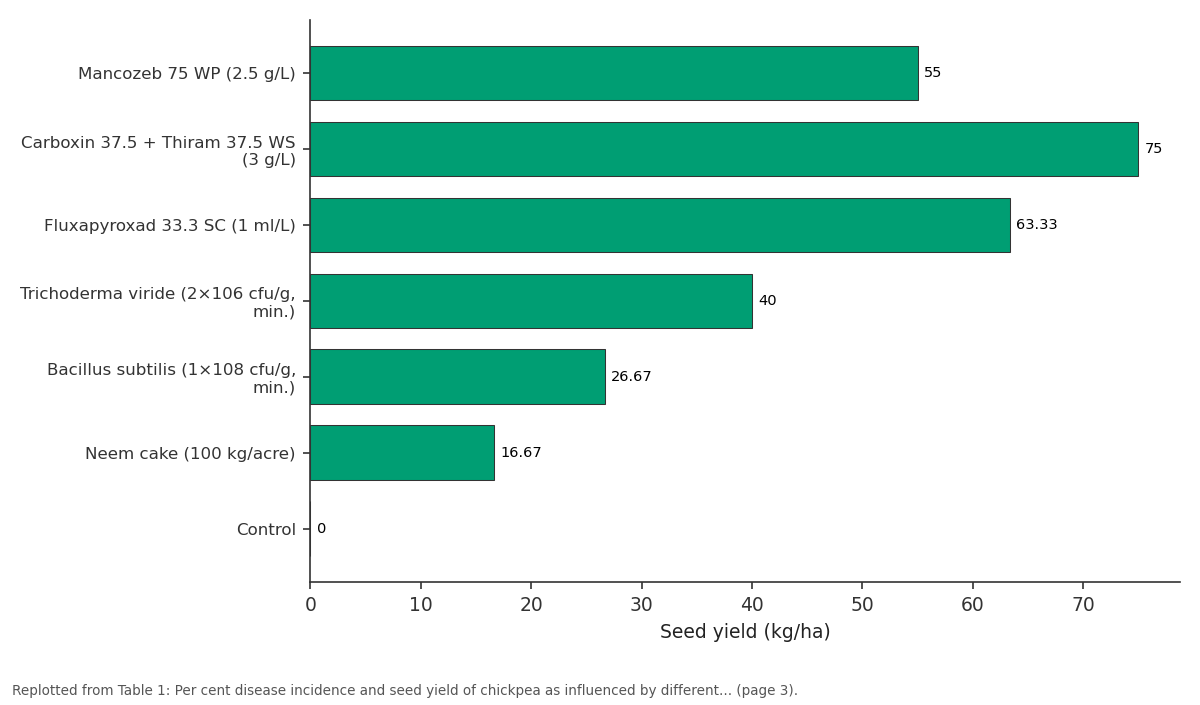
Per cent disease reduction over control: Mancozeb 75 WP (2.5 g/L) vs Carboxin 37.5 + Thiram... vs Fluxapyroxad 33.3 SC (1... vs Trichoderma viride... vs Bacillus subtilis...
Replotted from Table 1 (page 3) of the original paper. Every bar is the paper's own table value.
View source evidence ↗Figures & tables
From the original paper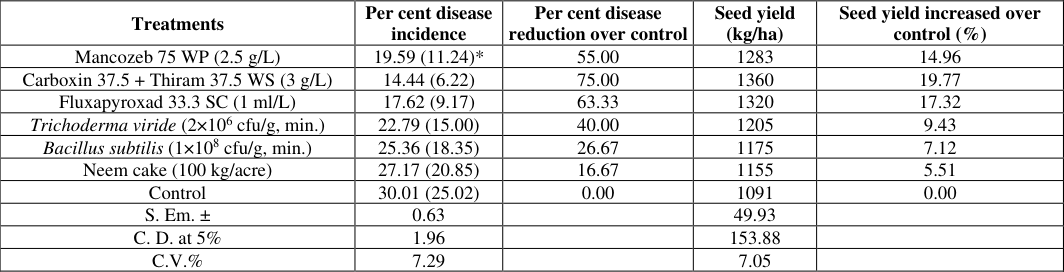 Table 1
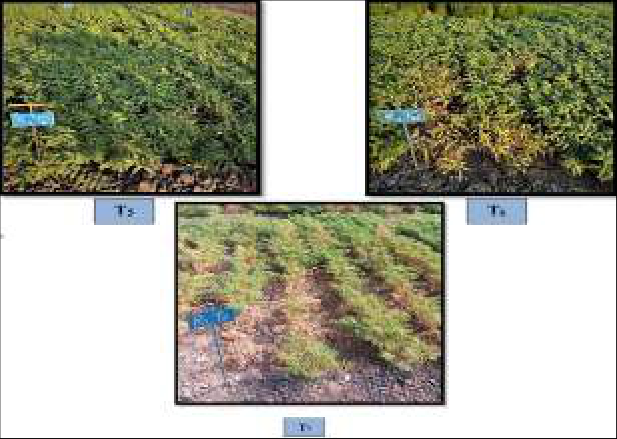 Plate 1
Introduction
Chickpea (Cicer arietinum L.) is an essential annual pulse crop that belongs to the genus Cicer, family Leguminosae or Fabaceae and is also recognized as "Bengal gram". In the world, it ranks third in importance among grain legumes, behind peas (Pisum sativum) and beans (Phaseolus vulgaris) (Aykoid and Doughty, 1964) [1] . Chickpea seeds are an excellent source of energy as; they contain protein (17.21%), carbohydrates (61.5%) and fat (4.5%). Green immature seeds of gram are used as vegetable while, husk and split beans are used as cattle feed (Jukanti et al., 2012) [2] . Chickpea production of India was 13.75 million tonnes from an acreage of 10.91 million ha. with a productivity of 12.6 q/ha. Chickpea solely contributes nearly (50%) of the Indian pulse production. States like Maharashtra (25.97%), Madhya Pradesh (18.59%), Rajasthan (20.65%), Gujarat (10.10%) and Uttar Pradesh (5.64%) are major chickpea producing states of India (Anon., 2023). Gujarat produce 1.44 million tonnes of output, which is higher than the national average. In terms of sowing area and production, Junagadh and Amreli districts lead with 819.30 and 753.95 hectares and 1489.98 and 1467.27 metric tonnes, respectively. However, in terms of productivity, Botad (2557 kg/ha) and Bhavnagar (2208 kg/ha) districts lead in 2023-24 (Anon., 2024). Chickpea collar rot is a serious illness that spreads quickly. There is a decrease in plant population since the condition is limited to the seedling stage up to 45 days. The symptoms of collar rot seen at the seedling stage up to 6 weeks after sowing. Affected seedlings turn yellow, upon uprooting seedlings show rotting at the collar region which covered with whitish mycelial strands. A white mycelial coating can be seen on the tap root of completely dried seedlings. Mustard grain sized light to dark brown structures known as sclerotia, serve as over wintering bodies (Kotastthane et al., 1976) [5] . Collar rot of chickpea is an important soil borne and fast spreading fungal pathogen, which causes considerable damage to the plant stand. Generally, the disease is more in loamy soil International Journal of Agriculture and Food Science https://www.agriculturaljournals.com regions and more prevalent in soybean-chickpea or paddychickpea based cropping system, when soil moisture is high and temperature is warm at the seedling stage. Seedling mortality in chickpea due to S. rolfsii has been reported to vary from 54.7 to 95.00 per cent (Shrivastava et al., 1984) [
Materials and Methods
The present study on efficacy of different fungicides, bioagents and soil amendments against Sclerotium rolfsii causing collar rot disease in chickpea were carried out at the Department of Plant Pathology, College of Agriculture, Junagadh Agricultural University, Junagadh, Gujarat, India.
Field evaluation of fungicides, bioagents and soil amendments against collar rot of chickpea
Field evaluation of fungicides, bioagents and soil amendments against collar rot of chickpea
Methodology
Apparently healthy and diseased free seeds of chickpea variety GG-3 was collected from Pulse Research Station, JAU, Junagadh. Pathogen mass multiplied on 9:1 sand maize meal medium having strength of 2 x 10 6 cfu/ml, minimum was applied @ 10 g per meter row length (500 g/plot) in soil one week prior of sowing at 5 cm depth to increase the disease pressure (Padamini, 2014) [7] . Effect of non-systemic, systemic and ready-mix fungicides was tested by seed treatment. While bioagents and soil amendment were applied as a soil application. The fungicides, soil amendments and bioagents found effective from in vitro trial were used as a seed treatment and drenched 25 days after sowing of crop by dissolving at their effective concentration at the rate of 400 L solution per hectare.
Required quantity of respective fungicides were added to quantity of water in order to set desired concentration. Whereas, the fungal bioagents having minimum 2×10 6 cfu/g and bacterial bioagents having minimum 1×10 8 cfu/ml were drenched by dissolving 1 kg or L of bioagents in 400 L of water per hectare. Control was also maintained without drenching with any fungicide, soil amendments and bioagents. Infected plants were recorded regularly by observing 5 plants in each row, totaling 25 plants per plot.
Observations Recorded
Per cent disease incidence calculated using following formula.
Per cent disease incidence = Number of infected plants Total number of plants observed × 100
The per cent disease reduction over control was calculated with the help of following formula (Mathur et al., 1971) [8] .
Disease control (%) = PDI in control plot -PDI in treated plot PDI in control plot × 100
Yield increase over control (%) = Yield in treated plot -Yield in control plot Yield in control plot × 100
Result and Discussion
Result and Discussion
Field evaluation of fungicides, bioagents and soil amendments against collar rot of chickpea
Perusal of data presented in Table 1 and Plate 1 revealed that all the treatments were effective in reducing the disease incidence with corresponding increase in seed yield as compared to control under field condition. Among the different treatments tried, seed treatment in chickpea plants at time of sowing and thereafter drenching at 25 days after sowing of crop with carboxin 37.5 + thiram 37.5 WS showed minimum disease incidence (6.22%) with maximum disease reduction over control (75.00%). The next effective treatment was fluxapyroxad 33. The present results corroborate the finding of Khalequzzaman (2016) [9] . They reported minimum disease incidence of 21.67 per cent in the treatment of carboxin 17.5 + thiram 17.5 FF against S. rolfsii. Shirsole et al. (2019) [10] showed mancozeb 75 WP inhibit the 79.71 per cent mycelial growth of S. rolsii. Whereas, More et al. (2016) [11] also reported the effectiveness of Trichoderma viride (92%) in germination of chickpea.
| Treatments | Per cent disease incidence | Per cent disease reduction over control | Seed yield (kg/ha) | Seed yield increased over control (%) |
|---|---|---|---|---|
| Mancozeb 75 WP (2.5 g/L) | 19.59 (11.24)* | 55.00 | 1283 | 14.96 |
| Carboxin 37.5 + Thiram 37.5 WS (3 g/L) | 14.44 (6.22) | 75.00 | 1360 | 19.77 |
| Fluxapyroxad 33.3 SC (1 ml/L) | 17.62 (9.17) | 63.33 | 1320 | 17.32 |
| Trichoderma viride (2×10⁶ cfu/g, min.) | 22.79 (15.00) | 40.00 | 1205 | 9.43 |
| Bacillus subtilis (1×10⁸ cfu/g, min.) | 25.36 (18.35) | 26.67 | 1175 | 7.12 |
| Neem cake (100 kg/acre) | 27.17 (20.85) | 16.67 | 1155 | 5.51 |
| Control | 30.01 (25.02) | 0.00 | 1091 | 0.00 |
| S. Em. ± | 0.63 | 49.93 | ||
| C. D. at 5% | 1.96 | 153.88 | ||
| C.V.% | 7.29 | 7.05 |
Table text extracted from the original PDF; superscript letters are shown inline. The original table image is below.
View original table image
Conclusions
Based on present investigation, it concluded that chickpea (Cicer arietinum L.) is also a host of Sclerotium rolfsii Sacc. and it causes collar rot disease in chickpea. Under field evaluation of fungicides, soil amendments and bioagents, seed treatment at the time of sowing and thereafter drenching at 25 days after sowing of crop with carboxin 37.5 + thiram 37.5 WS, fluxapyroxad 33.3 SC and mancozeb 75 WP found highly effective in reducing disease incidence with corresponding increase in seed yield of chickpea as compared to other treatments.
Acknowledgement
AcknowledgmentsThe authors sincerely express their gratitude to the Advisor and Head, Department of Plant Pathology, College of Agriculture, Junagadh Agricultural University, Junagadh, for their invaluable support, constant guidance and encouragement throughout the course of this study. The contributions and insights provided were instrumental in the successful completion of the research. The authors also acknowledge all the sources of referenced information cited in the manuscript.
Figures and tables from the paper
References
11 in the original paper- Aykroyd WR, Doughty J. Legumes in human nutrition. FAO Nutritional Studies. 1964;9.
- Jukanti AK, Gaur PM, Gowda CL, Chibbar RN. Nutritional quality and health benefits of chickpea -a review. Br J Nutr. 2012;108(1):11-26.
- Anonymous. World food and agriculture -statistical. 2023. [Accessed May 2025].
- Anonymous. District-wise area, production and yield of important food and non-food crops in Gujarat State. Gandhinagar: Directorate of Agriculture, Government of Gujarat; 2024. p. 32.
- Kotastthane SR, Agarwal PS, Joshi KK, Sing L. Studies on wilt complex in Bengal gram (Cicer arietinum L.). JNKVV Res J. 1976;10(3):257-258.
- Shrivastava SK, Singh SN, Khare MN. Assessment of yield losses in some promising gram cultivars due to fusarium wilt. Indian J Plant Prot. 1984;12(1):125-126.
- Padamini R. Studies on integrated management of wilt and root rot complex of chickpea (Cicer arietinum L.) caused by Fusarium spp. and Rhizoctonia solani [PhD thesis]. Udaipur: Maharana Pratap University of Agriculture and Technology; 2014. (Unpublished).
- Mathur RL, Singh G, Gupta RBL. Field evaluation of fungicides for the control of powdery mildew of pea. Indian J Mycol Plant Pathol. 1971;1(2):95-98.
- Khalequzzaman KM. Control of foot and root rot of lentil by using different management tools. ABC J Adv Res. 2016;5:35-42.
- Shirsole SS, Khare N, Lakpale N, Kotasthane AS. Evaluation of fungicides against Sclerotium rolfsii Sacc., incitant of collar rot of chickpea. Pharma Innov J. 2019;8(12):310-316.
- More PS, Parate RL, Mairan NR. Evaluation of botanicals and bioagents to record the root, shoot length and vigour index of chickpea. Int J Plant Prot. 2016;9(2):483-488.