
Research article · 2025 · Full text
International Journal of Agriculture and Food ScienceImpact of type of jaggery on quality attributes of pumpkin seed incorporated burfi
Volume 7(8) · Pages 921–926 · DOI: 10.33545/2664844x.2025.v7.i8h.659 ↗
Research areasAdvances in Cucurbitaceae ResearchFood Science and Nutritional StudiesNatural Products and Biological Research
Abstract
Author-writtenBurfi is an indigenous milk product made from khoa that is excellent in nutrition. Burfi contains various additives that boost its sensory appeal and customer acceptability. this study was conducted to select the type of jaggery to be used for manufacture of Pumpkin seed incorporated burfi. Three types of jaggery viz. sugarcane jaggery, palm jaggery and coconut jaggery were screened. Burfi samples containing 50% replacement of sugar with jaggery were prepared. Replacement of sugar with all the three types of jaggery significantly (P
Summary
Source-checkedPlain-language reading of the full paper, prepared with AI and checked against the text. Each point links to the authors' own words.
Why it matters
- Burfi is a traditional Indian milk-based sweet with potential for international popularity. View evidence ↗
- The refined sugar typically used in burfi is linked to health problems such as diabetes, obesity, and heart disease. View evidence ↗
- Jaggery is viewed as a healthier, more nutritional alternative to refined white sugar. View evidence ↗
The question
- The study aimed to determine which type of jaggery is most suitable for use in burfi that incorporates pumpkin seeds. View evidence ↗
What they did
- Researchers compared a sugar-based control with three burfi samples where 50% of the sugar was replaced by either sugarcane (J1), palm (J2), or coconut (J3) jaggery. View evidence ↗
- Textural attributes were measured using a Food Texture Analyzer by compressing samples to 80% of their initial height. View evidence ↗
What they found
- While the control had the highest overall acceptability (8.01±0.15), palm jaggery (J2) was the most acceptable among the three jaggery alternatives. View evidence ↗
- Replacing sugar with jaggery significantly increased moisture content, with coconut jaggery (J3) reaching 24.72±0.36% compared to the control's 19.44±0.44%. View evidence ↗
- All jaggery-based samples showed a significant increase in ash content (minerals) compared to the control (2.88±0.05%), with palm jaggery (J2) being the highest at 3.04±0.02%. View evidence ↗
- Carbohydrate levels significantly decreased in jaggery-based samples, dropping from 39.75±0.43% in the control to 35.40±0.29% in the coconut jaggery sample. View evidence ↗
- Jaggery substitution significantly reduced hardness; the control was the hardest (34.86±1.22 N), while sugarcane jaggery (J1) produced the softest burfi (15.08±0.93 N). View evidence ↗
- Jaggery darkened the product, significantly reducing the L* (lightness) value from 69.31±0.12 in the control to 53.51±0.15 in the sugarcane jaggery sample. View evidence ↗
- All jaggery samples increased the yellowness (b* value) of the burfi compared to the control (16.29±0.13), with coconut jaggery (J3) being the most yellow at 21.72±0.12. View evidence ↗
What it means
- The authors conclude that palm jaggery is the best sweetener for pumpkin seed incorporated burfi due to its superior flavor, acceptability, and nutritional profile. View evidence ↗
Visual summary
1 visualsIllustrations explain the paper; they do not show study data.
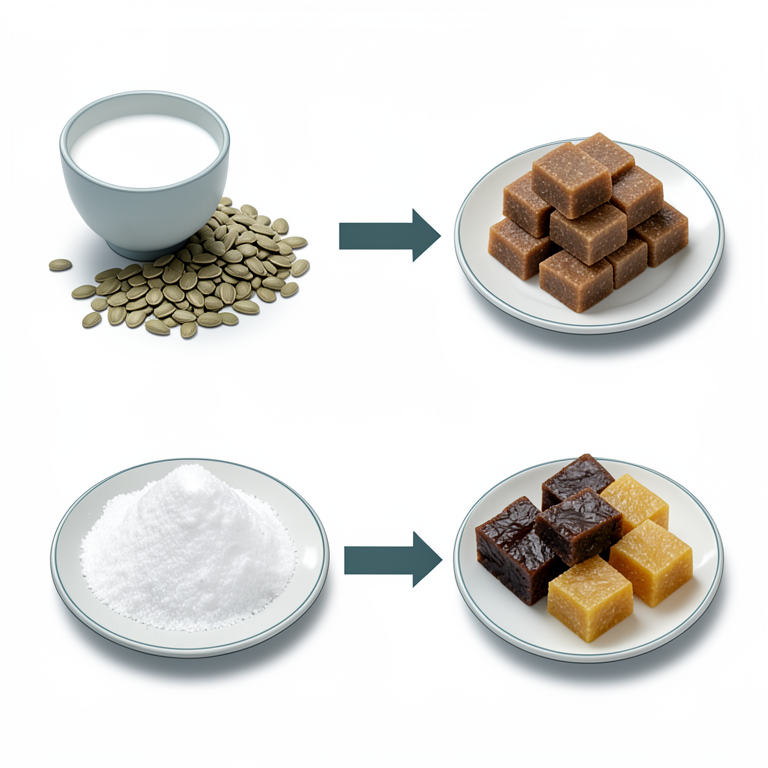
Experimental Design
AI-generated conceptual illustration (pumpkin seed burfi (Indian milk-based fudge) and various jaggery types). It explains the idea and does not show study data.
View source evidence ↗Figures & tables
From the original paper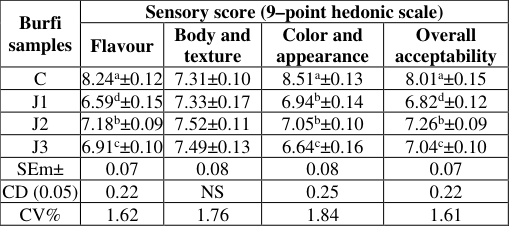 Table 1
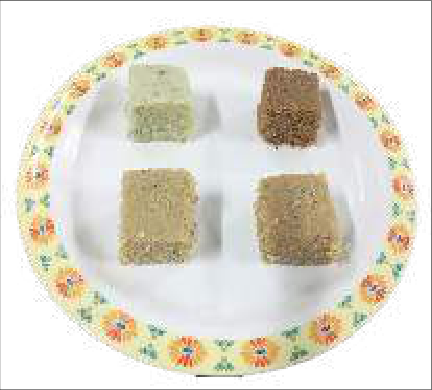 Figure 1
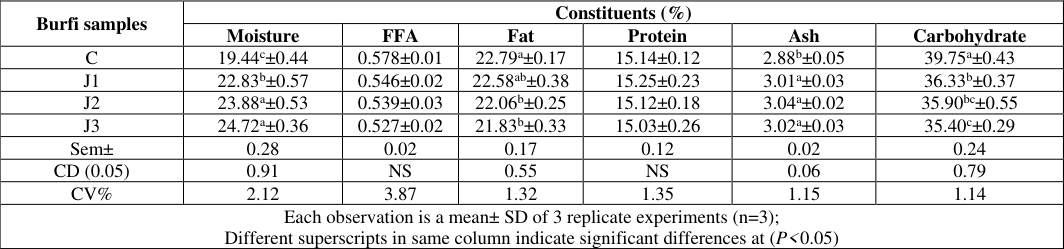 Table 2
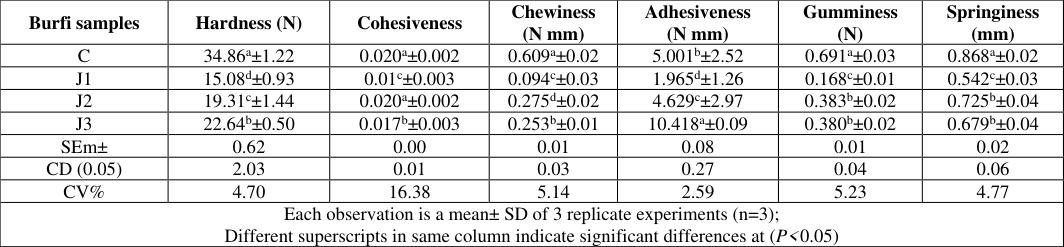 Table 3
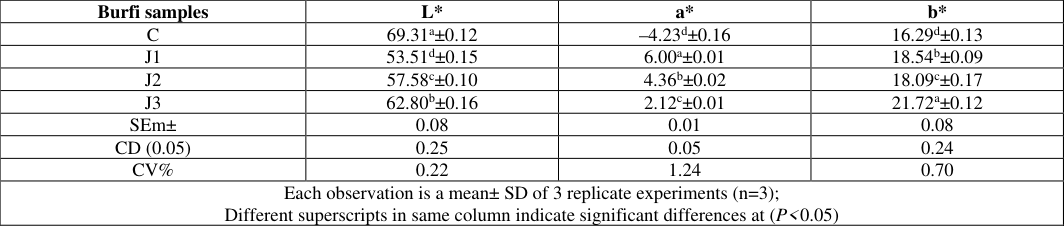 Table 4
Introduction
Burfi is a popular milk-based confection in India and has the potential to gain global recognition. On average, 100 g of plain milk burfi provides approximately 400 to 450 kcal, containing around 7 to 10 g of protein, 20 to 25 g of fat (with a significant portion as saturated fat) and 45 to 50 g of carbohydrates, of which about 35 to 40 g are sugars. The incorporation of fruit seeds or seed powder in burfi production is becoming increasingly popular among consumers due to its unique flavor and enhanced nutritional value. Introducing such ingredients into burfi not only adds value to the product but also enriches it with essential nutrients. The development of such nutrient-rich dairy products align with the growing consumer demand for healthier and more functional food options (Sharma et al., 2023) [13] . Pumpkin, belonging to the genus Cucurbita and the family Cucurbitaceae, is cultivated worldwide for various purposes, including food, animal feed and decoration. Utilizing pumpkin seeds is expected not only to add value to production but also can aids in developing new food products. Refined sugar is commonly used as a sweetener in burfi preparation. However, while it enhances sweetness, excessive consumption is linked to various health issues, including obesity, dental cavities, diabetes, hypertension, hyperglycaemia and heart disease. Growing awareness of these health risks has led consumers to seek healthier alternatives to sucrosebased products. And also, to compensate these sugar problems, use of other healthy sweeteners can be a solution. As a result, jaggery is gaining popularity due to its perceived higher nutritional value compared to refined white sugar. India is the largest producer and consumer of jaggery, accounting for over 70% of global production (Pravallika et al., 2018) [11] . Compared to refined sugar, jaggery is considered a more wholesome alternative. It contains 65 to 85% sucrose, whereas refined sugar consists of approximately 99.5% sucrose. Additionally, jaggery has a higher mineral content, ranging from 0.6% to 1.0%, while sugar contains only about 0.05% minerals (Singh, 2007) [14] . Research has also highlighted the pharmacological benefits of jaggery (Nayaka et al., 2009) supporting liver function and promoting overall health. Furthermore, it improves digestion, detoxifies the liver, relieves constipation and enhances energy levels. Jaggery also possesses anti-toxic and anti-carcinogenic properties and is used in managing stress, bronchial infections and premenstrual syndrome (Hirpara et al., 2020) [6] . Based on the source, jaggery is primarily made from sugarcane (Saccharum officinarum L.) and the sap of various palm species such as date palm (Phoenix dactylifera L.), palmyra palm (Borassus flabellifer L.), sago palm (Caryota urens L.), and coconut palm (Cocos nucifera L.) (Pattnayak and Misra, 2004) [10] . Replacing cane sugar with jaggery in dairy ingredients is expected to enhance its depth and imparts a distinct, caramel-like flavour. The rich, unique taste of jaggery cam impart a pleasing golden-brown colour which may improve its natural and appealing appearance. Consumers today are increasingly aware of the health implications of their diet and prefer dairy products that are not only delicious but also nutritionally enhanced. The integration of natural ingredients such as pumpkin seeds and jaggery into burfi presents an opportunity to enhance the protein, mineral, fiber and antioxidant content of burfi; reduce dependency on refined sugar by using a natural sweetener, improve the sensory appeal of burfi and develop a functional dairy sweet with health-promoting properties. Despite the commercial success of traditional burfi varieties, limited research has been conducted on replacement of sugar with jaggery in pumpkin seed incorporated burfi. The development of such a product could cater to the growing demand for healthier dairy-based sweets while utilizing locally available, cost-effective ingredients, keeping in view the above facts, this investigation has been planned to select the type of jaggery for preparation of pumpkin seed incorporated burfi.
Materials and Methods
Fresh, raw mixed (cow and buffalo) whole milk received at Anubhav Dairy; Anand was used as the base material for manufacture of burfi. Pumpkin seeds of "True elements" brand, HW wellness solutions Pvt. Ltd. Maharashtra were used. Cane sugar of "Madhur" Shree Renuka sugars Ltd; Mumbai brand of commercial grade (M grade) was used. Tata salt, Tata chemicals Ltd., Gujarat was used. Sugarcane jaggery of organic tattva, Mehrotra consumer products Pvt. Ltd., Greater Noida was used. Palm jaggery of Urban platter palm jaggery, Istore direct trading Pvt. Ltd., Mumbai was used. Coconut jaggery of urban platter, Istore direct trading Pvt. Ltd., Mumbai was used.
Preparation of burfi:
Burfi was prepared from milk standardized to (6.0% milk fat and 9.0% MSNF). Dry salt roasted (85 to 90 °C/15 min) pumpkin seeds were incorporated @ 3.0% w/w of milk. Half of the dry salt roasted pumpkin seeds in the form of a paste were added after forewarming of milk (85 °C/10 min). The remaining half (coarsely cut pumpkin seeds) were added after pat formation. Sugar was added @ 6% w/w of milk. In all the three burfi samples sugar was replaced @ 50% with the three types of jaggery viz. J1, J2 and J3 respectively. Preliminary trials were taken to select the rate of replacement of sugar with jaggery. At higher levels of replacement, the samples were criticized for pronounced jaggery flavour and slight stickiness in the samples. C (control) was prepared using sugar @ 6.0% w/w of milk and @ 3% dry salt roasted pumpkin seeds. The contents were heated in an open pan with continuous stirring. After the desired consistency was obtained the contents were whipped and worked on a low flame for 2 to 4 min. Thereafter, the contents were spread in a clean greased tray, moulded and allowed to set at room temperature for 10 to 12 h. Burfi was cut into square pieces (40 × 30 mm size, 25 mm thickness) and packed in composite polyethylene terephthalate (PET)/low density polyethylene (LDPE) film (50μ thickness) pouches and placed in PET box. For selecting the type of jaggery as sugar replacement, three types of jaggery were used viz. Sugarcane jaggery, Palm jaggery and Coconut jaggery. Preliminary trials were taken to select the level of sugar replacement. Three batches of burfi were prepared viz. J1 (50% replacement with sugarcane jaggery), J2 (50% replacement with palm jaggery) and J3 (50% replacement with coconut jaggery). Control (C) was prepared using the same procedure without replacement of sugar.
Chemical analysis:
The determine the moisture content of burfi, a gravimetric method based on the (FSSAI 01.039:2022). Fat extraction of burfi was determined by Rose-Gottlieb method described in Section (FSSAI 01.073:2022). Protein content in burfi was estimated by Kjeldahl method (FSSAI 01.062:2022). Total carbohydrate was derived by difference. Ash content in burfi was determined as per the method described by (FSSAI 01.077:2022). The free fatty acid (FFA) content of burfi was determined using the method described by Deeth et al. (1975) [1] .
Colour value analysis:
The colour value of pumpkin seed incorporated burfi was measured by chroma meter (Konica Minolta Chroma Meter CR-400, Japan).
Texture profile analysis: Burfi were subjected to uniaxial compression to 80% of the initial sample height, using a Food Texture Analyzer of Lloyd Instruments LRX Plus material testing machine, England; fitted with 0-500 kg load cell. The force-distance curve was obtained for a two-bite deformation cycle employing a Cross Head speed of 50 mm/min, Trigger 10 gf and 80% Compression of the samples to determine various textural attributes of burfi held for 1 h at 20±1 °C and 55% RH.
Sensory evaluation:
For the sensory evaluation of burfi, a panel of 10 judges familiar with the typical characteristics of dairy-based sweets were selected. Panelists were chosen based on their regular consumption of such products and consistent sensory perception across evaluation sessions. The evaluation was carried out using a 9-point hedonic scale scorecard as recommended by Stone and Sidel (2004) [15] . Statistical analysis: Data obtained was statistically analysed using completely randomized design. Statistical analysis was carried out using one-way ANOVA through MS-Excel. To select the most suitable form of jaggery for partial replacement of sugar in burfi, experimental samples viz., J1, J2, and J3 along with the control (C) were subjected to sensory evaluation. As presented in Table 1, flavour scores ranged from 8.24±0.12 (C) to 6.59±0.15 (J1). The preference order was: C > J2 > J3 > J1. Statistical analysis showed a significant (P<0.05) difference in flavour among the samples. The control (C) had the highest score, significantly (P<0.05) better than all jaggery-incorporated samples. On the other hand, several researchers have reported an increase in flavour scores when jaggery was used as an alternative sweetener compared to sugar (Kumar et al., 2024) [8] . Among the jaggery types, palm jaggery (J2) showed a significantly better flavour than sugarcane (J1) and coconut jaggery (J3), This suggests palm jaggery may be a better flavouring alternative in burfi.
| Burfi samples | Sensory score (9–point hedonic scale) | — | — | — |
|---|---|---|---|---|
| Flavour | Body and texture | Color and appearance | Overall acceptability | |
| C | 8.24a±0.12 | 7.31±0.10 | 8.51a±0.13 | 8.01a±0.15 |
| J1 | 6.59d±0.15 | 7.33±0.17 | 6.94b±0.14 | 6.82d±0.12 |
| J2 | 7.18b±0.09 | 7.52±0.11 | 7.05b±0.10 | 7.26b±0.09 |
| J3 | 6.91c±0.10 | 7.49±0.13 | 6.64c±0.16 | 7.04c±0.10 |
| SEm± | 0.07 | 0.08 | 0.08 | 0.07 |
| CD (0.05) | 0.22 | NS | 0.25 | 0.22 |
| CV% | 1.62 | 1.76 | 1.84 | 1.61 |
Table text extracted from the original PDF; superscript letters are shown inline. The original table image is below.
View original table image
Results and discussion
Body and texture scores (Table 1) ranged from 7.31±0.10 (C) to 7.52±0.11(J2). Differences were statistically nonsignificant (P>0.05). J2 recorded the highest score (7.52±0.11), followed by J3 (7.49±0.13), J1 (7.33±0.17), and the control (7.31±0.10). These findings suggest that jaggery incorporation had no adverse effect on burfi's body and texture. Similar trends have been observed in other milk-based sweets when sugar cane jaggery was incorporated (Thakare, 2019) [16] . Scores for colour and appearance ranged from 8.51±0.13 (C) to 6.64±0.16 (J3). A significant (P<0.05) difference was observed across samples. The control scored highest, followed by J2, while J3 scored lowest-likely due to the darker tone imparted by coconut jaggery. The colour variation may also be due to pigments from jaggery or pumpkin seeds. similar trends have been observed in decrease in colour and appearance scores when jaggery was used as an alternative sweetener compared to sugar for burfi making (Kumar et al., 2024) [8] .
Overall acceptability ranged from 8.01±0.15 (C) to 6.82±0.12 (J1). Statistically significant differences (P<0.05) were found. J2 had higher acceptability than J1 and J3, indicating palm jaggery as the most suitable among the alternatives in terms of flavour, colour, and overall liking.
Effect of partial replacement of sugar with different types of jaggery on chemical composition of pumpkin seeds incorporated burfi
The experimental samples J1, J2, and J3 along with the control (C) were analyzed for their moisture, free fatty acid (FFA), fat, protein, ash and carbohydrate contents and the results are presented in Table 2.
| Burfi samples | Constituents (%) | — | — | — | — | — |
|---|---|---|---|---|---|---|
| Moisture | FFA | Fat | Protein | Ash | Carbohydrate | |
| C | 19.44c±0.44 | 0.578±0.01 | 22.79a±0.17 | 15.14±0.12 | 2.88b±0.05 | 39.75a±0.43 |
| J1 | 22.83b±0.57 | 0.546±0.02 | 22.58ab±0.38 | 15.25±0.23 | 3.01a±0.03 | 36.33b±0.37 |
| J2 | 23.88a±0.53 | 0.539±0.03 | 22.06b±0.25 | 15.12±0.18 | 3.04a±0.02 | 35.90bc±0.55 |
| J3 | 24.72a±0.36 | 0.527±0.02 | 21.83b±0.33 | 15.03±0.26 | 3.02a±0.03 | 35.40c±0.29 |
| Sem± | 0.28 | 0.02 | 0.17 | 0.12 | 0.02 | 0.24 |
| CD (0.05) | 0.91 | NS | 0.55 | NS | 0.06 | 0.79 |
| CV% | 2.12 | 3.87 | 1.32 | 1.35 | 1.15 | 1.14 |
| Each observation is a mean± SD of 3 replicate experiments (n=3); Different superscripts in same column indicate significant differences at (P<0.05) |
Table text extracted from the original PDF; superscript letters are shown inline. The original table image is below.
View original table image
• Moisture: As shown in Table 2, moisture content ranged from 19.44±0.44% (C) to 24.72±0.36% (J3), increasing in the order: C < J1 < J2 < J3. The difference was significant (P<0.05), with control having the lowest and J3 the highest moisture content. The rise in moisture with jaggery substitution is likely due to its hygroscopic nature. However, Kumar et al. (2024) [8] reported higher moisture in sugar-based burfi than in jaggery-based versions. Thakare (2019) [16] observed a non-significant (P>0.05) decrease in moisture with higher jaggery levels. Factors such as jaggery type, replacement rate, ingredients and processing methods influence final moisture levels. This could be one of the reasons why in the present study 50% sugar replaced with jaggery burfi has increased moisture content compared to control burfi. • Free fatty acids: FFA content ranged from 0.527±0.02% (J3) to 0.578±0.01% (C), with no significant (P>0.05) difference across samples. While slight variations were noted, they were not statistically significant. • Fat: Fat content varied from 21.83±0.33% (J3) to 22.79±0.17% (C). Differences among jaggery added samples were non-significant (P>0.05). The slightly higher fat in control may be due to its lower moisture level. Jaggery-added samples showed marginally lower fat content. • Protein: Protein content ranged from 15.03±0.26% (J3) to 15.25±0.23% (J1), with non-significant (P>0.05) difference. J1 (Sugarcane jaggery) showed a slight increase. Thakare (2019) [] also found non-significant (P>0.05) protein increas16es with jaggery in brown peda.
• Ash: Ash content, indicating mineral presence, was significantly different (P<0.05), ranging from 2.88±0.05% (C) to 3.04±0.02% (J2). All jaggery-treated samples had higher ash content due to the natural minerals in jaggery. Kumar et al. (2024) found that ash content was significant (P<0.05) higher in jaggery burfi because it jaggery have more mineral content than sugar. Thakare (2019) [16] also observed that addition of jaggery in milk for making brown Peda significantly (P<0.05) increased the ash content of experimental brown Peda. • Carbohydrate: Carbohydrate content ranged from 39.75±0.43% (C) to 35.40±0.29% (J3), showing a significant (P<0.05) decrease in jaggery-based samples. The reduction is attributed to higher moisture and ash content in jaggery compared to the higher purity of sucrose in refined sugar. Kumar et al. (2024) [8] found that carbohydrate was lower in jaggery added burfi than control burfi because addition of cane sugar that have more purity of sucrose than jaggery.
Effect of partial replacement of sugar with different types of jaggery on rheological property of pumpkin seeds incorporated burfi
• The influence of partial sugar replacement with various types of jaggery on the rheological properties of pumpkin seed incorporated burfi was investigated and the results are presented in (2024) [8] found that, when the rate of jaggery addition increased, it was discovered that the hardness of experimental jaggery burfi significantly increased in all samples. Thakare, (2019) [16] observed that addition of jaggery in milk for brown Peda preparation was found to significantly (P<0.05) increase the hardness of experimental brown Peda. Since hardness depends on various factors like different moisture, sweeteners, type of jaggery, the rate of sugar replacement with jaggery, ingredients, manufacturing methods, heating time, etc. in the present study the increase in moisture content of jaggery added burfi could have resulted in lower hardness compared to control burfi. • Cohesiveness: Cohesiveness reflects the internal bonding of the product structure. The values ranged from 0.011±0.003 (J1) to 0.020±0.002 (C and J2). J1 exhibited a significantly (P<0.05) lower cohesiveness than the control and J2 (P<0.05), while J3 (0.017±0.003) did not differ significantly (P>0.05) from C and J2. This suggests that sugarcane jaggery may disrupt internal structural bonding more than palm or coconut jaggery. • Chewiness: Chewiness was highest in the control (0.609±0.02 N mm), significantly (P<0.05) greater than in J3 (0.253±0.01 N mm), J2 (0.275±0.02 N mm) and J1 (0.094±0.03 N mm). All differences were statistically significant (P<0.05). These results indicate that jaggery incorporation reduced the energy required to chew the product, likely due to a softer matrix and less cohesive texture. These results are in corroboration with those obtained by Kumar et al. (2024) who reported that when the rate of jaggery was replaced with sugar, the chewiness of experimental jaggery burfi significantly increased in all samples. • Adhesiveness: Adhesiveness was highest in J3 (10.418±0.09 N•mm), followed by C (5.001±2.52), J2 (4.629±2.97), and J1 (1.965±1.26), with all differences significant (P<0.05). The high adhesiveness in J3 may be due to sticky components in coconut jaggery. • Gumminess: Gumminess was highest in the control (0.691±0.03 N) and significantly lower in all jaggery samples, especially J1 (0.168±0.01 N). This decreases likely results from reduced hardness and cohesiveness, possibly influenced by jaggery. • Springiness: Springiness was highest in the control (0.868±0.02 mm), and significantly (P<0.05) lower in J1 (0.542±0.03 mm), with intermediate values for J2 and J3. The decline suggests reduced elastic recovery, potentially due to jaggery's hygroscopic nature affecting the matrix structure.
Effect of partial replacement of sugar with different types of jaggery on colour of pumpkin seeds incorporated burfi
Colour of burfi samples was measured using a chroma meter and expressed in terms of L*, a* and b* values are presented in Table 4.
| Burfi samples | L* | a* | b* |
|---|---|---|---|
| C | 69.31a±0.12 | –4.23d±0.16 | 16.29d±0.13 |
| J1 | 53.51d±0.15 | 6.00a±0.01 | 18.54b±0.09 |
| J2 | 57.58c±0.10 | 4.36b±0.02 | 18.09c±0.17 |
| J3 | 62.80b±0.16 | 2.12c±0.01 | 21.72a±0.12 |
| SEm± | 0.08 | 0.01 | 0.08 |
| CD (0.05) | 0.25 | 0.05 | 0.24 |
| CV% | 0.22 | 1.24 | 0.70 |
| Each observation is a mean± SD of 3 replicate experiments (n=3); Different superscripts in same column indicate significant differences at (P<0.05) |
Table text extracted from the original PDF; superscript letters are shown inline. The original table image is below.
View original table image
Conclusion
Among the three types of jaggery evaluated, palm jaggery consistently outperformed sugarcane and coconut jaggery across multiple parameters. It offered superior flavour and overall acceptability, enhanced the nutritional profile by increasing ash content (indicative of mineral enrichment) and maintained favourable textural integrity. In terms of colour, palm jaggery provided a moderate and visually appealing shift without excessive darkening. These findings support the selection of palm jaggery as a suitable sweetener for developing nutritionally enhanced and sensorially acceptable functional burfi.
Figures and tables from the paper
References
17 in the original paper- Deeth HC, Fitz-Gerald CH, Wood AF. A convenient method for determining the extent of lipolysis in milk. Aust J Dairy Technol. 1975;30(3).
- Food Safety and Standards Authority of India. Manual of methods of analysis of foods: Dairy and dairy products (FSSAI 01.039:2022). New Delhi: FSSAI; 2022.
- Food Safety and Standards Authority of India. Manual of methods of analysis of foods: Dairy and dairy products (FSSAI 01.062:2022). New Delhi: FSSAI; 2022.
- Food Safety and Standards Authority of India. Manual of methods of analysis of foods: Dairy and dairy products (FSSAI 01.073:2022). New Delhi: FSSAI; 2022.
- Food Safety and Standards Authority of India. Manual of methods of analysis of foods: Dairy and dairy products (FSSAI 01.077:2022). New Delhi: FSSAI; 2022.
- Hirpara P, Thakare N, Kele VD, Patel D. Jaggery: A natural sweetener. J Pharmacogn Phytochem. 2020;9(5):3145-8. Available from: https://www.healthunbox.com/en/milk-and-jaggery/
- Kamble KB, Kamble DK, Patange DD, Yadav MM, Londhe-Patil PB. Process standardization for preparation of green chickpea (Cicer arientinum) burfi. Pharma Innov J. 2019;8(11):201-6.
- Kumar M, Bajya SL, Kanetkar P, Lal S, Singh S. Process optimization and effect of jaggery on nutritional and rheological behaviour of burfi. Biol Forum Int J. 2024;16(8):119-24.
- Nayaka MAH, Sathisha UV, Manohar MP, Chandrashekar KB, Dharmesh SM. Cytoprotective and antioxidant activity studies of jaggery sugar. Food Chem. 2009;115:113-8.
- Pattnayak PK, Misra MK. Energetic and economics of traditional gur preparation: A case study in Ganjam District of Orissa, India. Biomass Bioenergy. 2004;26:79-88.
- Pravallika B, Patel S, Rao PJ, Sreedevi P. Development and optimization of jaggery based cold extruded products. Int J Curr Microbiol Appl Sci. 2018;7(9):2950-62.
- Rao PVKJ, Das M, Das SK. Jaggery-a traditional Indian sweetener. Indian J Tradit Knowl. 2007;6(1):95102.
- Sharma A, Kartikeyan S, Asgar S, Khare A, Choudhary KK. Studies on incorporation of date seed (Phoenix dactylifera L.) powder for development of burfi. Pharma Innov J. 2023;12(3):5510-2.
- Singh J. Proximate composition of Indian sweeteners, jaggery khandsari. Res Digest. 1998;6. Cited in: Rao PVKJ, Das M, Das SK. Jaggery-a traditional Indian sweetener. Indian J Tradit Knowl. 2007;6:95-102.
- Stone H, Sidel JL. Sensory evaluation practices. 3rd ed. New York: Elsevier Academic Press; 2004. p. 88.
- Thakare NS. Development of technology for manufacture of brown peda containing jaggery [master's thesis]. Anand: Anand Agricultural University; 2019.
- Tripathi AD, Kumar P, Agarwal A. Optimization of biofunctional jaggery yogurt: Its physicochemical and antioxidant properties. Indian J Dairy Sci. 2022;75(4).
Cited by 1
From OpenAlex, OpenCitations and reference lists read by Scinovex
- Development and quality evaluation of sweetened paneer cubes by incorporating sugar and jaggery
G. Gawdaman, M Prema, R Karthick, M. Anna Anandh · International Journal of Agriculture and Food Science · 2026
Paneer is one of the most widely consumed indigenous dairy products in India due to its high nutritional value, versatility and widespread consumer acceptance. The present study was aimed to develop sweetened paneer cubes by using sugar and jaggery and to evaluate their physico-chemical and sensory attributes. Paneer was prepared from standardized milk through citric acid coagulation and subsequently cut into cubes. Two different treatment groups were formulated: (T1) sugar-treated paneer cubes cooked in sugar syrup and (T2) jaggery-treated paneer cubes cooked in jaggery syrup along with contr