
Research article · 2025 · Full text
International Journal of Agriculture and NutritionResponse of green gram (Vigna radiata L.) varieties to phosphorus on yield and economics
Volume 7(8) · Pages 54–56 · DOI: 10.33545/26646064.2025.v7.i8a.268 ↗
Research areasCrop Yield and Soil FertilityAgricultural Science and Fertilization
Abstract
Author-writtenA field experiment was conducted at Research farm, Vivekananda Global University, Jaipur during kharif¸ 2024 on loamy sand soil. The experiment comprises six varieties (MSJ-118, RMG-975, SML 668, MH 421, IPM 02-3 and MH 318) and three levels of phosphorous (Control, 20 and 40 kg ha-1) thereby making 18 treatment combinations was laid out in factorial randomized block design and replicated thrice. The results indicated that among the greengram varieties MH 318 recorded significantly higher seed and stover yield. Maximum net return and B: C ratio obtained with variety MH 318. Further, results showed that application of 40 kg phosphorous ha-1 significantly increased the seed, stover yields, net returns and B: C ratio over preceding level of phosphorus.
Summary
Source-checkedPlain-language reading of the full paper, prepared with AI and checked against the text. Each point links to the authors' own words.
Why it matters
- Green gram, or mungbean, is the third most important pulse crop in India. View evidence ↗
- In Rajasthan, green gram covers 22.40 lakh hectares with a productivity of 473 kg ha-1. View evidence ↗
- The average productivity of green gram in Rajasthan is concerningly low compared to its potential. View evidence ↗
- Phosphorus is a critical nutrient for green gram, as the crop responds well to its application. View evidence ↗
The question
- The study aimed to evaluate the response of six green gram varieties to three different levels of phosphorus application. View evidence ↗
What they did
- The researchers used a factorial randomized block design with 18 treatment combinations, replicated three times. View evidence ↗
- The field experiment took place at the Research farm of Vivekananda Global University in Jaipur, Rajasthan. View evidence ↗
- Economic effectiveness was evaluated by calculating net returns and the benefit-cost (B:C) ratio. View evidence ↗
What they found
- Variety MH 318 was significantly superior to others, achieving the highest seed yield (1242 kg/ha) and biological yield (4293 kg/ha). View evidence ↗
- Variety MSJ-118 performed the worst, recording the lowest net return (Rs. 27,257 ha-1) and B:C ratio (2.18). View evidence ↗
- Variety MH 318 provided the highest economic return, with a net profit of Rs. 51,513 ha-1 and a B:C ratio of 3.24. View evidence ↗
- Applying 40 kg ha-1 of phosphorus resulted in the highest stover (straw) yield of 2854 kg/ha, significantly outperforming lower levels. View evidence ↗
- The 40 kg ha-1 phosphorus treatment yielded the highest net monetary returns (Rs. 45,890 ha-1) compared to 20 kg ha-1 (Rs. 42,001 ha-1) and the control (Rs. 31,276 ha-1). View evidence ↗
- Phosphorus application at 40 kg ha-1 and 20 kg ha-1 produced higher B:C ratios (2.96 and 2.83, respectively) than the control. View evidence ↗
What it means
- The authors conclude that variety MH 318 and a phosphorus application rate of 40 kg ha-1 are optimal for maximizing yield and economic returns. View evidence ↗
Visual summary
2 visualsIllustrations explain the paper; charts are replotted from the paper's own table values.
Experimental Layout
AI-generated conceptual illustration (green gram (Vigna radiata L.) plants in field plots). It explains the idea and does not show study data.
View source evidence ↗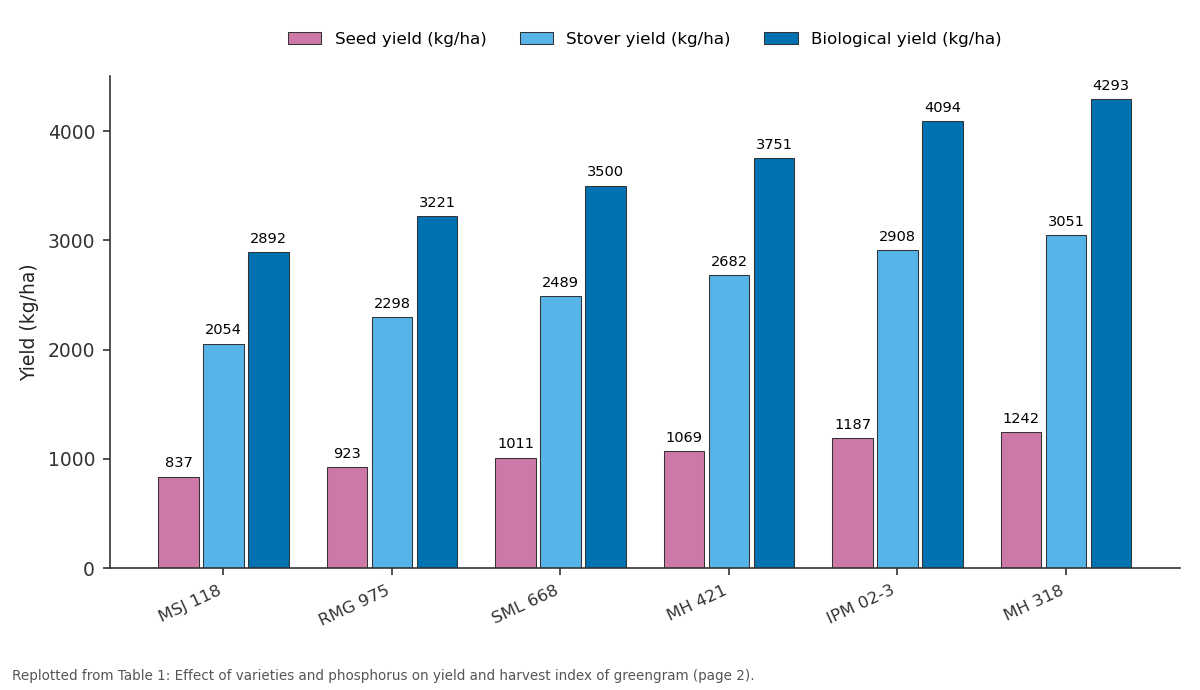
Seed yield (kg/ha) and Stover yield (kg/ha) and more: MSJ 118 vs RMG 975 vs SML 668 vs MH 421 vs IPM 02-3
Replotted from Table 1 (page 2) of the original paper. Every bar is the paper's own table value.
View source evidence ↗Figures & tables
From the original paper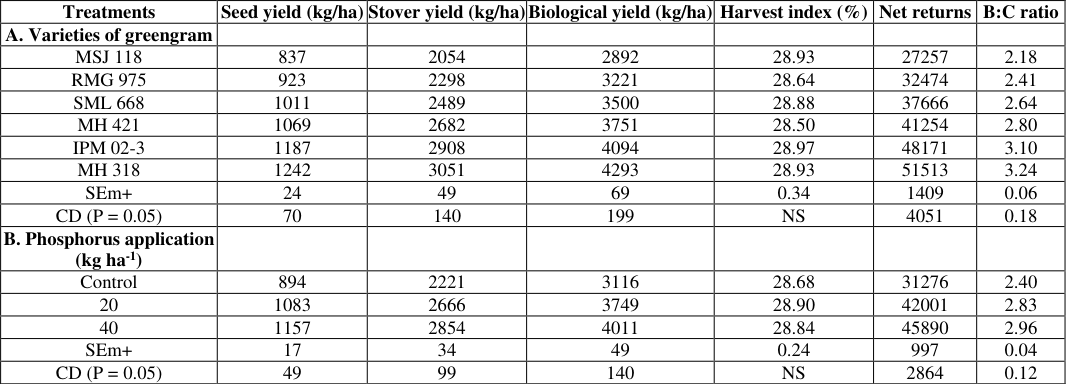 Table 1
Introduction
Greengram [Vigna radiata (L.) Wilczek], also known as mungbean, stands third after chickpea and pigeonpea among pulses. It occupies 2.93 Mha areas and contributes 2.07 Million tonnes in pulse production in the country (Anonymous, 23-24). The important greengram growing states are Rajasthan, Madhya Pradesh, Uttar Pradesh, Odisha, Maharashtra, Karnataka and Bihar. In Rajasthan, total area under greengram was 22.40 lakh hectares with the production of 9.71 lakh tonnes and productivity of 473 kg ha -1 (Anonymous, 2023-24). It is mainly cultivated in arid and semi-arid districts including Nagaur, Jaipur, Jodhpur, Sikar, Pali, Jhunjhunu and Ajmer. Despite of being such an important crop, the average productivity of greengram in the state is quite low compared to its production potential which is a matter of serious concern. Genotypes play an important role in crop production and the potential yield of a crop within the genetic limit is determined by its environments. The yield of crop varieties varies in different environment. Hence, combination of genotype and environmental factor can bring about increase in production. Differences in yield of genotype are attributed to the complex process occurring in various part of the plant involving many physiological changes. These physiological changes are influenced by environmental factors prevailing at different at different environment 'agronomic manipulation and yield analysis are required. A number of high yielding varieties have been developed at different research station of the state. These varieties also differ in their yielding potential under different climate and edaphic conditions (Verma et al., 2011) [9] . Different varieties of mungbean have varying nutrient demand and climate adaptability. Therefore, selection of appropriate adoptable variety requires immediate and large efforts in the direction of improved varieties for a particular tract and its distribution (Buriro et al., 2015) [2] . Fertilizer is one of the most important inputs required for increasing the yield of any crop. Green gram being legume crop responds well to phosphorus application. Phosphorus is the major essential nutrient required by the crop. In legumes, nitrogen requirement is less as compared to phosphorus because major protein is supplied through nitrogen fixation. Therefore, phosphorus is a key nutrient for increasing productivity of pulses in general and green gram in particular. Legumes as such have a relatively high phosphorus requirement being utilized by plant and bacteria. It assumes primary importance, owing to its important role in root proliferation and thereby atmospheric nitrogen fixation.
Majority of phosphorous gets fixed in the soil due to various factors. The yield and nutritional quality of pulses is greatly influenced by application of phosphorus. It plays a key role in various physiological processes like root growth and dry matter production, nodulation and nitrogen fixation and also in metabolic activities especially in protein synthesis. It also helps in establishing seedling quickly and also hastens maturity as well as improves the quality of crop produce. The most obvious effect of phosphorus is on the root system of plants. It promotes the formation of lateral and fibrous roots, which facilitates more nodule bacteria and ultimately affects the nitrogen fixation in leguminous crops. Phosphatic fertilizers have more importance than nitrogenous fertilizers because it increases the activity of symbiotic bacteria and brings significant improvement in yield attributing characters.
Materials and Methods
The experiment was conducted at Research farm, Vivekananda Global University, Jaipur. Geographically, is situated Geographically this place is situated at 750 47' East longitude, 260 51' North latitude and at altitude of 390 m above mean sea level in Jaipur district of Rajasthan. This region falls under Agro-climatic zone IIIa (Semi-arid eastern plain zone) of Rajasthan. The experiment consisting of six varieties of green gram (MSJ-118, RMG-975, SML-668, MH-421, IPM 02-3 and MH 318) and three treatments of phosphorus application (Control, 20 and 40 kg ha -1 ), thereby making eighteen treatment combinations.
Seed yield
After threshing, winnowing and cleaning, the produce of each plot was weighed separately in kg per plot and then converted to Seed yield in kg/ha.
Stover yield
Stover yield (kg/ha) was obtained by subtracting Seed yield (kg/ha) from the biological yield (kg/ha).
Biological yield
The weight of the thoroughly sun dried harvested produce of each plot was recorded separately before threshing and expressed as biological yield in (kg/ha).
Economics
The economics of treatments is the prime consideration before making any recommendation to the farmers for its adoption. Hence, to evaluate the effectiveness and profitability of the treatments, comprehensive economics in terms of net returns ( ha -1 ) and B:C ratio was calculated so that the most effective and remunerative treatment could be recommended. The details of calculation with prevailing market rates of the inputs and produce are given in appendices at the end.
Net returns = Gross returns -Total cost of cultivation Gross returns ( ha -1 ) B: C ratio = Cost of cultivation ( ha -1 )
Results and Discussion Effect of varieties
Variety MH 318 established its significant superiority over all other varieties were tested in the present experiment in terms of yields The differential behaviour among the genotypes may be explained primarily on the basis of variation in their genetic makeup and secondly their differential behaviour under different agroclimatic conditions. It is pertinent to note that in terms of straw yield, all the varieties differ significantly from one another yet, in their biological yields considerable variations have been noticed that established variety MH 318 superior to other varieties. This might be due to the fact that excess assimilates stored in the leaves and later their efficient translocation in to seeds at the time of senescence, ultimately led to higher seed yield of MH 318 and IPM 02-3. The findings are in corroborated with the findings of Rathod and Gawande (2014) [7] . The greengram variety MH 318 recorded the maximum gross return and net profit of Rs. 51513 ha -1 . The same variety had also maximum B.C ratio (3.24) due to its higher productivity which was followed by variety IPM 02-3 (3.10). MSJ-118 recorded lowest net return (Rs. 27257 ha -1 ) and B:C ratio (2.18) due to its less return. These findings are similar with the findings of Patel et al., (2013) [5] . mean seed yield (1226 kg ha -1 ) followed by the application of 30 kg P 2 O 5 ha -1 (1157 kg ha -1 ) and followed by the application of 20 kg Phosphorous ha -1 (1083 kg ha -1 ). Higher seed yield with higher level of phosphorus may be due to higher reproductive growth. These results reported by Deshbhratar et al., (2010) [3] . Further results revealed that straw yield kg ha -1 as influenced by different levels of phosphorus was found to be significant. The application of 40 kg Phosphorous ha -1 recorded maximum straw yield kg ha -1 (2854 kg ha -1 ) which was found significantly superior over lower levels of phosphorus. This might be due to phosphorus application may mobilize the photosynthates from growing organs to Seeds, consequently increasing their number and size (Singh et al., 2017) [8] . Phosphorus resulted in higher rate of dry matter accumulation which might be due to the increase in vegetative development and reproductive attributes under proper availability of phosphorus and better physical condition of soil. Positive responses in terms of yield attributes due to application of phosphorus have also been reported by Patil et al., (2011) [6] , Kumar et al., (2012) [4] , Patel et al., (2013) [5] . The data on net monetary returns per hectare it was revealed that the application of 40 kg Phosphorous ha -1 gave significantly higher net monetary returns (Rs. 45890 ha -1 ) over the application of 20 kg Phosphorous ha -1 (Rs. 42001 ha -1 ) and control (Rs. 31276 ha -1 ). Similar trends were obtained in benefit: cost ratio it was seen that the application of 40 kg Phosphorous ha -1 and 20 kg Phosphorous ha -1 gave higher on benefit: cost ratio (2.96 and 2.83) followed by the application control treatment because of higher gross monetary returns obtained by the application of 40 kg Phosphorous ha -1 .
Figures and tables from the paper
| Treatments | Seed yield (kg/ha) | Stover yield (kg/ha) | Biological yield (kg/ha) | Harvest index (%) | Net returns | B:C ratio |
|---|---|---|---|---|---|---|
| A. Varieties of greengram | ||||||
| MSJ 118 | 837 | 2054 | 2892 | 28.93 | 27257 | 2.18 |
| RMG 975 | 923 | 2298 | 3221 | 28.64 | 32474 | 2.41 |
| SML 668 | 1011 | 2489 | 3500 | 28.88 | 37666 | 2.64 |
| MH 421 | 1069 | 2682 | 3751 | 28.50 | 41254 | 2.80 |
| IPM 02-3 | 1187 | 2908 | 4094 | 28.97 | 48171 | 3.10 |
| MH 318 | 1242 | 3051 | 4293 | 28.93 | 51513 | 3.24 |
| SEm+ | 24 | 49 | 69 | 0.34 | 1409 | 0.06 |
| CD (P = 0.05) | 70 | 140 | 199 | NS | 4051 | 0.18 |
| B. Phosphorus application (kg ha-1) | ||||||
| Control | 894 | 2221 | 3116 | 28.68 | 31276 | 2.40 |
| 20 | 1083 | 2666 | 3749 | 28.90 | 42001 | 2.83 |
| 40 | 1157 | 2854 | 4011 | 28.84 | 45890 | 2.96 |
| SEm+ | 17 | 34 | 49 | 0.24 | 997 | 0.04 |
| CD (P = 0.05) | 49 | 99 | 140 | NS | 2864 | 0.12 |
Table text extracted from the original PDF; superscript letters are shown inline. The original table image is below.
View original table image
References
8 in the original paper- Buriro M, Hussain F, Talpur GH, Gandahi AW, Buriro B. Growth and Yield Response of Mungbean Varieties to Various Potassium Levels. Pak J Agri, Agril Engg, Vet Sci. 2015;31(2):203-210.
- Deshbhratar PB, Singh PK, Jambhulkar AP, Ramteke DS. Effect of sulphur and phosphorus on yield, quality and nutrient status of pigeonpea. Journal of Environmental Biology. 2010;31(6):933-937.
- Kumar R, Singh YV, Singh S, Latare AM, Mishra PK, Supriya. Effect of phosphorus and sulphur nutrition on yield attributes, yield of mungbean (Vigna radiata L. Wilczek). Journal of Chemical and Pharmaceutical Research. 2012;4(5):2571-2573.
- Patel HR, Patel HF, Maheriya VD, Dodia IN. Response of kharif greengram (Vigna radiata L. Wilczek) to sulphur and phosphorus fertilization with and without bio-fertilizer application. The Bioscan. 2013;8(1):149152.
- Patil SC, Jagtap DN, Bhale VM. Effect of phosphorus and sulphur on growth and yield of moongbean. International Journal of Agricultural Sciences. 2011;7(2):348-351.
- Rathod SL, Gawande MB. Response of greengram varieties to different fertilizers grades. International Journal Science and Research (IJSR). 2014;3(7):13131315.
- Singh P, Yadav KK, Meena FS, Singh B, Singh R. Effect of phosphorus and sulphur on yield attributes, yield and nutrient uptake of mungbean (Vigna radiata L.) in central plain zone of Punjab, India. Plant Archives. 2017;17(2):1756-1760.
- Verma CK, Yadav D, Singh V. Effect of yield and quality of green gram varieties by foliar spray of urea and seed rate. Plant Archives. 2011;11(1):289-291.