
Research article · 2025 · Full text
International Journal of Horticulture and Food ScienceMutation breeding: A tool for crop improvement in vegetable crops
Volume 7(8) · Pages 75–80 · DOI: 10.33545/26631067.2025.v7.i8b.367 ↗
Research areasPlant Genetic and Mutation StudiesPlant tissue culture and regenerationPlant Virus Research Studies
Abstract
Author-writtenWith the surging global population, decreasing arable farmland area and deteriorating environment, there is a strong requirement. For multiple breeding approaches to reduce the crop breeding cycle and to augment breeding efficiency with high productivity to meet the global food demands. Mutation breeding is one of the pivotal techniques for inducing novel variations in traits such as earliness, high yield, quality, breaking undesirable linkages, pest and disease resistance that leads to fasten the crop breeding cycles.
Summary
Source-checkedPlain-language reading of the full paper, prepared with AI and checked against the text. Each point links to the authors' own words.
Why it matters
- Increasing global food demands, coupled with shrinking arable land and environmental degradation, necessitate more efficient breeding methods to shorten crop breeding cycles. View evidence ↗
- Mutation breeding is a key technique used to accelerate breeding cycles by inducing new variations in traits like yield, quality, and resistance to pests and diseases. View evidence ↗
The question
- The primary objective of mutation breeding is to create wide genetic variation within a plant population to improve various economic traits. View evidence ↗
What they did
- Mutation breeding utilizes induced mutations, which are created artificially using chemical or physical agents, rather than relying on spontaneous natural mutations. View evidence ↗
- The LD 50 (lethal dose 50) is used to determine the optimal mutagen dose, defined as the dose that kills 50% of the treated individuals. View evidence ↗
- Physical mutagens differ in their effects: gamma rays typically cause point mutations and small deletions, while fast neutrons cause more massive deletions and chromosome losses. View evidence ↗
What they found
- In tomato (Solanum lycopersicum cv. Arka Vikas), the use of 0.75% EMS was found to increase genetic variability. View evidence ↗
- For Capsicum annuum L. varieties Pusa Jwala and Pusa Sadabahar, sodium azide was more effective than hydroxylamine at inducing genetic diversity and morphological changes in the M2 generation. View evidence ↗
- Treating Capsicum annuum and Capsicum frutescens with fast neutrons for 90 minutes was found to produce the highest yield performance. View evidence ↗
- A 50 kR gamma ray treatment in okra yielded the most promising results across both M1 and M2 generations. View evidence ↗
- Sweet potato mutants treated with 0.5% EMS for 2 to 2.5 hours showed increased tolerance to saline conditions. View evidence ↗
- EMS treatment in bottle gourd plants resulted in reduced disease severity and stronger resistance to the cucumber green mottle mosaic virus. View evidence ↗
- Cauliflower mutants treated with NEU and NMU maintained stable resistance to salt stress and drought after micropropagation and regeneration. View evidence ↗
What it means
- The authors conclude that induced mutagenesis is an effective method for increasing yield and other targeted characteristics in crops. View evidence ↗
- The authors recommend integrating mutation breeding with molecular mapping and genetic engineering to speed up the creation of climate-resilient, high-yielding varieties. View evidence ↗
Visual summary
1 visualsIllustrations explain the paper; they do not show study data.
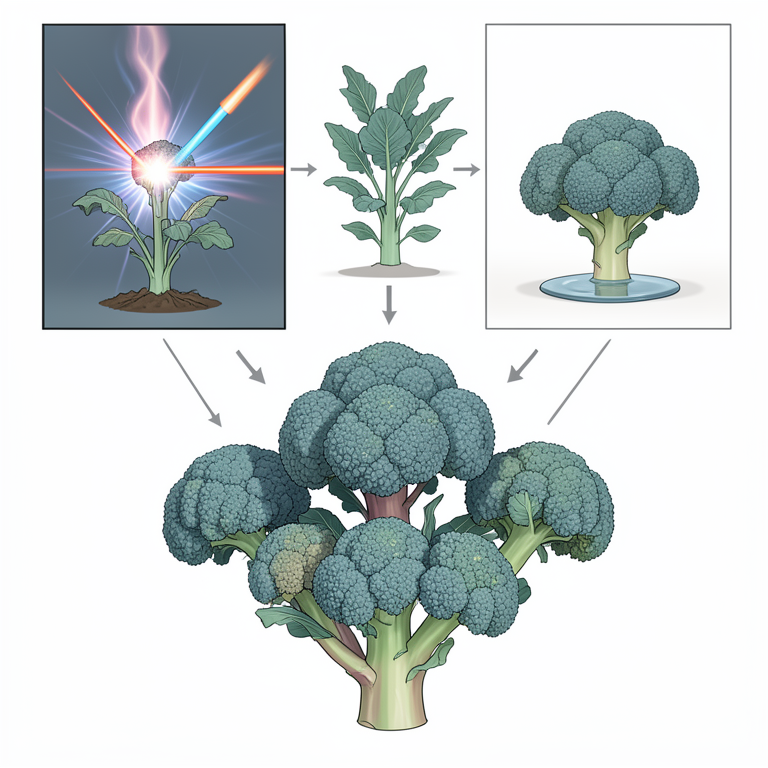
Types of Mutagens
AI-generated conceptual illustration (Brassica oleracea (broccoli plants)). It explains the idea and does not show study data.
View source evidence ↗Figures & tables
From the original paper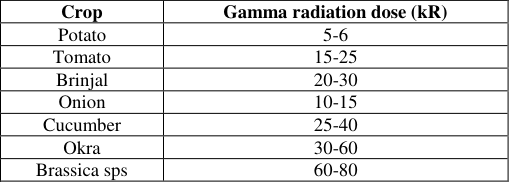 Table 1
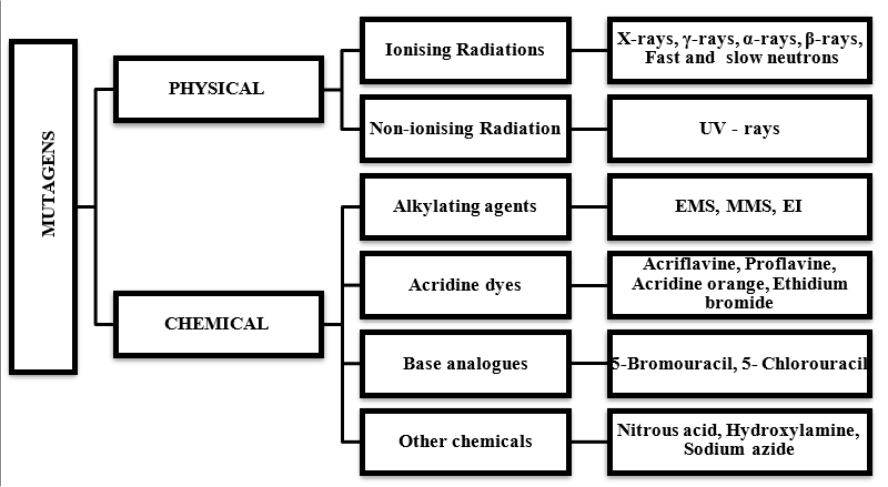 Figure 1
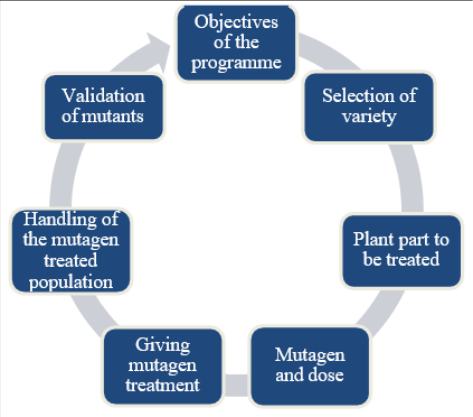 Figure 2
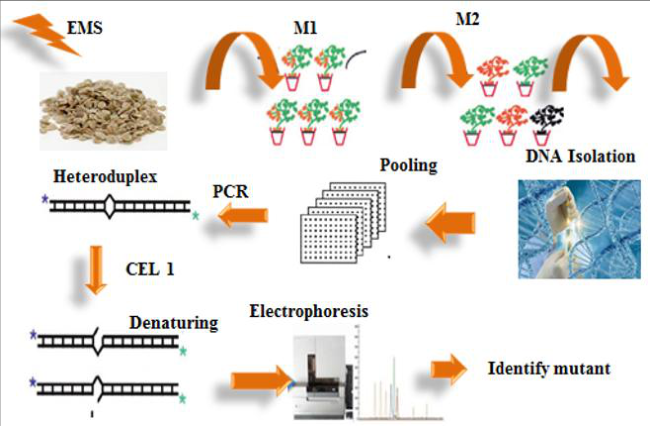 Plate 1
 Plate 2
Introduction
Introduction
History of mutation
Mutation, the term coined by Hugo de Vries in 1900 to describe heritable phenotypic alternations. Following Wilhelm Roentgen's 1895 discovery of X-rays, Muller (1927) and Stadler (1928) used X-rays to persuade mutations in Drosophila melanogaster and barley, respectively. One of the earliest milestones in crop mutation was the development of the chlorina mutant in Nicotiana tabacum (tobacco), marking the first commercially used mutant variety. Later, the induction of powdery mildew resistance in barley by X-ray was reported by Freisleben and Lein in 1942. A landmark contribution came from Gustafsson in 1947, whose work showed that a wide range of mutations in barley especially those affecting chlorophyll and stem stiffness (erectoides) responded differently depending on the plant genotype and environmental conditions. His research played a crucial role in shaping the field and is often credited as the driving force behind the growth of mutation breeding. For his pioneering efforts, Gustafsson is widely regarded as the Father of Mutation Breeding.
Mutation & Mutation Breeding
Mutation is any sudden, heritable alteration in an organism's genome that is neither the result of regular recombination nor segregation. Mutation breeding refers to the process of genetically modifying crop plants for a variety of economic traits through the use of induced mutations. Its main objective. is to create wide variation within the population. There are different types of mutations based upon certain factors. Mutations that occur naturally are spontaneous mutations whereas induced mutations are those that are created artificially by the use of specific physical or chemical agents. Among different types of mutations, induced mutation is used for the genetic improvement of various crops.
Mutagens
The term "mutagen" refers to substances that cause mutations. It can be induced by physical and chemical agents. Its classification is listed in fig 1.
Fig 1: Classification of Mutagens
Fig 1: Classification of Mutagens
Lethal dose 50 (LD 50)
The lethal dose 50 provides insight into the ideal mutagen dose. It is the dose of mutagen which would kill 50% of the treated individuals. An optimal dosage induces maximum mutations with minimal detrimental effects. A high mutagen dose will kill an excessive number of plants, whereas a low dose will result in an insufficient mutation spectrum and frequency. The concentration, treatment time, and treatment temperature are the key determinants of the mutagenic dosage. LD 50 values for gamma irradiation in various vegetables are given in table 1. [3] showed that treating Capsicum annuum and Capsicum frutescens with fast neutrons for 90 minutes resulted in the highest yield performance. Similarly, a study by Mohite and Gurav (2019) [101] found that 50 kR gamma ray treatment in okra produced the most promising results in both the M1 and M2 generations.
| Crop | Gamma radiation dose (kR) |
|---|---|
| Potato | 5-6 |
| Tomato | 15-25 |
| Brinjal | 20-30 |
| Onion | 10-15 |
| Cucumber | 25-40 |
| Okra | 30-60 |
| Brassica sps | 60-80 |
Table text extracted from the original PDF; superscript letters are shown inline. The original table image is below.
View original table image
Chemical mutagens
Chemical mutagens have proven effective in mutation breeding programs, helping to create genetic variations that lead to improved crop varieties with traits such as higher yield, reduced stature and better disease resistance. An experiment conducted by Reddaiah et al. (2014) [12] on induced mutation in Solanum lycopersicum cv. Arka Vikas using EMS (0.75%) found to obtain more number of genetic variability. Additionally, a comparative study conducted by Awachar et al. (2022) [2] on two Capsicum annuum L. varieties Pusa Jwala and Pusa Sadabahar in the M2 generation revealed that sodium azide was more effective than hydroxylamine in inducing desirable morphological changes and enhancing genetic diversity.
Procedure for mutation breeding
The entire process of using a mutagen on biological materials to create a desirable mutant phenotype is referred to,as mutation breeding. The various processes in mutation breeding are given in fig. 2: [6] .
Mutation breeding in sexually propagated plants. Mutation breeding for oligogenic traits
Mutation breeding for polygenic traits
Applications of mutation breeding
Mutation breeding is extensively employed to introduce favourable traits in crops. Its main objective is to obtain more variation among the population and to improve various qualitative and quantitative traits like growth, yield, quality, biotic and abiotic stress resistance, breaking undesirable traits etc. Luan et al. (2007) [8] screened sweet potato mutants for salt tolerance and reported that mutants treated with EMS 0.5% for 2 and 2.5 hours tolerated more in saline condition. Induced mutation creates new variation in genes and advanced modern approaches utilize mutated plants for breeding purposes as well as for creation of mutation library which can be utilized for both forward and reverse genetics studies (Tadmor et al., 2007) [13] . Anjitha, okra variety developed by KAU through induced mutation, in interspecific hybrids of Abelmoschus esculentus. var.
78
Kiran and A. manihot found to break its undesirable linkage by irradiation (Manju and Gopimony, 2009) [10] . In peas (Pisum sativum), Khan et al. (2018) [5] reported that lower doses of gamma irradiation improved morphological traits and yield components in the M2 generation. A study conducted by AL-Kubati et al., (2022) [1] discovered that bottle gourd plants treated with EMS developed stronger resistance to cucumber green mottle mosaic virus, with reduced disease severity in mutated plants. These examples demonstrate how mutation breeding effectively enhances genetic variation, leading to the development of superior crop varieties suited to modern agricultural challenges.
Modern trends in mutation breeding
Modern trends in mutation breeding
In vitro mutagenesis
The plant breeders has access to a variety of in vitro techniques such as micropropagation, protoplast culture, embryo rescue, and somatic embryogenesis to enhance the efficiency of creating, selecting, and multiplying desirable plant traits. Combining mutagenesis with tissue culture is a highly effective approach to boost genetic variation, which breeders can use for crop improvement. One of the major benefits of in vitro mutagenesis is the ability to expose large numbers of cells, protoplasts, or somatic embryos to mutagens in a controlled environment. This method allows for: Faster multiplication of mutant plant material Early selection of useful mutations in vitro Space-saving shoot multiplication under controlled conditions Efficient screening for resistance to diseases, pests, drought, and salinity Mutant clones developed through this method often show enhanced resistance to both biotic and abiotic stresses. For instance, Hadi and Fuller (2013) [4] reported that induced cauliflower mutants, treated with chemical mutagens like NEU and NMU, maintained stable resistance to drought and salt stress even after regeneration and micropropagation.
Space breeding
Strong cosmic radiation, microgravity, weak geomagnetic fields, and a super-clean super-vacuum create a unique atmosphere in space. A significant amount of experimental data demonstrated that the environment in space has an impact on plant growth and development as well as causing genetic variations in crop seeds. Space-induced mutation is an effective technique for creating new crop varieties as well as rare mutants that may significantly improve key economic traits like yield, and quality that are difficult to obtain through traditional breeding, methods on the ground (Liu, 2009) [7] .
High throughput screening method
A number of efficient, accurate, and systematic breeding techniques have been developed recently as a result of the development of modern high-throughput instruments and their combination with molecular labelling technology. These techniques can be used for the high-throughput identification of genotypes and phenotypes of mutagenized populations for consecutive generations. In particular, multispectral imaging and machine vision technologies, combined with image processing, have greatly enhanced the speed and accuracy of phenotype detection. These innovations help breeders spot useful mutations faster, making the selection process much more effective (Ma et al., 2021) [9] .
Tilling
The mutation techniques along with molecular technologies like high-throughput mutation-screening techniques are getting increasingly potent and effective at creating new varieties. With the advancement of modern biotechnology and the genomic discoveries of crop plants, particularly with the advent of targeted induced local lesions in genomics (TILLING) technology, mutation breeding could become, a productive strategy to complement other technologies in vegetable breeding. TILLING is a high-throughput, technology that uses a potent detection method to find single nucleotide mutations in a targeted area of a gene of interest caused by chemically induced mutagenesis. It is fast, efficient, and cost-effective, making it ideal for screening large populations of mutagenized plants to find desirable point mutations (Wang et al., 2006) [14] .
Plate 1: Procedure of TILLING
Conclusion& Future thrust
Plant breeders have been compelled to devise policies to improve the quantitative, and qualitative features of edible crops as, a result of rising food particularly in emerging nations like India. Induced mutagenesis has been demonstrated in numerous studies to be an effective technique for a balanced rise in the targeted characteristic, in addition to yield and its attributing characters. A particular benefit of mutation induction is the creation of a variety of mutant lines, the identification of trait-specific genes, the study of molecular functional, genomics, and the development of bio-informatics for the creation of plant varieties to be grown on the available arable land under climate change to feed the rapidly increasing human population. When guided by clear goals, a well-designed mutagenic protocol, and effective screening methods, mutagenesis can be a valuable technique for crop improvement. Furthermore, integrating mutation breeding with modern genetic engineering and molecular mapping can significantly accelerate the development of highyielding, climate-resilient plant varieties. These combined tools are likely to become essential in the future of plant breeding.
References
11 in the original paper- AL-Kubati AMS, Kang B, Abbas A, Kaseb MO, Gu Q. Screening for resistance to cucumber green mottle mosaic virus in bottle gourd mutated by Ethyl methanesulphonate. Aust Plant Pathol. 2022;51(5):53541.
- Awachar SR, Parveen S. Induction of genetic variability in Pusa Jwala and Pusa Sadabahar (Capsicum annuum L.) through Mutation via Sodium Azide and Hydroxyl Amine. YMER. 2022;21(6):313-8.
- Falusi OA, Daudu OAY, Teixeira da Silva JA. Effect of exposure time of fast neutron irradiation on growth and yield parameters of Capsicum annum and Capsicum frutescens. Afr J Plant Sci. 2012;6(9):251-5.
- Hadi F, Fuller MP. Chemically induced mutants of Brassica oleracea var. botrytis maintained stable resistance to drought and salt stress after regeneration and micropropagation. Am J Plant Sci. 2013;4(3):498507.
- Khan WM, Muhammad Z, Akhtar N, Burni T, Younas A, Umar N. Gamma radiation induced mutation in M2 generation of Pea (Pisum sativum L.). Pure Appl Biol. 2018;7(2):832-9.
- Sarkar T, Mondal T. Recent advances and achievements in mutation breeding of fruit crops. Int J Agric Food Sci. 2024;6(2):166-72.
- Liu LX, Guo HJ, Zhao LS, Wang J, Gu JY, Zhao SR. Achievements and perspectives of crop space breeding in China. In: Induced plant mutations in the genomics era. Rome: Food and Agriculture Organization of the United Nations; 2009. p. 213-5.
- Luan YS, Zhang J, Gao XR, An LJ. Mutation induced by ethylmethanesulphonate (EMS), in vitro screening for salt tolerance and plant regeneration of sweet potato (Ipomoea batatas L.). Plant Cell Tissue Organ Cult. 2007;88:77-81.
- Ma L, Kong F, Sun K, Wang T, Guo T. From Classical Radiation to Modern Radiation: Past, Present, and Future of Radiation Mutation Breeding. Front Public Health. 2021;9(1):768071.
- Manju P, Gopimony R. Anjitha-A new okra variety through induced mutation in interspecific hybrids of Abelmoschus spp. In: Induced plant mutations in the genomics era. 2009. p. 87-90.
- Mohite AV, Gurav RV. Induced mutation using gamma rays in okra (Abelmoschus esculentus (L.) Moench). J Appl Hortic. 2019;21(3):205-8.