
Research article · 2025 · Full text
International Journal of Agriculture and Food ScienceConstraint analysis in value added palmyra production in Tutucorin District of Tamil Nadu
Volume 7(8) · Pages 246–248 · DOI: 10.33545/2664844x.2025.v7.i8d.617 ↗
Research areasAgricultural Economics and Practices
Abstract
Author-writtenPalmyra (Borassus flabellifer L.,) is one of the world's oldest flowering plant known to mankind. Generally, it is also known as “Toddy Palm” or “Sugar palm”. The other is considered as ‘Kalpaga tharu’. Indian Palmyra palm trees, estimated at 102 million, are found in semi-arid regions including Tamil Nadu, Andhra Pradesh, Gujarat, Odisha, West Bengal, Bihar, Karnataka, and Maharashtra. Tamil Nadu has 90 million palm trees, with over 50% in Thoothukudi district, In Tamil Nadu, there are 9,674.46 hectares of Palmyra palm area with a production of 142,328. 40 tonnes yielding 14.71 tonnes per hectare. An economically important for its nutritional value but has not been commercialized due to its slow growth and wild nature. The study was conducted in Tutucorin district of Tamil Nadu state, India. As this district It’s a significant hub for Palmyra value-added products. Even though Particularly Udangudi block have been selected Totally 8 Villages having Highest area under Palmyra Palm production Were Purposively selected. A total number of 80 respondent's were Identified from selected Eight villages by Using Proportionate random sampling method. The constraint overall problem in Palmyra production faced by farmer, in This study assists in identifying the issues have with value addition and marketing. The findings also offer suggestions about how farmers might get around the challenges they face. The survey's findings reveal that the main constraints to value addition are identified by the lack of raw material availability and value addition, limited equipment and machinery, and the absence of export avenues and infrastructure facilities are key constraints for value-added products in the research area. Additionally, the shortage of competent laborers, inadequate worker training and technical guidance, and insufficient research and technology are further obstacles to producing and marketing value added goods made from Palmyra.
Summary
Source-checkedPlain-language reading of the full paper, prepared with AI and checked against the text. Each point links to the authors' own words.
Why it matters
- Palmyra (Borassus flabellifer L.) is recognized as one of the oldest flowering plants known to humans. View evidence ↗
- Despite its nutritional and economic importance in southern India, the Palmyra palm has not been fully commercialized because of its wild nature and slow growth. View evidence ↗
- Creating value-added products such as jaggery and palm flour can improve food security and generate income for marginal and poor farmers. View evidence ↗
The question
- The study aims to identify the overall constraints and issues farmers face regarding the production, value addition, and marketing of Palmyra. View evidence ↗
What they did
- The research was conducted in the Udangudi block of the Tutucorin district in Tamil Nadu, India, which is a major hub for Palmyra value-added products. View evidence ↗
- The researchers purposively selected eight villages with the highest Palmyra production and used proportionate random sampling to identify 80 respondents. View evidence ↗
- Constraints were assessed using a structured interview with a three-point scoring system: 3 for major constraint, 2 for somewhat constraint, and 1 for not a constraint. View evidence ↗
- The collected data were analyzed using mean scores and rank orders to assess the severity of the constraints. View evidence ↗
What they found
- The non-availability of raw materials was ranked as the top constraint, receiving the highest mean score of 3. View evidence ↗
- The lack of export avenues for value-added products was identified as the third major constraint with a mean score of 2.91. View evidence ↗
- Insufficient infrastructure facilities for selling value-added products ranked fourth with a mean score of 2.79. View evidence ↗
- Farmers reported a lack of time for preparing value-added products due to their farming commitments, which ranked fifth with a mean score of 2.7. View evidence ↗
- A shortage of skilled laborers was ranked sixth, with a mean score of 2.51. View evidence ↗
- The non-availability of necessary equipment and machinery for value addition was ranked second, with a mean score of 2.23. View evidence ↗
- The lack of assistance from extension personnel was the lowest-ranked constraint, with a mean score of 1.56. View evidence ↗
What it means
- The authors conclude that the primary barriers to Palmyra value addition are the lack of raw materials, limited machinery, and a deficiency in export avenues and infrastructure. View evidence ↗
- The authors further state that insufficient research, technology, technical guidance, and a shortage of trained laborers hinder the production and marketing of value-added Palmyra goods. View evidence ↗
Visual summary
1 visualsIllustrations explain the paper; charts are replotted from the paper's own table values.
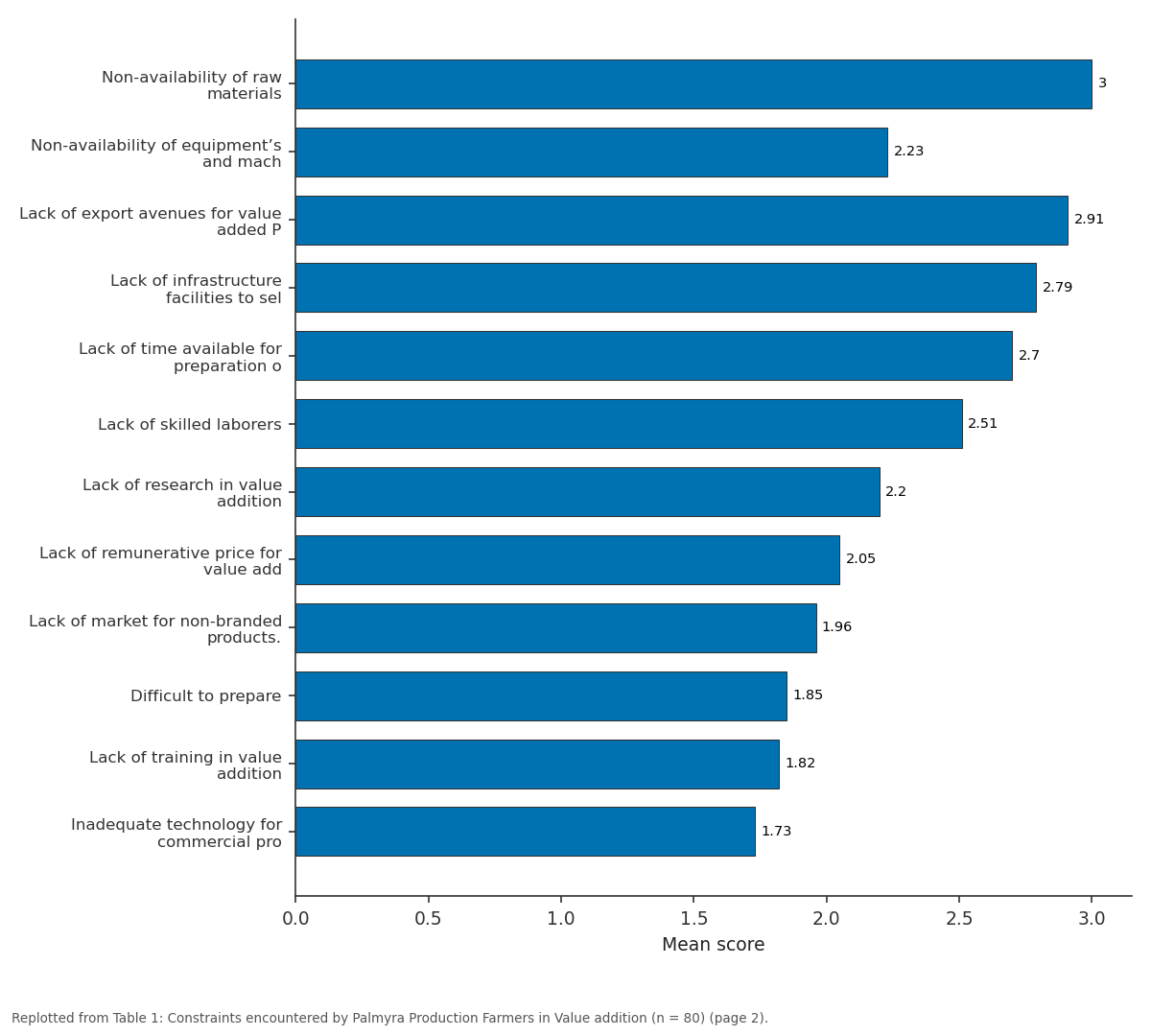
Mean score: Non-availability of raw... vs Non-availability of... vs Lack of export avenues... vs Lack of infrastructure... vs Lack of time available...
Replotted from Table 1 (page 2) of the original paper. Every bar is the paper's own table value.
View source evidence ↗Figures & tables
From the original paper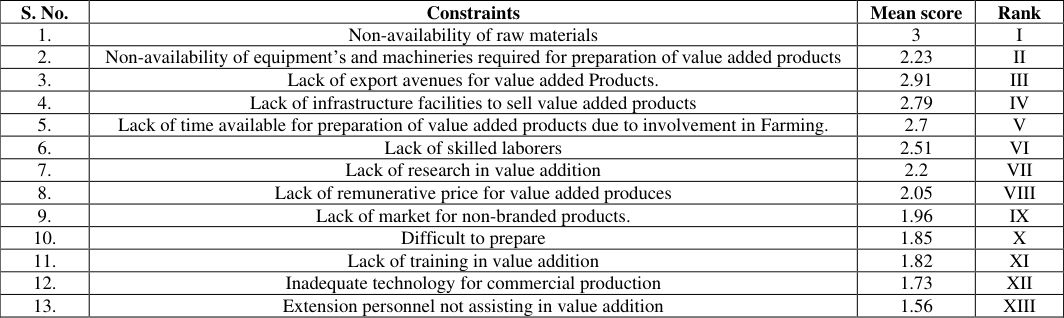 Table 1
Introduction
PALMYRA (Borassus flabellifer L.,) is one of the world's oldest flowering plants known to mankind. Generally, it is also known as "Toddy Palm" or "Sugar palm". The other is considered as 'Kalpaga tharu' [3] . The Palmyra a widely grown plant in southern India, is economically important for its nutritional value but has not been commercialized due to its slow growth and wild nature. Understanding its physic-chemical properties and developing value-added products is crucial. India's Palmyra palms, estimated at 102 million, are found in semi-arid regions like Tamil Nadu, Andhra Pradesh, Gujarat, Odisha, West Bengal, Bihar, Karnataka, and Maharashtra. Out of 51.90 million palms in Tamil Nadu, over 50% are concentrated in the Southern district of Thoothukudi [4] .Government of Tamil Nadu in the year 1978 recognized Palmyra as State Tree [2] . In Tamil Nadu state, Palmyra palm Area (9674.46 ha), Production 142328.40 tones and Productivity 14.71 tonnes /ha. (Tamil Nadu State Department of horticultural crops: Area, Production and Productivity of Horticulture Crops FINAL ESTIMATES 2021-22 Plantation Crops). Palmyrah palm is an underexploited crop with high nutritional value, potentially addressing malnutrition in developing countries like India. Its fresh and value-added forms, like palm flour and jaggery, can generate income and improve food security for the poor and marginal farmers. Popularization through value addition can also boost income generation and livelihood security [9,10] .
Value addition is a process that alters the physical form of agricultural produce, enhancing its acceptability, availability, market viability, and cost-to-benefit ratio for growers. This process also increases the produce's spatial and temporal availability, making it less sensitive to market fluctuations. This process, known as secondary agriculture, benefits both producers and consumers, making it a desirable practice in the United States Department of Agriculture.
Materials and Methods
The Study was Conducted in Tutucorin district of Tamil Nadu state. As this district It's a significant hub for Palmyra value-added products. Even though Particularly Udangudi block have been selected In this block villages are namely Kuthiraimozhi, Paramankurichi, Manadu Thandupathu, Laxmipuram, Chettiapattu, Udangudi, Vengatramanujapuram and Mathavankurichi Totally 8 Villages having Highest area under Palmyra Palm production Were Purposively selected. A total number of 80 respondent's were Identified from selected Eight villages by Using Proportionate random sampling method. The constraint overall problem in Palmyra production faced by farmer. A well structured interview schedule for Assessing the identified constraint were administrated through a three point continuum as Major constraint, Somewhat constraint, Not a constraint with scores of 3, 2 and 1 respectively. The score for each constraint was obtained. The data collected through interview was tabulated analyses using the mean score. Based on the mean score and rank order, the constraint were assessed.
Results and Discussion
Constraints encountered by Palmyra Production Farmers in Value addition. The mean score and rank order of the constraints are presented in Table 1. Mean score is (2.05), Producer farmer's statement from Palmyra value addition over the lack of a fair price for value-added output due to lack of remunerative pricing for value-added product. 9. Lack of market for non-branded products is (1.96), Farmers who manufacture Palmyra value-added products and the government both cited the lack of a market for non-branded goods and the need for marketing department support as significant marketing barriers. This discovery coincides with the results of D. Kanthimathi, Hence cooperative federation shows their existence by propaganda and creating awareness among the producers, provide advance like private traders, take up their issues or problem to the government in an organized manner, conduct series of market surveys and research, and then only they can attract the Palmyra product producer. The producer should also realize the fact that cooperative society are the only hope to them to derive fair price in the market in future [11] . 10. Difficult to prepare Mean score is (1.85),This is followed by personal constraints like lack of confidence in the preparation of product to the standards accepted by public difficult to prepare as expressed by the Palmyra Value added product producer.
| S. No. | Constraints | Mean score | Rank |
|---|---|---|---|
| 1. | Non-availability of raw materials | 3 | I |
| 2. | Non-availability of equipment’s and machineries required for preparation of value added products | 2.23 | II |
| 3. | Lack of export avenues for value added Products. | 2.91 | III |
| 4. | Lack of infrastructure facilities to sell value added products | 2.79 | IV |
| 5. | Lack of time available for preparation of value added products due to involvement in Farming. | 2.7 | V |
| 6. | Lack of skilled laborers | 2.51 | VI |
| 7. | Lack of research in value addition | 2.2 | VII |
| 8. | Lack of remunerative price for value added produces | 2.05 | VIII |
| 9. | Lack of market for non-branded products. | 1.96 | IX |
| 10. | Difficult to prepare | 1.85 | X |
| 11. | Lack of training in value addition | 1.82 | XI |
| 12. | Inadequate technology for commercial production | 1.73 | XII |
| 13. | Extension personnel not assisting in value addition | 1.56 | XIII |
Table text extracted from the original PDF; superscript letters are shown inline. The original table image is below.
View original table image
Conclusion
The study's findings reveal that the main constraints to value addition are identified by the lack of raw material availability and value addition, limited Equipment and machinery, and the absence of export avenues and infrastructure Facilities are key constraints for value-added products in the research area. Additionally, the shortage of competent laborers, inadequate worker training and Technical guidance, and insufficient research and technology are further obstacles to producing and marketing value-added goods made from Palmyra.
References
10 in the original paper- Sarma C, Mummaleti G, Sivanandham V, Kalakandan S, Rawson A, Anandharaj A. Anthology of palm sap: The global status, nutritional composition, health benefits & value added products. Trends Food Sci Technol. 2022;119:530-549.
- Upadhyaya A, Sonawane SK. Palmyrah Palm and its Products (Neera, Jaggery and candy)-A Review on chemistry and technology. Appl Food Res. 2023;3.
- Rao MCS, Swami DV, Ashok P, Nanda SP, Rao BB. Scope, Nutritional Importance and value addition in Palmyra (Borassus flabellifer L.,) an Exploited crop. In: Bio active Compounds-Bio synthesis, characterization and Application. 2021. p. 1090.
- Anonymous. Preliminary trial on vacuum Packaging of Nungu. In: AICRP (Palms). Annual report 2014-2015. ICAR-All India Co-operated Research project on Palm. ICAR-CPCRI, Kasaragod; c2015. p. 108.
- Chaurasiya S. Value addition of Palmyra Palm and studies on the storage life. Assoc Food Sci Technol. 2011;1.
- Chaurasiya AK, Chakraborty I, Saha J. Value addition of Palmyra Palm and studies on the storage life. J Food Sci Technol. 2014;51:768-773.
- Jana H, Jana S. Palmyra palm; Importance in Indian Agriculture. Rastriya Krishi. 2017;12.
- Sanyang ML, Sapaun SM, Jawaid M, Ishak MR, Sahari J. Recent developments in sugar Palm (Arena pinnate) based biocomposties and their potential industrial applications: review. Renew Sust Energy Rev. 2016;54:533-549.
- Vengaiah PC, Ravindra babu D, Murthy GN, Prasad KR. Jaggery from Palmyra Palm (Borassus flabellifer L.,)-present status and scope. Indian J Tradit Knowl. 2013;12(4):714-717.
- Shaliny S, Thayalan SS. Going local; Exploring consumer Behavior and motivations for Palmyra based products. In: Proceedings of International conference on contemporary management-2014 (ICCM-2014); 2014. p. 779-789.