
Research article · 2025 · Full text
International Journal of Agriculture and Food ScienceA comparative study of online and in-store shopping preferences of consumers of different age groups
Volume 7(8) · Pages 372–376 · DOI: 10.33545/2664844x.2025.v7.i8f.634 ↗
Research areasConsumer Retail Behavior StudiesTechnology Adoption and User Behaviour
Abstract
Author-writtenThis study compares the shopping preferences of consumers from the two age groups 20–40 years and 41–60 years, focusing on their preferences between online shopping platforms and retail shopping. The data was collected from 60 consumers with equal gender distribution using structured questionnaire. The result shows that 20-40 years age group consumers prefer online shopping due to its convenience, better prices, variety, and time-saving features, while the 41-60 years age group consumers prefer retail shopping for trust, quality assurance, personalised service, and loyalty rewards. The consumers in the age group of 20-40 years were mainly concerned about technology and digital marketing challenges, whereas the consumers in the age group 41-60 years were worried about high operational costs and losing regular customers. While most of the consumers in the age groups of 41-60 years believed that online shopping would replace physical stores, consumers from 20-40 years of age group felt both modes could continue together if stores adapt effectively. The study recommends that retailers focus on competitive pricing, loyalty programmes, digital services, personalised service, and better digital marketing to meet the needs of both age groups consumers and remain competitive in the changing retail markets.
Summary
Source-checkedPlain-language reading of the full paper, prepared with AI and checked against the text. Each point links to the authors' own words.
Why it matters
- The growth of online shopping has changed traditional consumer habits and created strong competition for physical retail stores. View evidence ↗
- Age is considered a key factor that determines how consumers behave when shopping. View evidence ↗
- Understanding age-based shopping preferences helps businesses and policymakers create targeted strategies to meet specific consumer needs. View evidence ↗
The question
- The research examines purchasing behaviors, attitudes, influencing factors, and challenges associated with both shopping modes. View evidence ↗
What they did
- The research used an exploratory design and was conducted in the old city market of Udaipur, Rajasthan. View evidence ↗
- The sample consisted of 60 consumers, split equally by age (30 in the 20-40 group and 30 in the 41-60 group) and gender (30 males and 30 females). View evidence ↗
- Data was collected using a structured interview schedule. View evidence ↗
What they found
- Elder consumers (41-60) are more certain that online shopping will replace physical stores (76.66%) than younger consumers (40% agree, 60% unsure). View evidence ↗
- Better pricing is a primary driver for returning to physical stores for both groups, cited by 100% of the 20-40 group and 80% of the 41-60 group. View evidence ↗
What it means
- The authors recommend that retailers implement competitive pricing strategies to attract both age groups. View evidence ↗
- To attract younger consumers, the authors suggest integrating digital services like home delivery and in-store pickup. View evidence ↗
- The authors recommend loyalty programs specifically to retain elder consumers. View evidence ↗
Visual summary
2 visualsIllustrations explain the paper; charts are replotted from the paper's own table values.
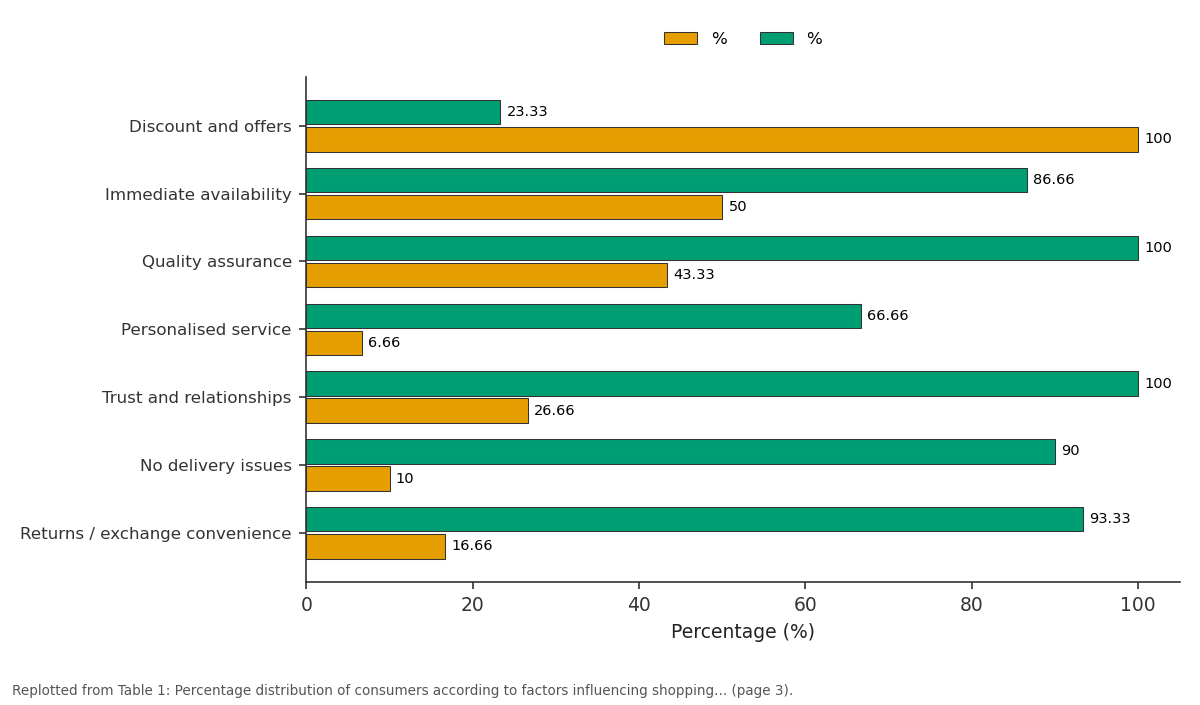
% and %: Discount and offers vs Immediate availability vs Quality assurance vs Personalised service vs Trust and relationships
Replotted from Table 1 (page 3) of the original paper. Every bar is the paper's own table value.
View source evidence ↗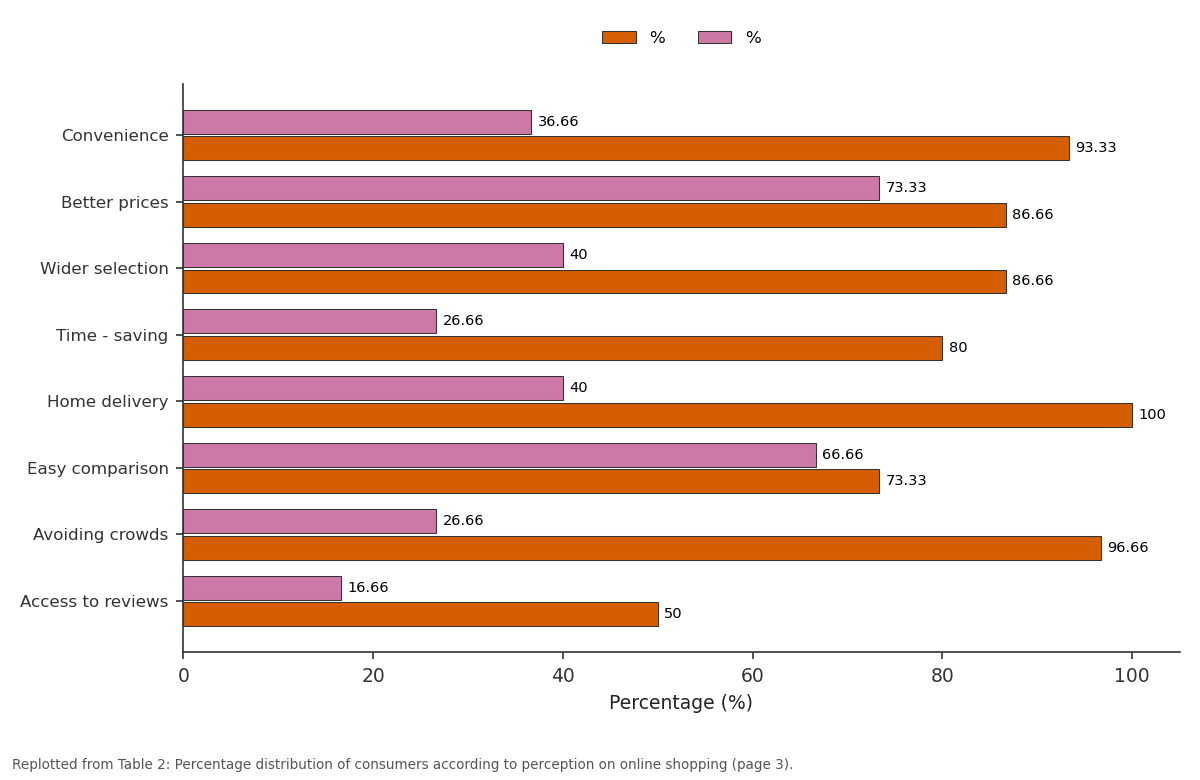
% and %: Convenience vs Better prices vs Wider selection vs Time - saving vs Home delivery
Replotted from Table 2 (page 3) of the original paper. Every bar is the paper's own table value.
View source evidence ↗Figures & tables
From the original paper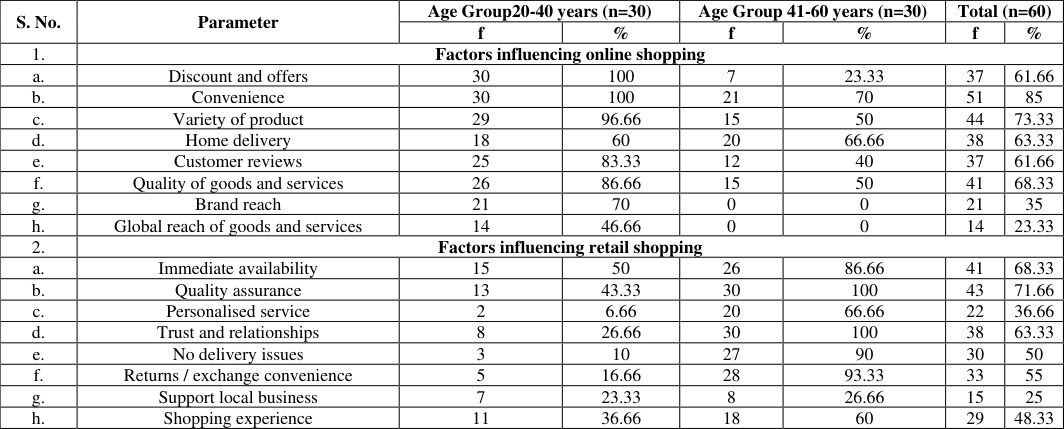 Table 1
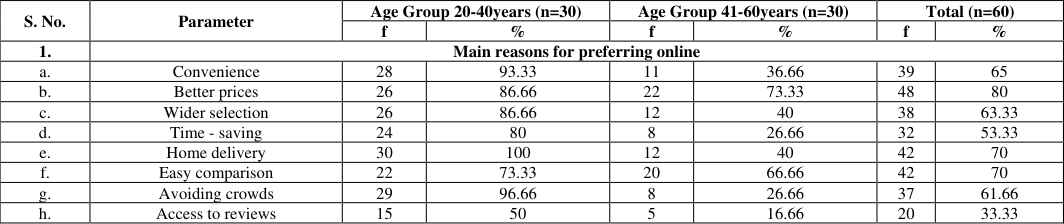 Table 2
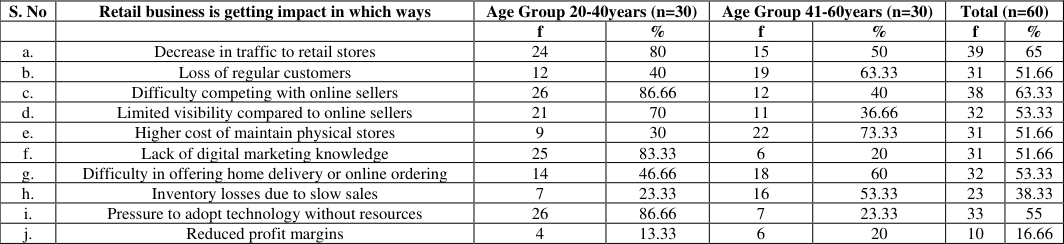 Table 3
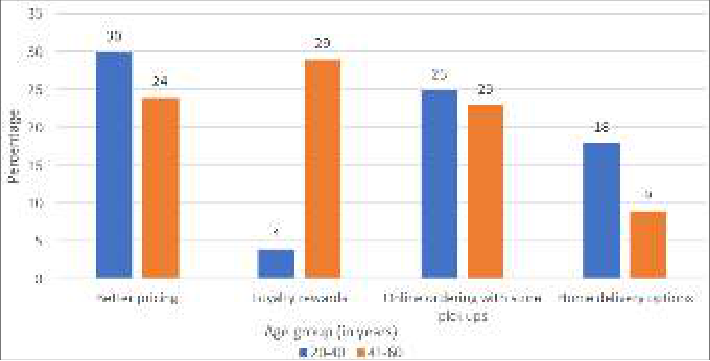 Figure 1
Introduction
Over the past two decades, the retail sector has undergone significant transformation as a result of rapid technological advancements and shifting consumer expectations. The rise of online shopping platforms has significantly transformed conventional shopping habits, creating intense competition for traditional retail stores. Online shopping is widely preferred for its convenience, time efficiency, broader product ranges, and competitive prices, attracting consumers from various demographic backgrounds. However, despite the growing dominance of online shopping, in-store shopping still holds substantial importance in consumers lives. Physical retail outlets offer unique advantages, such as face-to-face interaction with sales staff, the ability to physically inspect products before purchasing, and the immediate possession of goods. These benefits remain valuable to many consumers, suggesting that while technology enhances efficiency, personal experience and physical verification continue to play a crucial role in consumers choice. The several sociodemographic factors influence consumers shopping preferences, including age, gender, income, education level, and lifestyle. Among these, age stands out as a significant determinant of shopping behaviour. Consumers in the 20-40 years age group, being more technologically adapt and comfortable with digital platforms, tend to favour online shopping due to its ease, convenience, and exposure to a wider variety of products. Conversely, consumers in age group of 41-60 years may prefer in-store shopping, often due to limited familiarity with technology, concerns about online payment security, and their traditional shopping habits formed over the years. Analysing these differences in shopping preferences across age groups is vital for retailers, marketers, and policymakers to develop effective strategies that address the distinct needs of each consumer segment. Such insights enable businesses to design targeted marketing approaches, improve customer experiences, and adopt integrated retail strategies to remain competitive in the evolving market. This study aims to provide a detailed comparative analysis of online shopping platform and retail
Methodology
The study was conducted in the old city market of Udaipur district in Rajasthan and employed an exploratory research design. A sample of 60 consumers shopping at the selected retail stores were included in the sample. To make a fair comparison, they were divided equally into two age groups 20-40 years and 41-60 years, with 30 people in each group. Also, to keep the sample balanced, 30 males and 30 females were selected. This helped in understanding the shopping preferences and behaviour of different age groups and in both genders in a proper and clear way. A structured interview was schedule to collect data.
Result and Discussion
Result and Discussion
Socio-Demographic Characteristics
The socio-demographic profile of the consumers revealed that there was an equal number of male and female participants in both age groups (20-40 years and 41-60 years). Most consumers were well-educated, many having either a bachelor's or master's degree. In the age group of 20-40 years, 36.66 per cent had a bachelor's degree and the same percentage had a master's degree. Among the age group of 41-60 years, 26.66 per cent had a master's degree, 20 per cent had a bachelor's degree, and 20 per cent had a doctorate, which was higher compared to 10 per cent doctorates in the age group of 20-40 years. Only a small number (6.66%) had studied up to high school. Looking at their occupations, 48. Overall, the sample had equal gender distribution and was mostly educated, consisting mainly of working professionals and business owners.
Factors Shopping Decision
The finding shows clear differences between the two age groups regarding factors that influence their shopping decisions. Among consumers in age group of 20-40 years, all consumers (100%) said that discounts, offers, and convenience were the main reasons for shopping from online platforms.
Future of Shopping
Among consumers (41-60 years), 76.66 per cent believe that online shopping will replace physical stores, 10 per cent think it will not happen, and 13.33 per cent are unsure. In the younger age group (20-40 years), 40 per cent agree that online shopping will take over, while none completely ruled it out, and 60 per cent are unsure. This suggests that elder consumers are more certain about online platforms dominating in the future, while younger consumers have a more balanced view, believing that both online and physical stores might continue to exist together if retailers adapt to changing consumer needs. The data also highlights what improvements consumers want in retail stores. For consumers (20-40 years), better pricing was the top priority, with all of them (100%) saying it would make them shop more in stores. Many in this group (83.33%) liked the idea of ordering online and picking up in-store, and 60 per cent found home delivery services attractive. Only a few (13.33%) were interested in loyalty rewards. For elder consumers (41-60 years), better pricing was also the most important, chosen by 80 per cent. However, unlike the younger group, loyalty rewards were very important to them, with 96.66 per cent preferring this option. 76.66 per cent liked online ordering with store pickup, but only 30 per cent wanted home delivery services.
Overall, these results show that while both groups want better prices, younger consumers prefer digital options like store pickups and home delivery, whereas elder consumers value loyalty rewards more as an added benefit for shopping in physical stores.
Conclusion and Recommendations
This study explored the differences in shopping preferences between younger consumers 20-40 years age group and elder consumers (41-60 years), focusing on their attitudes towards online in-store shopping, factors influencing their choices, and their perceptions regarding the impact of online platforms on retail businesses. The findings revealed that younger consumers prefer online shopping due to its convenience, wider product variety, better prices, and timesaving benefits, while elder consumers prefer in-store shopping for reasons such as trust, quality assurance, personalised service, and immediate availability of products.
The study also showed that 20-40 years aged consumers are more concerned about technological and marketing challenges faced by retailers, whereas 41-60 years aged consumers worry about high operational costs and the loss of regular customers. When asked about the future of shopping, elder consumers were more confident that online platforms will replace physical stores, while younger consumers had a more balanced view, suggesting that both online and offline shopping modes might continue together if retailers adapt effectively. Furthermore, both groups emphasised the importance of better pricing as a key improvement in retail stores. Younger consumers showed a strong preference for digital conveniences like online ordering with in-store pickup and home delivery, whereas elder consumers valued loyalty rewards as an added incentive to continue shopping in physical stores.
Based on these findings, several recommendations can be made to help retailers adapt to changing consumer expectations. 1. It is crucial for retailers to adopt competitive pricing strategies, as both age groups prioritised better prices when choosing where to shop. 2. Introducing loyalty programmes can attract and retain elder consumers who highly value such rewards for their continued patronage. Retailers should also focus on integrating digital services such as online ordering with store pickups and home delivery options to cater to the preferences of younger consumers who seek convenience and flexibility.
Figures and tables from the paper
| S. No. | Parameter | Age Group20-40 years (n=30) | — | Age Group 41-60 years (n=30) | — | Total (n=60) | — |
|---|---|---|---|---|---|---|---|
| f | % | f | % | f | % | ||
| 1. | Factors influencing online shopping | ||||||
| a. | Discount and offers | 30 | 100 | 7 | 23.33 | 37 | 61.66 |
| b. | Convenience | 30 | 100 | 21 | 70 | 51 | 85 |
| c. | Variety of product | 29 | 96.66 | 15 | 50 | 44 | 73.33 |
| d. | Home delivery | 18 | 60 | 20 | 66.66 | 38 | 63.33 |
| e. | Customer reviews | 25 | 83.33 | 12 | 40 | 37 | 61.66 |
| f. | Quality of goods and services | 26 | 86.66 | 15 | 50 | 41 | 68.33 |
| g. | Brand reach | 21 | 70 | 0 | 0 | 21 | 35 |
| h. | Global reach of goods and services | 14 | 46.66 | 0 | 0 | 14 | 23.33 |
| 2. | Factors influencing retail shopping | ||||||
| a. | Immediate availability | 15 | 50 | 26 | 86.66 | 41 | 68.33 |
| b. | Quality assurance | 13 | 43.33 | 30 | 100 | 43 | 71.66 |
| c. | Personalised service | 2 | 6.66 | 20 | 66.66 | 22 | 36.66 |
| d. | Trust and relationships | 8 | 26.66 | 30 | 100 | 38 | 63.33 |
| e. | No delivery issues | 3 | 10 | 27 | 90 | 30 | 50 |
| f. | Returns / exchange convenience | 5 | 16.66 | 28 | 93.33 | 33 | 55 |
| g. | Support local business | 7 | 23.33 | 8 | 26.66 | 15 | 25 |
| h. | Shopping experience | 11 | 36.66 | 18 | 60 | 29 | 48.33 |
Table text extracted from the original PDF; superscript letters are shown inline. The original table image is below.
View original table image
| S. No. | Parameter | Age Group 20-40years (n=30) | — | Age Group 41-60years (n=30) | — | Total (n=60) | — |
|---|---|---|---|---|---|---|---|
| f | % | f | % | f | % | ||
| 1. | Main reasons for preferring online | ||||||
| a. | Convenience | 28 | 93.33 | 11 | 36.66 | 39 | 65 |
| b. | Better prices | 26 | 86.66 | 22 | 73.33 | 48 | 80 |
| c. | Wider selection | 26 | 86.66 | 12 | 40 | 38 | 63.33 |
| d. | Time - saving | 24 | 80 | 8 | 26.66 | 32 | 53.33 |
| e. | Home delivery | 30 | 100 | 12 | 40 | 42 | 70 |
| f. | Easy comparison | 22 | 73.33 | 20 | 66.66 | 42 | 70 |
| g. | Avoiding crowds | 29 | 96.66 | 8 | 26.66 | 37 | 61.66 |
| h. | Access to reviews | 15 | 50 | 5 | 16.66 | 20 | 33.33 |
Table text extracted from the original PDF; superscript letters are shown inline. The original table image is below.
View original table image
| S. No | Retail business is getting impact in which ways | Age Group 20-40years (n=30) | — | Age Group 41-60years (n=30) | — | Total (n=60) | — |
|---|---|---|---|---|---|---|---|
| f | % | f | % | f | % | ||
| a. | Decrease in traffic to retail stores | 24 | 80 | 15 | 50 | 39 | 65 |
| b. | Loss of regular customers | 12 | 40 | 19 | 63.33 | 31 | 51.66 |
| c. | Difficulty competing with online sellers | 26 | 86.66 | 12 | 40 | 38 | 63.33 |
| d. | Limited visibility compared to online sellers | 21 | 70 | 11 | 36.66 | 32 | 53.33 |
| e. | Higher cost of maintain physical stores | 9 | 30 | 22 | 73.33 | 31 | 51.66 |
| f. | Lack of digital marketing knowledge | 25 | 83.33 | 6 | 20 | 31 | 51.66 |
| g. | Difficulty in offering home delivery or online ordering | 14 | 46.66 | 18 | 60 | 32 | 53.33 |
| h. | Inventory losses due to slow sales | 7 | 23.33 | 16 | 53.33 | 23 | 38.33 |
| i. | Pressure to adopt technology without resources | 26 | 86.66 | 7 | 23.33 | 33 | 55 |
| j. | Reduced profit margins | 4 | 13.33 | 6 | 20 | 10 | 16.66 |
Table text extracted from the original PDF; superscript letters are shown inline. The original table image is below.
View original table image
References
6 in the original paper- Haridasan AC, Fernando AG. Online or in-store: Unravelling consumers channel choice motives. J Res Interact Mark. 2018;12(3):215-230. Available from: https://doi.org/10.1108/JRIM-07-2017-0060
- Millar G, Rabano CT, Rabina DJT. A comparative study of online and traditional shopping as revealed by the satisfaction of the selected consumers [Internet]. 2023 [cited 2025 Aug 7]. Available from: https://doi.org/10.13140/RG.2.2.22189.26088
- Patel K, Maruji J, Vidani J. Comparative analysis regarding consumers preference of online shopping vs in-store shopping for apparels in Ahmedabad city. Int J Appl Res Sustain Sci. 2024;2(11):953-974. Available from: https://doi.org/10.59890/ijarss.v2i11.78
- Rossolov A, Rossolova H, Holguín-Veras J. Online and in-store purchase behaviour: Shopping channel choice in a developing economy. Transportation. 2021;48(6):3143-3179. Available from: https://doi.org/10.1007/s11116-020-10129-0
- Sawhney C, Saini I, Tripti. A comparative study of consumer behaviour between online shopping and traditional shopping [Undergraduate research project, Janki Devi Memorial College]. Int J Novel Res Dev [Internet]. 2024 [cited 2025 Aug 7];
- Sonia. Consumer behaviour in online shopping: A comparative analysis of generational differences. Int J Res Public Seminars. 2024;15(3):136-141. Available from: https://doi.org/10.36676/jrps.v15.i3.1454