
Research article · 2025 · Full text
International Journal of Agriculture and NutritionInfluence of Nitrogen and Micronutrient Application on the Yield Components and Productivity of Pearl Millet (Pennisetum glaucum L.)
Volume 7(8) · Pages 08–11 · DOI: 10.33545/26646064.2025.v7.i8a.260 ↗
Research areasCrop Yield and Soil Fertility
Abstract
Author-writtenA field study was carried out during the Kharif season of 2024 at the research farm of Vivekananda Global University, Jaipur, on loamy sand soil. The experiment involved nine treatment combinations of nitrogen and micronutrient applications, including: 100% recommended dose of nitrogen (RDN) with soil application of FeSO₄ at 10 kg/ha; 100% RDN with soil application of ZnSO₄ at 25 kg/ha; 100% RDN with foliar application of 1.0% FeSO₄ at 25 and 50 days after sowing (DAS); 100% RDN with foliar application of 0.5% ZnSO₄ at 25 and 50 DAS; 75% RDN + 25% nitrogen via farmyard manure (FYM) with soil-applied FeSO₄ (10 kg/ha); 75% RDN + 25% FYM with soil-applied ZnSO₄ (25 kg/ha); 75% RDN + 25% FYM with foliar spray of 1.0% FeSO₄ at 25 and 50 DAS; 75% RDN + 25% FYM with foliar spray of 0.5% ZnSO₄ at 25 and 50 DAS; and a control with 100% RDN applied through chemical fertilizers. The layout followed a Randomized Block Design (RBD) with three replications. The findings revealed that the treatment T4 (100% RDN + 0.5% foliar spray of ZnSO₄) significantly outperformed others in terms of yield attributes such as earhead length, number of effective tillers, test weight, grain yield (1949 kg/ha), and biological yield (6242 kg/ha).
Summary
Source-checkedPlain-language reading of the full paper, prepared with AI and checked against the text. Each point links to the authors' own words.
Why it matters
- Pearl millet is a globally significant cereal, ranking fourth in importance within India. View evidence ↗
- Crop productivity in arid and semi-arid regions is primarily limited by irregular rainfall and low soil fertility. View evidence ↗
- Nitrogen is essential for plant development, specifically for promoting vegetative growth. View evidence ↗
The question
- The study aimed to evaluate how different combinations of nitrogen and micronutrients influence the productivity and yield components of pearl millet. View evidence ↗
What they did
- The field experiment was conducted on loamy sand soil during the 2024 Kharif season at Vivekananda Global University's research farm in Jaipur. View evidence ↗
- The researchers used a Randomized Block Design (RBD) with three replications for the experimental layout. View evidence ↗
- Grain yield was measured by weighing the cleaned produce from each plot and calculating the yield in kilograms per hectare. View evidence ↗
What they found
- Treatment T4 (100% RDN + 0.5% foliar ZnSO₄) produced the highest effective tillers (26.85), earhead length (36.62 cm), and test weight (7.94 g). View evidence ↗
- Treatment T4 achieved the highest grain yield at 1949 kg/ha and the highest biological yield at 6242 kg/ha. View evidence ↗
- Across all tested treatments, grain yields ranged from 1367 to 1949 kg/ha, and biological yields ranged from 4225 to 6242 kg/ha. View evidence ↗
- Every combination of nitrogen and micronutrients resulted in significantly higher yields than using chemical fertilizers alone. View evidence ↗
- The lowest grain yield (1367 kg/ha) and biological yield (4225 kg/ha) were recorded in the control group (T9) using only chemical fertilizers. View evidence ↗
What it means
- The authors conclude that the combination of 100% RDN and a 0.5% foliar spray of ZnSO₄ is the most effective treatment for maximizing pearl millet yield. View evidence ↗
Visual summary
2 visualsIllustrations explain the paper; charts are replotted from the paper's own table values.
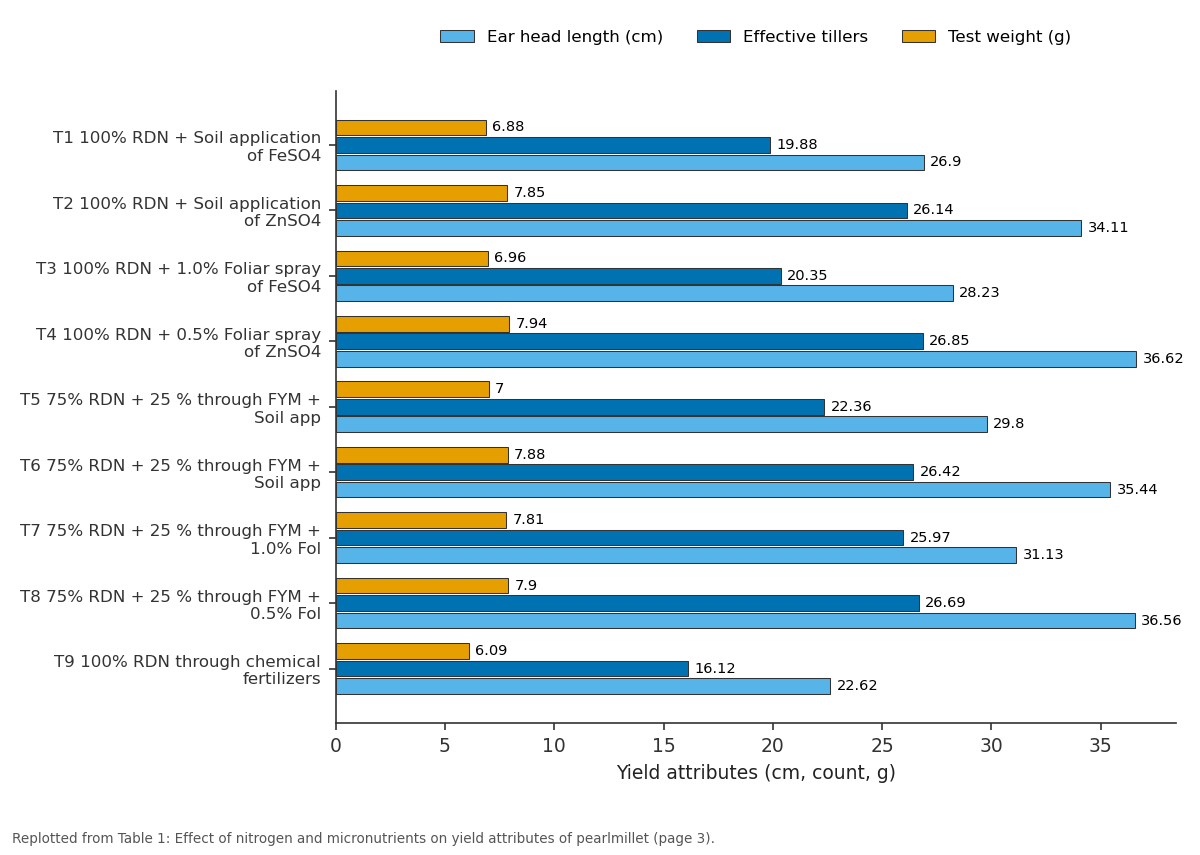
Ear head length (cm) and Effective tillers and more: T1 100% RDN + Soil... vs T2 100% RDN + Soil... vs T3 100% RDN + 1.0%... vs T4 100% RDN + 0.5%... vs T5 75% RDN + 25 %...
Replotted from Table 1 (page 3) of the original paper. Every bar is the paper's own table value.
View source evidence ↗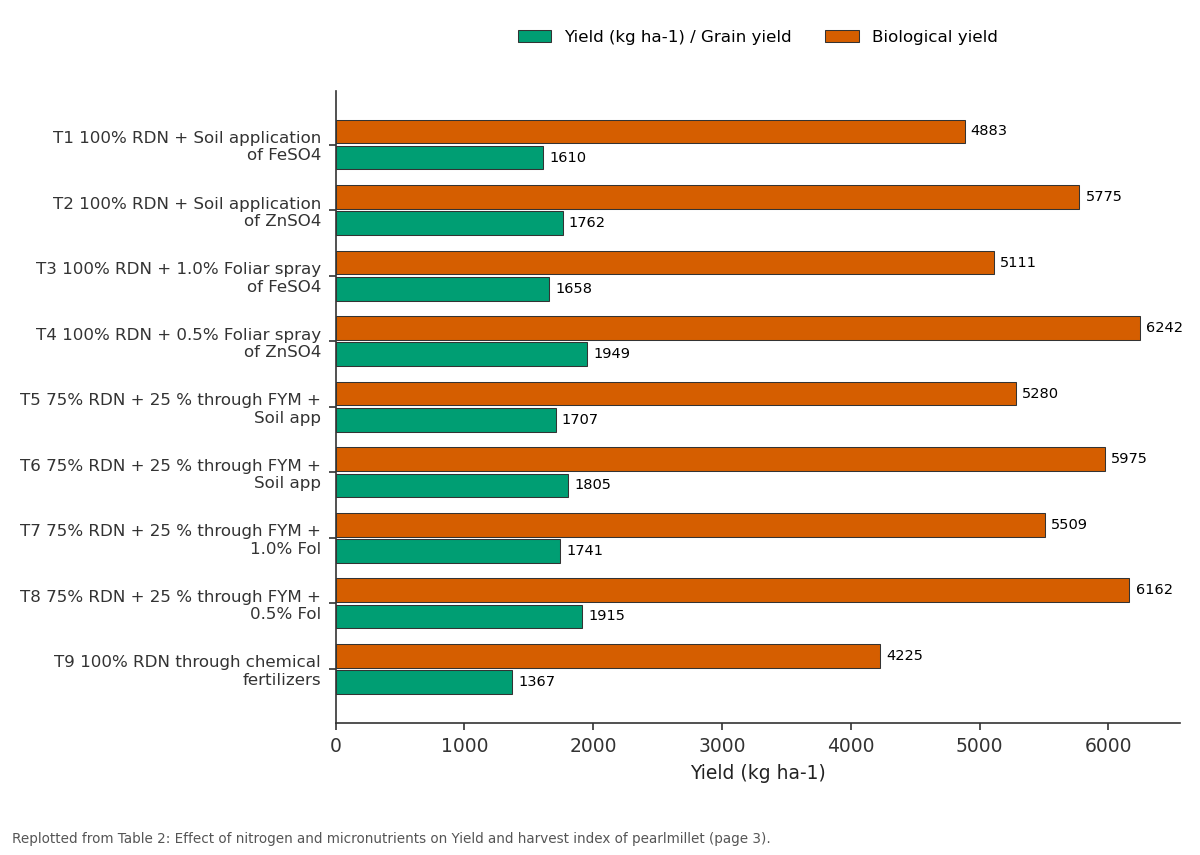
Yield (kg ha-1) / Grain yield and Biological yield: T1 100% RDN + Soil... vs T2 100% RDN + Soil... vs T3 100% RDN + 1.0%... vs T4 100% RDN + 0.5%... vs T5 75% RDN + 25 %...
Replotted from Table 2 (page 3) of the original paper. Every bar is the paper's own table value.
View source evidence ↗Figures & tables
From the original paper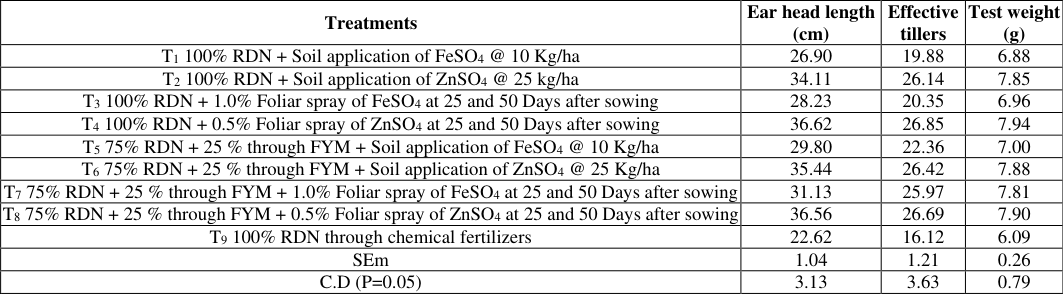 Table 1
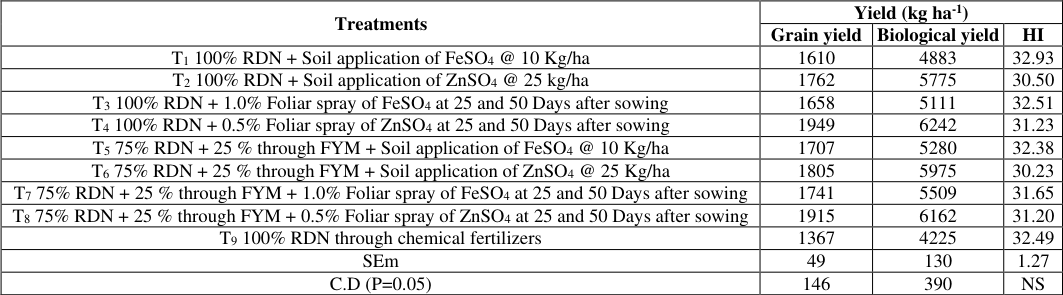 Table 2
Introduction
Pearl millet (Pennisetum glaucum L.), commonly known as Bajra in India, ranks as the fifth most important cereal globally and the fourth in India after rice, wheat, and maize. It plays a crucial role as a staple food crop in the arid and semi-arid regions of Africa and South Asia. In India, it serves as a primary dietary component for economically disadvantaged populations. Additionally, its dry stover holds significant value in livestock-based farming systems across many parts of the country. Nutritionally, pearl millet is not only comparable to other cereals but also stands out as a rich source of protein, energy, essential vitamins, and minerals (Rao et al., 2006) [10] . Moreover, it offers abundant dietary fiber, phytochemicals, micronutrients, and nutraceutical compounds, which is why it is now appropriately recognized as a "nutricereal." Low soil fertility and irregular rainfall patterns are among the primary challenges limiting crop productivity in arid and semi-arid regions. Effective soil fertility practices, particularly the management of nutrients like nitrogen (N), play a vital role in enhancing the growth and yield of pearl millet. Nitrogen is a critical macronutrient required for plant development, particularly in promoting vegetative growth. It is integral to numerous metabolic processes, as it forms part of essential cellular structures and biologically active compounds. Nitrogen is also a key element in chlorophyll and amino acids, both of which are crucial for capturing solar energy through photosynthesis. Adequate nitrogen supply ensures rapid leaf area expansion and stem development, thereby contributing to higher yields and better grain quality. Additionally, nitrogen improves the efficiency of phosphorus and potassium uptake by plants. In Indian soils, nitrogen is often the most limiting nutrient and its application has shown a significant positive response in pearl millet cultivation (Jadhav et al., 2011) [4] . Pearl millet, being a nutrient-demanding crop, responds variably to nitrogen application depending on soil and environmental conditions. Zinc (Zn) also holds a unique place in plant nutrition, as it is the only metal that serves as a component of all six classes of enzymes-oxidoreductases, transferases, hydrolases, lyases, isomerases, and ligases (Broadley et al., 2007) [3] . Zinc contributes to vital physiological functions including photosynthesis, protein formation, gene expression, auxin metabolism, and the maintenance of cellular membranes. It also plays a role in detoxifying reactive oxygen species, which collectively influence crop biomass and grain yield. Enhancing zinc concentration in edible plant parts is therefore essential for both plant and human health. Moreover, zinc interacts with other micronutrients, influencing their uptake and movement within the plant (Bell and Dell, 2008) [2] . On the other hand, applying iron (Fe) fertilizers can correct iron deficiencies in the soil, leading to improved crop growth and yield, which ultimately helps boost farmer income (Vikash et al., 2015) [12] . Iron is a vital micronutrient necessary for nearly all living organisms, owing to its key role in essential metabolic activities such as DNA replication, respiration, and photosynthesis. It activates several metabolic pathways and functions as a prosthetic group in numerous enzymes. A mismatch between the availability of iron in the soil and the plant's requirement often leads to iron chlorosis. While iron is generally abundant in well-aerated soils, its bioavailability is limited due to its tendency to form insoluble ferric compounds, especially under neutral pH conditions. In plants, iron is indispensable for various physiological and biochemical processes. It is a structural component of several critical enzymes, including cytochromes involved in the electron transport chain, making it essential for diverse biological functions. Additionally, iron is directly involved in chlorophyll production and is crucial for maintaining chloroplast integrity and functionality (Solanki et al., 2017) [11] .
Materials and Methods
The field experiment was carried out at the research farm of Vivekananda Global University, Jaipur. Geographically, the site is located at 26°51' North latitude and 75°47' East longitude, with an elevation of 390 meters above mean sea level in the Jaipur district of Rajasthan. This area falls under Agro-climatic Zone IIIa, also known as the Semi-Arid Eastern Plain Zone of Rajasthan. The study involved nine treatment combinations, including: 100% Recommended Dose of Nitrogen (RDN) + soil application of FeSO₄ @ 10 kg/ha 100% RDN + soil application of ZnSO₄ @ 25 kg/ha 100% RDN + 1.0% foliar spray of FeSO₄ at 25 and 50 days after sowing (DAS) 100% RDN + 0.5% foliar spray of ZnSO₄ at 25 and 50 DAS 75% RDN + 25% nitrogen via farmyard manure (FYM) + soil-applied FeSO₄ @ 10 kg/ha 75% RDN + 25% FYM + soil-applied ZnSO₄ @ 25 kg/ha 75% RDN + 25% FYM + 1.0% foliar spray of FeSO₄ at 25 and 50 DAS 75% RDN + 25% FYM + 0.5% foliar spray of ZnSO₄ at 25 and 50 DAS 100% RDN supplied through chemical fertilizers.
Length measurement of the earhead
From each plot, five earheads were randomly chosen from the sampled plants, and their lengths were measured using a meter scale, measuring from the neck node to the tip. The average length of these earheads was then calculated.
Number of viable tillers per plant
Tillers were counted from five randomly chosen and marked plants in each plot, and the average number of tillers per plant was calculated.
Grain test weight
A random sample of one thousand grains was taken from the fully cleaned and winnowed produce of each plot, and their combined weight was measured to determine the test weight (in grams).
Grain yield
Following threshing, winnowing, and cleaning, the yield from each plot was individually weighed in kilograms, and then the grain yield was calculated and expressed in kilograms per hectare (kg ha⁻¹).
Crop residue yield
Stover yield (kg ha⁻¹) was calculated by deducting the grain yield (kg ha⁻¹) from the total biological yield (kg ha⁻¹).
Total biomass yield
The weight of the harvested produce from each plot, after being completely sun-dried, was recorded individually before threshing and expressed as biological yield in kilograms per hectare (kg ha⁻¹). The grain-to-biomass yield ratio, or harvest index, was calculated using a standard method.
Results and Discussion
The number of effective tillers per meter of row length, earhead length, and 1000-grain weight in pearl millet were significantly affected by the various treatment combinations applied. As shown in Table 1, the highest values for effective tillers (26.85), earhead length (36.62 cm), and test weight (7.94 g) were observed under treatment T4, which involved 100% Recommended Dose of Nitrogen (RDN) combined with a 0.5% foliar spray of ZnSO₄ at 25 and 50 days after sowing. This was followed by treatments T 8 (75% RDN + 25% through farmyard manure (FYM) + 0.5% foliar spray of ZnSO₄ at 25 and 50 DAS), T 7 (75% RDN + 25% FYM + 1.0% foliar spray of FeSO₄ at 25 and 50 DAS), and T 6 (75% RDN + 25% FYM + soil application of ZnSO₄ @ 25 kg/ha). The improvement in these yield attributes is likely linked to enhanced photosynthetic activity, leading to greater production of photosynthates that accumulate in the sink organs, positively influencing the number of effective tillers, earhead length, and 1000-grain weight. The notable increase in these traits may be attributed to zinc's role in the biosynthesis of indole acetic acid, which promotes the initiation of reproductive primordia and stimulates photosynthesis (Rakesh et al., 2021). Additionally, nitrogen application enhances flower fertility, leaf area, and leaf longevity, thereby increasing the supply of assimilates to the developing sinks. The grain and biological yields of pearl millet showed significant variation due to the application of different nitrogen and micronutrient combinations. Across the treatments, grain yield ranged from 1367 to 1949 kg ha⁻¹, while biological yield varied between 4225 and 6242 kg ha⁻¹. The highest yields were recorded under treatment T4, which consisted of 100% Recommended Dose of Nitrogen (RDN) combined with a 0.5% foliar spray of ZnSO₄ applied at 25 and 50 days after sowing. All treatment combinations resulted in significantly greater yields compared to the use of chemical fertilizers alone, as detailed in Table 2. The increase in yield can be attributed to nitrogen's role in strengthening cell walls, which contributes to more robust straw and encourages prolific tillering. These findings are consistent with earlier reports by Rajput (2008) [8] , Ayub et al. (2007) [1] , and Pathan and Bhilare (2009) [7] . The combined application of nitrogen and zinc notably improved grain yield, likely due to nitrogen enhancing flower fertility and expanding leaf area and duration, thereby increasing the supply of assimilates to the developing grains (Mousavi et al., 2012). Zinc also plays a crucial role in the biosynthesis of indole acetic acid, promoting the initiation of reproductive primordia and stimulating photosynthesis directed towards these parts. Furthermore, nitrogen and zinc together enhance physiological and molecular processes within the plant, leading to increased grain production. Zinc's involvement in various enzymatic activities, hormone synthesis, and protein production acts as a catalyst for growth and yield attributes, ultimately boosting both stover and grain yields (Jakhar et al., 2006) [5] .
| Treatments | Yield (kg ha-1) | — | — |
|---|---|---|---|
| Grain yield | Biological yield | HI | |
| T1 100% RDN + Soil application of FeSO4 @ 10 Kg/ha | 1610 | 4883 | 32.93 |
| T2 100% RDN + Soil application of ZnSO4 @ 25 kg/ha | 1762 | 5775 | 30.50 |
| T3 100% RDN + 1.0% Foliar spray of FeSO4 at 25 and 50 Days after sowing | 1658 | 5111 | 32.51 |
| T4 100% RDN + 0.5% Foliar spray of ZnSO4 at 25 and 50 Days after sowing | 1949 | 6242 | 31.23 |
| T5 75% RDN + 25 % through FYM + Soil application of FeSO4 @ 10 Kg/ha | 1707 | 5280 | 32.38 |
| T6 75% RDN + 25 % through FYM + Soil application of ZnSO4 @ 25 Kg/ha | 1805 | 5975 | 30.23 |
| T7 75% RDN + 25 % through FYM + 1.0% Foliar spray of FeSO4 at 25 and 50 Days after sowing | 1741 | 5509 | 31.65 |
| T8 75% RDN + 25 % through FYM + 0.5% Foliar spray of ZnSO4 at 25 and 50 Days after sowing | 1915 | 6162 | 31.20 |
| T9 100% RDN through chemical fertilizers | 1367 | 4225 | 32.49 |
| SEm | 49 | 130 | 1.27 |
| C.D (P=0.05) | 146 | 390 | NS |
Table text extracted from the original PDF; superscript letters are shown inline. The original table image is below.
View original table image
| Treatments | Ear head length (cm) | Effective tillers | Test weight (g) |
|---|---|---|---|
| T1 100% RDN + Soil application of FeSO4 @ 10 Kg/ha | 26.90 | 19.88 | 6.88 |
| T2 100% RDN + Soil application of ZnSO4 @ 25 kg/ha | 34.11 | 26.14 | 7.85 |
| T3 100% RDN + 1.0% Foliar spray of FeSO4 at 25 and 50 Days after sowing | 28.23 | 20.35 | 6.96 |
| T4 100% RDN + 0.5% Foliar spray of ZnSO4 at 25 and 50 Days after sowing | 36.62 | 26.85 | 7.94 |
| T5 75% RDN + 25 % through FYM + Soil application of FeSO4 @ 10 Kg/ha | 29.80 | 22.36 | 7.00 |
| T6 75% RDN + 25 % through FYM + Soil application of ZnSO4 @ 25 Kg/ha | 35.44 | 26.42 | 7.88 |
| T7 75% RDN + 25 % through FYM + 1.0% Foliar spray of FeSO4 at 25 and 50 Days after sowing | 31.13 | 25.97 | 7.81 |
| T8 75% RDN + 25 % through FYM + 0.5% Foliar spray of ZnSO4 at 25 and 50 Days after sowing | 36.56 | 26.69 | 7.90 |
| T9 100% RDN through chemical fertilizers | 22.62 | 16.12 | 6.09 |
| SEm | 1.04 | 1.21 | 0.26 |
| C.D (P=0.05) | 3.13 | 3.63 | 0.79 |
Table text extracted from the original PDF; superscript letters are shown inline. The original table image is below.
View original table image
Acknowledgement
I am deeply grateful to Babul Al Choudhry, my primary advisor, for their invaluable guidance, continuous support, and motivation throughout this research. Their knowledge and advice have greatly enhanced the quality of this work. I would also like to thank the Department of Agriculture for offering the necessary facilities and resources essential for conducting this study. Special thanks to my colleagues and peers for their constructive feedback and assistance at various stages of the research.
References
11 in the original paper- Ayub M, Nadeem MA, Tanveer A, Tahir M, Khan RMA. Interactive effect of different nitrogen levels and seeding rates on fodder yield and quality of pearl millet. Pak J Agric Sci. 2007;44(4):592-7.
- Broadley MR, White PJ, Hammond JP, Zelko I, Lux A. Zinc in plants. New Phytol. 2007;173:677-702.
- Jadav RP, Khafi HR, Raj AD. Effect of nitrogen and vermicompost on protein content and nutrients uptake in pearl millet. Agric Sci Dig. 2011;31(4):319-21.
- Jakhar SR, Singh M, Balai CM. Effect of farmyard manure, phosphorus and zinc levels on growth, yield, quality and economics of pearl millet (Pennisetum glaucum). Indian J Agric Sci. 2006;76(1):58-61.
- Mousavi SGR, Seghatoleslami MJ, Arefi R. Effect of N fertilization and plant density on yield and yield components of grain sorghum under climatic conditions of Sistan, Iran. Plant Ecophysiology. 2012;4:141-9.
- Pathan AH, Bhilare RL. Growth parameters and seed yield of forage pearl millet varieties as influences by nitrogen levels. J Maharastra Agric Univ. 2009;34(1):101-2.
- Rajput SC. Effect of integrated nutrient management of International Journal of Agriculture and Nutrition https://www.agriculturejournal.net productivity and monetary returns of pearl millet (Pennisetum glaucum L.). Res Crops. 2008;9(2):248-50.
- Rakesh K, Umesha C, Balachandra Y. Influence of nitrogen and zinc levels on pearl millet (Pennisetum glaucum L.). Biol Forum-An Int J. 2021;13(1):128-32.
- Rao PP, Birthal PS, Reddy BVS, Rai KN, Ramesh S. Diagnostics of sorghum and pearlmillet grains-based nutrition in India. Int Sorghum Millets Newsl. 2006;47:93-6.
- Solanki RB, Yadav LR, Gupta A, Verma HP. Effect of foliar application of iron on cluster bean [Cyamposis tetragonoloba (L.) Taub] varieties. Res Environ Life Sci. 2017;10(4):295-8.
- Vikash K, Dinesh K, Singh YV, Rishi R. Effect of Iron fertilization on drymatter production, yield and economics of aerobic rice (Oryza sativa L.). Indian J Agron. 2015;60(4):547-53.
Cited by 1
From OpenAlex, OpenCitations and reference lists read by Scinovex
- Response of pearl millet (Pennisetum glaucum L.) hybrids to micronutrient application under irrigated condition
Sadhana R Babar, Vivek S Devaranavadagi, Ramesh Beerge · International Journal of Research in Agronomy · 2025
The present investigation was carried out at the Regional Agricultural Research Station, Vijayapur, during the kharif seasons of 2021, 2022, and 2023 on sandy loam soil. The experiment followed a split-plot design, with two pearl millet hybrids as main plot treatments [M1: MPMH 17 and M2: HHB 299] and nine micronutrient application treatments as sub-plots. The sub-plot treatments included: T1 - RDF (control), T2 - RDF + soil application of ZnSO₄ at 25 kg/ha, T3 - RDF + 0.5% ZnSO₄ foliar spray at 20-25 DAS, T4 - RDF + soil application of FeSO₄ at 20 kg/ha, T5 - RDF + 0.5% FeSO₄ foliar spray at