
Research article · 2025 · Full text
International Journal of Agriculture and NutritionEffect of foliar spray of N, P, K fertilizers on nutrient content and uptake in pearl millet (Pennisetum glaucum L.)
Volume 7(8) · Pages 12–14 · DOI: 10.33545/26646064.2025.v7.i8a.261 ↗
Research areasRice Cultivation and Yield ImprovementAgricultural Science and FertilizationCrop Yield and Soil Fertility
Abstract
Author-writtenA field experiment was carried out during the Kharif season of 2024 at the Research Farm of Vivekananda Global University, Jaipur, on loamy sand soil. The study involved eleven fertilizer treatments with varying combinations of nitrogen (N), phosphorus (P), and potassium (K), including: a control; recommended dose of NPK (60:40:20 kg ha⁻¹) applied in two equal splits; and several combinations involving 50%, 75%, and 100% N applied either as basal, top dressing, or foliar sprays using NPK (18:18:18) at concentrations of 1.0%, 1.5%, and 2.0% at 35 days after sowing (DAS). The experiment was designed using a randomized block design (RBD) with three replications. The results demonstrated that the treatment receiving 100% N (in two equal splits) along with a 2% foliar spray of NPK (18:18:18) at 35 DAS significantly enhanced the nutrient content and uptake of N, P, and K in both the grain and straw of pearl millet compared to other treatments.
Summary
Source-checkedPlain-language reading of the full paper, prepared with AI and checked against the text. Each point links to the authors' own words.
Why it matters
- Pearl millet is a critical staple food crop for arid and semi-arid regions in South Asia and Africa. View evidence ↗
- Crop production in these regions is hindered by irregular rainfall and low soil fertility, making effective nutrient management, especially nitrogen, essential for growth and yield. View evidence ↗
- Foliar feeding of N, P, and K is an effective strategy to bypass soil nutrient limitations that occur when low soil moisture reduces the efficiency of traditional fertilizers. View evidence ↗
The question
- The study aimed to evaluate how foliar sprays of nitrogen (N), phosphorus (P), and potassium (K) fertilizers affect the nutrient content and uptake in pearl millet. View evidence ↗
What they did
- The field experiment was conducted on loamy sand soil at the Vivekananda Global University Research Farm in Jaipur during the 2024 Kharif season. View evidence ↗
- The researchers tested eleven treatments, including a control, a recommended NPK dose (60:40:20 kg ha⁻¹), and various combinations of 50%, 75%, and 100% N paired with 1.0%, 1.5%, or 2.0% NPK (18:18:18) foliar sprays at 35 days after sowing (DAS). View evidence ↗
- The study utilized a randomized block design (RBD) with three replications. View evidence ↗
- Grain and stover samples were oven-dried at 65°C for 24 hours and ground before being analyzed for N, P, and K concentrations. View evidence ↗
What they found
- Compared to the control, T11 showed the highest nutrient uptake, specifically 30.34 kg ha⁻¹ of N in grain, 23.97 kg ha⁻¹ of N in stover, 5.31 kg ha⁻¹ of P in grain, and 7.28 kg ha⁻¹ of P in stover. View evidence ↗
- The results for T11 were statistically similar to those of treatments T10, T9, and T8. View evidence ↗
- Increasing levels of nitrogen and phosphorus led to improved phosphorus content in both grain and stover, likely by increasing soil phosphorus availability. View evidence ↗
What it means
- The authors conclude that applying 100% N in two splits combined with a 2% NPK foliar spray at 35 DAS significantly improves the nutrient content and uptake of N, P, and K in pearl millet grain and straw. View evidence ↗
Visual summary
3 visualsIllustrations explain the paper; charts are replotted from the paper's own table values.
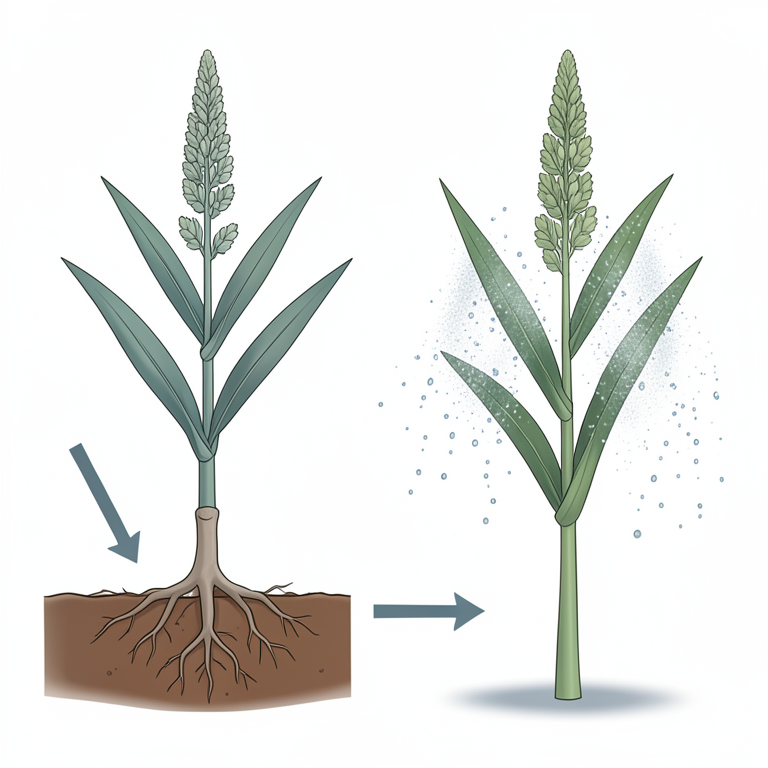
Foliar vs. Root Nutrient Absorption
AI-generated conceptual illustration (pearl millet plants (Pennisetum glaucum L.)). It explains the idea and does not show study data.
View source evidence ↗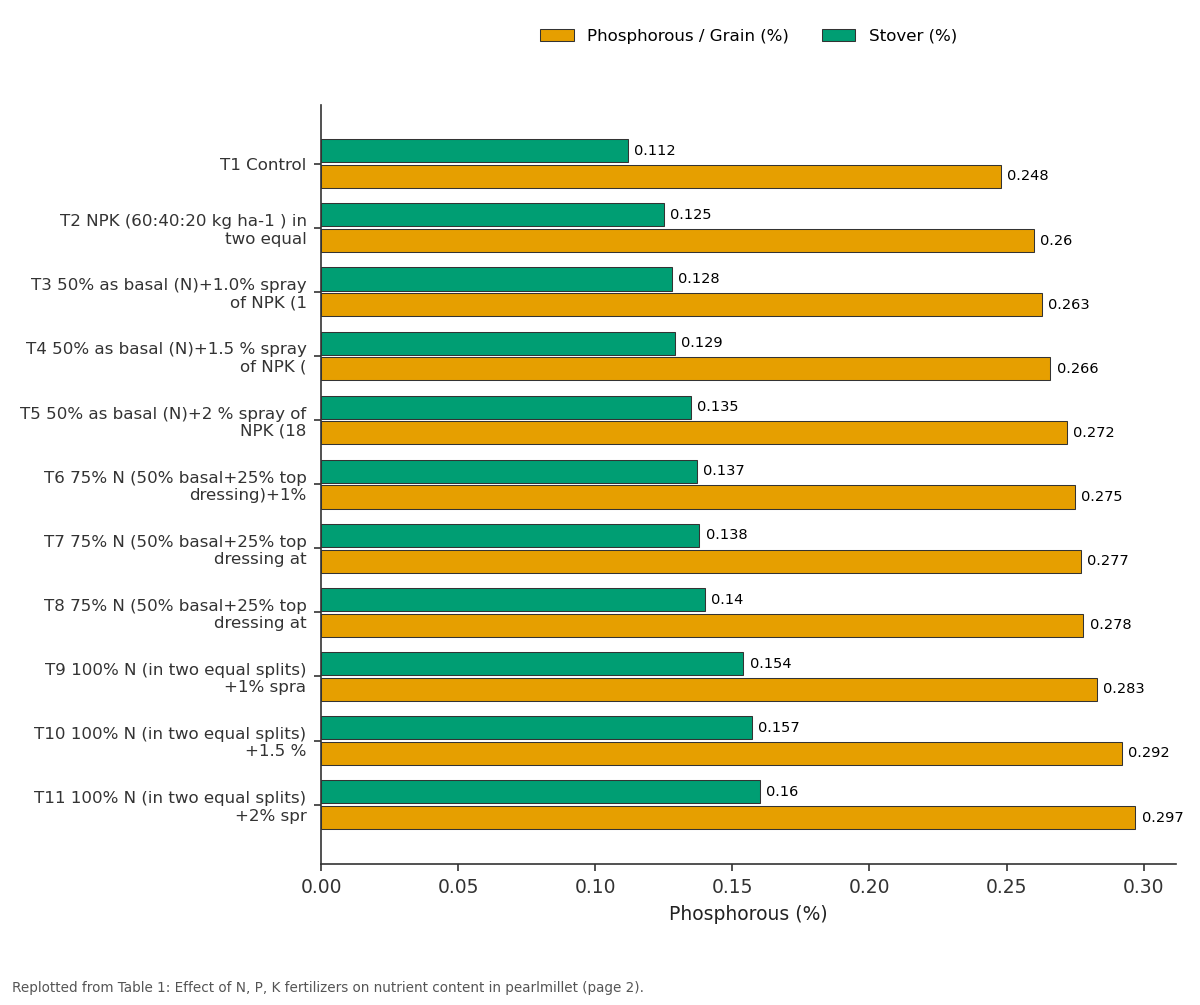
Phosphorous / Grain (%) and Stover (%): T1 Control vs T2 NPK (60:40:20 kg... vs T3 50% as basal... vs T4 50% as basal (N)+1.5... vs T5 50% as basal (N)+2 %...
Replotted from Table 1 (page 2) of the original paper. Every bar is the paper's own table value.
View source evidence ↗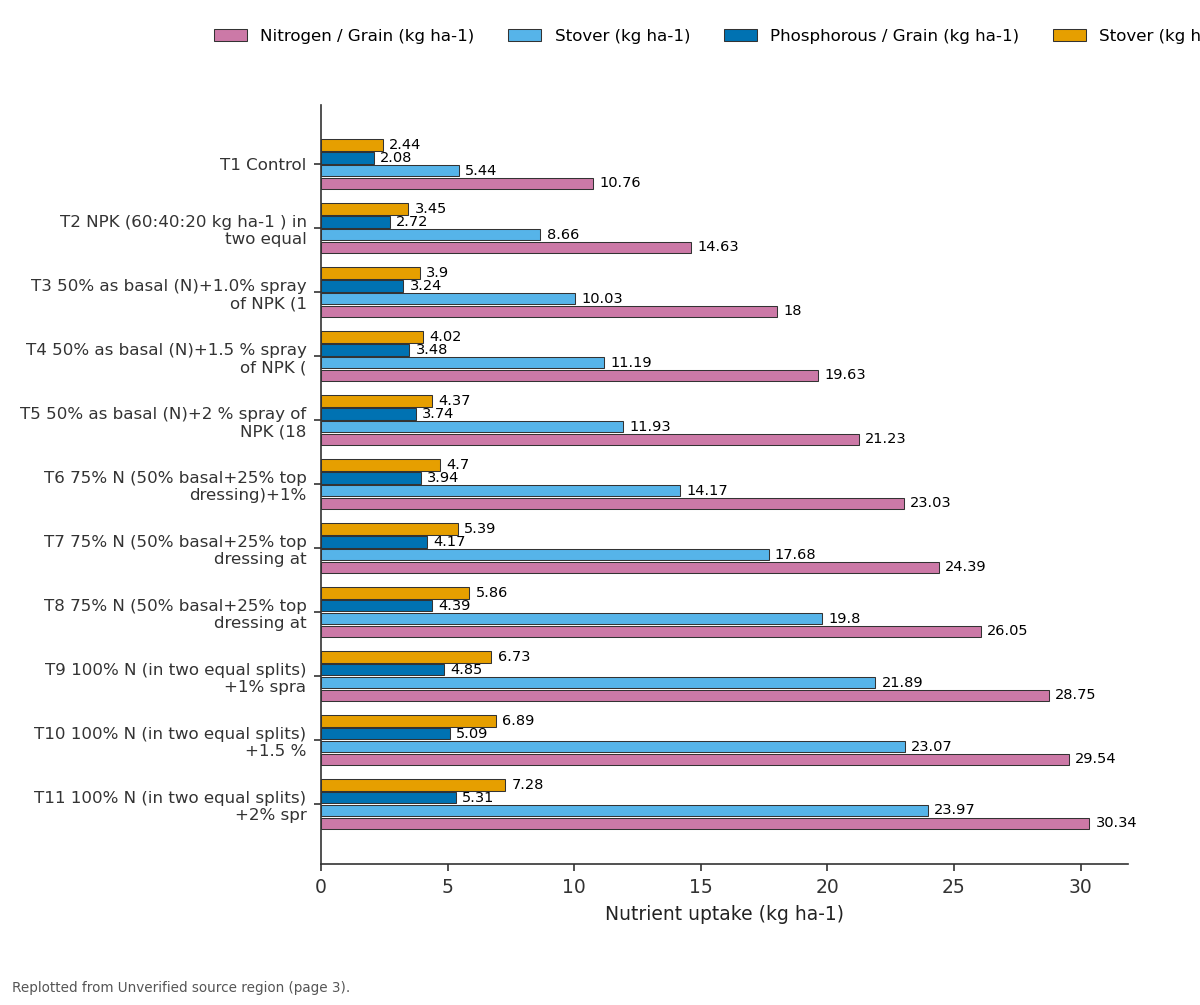
Nitrogen / Grain (kg ha-1) and Stover (kg ha-1) and more: T1 Control vs T2 NPK (60:40:20 kg... vs T3 50% as basal... vs T4 50% as basal (N)+1.5... vs T5 50% as basal (N)+2 %...
Replotted from a table (page 3) of the original paper. Every bar is the paper's own table value.
View source evidence ↗Figures & tables
From the original paper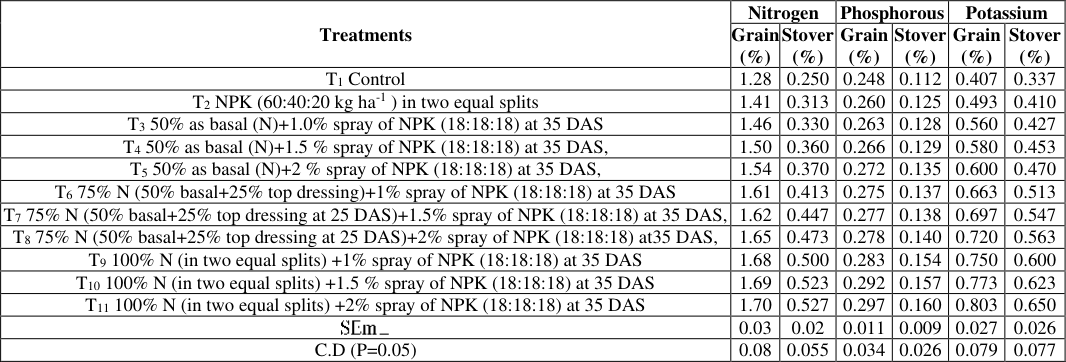 Table 1
Introduction
Among the various coarse and minor millets, pearl millet (Pennisetum glaucum L.) stands out as a vital cereal grain and staple food crop, especially in the arid and semi-arid regions of Africa and South Asia. Commonly known as bajra in India, it is highly valued for its exceptional tolerance to heat and drought, making it a dependable crop under harsh environmental conditions. Pearl millet can produce satisfactory yields with as little as 200-250 mm of annual rainfall (Bidinger and Hash, 2003) [1] , earning its reputation as one of the most reliable cereals in rainfed regions of the arid and semi-arid tropics. Nutritionally, pearl millet compares well with other cereals and millets. Its grains contain approximately 11.6% protein, 5% fat, 67% carbohydrates, 2.7% minerals, and 12.4% moisture, along with relatively higher levels of carotene, riboflavin (Vitamin B2), and niacin (Vitamin B4). The crop is well-suited to drought-prone, nutrient-poor, and acidic soils (Choudhary et al., 2014) [2] . On a global scale, pearl millet ranks sixth in terms of cultivated area and contributes 42% to the total world production (Patel et al., 2015) [6,7] . It is widely cultivated due to its efficient drought escape mechanisms and lower water needs compared to other cereals like sorghum and maize (Meena and Gautam, 2005) [9] . This versatile and stress-tolerant crop is responsive to inputs and has significant potential for cultivation in non-traditional seasons such as summer, especially under irrigated and high-input conditions (Jakhar et al., 2013) [5] . Low soil fertility and irregular rainfall are among the primary challenges to crop production in arid and semi-arid regions. Effective soil fertility or nutrient management, particularly the use of nitrogen (N), is crucial for enhancing the growth and yield of pearl millet. Nitrogen is a key macronutrient required for plant development, especially during the vegetative growth phase. It plays a fundamental role in plant metabolism, being a core component of cell wall structures and various metabolically active compounds. It is also essential in the formation of chlorophyll and amino acids, both vital for photosynthesis and energy capture. Nitrogen supports the early expansion of leaf area, enabling more effective photosynthesis, and stimulates rapid leaf and stem growth, which directly contributes to improved yield and grain quality. Additionally, nitrogen enhances the efficiency of phosphorus and potassium utilization. In Indian soils, nitrogen is often the most limiting nutrient, and its application typically results in a significant yield response in pearl millet (Jadhav et al., 2011) [4] . As a nutrient-exhaustive crop, pearl millet demands substantial nitrogen input, and its response to nitrogen fertilization can vary with environmental conditions. Even when fertilizers are applied at appropriate rates and times, their efficiency can be compromised by low soil moisture. Therefore, the integrated use of chemical fertilizers-especially N, P, and K via foliar feeding-has proven to be an effective strategy to overcome soil nutrient limitations and support productivity in nutrientpoor conditions (Rundla and Bairwa, 2018) [8] . Foliar application is a beneficial method of fertilization, as nutrients can enter the plant through the leaf cuticle or stomata, allowing for quick and efficient absorption and utilization. It is well-documented that nutrients traditionally absorbed through the roots can also be taken up effectively through the foliage (Ganapathy et al., 2008) [3] , making foliar feeding a practical approach in regions where soil nutrient transfer is limited.
Methodological Approach
The field trial was carried out at the Research Farm of Vivekananda Global University, Jaipur. Geographically, the site is located at 26°51' North latitude and 75°47' East longitude, with an elevation of 390 meters above mean sea level, situated in Jaipur district, Rajasthan. This area falls within the Agro-climatic Zone IIIa, also known as the Semi-Arid Eastern Plain Zone of Rajasthan.
The experiment involved eleven treatment combinations, including a control and a recommended NPK dose of 60:40:20 kg ha⁻¹ applied in two equal splits. Additional treatments included 50% nitrogen as basal dose combined with foliar application of NPK (18:18:18) at concentrations of 1.0%, 1.5%, and 2.0% at 35 days after sowing (DAS).
Other treatments consisted of 75% nitrogen (applied as 50% basal and 25% top dressing at 25 DAS) with the same foliar spray concentrations at 35 DAS. Lastly, treatments with 100% nitrogen (split into two equal doses) were also evaluated along with foliar sprays of NPK (18:18:18) at 1.0%, 1.5%, and 2.0%, respectively, applied at 35 DAS.
Nutrient content in grain and straw
Separate representative samples of grain and stover were collected from each plot to assess the nitrogen (N), phosphorus (P), and potassium (K) content. The collected samples were oven-dried at 65°C for 24 hours, ground into a fine powder using a mechanical grinder, and subsequently analyzed for their respective nutrient concentrations using standard analytical procedures.
Methods of nutrient measurement in grain and stover
Methods of nutrient measurement in grain and stover
Absorption of nutrients
The total nitrogen, phosphorus, and potassium uptake was calculated based on the N, P, and K concentrations in grain and stover at harvest, using the following formula:
Results and discussion
The findings showed that treatment T11-which involved the application of 100% nitrogen in two equal splits along with a 2% foliar spray of NPK (18:18:18) at 35 DASresulted in the highest concentrations of nitrogen (1.70% in grain and 0.527% in stover), phosphorus (0.297% and 0.160%), and potassium (0.803% and 0.650%) in the crop. This treatment also recorded the greatest nutrient uptake, with nitrogen uptake of 30.34 kg ha⁻¹ in grain and 23.97 kg ha⁻¹ in stover, phosphorus uptake of 5.31 and 7.28 kg ha⁻¹, and similarly higher potassium uptake, compared to the control. These values were statistically at par with treatments T10, T9, and T8. The increased nutrient content and uptake may be attributed to the positive influence of N, P, and K fertilization on plant growth and yield components, leading to higher grain, stover, and total biomass production, and consequently, greater absorption of nutrients by the crop. A noticeable improvement in phosphorus content in both grain and stover was observed with increasing levels of nitrogen and phosphorus, likely due to the direct effect of P and N applications, which enhanced the availability of phosphorus in the soil and its uptake by the plant. These findings are consistent with the observations reported by Pareek et al.
Figures and tables from the paper
| Treatments | Nitrogen | — | Phosphorous | — | Potassium | — |
|---|---|---|---|---|---|---|
| Grain (%) | Stover (%) | Grain (%) | Stover (%) | Grain (%) | Stover (%) | |
| T1 Control | 1.28 | 0.250 | 0.248 | 0.112 | 0.407 | 0.337 |
| T2 NPK (60:40:20 kg ha-1 ) in two equal splits | 1.41 | 0.313 | 0.260 | 0.125 | 0.493 | 0.410 |
| T3 50% as basal (N)+1.0% spray of NPK (18:18:18) at 35 DAS | 1.46 | 0.330 | 0.263 | 0.128 | 0.560 | 0.427 |
| T4 50% as basal (N)+1.5 % spray of NPK (18:18:18) at 35 DAS, | 1.50 | 0.360 | 0.266 | 0.129 | 0.580 | 0.453 |
| T5 50% as basal (N)+2 % spray of NPK (18:18:18) at 35 DAS, | 1.54 | 0.370 | 0.272 | 0.135 | 0.600 | 0.470 |
| T6 75% N (50% basal+25% top dressing)+1% spray of NPK (18:18:18) at 35 DAS | 1.61 | 0.413 | 0.275 | 0.137 | 0.663 | 0.513 |
| T7 75% N (50% basal+25% top dressing at 25 DAS)+1.5% spray of NPK (18:18:18) at 35 DAS, | 1.62 | 0.447 | 0.277 | 0.138 | 0.697 | 0.547 |
| T8 75% N (50% basal+25% top dressing at 25 DAS)+2% spray of NPK (18:18:18) at35 DAS, | 1.65 | 0.473 | 0.278 | 0.140 | 0.720 | 0.563 |
| T9 100% N (in two equal splits) +1% spray of NPK (18:18:18) at 35 DAS | 1.68 | 0.500 | 0.283 | 0.154 | 0.750 | 0.600 |
| T10 100% N (in two equal splits) +1.5 % spray of NPK (18:18:18) at 35 DAS | 1.69 | 0.523 | 0.292 | 0.157 | 0.773 | 0.623 |
| T11 100% N (in two equal splits) +2% spray of NPK (18:18:18) at 35 DAS | 1.70 | 0.527 | 0.297 | 0.160 | 0.803 | 0.650 |
| 0.03 | 0.02 | 0.011 | 0.009 | 0.027 | 0.026 | |
| C.D (P=0.05) | 0.08 | 0.055 | 0.034 | 0.026 | 0.079 | 0.077 |
Table text extracted from the original PDF; superscript letters are shown inline. The original table image is below.
View original table image
References
9 in the original paper- Bidinger FR, Hash CT. Pearl Millet in: Ngugen (ed) Integration of physiology and Molecular Biology in plant breeding, N.Y, U.S.A: Marcel-Decker conservation practices and N fertilization. J Soil Wat Conserv India. 2003;1(2&3):158-162.
- Choudhary M, Prabhu G. Quality fodder production and economics of dual-purpose pearl millet (Pennisetum glaucum) under different fertility levels and nitrogen scheduling. Indian J Agron. 2014;59(3):410-414.
- Ganapathy M, Baradhan G, Ramesh N. Effect of foliar nutrition on reproductive efficiency and grain yield of rice fallow pulses. Legume Res. 2008;31(2):142-144.
- Jadhav RP, Khafi HR, Raj AD. Effect of nitrogen and vermicompost on protein content and nutrients uptake in pearl millet. Agric Sci Dig. 2011;31(4):319-321.
- Jakhar SR, Singh M, Balai CM. Effect of FYM, Phosphorus and Zinc levels on growth, yield, quality and economics of pearl millet (Pennisetum glaucum). Indian J Agric Sci. 2013;(1):58-61.
- Pareek P, Patel MR, Patel HK, Patel PM. Effect of irrigation and nitrogen levels on forage yield and quality of pearl millet [Pennisetum glaucum (L.) R. Br.]. Int J Agric Sci. 2015;11(2):264-267.
- Patel NI, Patel BR, Patel CK, Patel FB. Effect of foliar spray of nutrients at different growth stages on pearl millet under Dryland condition. Int J Chem Stud. 2015;7(5):05-09.
- Rundla S, Bairwa RC. Response of foliar supplementation of N, P and K fertilizers on yield and economics of fertilizers. Int J Curr Microbiol Appl Sci. 2018;7(4):1203-1209.
- Meena R, Gautam RC. Effect of integrated nutrient management on productivity, nutrient uptake and moisture-use functions of pearlmillet (Pennisetum glaucum). Indian Journal of Agronomy. 2005;50(4):305-307.