
Research article · 2025 · Full text
International Journal of Geography Geology and EnvironmentTrend in growth of Tendu leaves collection in Marwahi forest division, Chhattisgarh
Volume 7(8) · Pages 20–22 · DOI: 10.22271/27067483.2025.v7.i8a.390 ↗
Research areasForest ecology and managementAgroforestry and silvopastoral systemsAgricultural Economics and Practices
Abstract
Author-writtenMarwahi Forest division is located in Gaurella- Pendra- Marwahi District of Chhattisgarh where minor forest products are major source of livelihood in Villegers. Tendu leaves collection are traditional economical source of these peoples. They are interestingly engaged on this seasonal work because government provides many facilities to them. Forests are the income and employment generating renewable resources in any rural area. Tribal life and their livelihood are depending on forest resources directly and indirectly. Tribal societies collected different types of minor forest products for their livelihood. They collected minor forest products for food, medicine and generating incomes in fruit’s, roots, tendu patta for Bidi leaf and flowers way. Tribal communities always affected with availability of minor forest products in any tribal dominated area just like life style, living standard, culture, tradition and animal husbandry also. The role of forests interrelated with development of tribal communities is just like both face of coin in currently. In this paper we will discuss the Spatio-temporal scenario of tendu leaves collection in the study area.
Summary
Source-checkedPlain-language reading of the full paper, prepared with AI and checked against the text. Each point links to the authors' own words.
Why it matters
- In the Marwahi Forest division of Chhattisgarh, minor forest products serve as a primary source of livelihood for local villagers. View evidence ↗
- The collection of Tendu leaves is a traditional economic activity for the people in this region. View evidence ↗
- Tendu leaves, from the Diospyros melanoxyion tree, are used as wrappers for tobacco to produce bidis. View evidence ↗
The question
- The study aims to analyze the trends and growth of Tendu leaf collection and the status of collection centers in the Marwahi Forest Division of Chhattisgarh. View evidence ↗
What they did
- The researchers used secondary data gathered from various sources, including forest departments, district statistical yearbooks, journals, and websites. View evidence ↗
What they found
- Chhattisgarh produces approximately 16.72 lakh standard bags of Tendu leaves annually, which is nearly 20% of India's total production. View evidence ↗
- Despite fluctuations in volume, the total collection value in Chhattisgarh increased significantly from 75.53 crore rupees in 2001 to 855.68 crore rupees in 2024. View evidence ↗
- Tendu leaves in the Marwahi Forest Division are collected through 185 'phads', which are village-level collection centers. View evidence ↗
- There are 14 Phad headquarters in the Marwahi Forest Division responsible for managing the collection and protecting the leaves. View evidence ↗
What it means
- The authors conclude that the government should increase its focus on the tribal populations who collect Tendu leaves and other minor forest products. View evidence ↗
- The authors state that the continuous growth in the collection value of Tendu leaves will improve the living conditions of rural people in the Marwahi Forest Division. View evidence ↗
Visual summary
2 visualsIllustrations explain the paper; charts are replotted from the paper's own table values.
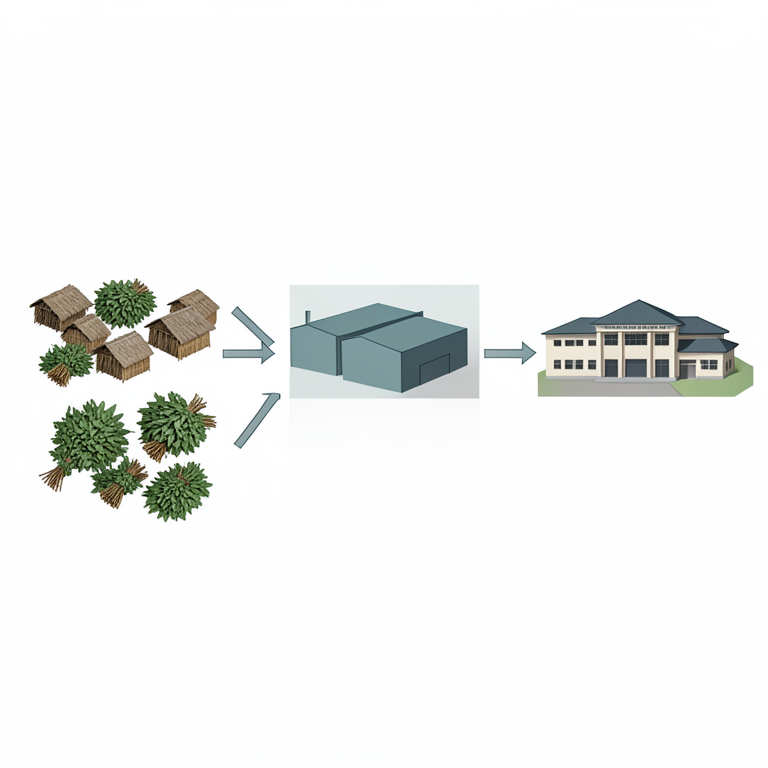
Tendu Collection Hierarchy
AI-generated conceptual illustration (Tendu leaves (Diospyros melanoxylon) and rural collection centers in a forest setting). It explains the idea and does not show study data.
View source evidence ↗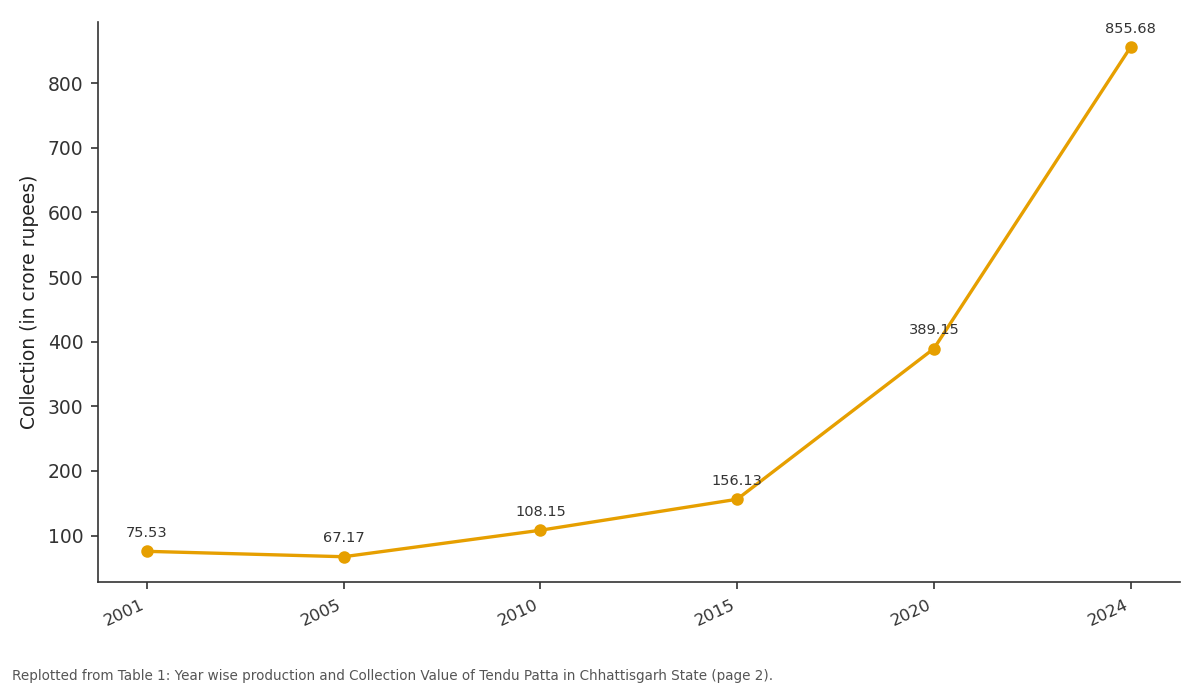
Collection (in crore rupees): 2001 vs 2005 vs 2010 vs 2015 vs 2020
Replotted from Table 1 (page 2) of the original paper. Every bar is the paper's own table value.
View source evidence ↗Figures & tables
From the original paper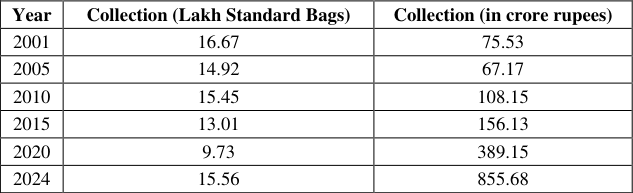 Table 1
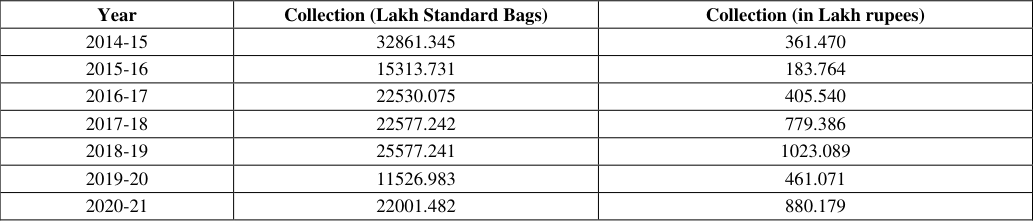 Table 2
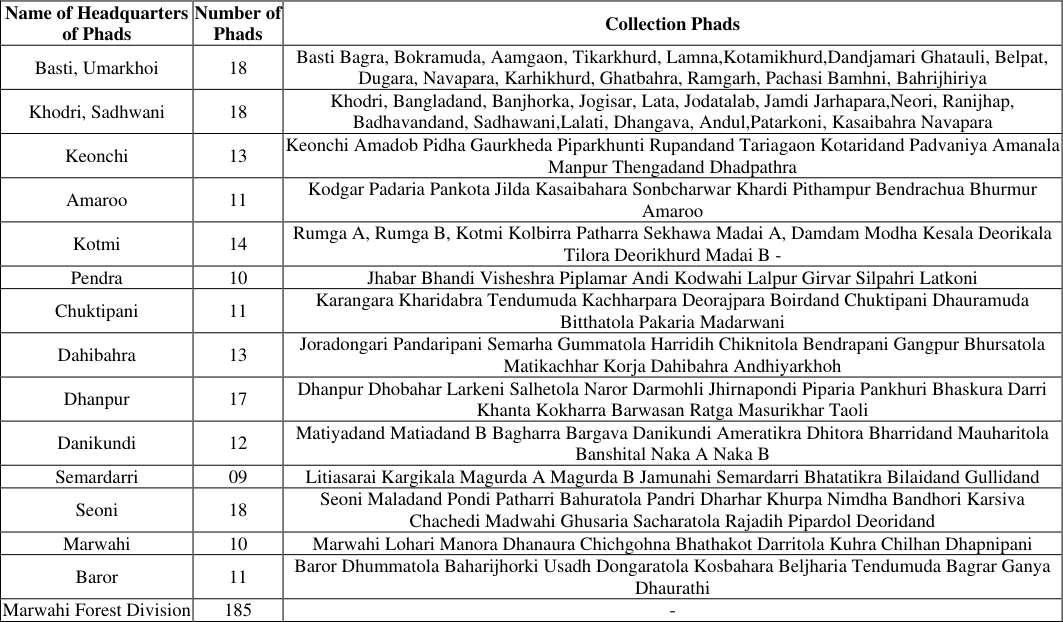 Table 3
Introduction
The leaves of the Diospyros melanoxyion tree species are utilized as wrappers for tobacco to create bidi. This tree is commonly referred to as tendu and is also known by various names such as Abnus in Andhra Pradesh, Kendu in Orissa and West Bengal, Tembru in Gujarat, Kari in Kerala, Tembhurni in Maharashtra, and Balitupra in Tamil Nadu. The scientific name of this tree is Diospyros melanoxyion. The leftover pieces of leaves are incinerated, and the resulting ash is incorporated into tooth powder. (Sharma, 2012) [2] . The tendu tree (Diospyros melanoxylon) is commonly found throughout central India. Leaves harvested from its bushes are utilized for wrapping bidi, often referred to as the poor man's cigarette. The All-India Bidi Industry Federation reports that approximately 550 billion bidi are sold annually in India, produced by around 10 million workers. Additionally, collecting tendu is a labor-intensive process that provides employment to millions of tribal people during the lean month of April and May, a time when their income opportunities are limited. (https://www.downtoearth.org.in/environment) Section 2(4) of the Indian Forest Act of 1927 defines forest produce. Timber, charcoal, catechu, wood oil, resin, natural varnish, bark, lac, myrobalans, mahua flowers (Whether they are discovered inside or brought from a forest), trees and leaves, flowers and fruit, plants (Including grass, creepers, reeds, and moss), untamed animals, skins, tusks, horns, bones, cocoons, slik, honey, wax, and other animal parts or produce, as well as peat, surface soil, boulders, and minerals, among other items, when discovered within or transported from a forest. (Mandal, 2018) [1] TRIFED's data indicates that the state has purchased 27,7958 quintals of minor forest produce valued at Rs.80 crore 12 lakh under the minimum support price scheme, representing 88.36 percent of the total minor forest produce worth Rs.93 crore collected across the country during the 2020-21. Among these, 113614 quintals of tamarind (Including seeds) with a value of Rs 40.90 crore and 1,37,946 quintals of sal seed valued at Rs 27.59 crore have been gathered. Additionally, 6,595 quintals of flower tamarind worth Rs 4.15 crore, 2390 quintals of chironji kernels valued at Rs 2.92 crore, and 10,493 quintals of Bahera totaling Rs 1.78 crore are also part of this collection. During this period, a variety of minor forest products including Mahul Patta, Nagarmotha, Bhelwa, Bahera Kacharia, Dhavai Phool (dry), Harra Kacharia, Puwad (Charota), Bell Pulp, Satavar (Dry), Safflower Seed, Flower Broom, Rangini Lac, Van Tulsi, Flower Tamarind, Jamun Seeds (dry), Van cumin, Tamarind seed, Amla seedless, Kusumi lac, Kullu gum, Mahua seed, Karanj seed, collected. (https://www.drishtiias.com/state-pcs-current-affairs/chhattisgarh).
Methodology
Secondary data have been collected from the wide network including Website, Magzine, forest departments, different journals, district statistical yearbook, reports etc.
Objective of Study
To know about the Trend and growth scenario of Tendu Leaves collection and collection centre in Marwahi Forest Divison Chhattisgarh.
Results and Discussion
Chhattisgarh is a leading state in India, known for producing the highest quality Tendu leaves. These Tendu leaves are utilized as wrappers for Beedi. Annually, the state produces around 16.72 lakh standard bags of Tendu leaves, accounting for nearly 20% of the nation's total production. A standard bag of Tendu leaves in Chhattisgarh contains 1000 bundles, with each bundle consisting of 50 leaves. The collection season in Chhattisgarh runs from the first week of April to the first week of June. In this state, the collection season begins earlier in the southern regions compared to the northern regions. For the year 2025, the collection rate for Tendu Patta is set at Rs. 5,500/-for each standard bag. A single standard bag is made up of 1000 bundles, with each bundle containing 50 leaves. (https://www.cgmfpfed.org) The table 1. shows the trend production and collection of tendu leaves in Chhattisgarh. Five year intervals taken for the studies because the Chhattisgarh state recently completed 25 years from its formation. In the table we can see the collection of Tendu leaves continousely decreasing but the 2024 shows the positive growth due to minimum support price rise. Many government facilities and programmers are runs to increase the livelihood of Tendu leaves Plucker. In the table the collection value is continuously increase shows the economic growth of tendu leave puckers. The Marwahi Forest division comes under the Bilaspur forest circle of Chhattisgarh. Which is rich in their forest resoyurces. many rural peoples of Marwahi forest division are depended on forest products likes Tendu Leaves, Saal Beej, Bhelwa, Mahua Collection etc. Tendu Leaves collection in seasonal practices. In the season they are collected the tendu leaves and sale through the cooperatives society on maximum supporting price. The year 2018-19 shows the highest collection and collection value and the 2019-20 shows lowest collection of tendu leaves due to unfavorable weather condition for Tendu leave. Sometimes its collection affects due to government policies.
| Year | Collection (Lakh Standard Bags) | Collection (in crore rupees) |
|---|---|---|
| 2001 | 16.67 | 75.53 |
| 2005 | 14.92 | 67.17 |
| 2010 | 15.45 | 108.15 |
| 2015 | 13.01 | 156.13 |
| 2020 | 9.73 | 389.15 |
| 2024 | 15.56 | 855.68 |
Table text extracted from the original PDF; superscript letters are shown inline. The original table image is below.
View original table image
In the table the Tendu leave are collected from the 185 phads. Phads denotes the village level tendu leaves collection centre. In Marwahi Forest Division have 14 Phads headquarters which are responsible to collection and provides better condition and protection to tendu leaves after the collection. The Basti Umarkhoi and the Khodri Sadhwani and seoni Headquater each are managed 18 Phads of Marwahi Forest Devision. Later then Dhanpur (17), Kotmi (14), Keochi (13), dahibahra (13), Amaroo (11), Chuktipani (11), Baror (11), Marwahi (10), Semardarri (09) are effectively managed the collection of tendu leaves in Marwahi Forest Division.
Figures and tables from the paper
| Year | Collection (Lakh Standard Bags) | Collection (in Lakh rupees) |
|---|---|---|
| 2014-15 | 32861.345 | 361.470 |
| 2015-16 | 15313.731 | 183.764 |
| 2016-17 | 22530.075 | 405.540 |
| 2017-18 | 22577.242 | 779.386 |
| 2018-19 | 25577.241 | 1023.089 |
| 2019-20 | 11526.983 | 461.071 |
| 2020-21 | 22001.482 | 880.179 |
Table text extracted from the original PDF; superscript letters are shown inline. The original table image is below.
View original table image
| Name of Headquarters of Phads | Number of Phads | Collection Phads |
|---|---|---|
| Basti, Umarkhoi | 18 | Basti Bagra, Bokramuda, Aamgaon, Tikarkhurd, Lamna,Kotamikhurd,Dandjamari Ghatauli, Belpat, Dugara, Navapara, Karhikhurd, Ghatbahra, Ramgarh, Pachasi Bamhni, Bahrijhiriya |
| Khodri, Sadhwani | 18 | Khodri, Bangladand, Banjhorka, Jogisar, Lata, Jodatalab, Jamdi Jarhapara,Neori, Ranijhap, Badhavandand, Sadhawani,Lalati, Dhangava, Andul,Patarkoni, Kasaibahra Navapara |
| Keonchi | 13 | Keonchi Amadob Pidha Gaurkheda Piparkhunti Rupandand Tariagaon Kotaridand Padvaniya Amanala Manpur Thengadand Dhadpathra |
| Amaroo | 11 | Kodgar Padaria Pankota Jilda Kasaibahara Sonbcharwar Khardi Pithampur Bendrachua Bhurmur Amaroo |
| Kotmi | 14 | Rumga A, Rumga B, Kotmi Kolbirra Patharra Sekhawa Madai A, Damdam Modha Kesala Deorikala Tilora Deorikhurd Madai B - |
| Pendra | 10 | Jhabar Bhandi Visheshra Piplamar Andi Kodwahi Lalpur Girvar Silpahri Latkoni |
| Chuktipani | 11 | Karangara Kharidabra Tendumuda Kachharpara Deorajpara Boirdand Chuktipani Dhauramuda Bitthatola Pakaria Madarwani |
| Dahibahra | 13 | Joradongari Pandaripani Semarha Gummatola Harridih Chiknitola Bendrapani Gangpur Bhursatola Matikachhar Korja Dahibahra Andhiyarkhoh |
| Dhanpur | 17 | Dhanpur Dhobahar Larkeni Salhetola Naror Darmohli Jhirnapondi Piparia Pankhuri Bhaskura Darri Khanta Kokharra Barwasan Ratga Masurikhar Taoli |
| Danikundi | 12 | Matiyadand Matiadand B Bagharra Bargava Danikundi Ameratikra Dhitora Bharridand Mauharitola Banshital Naka A Naka B |
| Semardarri | 09 | Litiasarai Kargikala Magurda A Magurda B Jamunahi Semardarri Bhatatikra Bilaidand Gullidand |
| Seoni | 18 | Seoni Maladand Pondi Patharri Bahuratola Pandri Dharhar Khurpa Nimdha Bandhori Karsiva Chachedi Madwahi Ghusaria Sacharatola Rajadih Pipardol Deoridand |
| Marwahi | 10 | Marwahi Lohari Manora Dhanaura Chichgohna Bhathakot Darritola Kuhra Chilhan Dhapnipani |
| Baror | 11 | Baror Dhummatola Baharijhorki Usadh Dongaratola Kosbahara Beljharia Tendumuda Bagrar Ganya Dhaurathi |
| Marwahi Forest Division | 185 | - |
Table text extracted from the original PDF; superscript letters are shown inline. The original table image is below.
View original table image
References
6 in the original paper- Mandal SM. Forest produce of Chhattisgarh. Int J Adv Res Ideas Innov Technol. 2018;337:1-5.
- Sharma UK. Tendu Leaves. Dehradun: Indira Gandhi National Forest Academy; 2012. p. 1-72.
- Tamrakar A, Dixit B. Identifying the economic and ecological potential of tendu leaves to develop innovative value addition strategies in Chhattisgarh. Int J Plant Soil Sci. 2025;37(4):366-376.
- Sahu LK, Ayub MA, Netam OK. Trends in growth of collection and sales of tendu leaves in Chhattisgarh State, India. 2017. p. 1-10.
- Boaz AA. Case study of tendu leaves (Diospyros melanoxylon) in Harda district, Madhya Pradesh, India. In: Kusters K, Belcher B, editors. Forest Products, Livelihoods and Conservation: Case Studies of NonTimber Forest Product Systems. Volume 1 -Asia. Jakarta: CIFOR; 2004. p. 287-299.
- Naik AR, Gawande SM. Management of tendu leaf in Solapur city. Int Res J Eng Technol. 2015;2(3):15381545.