
Research article · 2025 · Full text
International Journal of Geography Geology and EnvironmentSlope stability analysis in weak rock formations: Engineering implications and risk mitigation
Volume 7(8) · Pages 35–45 · DOI: 10.22271/27067483.2025.v7.i8a.392 ↗
Research areasLandslides and related hazardsGeotechnical Engineering and AnalysisGeotechnical and Geomechanical Engineering
Abstract
Author-writtenSlope stability in weak rock formations is critical due to low strength, weathering susceptibility and complex geology. Hhydrogeological conditions, geomechanical properties, climate-induced dynamic loads. Analytical methods like limit equilibrium, finite element modeling and probabilistic approaches address creep, swelling and progressive failure. Risks encompass infrastructure damage, environmental harm and economic losses. Mitigation involves stabilization, real-time monitoring, and case-specific interventions. Emerging tools like AI, remote sensing and drones enhance predictive capabilities and early warnings. Challenges persist in characterizing time-dependent behaviors material properties. Interdisciplinary collaboration, sustainable practices, robust regulations are essential to address gaps and leverage innovation, ensuring safety amid climatic, anthropogenic pressures.
Summary
Source-checkedPlain-language reading of the full paper, prepared with AI and checked against the text. Each point links to the authors' own words.
Why it matters
- Analyzing slope stability in weak rock formations is essential because these materials have low strength, are susceptible to weathering, and possess complex geological structures. View evidence ↗
- Slope failures can lead to catastrophic outcomes, such as the loss of human life, the destruction of critical infrastructure, and significant environmental damage. View evidence ↗
- Weak rock formations are found in both natural settings, like mountains and riverbanks, and engineered sites, such as open-pit mines and road cuts. View evidence ↗
The question
- The paper aims to analyze the factors contributing to slope instability in weak rock, including geomechanical properties, geological characteristics, hydrogeological conditions, and external loading. View evidence ↗
What they did
- Limit equilibrium methods analyze stability by dividing a slope into slices to calculate a factor of safety based on the balance of resisting and driving forces. View evidence ↗
- Numerical modeling techniques, specifically the Finite Element Method (FEM) and Finite Difference Method (FDM), are used to capture complex behaviors that limit equilibrium methods cannot. View evidence ↗
- Probabilistic approaches, such as Monte Carlo simulation, treat input parameters as random variables to quantify the likelihood of failure. View evidence ↗
- Field monitoring utilizes inclinometers, piezometers, and extensometers to provide real-time data on groundwater levels, pore water pressures, and deformation. View evidence ↗
What they found
- Shale is characterized by high weathering susceptibility, a friction angle of 15-25°, and cohesion between 5-30 kPa. View evidence ↗
- Saturation can cause argillaceous rocks, such as mudstone and shale, to undergo softening, which may reduce their uniaxial compressive strength by up to 70%. View evidence ↗
- Climate change is estimated to potentially increase the frequency of landslides by up to 30% in certain regions dominated by weak rock formations. View evidence ↗
- In some instances, swelling pressures in weak rocks can exceed 1 MPa, resulting in slope cracking and heave. View evidence ↗
- The 2013 Bingham Canyon Mine slide in Utah, caused by progressive failure in weakly cemented sedimentary rocks, resulted in $1 billion in losses but no fatalities due to advanced monitoring. View evidence ↗
- The 2014 Oso Landslide in Washington, triggered by rainfall-induced pore pressure increases in glacial sediments, caused 43 fatalities and $120 million in damages. View evidence ↗
- The 2010 Zhouqu Mudslide in China, triggered by intense rainfall in weathered rock, resulted in over 1,400 fatalities. View evidence ↗
What it means
- The authors conclude that risks can be effectively reduced through real-time monitoring, stabilization techniques like drainage systems and rock bolts, and design interventions such as benching and slope flattening. View evidence ↗
- The authors recommend prioritizing interdisciplinary research that integrates data science, engineering, and geology to improve stabilization techniques and predictive models. View evidence ↗
- A limitation of numerical modeling techniques is their requirement for detailed input data, which is sometimes uncertain or unavailable. View evidence ↗
Visual summary
1 visualsIllustrations explain the paper; they do not show study data.
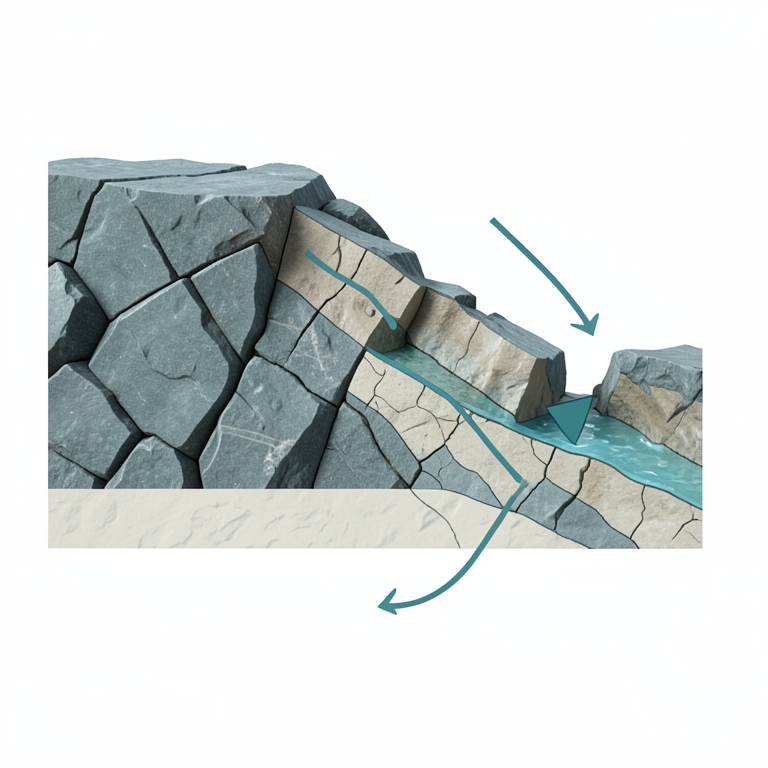
Factors of Slope Instability
AI-generated conceptual illustration (A cross-section of a weathered weak rock slope). It explains the idea and does not show study data.
View source evidence ↗Figures & tables
From the original paper Table 1
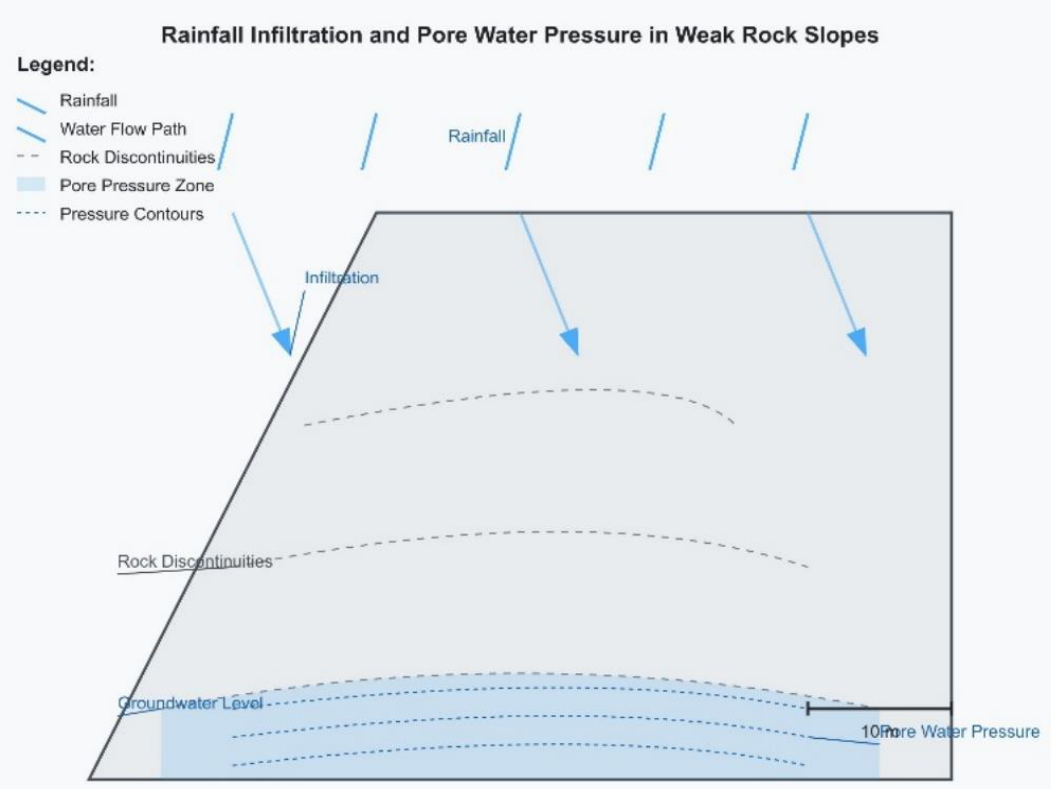 Figure 1
 Table 2
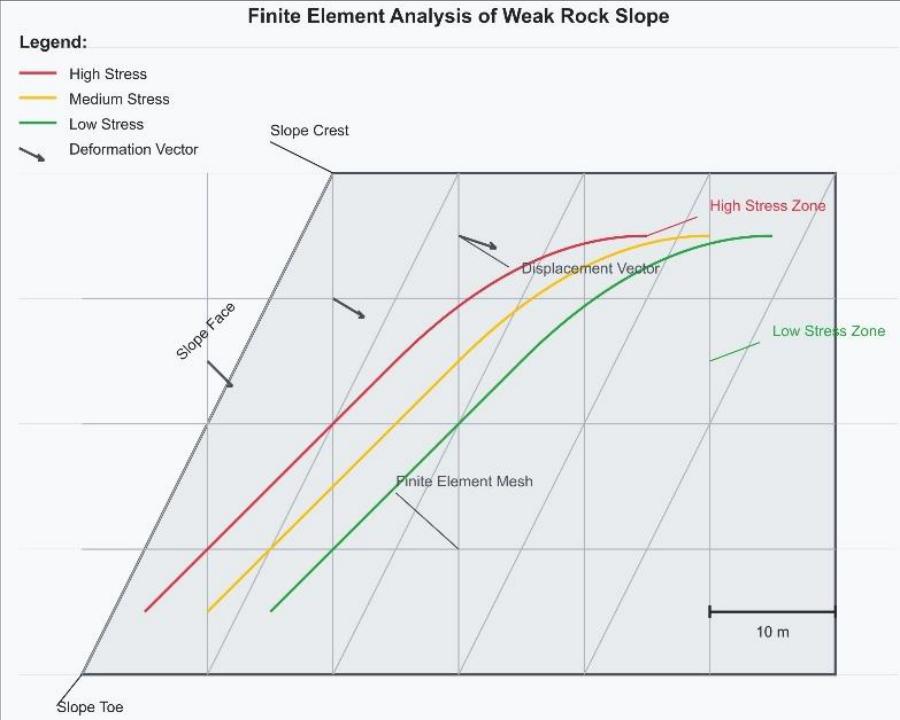 Figure 2
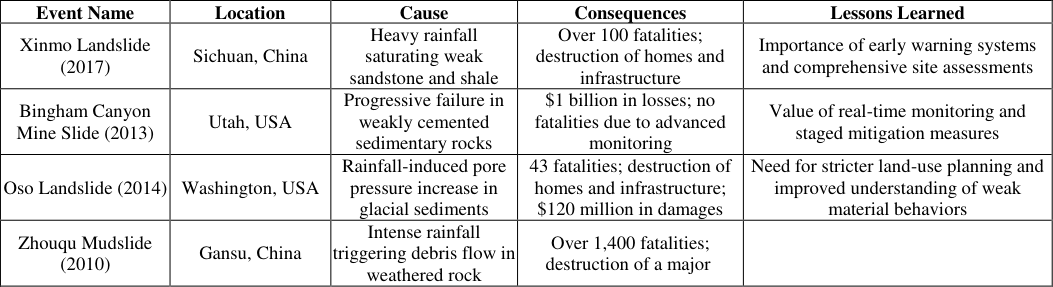 Table 3
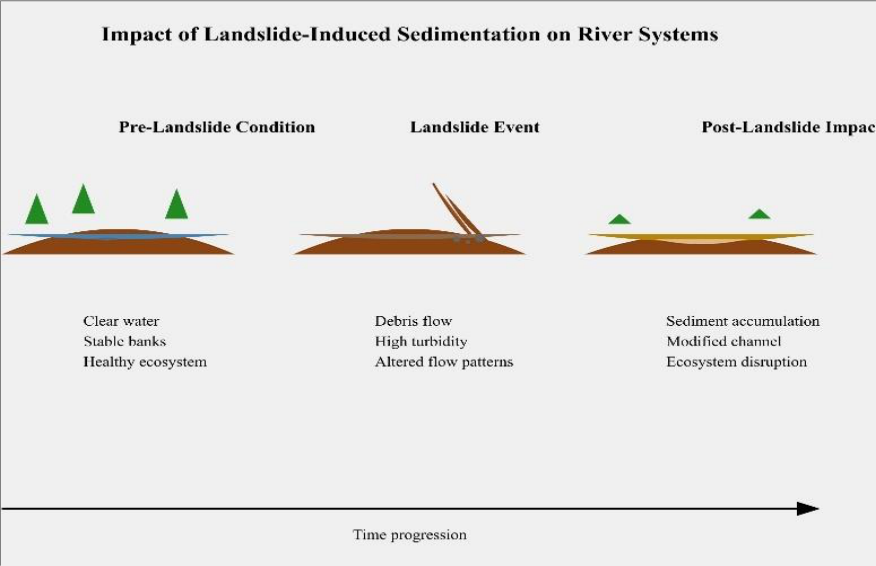 Figure 3
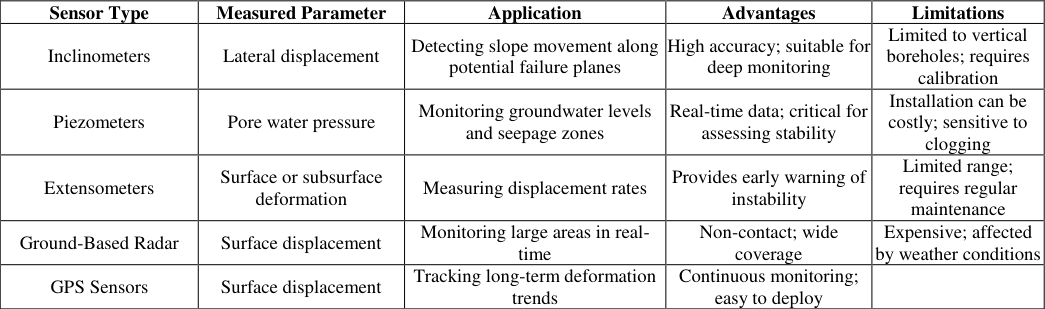 Table 4
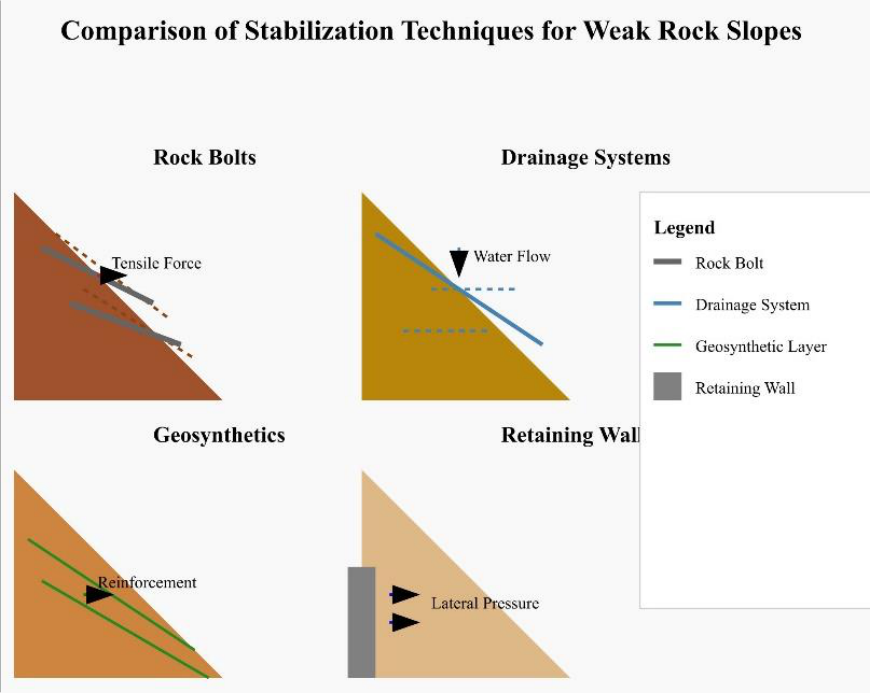 Figure 4
Introduction
Slope stability is a critical aspect of geotechnical engineering that involves assessing the equilibrium between driving forces (e.g., gravity) and resisting forces (e.g., shear strength) within a slope. The failure of slopes can result in catastrophic consequences, including loss of life, destruction of infrastructure, and environmental degradation. In weak rock formations-characterized by inherently low strength, susceptibility to weathering, and complex geological structures-the risk of slope instability is particularly pronounced. These formations include shale, mudstone, highly jointed rock masses, and other materials prone to deterioration under external loading or environmental conditions. Weak rock formations are commonly encountered in natural landscapes such as mountainous regions, riverbanks, and coastal cliffs, as well as in engineered environments like road cuts, open-pit mines, and urban developments. Their inherent properties make them vulnerable to various destabilizing factors, including groundwater infiltration, dynamic loads, and climate change impacts. For instance, the Vajont Dam disaster in Italy (1963), which claimed over 2,000 lives, was caused by the failure of a weak limestone slope due to a combination of geological discontinuities and rising reservoir levels (Müller, 1964) [23] . Similarly, the 2014 Oso landslide in Washington State, USA, highlighted the devastating potential of unstable slopes in glacial sediments and weak rock formations (Iverson et al., 2015) [17] . Understanding slope stability in weak rock formations is essential not only for ensuring public safety but also for optimizing resource utilization and minimizing economic losses. Geotechnical engineers must account for the unique challenges posed by these materials when designing infrastructure projects or mitigating risks associated with natural slopes. This necessitates a comprehensive understanding of the factors influencing slope stability, advanced analytical tools, and effective risk mitigation strategies.
Research Objectives
To Analyze Factors Influencing Slope Stability in Weak Rock Formations: This involves examining geological characteristics, hydrogeological conditions, geomechanical properties, and external loading factors that contribute to slope instability. To Evaluate Engineering Implications and Propose Effective Risk Mitigation Strategies: By identifying the potential risks posed by unstable slopes, this paper aims to provide practical recommendations for designing stable slopes and implementing preventive measures. To Highlight Gaps in Current Knowledge and Suggest Future Research Directions: Despite significant advancements in slope stability analysis, there remain unresolved challenges related to timedependent behaviors, uncertainties in input parameters, and the integration of emerging technologies. Addressing these gaps is crucial for improving predictive capabilities and developing resilient designs.
Scope of the Paper
This paper focuses specifically on weak rock formations, which are defined as materials with relatively low compressive strength, high porosity, and susceptibility to weathering. Examples include shale, mudstone, siltstone, and highly fractured igneous or metamorphic rocks. Both natural and engineered slopes are considered, encompassing scenarios such as highway embankments, open-pit mine walls, and residential developments in hilly terrain. While the principles discussed herein are broadly applicable, the emphasis is on addressing the unique challenges posed by weak rock formations.
Factors Influencing Slope Stability in Weak Rock Formations 2.1 Geological Characteristics
The lithology and mineral composition of a rock mass play a fundamental role in determining its mechanical behavior and susceptibility to failure. Weak rock formations often consist of fine-grained sedimentary rocks such as shale and mudstone, which are characterized by their laminated structure and clay mineral content. Clay minerals, such as montmorillonite and illite, exhibit low shear strength and are highly sensitive to moisture variations (Skempton, 1985). When exposed to water, these minerals swell and soften, significantly reducing the overall stability of the slope. For example, studies have shown that the presence of smectite-a swelling clay mineral-can lead to progressive weakening of shale slopes, particularly during periods of heavy rainfall (Kellerer-Pirklbauer et al., 2012) [19] . Additionally, the orientation of bedding planes relative to the slope face influences the mode of failure; slopes parallel to bedding planes are more prone to planar sliding, while those perpendicular to bedding may experience toppling or wedge failures.
Presence of Discontinuities
Discontinuities such as joints, faults, and bedding planes are pervasive features in weak rock formations and serve as preferential pathways for water infiltration and stress concentration. These structural weaknesses reduce the effective cohesion and friction angle of the rock mass, thereby increasing the likelihood of failure. The spacing, persistence, and aperture of discontinuities are key factors that govern their influence on slope stability. In highly jointed rock masses, the interaction between multiple sets of discontinuities can create complex failure mechanisms, such as wedge failures or block slides (Hoek & Bray, 1981) [15] . For instance, the 2017 Xinmo landslide in China occurred along pre-existing fault zones in a weakly cemented sandstone formation, highlighting the critical role of discontinuities in triggering large-scale failures (Fan et al., 2019) [12] .
Degree of Weathering and Alteration
Weathering processes degrade the physical and chemical properties of rock masses, rendering them more susceptible to instability. In tropical and subtropical climates, intense weathering transforms fresh rock into residual soils with significantly reduced shear strength. Even in temperate regions, freeze-thaw cycles and chemical reactions can weaken rock formations over time. The degree of weathering is typically classified into grades ranging from fresh rock (Grade I) to completely weathered material resembling soil (Grade VI). Intermediate grades (e.g., moderately weathered rock) represent transitional zones where the mechanical properties vary spatially, complicating slope stability analyses (ISRM, 1981). Understanding the extent and distribution of weathered zones is therefore essential for accurate modeling and risk assessment.
Hydrogeological Conditions
Groundwater exerts a profound influence on slope stability by altering the effective stress regime within the rock mass. Elevated pore water pressures reduce the normal stress acting across potential failure surfaces, thereby decreasing the available shear strength. This effect is particularly pronounced in weak rock formations, where permeability is often low, leading to prolonged saturation and delayed drainage. The relationship between pore water pressure and slope stability can be quantified using the Mohr-Coulomb failure criterion, which incorporates the effective stress concept (Terzaghi, 1943) [26] . Field observations have demonstrated that many slope failures occur during or immediately after rainfall events, underscoring the importance of hydrogeological considerations in stability assessments (Corominas et al., 2014) [7] . Conceptual model showing (Figure 1) rainfall infiltration mechanisms and pore water pressure development in weak rock slopes, including preferential flow paths through discontinuities and pressure distribution zones. Rainfall infiltration is a primary driver of slope instability in weak rock formations, especially in regions with seasonal precipitation patterns. The rate and depth of infiltration depend on factors such as rainfall intensity, antecedent moisture conditions, and surface cover. Infiltrated water migrates through the rock mass via interconnected pores and fractures, eventually reaching the basal failure surface. Snowmelt poses similar challenges, as rapid melting can generate substantial runoff and increase pore water pressures. A notable example is the 1999 Shuping landslide in China, which was triggered by snowmelt-induced seepage into a weakly cemented sandstone slope (Wang et al., 2004). [7,17] . [3,10] . The shear strength of weak rock formations is a critical parameter in slope stability analysis, as it determines the resistance of the material to sliding along potential failure surfaces. Shear strength is typically expressed using the Mohr-Coulomb failure criterion: τ=c+σntan(ϕ) where: τ = shear strength, c = cohesion, σn = normal stress, ϕ = angle of internal friction.
Geomechanical Properties
Geomechanical Properties
Rock
In weak rock formations, both cohesion (c) and the angle of internal friction (ϕ) are generally low compared to stronger rock types. For example, Values are approximate and depend on the degree of weathering, mineral composition, and stress conditions (Table 1) shale and mudstone often exhibit cohesion values ranging from 5 to 30 kPa and friction angles between 15° and 30°, depending on the degree of weathering and moisture content (Barton, 2002) [3] . These low values make weak rock slopes highly susceptible to failure, particularly when subjected to external loads or environmental changes. Field and laboratory tests, such as triaxial compression tests and direct shear tests, are commonly used to determine these parameters. However, the heterogeneity of weak rock formations often leads to significant variability in test results, necessitating probabilistic approaches to account for uncertainties (Duncan & Wright, 2005) [8] .
| Rock Type | Cohesion (kPa) | Friction Angle (°) | Permeability (m/s) | Weathering Susceptibility |
|---|---|---|---|---|
| Shale | 5-30 | 15-25 | 10⁻⁹ to 10⁻¹² | High |
| Mudstone | 10-40 | 20-30 | 10⁻¹⁰ to 10⁻¹³ | Moderate to High |
| Siltstone | 20-50 | 25-35 | 10⁻⁸ to 10⁻¹¹ | Moderate |
| Sandstone | 30-60 | 30-40 | 10⁻⁶ to 10⁻⁹ | Low |
Table text extracted from the original PDF; superscript letters are shown inline. The original table image is below.
View original table image
Deformation Characteristics under Varying Stress Conditions
Weak rock formations exhibit complex deformation behaviors that depend on the applied stress conditions. Under low confining pressures, these materials tend to deform plastically, leading to progressive failure. [11] . Understanding these deformation characteristics is crucial for predicting long-term slope performance. Time-dependent behavior is a hallmark of weak rock formations and poses unique challenges for slope stability analysis. Three key phenomena-creep, swelling, and softening-are particularly relevant. Creep: As mentioned earlier, creep involves the gradual deformation of rock under sustained loading. This phenomenon is exacerbated by factors such as high pore water pressures and elevated temperatures. Swelling: Clay minerals in weak rocks, such as smectite, absorb water and expand, causing volumetric changes that reduce shear strength. Swelling pressures can exceed 1 MPa in some cases, leading to heave and cracking in slopes (Al-Homoud et al., 1995) [2] . Softening: When exposed to water, weak rocks undergo softening, wherein their mechanical properties deteriorate over time. This process is particularly pronounced in argillaceous rocks like shale and mudstone, where the uniaxial compressive strength can decrease by up to 70% after saturation (Erguler & Ulusay, 2009) [10] .
External Loading and Environmental Factors
Dynamic loads, such as those induced by earthquakes, blasting, or traffic vibrations, can significantly impact the stability of slopes in weak rock formations. Earthquakes, in particular, generate cyclic loading that can trigger liquefaction, amplify pore water pressures, and induce inertial forces that destabilize slopes. The 2008 Wenchuan earthquake in China, for instance, caused widespread landslides in weakly cemented sandstone and shale formations, resulting in extensive damage and loss of life (Yin et al., 2009) [28] . Blasting operations in mining and construction projects also pose risks to slope stability. The shock waves generated by explosions can create new fractures or widen existing ones, reducing the overall integrity of the rock mass. Similarly, traffic vibrations from heavy vehicles traveling near slopes can induce cumulative damage, particularly in areas with pre-existing weaknesses.
Climate change exacerbates slope instability by altering hydrogeological and thermal conditions. Increased precipitation, whether due to more frequent storms or prolonged wet seasons, enhances infiltration and raises pore water pressures. Rising temperatures, on the other hand, can accelerate weathering processes and increase evaporation rates, leading to desiccation cracks that further weaken the rock mass. For example, a study by Gariano and Guzzetti (2016) [13] found that climate change could increase landslide frequency by up to 30% in certain regions, particularly those dominated by weak rock formations.
Incorporating climate projections into slope stability analyses is therefore essential for developing resilient designs.
Human activities, including excavation, deforestation, and urbanization, can destabilize slopes by altering natural drainage patterns, removing lateral support, and increasing surface runoff. Excavation, in particular, modifies the stress distribution within a slope, potentially triggering failures if not properly managed. The 2015 Malin landslide in India, which claimed over 150 lives, was attributed to improper excavation practices in a weak basaltic formation (Kumar et al., 2017) [21] . Land use changes, such as converting forested areas into agricultural land, can also increase erosion rates and reduce vegetation cover, which plays a vital role in stabilizing slopes through root reinforcement and interception of rainfall.
Methods of Slope Stability Analysis
Limit equilibrium methods are widely used for slope stability analysis due to their simplicity and ease of application. These methods involve dividing the slope into slices and calculating the factor of safety (FOS) based on the balance of driving and resisting forces. Suitability for weak rocks depends on the ability of the method to account for complexities such as discontinuities, time-dependent behaviors, and spatial variability (Table 2). Bishop's Simplified Method: This method assumes circular failure surfaces and accounts for interslice forces in a simplified manner. It provides accurate results for most practical applications but requires iterative calculations (Bishop, 1955) [4] . Janbu's Generalized Procedure: Janbu's method allows for non-circular failure surfaces and incorporates horizontal and vertical interslice forces. While more versatile than Bishop's method, it is computationally intensive and sensitive to assumptions about interslice force distributions (Janbu, 1973) [18] . Despite their popularity, limit equilibrium methods have limitations when applied to weak rock formations. They assume rigid body behavior and do not account for complex stress-strain relationships or time-dependent behaviors. As a result, they may underestimate the risk of progressive failure in weak rocks.
Numerical Modeling Techniques
Numerical modeling techniques, such as the Finite Element Method (FEM) and Finite Difference Method (FDM), have become increasingly popular for analyzing slope stability in weak rock formations due to their ability to capture complex behaviors that traditional limit equilibrium methods cannot address. These methods simulate the stress-strain relationships within a slope, allowing engineers to evaluate deformation patterns, progressive failure mechanisms, and time-dependent behaviors.
Finite Element Method (FEM)
The Finite Element Method (FEM) is a powerful numerical tool used to solve partial differential equations governing the mechanical behavior of materials. In slope stability analysis, FEM divides the slope into discrete elements, each assigned specific material properties such as shear strength, elasticity, and permeability. The method calculates stresses, strains, and displacements throughout the slope, providing insights into potential failure zones. One of the key advantages of FEM is its ability to model non-linear material behavior, including plasticity, creep, and softening. This makes it particularly suitable for weak rock formations, which often exhibit complex deformation characteristics. For example, FEM has been successfully applied to analyze the progressive failure of shale slopes subjected to rainfall infiltration, where time-dependent softening plays a critical role (Griffiths & Lane, 1999) [14] . Finite element analysis of a weak rock slope showing (Figure 2) stress distribution and deformation patterns. The model illustrates the stress contours (red: high stress; yellow: medium stress; green: low stress) and displacement vectors indicating potential failure mechanisms. The triangular and quadrilateral mesh elements provide detailed resolution of stress concentrations near the toe of the slope and along potential failure surfaces. Analysis performed using finite element methods following principles outlined in Griffiths & Lane (1999) [14] ."
Fig 2:
Finite element analysis of a weak rock slope showing stress distribution and deformation patterns (Griffiths & Lane, 1999; Itasca Consulting Group, 2011) [14,16] .
Additionally, FEM can incorporate coupled hydromechanical analyses to account for the interaction between groundwater flow and slope deformation. This is crucial for understanding how pore water pressure changes influence stability in weak rock formations. However, FEM requires significant computational resources and expertise to implement effectively, making it less accessible for routine engineering applications. The Finite Difference Method (FDM) is another widely used numerical technique for slope stability analysis. Unlike FEM, which uses variational principles, FDM approximates derivatives in governing equations using finite differences. This approach is particularly effective for simulating transient processes, such as seepage and consolidation, which are common in weak rock slopes. FDM is often implemented in software packages like FLAC (Fast Lagrangian Analysis of Continua), which allows users to model large deformations and dynamic loading conditions. For instance, FLAC has been employed to study the effects of blasting-induced vibrations on weak rock slopes in openpit mines, where sudden stress changes can trigger failures (Itasca Consulting Group, 2011) [16] . While FDM shares many advantages with FEM, such as the ability to model complex behaviors, it is generally considered more straightforward to apply for problems involving fluid flow and heat transfer. However, like FEM, FDM requires careful calibration of input parameters and validation against field data to ensure accurate results. Additionally, the computational cost can be prohibitive for large-scale analyses, necessitating simplifications that may compromise accuracy.
Advantages of Numerical Models in
Advantages of Numerical Models in
Probabilistic Approaches
Slope stability analysis in weak rock formations is inherently uncertain due to the variability of geological, hydrogeological, and geomechanical parameters. Probabilistic approaches address this uncertainty by treating input parameters as random variables with defined probability distributions. This allows engineers to quantify the likelihood of failure and assess risk more comprehensively. Monte Carlo simulation is one of the most widely used probabilistic methods. It involves running thousands of simulations with randomly sampled input values to generate a distribution of factor of safety (FOS) outcomes. For example, a study by Duncan et al. (2014) [9] demonstrated how Monte Carlo simulation could predict the probability of failure in a shale slope subject to rainfallinduced pore pressure fluctuations. The results highlighted the importance of accounting for spatial variability in cohesion and friction angle. Another probabilistic technique is the First-Order Second-Moment (FOSM) method, which estimates the mean and standard deviation of FOS based on linear approximations of input parameter uncertainties. While computationally efficient, FOSM assumes normal distributions and may underestimate tail risks in highly variable systems.
Reliability-Based Design Considerations
Reliability-based design (RBD) integrates probabilistic analyses into the design process, ensuring that slopes meet specified performance targets with an acceptable level of risk. RBD typically involves defining a target reliability index (β), which corresponds to the desired probability of failure. For example, a β value of 3.0 implies a failure probability of approximately 0.13%, which is commonly adopted for critical infrastructure projects. In weak rock formations, RBD can help optimize slope geometry and reinforcement strategies by balancing safety and cost. For instance, increasing the bench width in an open-pit mine may reduce the probability of failure but also increase excavation costs. By quantifying the trade-offs, engineers can make informed decisions that align with project objectives.
Field Monitoring and Instrumentation
Field monitoring plays a vital role in assessing slope stability in weak rock formations, particularly during construction and post-construction phases. Instruments such as inclinometers, piezometers, and extensometers provide real-time data on deformation, pore water pressures, and groundwater levels, enabling early detection of instability. Inclinometers: These devices measure lateral displacements along boreholes installed within the slope. Changes in displacement rates can indicate impending failure, allowing engineers to take corrective actions. Piezometers: Piezometers monitor pore water pressures, which are critical for evaluating the effectiveness of drainage systems and predicting rainfall-induced failures. Extensometers: Extensometers measure surface or subsurface movements, providing insights into the kinematics of slope deformation.
Real-Time Data Acquisition for Early Warning
Systems: Advances in sensor technology and wireless communication have enabled the development of real-time monitoring systems that enhance slope safety. These systems integrate data from multiple instruments into centralized platforms, where machine learning algorithms can detect anomalies and issue alerts. For example, the LEMONADE system (Landslide Early Warning System) has been deployed in landslide-prone areas worldwide, combining IoT sensors with predictive analytics to minimize risks (Casagli et al., 2017) [5] . Early warning systems are particularly valuable for weak rock slopes, where gradual deformation often precedes catastrophic failure. By detecting subtle changes in slope behavior, these systems provide critical lead time for evacuation and mitigation efforts.
4 Engineering Implications of Slope Instability 4.1 Infrastructure Risks: Unstable slopes pose significant risks to transportation networks, including roads, railways, and bridges. Landslides can block traffic, damage infrastructure, and disrupt supply chains, leading to economic losses and public inconvenience. For example, the 2010 Zhouqu mudslide in China destroyed a major highway, isolating communities and delaying relief operations (Zhang et al., 2011) [29] . In weak rock formations, the risk is exacerbated by the presence of discontinuities and high pore water pressures, which increase the likelihood of failure during heavy rainfall or seismic events. Engineers must therefore prioritize slope stabilization measures, such as retaining walls and drainage systems, to protect transportation corridors. Case studies highlight the diverse causes and consequences of slope instability in weak rock formations, emphasizing the need for tailored risk mitigation strategies (Table 3). [24] . Industrial facilities located near unstable slopes are also vulnerable to debris flows and rockfalls. Proper site selection and slope stabilization are essential to safeguard these assets.
Environmental Consequences
Slope instability in weak rock formations often leads to soil erosion, which can have far-reaching environmental consequences. When slopes fail, large volumes of sediment are mobilized and transported downstream, contributing to sedimentation in rivers, lakes, and reservoirs. This not only reduces water storage capacity but also disrupts aquatic ecosystems by altering habitat conditions and increasing turbidity. For example, the 2018 Polochic Valley landslide in Guatemala deposited millions of cubic meters of debris into the Polochic River, causing widespread flooding and damaging agricultural lands downstream (Malamud et al., 2019) [22] . Such events highlight the interconnectedness of slope stability and watershed health, emphasizing the need for integrated management strategies. The environmental consequences of landslides on river systems. By showing the progression from pre-landslide conditions to postlandslide impacts, the figure emphasizes the cascading effects of slope instability on water resources, ecosystems, and communities (Figure 3).
Loss of Biodiversity and Habitat Destruction
Landslides in weak rock formations can devastate local ecosystems by destroying vegetation and fragmenting habitats. Forested slopes, in particular, provide critical ecosystem services such as carbon sequestration, soil stabilization, and biodiversity support. When these slopes fail, the loss of vegetation cover exacerbates erosion and reduces habitat availability for wildlife. A study by Sidle and Ochiai (2006) [25] demonstrated that landslides in tropical regions, where weak rock formations are prevalent, often lead to long-term ecological degradation. Recovery times can span decades or even centuries, depending on the severity of the event and the resilience of local species.
Protecting slopes through sustainable land-use practices is therefore essential for conserving biodiversity.
Economic Costs
The economic costs associated with slope instability in weak rock formations are substantial, encompassing direct expenses such as repair, reconstruction, and compensation. For instance, repairing damaged infrastructure after a landslide can cost millions of dollars, while relocating affected communities may require additional funding for housing and social services. The 2014 Oso landslide in Washington State, USA, serves as a stark example. The disaster caused an estimated $120 million in damages, including costs for search and rescue operations, debris removal, and rebuilding efforts (Iverson et al., 2015) [17] . These figures underscore the financial burden of slope failures, particularly in areas with inadequate mitigation measures.
Indirect Costs (Disruption of Services, Loss of Productivity):
Beyond direct costs, slope instability imposes significant indirect costs by disrupting essential services and reducing productivity. Transportation networks, power lines, and communication systems are often impacted, leading to delays in commerce and emergency response. In mining operations, slope failures can halt production, resulting in revenue losses and missed market opportunities. For example, the 2013 Bingham Canyon Mine landslide in Utah, USA, forced the temporary closure of one of the world's largest copper mines, costing the company approximately $1 billion in lost output (Pankow et al., 2014) [24] . Such disruptions highlight the broader economic implications of slope instability and the importance of proactive risk management.
Risk Mitigation Strategies
One of the most effective ways to mitigate slope instability is through design-level interventions that optimize slope geometry. Flattening the slope angle reduces the driving forces acting on the slope, thereby increasing stability.
Similarly, benching-creating horizontal terraces along the slope face-distributes stresses more evenly and provides additional resistance against sliding. These techniques are widely used in open-pit mining and road construction projects, where steep slopes are common. However, they must be carefully balanced against economic considerations, as excessive flattening or benching can increase excavation costs and reduce usable land area. Choosing appropriate construction techniques is equally important for minimizing slope instability. For example, controlled blasting methods can reduce the risk of over-excavation and damage to adjacent slopes. Similarly, staged construction allows engineers to monitor slope behavior incrementally, enabling timely adjustments to design parameters. In weak rock formations, pre-loading-a technique that applies surcharge loads to compact loose materials-can enhance stability by increasing effective stresses and reducing settlement. These strategies, when combined with thorough site investigations, form the foundation of safe and sustainable slope designs. [20] demonstrated the effectiveness of geosynthetic-reinforced slopes in mitigating shallow failures in weak rock formations. Drainage plays a pivotal role in slope stabilization by reducing pore water pressures and controlling infiltration. Surface drains intercept runoff before it reaches the slope, while subsurface drainage systems, such as French drains and horizontal boreholes, lower groundwater levels within the slope. Effective drainage design requires a thorough understanding of hydrogeological conditions and rainfall patterns. For example, installing interceptor trenches uphill of a slope can prevent surface water from infiltrating weak rock layers, thereby reducing the risk of saturation-induced failures. Comparison of stabilization techniques for weak rock slopes, including rock bolts, drainage systems, geosynthetics, and retaining walls (Figure 4). [20] .
Stabilization Techniques
Monitoring and early warning systems are essential for mitigating risks associated with slope instability in weak rock formations, where gradual deformation often precedes catastrophic failure. These systems rely on advanced sensors and Internet of Things (IoT) technologies to provide realtime data on slope behavior, enabling timely interventions.
For instance, inclinometers measure lateral displacements along potential failure planes, while piezometers monitor pore water pressures, which are critical indicators of instability. Extensometers, on the other hand, detect surface or subsurface deformations that may signal impending failure. IoT platforms integrate data from these sensors into centralized dashboards, allowing for real-time alerts and automated decision-making. An example of such a system is the LEMONADE system, which combines IoT sensors with predictive analytics to minimize landslide risks (Casagli et al., 2017) [5] . Predictive models further enhance these systems by interpreting monitoring data to forecast failures.
Statistical models analyze historical data to establish correlations between rainfall intensity, pore water pressure changes, and slope failures, as demonstrated by Corominas et al. (2014) [7] . Numerical models, such as Finite Element Method (FEM), simulate stress-strain relationships and progressive failure mechanisms, while machine learning algorithms like Random Forest and Convolutional Neural Networks (CNNs) classify landslide-prone areas and predict failure probabilities (Chen et al., 2020) [6] . Together, these technologies form a robust framework for proactive risk management, ensuring that stakeholders can take timely action to prevent disasters. (Table 4) summary of sensors for slope monitoring, their parameters, applications, benefits, and limitations. The landslide occurred in a remote village situated on a steep slope composed of highly fractured sandstone and shale. Heavy rainfall preceding the event saturated the slope, significantly increasing pore water pressures and reducing shear strength (Fan et al., 2019). On June 24, 2017 [12] , approximately 6 million cubic meters of debris cascaded down the slope, burying over 100 people and destroying dozens of homes. The failure was triggered by a combination of geological discontinuities, weathering, and hydrogeological conditions that had weakened the slope over time. This disaster highlighted the catastrophic potential of unstable slopes in weak rock formations, particularly in regions prone to seasonal rainfall.
Case Study 2: Engineered Slope in Mining Operation
The Bingham Canyon Mine in Utah, USA, provides a compelling case study of slope stability challenges in engineered environments. As one of the largest open-pit mines in the world, Bingham Canyon relies on steep pit walls to maximize ore extraction efficiency. However, the mine's weakly cemented sedimentary rocks, combined with high groundwater levels, create significant instability risks.
In April 2013, a massive landslide occurred along the northeastern wall of the pit, releasing an estimated 55 million cubic meters of material. While no fatalities were reported due to advanced monitoring systems, the event caused extensive damage to equipment and infrastructure, resulting in $1 billion in losses (Pankow et al., 2014) [24] .
Case Study 3: Urban Infrastructure Project
The construction of the Marmaray Tunnel in Istanbul, Turkey, illustrates how slope stability analysis can be integrated into urban infrastructure projects. Located near the North Anatolian Fault Zone, the project involved excavating tunnels through weak volcanic tuffs and clayrich sediments. These materials posed significant challenges due to their low strength and susceptibility to swelling. To address these issues, engineers conducted detailed geotechnical investigations and implemented innovative stabilization techniques, such as jet grouting and ground freezing. Jet grouting involved injecting cementitious materials into the soil to improve its mechanical properties, while ground freezing temporarily stabilized the excavation face by lowering temperatures and increasing stiffness (Ulusay et al., 2014).
Recommendation
To enhance slope stability in weak rock formations, interdisciplinary research must be prioritized, integrating geology, engineering, and data science to improve predictive models and stabilization techniques. Sustainable practices, such as eco-friendly materials and green infrastructure, should be adopted to enhance resilience while minimizing environmental impact. Case studies from natural disasters, mining operations, and urban infrastructure projects highlight the importance of integrating these measures into planning and execution phases.
Emerging Technologies: AI, machine learning, remote sensing, and drone-based monitoring are transforming slope stability assessments by enabling data-driven predictions and enhancing early warning capabilities. These innovations hold great promise for improving predictive accuracy and operational efficiency.
References
28 in the original paper- Alexander D. Resilience and disaster risk reduction: An etymological journey. Nat Hazards Earth Syst Sci. 2013;13(11):2707-2716. doi:10.5194/nhess-13-27072013.
- Al-Homoud AS, Tahtamoni W, Al-Shra'ah A. Swelling pressure of expansive soils: Review of models and experimental data. Appl Clay Sci. 1995;10(4):321-342. doi:10.1016/0169-1317(95)00016-X.
- Barton N. Some new Q-value correlations to assist in site characterisation and tunnel design. Int J Rock Mech Min Sci. 2002;39(2):185-216. doi:10.1016/S13651609(02)00011-4.
- Bishop AW. The use of the slip circle in the stability analysis of slopes. Geotechnique. 1955;5(1):7-17. doi:10.1680/geot.1955.5.1.7.
- Casagli N, Frodella W, Morelli S, Tofani V, Ciampalini A, Intrieri E, et al. Integration of ground-based remote sensing techniques for landslide monitoring: A case study in central Italy. Remote Sens. 2017;9(11):1142. doi:10.3390/rs9111142.
- Chen W, Xie X, Wang J, Pradhan B, Hong H, Bui DT, et al. A comparative study of logistic model tree, random forest, and classification and regression tree models for spatial prediction of landslide susceptibility. Catena. 2020;186:104347. doi:10.1016/j.catena.2019.104347.
- Corominas J, van Westen C, Frattini P, Cascini L, Malet JP, Fotopoulou S, et al. Recommendations for the quantitative analysis of landslide risk. Bull Eng Geol Environ. 2014;73(2):209-63. doi:10.1007/s10064013-0538-8.
- Duncan JM, Wright SG. Soil strength and slope stability. J Geotech Geoenviron Eng. 2005;131(1):1-14. doi:10.1061/(ASCE)1090-0241(2005)131:1(1).
- Duncan JM, Wright SG, Brandon TL. Soil strength and slope stability. 2nd ed. Hoboken: John Wiley & Sons; 2014.
- Erguler ZA, Ulusay R. Water-induced variations in mechanical properties of clay-bearing rocks. Int J Rock Mech Min Sci. 2009;46(2):355-370. doi:10.1016/j.ijrmms.2008.07.005.
- Fabre G, Pellet F. Creep and time-dependent damage in argillaceous rocks. Int J Rock Mech Min Sci. 2006;43(6):950-60. doi:10.1016/j.ijrmms.2006.02.004.
- Fan X, Xu Q, Scaringi G, Dai L, Li W, Dong X. Failure mechanism and kinematics of the deadly June 24th 2017 Xinmo landslide, Maoxian, Sichuan, China. Landslides. 2019;16(3):465-80. doi:10.1007/s10346018-1078-5.
- Gariano SL, Guzzetti F. Landslides in a changing climate. Earth Sci Rev. 2016;162:227-52. doi:10.1016/j.earscirev.2016.08.011.
- Griffiths DV, Lane PA. Slope stability analysis by finite elements. Geotechnique. 1999;49(3):387-403. doi:10.1680/geot.1999.49.3.387.
- Hoek E, Bray JW. Rock slope engineering. 3rd ed. London: Institution of Mining and Metallurgy; 1981.
- Itasca Consulting Group. FLAC3D (Fast Lagrangian Analysis of Continua in 3 Dimensions) user's manual. Minneapolis: Itasca Consulting Group; 2011.
- Iverson RM, George DL, Allstadt K, Reid ME, Collins BD, Vallance JW, et al. Landslide mobility and hazards: Implications of the 2014 Oso disaster. Earth Planet Sci Lett. 2015;412:197-208. doi:10.1016/j.epsl.2014.12.020.
- Janbu N. Slope stability computations. In: Hirschfeld RC, Poulos SJ, editors. Embankment-dam engineering. New York: John Wiley & Sons; 1973. p. 47-86.
- Kellerer-Pirklbauer A, Avian M, Proske H. Swelling pressure of clay-sulfate rocks: Experimental results and implications for tunneling. Eng Geol. 2012;125:1-12. doi:10.1016/j.enggeo.2011.11.004.
- Koerner RM, Soong T-Y. Leachate in landfills: The stability issues. Geotext Geomembr. 2001;19(5):293319. doi:10.1016/S0266-1144(01)00012-1.
- Kumar V, Chauhan AK, Sharma KG. Malin landslide: A perspective on the role of geological conditions. J Geol Soc India. 2017;89(4):435-40. doi:10.1007/s12594-017-0586-5.
- Malamud BD, Turcotte DL, Guzzetti F, Reichenbach P. Landslide inventories and their statistical properties. Earth Surf Process Landf. 2019;29(6):687-711. doi:10.1002/esp.1005.
- Pankow KL, Moore JR, Hale JM, Koper KD, McCarter MK, Pechmann JC. Seismic and geodetic evidence for extensive ground deformation related to the 2013 Bingham Canyon Mine landslide. Geophys Res Lett. 2014;41(11):3957-3964. doi:10.1002/2014GL060762.
- Sidle RC, Ochiai H. Landslides: Processes, prediction, and land use. Washington (DC): American Geophysical Union; 2006. doi:10.1029/WM018.
- Terzaghi K. Theoretical soil mechanics. New York: John Wiley & Sons; 1943. doi:10.1002/9780470172766.
- Wasowski J, Bovenga F. Investigating landslides and unstable slopes with satellite multi-temporal interferometry: Current issues and future perspectives. Eng Geol. 2014;174:103-138. doi:10.1016/j.enggeo.2014.03.003.
- Yin Y, Wang F, Sun P. Landslide hazards triggered by the 2008 Wenchuan earthquake, Sichuan, China. Landslides. 2009;6(2):139-52. doi:10.1007/s10346009-0148-5.
- Zhang J, Li J, Atkinson PM. Assessing the impact of the 2010 Zhouqu mudslide on land cover changes using remote sensing. Nat Hazards. 2011;59(3):1677-90. doi:10.1007/s11069-011-9835-9838.
Social and Safety Concerns:
The most immediate and devastating consequence of slope instability is the threat to human life and property. Landslides in weak rock formations can bury entire communities, destroy homes, and claim lives. For instance, the 2017 Xinmo landslide in China buried over 100 people in a remote village, leaving survivors traumatized and displaced (Fan et al., 2019) [12] . In urban areas, where population density is high, the risks are even greater. Weak rock slopes adjacent to residential developments pose a constant hazard, particularly during extreme weather events. Engineers must prioritize safety through rigorous site assessments and robust mitigation measures to protect vulnerable populations. Slope failures often result in community displacement, forcing residents to relocate and rebuild their lives elsewhere. This process can be emotionally and financially taxing, leading to psychological impacts such as anxiety, depression, and posttraumatic stress disorder (PTSD). A study by Alexander (2013) [1] found that landslide survivors frequently experience prolonged mental health challenges due to the sudden loss of homes and livelihoods. Moreover, displaced communities often face difficulties reintegrating into new environments, particularly if relocation sites lack adequate infrastructure or social support systems. Addressing these social dimensions is crucial for fostering resilience and ensuring equitable recovery.