
Research article · 2024 · Full text
International Journal of Biology SciencesPhotosynthetic efficiency under climate stress: Implications for crop yield
Volume 6(1) · Pages 204–206 · DOI: 10.33545/26649926.2024.v6.i1c.439 ↗
Research areasCrop Yield and Soil Fertility
Abstract
Author-writtenPhotosynthesis is the fundamental physiological process that supports plant productivity, yet it is highly sensitive to abiotic climate stresses such as elevated temperature, drought, and salinity. These stressors disrupt stomatal conductance, chloroplast integrity, and electron transport, directly impacting photosynthetic efficiency (PE) and, by extension, crop yield. With the intensification of climate change, understanding the mechanistic responses of photosynthetic machinery under varying environmental conditions has become crucial. This paper investigates the biochemical and molecular disruptions in photosynthesis due to climate stress and their downstream effects on crop productivity. Using field data, chlorophyll fluorescence analysis, and remote sensing-based measurements, we demonstrate the decline in photosynthetic rate across major crops such as rice, wheat, and maize in stress-prone regions. Comparative analysis reveals varietal differences in photosynthetic acclimation strategies, particularly in the expression of heat-shock proteins (HSPs), antioxidant enzymes, and Rubisco activase regulation. Moreover, the paper evaluates recent advancements in genetic engineering, phenotyping platforms, and precision agriculture aimed at enhancing PE under climate constraints. The discussion explores the potential of C4-engineering in C3 crops, photoprotection enhancement, and breeding for chloroplast resilience. Ultimately, integrating physiological, genomic, and agronomic insights provides a pathway toward climate-resilient agriculture, ensuring food security amid global warming.
Summary
Source-checkedPlain-language reading of the full paper, prepared with AI and checked against the text. Each point links to the authors' own words.
Why it matters
- Photosynthesis is the essential process for plant productivity, but it is highly vulnerable to climate-related stresses like salinity, drought, and high temperatures. View evidence ↗
- Global surface temperatures have increased by about 1.1°C since pre-industrial times, leading to more frequent heatwaves, droughts, and soil salinity. View evidence ↗
- C3 crops, including soybean, rice, and wheat, are generally less efficient under climate stress than C4 crops like sorghum and maize. View evidence ↗
The question
- The study aims to evaluate how heat, drought, and salinity affect photosynthetic processes and the resulting impact on crop yields. View evidence ↗
What they did
- Field experiments were conducted during the 2023-2024 growing seasons using maize, wheat, and rice. View evidence ↗
- The experimental treatments consisted of ambient control conditions, heat stress (raising canopy temperature by ~4°C), and drought (no irrigation for 15 days after anthesis). View evidence ↗
- Real-time PCR with SYBR Green was used to measure the expression of SOD, Rubisco activase, and HSP70. View evidence ↗
What they found
- Yield reduction was most severe in wheat under drought (-41.0%) and rice under drought (-38.2%), while maize showed the least reduction under both drought (-23.5%) and heat stress (-19.2%). View evidence ↗
- Wheat exhibited a high dependence on stomatal regulation under drought, as indicated by a stomatal limitation index (SLI) of 0.73. View evidence ↗
- Tolerant rice lines (IR64-Drought) showed significantly higher expression of HSP101 and HSP70 than susceptible lines (Swarna). View evidence ↗
- PRI and NDVI remote sensing indices strongly correlated (R² = 0.84) with net photosynthetic rate and Fv/Fm, supporting their use for high-throughput phenotyping. View evidence ↗
What it means
- The authors conclude that heat and drought impair photosynthesis via non-stomatal and stomatal limitations, with maize showing superior adaptive machinery compared to wheat and rice. View evidence ↗
- The authors recommend that breeding programs prioritize traits that enhance photosynthetic efficiency (PE) to ensure crop yields remain resilient. View evidence ↗
Visual summary
3 visualsIllustrations explain the paper; charts are replotted from the paper's own table values.
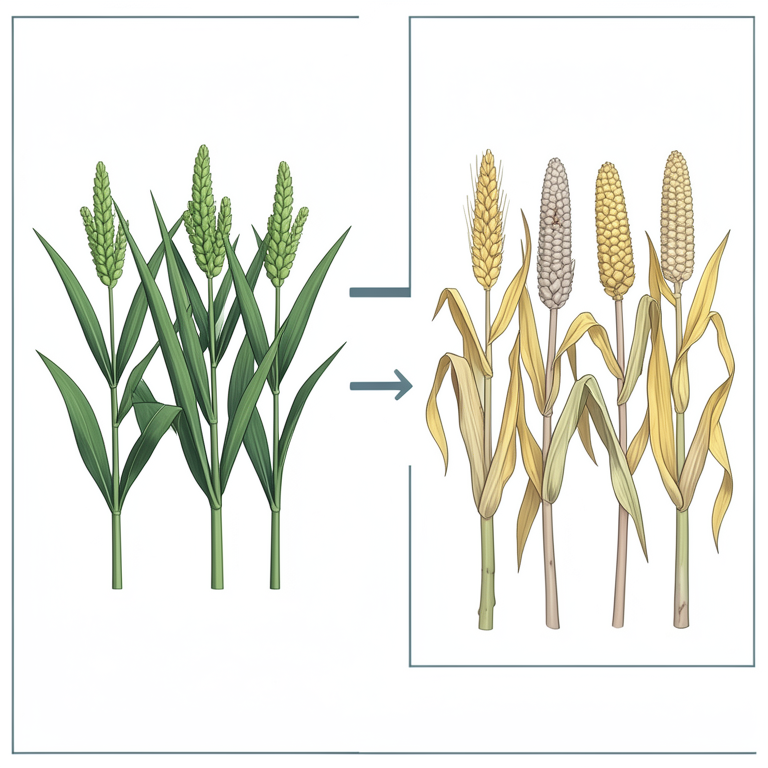
Impact of Stress on Photosynthesis and Yield
AI-generated conceptual illustration (rice, wheat, and maize plants). It explains the idea and does not show study data.
View source evidence ↗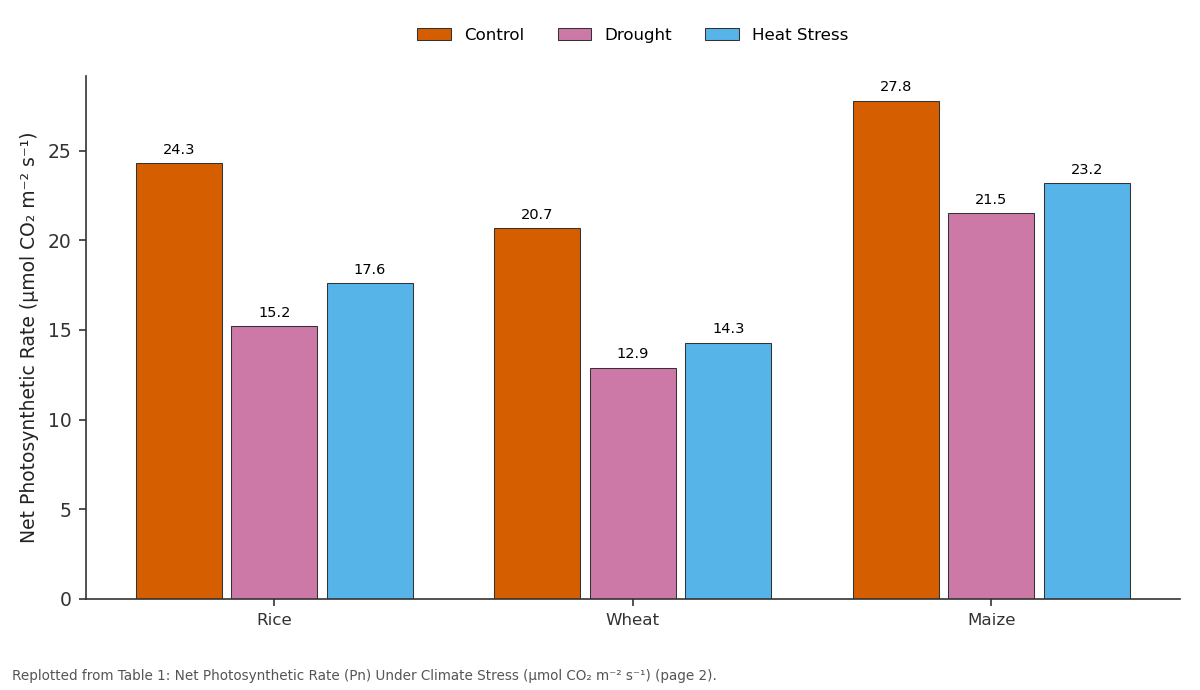
Control and Drought and more: Rice vs Wheat vs Maize
Replotted from Table 1 (page 2) of the original paper. Every bar is the paper's own table value.
View source evidence ↗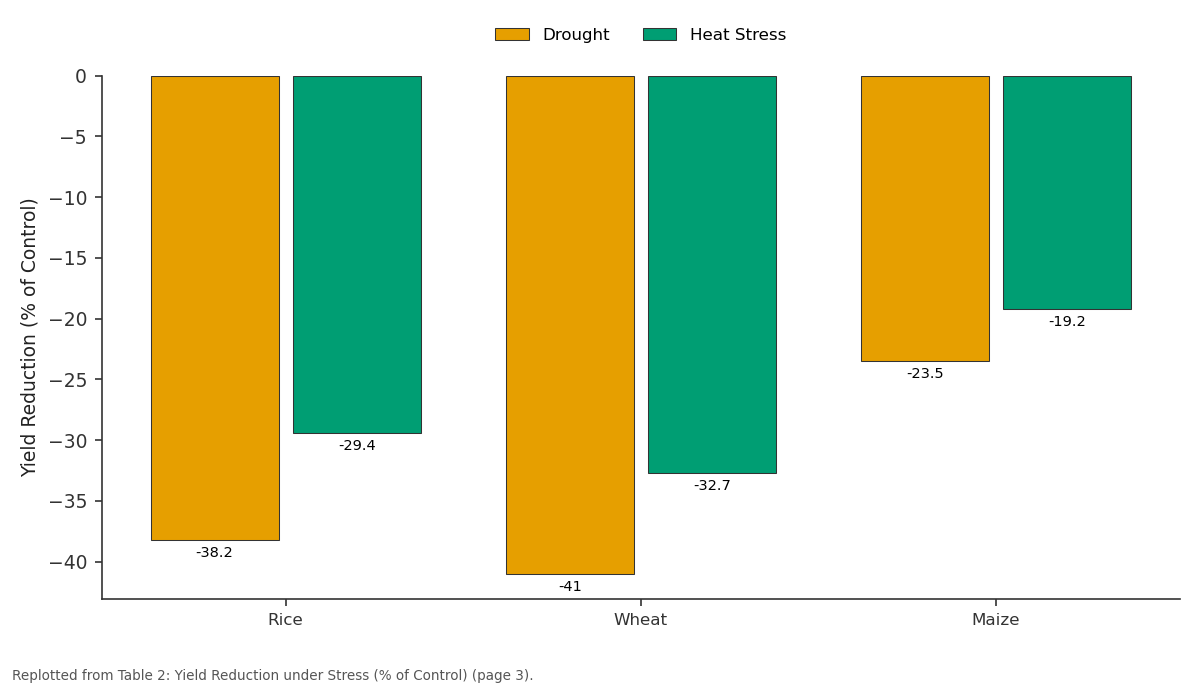
Drought and Heat Stress: Rice vs Wheat vs Maize
Replotted from Table 2 (page 3) of the original paper. Every bar is the paper's own table value.
View source evidence ↗Figures & tables
From the original paper Table 1
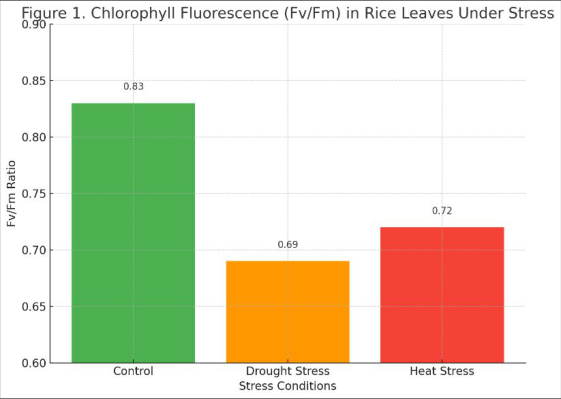 Figure 1
 Table 2
Introduction
Photosynthesis is the primary process by which plants convert light energy into chemical energy, forming the base of the terrestrial food chain. It not only sustains plant growth and development but directly determines crop productivity. The efficiency of this processreferred to as photosynthetic efficiency (PE)-is influenced by environmental factors including light intensity, CO₂ concentration, temperature, and water availability. In recent decades, global climate change has emerged as a significant threat to this efficiency, leading to reduced agricultural yields and jeopardizing food security. According to the Intergovernmental Panel on Climate Change (IPCC, 2021), the global surface temperature has risen by approximately 1.1°C above pre-industrial levels, accompanied by more frequent droughts, erratic rainfall, heatwaves, and increased salinity in soil due to sea-level rise. These stressors impact the photosynthetic machinery at multiple levels-starting from stomatal conductance to chloroplast ultrastructure and the activity of the Calvin-Benson cycle enzymes (Flexas et al., 2016) [9] . Moreover, these effects are more pronounced in C3 crops such as wheat, rice, and soybean, which dominate global agriculture but are inherently less efficient under stress compared to C4 crops like maize and sorghum. The significance of PE in determining yield has spurred extensive research on physiological adaptation, genetic modifications, and breeding strategies aimed at mitigating climateinduced losses. Studies have shown that improving PE even marginally can result in substantial yield gains (Zhu et al., 2010) [4] . Despite this potential, PE remains a complex and under -optimized trait in most breeding programs, primarily due to challenges in accurate measurement and the intricate interactions between genotype and environment. This paper aims to examine the impact of major climatic stressors-drought, heat, and salinity-on photosynthetic processes and to assess their consequences on crop yield.
It further explores molecular responses, varietal adaptations, and innovative agronomic strategies to enhance photosynthetic resilience. By integrating empirical data, case studies, and recent technological advancements, the study seeks to present a comprehensive view of how climate stress influences PE and how targeted interventions can safeguard future food production systems.
Literature Review
Several studies have documented the sensitivity of photosynthesis to environmental stress. Farquhar et al. (1980) [1] developed the foundational biochemical model of photosynthesis, explaining the role of Rubisco and stomatal limitation under varying CO₂ and temperature regimes.
Recent updates to the model have incorporated mesophyll conductance and electron transport constraints under drought (Flexas et al., 2009) [2] . Heat stress reduces the thermostability of photosystem II (PSII), causing photoinhibition and limiting ATP synthesis. Yamori et al. (2014) [3] demonstrated that short-term heat stress (>35°C) could irreversibly damage the oxygenevolving complex of PSII in rice and wheat, while also downregulating Rubisco activase expression. Likewise, salinity-induced osmotic stress reduces chloroplast turgor, impairing the light reactions and thylakoid membrane potential (Parida and Das, 2005) [6] . Drought, one of the most critical stressors in rainfed agriculture, closes stomata to conserve water, leading to a decrease in internal CO₂ concentration. Studies by Lawlor and Tezara (2009) [5] confirmed that this limitation is compounded by reduced Rubisco content and NADPH regeneration under prolonged water stress. However, gaps remain in understanding the cross-tolerance mechanisms-how one stress prepares or compromises the plant for another-and the integration of PE with whole-plant water-use efficiency. Moreover, breeding programs have not fully exploited traits like non-photochemical quenching (NPQ), chlorophyll retention under stress, or photoprotective pigment ratios, which are essential components of PE.
Materials and Methods Study Sites and Crop Varieties
Three key crops were selected: rice (Oryza sativa), wheat (Triticum aestivum), and maize (Zea mays). Field were conducted over the 2023-2024 growing seasons.
Instruments and Tools
Instruments and Tools
Experimental Design
Split-plot randomized design was adopted with three replications. Treatments included control (ambient conditions), drought (withholding irrigation for 15 days post-anthesis), and heat stress (temperature tents to raise canopy temp by ~4°C). Measurements were taken at vegetative, flowering, and grain-filling stages.
Results
Results
Comparative Analysis and Performance Metrics
Maize maintained higher photosynthetic efficiency under both drought and heat stress, likely due to its inherent C4 photosynthetic pathway. C4 metabolism minimizes photorespiration and maintains carbon assimilation even at lower stomatal conductance. The stomatal limitation index (SLI) was highest in wheat under drought (0.73) indicating high dependence on stomatal regulation. Conversely, the expression of heat-shock proteins (HSP70 and HSP101) was markedly higher in tolerant rice lines (IR64-Drought) compared to susceptible lines (Swarna).
Remote sensing indices like NDVI and PRI showed strong correlation (R² = 0.84) with Fv/Fm and net photosynthetic rate, confirming their utility in high-throughput phenotyping under stress.
Discussion
The observed decline in net photosynthesis and Fv/Fm under climate stress supports the hypothesis that photosynthetic apparatus is a primary target of heat and drought injury. PSII photoinhibition and reduced Rubisco activase stability under elevated temperatures significantly lower CO₂ assimilation capacity. Maize's resilience under such conditions further reinforces the advantage of the C4 pathway in a warming world. Interestingly, the greater yield penalty in wheat suggests that despite comparable reductions in photosynthesis, grain filling processes in wheat are more sensitive to terminal stress. The role of antioxidant defense systems (e.g., upregulation of superoxide dismutase and catalase) also emerged as critical, particularly in rice, which showed partial recovery under post-stress irrigation. Future breeding efforts must therefore target chloroplast stability, Rubisco activase thermostability, and canopy cooling traits. Gene editing tools like CRISPR/Cas9 offer promising avenues to enhance expression of such traits, as seen in recent work on Rubisco small subunit replacement in rice (Long et al., 2023).
Conclusion and
Conclusion and
Figures and tables from the paper
| Crop | Control | Drought | Heat Stress |
|---|---|---|---|
| Rice | 24.3 | 15.2 | 17.6 |
| Wheat | 20.7 | 12.9 | 14.3 |
| Maize | 27.8 | 21.5 | 23.2 |
Table text extracted from the original PDF; superscript letters are shown inline. The original table image is below.
View original table image
| Crop | Drought | Heat Stress |
|---|---|---|
| Rice | -38.2% | -29.4% |
| Wheat | -41.0% | -32.7% |
| Maize | -23.5% | -19.2% |
Table text extracted from the original PDF; superscript letters are shown inline. The original table image is below.
View original table image
References
9 in the original paper- Farquhar GD, von Caemmerer S, Berry JA. A biochemical model of photosynthetic CO₂ assimilation in leaves of C3 species. Planta. 1980;149(1):78-90.
- Flexas J, et al. Diffusional conductances to CO₂ as a target for increasing photosynthesis and photosynthetic water-use efficiency. Photosynth Res. 2009;101(1):117.
- Yamori W, Hikosaka K, Way DA. Temperature response of photosynthesis in C3, C4, and CAM plants: temperature acclimation and temperature adaptation. Photosynth Res. 2014;119(1-2):101-117.
- Zhu XG, Long SP, Ort DR. Improving photosynthetic efficiency for greater yield. Annu Rev Plant Biol. 2010;61:235-261.
- Lawlor DW, Tezara W. Causes of decreased photosynthetic rate and metabolic capacity in waterdeficient leaf cells: a critical evaluation of mechanisms and integration of processes. Ann Bot. 2009;103(4):561-579.
- Parida AK, Das AB. Salt tolerance and salinity effects on plants: a review. Ecotoxicol Environ Saf. 2005;60(3):324-349.
- Long BM, et al. Carboxysome encapsulation of Rubisco in Oryza sativa chloroplasts enhances CO₂ assimilation. Nat Plants. 2023;9(2):210-220.
- Intergovernmental Panel on Climate Change (IPCC). Climate change 2021: the physical science basis. Cambridge: Cambridge University Press; 2021.
- Flexas J, et al. Understanding down-regulation of photosynthesis under water stress: future prospects and searching for physiological tools for irrigation management. Ann Appl Biol. 2016;148(2):135-149.