
Research article · 2025 · Full text
International Journal of Agriculture and Food ScienceAI-driven crop disease prediction using satellite imagery and deep learning models
Volume 7(8) · Pages 494–506 · DOI: 10.33545/2664844x.2025.v7.i8g.649 ↗
Research areasSmart Agriculture and AI
Abstract
Author-writtenArtificial Intelligence (AI) and satellite imaging are transforming agriculture by enabling precise, data-driven crop health monitoring. This paper explores how deep learning techniques, combined with high-resolution multispectral and hyperspectral satellite imagery, can be leveraged for real-time crop disease detection. By utilizing models like Convolutional Neural Networks (CNNs), YOLO V8, and Faster R CNN, researchers have achieved classification accuracies ranging from 75% to over 99% across crops such as wheat, potatoes, soybean, and bananas. These AI-powered systems empower farmers with early warnings, allowing for timely intervention, reduced pesticide use, and optimized resource management. The integration of satellite data helps in covering large-scale agricultural fields while reducing manual efforts. However, challenges such as atmospheric interference in satellite data, limited labelled datasets, and the need for cross-domain collaboration remain significant. This study presents a system framework and outlines the data acquisition, processing, and evaluation steps necessary for implementing AI-satellite solutions in agriculture. It concludes that combining AI with remote sensing technologies can significantly improve crop disease management and support sustainable farming practices. Future research directions include federated learning, improved sensor integration, and standardized datasets to scale the technology for broader adoption in smart agriculture.
Summary
Source-checkedPlain-language reading of the full paper, prepared with AI and checked against the text. Each point links to the authors' own words.
Why it matters
- Global agriculture faces increasing pressure to increase food production while dealing with limited resources and climate change. View evidence ↗
- Plant diseases are a major threat to the global food supply, necessitating the development of effective management strategies. View evidence ↗
- Traditional disease detection methods are often insufficient because they rely on human judgment, which can be slow and inaccurate. View evidence ↗
The question
- The study examines how deep learning models and high-resolution satellite imagery can be used for the real-time detection of crop diseases. View evidence ↗
What they did
- The review analyzes the use of deep learning architectures, including CNNs, YOLO-V8, and Faster R-CNN, for disease classification in crops like wheat, potatoes, soybean, and bananas. View evidence ↗
- The approach involves using multispectral and hyperspectral satellite imagery to analyze vegetation health, soil moisture, and disease indicators. View evidence ↗
- Data preprocessing for these models includes normalization, cleaning, and augmentation techniques like random cropping and color jittering to improve model generalization. View evidence ↗
What they found
- In a specific case study on banana plants, drones equipped with specialized cameras detected Xanthomonas wilt with an accuracy rate exceeding 90%. View evidence ↗
- AI models have demonstrated a crop disease detection accuracy of 99.35%, contributing to a 50% reduction in crop losses and a 40% decrease in pesticide use. View evidence ↗
- The integration of AI has led to a 30% improvement in crop yield prediction and a 25% advancement in disease forecasting. View evidence ↗
- Among various classifiers evaluated, the Artificial Neural Network (ANN) classifier achieved the highest accuracy at 90.79%. View evidence ↗
- AI systems combined with drones and satellites can monitor up to 100 acres per day, significantly outperforming manual inspections that take days or weeks. View evidence ↗
- Predictive AI models have increased the decision-making confidence of 70% of farmers by providing detailed forecasts on disease risks and harvest times. View evidence ↗
What it means
- The authors conclude that the combination of AI and remote sensing technologies significantly improves crop disease management and supports sustainable agriculture. View evidence ↗
- Significant challenges remain, including atmospheric interference in satellite data, a lack of labeled datasets, and the need for collaboration across different professional domains. View evidence ↗
- There is a gap in the integration of AI with newer agricultural sciences, particularly regarding nutrient management and the merging of diverse data sources. View evidence ↗
Visual summary
2 visualsIllustrations explain the paper; charts are replotted from the paper's own table values.
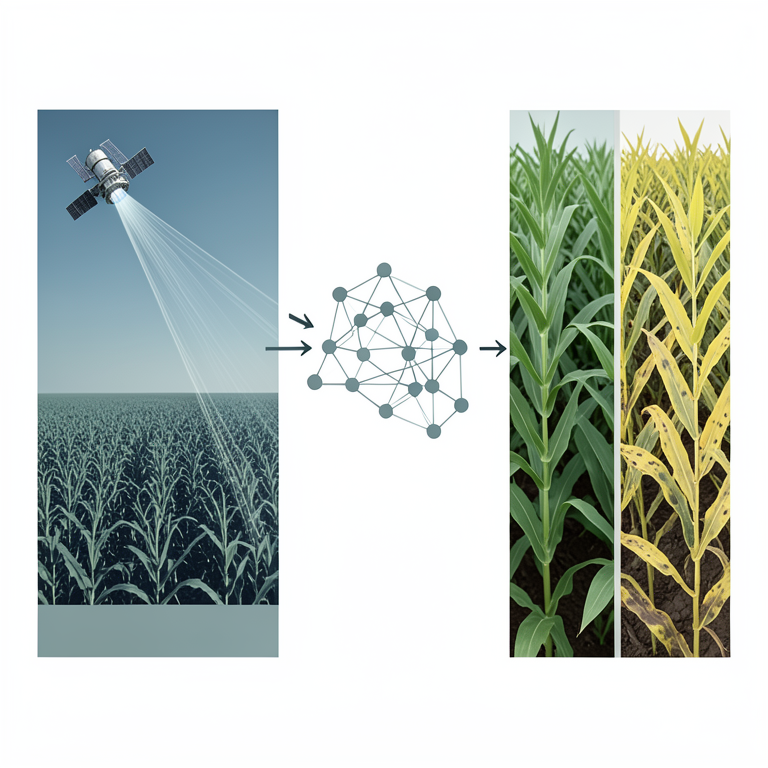
AI-Satellite Disease Detection Workflow
AI-generated conceptual illustration (maize fields and a satellite). It explains the idea and does not show study data.
View source evidence ↗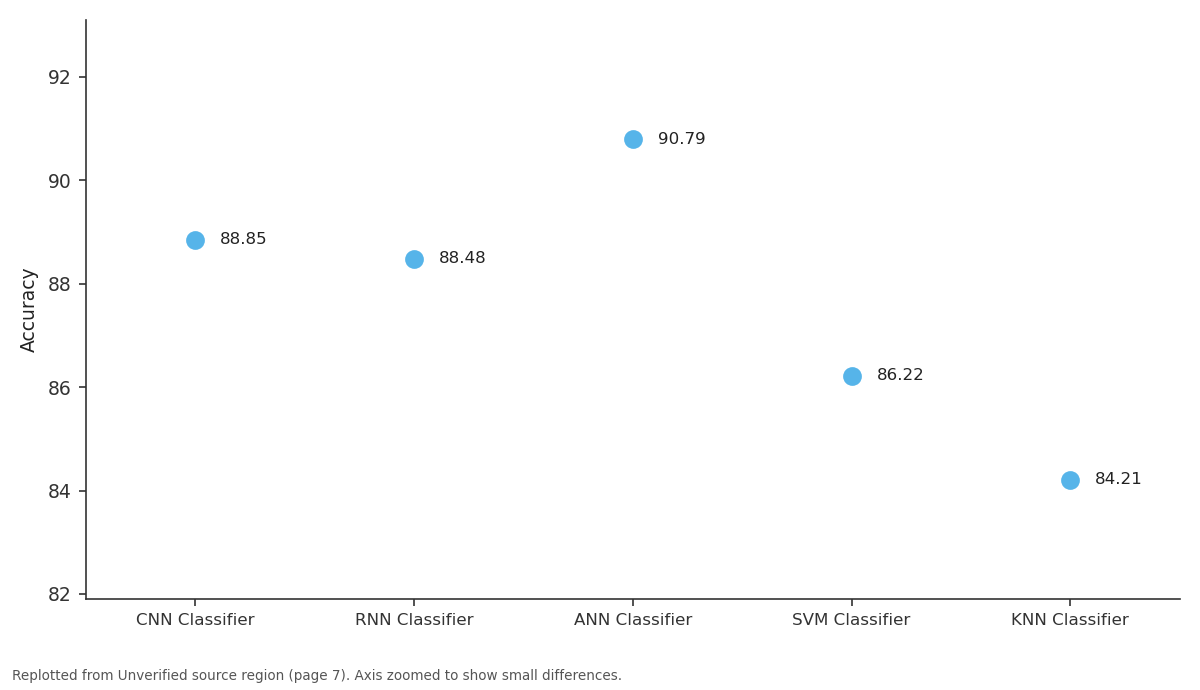
Accuracy: CNN Classifier vs RNN Classifier vs ANN Classifier vs SVM Classifier vs KNN Classifier
Replotted from a table (page 7) of the original paper. Every bar is the paper's own table value.
View source evidence ↗Introduction
Agriculture is under growing pressure to produce more food despite climate change and limited resources, which calls for new tech solutions. Artificial intelligence (AI) is a noteworthy development in precision agriculture; specifically, the analysis of satellite images and the use of deep learning models. These tools help farmers predict crop diseases with better accuracy, which improves both their decision-making and resource management. Researchers are finding better ways to monitor crop health in real-time by combining satellite data with machine learning. This real-time monitoring is key for taking quick action against diseases (Deepika et al., 2025) [21] . Furthermore, drones with AI are changing how data is collected, allowing for detailed analyses across large areas (Mhamdi E et al., 2024) [22] . This paper will examine the progress in AI-driven crop disease prediction, showing how these new tools can help solve farming issues and boost sustainability. The flowchart of data collection techniques effectively demonstrates these processes, visualizing how technology is being integrated into farming.
that were not possible before (Fern Cández et al., 2024). These technologies offer opportunities for better yield forecasts and pest control, signaling a big shift to smarter farming methods focused on maximizing resource use and productivity (Rafique A et al., 2025) (Jacobsen et al., 2022). The flowchart that shows these steps explains the detailed stages of AI use in agriculture.
Overview of crop diseases and their impact on food security
Plant diseases represent a considerable challenge to the world's food supply, making effective management approaches essential. Economic damage from these diseases can severely harm agricultural production, impacting farmers as well as consumers. Wheat and potatoes, vital components of diets globally, are especially vulnerable.
Acting quickly is key to reducing these damages, but conventional detection methods often fall short. They depend on human judgment, which can sometimes be slow and also inaccurate (Dhammabhushan R raibole et al., 2025) [1] . However, AI-driven technologies, especially the combination of deep learning models with satellite images, provide great opportunities for detecting diseases in real time. For example, a mobile app that helps farmers identify potato leaf diseases improves their capacity to react quickly, highlighting how technology can transform agricultural results and, ultimately, food availability (Sriranjani et al., 2025) [3] . The agricultural industry, by utilizing AI's abilities, can better meet the challenges that arise and make sure our food supply is more dependable (Panwar SV et al., 2024) [4] . One might suggest that the best way to handle these issues is through early detection and intervention.
The chart displays the annual global economic losses resulting from various plant diseases and specifically from soybean diseases in the United States over a 21-year period . The losses due to plant diseases and invasive insect pests are significantly higher compared to those caused by mycotoxins and soybean diseases. This emphasizes the substantial economic impact of these challenges on global food security and highlights the need for effective management strategies.
Importance of satellite imagery in agricultural monitoring: Satellite imagery is quite important for keeping tabs on agriculture, specifically when it comes to boosting AI-powered crop disease predictions. High-resolution, realtime data on crop health from satellites lets us closely monitor plant health, soil moisture, and how well crops are doing overall. When we combine this data with machine learning, it helps us spot possible disease outbreaks and pest problems early, so farmers can step in quickly and target their efforts effectively. Furthermore, using AI to analyze
Introduction to deep learning models in data analysis
Deep learning models are now revolutionizing agricultural research, especially when it comes to predicting crop diseases. These models utilize large datasets -think satellite images and the like -to spot patterns we might miss using older methods. By integrating deep learning, we gain access to sophisticated image processing that can identify specific indicators of crop health through things like spectral signatures (N/A, 2022). This shift is aided by advances in AI and machine learning, facilitating real-time data use and predictive analytics, thus helping farmers make informed decisions to manage disease (Banerjee et al., 2024). Such tech highlights the need for open, high-quality datasets to improve model training and encourage collaboration among agricultural researchers (Chawade et al., 2024). As, for example, illustrates, using these models systematically shows how effective they are in monitoring crop yields and supporting sustainable farming.
The Role of Satellite Imagery in Agriculture
Satellite imagery is undeniably central to today's agriculture, especially when it comes to AI's role in predicting crop diseases. Farmers can keep a closer watch on their fields because satellites give them real-time info on how healthy the crops are, how much moisture is in the soil, and what the environmental conditions are. This tech lets them use different ways of analyzing things, including deep learning models that can handle complicated data sets. This helps spot possible disease outbreaks before they wreck entire crops. As some research points out, satellite data and machine learning work really well together to help agriculture become more precise. This leads to interventions that are well-targeted and resources that are used better. Plus, better imagery means improvements in how crops are managed, which boosts productivity and cuts down on environmental harm ((Deepika et al., 2025) [21] , (Aashu et al., 2024) [19] , (EA A et al., 2024)). To see how these things connect, [extractedKnowledge1] shows how different imaging methods can help estimate yields, further proving how vital satellite imagery is for making agriculture better. Types of satellite imagery used in agriculture Satellite imagery has greatly altered how agriculture professionals monitor both crop health and productivity. Multispectral and hyperspectral imaging are among the different types of satellite imagery, and in most cases, they offer crucial data that can be analyzed to spot crop diseases, vegetation health, and soil moisture levels. This enables well-informed decision-making with regards to resource management (Aashu et al., 2024) [19] . Multispectral imagery, for example, captures wavelengths. Because of this, chlorophyll content and the overall vigor of plants can be assessed. This is particularly critical for early disease detection (Deepika et al., 2025) [21] . Hyperspectral imaging advances this process by providing in-depth spectral information. It helps, therefore, to pinpoint specific crop stress indicators, which enhances precision agriculture methodologies (Mhamdi E et al., 2024) [22] . Furthermore, the integration of these advanced imaging techniques alongside machine learning algorithms fosters predictive analytics. Such analytics are essential for forecasting diseases (Ali et al., 2025). Thus, the combined effect of satellite imagery and AI facilitates sustainable agricultural practices, changing the ways in which crops are monitored and managed. The visual representation in effectively summarizes this multifaceted approach, illustrating the interplay of these technologies.
Satellite System
Resolution Spectral Bands Applications Data Access
GeoEye [5] . Plus, satellite imagery makes it easier to mix in climate info and farming trends, which helps farmers handle changing weather and pests (Chinchorkar S, 2025) [6] . On top of that, AI uses computer vision to automatically find diseases, making it easier for farmers to monitor their crops and get more out of their work (P B et al., 2024). So, satellite imagery and AI working together is a big change in how we manage crops (Dubey I et al., 2024) [7] .
The chart illustrates the impact of AI and satellite imagery in agriculture, highlighting various potential benefits such as increased crop yields, reduced costs, and improved disease detection accuracy. Each bar represents a different aspect of these technologies, emphasizing their significant advantages in enhancing agricultural practices and sustainability. )) [18] .
Techniques for capturing and processing satellite data
Image 1: Overview of Agricultural Management Categories
Case studies showcasing successful applications of satellite imagery Successful applications of satellite imagery in agriculture, as seen in various case studies, really show how much this tech can change things, especially in managing crops and predicting diseases. Recent research points out that when you use deep learning models along with images from satellites, you can spot plant diseases sooner, which helps make farming more efficient and keeps our food supply safer (Blomme et al., 2024) [18] . Take, for example, a study on banana plants: it showed that using drones with special cameras can help find Xanthomonas wilt with a pretty high accuracy rate-over 90% (Blomme et al., 2024) [18] . Plus, AI models make it possible to gather and analyze huge amounts of data from remote sensing, which means farmers can make better calls about how to use their resources and keep an eye on their crops [, cite40]. You can even visually represent how this all works with models like, showing how data flows in agricultural monitoring, and highlighting how satellite imagery is now a key part of catching and dealing with diseases early on.
Deep Learning Models for Disease Prediction
Deep learning models are now key for improving disease prediction in crop management, especially when used with satellite imagery. These models greatly improve our ability to analyze large amounts of data, enabling us to monitor crops in real-time and identify disease outbreaks with greater precision. Recent studies, for instance, have shown that using advanced architectures like Yolo-V8 and Faster R-CNN makes it easier to detect plant diseases, such as Xanthomonas wilt of banana, with very high accuracygenerally between 75% and 99% (Blomme et al., 2024) [18] . In most cases, AI-driven methods, supported by IoT and satellite data, offer important insights that help optimize how resources are used and improve sustainable farming practices (Deepika et al., 2025) [25] . Integrating deep learning algorithms into crop disease management represents a significant shift toward precision agriculture; this enables early interventions, ultimately strengthening food security (Asolo et al., 2024). This integration, it should be noted, not only aids agricultural productivity but also fosters environmentally sustainable practices essential for the future of farming (Firdaus et al., 2022) [13] .
This bar chart illustrates the impact of artificial intelligence (AI) in agriculture, showcasing various improvements. The data reveals that the accuracy of AI models in crop disease detection is exceptionally high at 99.35%, while reductions in crop losses and pesticide use are significant at 50% and 40%, respectively. The improvement in crop yield prediction is shown to be 30%, and advancements in AIdriven disease forecasting account for 25%. This emphasizes the transformative role of AI in enhancing agricultural practices.
Overview of deep learning and its applications in agriculture:
Deep learning has dramatically changed agriculture, mostly by improving precision farming and helping farmers use big datasets to make better decisions. By integrating machine learning algorithms with satellite images, farmers are now able to find crop diseases sooner. This optimizes crop yields and resource use. Crop monitoring exemplifies these advancements. Satellite data is analyzed to predict and help prevent disease outbreaks, generally leading to healthier harvests. AI-driven drones are also used for real-time field analysis, highlighting deep learning's capability in facilitating precise interventions, like targeted pest control and irrigation management (Mhamdi E et al., 2024) [22] . As highlighted in the research, deep learning can provide multi-faceted benefits in agricultural practices, which aligns agronomic innovation with the demands of a growing population (Deepika et al., 2025) [25] . Furthermore, studies show the need for integrated approaches to improve nutrient management. These technologies can potentially transform agriculture into a sustainable practice (Aashu et al., 2024) [24] . The visual representation of machine learning models in agricultural applications further conveys these innovations emphatically. A et al., 2024). The real-world application of these models underscores how effective they are; specifically, they enable proactive responses to lower the impact of diseases on crop yields.
Image 2: AI-driven analysis of plant health with annotated leaf conditions.
Data requirements and pre-processing for deep learning models
When it comes to AI and predicting crop diseases, how we handle data for deep learning models is important. If these models are going to work well, we need good, varied data, like pictures from space and info from sensors. We must preprocess the data, doing things like normalization, making it bigger, and cleaning it up. This helps the model get better at making predictions. Using multi-spectral imaging, for example, can make it easier to spot diseases because it gives us spectral information that regular imaging can't (Botova et al., 2025). Also, pulling together different kinds of agricultural data can make the model better, helping it adjusts to different growing conditions and plant types. So, for sustainable agriculture, we need to use the best ways to manage and preprocess data to get the most out of deep learning (Battilani P et al., 2025), (Battilani et al., 2025). In most cases.
Data Requirement Description
Data Requirement Description
High-Resolution Satellite Imagery
High-resolution images captured from various angles and under varied lighting conditions are essential for accurate crop disease detection. These images should depict multiple stages of plant development, including seedlings, mature plants, and diseased or damaged plants. Annotated datasets provide information about plant species, plant parts, diseases, or other relevant attributes. ([ncbi.nlm.nih.gov
Evaluation metrics for assessing model performance
To truly gauge how well an AI crop disease prediction model performs, we need to use a few good evaluation metrics to be sure our algorithms work in the field. You'll often see accuracy, precision, recall, and the F1 score mentioned; together, they give us a complete picture of how well a model can predict. Precision tells us how often the diseases we said were there actually there. Recall, on the other hand, checks if the model could find all the diseases that existed in the data. The F1 score is a sort of average of precision and recall, balancing both. In research where they're using deep learning and satellite photos-like some studies looking at crop health and disease-these metrics are super important. They help us understand if a model will hold up and be useful in different farming situations, which then helps farmers make good decisions (N/A, 2022) (Blomme et al., 2024) [18] (Bari et al., 2021) (Botova et al., 2025). The flowchart provided brings a visual component to these evaluation steps within the larger picture of agricultural management.
Model
Model
Integration of AI and Satellite Imagery for Disease
Prediction: Merging artificial intelligence with satellite imagery brings considerable potential for forecasting crop diseases and supporting agricultural sustainability through the use of large datasets. Advanced machine learning, like deep learning models, allows for the analysis of multispectral images and the extraction of essential plant health insights. As an example, convolutional neural networks can improve disease classification accuracy compared to traditional manual scouting methods (Koshariya AK et al., 2025) [12] . In most cases, research points out the importance of satellite imagery for monitoring various growth stages and environmental factors, which contributes significantly to understanding disease development (Ashfaq M et al., 2025) [10] . As agricultural systems show, using AI to analyze imagery can lead to early detection of infections before they become visible, which helps with crop management and the allocation of resources (Pasupuleti MK, 2025). Such integration emphasizes data-driven methods in addressing challenges in agriculture.
Image 3: Framework for Crop-Yield Estimation Using Machine Learning and Deep Learning Techniques
Methodologies for combining satellite imagery with AI models: The strategies for merging AI models with satellite imagery are progressing swiftly, particularly given the demand for precise crop disease forecasting in sustainable farming. The combination of deep learning algorithms and detailed satellite imagery facilitates in-depth data analysis, which helps researchers gain practical insights into agricultural health and efficiency. Hybrid models, which mix traditional physics-based methods with data-centric techniques, have demonstrated potential for improving forecast accuracy while addressing problems like limited data and high computational costs (Chanussot et al., 2024). Recent innovations also underscore the importance of using multi-spectral and hyperspectral images, as these can capture subtle differences in crop health that are essential for early disease identification (He et al., 2022). Visual aids, for instance, a flowchart outlining data processing for machine learning in agriculture, effectively summarize these methods, demonstrating the structured approach used when implementing AI-driven solutions. This combination of tools ultimately supports better-informed choices in crop management.
Challenges in integrating satellite data with deep learning: Dealing with satellite data alongside deep learning isn't always a walk in the park, mainly because the data itself can be quite complex and change a lot. Satellite images sometimes have problems like not being super clear, or clouds getting in the way, and even stuff in the atmosphere messing things up. These issues? They can throw a wrench in how well machine learning does at spotting crop diseases. On top of that, there's just so much data that you need some advanced tricks to get it ready for analysis. This makes it clear why we need solid setups that can handle bringing all this data together smoothly (Deepika et al., 2025) [25] , (Abu-Naser et al., 2024) [16] . When we look at AI tech in farming, studies show we still don't fully get how to use this data to really make predictions better while keeping things sustainable (Ali et al., 2025), (Firdaus et al., 2022) [13] . The puzzle gets even trickier because we need people from different fields to work together. Basically, you need farming smarts mixed with some serious computing skills to give farmers useful insights. For a picture of how this all comes together, provides a good look at the data steps for farming, showing how it goes from raw information to using a model.
Image 4: Flowchart of Machine Learning Applications in Agriculture
Image 4: Flowchart of Machine Learning Applications in Agriculture
Real-time monitoring and prediction capabilities
Real-time monitoring and predictive capabilities, particularly in AI-driven crop disease prediction, signify a major step forward for agriculture. Stakeholders can gain crucial insights into crop health promptly by using tools like satellite imagery alongside deep learning models; this facilitates proactive choices. Models using deep learning, for example, have demonstrated high accuracy in discerning crop health and spotting diseases, reaching a precision rate of up to 99.25% with models developed for specific functions (Botova et al., 2025). This kind of tech integration makes it easier to recognize problems, such as nutrient shortfalls or pest invasions, plus it helps with optimizing the use of resources, which is important for sustainable farming (Firdaus et al., 2022) [13] . A flowchart depicting this process is available in, presenting the methodical way large datasets are assessed for interventions. To sum it up, real-time capabilities empower farmers to improve crop yields and sustainability, and this marks a key change in precision agriculture (Asolo et al., 2024).
Future trends in AI-driven agricultural practices
Looking ahead, AI's role in agriculture is set to explode, particularly when it comes to predicting crop diseases. This will really bolster food security and make farming more sustainable. New tech is using satellite images and machine learning to crunch huge amounts of data, helping farmers make smart calls on the fly. Take deep learning, for example. Recent research shows it's great at spotting and predicting changes in crop health by using NDVI analysis. This helps farmers use resources better and cut down on their environmental footprint (Zacharia S et al., 2025) [11] . Plus, with IoT and data coming from all over, we're getting a complete picture for predicting yields. The chart illustrates the impact of AI in precision agriculture, showcasing five key areas. It highlights that AI models significantly enhance accuracy in crop disease detection at 99.35%, while also contributing to a 50% reduction in crop losses, a 40% decrease in pesticide usage, a 30% improvement in crop yield predictions, and 25% advancements in disease forecasting. This data underscores the transformative role of AI in agriculture.
Conclusion
The convergence of AI and deep learning models alongside satellite imagery represents a notable step forward for agricultural practices, with a focus on crop disease prediction. These technologies facilitate the prompt detection and handling of diseases, improving crop yield and sustainability, in most cases. The literature review indicated that AI applications in agriculture-notably the studies involving machine learning and drones-have shown promising results in both disease management and precision agriculture (Deepika et al., 2025) [25] . Furthermore, farmers can potentially gain from real-time, tailored insights by using tools like automated decision support systems (Asolo et al., 2024). The successful use of deep learning models in detecting diseases, seen in crop monitoring initiatives (Blomme et al., 2024) [18] , further highlights the potential of such innovations. Ultimately, AI-driven crop disease prediction advancements may foster a more resilient agricultural future, ensuring food security as discussed in sustainable farming practices, and incorporating a flowchart of the data collection process clarifies this comprehensive approach.
Summary of key findings and insights
Research into AI's role in predicting crop disease reveals a potentially transformative shift in agriculture. This is especially true when satellite imagery combines with deep learning models. This combination substantially improves our capacity to keep tabs on the health of crops. It also allows for on-time actions that lessen the effects of disease, and this improves both yields and sustainability. Indeed, AI's applications, like predictive analytics coupled with realtime decision support, make optimizing resource management in farming simpler ((Deepika et al., 2025), (Abu-Naser et al., 2024)) [26] . Furthermore, the role of automated systems -think AI-equipped drones -is notable because of their suitability for precision agriculture. That's a big help with the key issues in both crop and resource management ((Mhamdi E et al., 2024)) [22] . Yet, some gaps exist. Specifically, AI isn't always well-integrated with newer agricultural sciences, especially nutrient management and when merging distinct data sources to get more accurate predictions ((Ali et al., 2025)). Relevant flowcharts and diagrams, like and, offer a clear picture of these interwoven technologies and agricultural practices.
Implications for farmers and agricultural stakeholders
For farmers and others involved in agriculture, adopting crop disease prediction technologies powered by AI carries considerable weight; these technologies stand to improve both resource management and decision-making. Farmers can look forward to better crop health monitoring and quicker disease detection, thanks to the use of satellite imagery coupled with deep learning models -these are vital for keeping losses low and yields high. Research indicates that these technologies do more than just collect data and spot anomalies; they also lend themselves to precision farming, in turn fostering sustainable methods ((Firdaus et al., 2022)) [13] . Furthermore, AI allows for a more precise approach to risk management, particularly given how unpredictable climate change has become; this might also lower insurance costs because the risk profile of farmers would be improved ((Leucci et al., 2024)) [14] . The implications reach beyond individual farms, impacting entire supply chains and encouraging a move toward smarter agricultural systems that emphasize both sustainability and inclusivity ((Gikunda et al., 2024)) [15] . Visual aids, like, do well to show how these agricultural management practices are all related, which only highlights how important it is to have integrated strategies.
References
0 in the original paperCited by 4
From OpenAlex, OpenCitations and reference lists read by Scinovex
- The Role of AI-Integrated Drone Systems in Agricultural Productivity and Sustainable Pest Management ↗
Muhammad Towfiqur Rahman, A S M Bakibillah, A. B. M. I. Hossain, Ali Ahasan, Naimul Basher, Kabiratun Ummi Oyshe et al. · AgriEngineering · 2026
Artificial intelligence (AI)-assisted drone technology in agriculture has transformed productivity and pest control techniques, resulting in novel solutions to modern farming challenges. Drones utilizing sensors, cameras, and AI algorithms can precisely monitor crop health, soil conditions, and insect infestations. Using AI-assisted drones for precision irrigation and yield predictions further improves resource allocation, promotes sustainability, and reduces operating costs. This review…
❝ 3PDF - A Hybrid Machine Learning–Deep Learning Framework for Early Wheat Crop Stress Detection in Northwest Tunisia Under Climate Change Using Multi-Temporal Satellite Data ↗
Cherni Aya, Anis Bousselmi, Lokman Sboui, Néji Youssef · Lecture notes on data engineering and communications technologies · 2026
❝ 0 - Aletheia Agri: A Deep Learning Framework for Segregated Multi-Crop Disease Classification with Remedy Recommendation ↗
Shiraj Akhtar, Shishir Suman, Shivam, Arvind Kumar · 2026
❝ 0 - Technology-Driven Wheat Cultivation: IoT, Sensing and Data Analytics for Climate-Smart Agriculture ↗
Angel Alfredo Osorio-Oviedo · IntechOpen eBooks · 2026
Wheat (Triticum aestivum L.) is a strategic crop for global food security and faces increasing limitations associated with climate change, soil degradation, and the demand for higher resource-use efficiency. In this context, climate-smart agriculture (CSA) emerges as an integrated framework that combines sustainability, resilience, and mitigation of greenhouse gas emissions. This chapter analyzes the role of digital technologies – Internet…
❝ 0PDF