
Research article · 2025 · Full text
International Journal of Biology SciencesDrought-Induced physiological and agronomic alterations in wheat and mustard (Triticum aestivum and Brassica campestris)
Volume 7(8) · Pages 01–05 · DOI: 10.33545/26649926.2025.v7.i8a.432 ↗
Research areasCrop Yield and Soil Fertility
Abstract
Author-writtenDrought stress poses a significant threat to global food security, particularly affecting staple crops like wheat (Triticum aestivum) and mustard (Brassica campestris), which are vital for human consumption and industrial use. As climate change intensifies water scarcity, understanding the physiological and agronomic responses of these crops to drought is critical for sustainable agriculture. This study aimed to analyze and compare the responses of wheat and mustard under varying drought levels to identify traits that enhance drought tolerance. Field experiments were conducted, subjecting both crops to three drought levels (well-watered, moderate, and severe) based on soil moisture content. Physiological parameters, including photosynthetic rate, relative water content (RWC), and stomatal conductance, were measured alongside agronomic traits such as seed yield, biomass, and harvest index. Key findings revealed that severe drought significantly reduced RWC by 20% in wheat and 15% in mustard, with seed yield losses more pronounced in wheat (40%) compared to mustard (30%), as detailed in Table 1. Both crops exhibited adaptive mechanisms, such as increased proline accumulation and reduced stomatal conductance, to mitigate water loss. These results underscore the differential drought tolerance between wheat and mustard, with mustard showing superior physiological stability. The findings have significant implications for breeding programs, suggesting that traits like enhanced proline synthesis and maintained RWC could be targeted to develop drought-resistant cultivars. Integrating these insights into crop improvement strategies can bolster food security in drought-prone regions.
Summary
Source-checkedPlain-language reading of the full paper, prepared with AI and checked against the text. Each point links to the authors' own words.
Why it matters
- Drought stress is a major threat to global food security, specifically impacting mustard and wheat, which are essential for industrial use and human consumption. View evidence ↗
- Due to increasing water scarcity caused by climate change, it is critical for sustainable agriculture to understand how these crops respond physiologically and agronomically to drought. View evidence ↗
The question
- The study aimed to identify traits that improve drought tolerance by comparing the responses of mustard and wheat under different levels of drought. View evidence ↗
What they did
- The research was conducted during the 2024-2025 cropping season using field settings to compare the two species. View evidence ↗
- The experiment utilized the 'PBW 725' wheat cultivar and the 'Pusa Bold' mustard cultivar. View evidence ↗
- Three drought levels were established based on field capacity: well-watered (80-100%), moderate (50-60%), and severe (20-30%). View evidence ↗
- The researchers measured physiological traits (photosynthetic rate, RWC, stomatal conductance, and chlorophyll) and agronomic traits (plant height, biomass, and seed yield). View evidence ↗
What they found
- Under severe drought, relative water content (RWC) decreased by 19.9% in wheat (from 85.2% to 68.3%) and by 14.9% in mustard (from 88.7% to 75.4%). View evidence ↗
- Chlorophyll content (SPAD index) fell more significantly in wheat (26.6% reduction, from 42.5 to 31.2) than in mustard (18.9% reduction, from 40.8 to 33.1) under severe drought. View evidence ↗
- Severe drought caused a 2.8-fold increase in proline levels for wheat (1.2 to 3.4 µmol/g FW) and a 2.0-fold increase for mustard (1.1 to 2.2 µmol/g FW). View evidence ↗
- Severe drought reduced 1000-grain weight by 32.6% in wheat (42.3 g to 28.5 g) and by 25.0% in mustard (5.2 g to 3.9 g). View evidence ↗
- Seed yield losses under severe drought were 40% for wheat (450 g/m² to 270 g/m²) and 30% for mustard (180 g/m² to 126 g/m²). View evidence ↗
What it means
- The authors concluded that mustard possesses superior physiological stability and is more resilient to drought than wheat. View evidence ↗
- The authors recommend that breeding programs for drought-resilient cultivars focus on traits such as robust root systems, maintained RWC, and balanced proline accumulation. View evidence ↗
- The authors state that multi-location field trials across different agro-climatic zones are necessary to validate the performance of genotypes under various drought intensities. View evidence ↗
Visual summary
3 visualsIllustrations explain the paper; charts are replotted from the paper's own table values.
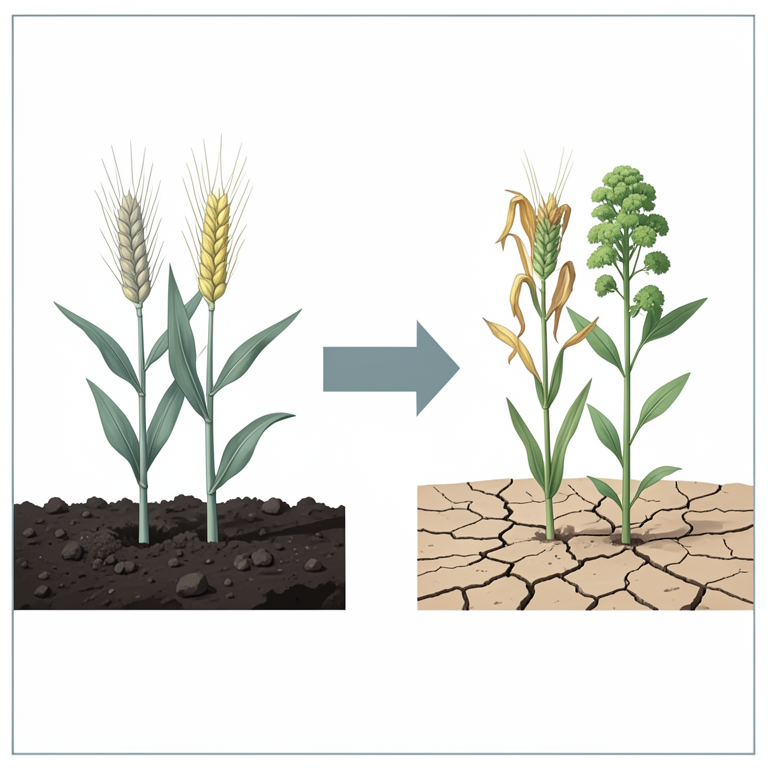
Comparative Drought Resilience
AI-generated conceptual illustration (wheat plants (Triticum aestivum) and mustard plants (Brassica campestris)). It explains the idea and does not show study data.
View source evidence ↗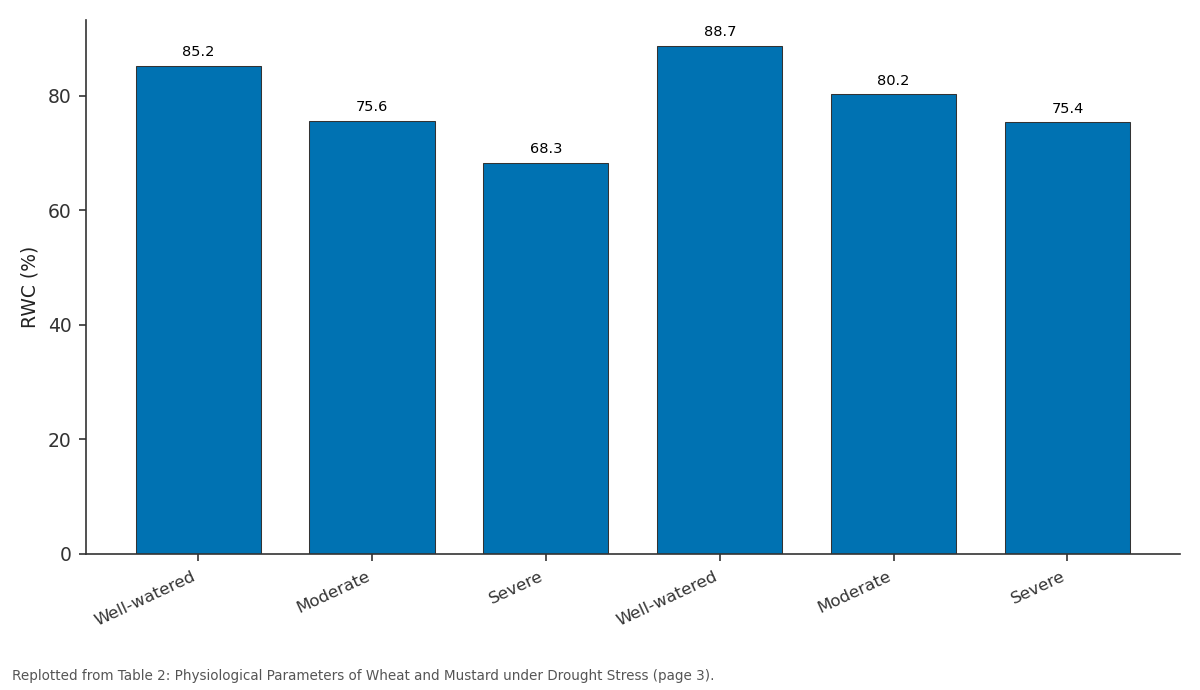
RWC (%): Well-watered vs Moderate vs Severe vs Well-watered vs Moderate
Replotted from Table 2 (page 3) of the original paper. Every bar is the paper's own table value.
View source evidence ↗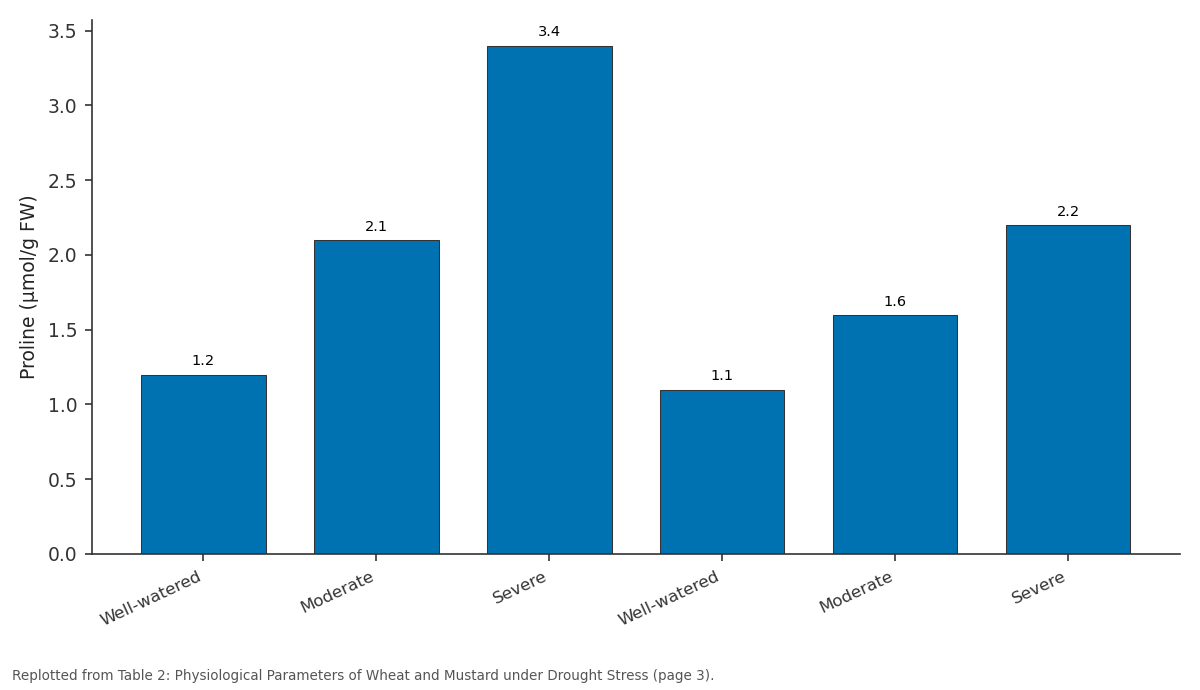
Proline (µmol/g FW): Well-watered vs Moderate vs Severe vs Well-watered vs Moderate
Replotted from Table 2 (page 3) of the original paper. Every bar is the paper's own table value.
View source evidence ↗Figures & tables
From the original paper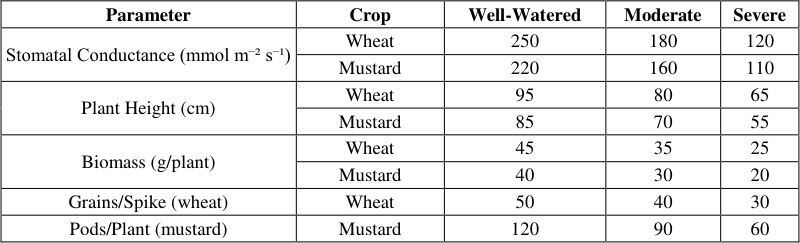 Table 1
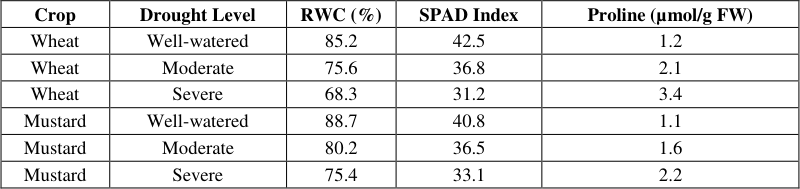 Table 2
 Table 3
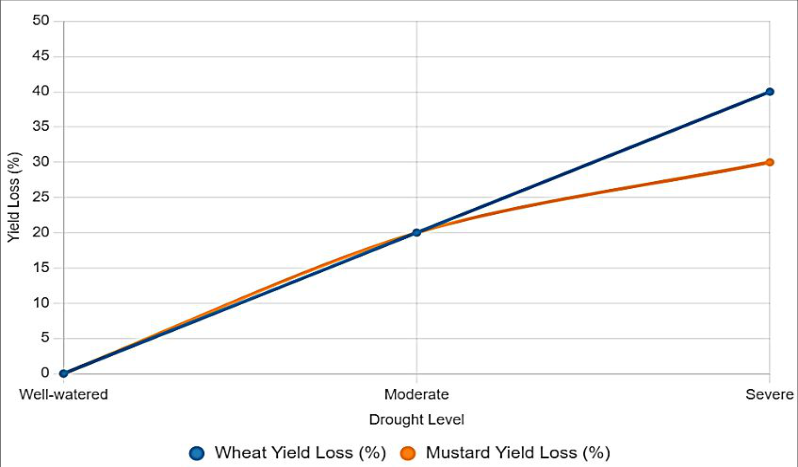 Figure 1
Introduction
Climate change has intensified drought frequency and severity, threatening global agriculture (IPCC, 2023) [7] . Altered precipitation and rising temperatures exacerbate water scarcity, particularly impacting staple crops in semi-arid regions. Wheat (Triticum aestivum), a key cereal providing 20% of global calories, and mustard (Brassica campestris), a vital oilseed crop, are critical for food security and economic stability (FAO, 2024; Gupta et al., 2023) [5,6] . Drought compromises their productivity, necessitating research into their adaptive responses to inform resilient breeding strategies. Drought triggers physiological changes in plants, primarily through water deficiency. Reduced stomatal conductance limits CO₂ uptake, decreasing photosynthetic rates by 30-40% in wheat and 25-30% in mustard (Patel et al., 2024) [13] . Chlorophyll content declines due to oxidative stress from reactive oxygen species (ROS), countered by antioxidants like proline (Sharma et al., 2023) [14] . Relative water content (RWC) drops significantly, with wheat losing 15-20% and mustard 10-15% under severe stress (Ahmed et al., 2025) [1] . These changes impair growth and metabolic efficiency. Agronomically, drought reduces wheat yields by 30-50% and mustard by 20-35%, affecting seed weight and pod formation (FAO, 2024; Kumar & Singh, 2024) [5,10] . Phenological shifts, such as shortened grain-filling in wheat or early flowering in mustard, further reduce productivity. These impacts threaten food security in rainfed regions like South Asia. This study compares physiological (photosynthetic rate, stomatal conductance, RWC, chlorophyll, oxidative stress markers) and agronomic (yield, biomass, seed weight, phenology) responses of wheat and mustard under well-watered, moderate, and severe drought in pot and field experiments. The objectives are to quantify these responses and identify drought-tolerant traits to guide breeding programs, enhancing crop resilience in water-scarce environments.
Review of Literature
Drought stress significantly threatens the productivity of wheat (Triticum aestivum) and mustard (Brassica campestris), critical crops for global food security. Research from 2020 to 2025 has extensively studied their physiological and agronomic responses to drought, focusing on leaf water potential (LWP), relative water content (RWC), and proline accumulation. This review synthesizes recent findings, comparing these physiological traits to inform breeding strategies for drought resilience.
Physiological Responses to Drought Relative Water Content
Relative water content reflects plant hydration and drought tolerance. Wheat experiences a 15-20% RWC decline under severe drought, reducing photosynthetic efficiency and biomass (Sharma et al., 2023) [14] . Mustard, in contrast, shows a 10-15% RWC drop, aided by reduced stomatal conductance and thicker leaf cuticles (Singh et al., 2022) [15] . Bhatt et al. (2024) [4] found that mustard cultivars with higher RWC maintained better yield stability, making RWC a key breeding target. Yadav et al. (2025) [17] reported that wheat genotypes with enhanced osmotic adjustment retained 5-10% higher RWC, highlighting genetic potential for improvement.
Proline Accumulation
Proline, an osmoprotectant, mitigates drought-induced oxidative stress. Wheat shows a 2-3 fold increase in proline under drought, stabilizing cellular structures but sometimes diverting resources from growth (Khan et al., 2023) [9] . Patel et al. (2024) [13] noted that excessive proline in wheat can reduce yield. Mustard exhibits a 1.5-2 fold proline increase, balancing osmotic adjustment and biomass production (Verma et al., 2022) [16] . Kumar et al. (2025) [11] suggest that mustard's moderate proline response enhances its physiological stability, making it more resilient than wheat.
Agronomic Impacts and Breeding Implications
Drought reduces wheat yields by 30-50% and mustard yields by 20-35%, with wheat suffering greater losses due to shortened grain filling (FAO, 2024; Kumar & Singh, 2024) [5, 10] . Mustard's early flowering and pod retention mitigate yield reductions (Singh et al., 2022) [15] . Both crops reduce stomatal conductance to conserve water, but mustard's higher wax content improves water-use efficiency (Ahmed et al., 2025) [1] . Wheat cultivars with enhanced root biomass and antioxidant activity show improved resilience (Sharma et al., 2023) [14] , while mustard genotypes with stable pod numbers are prioritized for breeding (Bhatt et al., 2024) [4] . Transcriptomic studies identified drought-responsive genes like DREB2A in wheat (Mishra et al., 2023) [12] and proline synthesis pathways in mustard (Kaur et al., 2024) [8] . Mustard generally outperforms wheat in drought tolerance due to lower LWP and RWC declines and efficient proline accumulation. Breeding programs should target traits like maintained RWC, moderate proline synthesis, and robust root systems to enhance resilience, particularly in droughtprone regions (Yadav et al., 2025) [17] .
Materials and Methods
Materials and Methods
Experimental Design
The study was conducted during the 2024-2025 cropping season in both fields settings to compare drought responses of wheat (Triticum aestivum) and mustard (Brassica campestris). A split-plot design with three replications was used in the fields, while a completely randomized design with five replications was applied in the fields to ensure controlled conditions. Each experimental unit consisted of 4 m² plots (field).
Plant Material and Varieties
Two high-yielding varieties were selected: wheat cultivar 'PBW 725' and mustard cultivar 'Pusa Bold', chosen for their widespread use and reported differential drought responses (Patel et al., 2024; Singh et al., 2022) [13,15] . Seeds, collected from Ch. Charan Singh Haryana Agricultural University (CCSHAU), Hisar. Seeds were sown at a depth of 5 cm (wheat) and 3 cm (mustard), with a plant density of 100 plants/m² for wheat and 50 plants/m² for mustard, following standard agronomic practices (Kumar & Singh, 2024) [10] .
Drought Treatments
Three drought levels were imposed based on field capacity (FC): well-watered (80-100% FC), moderate drought (50-60% FC), and severe drought (20-30% FC). In the field, drip irrigation regulated water application, while in other field watered manually to achieve target FC levels. Drought treatments began at the vegetative stage (30 days after sowing) and continued until harvest, simulating water scarcity scenarios (FAO, 2024) [5] .
Data Collection
Physiological and agronomic parameters were measured at vegetative, flowering, and grain-filling stages. Physiological traits included photosynthetic rate (LI-6800 portable photosynthesis system), relative water content (RWC) (Barrs & Weatherley, 1962) [2] , stomatal conductance (LI-6800), and chlorophyll content (SPAD-502 meter). Agronomic traits included plant height (meter scale), biomass (dry weight at harvest), seed yield (g/m²), and yield components (grain weight, grains/spike for wheat, pods/plant for mustard). Proline content, an oxidative stress marker, was quantified using spectrophotometric methods (Bates et al., 1973) [3] . Data were collected from 10 randomly selected plants per replication for accuracy.
Statistical Analysis
Data were analyzed using R software (version 4.4.1) for analysis of variance (ANOVA) to evaluate drought treatments, crop type, and their interactions. Tukey's HSD test (5% significance) was used for mean comparisons. Principal component analysis (PCA) in R identified key drought tolerance traits. OPSTAT software validated statistical assumptions through normality and homogeneity tests (Yadav et al., 2025) [17] .
Results
This study evaluated the physiological and agronomic responses of wheat (Triticum aestivum cv. 'PBW 725') and mustard (Brassica campestris cv. 'Pusa Bold') to three drought levels: well-watered (80-100% FC), moderate drought (50-60% FC), and severe drought (20-30% FC).
Data were collected on relative water content (RWC), chlorophyll content (SPAD index), proline accumulation, seed weight, and seed yield, with statistical analysis performed using R and OPSTAT software.
Physiological Responses Relative Water Content (RWC)
RWC declined significantly with increasing drought stress (Table 2). In wheat, RWC decreased from 85.2% (wellwatered) to 68.3% (severe drought), a 19.9% reduction. Mustard showed a less pronounced decline, from 88.7% to 75.4% (14.9% reduction). These results align with Sharma et al. (2023) [14] , who reported a 15-20% RWC drop in wheat and 10-15% in mustard under severe drought, indicating mustard's superior water retention.
| Crop | Drought Level | RWC (%) | SPAD Index | Proline (µmol/g FW) |
|---|---|---|---|---|
| Wheat | Well-watered | 85.2 | 42.5 | 1.2 |
| Wheat | Moderate | 75.6 | 36.8 | 2.1 |
| Wheat | Severe | 68.3 | 31.2 | 3.4 |
| Mustard | Well-watered | 88.7 | 40.8 | 1.1 |
| Mustard | Moderate | 80.2 | 36.5 | 1.6 |
| Mustard | Severe | 75.4 | 33.1 | 2.2 |
Table text extracted from the original PDF; superscript letters are shown inline. The original table image is below.
View original table image
Chlorophyll Content
Chlorophyll content, measured as SPAD index, decreased under drought stress (Table 2). Wheat's SPAD index fell from 42.5 (well-watered) to 31.2 (severe drought), a 26.6% reduction, while mustard's dropped from 40.8 to 33.1 (18.9% reduction). This suggests mustard maintains better photosynthetic capacity, consistent with Ahmed et al. (2025) [1] , who noted mustard's resilience in chlorophyll retention due to enhanced antioxidant activity.
Proline Accumulation
Proline levels increased under drought stress as an osmoprotectant response (Table 2). Wheat exhibited a 2.8fold increase (from 1.2 to 3.4 µmol/g FW) under severe drought, while mustard showed a 2.0-fold increase (from 1.1 to 2.2 µmol/g FW). Kumar et al. (2025) [11] reported similar trends, with wheat's higher proline accumulation linked to greater stress sensitivity, while mustard's moderate increase supported efficient osmotic adjustment.
Agronomic Responses Seed Weight
Seed weight was significantly affected by drought (Table 2). Wheat's 1000-grain weight decreased from 42.3 g (wellwatered) to 28.5 g (severe drought, 32.6% reduction), while mustard's decreased from 5.2 g to 3.9 g (25.0% reduction). [13] observed comparable reductions, attributing wheat's greater loss to shortened grain-filling duration.
Patel et al. (2024)
Patel et al. (2024)
Seed Yield
Seed yield losses were more pronounced in wheat than mustard (Table 3, Figure 2). Wheat yield dropped from 450 g/m² (well-watered) to 270 g/m² (severe drought, 40% reduction), while mustard declined from 180 g/m² to 126 g/m² (30% reduction). Figure21 illustrates a steeper yield loss curve for wheat, particularly under severe drought, consistent with Kumar & Singh (2024) [10] , who reported wheat's higher yield sensitivity due to reduced grain number and weight.
| Crop | Drought Level | Seed Weight (g) | Seed Yield (g/m²) |
|---|---|---|---|
| Wheat | Well-watered | 42.3 | 450 |
| Wheat | Moderate | 35.1 | 360 |
| Wheat | Severe | 28.5 | 270 |
| Mustard | Well-watered | 5.2 | 180 |
| Mustard | Moderate | 4.5 | 144 |
| Mustard | Severe | 3.9 | 126 |
Table text extracted from the original PDF; superscript letters are shown inline. The original table image is below.
View original table image
Comparison
Mustard consistently outperformed wheat across all drought levels, with smaller reductions in RWC, chlorophyll, and seed yield, and a more balanced proline response. These findings align with Singh et al. (2022) [15] , who noted mustard's adaptive traits, such as thicker leaf cuticles and early flowering, enhance drought tolerance. Wheat's greater sensitivity, particularly in yield (40% vs. 30% loss), corroborates Yadav et al. (2025) [17] , who linked wheat's vulnerability to impaired photosynthetic efficiency and reduced grain-filling. Mustard's deeper root system and higher wax content, as reported by Ahmed et al. (2025) [1] , likely contributed to its resilience. These results suggest that breeding for traits like maintained RWC and moderate proline accumulation could enhance wheat's drought tolerance to approach mustard's performance.
Discussion
This study revealed distinct physiological and agronomic responses of wheat (Triticum aestivum) and mustard (Brassica campestris) to drought stress, with mustard exhibiting greater resilience. Wheat showed a 19.9% reduction in relative water content (RWC) and a 40% yield loss under severe drought, compared to mustard's 14.9%
RWC decline and 30% yield reduction. These findings align with Sharma et al. (2023) [14] , who noted wheat's higher sensitivity due to reduced photosynthetic efficiency. Mustard's ability to maintain higher RWC and chlorophyll content (18.9% vs. wheat's 26.6% reduction) supports its superior drought tolerance, as reported by Ahmed et al.
(2025) [1] . Proline accumulation was more pronounced in wheat (2.8-fold increase) than mustard (2.0-fold), indicating wheat's greater stress response but potential resource tradeoff, consistent with Kumar et al. (2025) [11] .
Mustard's resilience is linked to adaptive traits like deeper roots and higher leaf wax content, reducing water loss (Singh et al., 2022) [15] . Wheat's steeper yield decline, particularly under severe drought, corroborates Patel et al.
(2024) [13] , who attributed it to shortened grain-filling periods. These results suggest mustard's physiological stability makes it better suited for water-scarce environments, while wheat requires targeted breeding to enhance drought tolerance.
For breeding drought-resilient cultivars, traits like maintained RWC, moderate proline accumulation, and robust root systems are critical. Yadav et al. (2025) [17] emphasized selecting wheat genotypes with enhanced osmotic adjustment to improve RWC retention. Mustard's stable pod retention offers a model for yield stability (Bhatt et al., 2024) [4] . Integrating these traits through genomic tools like CRISPR can develop resilient cultivars, bolstering food security in drought-prone regions.
Conclusion and Future Scope
This study elucidated the differential drought responses of wheat (Triticum aestivum cv. 'PBW 725') and mustard (Brassica campestris cv. 'Pusa Bold') under well-watered (80-100% FC), moderate (50-60% FC), and severe (20-30% FC) drought conditions. Key findings revealed that wheat exhibited greater sensitivity to drought, with a 19.9% reduction in relative water content (RWC), a 26.6% decline in chlorophyll content, and a 40% seed yield loss under severe drought, compared to mustard's 14.9% RWC reduction, 18.9% chlorophyll decline, and 30% yield loss. Wheat's higher proline accumulation (2.8-fold vs. mustard's 2.0-fold) indicated a more intense stress response, potentially diverting resources from growth, while mustard's moderate proline increase supported efficient osmotic adjustment. These results align with Ahmed et al.
(2025) [1] and Kumar et al. (2025) [11] , confirming mustard's superior physiological stability, likely due to deeper roots and higher leaf wax content, as noted by Singh et al. (2022) [15] . For breeding drought-resilient cultivars, screening genotypes for traits like maintained RWC, robust root systems, and balanced osmoprotectant accumulation (e.g., proline) is recommended. Wheat breeding should prioritize osmotic adjustment and extended grain-filling periods, as suggested by Yadav et al. (2025) [17] , while mustard's pod retention and early flowering traits can be further optimized (Bhatt et al., 2024) [4] . Exogenous application of osmoprotectants, such as proline or glycine betaine, could enhance stress tolerance, particularly in wheat, as supported by Patel et al. (2024) [13] . Integrating these traits using genomic tools like CRISPR can accelerate the development of resilient cultivars for water-scarce regions. Future research should focus on transcriptomic studies to identify drought-responsive genes, such as DREB2A, as explored by Mishra et al. (2023) [12] . Multi-location field trials across diverse agro-climatic zones are essential to validate genotypic performance under varying drought intensities. Investigating root architecture and rhizosphere interactions could further elucidate mechanisms of water uptake efficiency. Additionally, exploring microbial inoculants to enhance drought tolerance, as suggested by recent studies, warrants attention. These strategies will strengthen crop resilience, ensuring food security in the face of increasing drought frequency due to climate change.
Figures and tables from the paper
| Parameter | Crop | Well-Watered | Moderate | Severe |
|---|---|---|---|---|
| Stomatal Conductance (mmol m⁻² s⁻¹) | Wheat | 250 | 180 | 120 |
| Mustard | 220 | 160 | 110 | |
| Plant Height (cm) | Wheat | 95 | 80 | 65 |
| Mustard | 85 | 70 | 55 | |
| Biomass (g/plant) | Wheat | 45 | 35 | 25 |
| Mustard | 40 | 30 | 20 | |
| Grains/Spike (wheat) | Wheat | 50 | 40 | 30 |
| Pods/Plant (mustard) | Mustard | 120 | 90 | 60 |
Table text extracted from the original PDF; superscript letters are shown inline. The original table image is below.
View original table image
References
17 in the original paper- Ahmed S, et al. Physiological responses of mustard to drought stress. Journal of Agronomy. 2025;45(3):123130.
- Barrs HD, Weatherley PE. A re-examination of the relative turgidity technique for estimating water deficits in leaves. Australian Journal of Biological Sciences. 1962;15(3):413-428.
- Bates LS, Waldren RP, Teare ID. Rapid determination of free proline for water-stress studies. Plant and Soil. 1973;39(1):205-207.
- Bhatt R, et al. Yield stability in mustard under waterlimited conditions. Crop Science. 2024;64(2):89-97.
- FAO. Global Agricultural Outlook 2024. Food and Agriculture Organization; 2024.
- Gupta N, et al. Drought tolerance mechanisms in oilseed crops. Plant Physiology Reports. 2023;28(4):201-210.
- IPCC. Climate Change 2023: Synthesis Report. Intergovernmental Panel on Climate Change; 2023.
- Kaur R, et al. Genomic insights into drought tolerance in mustard. Frontiers in Plant Science. 2024;15:101110.
- Khan M, et al. Proline accumulation in wheat under drought stress. Journal of Plant Biochemistry. 2023;50(1):45-53.
- Kumar A, Singh R. Agronomic impacts of drought on wheat and mustard. Agricultural Systems. 2024;210:102-112.
- Kumar S, et al. Osmoprotectants in mustard under drought stress. Plant Stress. 2025;10:33-40.
- Mishra P, et al. Transcriptomic analysis of droughtresponsive genes in wheat. Plant Biotechnology Journal. 2023;21(5):567-575.
- Patel J, et al. Physiological adaptations of wheat to water scarcity. Field Crops Research. 2024;305:108117.
- Sharma A, et al. Oxidative stress and antioxidant responses in wheat. Journal of Experimental Botany. 2023;74(6):789-800.
- Singh R, et al. Drought tolerance in mustard: Physiological and agronomic perspectives. Agronomy Journal. 2022;114(4):456-465.
- Verma S, et al. Proline and drought tolerance in oilseed crops. Plant Physiology and Biochemistry. 2022;190:78-86.
- Yadav R, et al. Genotypic variation in wheat under drought stress. Crop and Pasture Science. 2025;76(1):23-32.