
Research article · 2025 · Full text
International Journal of Agriculture and Food ScienceIndigenous risk management practices and their effect on small agribusiness in supplementing farmer’s income related to major vegetables in Patna District of Bihar
Volume 7(8) · Pages 161–164 · DOI: 10.33545/2664844x.2025.v7.i8c.605 ↗
Research areasAgricultural Economics and PracticesAgricultural risk and resilience
Abstract
Author-writtenThe agricultural landscape of Patna district, Bihar, depends heavily on small-scale vegetable farming, often threatened by climate change, pests, market fluctuations, and weak risk management access. This study examines the role of Indigenous Risk Management Practices (IRMPs) in addressing these challenges and improving the income of farmers growing tomato, potato, and brinjal. Based on field data and farmer interviews, key practices include intercropping, neem-based bio-pesticides, cow urine sprays, composting, and traditional storage methods. These are supported by institutional tools like FPOs, crop insurance (PMFBY), and mobile-based weather and market updates. The findings show that blending traditional wisdom with modern support enhances productivity, reduces vulnerability, and boosts income. The paper urges policy support to scale these integrated, farmer-led solutions.
Summary
Source-checkedPlain-language reading of the full paper, prepared with AI and checked against the text. Each point links to the authors' own words.
Why it matters
- Small-scale vegetable farming in the Patna district of Bihar is a critical economic activity but is frequently threatened by pests, market instability, climate change, and limited access to risk management. View evidence ↗
- Cultivating major vegetables like potato, tomato, cauliflower, and brinjal serves as a vital income source for smallholder farmers in the Patna district. View evidence ↗
- Indigenous risk management practices, based on generational traditional knowledge, help farmers mitigate resource constraints and unpredictable climate and market conditions. View evidence ↗
The question
- The study aims to examine how Indigenous Risk Management Practices (IRMPs) address agricultural challenges and improve the income of farmers growing brinjal, potato, and tomato. View evidence ↗
What they did
- The research was conducted in the Patna district of Bihar, where one active vegetable cultivation block was chosen, 5% of villages were randomly selected, and 10% of vegetable farmers were sampled based on landholding size. View evidence ↗
- Data collection involved structured interviews using a pre-tested schedule for primary data, supplemented by secondary data from institutional sources and government reports. View evidence ↗
- The data for the study was collected during the 2024–2025 agricultural year. View evidence ↗
- The analysis utilized Garrett’s Ranking Technique to rank farmer opinions and the Chi-Square Test to examine the relationship between landholding size and the adoption of risk management practices. View evidence ↗
What they found
- Production risk management is the highest priority for farmers, with 85% prioritizing it through practices such as timely sowing, mulching, bio-pesticides, intercropping, and the use of Farmyard Manure (FYM). View evidence ↗
- Regarding other risk types, 68% of farmers prioritize market risk management (using local markets and traditional storage) and 62% prioritize financial risk management (using Kisan Credit Cards and PMFBY crop insurance). View evidence ↗
- Traditional weather forecasting methods have the highest adoption rate among indigenous practices at 79.86%. View evidence ↗
- Other widely adopted indigenous practices include intercropping/mixed cropping (67.4%), seed storage in earthen pots with ash (66.77%), and the use of indigenous storage structures like bhakari (66.77%). View evidence ↗
- Farmers also utilize Farmyard Manure (65.72%), neem leaves for pest control (60%), and botanical pesticides such as cow urine (60%). View evidence ↗
- Despite current practices, 28% of farmers suggest a need for better insurance schemes and 22% seek improved access to weather forecasting tools. View evidence ↗
What it means
- The authors conclude that integrating traditional indigenous knowledge with formal institutional mechanisms can significantly improve the productivity, efficiency, and profitability of small vegetable farmers. View evidence ↗
- The authors recommend that policies focus on scaling these integrated practices using mobile technology, Self Help Groups (SHGs), and Farmer Producer Organizations (FPOs) to secure farmer incomes. View evidence ↗
Visual summary
3 visualsIllustrations explain the paper; charts are replotted from the paper's own table values.
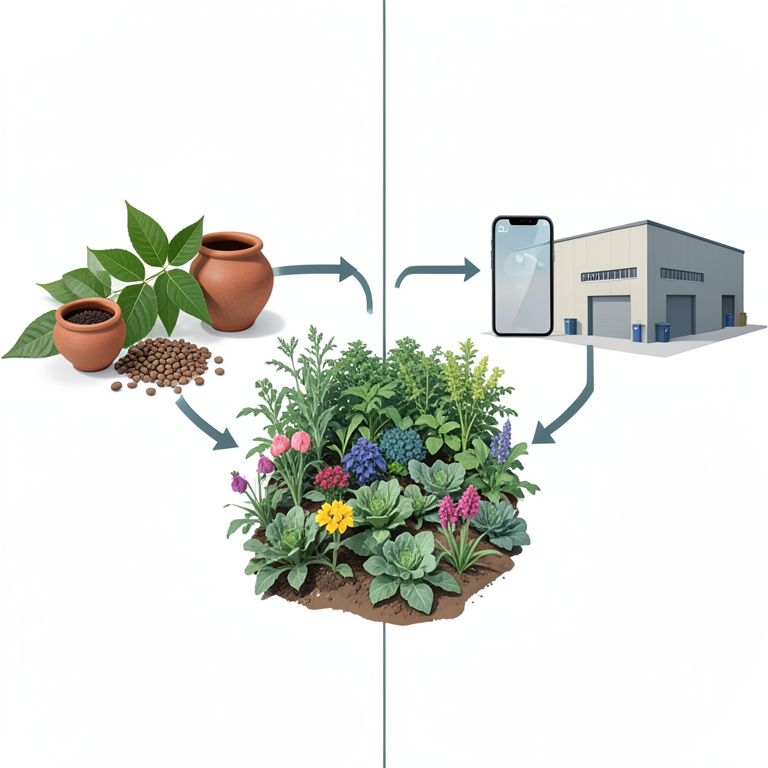
Integrated Risk Management Framework
AI-generated conceptual illustration (Vegetable crops in a small-scale farm setting in Bihar, India). It explains the idea and does not show study data.
View source evidence ↗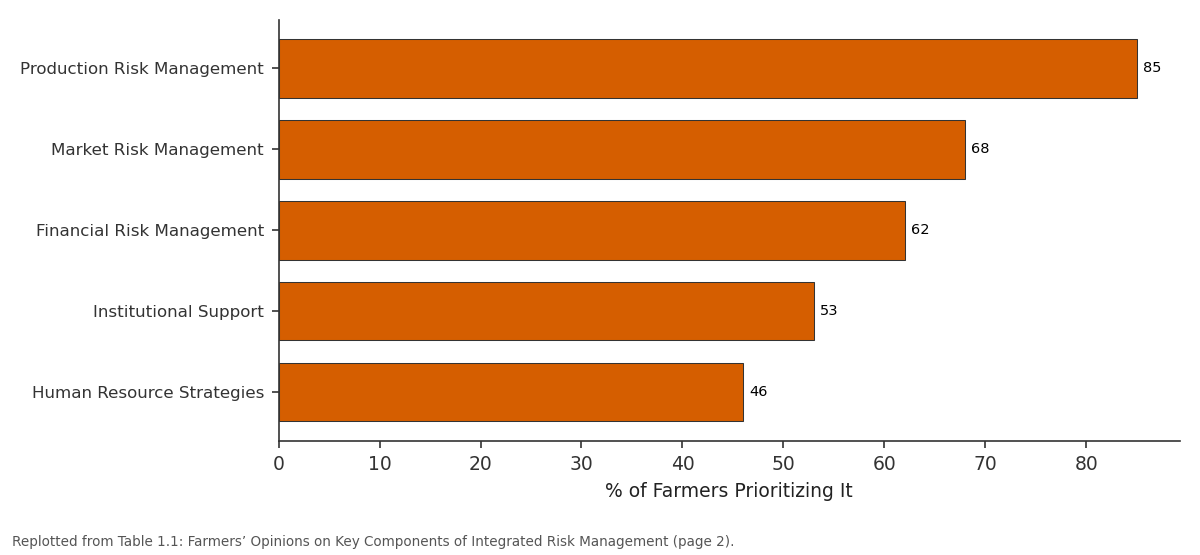
% of Farmers Prioritizing It: Production Risk... vs Market Risk Management vs Financial Risk... vs Institutional Support vs Human Resource...
Replotted from Table 1 (page 2) of the original paper. Every bar is the paper's own table value.
View source evidence ↗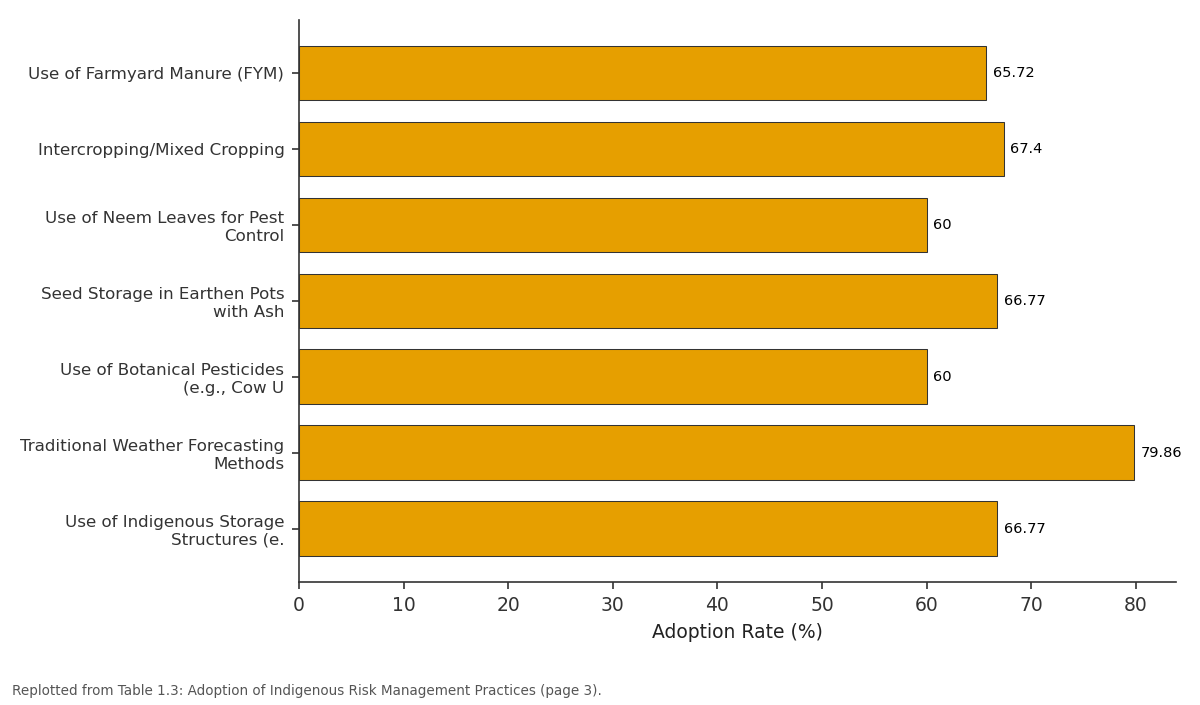
Adoption Rate (%): Use of Farmyard Manure... vs Intercropping/Mixed... vs Use of Neem Leaves for... vs Seed Storage in Earthen... vs Use of Botanical...
Replotted from Table 1 (page 3) of the original paper. Every bar is the paper's own table value.
View source evidence ↗Figures & tables
From the original paper Table 1
 Table 1
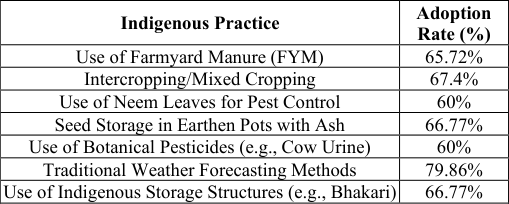 Table 1
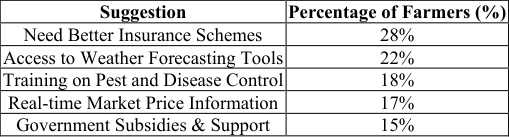 Table 1
Introduction
Indigenous risk management practices have long been integral to small agribusinesses, especially in regions such as the Patna district of Bihar, where agriculture forms the backbone of the local economy. These practices, rooted in traditional knowledge passed down through generations, play a crucial role in mitigating the challenges posed by unpredictable climatic conditions, market fluctuations, and resource constraints. Small agribusinesses in this area, primarily focused on cultivating major vegetables such as tomatoes, potatoes, and brinjals, face numerous risks that can significantly impact farmers’ incomes. The reliance on indigenous methods highlights their adaptability and resilience, enabling farmers to navigate uncertainties while maximizing productivity and profitability.
Agriculture remains the backbone of rural livelihoods in India, and the state of Bihar is no exception. With a significant portion of its population dependent on farming, Bihar’s agricultural sector plays a vital role in ensuring food security, generating employment, and driving rural development. Within this framework, vegetable cultivation has emerged as an important source of income for smallholder farmers, especially in the Patna district, which is known for producing major vegetables such as tomato, brinjal, cauliflower, and potato. However, the sector remains vulnerable to a range of risks including weather variability, pest infestations, price fluctuations, and lack of institutional support.
These risks, if unmanaged, can severely affect the profitability and sustainability of small agri-businesses.
Methodology
The study was conducted in Patna district, Bihar, selected purposively due to its high concentration of small vegetable farmers. One block known for active vegetable cultivation was chosen, and 5% of villages were randomly selected. From these, 10% of farmers involved in vegetable farming were sampled based on landholding size. Primary data was collected through structured interviews using a pre-tested schedule, while secondary data was obtained from government reports and institutional sources.
Vegetable markets and 10% of NAAS Rating: 4.97 IJAFS 2025; 7(8): 161-164 Bibhu Binod PG Scholar, Department of Agricultural Economics, Naini Agricultural Institute, Sam Higginbottom University of Agriculture Technology & Sciences, Prayagraj, Uttar Pradesh, India Victoria Amit Masih Professor, Department of Agricultural Economics, Naini Agricultural Institute, Sam Higginbottom University of Agriculture Technology & Sciences, Prayagraj, Uttar Pradesh, India Bibhu Binod PG Scholar, Department of Agricultural Economics, Naini Agricultural Institute, Sam Higginbottom University of Agriculture Technology & Sciences, Prayagraj, Uttar Pradesh, India https://www.agriculturaljournals.com market intermediaries were also surveyed. Data collection was completed during the 2024–2025 agricultural year for accurate and timely analysis. 1. Chi-Square Test (χ² Test) Used to examine the relationship between categorical variables such as landholding size and adoption of risk management practices. Formula: χ2 = ∑(Oi – Ei)2/Ei, where, Oi = observed value (actual value) Ei = expected value. 2.
Garrett’s Ranking Technique Used to identify and rank the preferences, constraints, or opinions of farmers. Formula for Percent Position Percent position = 100 (Rij – 0.5)/ Nj Where, Rij = Rank given for the ith variable by jth respondents Nj = Number of variables ranked by jth respondents 3. Market Share Used to estimate the proportion of total market revenue contributed by the farmer or group. • Cf= Cost borne by the farmer • Cmn = Cost borne by each intermediary 5. Mean (Average) Used to calculate average income, yield, or cost across observations.
Formula Mean = Sum of the Observation / No. of Numbers 6. Price Spread Measures the difference between the price received by the producer and the price paid by the consumer. Formula Price spread = (Consumer price - Net price of producer) x 100 Consumer price Consumer price 7. Marketing Margin Calculates the margin earned by intermediaries in the marketing chain.
Formula Marketing margin= {Selling price- (purchase price + Marketing Cost)}
Results And Discussion
The findings highlight the impact of Indigenous Risk Management Practices (IRMPs) on the performance of small-scale vegetable farmers in Patna district. Farmers cultivating tomato, potato, and brinjal have adopted several IRMPs, such as neem-based bio-pesticides, traditional seed storage, organic composting, and mulching. These practices have significantly contributed to increased productivity, reduced input costs, and improved resilience against climate-related risks. The following tables summarize the risk factors, indigenous solutions, and outcomes of timely risk management interventions. 4.
Marketing Cost Measures the total cost incurred in marketing produce from farm to consumer. Formula: C = Cf + Cm1 + Cm2 + Cm3 +. + Cmn Where: • C = Total marketing cost Table 1.1: Farmers’ Opinions on Key Components of Integrated Risk Management Component % of Farmers Prioritizing It Common Practices Used Production Risk Management 85% Use of FYM, intercropping, bio- pesticides, mulching, timely sowing Market Risk Management 68% Cooperative selling, local markets, traditional storage (bhakari, pits) Financial Risk Management 62% Crop insurance (PMFBY), Kisan Credit Card, group seed/fertilizer buying Institutional Support 53% PM-KISAN, soil health cards, extension training Human Resource Strategies 46% Labor-sharing, off-farm jobs, learning from peers Table 1.1 outlines farmers’ perspectives on integrated risk management components. Production risk management is the top priority for 85% of farmers, who use practices like FYM, intercropping, bio-pesticides, mulching, and timely sowing to safeguard yields. About 68% focus on market risk management through cooperative selling, local markets, and traditional storage methods.
| Suggestion | Percentage of Farmers (%) |
|---|---|
| Need Better Insurance Schemes | 28% |
| Access to Weather Forecasting Tools | 22% |
| Training on Pest and Disease Control | 18% |
| Real-time Market Price Information | 17% |
| Government Subsidies & Support | 15% |
Table text extracted from the original PDF; superscript letters are shown inline. The original table image is below.
View original table image
| Indigenous Practice | Adoption Rate (%) |
|---|---|
| Use of Farmyard Manure (FYM) | 65.72% |
| Intercropping/Mixed Cropping | 67.4% |
| Use of Neem Leaves for Pest Control | 60% |
| Seed Storage in Earthen Pots with Ash | 66.77% |
| Use of Botanical Pesticides (e.g., Cow Urine) | 60% |
| Traditional Weather Forecasting Methods | 79.86% |
| Use of Indigenous Storage Structures (e.g., Bhakari) | 66.77% |
Table text extracted from the original PDF; superscript letters are shown inline. The original table image is below.
View original table image
| Institution/Cooperation | Key Role in Risk Management |
|---|---|
| FPOs (Farmer Producer Orgs) | Collective input purchase, shared machinery, direct market access |
| Agricultural Insurance (PMFBY) | Compensation for crop loss due to weather or pests |
| Primary Agricultural Credit Societies (PACS) | Credit support and fertilizer distribution |
| Horticulture Cooperatives | Specialized training and infrastructure for vegetable growers |
| Self Help Groups (SHGs) | Micro-loans, savings support, and knowledge sharing |
| NGO Collaborations | Capacity-building, awareness campaigns, digital advisory services |
Table text extracted from the original PDF; superscript letters are shown inline. The original table image is below.
View original table image
| Component | % of Farmers Prioritizing It | Common Practices Used |
|---|---|---|
| Production Risk Management | 85% | Use of FYM, intercropping, bio- pesticides, mulching, timely sowing |
| Market Risk Management | 68% | Cooperative selling, local markets, traditional storage (bhakari, pits) |
| Financial Risk Management | 62% | Crop insurance (PMFBY), Kisan Credit Card, group seed/fertilizer buying |
| Institutional Support | 53% | PM-KISAN, soil health cards, extension training |
| Human Resource Strategies | 46% | Labor-sharing, off-farm jobs, learning from peers |
Table text extracted from the original PDF; superscript letters are shown inline. The original table image is below.
View original table image
Financial risk management, prioritized by 62%, includes crop insurance (PMFBY), Kisan Credit Cards, and group input purchases. Institutional support (53%) involves schemes like PM-KISAN and training programs, while 46% adopt labor-sharing, off-farm work, and peer learning to manage risks effectively. Table 1.2: Highlighting the role of various organizations in managing agricultural risks Institution/Cooperation Key Role in Risk Management FPOs (Farmer Producer Orgs) Collective input purchase, shared machinery, direct market access Agricultural Insurance (PMFBY) Compensation for crop loss due to weather or pests Primary Agricultural Credit Societies (PACS) Credit support and fertilizer distribution Horticulture Cooperatives Specialized training and infrastructure for vegetable growers Self Help Groups (SHGs) Micro-loans, savings support, and knowledge sharing NGO Collaborations Capacity-building, awareness campaigns, digital advisory services https://www.agriculturaljournals.com Table 1.2 highlights the vital roles of various organizations in managing agricultural risks. Farmer Producer Organizations (FPOs) support collective input purchases, machinery use, and direct market access.
PMFBY provides crop loss compensation. PACS offer credit and fertilizer access. Horticulture cooperatives give specialized training and infrastructure. SHGs assist with micro-loans, savings, and shared knowledge, while NGOs enhance farmer capacity through awareness programs and digital advisory services, strengthening resilience and productivity.
Table 1.3: Adoption of Indigenous Risk Management Practices Among Small Vegetable Farmers in Patna, Bihar Indigenous Practice Adoption Rate (%) Use of Farmyard Manure (FYM) 65.72% Intercropping/Mixed Cropping 67.4% Use of Neem Leaves for Pest Control 60% Seed Storage in Earthen Pots with Ash 66.77% Use of Botanical Pesticides (e.g., Cow Urine) 60% Traditional Weather Forecasting Methods 79.86% Use of Indigenous Storage Structures (e.g., Bhakari) 66.77% Source: (Indian Journal of Extension Education,2020) Table 1.3 shows high adoption of indigenous risk practices among Patna's small vegetable farmers. Traditional weather forecasting (79.86%) leads, followed by intercropping (67.4%) and earthen pot seed storage (66.77%). FYM use (65.72%), bhakari storage (66.77%), neem-based pest control (60%), and botanical pesticides (60%) also play key roles in managing risks effectively. Table 1.4: Improving Agricultural Risk Management Practices in Bihar schemes, and 22% seek improved access to weather forecasting tools.
The findings underline that combining traditional knowledge with formal institutional mechanisms can significantly enhance efficiency, productivity, and profitability. Policies should focus on scaling these practices through FPOs, SHGs, and mobile technology to strengthen adaptive capacity and secure farmer incomes. Thus, an integrated approach is essential to build a sustainable, risk- resilient agricultural system in Bihar.
Conclusion
The study reveals that Indigenous Risk Management Practices (IRMPs) play a vital role in improving farm resilience and income among small-scale vegetable growers in Patna district, Bihar. For instance, 79.86% of farmers use traditional weather forecasting methods, and over 66% rely on seed storage in earthen pots with ash and indigenous structures like bhakari. Intercropping and mixed cropping are practiced by 67.4% of farmers, helping manage pest outbreaks and optimize land use. Institutional support also plays a key role, with 62% of farmers benefiting from financial tools like crop insurance (PMFBY) and Kisan Credit Cards, while 53% access government schemes such as PM-KISAN and extension training.
Despite these strengths, 28% of farmers still demand better insurance https://www.agriculturaljournals.com 18. Ministry of Agriculture & Farmers Welfare, Agricultural Census 2021 19. Bihar Agriculture Management & Extension Training Institute (BAMETI) 20. Patna District Agriculture Office Reports 2021-2023
References
17 in the original paper- Hassan A, Farooq A, Ishaq M, Sadiq G, Nawaz A. Risk and coping strategies of vegetable smallholder farmers in Khyber Pakhtunkhwa of Pakistan. Sarhad J Agric. 2023 May;39(2).
- Kehinde AD, Ogundeji AA. Distributive impacts of non-farm income on output and farm income of cassava farmers in Southwestern Nigeria; 2023.
- Boakye AA. Indigenous risk management practices and their effects on small agribusiness firm growth amid economic crisis in Ghana. 2024, ISSN: 2468-2276.
- Senapati AK. Weather effects and their long-term impact on agricultural yields in Odisha, East India. 2020.
- Baskaran V. Marketing problems of agricultural products in Villupuram district. 2020.
- Panyukov DI, Kozlovskii VN. The cost-effectiveness of Failure Mode and Effects Analysis (FMEA) in technical risk management. 2022.
- Barratt J, Kath J, Mushtaq S, Collins B, Chenu K, Christopher J, et al. Strategic use of index-based frost insurance to reduce financial risk and improve income stability for wheat producers in Australia. 2025.
- Kazzaz L. The art and science of opportunity identification: A strategic approach to business growth. 2024.
- Birthal PS, Hazrana J, Negi DS. Effectiveness of farmers’ risk management strategies in smallholder agriculture: Evidence from India. Agric Econ Res Rev. 2021;169:Article number 30.
- Roger. What are the six steps in opportunity identification process. 2024.
- Kaplan RS, Leonard HB, Mikes A. The risks you can’t foresee: What to do when there’s no playbook. Harvard Bus Rev. 2020.
- Sethumadhavan R, Prasad AB, Sindhu K, Santosh, Rao DS, Dhanasekaran P, Mishra I. A critical note on evaluating risk management strategies tailored to the unique challenges faced by small-scale farmers. 2023.
- Jahan SA. Utilizing predictive analytics and machine learning for enhanced project risk management and resource optimization. 2024.
- Apaloo S, Dzah B. The effect of risk management practices on performance of small and medium scale enterprises. Enterp Risk Manag. 2022;7(1):149–160.
- Shang Y, Xiong T. The impact of farmers’ assessments of risk management strategies on their adoption willingness. 2021.
- Kanwal V, Sirohi S. Addressing agricultural income risks in India: Efficacy of risk management options in hazard-prone regions. [Document title: Microsoft Word - 0178]; 2022.
- Indian Journal of Extension Education,2020 Suggestion Percentage of Farmers (%) Need Better Insurance Schemes 28% Access to Weather Forecasting Tools 22% Training on Pest and Disease Control 18% Real-time Market Price Information 17% Government Subsidies & Support 15% Table 1.4 highlights farmers’ suggestions to strengthen agricultural risk management in Bihar. About 28% demand better insurance schemes, while 22% seek improved access to weather forecasting tools. Another 18% emphasize training on pest and disease control. Real-time market price updates (17%) and increased government subsidies and support (15%) are also seen as essential for reducing risk and improving farm income.