
Research article · 2025 · Full text
International Journal of Agriculture and Food ScienceRole of recent improved breeding methods in crop improvement in India
Volume 7(8) · Pages 119–122 · DOI: 10.33545/2664844x.2025.v7.i8b.601 ↗
Research areasAgricultural Economics and PracticesGenetics and Plant BreedingAgricultural pest management studies
Abstract
Author-writtenIndia, with its vast population and diverse agro-climatic zones, faces the challenge of ensuring food security amidst climate change, shrinking arable land, and increasing biotic and abiotic stresses. Recent advances in plant breeding methods, including genomic-assisted breeding, speed breeding, CRISPR/Cas9 genome editing, and marker-assisted selection, have revolutionized crop improvement. These techniques have accelerated the development of high-yielding, stress-tolerant, and nutritionally enhanced crop varieties. This paper reviews the role of these improved breeding methods in enhancing crop productivity in India, with a focus on recent examples such as heat-tolerant pigeonpea, drought-resistant wheat, and biofortified rice. The integration of these technologies with conventional breeding, their impact on Indian agriculture, and the challenges of adoption are discussed, along with future prospects for sustainable crop improvement.
Summary
Source-checkedPlain-language reading of the full paper, prepared with AI and checked against the text. Each point links to the authors' own words.
Why it matters
- Agriculture is a critical pillar of the Indian economy, providing support for more than half of the country's population. View evidence ↗
- India needs to double its agricultural productivity to feed a projected population of 1.7 billion by 2050, while facing environmental threats like soil degradation and water scarcity. View evidence ↗
- Conventional breeding methods used during the Green Revolution are now considered too slow and limited by a lack of genetic diversity. View evidence ↗
The question
- The paper aims to review how modern breeding methods enhance crop productivity in India, specifically examining heat-tolerant pigeonpea, biofortified rice, and drought-resistant wheat. View evidence ↗
What they did
- The review focuses on several advanced technologies: genomic-assisted breeding (GAB), speed breeding (SB), marker-assisted selection (MAS), and CRISPR/Cas9 genome editing. View evidence ↗
- Genomic-assisted breeding improves efficiency by using tools such as GWAS, QTL mapping, and molecular markers to move from phenotype-based to genotype-based selection. View evidence ↗
- Speed breeding increases the number of crop generations per year by optimizing photoperiod, temperature, and light. View evidence ↗
What they found
- Using speed breeding, the ICPV 25444 pigeonpea variety was developed in 5 years instead of 15; it can ripen in 125 days and withstand temperatures of 45 °C. View evidence ↗
- The ICPV 25444 variety increases profitability by USD 234/ha and helps address a 1.5 million-ton pigeonpea imbalance, potentially reducing imports by USD 800 million. View evidence ↗
- The Swarna-Sub1 rice variety, created via marker-assisted selection, can survive submergence for 14 days and increases yields by 1–3 t/ha in flood-prone areas. View evidence ↗
- Mutation breeding produced the Trombay Groundnut variety, which is resistant to rust and leaf spot and has increased yields by 15–20% in Maharashtra and Gujarat. View evidence ↗
- CRISPR/Cas9 has been used to create biofortified golden rice by editing genes to increase carotenoid accumulation, targeting vitamin A deficiency. View evidence ↗
- The Indian Agricultural Research Institute used GAB and MAS to develop the drought-tolerant wheat varieties HD 3086 and HD 2967. View evidence ↗
What it means
- The authors conclude that strategic policy support and investments in these breeding technologies are essential for sustainable agricultural growth and resilience in India. View evidence ↗
- Adoption is hindered by stringent regulations for genome-edited crops and a lack of advanced infrastructure, such as high-throughput genotyping platforms, in public institutions. View evidence ↗
Visual summary
1 visualsIllustrations explain the paper; they do not show study data.
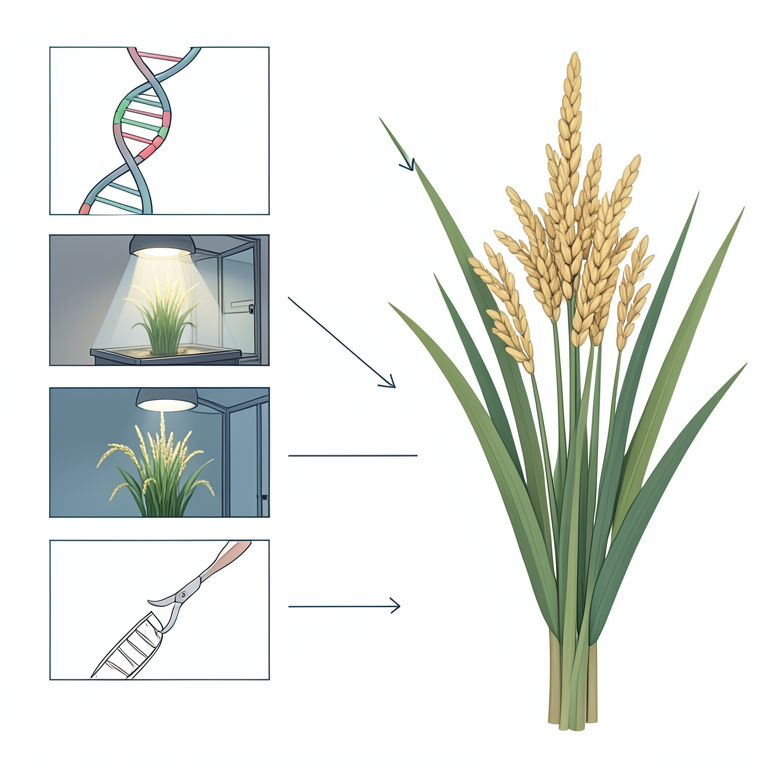
Modern Breeding Toolkit
AI-generated conceptual illustration (Rice plants (Oryza sativa)). It explains the idea and does not show study data.
View source evidence ↗Introduction
Agriculture is the backbone of India's economy, supporting over 50% of its population and contributing significantly to GDP. With a projected population of 1.7 billion by 2050, India must double its agricultural productivity to meet food demands while addressing challenges like climate change, water scarcity, and soil degradation (Godfray et al., 2010) [4] . Traditional breeding methods, while effective during the Green Revolution, are time-consuming and limited by genetic diversity constraints. Recent advancements in breeding technologies, such as genomic-assisted breeding (GAB), speed breeding (SB), and genome editing, have transformed crop improvement by enabling precise, rapid, and efficient trait selection (Varshney et al., 2021) [16] . These methods have been instrumental in developing climateresilient, high-yielding, and nutritionally superior crop varieties in India. This paper explores the role of these improved breeding methods, highlights recent examples, and evaluates their impact on Indian agriculture.
Recent Improved Breeding Methods
Recent Improved Breeding Methods
Genomic-Assisted Breeding (GAB)
GAB integrates genomic tools like molecular markers, quantitative trait loci (QTL) mapping, and genome-wide association studies (GWAS) to enhance breeding efficiency. It shifts from phenotype-based to genotype-based selection, reducing breeding cycles and improving precision (Mangal et al., 2024) [7] In India, GAB has been widely adopted for crops like rice, wheat, and pulses. For instance, marker-assisted selection (MAS) has been used to introgress drought tolerance genes into rice varieties like IR64 and Swarna (Swamy et al., 2021 and Kumar et al., 2024) [15,5] . Similarly, GWAS identified QTLs for blast resistance in rice, enabling the development of resistant varieties (Kumar et al., 2024) [5] .
Speed Breeding (SB)
SB accelerates crop generation cycles by optimizing environmental conditions like light, temperature, and photoperiod, allowing multiple generations per year (Potts et al., 2023) [10] . In India, SB has been pivotal in developing climate-resilient varieties. For example, the International Crops Research Institute for the Semi-Arid Tropics (ICRISAT) used SB to develop the world's first extreme heat-tolerant pigeonpea, enhancing resilience in semi-arid regions. SB is often integrated with GAB and gene editing to further expedite breeding programs.
CRISPR/Cas9 Genome Editing
CRISPR/Cas9 enables precise modifications in crop genomes, targeting traits like yield, stress tolerance, and nutritional quality (Nerkar et al., 2022) [9] . Unlike transgenic methods, CRISPR-edited crops are often free of foreign DNA, easing regulatory hurdles. In India, CRISPR has been used to enhance rice nutritional content by editing genes for carotenoid accumulation, resulting in biofortified golden rice (Dong et al., 2020) [2] . Additionally, CRISPR-edited wheat varieties with improved disease resistance are under development (Nerkar et al., 2022) [9] .
Marker-Assisted Selection (MAS)
MAS improves breeding accuracy for complex traits like disease and drought tolerance by using molecular markers to select desired features (Kumar et al., 2024) [5] . According to Neeraja et al. (2007) [8] , MAS has played a crucial role in the development of flood-tolerant rice varieties in India, such as Swarna-Sub1, which carries the SUB1 gene for submergence resistance. MAS is commonly used in public sector breeding programs and is reasonably priced (Yadav and Das, 2024) [17] .
Mutation Breeding: Using chemical or physical mutagens, mutation breeding creates genetic variety to
improve qualities like stress tolerance and yield. The Bhabha Atomic Research Centre (BARC) in India has created more than 50 mutant varieties, such as the highly productive Trombay Groundnut and Trombay Mung mungbean, which are more resistant to disease (Raina et al., 2016) [11] .
Recent Examples of Crop Improvement in India 3.1 Heat-Tolerant Pigeonpea
ICRISAT's speed breeding program developed an extreme heat-tolerant pigeonpea variety, addressing yield losses in India's semi-arid tropics. By accelerating generation cycles under controlled conditions, this variety was released in record time, boosting farmer resilience against rising temperatures. The world's first heat-tolerant pigeonpea cultivar, ICPV 25444, was created by ICRISAT and can endure summer temperatures of 45 °C while ripening in 125 days. It has been tested in Telangana, Odisha, and Karnataka and produces 2 tons per hectare, allowing for year-round agriculture. Researchers grew four generations a year by cutting the variety development time from 15 to 5 years using a ground-breaking speed-breeding methodology. This innovation reduces imports by USD 800 million and solves India's 1.5 million-ton pigeonpea imbalance. ICPV 25444 promotes both horizontal and vertical growth, increasing profitability by USD 234/ha, especially in summer fields and rice fallows, and transforming Indian agriculture (Anonymous, 2025) [1] .
Drought-Resistant Wheat
Using MAS and GAB, the Indian Agricultural Research Institute (IARI) developed drought-tolerant wheat varieties like HD 2967 and HD 3086. These varieties carry QTLs for root architecture and water-use efficiency, ensuring stable yields under water-limited conditions (Sundaram et al., 2019) [14] .
Biofortified Rice
CRISPR/Cas9 was used to enhance the nutritional quality of rice by increasing carotenoid content, addressing vitamin A deficiency in India. The resulting golden rice variety is under regulatory evaluation and promises to improve public health (Dong et al., 2020) [1] .
Flood-Tolerant Rice
The Swarna-Sub1 rice variety, developed through MAS, has transformed rice farming in flood-prone eastern India. The SUB1 gene confers submergence tolerance for up to 14 days, increasing yields by 1-3 t/ha in affected areas (Neeraja et al., 2007) [8] .
Disease-Resistant Groundnut
Mutation breeding at BARC produced the Trombay Groundnut variety with resistance to leaf spot and rust diseases. This variety has improved yields by 15-20% in Gujarat and Maharashtra (Raina et al., 2016) [11] .
Impact on Indian Agriculture 4.1 Enhanced Productivity
Improved breeding methods have significantly increased crop yields. For instance, Swarna-Sub1 rice has boosted productivity in flood-prone regions, while drought-tolerant wheat varieties have stabilized yields in rainfed areas (Sundaram et al., 2019) [14] . These gains are critical for meeting India's food security goals.
Climate Resilience
Climate-resilient varieties like heat-tolerant pigeonpea and drought-resistant wheat have reduced yield losses due to abiotic stresses. These varieties are vital for adapting to India's diverse agro-climatic zones, where extreme weather events are increasingly common (Fels et al., 2019) [3] .
Nutritional Security
Biofortified crops like golden rice address micronutrient deficiencies, improving public health outcomes. Such interventions align with India's National Nutrition Mission, targeting malnutrition in vulnerable populations (Dong et al., 2020) [2] .
Economic Benefits
High-yielding and stress-tolerant varieties have increased farmer incomes by reducing input costs and stabilizing yields. For example, Trombay Groundnut has lowered fungicide use, enhancing profitability for smallholder farmers (Raina et al., 2016) [11] .
Challenges in Adoption 5.1 Regulatory Hurdles
Genome-edited crops face stringent regulations in India, delaying commercialization. While SDN-1 and SDN-2 edited plants are exempt from biosafety regulations, public acceptance remains a challenge (Nerkar et al., 2022) [9] . Clear policies are needed to streamline approvals.
Infrastructure Limitations
SB and GAB require advanced facilities like controlled environment chambers and high-throughput genotyping platforms, which are limited in India's public sector institutions (Potts et al., 2023) [10] . Investments in infrastructure are essential for scaling these technologies.
Capacity Building
The adoption of advanced breeding methods demands skilled personnel. Training programs for breeders and extension workers are critical to bridge the knowledge gap (Potts et al., 2023) [10] .
Socio-Economic Barriers
Smallholder farmers, who dominate Indian agriculture, face financial constraints in accessing improved varieties and technologies. Subsidies and public-private partnerships can enhance affordability and dissemination.
Future Prospects
The integration of SB, GAB, and CRISPR/Cas9 with artificial intelligence (AI) and high-throughput phenotyping offers immense potential for crop improvement. AI can predict breeding outcomes, while phenotyping platforms can accelerate trait identification (Sun et al., 2024) [13] . India should prioritize investments in research, infrastructure, and policy frameworks to harness these technologies. Publicprivate collaborations and participatory breeding approaches can enhance farmer adoption and ensure equitable benefits. Additionally, leveraging India's rich genetic diversity through gene banks can fuel future breeding programs.
Conclusion
Recent improved breeding methods have revolutionized crop improvement in India, addressing challenges of food security, climate change, and nutritional deficiencies. Techniques like GAB, SB, CRISPR/Cas9, MAS, and mutation breeding have delivered high-yielding, stress-tolerant, and biofortified varieties, with notable examples including heat-tolerant pigeonpea, drought-resistant wheat, and golden rice. Despite their transformative impact, challenges like regulatory hurdles, infrastructure limitations, and socio-economic barriers must be addressed to scale adoption. With strategic investments and policy support, these technologies can drive sustainable agricultural growth, ensuring India's resilience in a rapidly changing world.
References
17 in the original paper- Anonymous. Breakthrough at ICRISAT: World's first extreme heat-tolerant pigeonpea developed via speed breeding [Internet]. ICRISAT; 2025 [cited 2025 Aug 5]. Available from: https://pressroom.icrisat.org/breakthrough-at-icrisatworlds-first-extreme-heat-tolerant-pigeonpeadeveloped-via-speed-breeding
- Dong OX, Yu S, Jain R, Zhang N, Duong PQ, Butler C. Marker-free carotenoid-enriched rice generated through targeted gene insertion using CRISPR-Cas9. Nat Commun. 2020;11:1178. https://doi.org/10.1038/s41467-020-14981-y International Journal of Agriculture and Food Science https://www.agriculturaljournals.com
- Fels KPV, Stahl A, Hickey LT. Modern crop breeding for future food security. BMC Biol. 2019;17(18):2-7.
- Godfray HCJ, Beddington JR, Crute IR, Haddad L, Lawrence D, Muir JF. Food security: The challenge of feeding 9 billion people. Science. 2010;327(5967):812818. https://doi.org/10.1126/science.1185383
- Kumar R, Bhandari S, Sarita, Gayathri PM. Effect of heat stress on wheat production in semi-arid region of Rajasthan. AGBIR. 2024;40(4):1210-1213.
- Kumar R, Das SP, Choudhury BU, Kumar A, Prakash NR, Verma R, et al. Advances in genomic tools for plant breeding. Biol Res. 2024;57:1-23.
- Mangal V, Verma LK, Singh SK, Saxena N, Roy A, Karn A, et al. Triumphs of genomic-assisted breeding in crop improvement. Heliyon. 2024;10:1-16.
- Neeraja CN, Maghirang-Rodriguez R, Pamplona A, Heuer S, Collard BCY, Septiningsih EM. A markerassisted backcross approach for developing submergence-tolerant rice cultivars. Theor Appl Genet. 2007;115(6):767-776. https://doi.org/10.1007/s00122007-0607-0
- Nerkar G, Devarumath S, Purankar M, Kumar A, Valarmathi R, Devarumath R, Appunu C. Advances in crop breeding through precision genome editing. Front Genet. 2022;13:1-14.
- Potts J, Jangra S, Michael VN, Wu X. Speed breeding for crop improvement and food security. Crops. 2023;3(4):276-291.
- Raina A, Laskar RA, Khursheed S, Amin R, Tantray YR, Parveen K, Khan S. Role of mutation breeding in crop improvement: Past, present and future. Asian Res J Agric. 2016;2(2):1-13. https://doi.org/10.9734/ARJA/2016/29334
- Serres JB, Parker JE, Ainsworth EA, Oldroyd GED, Schroeder JI. Genetic strategies for improving crop yields. Nature. 2019;575(7781):109-118.
- Sun L, Lai M, Ghouri F, Nawaz MA, Ali F, Baloch FS, et al. Modern plant breeding techniques in crop improvement and genetic diversity. Plants. 2024;13:132.
- Sundaram RM, Vishnupriya MR, Laha GS, Balachandran SM, Reddy GA, Viraktamath BC. Markerassisted breeding for development of improved rice varieties in India. Plant Breed Rev. 2019;42:189-226.
- Swamy BPM, Rahman MA, Inabangan-Asilo MA, Amparado A, Manito C, Chadha-Mohanty P. Advances in breeding for drought tolerance in rice. Plant Breed Rev. 2021;45:279-328. https://doi.org/10.1002/9781119828228.ch8
- Varshney RK, Bohra A, Yu J, Graner A, Zhang Q, Sorrells ME. Designing future crops: Genomics-assisted breeding comes of age. Trends Plant Sci. 2021;26(6):631-649. https://doi.org/10.1016/j.tplants.2021.03.010
- Yadav MK, Das J. Breeding strategies for vegetable improvement: An extensive analysis. J Biodivers Environ Sci. 2024;24(3):27-36.