
Research article · 2025 · Full text
International Journal of Horticulture and Food ScienceInfluence of jeevamrut and waste decomposer under different methods of application and fertility levels on growth, yield and quality of tomato
Volume 7(8) · Pages 06–12 · DOI: 10.33545/26631067.2025.v7.i8a.359 ↗
Research areasHumic Substances and Bio-Organic StudiesPowdery Mildew Fungal DiseasesPhytochemical and Pharmacological Studies
Abstract
Author-writtenThe present investigation entitled “Influence of Jeevamrut and waste decomposer under different methods of application and fertility levels on growth yield and quality of tomato” was carried out during kharif season with total twelve treatments and three replications. Result revealed that, among various liquid organic substances, o1 (4% Jeevamrut) recorded significantly maximum plant height (73.84 and 122.60 cm) at 45 and 90 DAT, respectively, number of branches per plant (25.62), days to last picking (177.51), whereas minimum days to first flowering (40.37), days to first picking (86.90) and days taken from flowering to edible maturity (44.05). In case of yield and quality attributes, the significantly maximum average fruit weight (93.12 g), yield per plant (2.22 kg), yield per plot (18.45 kg) and yield per hectare (379.65 q), maximum fruit volume (95.31 cc), total soluble solids (4.70 0Brix), ascorbic acid (28.65 mg/100g), chlorophyll a (0.24 mg/g), chlorophyll b (0.13 mg/g) and total chlorophyll (0.35 mg/g) were reported in plants treated with o1 (4% Jeevamrut). Amongst the methods of application, significantly maximum plant height (123.11 cm) at 90 DAT, early flowering (40.20 days), maximum average fruit weight (90.80 g), yield per plant (2.23 kg), yield per plot (19.03 kg), yield per hectare (391.46 q), total soluble solids (4.72 0Brix), ascorbic acid (28.95 mg/100g), chlorophyll a (0.24 mg/g), chlorophyll b (0.13 mg/g) and total chlorophyll (0.36 mg/g) content were found with treatment m3 i.e. drenching at 30, 60 & 90 DAT + foliar spray at 15, 45 & 75 DAT. Supplementation of 100% RDF gave maximum plant height (72.23 and 121.99 cm) at 45 and 90 DAT, respectively, number of branches per plant (25.28), days to last picking (173.60), early flowering (40.60 days), early picking (89.13 days), days taken from flowering to edible maturity (45.51), maximum average fruit weight (90.14 g), yield per plant (2.18 kg), yield per plot (18.47 kg), yield per hectare (380.60 q), fruit volume (91.22 cc), total soluble solids (4.68 0Brix), ascorbic acid (28.61 mg/100g), chlorophyll a (0.23 mg/g), chlorophyll b (0.13 mg/g) and total chlorophyll (0.36 mg/g) content.
Summary
Source-checkedPlain-language reading of the full paper, prepared with AI and checked against the text. Each point links to the authors' own words.
Why it matters
- Tomato is a globally grown, versatile vegetable crop that is second only to potato in importance. View evidence ↗
- The excessive use of chemical pesticides, fungicides, and fertilizers has led to the deterioration of soil health. View evidence ↗
- Liquid organic amendments derived from cow products, such as Jeevamrut, provide eco-friendly and affordable nutrient sources. View evidence ↗
The question
- The study aimed to evaluate how different fertility levels and application methods of Jeevamrut and waste decomposer influence the growth, yield, and quality of tomatoes. View evidence ↗
What they did
- The research was conducted during the 2019-20 kharif season at the College Farm in Jagudan, Gujarat. View evidence ↗
- The study used twelve treatments across three factors: liquid organic substances (4% Jeevamrut or 40% Waste decomposer), application methods (drenching, foliar spray, or both), and fertility levels (100% or 80% Recommended Dose of Fertilizer). View evidence ↗
- The experiment followed a factorial Randomized Block Design with three replications. View evidence ↗
What they found
- Among organic substances, 4% Jeevamrut produced the highest plant height (73.84 cm at 45 DAT and 122.60 cm at 90 DAT) and the most branches per plant (25.62). View evidence ↗
- The combined application of drenching and foliar spray (m3) resulted in the highest yield per hectare (391.46 q), highest plant height at 90 DAT (123.11 cm), and superior quality markers including ascorbic acid (28.95 mg/100g) and total chlorophyll (0.36 mg/g). View evidence ↗
- 4% Jeevamrut produced significantly heavier fruits (93.12 g) compared to the 40% Waste decomposer treatment (80.56 g). View evidence ↗
- 4% Jeevamrut increased the quality of the fruit, recording the highest total soluble solids (4.70 0Brix) compared to the waste decomposer (4.48 0Brix). View evidence ↗
- Treatment with 4% Jeevamrut resulted in the highest ascorbic acid content (28.65 mg/100g), while the waste decomposer resulted in the lowest (27.78 mg/100g). View evidence ↗
What it means
- The authors conclude that the most effective combination for enhancing tomato growth, yield, and quality is 4% Jeevamrut applied via both drenching and foliar spray, combined with 100% RDF. View evidence ↗
Visual summary
3 visualsIllustrations explain the paper; charts are replotted from the paper's own table values.
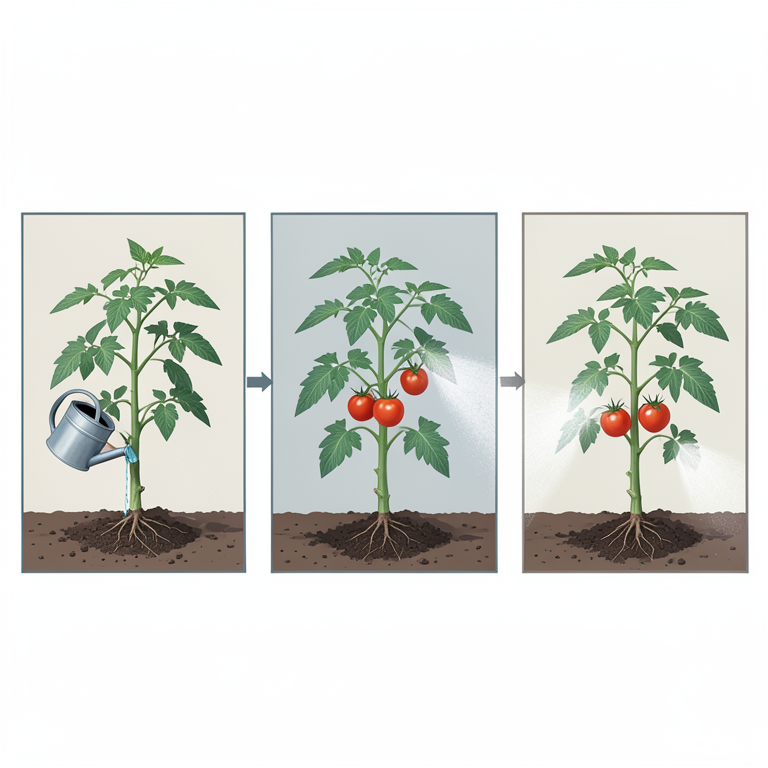
Experimental Factor Matrix
AI-generated conceptual illustration (tomato plants). It explains the idea and does not show study data.
View source evidence ↗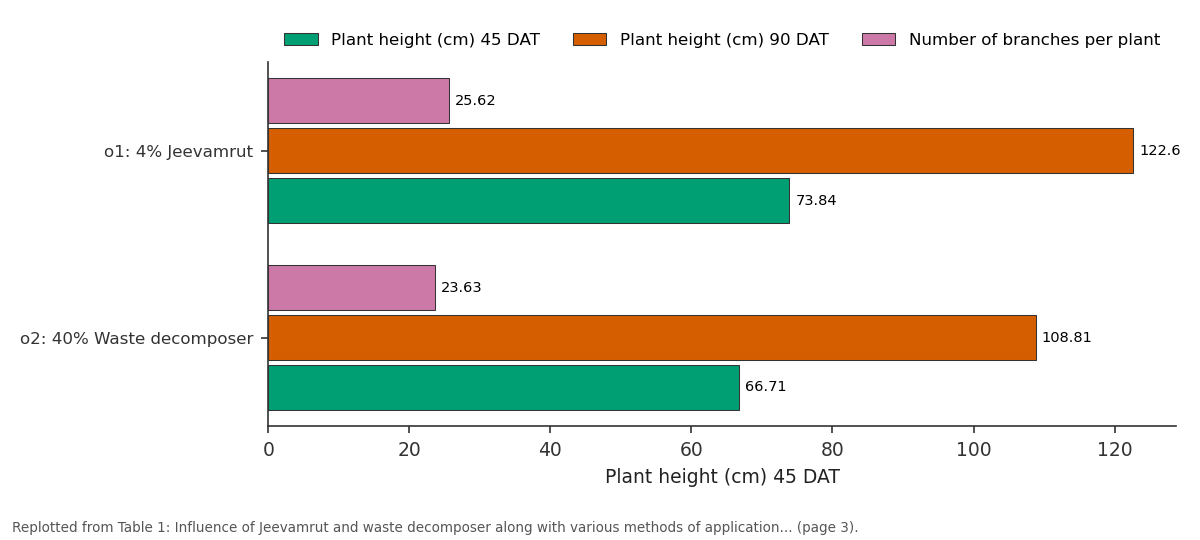
Plant height (cm) 45 DAT and Plant height (cm) 90 DAT and more: o1: 4% Jeevamrut vs o2: 40% Waste decomposer
Replotted from Table 1 (page 3) of the original paper. Every bar is the paper's own table value.
View source evidence ↗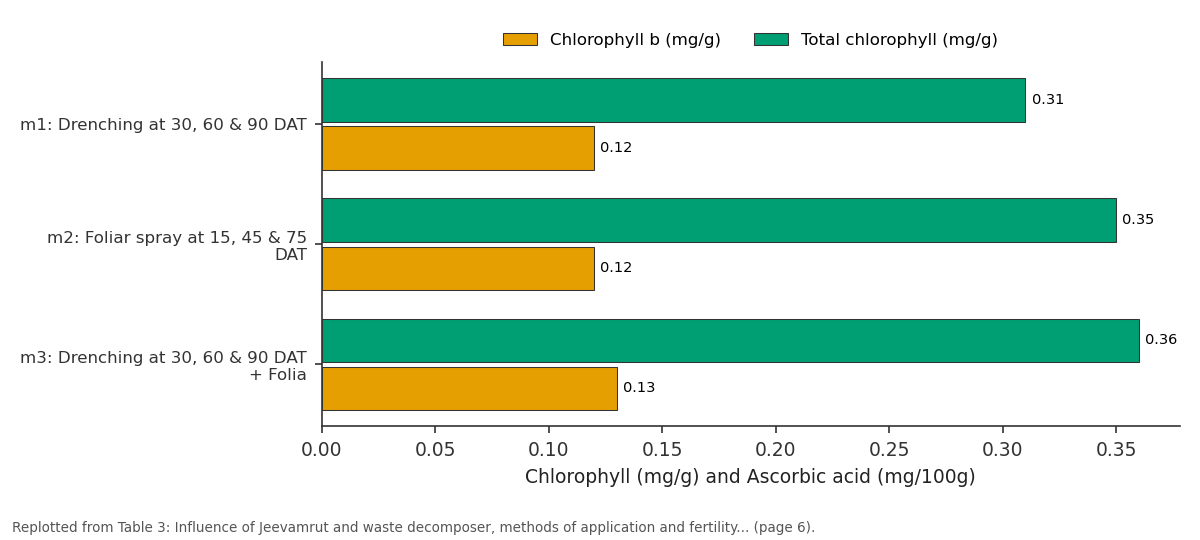
Chlorophyll b (mg/g) and Total chlorophyll (mg/g): m1: Drenching at 30, 60... vs m2: Foliar spray at 15... vs m3: Drenching at 30, 60...
Replotted from Table 3 (page 6) of the original paper. Every bar is the paper's own table value.
View source evidence ↗Figures & tables
From the original paper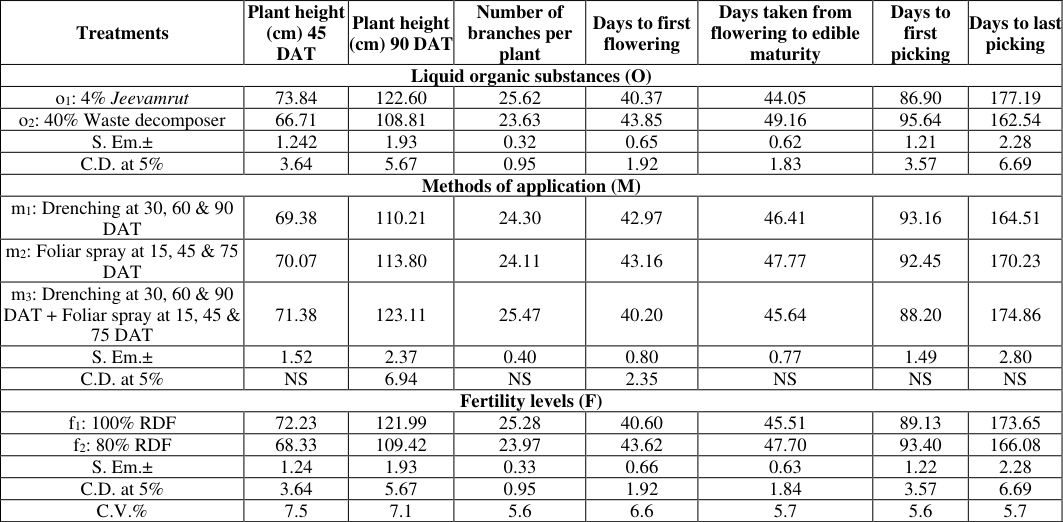 Table 1
 Table 2
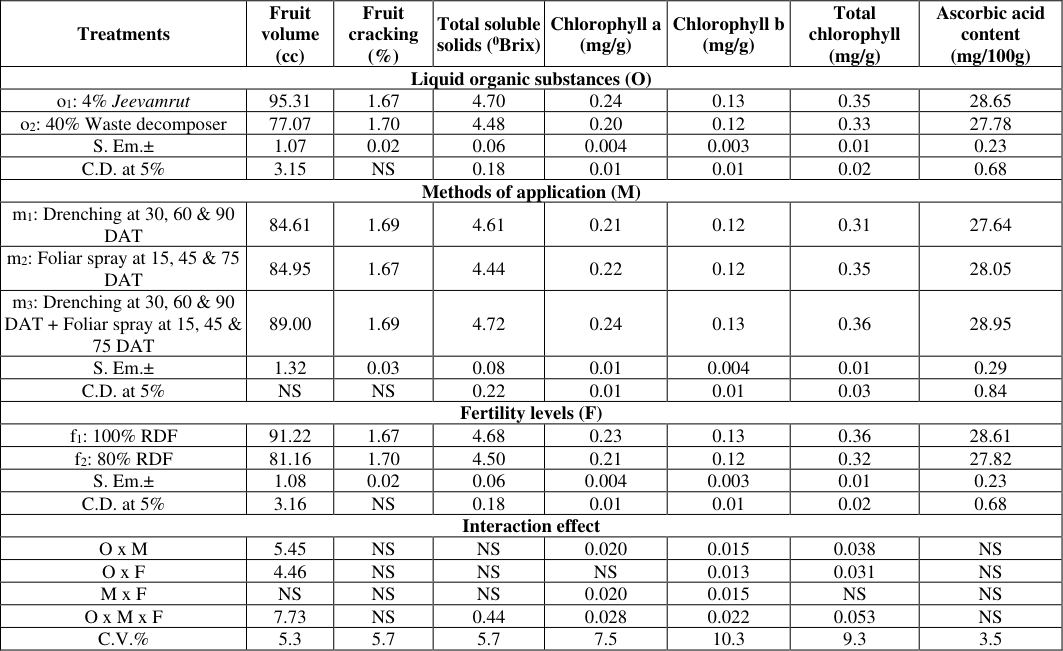 Table 3
Introduction
India has diverse climate which ensures the availability of all kinds of fresh vegetables. It ranks second in vegetable production in the world after China. Tomato (Solanum lycopersicum L.) is versatile vegetable crop grown globally and ranks second in importance after potato. From nutritional point of view tomato is popularly known as "The Poor man's Apple" [25] . In India, tomato has become popular within the last six decades and plays vital role in Indian economy. It is cultivated on 8.14 lakh ha with the total production of 205.14 lakh tonne having productivity of 25.20 tonne per hectare [3] . Large quantities of tomato are used to produce sauce chutney, juice, ketchup, puree, paste and powder besides fresh consumption. Tomato tops in the canned vegetables. The fruit is rich in lycopene, which may have beneficial health effects. The red pigment in tomato i.e. lycopene is now being considered as the "world's most powerful natural antioxidant" [16] . Tomato is nutrient loving crop; out of various management practices the application of fertilizers plays major role for harnessing the optimum yields per unit area. Conventional agriculture has made an adverse impact on soil and plant health. Liberal rash use of chemical fertilizers, pesticides, and fungicides are responsible for deterioration of soil health. This eventually leads to high demand for integrated crop management approach to protect soil and plant health. Cow is playing a vital role in Indian agriculture from centuries and has served as sources of nutrition for farming communities. The various liquid organic amendments viz., Jeevamrut, Panchgavya and Beejamruta etc. made by cow products. These are the cheaper and ecofriendly sources of nutrients. In these liquid manures, beneficial organisms survive and are helpful in phosphate solubilization, nitrogen fixation etc. [12,27] have reported the presence of many beneficial micro-organisms viz., nitrogen fixers, phosphorus solubilizers, actinomycetes and fungi in Panchagavya and Jeevamrut. National Centre of Organic Farming (NCOF), Ghaziabad has developed a waste decomposer culture which is used for quick composting from organic waste, soil health improvement and as plant protection agent. It is a consortium of microorganism extracted from desi cow dung. Farmers can do farming with the use of waste decompose without using chemical fertilizers and pesticides [7] . Very scanty of research work has been reported on these liquid organic substances, so that present investigation was planned and executed entitled "Influence of Jeevamrut and waste decomposer under different methods of application and fertility levels on growth yield and quality of tomato".
Materials and Methods
The present investigation was carried out during kharif season of 2019-20 at College Farm, College of Horticulture, Sardarkrushinagar Dantiwada Agricultural University, Jagudan, Dist. Mehsana, Gujarat. The details of material used and methods adopted during the present investigation in the field as well as in laboratory are briefly described in this chapter. The experiment was carried out with total twelve treatments comprising of three factors viz., liquid organic substances with two levels viz., o 1 (4% Jeevamrut) and o 2 (40% Waste decomposer); methods of application with three levels viz., m 1 (Drenching at 30, 60 & 90 DAT), m 2 (Foliar spray at 15, 45 & 75 DAT) and m 3 (Drenching at 30, 60 & 90 DAT + Foliar spray at 15, 45 & 75 DAT) and two fertility levels viz., f 1 (100% RDF) and f 2 (80% RDF). The experiment was laid out in Factorial Randomized Block Design with three replications. The soil of experimental field was having an even topography with a gentle slope and good drainage. The soil of experimental site is sandy loam in texture with slightly alkaline in reaction, low in organic carbon and available nitrogen, medium in available phosphorus and high in potassium. The pH of the soil is almost neutral and normal in salt content. Tomato cv. "Gujarat Anand Tomato 5" was used for the present study. This is promising one and was released from Main Vegetable Research Station, Anand Agricultural University, Anand in 2017. The seedlings were transplanted at 90 cm × 60 cm in 4.5 m × 3.0 m plots. Recommended dose of fertilizer adopted in tomato was NPK 125:50:50 kg/ha. Well decomposed FYM @ 20 t/ha was applied at the time of field preparation and recommended dose of fertilizer was applied as per treatment. The half dose of nitrogen and full dose of phosphorous and potassium was applied as a basal dose. Remaining half dose of nitrogen was applied as top dressing in two splits i.e. 40 and 70 days after transplanting. Irrigation applied through drip irrigation method having 4 lph dripper.
Preparation of liquid organic substances
In the present investigation, the following organic amendments were prepared freshly as per the procedure of NCOF, Ghaziabad and applied as per the treatments. 1. Jeevamrut: cow dung 10 kg, cow urine 10 liter, jaggary 2 kg, gram flour 2 kg and soil under live tree 1 kg were taken in plastic drum and volume was made up to 200 liters with the addition of water. The drum was kept in the shade and stirred twice in a day and covered it. After one week, Jeevamrut was ready and it was used application as per treatment. 2. Waste decomposer: For the preparation of waste decomposer, jaggary 2 kg was taken in plastic drum and volume was made up to 200 liters with the addition of water. Add 30 g of waste decomposer in a plastic drum containing jaggery solution. Avoided direct contact of contents with hands and mixed it properly with a wooden stick. Covered the drum and stirred it every day once or twice. After 5 days, the solution of the drum turned creamy and then it was used for application as per treatment.
The experiment was laid out in Randomized block design with factorial concept and replicated thrice. The observations were recorded periodically concerning growth, yield and quality parameters of tomato from five plants from each net plot by adopting standard methodology and treatments were analyzed statistically by adopting the standard procedures described by [23] .
Results and Discussion
The experimental results obtained from the present investigation are described as follows. The application of Jeevamrut may have attributed to the faster enhancement of vegetative growth and storing sufficient reserved food materials for differentiation of buds into flower buds and consequently fruit growth and development ultimately resulted in early harvest. This was might be due to more vegetative growth from transplanting to floral bud caused nutrient stress and it resulted to early flower. The flowering period extend for long time due to supply of nutrient through top dress of fertilizer and higher cytokinin and auxin in the tissue by spray of organics on plant. These findings are in agreement with [24] in tomato [1] in sweet pepper and in pea [10] .
Influence of Jeevamrut and waste decomposer along with various methods of application and fertility levels on growth and flowering of tomato Data presented in
The influence of methods of application on plant height at 45 DAT was found non-significant. Whereas, significantly maximum plant height of 123. The results showed that the application of organic manure with combination of chemical fertilizer was found more beneficial for increasing the height of tomato plants. The better efficiency of organic manures in combination with inorganic fertilizers might be due to the fact that the organic manures would have provided congenial of soil physical condition and the micronutrients in an optimum range to the plant. Application of organic manures helped to promote the metabolic activity through the supply of such important micronutrients in the early growth phase which in turn must have encouraged the overall growth. [15] reported the highest plant growth due to the combined application of organic manures and chemical fertilizers in tomato.
Significantly minimum days to first flowering (40.60) were noted under the treatment of f 1 (100% RDF). The maximum days to first flowering (43.62) was noted under the treatment f 2 (80% RDF).
The better nutrient availability and nutrient uptake increased the growth and yield of crop. The possible reason for earliness in flowering might be due to accelerated photosynthesis and rapid translocation of photosynthates towards the initiating flower buds resulting in early flowering. [24] reported similar result from combination of vermicompost, liquid manure and RDF in tomato. These findings are in agreement in sweet pepper [1] . The influence of different fertility levels on days taken from flowering to edible maturity was found significant. The minimum days taken from flowering to edible maturity (45.51) was noted under the treatment of f1 (100% RDF) and maximum (47.70) in treatment f2 (80% RDF). The influence of different fertility levels on days to first picking was found significant. The minimum days to first picking (89.13) was noted under the treatment of f 1 (100% RDF) and maximum (93.40) in treatment f 2 (80% RDF).
The enhanced effect of fertility level on days to last flowering registered significantly maximum day to last picking (173.65) was noted under the treatment of f1 (100% RDF) and minimum (166.08) in treatment f2 (80% RDF). These findings are in agreement with [5] in tomato [4] , in pepper [14] , in pepper [17] , in tomato [24] , in tomato [1,13] in bell pepper. . The Jeevamrut and organic manure are environmentally safe organic amendment made from the products of cow. The application of organic manure as well as liquid manure such as Jeevamrut results in significantly higher growth, yield and quality of crops [38] . The finding corroborates with the results obtained [41] in bell pepper.
Influence of different fertility levels on average fruit weight (g) was found significant. Significantly maximum average fruit weight (90.14 g) was recorded in treatment f 1 (100% RDF). The minimum average fruit weight (83.54 g) was noted under the treatment f 2 (80% RDF).
It may be due to promotion of immense biological activities in soil and enhanced nutrient availability to crop with the application of Jeevamrut. These findings are in conformity with [4] in pepper, [14] tomato, in bell pepper [1,18] in tomato and also reported positive effect of vermicompost on pepper [13] .
The effect due to various liquid organic substances, methods of application and fertility levels treatment on fruit yield per plant (kg) and the mean data is furnished in Table 2.
| Treatments | Average fruit weight (g) | Fruit yield per plant (kg) | Fruit yield per plot (kg) | Fruit yield per hectare (q) |
|---|---|---|---|---|
| Liquid organic substances (O) | ||||
| o1: 4% Jeevamrut | 93.12 | 2.22 | 18.45 | 379.65 |
| o2: 40% Waste decomposer | 80.56 | 1.95 | 16.94 | 348.52 |
| S. Em.± | 1.20 | 0.06 | 0.45 | 9.27 |
| C.D. at 5% | 3.55 | 0.17 | 1.32 | 27.20 |
Table text extracted from the original PDF; superscript letters are shown inline. The original table image is below.
View original table image
An appraisal data due to various liquid organic substances application treatments were found significant for fruit yield per plant (kg).
The results pertaining to effect of different liquid organic substances, methods of application, fertility levels and its interaction on fruit yield per plot (kg) is summarized in Table 2.
Data mentioned in
Data mentioned in
Fruit yield per hectare (q)
Examination of the data on influences of different liquid organic substances on fruit yield per hectare revealed that the significantly maximum fruit yield per hectare (379.65 q) was recorded with treatment of o 1 (4% Jeevamrut); whereas, minimum yield per hectare (348.52 q) was noticed with treatment of o 2 (40% waste decomposer). The beneficial effects of Jeevamrut reported by [22,28,9] was attributed to higher microbial load and growth hormones which might have enhanced the soil biomass thereby sustaining the availability and uptake of applied as well as native soil nutrients which ultimately resulted in better growth and yield of crops. The results are in conformity with the findings of [6] in chilli and [13] in bell pepper. The effect of different methods of application on fruit yield per hectare (q) was to be found significant. The maximum fruit yield per hectare (391.46 q) was noticed in the treatment m 3 (Drenching at 30, 60 & 90 DAT + Foliar spray at 15, 45 & 75 DAT). Whereas, the minimum fruit yield per hectare (348.15 q) was noticed in the treatment m 1 (Drenching at 30, 60 & 90 DAT). Similar result was obtained in bell pepper [13] .
From the above results, it was found that the Jeevamrut is liquid organic solution, prepared from cow dung, urine, legume flour, soil and jaggary. They contain macro nutrients, essential micro nutrients, many vitamins, essential amino acids, PGRs like IAA, GA and beneficial microorganisms [22,20,26] .
Influence of Jeevamrut and waste decomposer, methods of application and fertility levels on quality of tomato Fruit volume (cc)
The data pertaining to fruit volume (cc) as influenced by various liquid organic substances, methods of application and fertility levels are furnished in Table 3.
| Treatments | Fruit volume (cc) | Fruit cracking (%) | Total soluble solids (0Brix) | Chlorophyll a (mg/g) | Chlorophyll b (mg/g) | Total chlorophyll (mg/g) | Ascorbic acid content (mg/100g) |
|---|---|---|---|---|---|---|---|
| Liquid organic substances (O) | |||||||
| o1: 4% Jeevamrut | 95.31 | 1.67 | 4.70 | 0.24 | 0.13 | 0.35 | 28.65 |
| o2: 40% Waste decomposer | 77.07 | 1.70 | 4.48 | 0.20 | 0.12 | 0.33 | 27.78 |
| S. Em.± | 1.07 | 0.02 | 0.06 | 0.004 | 0.003 | 0.01 | 0.23 |
| C.D. at 5% | 3.15 | NS | 0.18 | 0.01 | 0.01 | 0.02 | 0.68 |
| Methods of application (M) | |||||||
| m1: Drenching at 30, 60 & 90 DAT | 84.61 | 1.69 | 4.61 | 0.21 | 0.12 | 0.31 | 27.64 |
| m2: Foliar spray at 15, 45 & 75 DAT | 84.95 | 1.67 | 4.44 | 0.22 | 0.12 | 0.35 | 28.05 |
| m3: Drenching at 30, 60 & 90 DAT + Foliar spray at 15, 45 & 75 DAT | 89.00 | 1.69 | 4.72 | 0.24 | 0.13 | 0.36 | 28.95 |
| S. Em.± | 1.32 | 0.03 | 0.08 | 0.01 | 0.004 | 0.01 | 0.29 |
| C.D. at 5% | NS | NS | 0.22 | 0.01 | 0.01 | 0.03 | 0.84 |
| Fertility levels (F) | |||||||
| f1: 100% RDF | 91.22 | 1.67 | 4.68 | 0.23 | 0.13 | 0.36 | 28.61 |
| f2: 80% RDF | 81.16 | 1.70 | 4.50 | 0.21 | 0.12 | 0.32 | 27.82 |
| S. Em.± | 1.08 | 0.02 | 0.06 | 0.004 | 0.003 | 0.01 | 0.23 |
| C.D. at 5% | 3.16 | NS | 0.18 | 0.01 | 0.01 | 0.02 | 0.68 |
| Interaction effect | |||||||
| O x M | 5.45 | NS | NS | 0.020 | 0.015 | 0.038 | NS |
| O x F | 4.46 | NS | NS | NS | 0.013 | 0.031 | NS |
| M x F | NS | NS | NS | 0.020 | 0.015 | NS | NS |
| O x M x F | 7.73 | NS | 0.44 | 0.028 | 0.022 | 0.053 | NS |
| C.V.% | 5.3 | 5.7 | 5.7 | 7.5 | 10.3 | 9.3 | 3.5 |
Table text extracted from the original PDF; superscript letters are shown inline. The original table image is below.
View original table image
Appraisal of data revealed that the influence of different liquid organic substances treatment on fruit volume (cc) was found significant. The maximum fruit volume (95.31 cc) was obtained from the treatment of o 1 (4% Jeevamrut) whereas, minimum fruit volume (77.07 cc) was obtained from the treatment of o 2 (40% Waste decomposer).
Looking to the influence of methods of application on fruit volume (cc) was to be found non significant. Inspection of data disclosed significant difference for fruit volume (cc) with different fertility levels. The maximum fruit volume (91.22 cc) was recorded in treatment f 1 (100% RDF). The minimum fruit volume (81.16 cc) was noted under the treatment f 2 (80% RDF).
An influence of different liquid organic substances, methods of application and fertility levels and its interaction was found non significant on fruit cracking (%).
Total soluble solids ( 0 Brix)
The effect of various liquid organic substances, methods of application and fertility levels and their interaction on total soluble solids ( 0 Brix) are presented in Table 3. Data showed that the influence of different liquid organic substances on total soluble solids ( 0 Brix) was found significant. The significantly highest total soluble solids (4.70 0 Brix) was recorded with treatment of o 1 (4% Jeevamrut) whereas, lowest total soluble solids (4.48 0 Brix) was recorded with treatment of o 2 (40% Waste decomposer). The possible reason for increased TSS in organic manure is might be due the increased the activity of the hydrolytic enzyme which converted the complex polysaccharides into simple sugar. Growth regulators also increase translocation of photosynthetic metabolites from other parts of the plant towards developing fruits. This finding is in conformity with the result in tomato [19] [21] , in bell pepper [13] and in chilli [11] . Data revealed that the influence of methods of application on total soluble solids ( 0 Brix) was to be found significant. Accelerated mobility of phothosynthates from the source to the sink, enhanced metabolism of carbohydrates as influenced by growth hormones might have resulted in higher total soluble solids content. These findings are in accordance in bell pepper [13] .
Influence of different fertility levels on total soluble solids ( 0 Brix) was found significant. The highest total soluble solids (4.68 0 Brix) was recorded in treatment f 1 (100% RDF) and lowest total soluble solids (4.50 0 Brix) was noted under the treatment f 2 (80% RDF).
Chlorophyll a content (mg/g) Data revealed that the influence of different liquid organic substances with respect to chlorophyll a (mg/g) was found significant. The significantly maximum chlorophyll a (0. Influence of different fertility levels on chlorophyll a revealed that significantly maximum chlorophyll a (0.23 mg/g) was registered in treatment f 1 (100% RDF) and minimum chlorophyll a (0.21 mg/g) was recorded in treatment f 2 (80% RDF).
The results pertaining to effect of different liquid organic substances, methods of application, fertility levels and its interaction on chlorophyll b (mg/g) is presented in Table 3.
Perusal of data from Influence of different fertility levels on chlorophyll b (mg/g) showed that significantly maximum chlorophyll b (0.13 mg/g) was recorded in treatment f 1 (100% RDF) whereas, minimum chlorophyll a (0.12 mg/g) was recorded in treatment f 2 (80% RDF).
The results pertaining to effect of different liquid organic substances, methods of application, fertility levels and its interaction on total chlorophyll content (mg/g) is furnished in Table 3 Another reason for increased ascorbic acid content could be the increased efficiency of microbes and secretion of growth promoting substances which accelerates the physiological process like synthesis of carbohydrates and biochemical activities [27] . These results are in close accordance with and in tomato [19,21] , in bell pepper [13] and in chilli [11] . The effect of different methods of application on ascorbic acid was to be found significant. The maximum ascorbic acid (28.95 . Similar results were obtained in bell pepper [13] .
The ascorbic acid data showed significant differences due to different fertility level treatment. The maximum ascorbic acid (28.61 mg/100g) was worked out into f 1 (100% RDF) and minimum ascorbic acid (27.82 mg/100g) was worked out into f 2 (80% RDF). DAT with 100% RDF enhanced growth and yield parameters along with the quality of tomato. Moreover, this treatment also recorded the highest net income.
Figures and tables from the paper
| Treatments | Plant height (cm) 45 DAT | Plant height (cm) 90 DAT | Number of branches per plant | Days to first flowering | Days taken from flowering to edible maturity | Days to first picking | Days to last picking |
|---|---|---|---|---|---|---|---|
| Liquid organic substances (O) | |||||||
| o1: 4% Jeevamrut | 73.84 | 122.60 | 25.62 | 40.37 | 44.05 | 86.90 | 177.19 |
| o2: 40% Waste decomposer | 66.71 | 108.81 | 23.63 | 43.85 | 49.16 | 95.64 | 162.54 |
| S. Em.± | 1.242 | 1.93 | 0.32 | 0.65 | 0.62 | 1.21 | 2.28 |
| C.D. at 5% | 3.64 | 5.67 | 0.95 | 1.92 | 1.83 | 3.57 | 6.69 |
| Methods of application (M) | |||||||
| m1: Drenching at 30, 60 & 90 DAT | 69.38 | 110.21 | 24.30 | 42.97 | 46.41 | 93.16 | 164.51 |
| m2: Foliar spray at 15, 45 & 75 DAT | 70.07 | 113.80 | 24.11 | 43.16 | 47.77 | 92.45 | 170.23 |
| m3: Drenching at 30, 60 & 90 DAT + Foliar spray at 15, 45 & 75 DAT | 71.38 | 123.11 | 25.47 | 40.20 | 45.64 | 88.20 | 174.86 |
| S. Em.± | 1.52 | 2.37 | 0.40 | 0.80 | 0.77 | 1.49 | 2.80 |
| C.D. at 5% | NS | 6.94 | NS | 2.35 | NS | NS | NS |
| Fertility levels (F) | |||||||
| f1: 100% RDF | 72.23 | 121.99 | 25.28 | 40.60 | 45.51 | 89.13 | 173.65 |
| f2: 80% RDF | 68.33 | 109.42 | 23.97 | 43.62 | 47.70 | 93.40 | 166.08 |
| S. Em.± | 1.24 | 1.93 | 0.33 | 0.66 | 0.63 | 1.22 | 2.28 |
| C.D. at 5% | 3.64 | 5.67 | 0.95 | 1.92 | 1.84 | 3.57 | 6.69 |
| C.V.% | 7.5 | 7.1 | 5.6 | 6.6 | 5.7 | 5.6 | 5.7 |
Table text extracted from the original PDF; superscript letters are shown inline. The original table image is below.
View original table image
References
27 in the original paper- Adhikari P, Khanal A, Subedi R. Effect of different sources of organic manure on growth and yield of sweet pepper. Advances in Plants & Agriculture Research. 2016;3:00111.
- Am-Euras. Earthworms vermicompost: a powerful crop nutrient over the conventional compost & protective soil conditioner against the destructive chemical fertilizers for food safety and security. Journal of Agriculture & Environmental Sciences. 2009;5(1):5055.
- Arancon NQ, Edwards CA, Bierman P, James DM, Stephen L, Christie W. Effects of vermicomposts on growth and marketable fruits of field-grown tomatoes, peppers and strawberries. Pedobiologia. 2003;47:731735.
- Arancon NQ, Edward CA, Bierman P, Metzger JD, Lucht C. Effects of vermicompost produced from cattle manure, food waste and paper waste on the growth and yield of peppers in the field. Pedobiologia. 2005;49:297-306.
- Boraiah B, Devakumar N, Palanna KB. Growth and yield of capsicum (Capsicum annuum L. cv. Grossum) as influenced by organic liquid formulations. International Journal of Current Microbiology and Applied Sciences. 2017;6(8):1637-1648.
- Chandra K, Kumar VP, Singh R, Kannojia P. Waste decomposer-A way of farmer doubling income. Ghaziabad: NCOF; 2017. p 3-5.
- Chattoo MA, Gandroo MY, Zargar MY. Effect of Azospirillum and Azotobacter on growth, yield and quality of knol khol. Vegetable Science. 1997;24:16-19.
- Devakumar NG, Ra GE, Gowda SB. Activities of organic farming research centre. Navile, Shivamogga: University of Agricultural Sciences, Bangalore; 2008. p 12.
- Dutta A, Majee S, Das R. Effect of BD 501 and panchagavya on yield and quality of garden pea cv. Arkel. International Journal of latest Engineering and management Research. 2018;3(2):50-53.
- Gangadhar K, Kumar ND, Vishwajith, Lavanya G. Growth, yield and quality parameters of chilli (Capsicum annuum L.) as influenced by application of different organic manures and decomposers. International Journal of Chemical Studies. 2020;8(1):473-482.
- Gore NS, Sreenivasa MN. Influence of liquid organic manures on growth, nutrient content and yield of tomato (Lycopersicon esculentum Mill.) in the sterilized soil. Karnataka Journal of Agricultural Sciences. 2011;24(2):153-157.
- Hameedi A, Thakur KS, Kansal S, Mehta DK, Yousafzai A, Mohammadi MH. Effect of organic nutrient sources on growth, yield and quality of bell pepper (Capsicum annuum L.) under mid hill condition of Himachal Pradesh. International Journal of Multidisciplinary Research and Development. 2018;5(1):135-138.
- Huerta E, Vidal O, Jarquin A, Geissen V, Gomez R. Effect of vermicompost on the growth and production of amashito pepper, interactions with earthworms and rhizobacteria. Compost Science & Utilization. 2010;18(5):282-288.
- Islam MR, Chaudhary MAH, Saha BK, Hasan MM. Integrated nutrient management on soil fertility, growth and yield of tomato. Journal of Bangladesh Agricultural University. 2013;11(1):33-40.
- Jones JB. Tomato plant culture. Boca Raton, Florida: CRC Press, LLC; 1999. p 199.
- Joshi R, Pal VA. Effect of vermicompost on growth, yield and quality of tomato (Lycopersicum esculentum L). African Journal of Basic & Applied Sciences. 2010;2:117-123.
- Kumar BM. Effect of vermicompost on germination, growth and yield of vegetable plants. Scrutiny International Research Journal of Agriculture, Plant Biotechnology and Bio Products. 2016;3:7-13.
- Meena RK, Kumar S, Maji S, Kumar DKM. Effect of organic manures and biofertilizers on growth, flowering, yield and quality of tomato cv. Pusa Sheetal. Pakistan Journal of Nematology. 2014;7:39-46.
- Natarajan K. Panchagavya for plant. In: Glory of Gomatha. Tirupati: S. V. Veterinary University; 2007. p 72-75.
- Pal A, Maji S, Kumawat GR, Kumar S, Meena DC. Efficacy of various sources of nutrients on growth, flowering, yield and quality of tomato (Solanum lycopersicum) cv. Azad T-6. An International Quarterly Journal of Life Sciences. 2015;10(5):473-477.
- Palekar S. Text book on Shoonya Bandovalada naisargika Krushi. Bangalore: Swamy Anand, Agri Prakashana; 2006.
- Panse VG, Sukhatme PV. Statistical methods for Agricultural workers. 4th ed. New Delhi: Indian Council of Agricultural Research Publication; 1985. p 87-89.
- Ramesh G, Ajithkumar K, Savitha AS, Patil SG. Integrated influence of organic manures in addition to inorganic fertilizers on growth, yield parameters and early blight disease of tomato (Lycopersicon esculentum L.). International Journal of Biological & Pharmaceutical Research. 2015;6(6):478-483.
- Rick CM. The tomato. Scientific American. 1978;239:76-87.
- Sreenivasa MN, Nagaraj M, Naik Bhat SN. Beneficial traits of microbial isolates of organic liquid manures. In: First Asian PGPR Congress for sustainable agriculture; 2009. p 21-24.
- Sreenivasa MN, Nagaraj M, Naik, Bhat SN. Beejamruth: A source for beneficial bacteria. Karnataka Journal of Agricultural Sciences. 2010;17(3):72-77.
- Usman M. Cow dung, goat and poultry manure and their effects on the average yields and growth parameters of tomato crop. Journal of Biology Agriculture and Healthcare. 2015;5(5):123-133.