
Research article · 2025 · Full text
International Journal of Agriculture and Food ScienceEconomics of pineapple cultivation in Ernakulam District of Kerala
Volume 7(8) · Pages 115–118 · DOI: 10.33545/2664844x.2025.v7.i8b.600 ↗
Research areasAgricultural Economics and PracticesPineapple and bromelain studies
Abstract
Author-writtenThe study was conducted in Ernakulam district which has the highest area and production of pineapple in Kerala. The study was based on primary collected from 250 pineapple cultivators from different villages in Ernakulam district from January 2024- March 2025. Costs involved in pineapple cultivation and the returns from it were analyzed to assess the profitability of pineapple cultivation in the study area. The study has found that the cost C3 of pineapple for the first year period is Rs. 526152/Ha, second and third year Rs. 310310/ha. It was noticed that the cost of production exhibits a negative growth, moving towards the final year. Total yield (kg/ha) was 17584 of A grade, 3958 of B grade and 2223 of C grade. Gross returns for an average 23765 Kg produce per hectare was estimated to be ₹770931. The additional average income from suckers from the farms fetched a yield of ₹193000. Combining both of these incomes, the total gross income was ₹963131.The net profit per hectare was Rs. 436979. The profitability of pineapple estimated from this study was higher in comparison with similar peer studies. The Cost- Benefit ratio was computed for Costs A was 2.65, B1 was 1.89, B2 was 1.84 and C2 was 1.83. The study has found that 70% of pineapple cultivation take place in leased lands. The major problems faced by the farmers were price fluctuations in the pineapple market, Labour shortage, Increasing cost of production, Lack of value addition, Wild Animal Attacks, Lack of Institutional support, Shortage in Quality land /sapling and Climate problems. Absence of women cultivators in pineapple cultivation was also found. Lease land farming was observed to be the normal case with 80% supporting this choice.
Summary
Source-checkedPlain-language reading of the full paper, prepared with AI and checked against the text. Each point links to the authors' own words.
Why it matters
- Horticulture is a vital part of India's economy, contributing 33% of the Gross Value Addition in the agricultural sector. View evidence ↗
- Pineapples from Kerala are highly demanded, with the Ernakulam district producing over half of the state's total output. View evidence ↗
- Despite its long history in the region, pineapple production remains a basic farming activity lacking significant value addition or agro-based industrialization. View evidence ↗
The question
- The study aims to examine growth trends in area and productivity, assess the costs and benefits of cultivation, and analyze the problems faced by pineapple farmers in the Ernakulam district. View evidence ↗
What they did
- Primary data was collected from 250 pineapple cultivators across various villages in the Ernakulam district between January 2024 and March 2025. View evidence ↗
- The researchers used ABC cost measures from the Government of India's Manual on Cost of Cultivation Surveys to perform the cost-benefit analysis. View evidence ↗
- The Garrett Ranking Technique was employed to prioritize the various constraints reported by the farmers. View evidence ↗
What they found
- The total cost (Cost C) for pineapple cultivation was ₹526,152 per hectare in the first year, decreasing to ₹310,310 per hectare in the second and third years. View evidence ↗
- The total yield per hectare consisted of 17,584 kg of Grade A, 3,958 kg of Grade B, and 2,223 kg of Grade C pineapples. View evidence ↗
- The total gross income per hectare was ₹963,131, comprising ₹770,931 from fruit produce (average 23,765 kg) and ₹193,000 from the sale of suckers. View evidence ↗
- The net profit for pineapple cultivation in the study area was calculated at ₹436,979 per hectare. View evidence ↗
- The cost-benefit ratios were 2.65 for Cost A, 1.89 for Cost B1, 1.84 for Cost B2, and 1.83 for Cost C2, indicating profitability across all measures. View evidence ↗
- Leased land is the primary medium for cultivation, with 70% of pineapple farming occurring on leased lands. View evidence ↗
What it means
- The authors conclude that pineapple cultivation in the Ernakulam district is a profitable venture despite challenges like rising costs and price volatility. View evidence ↗
- The authors highlight a missed opportunity for farmers to engage in agro-based industries, such as producing pineapple fiber cloth from waste. View evidence ↗
Visual summary
2 visualsIllustrations explain the paper; charts are replotted from the paper's own table values.
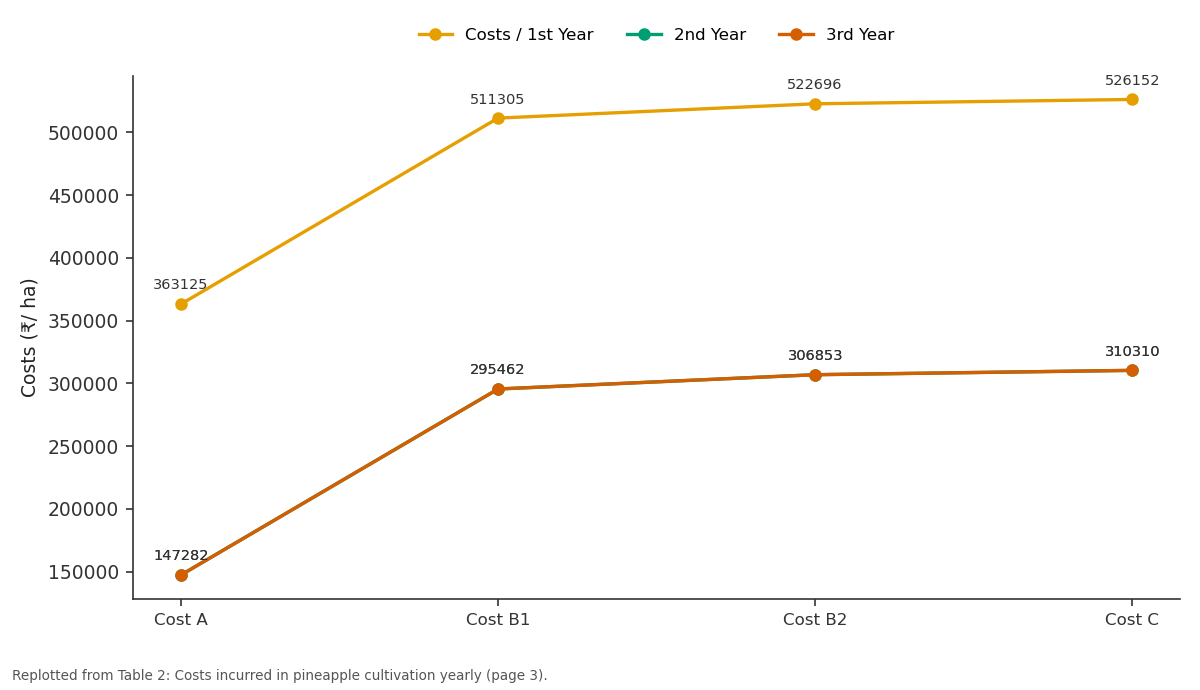
Costs / 1st Year and 2nd Year and more: Cost A vs Cost B1 vs Cost B2 vs Cost C
Replotted from Table 2 (page 3) of the original paper. Every bar is the paper's own table value.
View source evidence ↗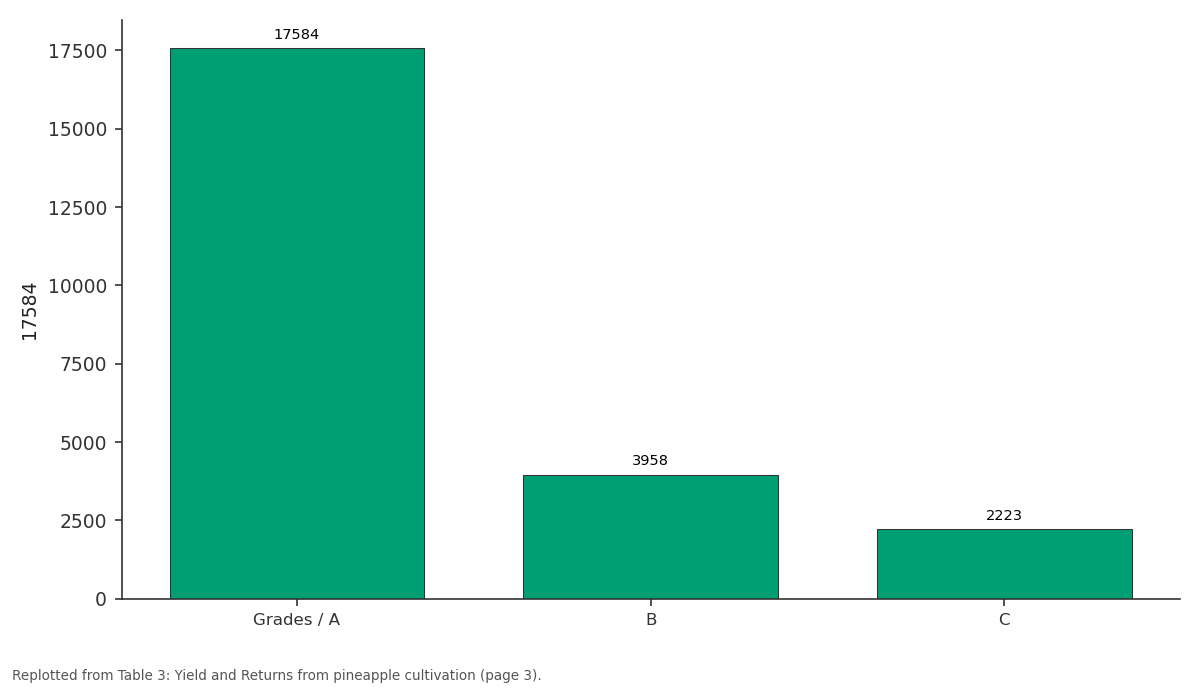
17584: Grades / A vs B vs C
Replotted from Table 3 (page 3) of the original paper. Every bar is the paper's own table value.
View source evidence ↗Figures & tables
From the original paper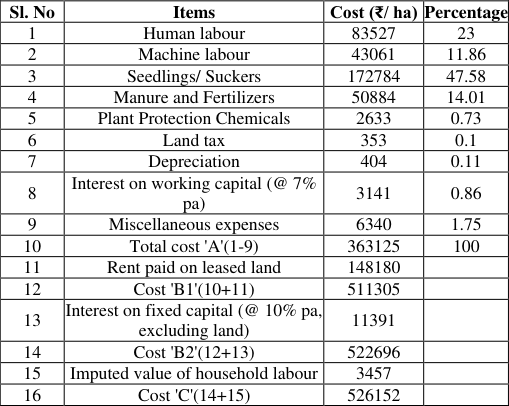 Table 1
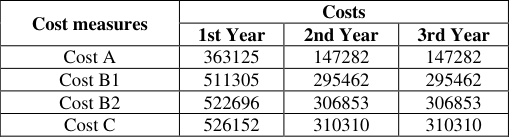 Table 2
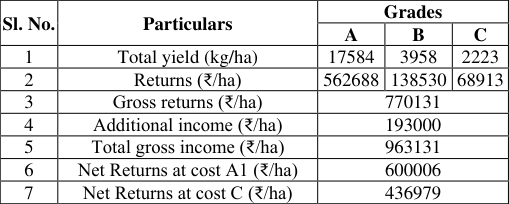 Table 3
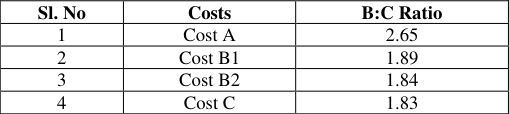 Table 4
 Table 5
Introduction
India holds the position as second largest producer of fruits and vegetables globally. The Indian Horticulture sector marks a significant contribution to the country's economy with 33% of Gross Value Addition (GVA) in agriculture coming from horticulture alone. India is emerging as a leading global hub for fruits and vegetables, the relevance and scope of horticulture is immense, especially considering its higher farm profitability and multiple uses in direct consumption as well as for raw material purposes in various industries. The global production of pineapple is estimated to be around 27.92 million tonnes per annum, produced by 85 countries. But despite being ranked sixth in terms of global pineapple production, India has got a market share of only 8%. The Pineapple Market exhibits immense opportunities with growing demands and the global market size being forecasted to have a growth from USD 27.08 billion in 2023 to USD 36.80 billion by 2028, at a CAGR of 6.33%. Globally, pineapple, avocado and mango are set to continue to be the three most significantly traded tropical fruits in terms of their export quantities in 2024, bananas aside. With estimated global exports of approximately 3.2 million tonnes, pineapples will remain the predominant commodity in quantity, with their popularity primarily driven by the fruit's low average export unit values and an expected expansion in exports by 4 percent. (FAO. 2024. Major Tropical Fruits Market Review. Preliminary Results 2023). Pineapple from Kerala is always in great demand within and outside the country and Ernakulam district produces more than half of the states total produce. Pineapple has been an important commercial crop and the Vazhakulam pineapple market in Kerala's Ernakulam district has emerged as Asia's largest pineapple market. The area under cultivation of pineapple for the state of Kerala during 2021-22 was 11508 Ha. It occupied 3.76% in the category of fresh fruits, holding to 6th top position in this category.
The state's area under pineapple cultivation witnessed an expansion in area by 4.45% in the year 2021-22, in comparison with the previous year. And the Production of Pineapple during 2021-22 was 106654 tonnes. Kerala's agriculture has undergone significant change in the 1980s, shifting attention from food crops to cash crops. According to Thomas (2015) this shift in land use pattern was of much favor to pineapple cultivation and this made great contributions the state's agricultural revenue and economic growth. Cultivation expanded, and the local economy flourished with provision of more employment, more economic transactions and betterment in standard of living. Despite pineapple being introduced in the area long back, pineapple production is still a mere farming activity with very little attention given to value addition and agrobased industries being almost absent. The problem of fragmented agricultural land holdings in Kerala could be managed to an extent through pineapple cultivation's leasing culture, which would also favor the landless small farmers. Pineapple plays significant role as inter crop in rubber cultivation. The price fluctuations in rubber market increase the importance of avoiding monocropping and hence more attention to pineapple as an intercrop. The Pineapple from Ernakulam district is known for its sweetness and quality. The crop has also got great export potential with Kerala's strong Middle East connections and the Keralite diaspora spread across the globe. Ernakulam district's advantage over transportation through sea and air ports is also notable. Adding to it, the presence of research institutes in pineapple is also a favorable factor. All these factors point out the significance and economic relevance of pineapple cultivation. Pineapple cultivation of Kerala in general and the study area of 'Ernakulam district' in particular passed through further stages of growth in early 2000's through increase in usage of chemical fertilizers and the next phase of expansion post 2010's through flow of cheap migrant labour from northern parts of the country. The highly fluctuating prices and the primitive natured cultivation practices provides new has lots of underlying problems that are yet to be examined. Regarding with trend and patterns of pineapple cultivation, there aren't many studies with Ernakulam district taken as area of study, despite this district playing key role in production and trade of Kerala s pineapple market. At present pineapple cultivation in Kerala is generating employment of about 45 lakh man days among farmers, agricultural workers, people involved in loading, unloading, transporting, traders, retailers etc. By doubling the area under pineapple cultivation, an additional 45 lakhs work days per year can be created. The main objectives of the study are to examine the growth and trend in area, production and productivity of pineapple cultivation in Ernakulam district, to assess the cost and benefit of pineapple cultivation in Ernakulam district and to analyse the problems faced by pineapple farmers in Ernakulam district.
Methodology
The study was based on primary and secondary data. Primary data was collected using random sampling from 250 pineapple cultivators from various villages in Ernakulam district from January 2024-March 2025. The secondary data was collected on area, production and productivity of pineapple cultivation in Ernakulam district from the period of 1992-2021 from Ministry of Agriculture and Directorate of Economics and Statistics, Government of Kerala (GOK), Food and Agriculture Organization (FAO) Statistics, periodicals and journals.
Cost-benefit analysis
The cost-benefit analysis following ABC cost measures as given in the Manual on Cost of Cultivation Surveys published by the Ministry of Statistics and program implementation, under Government of India and averages and percentages.
Benefit -Cost Ratio
Benefitcost ratio is a concept of profitability, in which higher value indicate more returns per rupee spent on cost.
BCR =
BCR =
Gross Returns
Gross Returns
Garrett Ranking Technique
Garrett Ranking Technique is used to rank various constraints faced by the respondents;
Where, Rij = rank constraint given by the j th respondent Nij= total number of constrains ranked by j th respondent
Results and Discussion
Costs involved in pineapple cultivation and the returns from it were analyzed to assess the profitability of pineapple cultivation in the study area. Estimations were based on primary data collected via personal interviews, considering the costs and returns per hectare in pineapple cultivation.
Pineapple is tropical plant and has a great economic significance. Cultivation of pineapple is a labour-intensive enterprise and has high initial establishment cost. The initial cost of establishment of pineapple orchard in the study area consists of the preparation of land and layout, cost of plantation, cost of planting materials and cost of fencing. Cost of cultivating pineapple per hectare was estimated by taking the averages of cost of production incurred by 250 farmers. Input wise costs were taken into consideration individually and its percent wise contribution to total costs were also assessed. Cost of cultivation varies annually as farming procedures varies within the 3-year cultivation period. The initial cost of planting occurs only in the 1 st year hence cost on machine, manure and suckers ends in 1 st year. Further variations in labour requirements and changes in usage of fertilizers are not taken in to consideration, for the ease of this study. It is noticeable that the cost of production exhibits a negative growth, moving towards the final year. Apeksha (2020) observed that cost of production in pineapple reduced from 500575 in 1 st year to 277742 in 2 nd year and 283977 in final year. This is a reduction of 44.51% in 1 st year and a 2.24% rise in 3 rd year.
The study on Yield and returns from pineapple cultivation revealed that the pineapples are graded on the basis of size and appearance post-harvest as Grade A, Grade B and Grade C. Grade A weighs above 800g, Grade B between 500-800g and grade C below 500g. However, in the year 2024, Grade B was observed to have earned better prices in an average annual basis (Vazhakulam Pineapple, annual price analysis 2024). Year 2024 was also favourable in prices; hence calculations were made taking prices per Kg pineapple as ₹40 for Grade A, ₹45 for Grade B and ₹35 for Grade C.
Gross returns for an average 23765 Kg produce per hectare was estimated to be ₹770931. The additional average income from harvesting about 38600 units of suckers from the farms, priced at ₹5 per sapling would fetch a yield of ₹193000 as an additional income to the farmer. Combining both of these incomes, the total gross income was ₹963131. Now deducting ₹363125 as Cost A1 would show a net return of ₹600006 after all the external deductions. From this amount when the imputed value of household labour also gets deducted, the Net Return at cost C will be ₹436979.
For the ease of calculation, the differences in production levels throughout years of cultivation and the daily price fluctuations were avoided, taking average values of standardized nature for the purpose of analysis. Benefit-Cost relationship indicates the profitability of pineapple cultivation. When B:C is taken as a ratio, output value as 1 indicate no profit no loss condition, with an increase in value indicating an increase in returns. The Cost-Benefit ratio was computed for Costs A as 2.65, Cost B1 as 1.89, Cost B2 as 1.84 and C2 as 1.83. B:C Ratios computed using different types of costs had ratios obtained to be greater than unitary for all. This indicates that pineapple cultivation is a profitable venture in the study area. It is also noticeable that the highest level of returns occurred when ratio was computed using Cost A, meaning cultivation in own farm land is always more yielding than that of leased farms, capable of making a significant difference The problems faced by pineapple cultivators were analyzed using the Garrett Ranking Technique. Eight major constraints that are affecting the cultivators were identified.
Respondents were given choice to assign ranks to each problem based on subjective choices, and then weights were assigned to each set and then mean values were taken. The factors having highest mean value was identified as the most serious constraint. It was found that price fluctuations in the pineapple market was considered the biggest of all, with a percentage value of 18.14%.
Conclusion
The profitability of pineapple estimated from this study was higher in comparison with similar peer studies. Pineapple in the study area was found to be profitable, but with so much of unused potential, which need not be let to go in vain. The growing demand globally is an incentive for the state and national governments, as well as private change the approach towards Pineapple cultivation as a whole. If effectively used, Kerala has got great set of opportunities to initiate technological advancements and the industry has to make the change, keeping aside all other hindrances. The pineapple cultivation involves various stages and steps which might vary based on topography and local cultivation practices. Pineapple being a plantation crop demands large land areas. Lease farming is the common practice and hence finding suitable land with good soil quality, adequate sunlight and water supply is chosen; as these factors have influence on the sweetness of pineapples. The study on cost and yield gave positive feedback on profitability of pineapple cultivation in the study area, despite all the price fluctuations and cost rises. Agro based industries using pineapple waste, producing various products like pineapple fiber cloth, are getting popular globally, yet it's not even introduced to farmers in the study area.
Figures and tables from the paper
| Sl. No | Items | Cost (₹/ ha) | Percentage |
|---|---|---|---|
| 1 | Human labour | 83527 | 23 |
| 2 | Machine labour | 43061 | 11.86 |
| 3 | Seedlings/ Suckers | 172784 | 47.58 |
| 4 | Manure and Fertilizers | 50884 | 14.01 |
| 5 | Plant Protection Chemicals | 2633 | 0.73 |
| 6 | Land tax | 353 | 0.1 |
| 7 | Depreciation | 404 | 0.11 |
| 8 | Interest on working capital (@ 7% pa) | 3141 | 0.86 |
| 9 | Miscellaneous expenses | 6340 | 1.75 |
| 10 | Total cost 'A'(1-9) | 363125 | 100 |
| 11 | Rent paid on leased land | 148180 | |
| 12 | Cost 'B1'(10+11) | 511305 | |
| 13 | Interest on fixed capital (@ 10% pa, excluding land) | 11391 | |
| 14 | Cost 'B2'(12+13) | 522696 | |
| 15 | Imputed value of household labour | 3457 | |
| 16 | Cost 'C'(14+15) | 526152 |
Table text extracted from the original PDF; superscript letters are shown inline. The original table image is below.
View original table image
| Cost measures | Costs | — | — |
|---|---|---|---|
| 1st Year | 2nd Year | 3rd Year | |
| Cost A | 363125 | 147282 | 147282 |
| Cost B1 | 511305 | 295462 | 295462 |
| Cost B2 | 522696 | 306853 | 306853 |
| Cost C | 526152 | 310310 | 310310 |
Table text extracted from the original PDF; superscript letters are shown inline. The original table image is below.
View original table image
| Sl. No. | Particulars | Grades | — | — |
|---|---|---|---|---|
| A | B | C | ||
| 1 | Total yield (kg/ha) | 17584 | 3958 | 2223 |
| 2 | Returns (₹/ha) | 562688 | 138530 | 68913 |
| 3 | Gross returns (₹/ha) | 770131 | ||
| 4 | Additional income (₹/ha) | 193000 | ||
| 5 | Total gross income (₹/ha) | 963131 | ||
| 6 | Net Returns at cost A1 (₹/ha) | 600006 | ||
| 7 | Net Returns at cost C (₹/ha) | 436979 |
Table text extracted from the original PDF; superscript letters are shown inline. The original table image is below.
View original table image
| Sl. No | Costs | B:C Ratio |
|---|---|---|
| 1 | Cost A | 2.65 |
| 2 | Cost B1 | 1.89 |
| 3 | Cost B2 | 1.84 |
| 4 | Cost C | 1.83 |
Table text extracted from the original PDF; superscript letters are shown inline. The original table image is below.
View original table image
| Sl. No | Issues | Total Score | Rank | Percentage |
|---|---|---|---|---|
| 1 | Price Fluctuations | 3627 | 1 | 18.14 |
| 2 | Labour shortage | 3349 | 2 | 16.75 |
| 3 | Increasing cost of production | 2791 | 3 | 13.96 |
| 4 | Lack of value addition | 2678 | 4 | 13.39 |
| 5 | Wild Animal Attacks | 2295 | 5 | 11.48 |
| 6 | Lack of Institutional support | 1970 | 6 | 9.85 |
| 7 | Shortage in Quality land /sapling | 1764 | 7 | 8.82 |
| 8 | Climate problems | 1526 | 8 | 7.63 |
Table text extracted from the original PDF; superscript letters are shown inline. The original table image is below.
View original table image
References
11 in the original paper- Karthikeyan N, Ramesh B, Kumar AD. An empirical study on factors that influences the marketing of pineapples in Vazhakulam -Kerala. Indo Am J Multidiscip Res Rev. 2018, 2(2).
- Alam P, Usmani TM, Danish M. Growth of pineapple cultivation: a spatio-temporal analysis in India. Int J Wall G. Social capital and the sectoral system of innovation: the case of Vazhakulam pineapple, Kerala, South India. Thiruvananthapuram: Centre for Development Studies; 2010.
- Thomas L, Dinesh V. Economics of pineapple cultivation under climate variability in Kerala. Plant Arch. 2020;20(2):3292-3295.
- Afzal MF, Siddiqui SH, Farrukh S. Growth analysis of productivity, dispersal and profitability of pineapple in India. Am Int J Res Humanit Arts Soc Sci. 2018.
- Mathew S, Wadkar SS, Kshirsagar PJ. Economic analysis of pineapple production in Sindhudurg district of Maharashtra. Int Res J Agric Econ Stat. 2017;8(2):351-356.
- Dasa B, Dasb KK, Roy TN. Study on marketing system and value addition of pineapple fruit (Ananus comosus) in West Bengal. Agric Econ Res Rev. 2016, 29(2).
- Rai KA. Value chain analysis of pineapple in Ernakulam district [thesis]. Thrissur: Kerala Agricultural University; 2020.
- Thomas J. Determinants and dynamics of lease land farming in pineapple [thesis]. Thrissur: Kerala Agricultural University; 2015.
- Sivagnanam KJ. Agro-economic research: impact study of the National Horticulture Mission (NHM) Scheme in Kerala. New Delhi: Directorate of Economics and Statistics; 2016.
- Thomas JM. Return and efficiency of intercropped pineapple cultivation in Kerala [thesis]. Kochi: Cochin University of Science and Technology; 2015.
- Tomy V, Alagumani T. Effect of geographical indication tagging on farmers' income: a study of pineapple farmers in Kerala. Agric Econ Res Rev. 2017;(Conf. No):311.