
Research article · 2025 · Full text
International Journal of Agriculture and Food ScienceThe effect of modern irrigation techniques on wheat growth and yield
Volume 7(8) · Pages 101–103 · DOI: 10.33545/2664844x.2025.v7.i8b.596 ↗
Research areasCrop Yield and Soil FertilityAgriculture, Plant Science, Crop Management
Abstract
Author-writtenA field experiment was conducted in Al-Burjessia farms and the Al-Burjessia Demonstration Farm affiliated with the Agricultural Extension and Training Department / Ministry of Agriculture, located 65 km from Basra city, during the 2024/2025 season. The region is classified physiographically as desert (Buringh, 1960) and climatically as arid. The soil is categorized as Typic Quartzipsamment. The study aimed to assess the impact of irrigation techniques on wheat (Triticum aestivum L.) yield. Wheat seeds (variety: Bohouth 22) were sown using surface irrigation and drip irrigation systems. The experimental design followed a strip plot layout. Irrigation water quantity was calculated based on a root depth of 0-20 cm and 0-40 cm, restoring soil moisture to field capacity. Results showed that irrigation methods significantly affected growth parameters and grain yield, with drip irrigation producing the highest wheat yield.
Summary
Source-checkedPlain-language reading of the full paper, prepared with AI and checked against the text. Each point links to the authors' own words.
Why it matters
- Effective irrigation design is critical for food production in arid and semi-arid regions where water resources are limited. View evidence ↗
- Wheat is a strategic crop for Iraq, but its current productivity levels are below the country's potential. View evidence ↗
- Drip irrigation is viewed as a highly efficient method that can potentially save 40-80% of water and double crop yields. View evidence ↗
The question
- The researchers aimed to evaluate how different irrigation techniques affect the yield of wheat. View evidence ↗
What they did
- The field experiment took place during the 2024/2025 season at Al-Burjessia farms, located 65 km from Basra city. View evidence ↗
- The study used a strip plot layout to compare the effects of surface irrigation and drip irrigation on the Bohouth 22 wheat variety. View evidence ↗
- Water quantities were determined by calculating the amount needed to restore soil moisture to field capacity for root depths of 0-20 cm and 0-40 cm. View evidence ↗
- The researchers used a randomized complete block design (RCBD) with factorial arrangement, analyzing data via GenStat and comparing means using RLSD in Excel. View evidence ↗
What they found
- Drip irrigation led to a significant 21.49% increase in nitrogen concentration in wheat leaves compared to surface irrigation. View evidence ↗
- Phosphorus concentration was 52.97% higher in wheat treated with drip irrigation than in those treated with surface irrigation. View evidence ↗
- The use of drip irrigation improved the uptake of potassium by 21.29%. View evidence ↗
- Sulfur content was higher with drip irrigation (3.43 g/kg) compared to surface irrigation (3.00 g/kg). View evidence ↗
- Flag leaf area increased by 43.17% when drip irrigation was used. View evidence ↗
- Dry biomass was higher for plants under drip irrigation (712 kg/ha) than for those under surface irrigation (547 kg/ha). View evidence ↗
- Total grain yield improved by 35.98% when using drip irrigation instead of surface irrigation. View evidence ↗
What it means
- The authors concluded that irrigation methods significantly impact growth and yield, with drip irrigation being the most effective for maximizing wheat yield. View evidence ↗
Visual summary
2 visualsIllustrations explain the paper; charts are replotted from the paper's own table values.
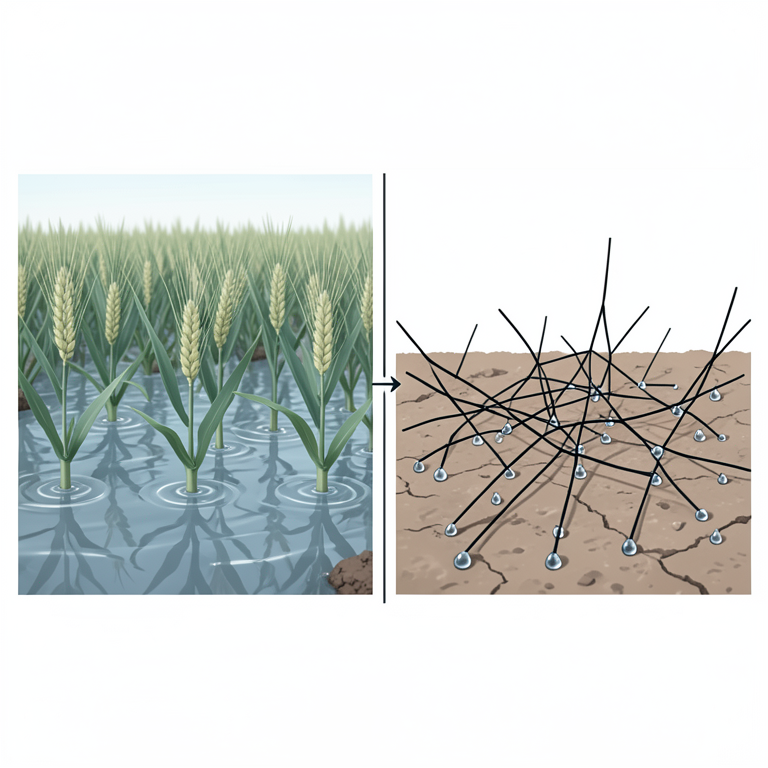
Comparison of Irrigation Systems
AI-generated conceptual illustration (Bohouth 22 wheat plants in soil). It explains the idea and does not show study data.
View source evidence ↗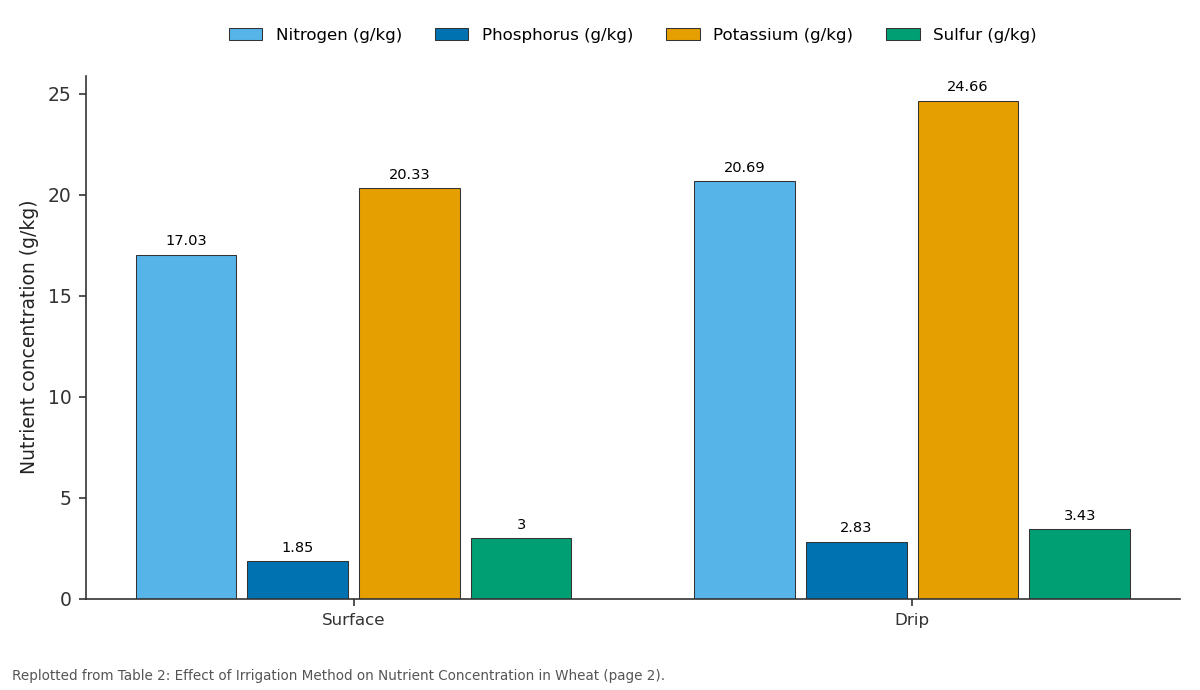
Nitrogen (g/kg) and Phosphorus (g/kg) and more: Surface vs Drip
Replotted from Table 2 (page 2) of the original paper. Every bar is the paper's own table value.
View source evidence ↗Figures & tables
From the original paper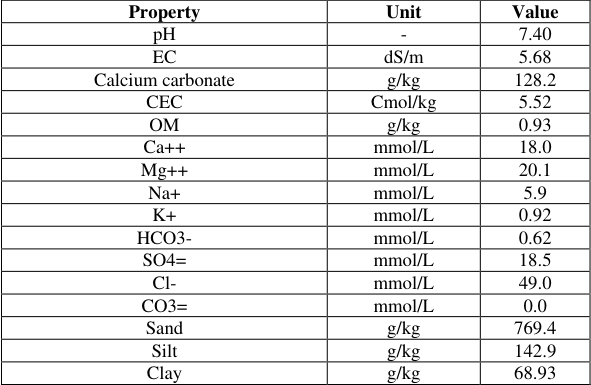 Table 1
 Table 2
 Table 3
Introduction
Water management refers to controlling and utilizing water to produce food and forage in an optimal manner while integrating natural, chemical, biological, and social resources to meet crop water requirements without harming the environment. Designing irrigation projects, including network capacity and irrigation methods, is crucial especially in areas with limited water resources, such as arid and semi-arid regions (Al-Akidi, 2018) [2] . Water is essential for plant growth. Its availability can be controlled, particularly in dry regions, by irrigation scheduling, which defines the amount and timing of water application. Irrigation also aims to manage saline water and reduce salt concentration in the root zone, enhancing plant growth by maintaining salt balance-closely linked to water quality, irrigation practices, climate, and soil properties (Emdad & Raine, 2014) [6] . Drip irrigation is considered the most efficient method, potentially increasing yields by up to 100% and saving 40-80% of water. It also improves water and nutrient use efficiency and reduces the need for labor, fertilizers, and pesticides (Lodhi et al., 2014; Kumari et al., 2014) [11, 8] . Drip irrigation can prevent runoff, deep percolation, and evaporation (Liu et al., 2021) [10] . Wheat (Triticum aestivum L.) is a strategic cereal crop in Iraq. Although the country has favorable conditions, wheat productivity remains below potential. In 2024, Iraq produced 5.234 million tons of wheat on 8.177 million hectares (Agricultural Statistics Directorate, Ministry of Planning, 2024).
Materials and Methods
The experiment was conducted during the 2024/2025 winter season in Al-Burjessia, Basra. Initial soil properties are presented in Table 1. Land Preparation: The land was plowed twice perpendicularly, leveled, and divided into 2x2 m plots with 0.5 m spacing. Five planting rows were made per plot using 120 kg/ha of wheat seeds (Bohouth 22). Surface irrigation setup included main, sub-main, and feeder pipes; a drip system was installed on the second part of the field. Mixed irrigation water from the farm's desalination unit and well was used as needed. Fertilizers were applied evenly along planting rows:
| Property | Unit | Value |
|---|---|---|
| pH | - | 7.40 |
| EC | dS/m | 5.68 |
| Calcium carbonate | g/kg | 128.2 |
| CEC | Cmol/kg | 5.52 |
| OM | g/kg | 0.93 |
| Ca++ | mmol/L | 18.0 |
| Mg++ | mmol/L | 20.1 |
| Na+ | mmol/L | 5.9 |
| K+ | mmol/L | 0.92 |
| HCO3- | mmol/L | 0.62 |
| SO4= | mmol/L | 18.5 |
| Cl- | mmol/L | 49.0 |
| CO3= | mmol/L | 0.0 |
| Sand | g/kg | 769.4 |
| Silt | g/kg | 142.9 |
| Clay | g/kg | 68.93 |
Table text extracted from the original PDF; superscript letters are shown inline. The original table image is below.
View original table image
Urea (46% N) at 125 kg N/ha in three splits (sowing, 1 month, and 2 months after sowing). Potassium sulfate (43% K) at 100 kg/ha (10% at sowing, the rest at flowering).
Super phosphate (20.21% P2O5) at 120 kg P2O5/ha at sowing. Seeds were sown on 15/11/2024.
Plant Analysis and Growth Measurements
Flag leaves were collected from 10 randomly selected plants per plot at flowering, washed, dried at 65°C, ground, and analyzed using the wet digestion method (Cresser & Parsons, 1979). Total Nitrogen: Steam distilled after adding NaOH (10 N), per Bremner (1970) [21] . Total Phosphorus: Extracted using 0.5 M NaHCO3 (pH 8.5), color developed with ammonium molybdate and ascorbic acid, measured by spectrophotometer at 882 nm (Olsen in Page et al., 1982) [22] . Total Sulfur: Determined by turbidity using BaCl2 and gum acacia (Page et al., 1982) [23] . Total Potassium: Measured using a flame photometer (Page et al., 1982) [23] .
Growth Parameters: Ten plants per plot were used to measure: Flag leaf area (cm2): LSA = L x W x 0.75 (Thomas, 1975). Dry biomass: Plants harvested at soil level, dried at 65°C to constant weight, and converted to kg/ha. 1000-grain weight: Seeds from 0.5 x 0.5 m area were collected and weighed. Grain yield: Calculated from 0.5 x 0.5 m area and expressed in Mg/ha.
Statistical Analysis
The experiment followed a randomized complete block design (RCBD) with factorial arrangement. Data were analyzed using GenStat, and means were compared using RLSD in Excel (Al-Rawi & Khalafallah, 1980) [24] .
Results and Discussion
Nitrogen concentration in wheat leaves: Drip irrigation significantly increased nitrogen concentration by 21.49% compared to surface irrigation (p ≤ 0.05), likely due to improved water use efficiency and root nutrient uptake (Yang et al., 2020; Dessie et al., 2024) [18, 5] . Phosphorus concentration: Drip irrigation also increased phosphorus concentration by 52.97% over surface irrigation (p ≤ 0.05), attributed to enhanced moisture and phosphorus mobility in the root zone (Chtouki et al., 2024) [13] . Potassium concentration: Drip irrigation improved potassium uptake by 21.29%, likely due to better soil aeration and root access (Rajiv et al., 2024) [20] . Sulfur concentration: Drip irrigation yielded higher sulfur content (3.43 g/kg vs. 3.00 g/kg) through direct delivery of sulfur-containing fertilizers to the root zone (Aujla et al., 2007; Yang et al., 2023) [12,17] . [15,7] .
1000-grain weight: Drip irrigation resulted in heavier grains (60.03 vs. 52.20 g), linked to consistent moisture and nutrient uptake (Yu et al., 2024; Lei et al., 2022) [9,19] . Grain yield: Drip irrigation improved total yield by 35.98% over surface irrigation, aligning with results from Liu et al. (2021) [10] .
Figures and tables from the paper
| Irrigation Method | Nitrogen (g/kg) | Phosphorus (g/kg) | Potassium (g/kg) | Sulfur (g/kg) |
|---|---|---|---|---|
| Surface | 17.03 | 1.85 | 20.33 | 3.00 |
| Drip | 20.69 | 2.83 | 24.66 | 3.43 |
Table text extracted from the original PDF; superscript letters are shown inline. The original table image is below.
View original table image
| Irrigation Method | Leaf Area (cm2) | Dry Biomass (kg/ha) | 1000-Grain Weight (g) | Grain Yield (Mg/ha) |
|---|---|---|---|---|
| Surface | 19.11 | 547.00 | 52.20 | 3.64 |
| Drip | 27.36 | 712.00 | 60.03 | 4.95 |
Table text extracted from the original PDF; superscript letters are shown inline. The original table image is below.
View original table image
References
23 in the original paper- Al-Akeedi HARW. The role of irrigation and fertilization management in growth and productivity of two wheat varieties (Triticum aestivum L.). Baghdad: College of Agricultural Engineering Sciences, University of Baghdad; 2018.
- Buringh P. Soils and soil conditions in Iraq. Iraq: Ministry of Agriculture; 1960.
- Burney J, Woltering L, Burke M, Naylor R, Pasternak D. Solar-powered drip irrigation enhances food security in the Sudano-Sahel. Texas Water Development Board: Agricultural Water Conservation Practices; 2009.
- Dessie GA, Zimale FA, Sull GG. Effect of irrigation regimes on nutrient uptake and nitrate leaching in maize (Zea mays L.) production at Birr-Farm, Upper Blue Nile, Ethiopia. Heliyon. 2024;10(18):e38005. https://doi.org/10.1016/j.heliyon.2024.e38005
- Emdad MR, Raine SR. Effect of water quality on soil structure and infiltration under furrow irrigation. Irrig Sci. 2014;23:55-60.
- Impa S, Perumal R, Bean S, Sunoj VJ, Jagadish SK. Water deficit and heat stress induced alterations in grain physico-chemical characteristics and micronutrient composition in field grown grain sorghum. J Cereal Sci. 2019;86:124-131.
- Kumari R, Kaushal A, Singh KG. Water use efficiency of drip fertigated sweet pepper under the influence of different kinds and levels of fertilizers. Indian J Sci Technol. 2014;7:1538-1543.
- Lei H, Yu J, Zang M, Pan H, Liu X, Zhang Z, et al. Effects of water-fertilizer-air-coupling drip irrigation on soil health status: Soil aeration, enzyme activities and microbial biomass. Agronomy. 2022;12(11):2674. https://doi.org/10.3390/agronomy12112674
- Liu M, Zikui W, Le M, Rui X, Huimin Y. Effect of regulated deficit irrigation on alfalfa performance under two irrigation systems in the inland arid area of midwestern China. Agric Water Manag. 2021;248:106764. https://doi.org/10.1016/j.agwat.2021.106764
- Lodhi AS, Kaushal A, Singh KG. Impact of irrigation regimes on growth, yield and water use efficiency of sweet pepper. Indian J Sci Technol. 2014;7:790-794.
- Aujla MS, Thind HS, Buttar GS. Fruit yield and water use efficiency of eggplant (Solanum melongena L.) as influenced by different quantities of nitrogen and water applied through drip and furrow irrigation. Sci Hortic. 2007;112(2):142-148. https://doi.org/10.1016/j.scienta.2006.12.020
- Chtouki M, Naciri R, Oukarroum A. A review on phosphorus drip fertigation in the Mediterranean region: Fundamentals, current situation, challenges, and perspectives. Heliyon. 2024;10(3):e25543. https://doi.org/10.1016/j.heliyon.2024.e25543
- Srivastava RK, Purohit S, Alam E, Islam MK. Advancements in soil management: Optimizing crop production through interdisciplinary approaches. J Agric Food Res. 2024;18:101528. https://doi.org/10.1016/j.jafr.2024.101528
- Si Z, Qin A, Liang Y, Duan A, Gao Y. A review on regulation of irrigation management on wheat physiology, grain yield, and quality. Plants. 2023;12(4):692. https://doi.org/10.3390/plants12040692
- Singh J, Sandal SK, Yousuf A, Sandhu PS. Effect of drip irrigation and fertigation on soil water dynamics and productivity of greenhouse tomatoes. Water. 2023;15(11):2086. https://doi.org/10.3390/w15112086
- Yang P, Wu L, Cheng M, Fan J, Li S, Wang H, et al. Review on drip irrigation: Impact on crop yield, quality, and water productivity in China. Water. 2023;15(9):1733. https://doi.org/10.3390/w15091733
- Yang W, Jiao Y, Yang M, Wen H, Gu P, Yang J, et al. Minimizing soil nitrogen leaching by changing furrow irrigation into sprinkler fertigation in potato fields in the northwestern China plain. Water. 2020;12(8):2229. https://doi.org/10.3390/w12082229
- Yu ZZ, Wang HX, Yu DS, Yin NX, Zhang J. The effect of aeration and irrigation on the improvement of soil environment and yield in dryland maize. Front Plant Sci. 2024;15:1464624. https://doi.org/10.3389/fpls.2024.1464624
- Rajiv A, Pandey AK, Pandey VK. Detection and Localization of Intracranial Vascular Occlusions Using 3D Magnetic Resonance Imaging. In2024 15th International Conference on Computing Communication and Networking Technologies (ICCCNT) 2024 Jun 24 (pp. 1-6). IEEE.
- Bremner I. Zinc, copper and manganese in the alimentary tract of sheep. British Journal of Nutrition. 1970 Sep;24(3):769-783.
- Evans SA, Olson ST, Shore JD. p-Aminobenzamidine as a fluorescent probe for the active site of serine proteases. Journal of Biological Chemistry. 1982 Mar 25;257(6):3014-3017.
- Page TL. Transplantation of the cockroach circadian pacemaker. Science. 1982 Apr 2;216(4541):73-75.
- Al-Rawi KM, Khalafallah AM. Design and analysis of agricultural experiments. Mosul, Iraq: College of Agriculture and Forestry, University of Mosul; 1980.