
Research article · 2025 · Full text
International Journal of Agriculture and NutritionEffect of foliar spray of potassium nitrate on growth, flowering and yield of rejuvenated custard apple (Annona squamosa L.) cv. Balanagar
Volume 7(8) · Pages 01–07 · DOI: 10.33545/26646064.2025.v7.i8a.259 ↗
Research areasPlant Physiology and Cultivation StudiesFlowering Plant Growth and CultivationPlant Growth Enhancement Techniques
Abstract
Author-writtenThe present investigation entitled “Effect of Foliar Spray of Potassium Nitrate on Growth and Yield of Rejuvenated Custard Apple (Annona squamosa L.) cv. Balanagar” was conducted during 2024 at the All India Coordinated Research Project on Arid Zone Fruits, Department of Horticulture, MPKV, Rahuri. The study aimed to evaluate the influence of pruning and foliar application of potassium nitrate (KNO₃) on the growth, flowering and yield in 32 years old rejuvenated custard apple orchard. The experiment was laid out in a Factorial Randomized Block Design with two replications and 18 treatment combinations across six pruning levels and three foliar sprays of KNO3. Foliar spray was applied twice-at flowering and fruit set stage. Two years after rejuvenation, the maximum plant height (484.00 cm), plant spread (255.75 cm EW), (246.67 cm NS) and shoot length (112.25 cm) were recorded in T6 [Control without pruning] while T5 [Recommended practice of 25% pruning] recorded the highest number of shoots per tree (252.00) and yield (17.94 kg/tree). The earliest flowering (34.87 days) recorded in T4 [Retention of main trunk including primary branches and basal portion of secondary branches 10-15 cm]. Among the foliar sprays, S2 (KNO3 2%) significantly enhanced plant height (322.24 cm), plant spread (EW) (212.36 cm), number of shoots (203.42), days to flowering (39.67 days) and yield (15.09 kg/tree). The findings indicate that T5S2 [25% pruning with KNO3 2% spray] is most effective for improving growth and productivity in rejuvenated custard apple trees.
Summary
Source-checkedPlain-language reading of the full paper, prepared with AI and checked against the text. Each point links to the authors' own words.
Why it matters
- Custard apple is a tropical fruit cultivated in India across approximately 56,000 hectares, with an average yield of 513.4 MT/ha. View evidence ↗
- Potassium nitrate (KNO₃) is used to improve plant growth by increasing tolerance to drought, salinity, frost, and disease, while also enhancing water-use efficiency. View evidence ↗
- KNO₃ can promote flowering by increasing enzyme activity and ethylene levels, which helps break bud dormancy. View evidence ↗
The question
- The research aimed to determine how different pruning levels and foliar applications of potassium nitrate (KNO₃) affect the yield, flowering, and growth of 32-year-old rejuvenated custard apple trees. View evidence ↗
What they did
- The experiment used a Factorial Randomized Block Design with two replications, testing 18 combinations of six pruning levels (ranging from no pruning to retention of only the main trunk) and three KNO₃ spray concentrations (1%, 2%, and a control). View evidence ↗
- Foliar sprays were applied to the trees twice: once during the flowering stage and once during the fruit set stage. View evidence ↗
What they found
- The highest plant height (484.00 cm) occurred in the unpruned control (T₆), while the lowest (192.13 cm) was found in trees where only the main trunk was retained (T₁). View evidence ↗
- Pruning at the recommended 25% level (T₅) produced the most shoots (252.00), whereas the unpruned control (T₆) produced the fewest (151.17). View evidence ↗
- Trees in treatment T₄ flowered the earliest (34.87 days), while the unpruned control (T₆) took the longest to flower (46.73 days). View evidence ↗
- The highest fruit yield (17.94 kg/tree) was achieved with 25% pruning (T₅), compared to the lowest yield (12.50 kg/tree) in the unpruned control (T₆). View evidence ↗
- The lowest mealy bug infestation (6.67 colonies) was found in the most severe pruning treatment (T₁), while the highest (10.67 colonies) was in the unpruned control (T₆). View evidence ↗
- Anthracnose disease intensity was lowest (6.46%) in trees with 25% pruning (T₅) and highest (17.97%) in unpruned trees (T₆). View evidence ↗
What it means
- The authors conclude that the most effective treatment for improving growth and yield in custard apple cv. Balanagar is a combination of 25% pruning and a 2% foliar spray of KNO₃. View evidence ↗
Visual summary
1 visualsIllustrations explain the paper; they do not show study data.
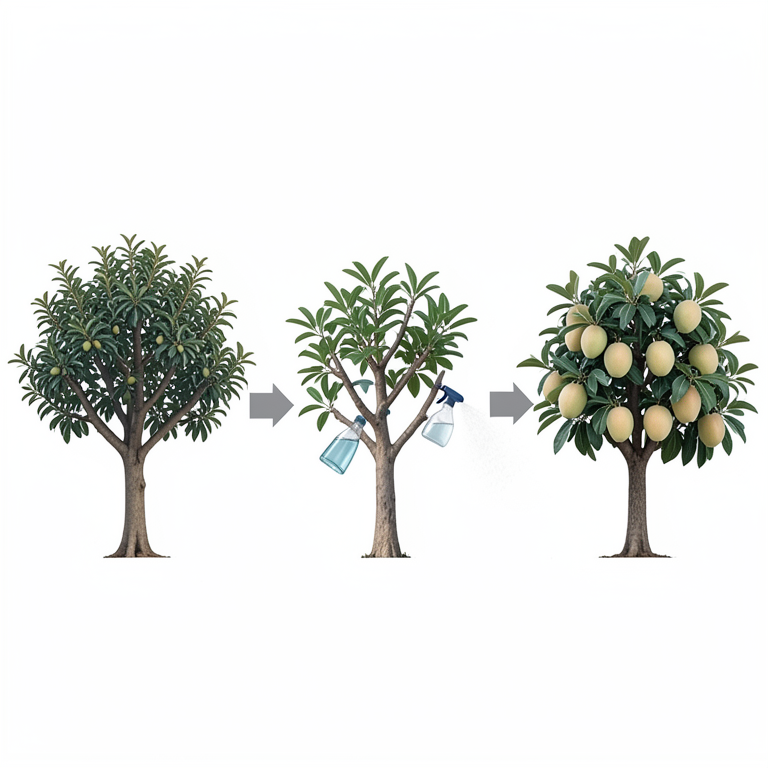
Synergistic Effect of Pruning and KNO₃ on Yield
AI-generated conceptual illustration (custard apple trees (Annona squamosa L.) cv. Balanagar). It explains the idea and does not show study data.
View source evidence ↗Figures & tables
From the original paper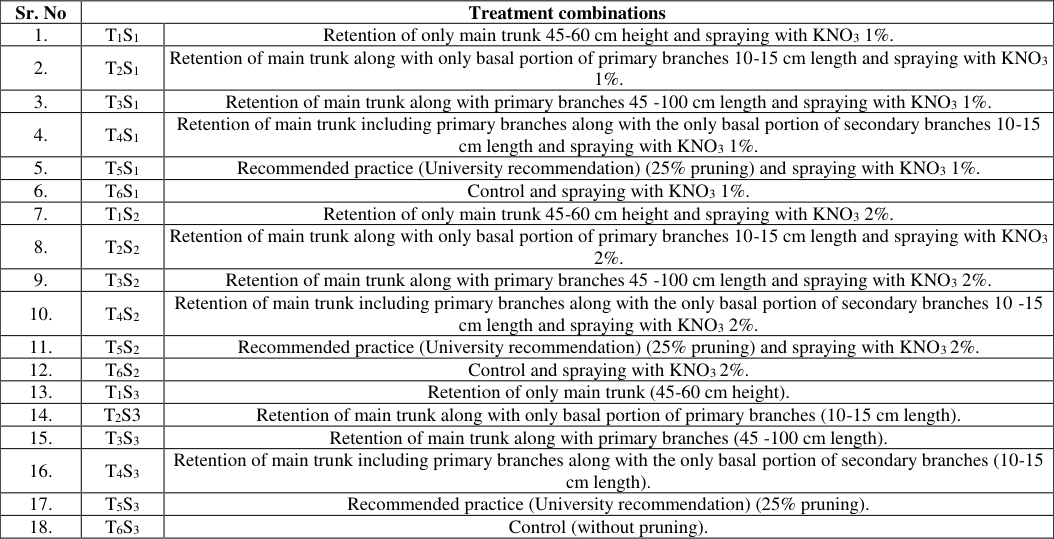 Table 1
 Table 2
 Table 3
 Table 4
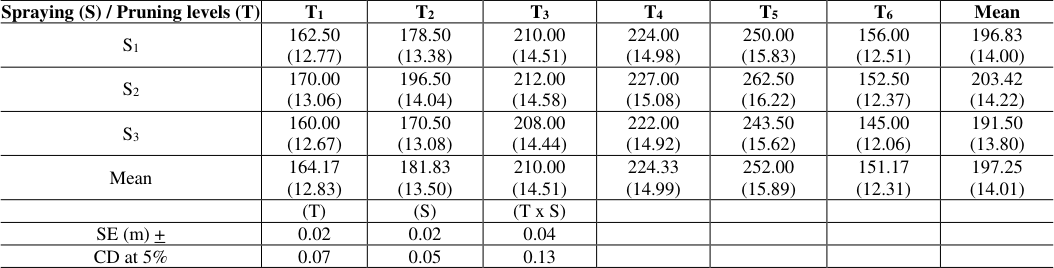 Table 5
 Table 6
 Table 7
 Table 8
 Table 9
 Table 10
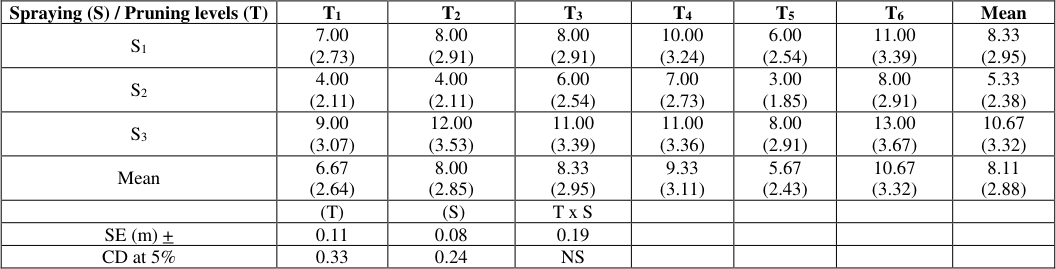 Table 11
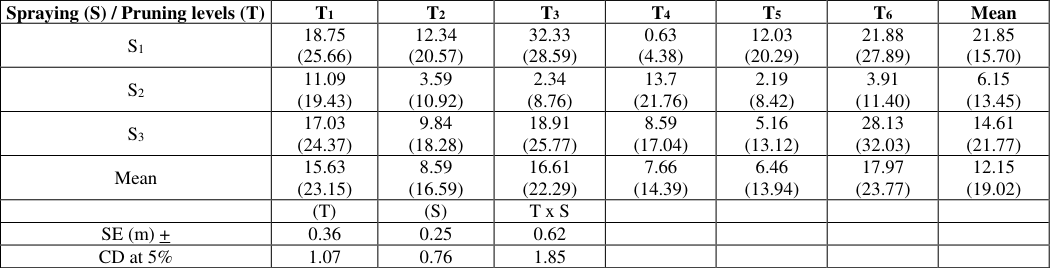 Table 12
Introduction
Custard apple (Annona squamosa L.), a tropical fruit of the Annonaceae family (2n = 14), originates from tropical America and is cultivated in countries like the Philippines, West Indies, South Africa, Sri Lanka, Israel and Myanmar. In India, about 56,000 hectare are under cultivation with an average yield of 513.4 MT/ha. Major producing states include Gujarat, Karnataka, Madhya Pradesh, Maharashtra, Odisha, Rajasthan, Uttar Pradesh Andhra Pradesh and Tamil Nadu. In Maharashtra alone, production reached 828.92 MT/ha during 2023-24, with major cultivation in Pune, Ahilyanagar, Aurangabad, Dhule, Dharashiv and Solapur (Anon., 2024). The crop is well-suited to Maharashtra's rainy season due to its drought tolerance and adaptability to sandy loam or well-drained clay loam soils (Bajpai et al., 1973) [4] . Among nutrients, nitrogen is vital for vegetative growth, while potassium plays a crucial role in fruit development (Pleguezuelo et al., 2011; Cavalcante et al., 2012) [5,14] . Potassium nitrate (KNO₃) enhances plant growth by improving frost, disease, drought and salinity tolerance, as well as water-use efficiency. It reduces water loss, boosts nutrient availability and supports healthier plants and higher yields. Its ease of application and compatibility with other fertilizers make it farmer-friendly. Unlike other nitrogen sources, KNO₃ is non-volatile and readily absorbed by plants, limiting uptake of harmful elements. KNO₃ also plays a role Nutrients applied to the soil often undergo leaching or become unavailable due to complex chemical interactions (Kundu et al., 2007) [11] . Foliar feeding effectively overcomes these issues by delivering nutrients directly to plant tissues, enhancing efficiency and nutrient availability in modern horticulture.
Materials and methods
The experiment was conducted during May to November, 2024 on thirty two year old rejuvenated custard apple (Annona squamosa L.) cv. Balanagar at the All India Coordinated Research Project on Arid Zone Fruits, Department of Horticulture, MPKV., Rahuri, Dist. Ahmednagar, Maharashtra. The trial consisted of 18 treatment combinations comprising six pruning levels [T1: Retention of only main trunk 45-60 cm height, T2: Retention of main trunk along with only basal portion of primary branches 10-15 cm length, T3: Retention of main trunk along with primary branches 45-100 cm, T4: Retention of main trunk including primary branches and basal portion of secondary branches 10-15 cm, T5: Recommended practice of 25% pruning, T6: Control without pruning] and three foliar spray application of KNO₃ [S1: KNO3 1%, S2: KNO3 2%, S3:Control], laid out in a Factorial Randomized Block Design (FRBD) with two replications. The spacing of the orchard was 5 m × 5 m. The data were collected on various growth, yield and plant protection parameters including plant height (cm), plant spread (E-W and N-S) (cm), number of shoots, stem girth (cm), shoot length (cm), shoot girth (cm), days to flowering, fruit fly infestation (%), number of mealy bug colonies per fruiting body and anthracnose disease intensity (%). The collected data were subjected to statistical analysis as per the standard procedure outlined for FRBD.
Table 1: Details of treatment combinations
Table 1: Details of treatment combinations
Sr. No
T1S1 Retention of only main trunk 45-60 cm height and spraying with KNO3 1%.
T2S1
Retention of main trunk along with only basal portion of primary branches 10-15 cm length and spraying with KNO3 1%.
3.
T3S1 Retention of main trunk along with primary branches 45 -100 cm length and spraying with KNO3 1%.
T4S1
Retention of main trunk including primary branches along with the only basal portion of secondary branches 10-15 cm length and spraying with KNO3 1%. 5.
T5S1
Recommended practice (University recommendation) (25% pruning) and spraying with KNO3 1%. 6.
T6S1 Control and spraying with KNO3 1%. 7.
T1S2 Retention of only main trunk 45-60 cm height and spraying with KNO3 2%.
T2S2
Retention of main trunk along with only basal portion of primary branches 10-15 cm length and spraying with KNO3 2%. 9.
T3S2 Retention of main trunk along with primary branches 45 -100 cm length and spraying with KNO3 2%.
T4S2
Retention of main trunk including primary branches along with the only basal portion of secondary branches 10 -15 cm length and spraying with KNO3 2%. 11.
T5S2
Recommended practice (University recommendation) (25% pruning) and spraying with KNO3 2%. 12.
T6S2 Control and spraying with KNO3 2%. 13.
T1S3 Retention of only main trunk (45-60 cm height). 14.
T2S3 Retention of main trunk along with only basal portion of primary branches (10-15 cm length). 15.
T3S3 Retention of main trunk along with primary branches (45 -100 cm length).
T4S3
Retention of main trunk including primary branches along with the only basal portion of secondary branches (10-15 cm length). 17.
T5S3 Recommended practice (University recommendation) (25% pruning). 18.
T6S3 Control (without pruning).
The average height of the four trees was measured from ground level to the growing tip with the help of marked bamboo (13 ft.) and presented in centimetre
Plant spread in both E-W & N-S directions were measured by using measuring tape and presented in centimetre.
Number of shoots
The average of visible number of new shoots in each tree was recorded from tagged branch of each tree. The number of shoots emerged from the date of pruning till the date of visible appearance of first new shoot were counted and recorded.
Diameter of selected stem was measured with the help of measuring tape after computing mean; it was recorded as average diameter of stem in centimetre.
Four shoots randomly from all directions were selected and tagged and their length was measured by using measuring tape and presented in centimetre.
Four shoots randomly from all directions were selected and tagged and measured by using measuring tape and presented in centimetre
Days to flowering
The date of visible appearance of flower on each observational tree was recorded. The average number of days from the date of pruning till the date of appearance of flower were counted and recorded as the period required for appearance of flowering.
2.1.2 Yield parameter 2.1.2.1 Yield (kg / tree) A weight of fruits harvested at each picking was recorded from each tree and sum of all pickings was expressed as yield in kilograms per tree.
The infestation of fruit fly was estimated by random selection of five fruits from all directions of the tree from each treatment and replication. Selected fruits were kept for ripening and on ripening the fruits were observed for fruit fly damage. The total number of fruits and number of damaged fruits were counted and converted into percent infestation by the following formula.
Number of mealy bug colony per fruiting body
Five fruiting bodies were randomly selected from each direction in every treatment. The number of visible mealy bug colonies on each fruiting body was recorded by direct visual observation. A cluster of ten or more individuals was considered a single colony. The total number of colonies was averaged per fruiting body by the following formula.
Number of mealy bug colony/fruiting body =
Number of mealy bug colony/fruiting body =
Anthracnose disease intensity was recorded on leaves after the initiation of new flushes. Four trees per treatment were selected and from each tree, five mature leaves from each direction were examined visually for disease symptoms. The number of infected leaves by incidence of anthracnose was counted and the per cent disease intensity was worked out as per following formula. The following formula was used:
Anthracnose disease intensity (%) =
The data presented in Table 2 revealed that plant height was significantly influenced by pruning levels, foliar application of potassium nitrate and their interaction. Among the pruning treatments, significantly maximum plant height (484.00 cm) was recorded in T₆ [Control], followed by T₅ [Recommended practice: 25% pruning intensity], while minimum (192.13 cm) was observed in T₁ [Retention of
| Spraying (S) / Pruning levels (T) | T1 | T2 | T3 | T4 | T5 | T6 | Mean |
|---|---|---|---|---|---|---|---|
| S1 | 189.91 | 215.90 | 237.80 | 259.72 | 311.88 | 477.29 | 282.08 |
| S2 | 209.63 | 218.64 | 234.66 | 298.92 | 441.21 | 530.38 | 322.24 |
| S3 | 176.85 | 222.87 | 232.69 | 243.21 | 367.48 | 444.33 | 281.23 |
| Mean | 192.13 | 219.14 | 235.05 | 267.28 | 373.52 | 484.00 | 295.19 |
| (T) | (S) | T x S | |||||
| SE (m) + | 5.80 | 4.10 | 10.04 | ||||
| CD at 5% | 17.30 | 12.23 | 29.96 |
Table text extracted from the original PDF; superscript letters are shown inline. The original table image is below.
View original table image
only main trunk at 45 to 60 cm height].With respect to foliar application, S₂ (KNO₃ 2%) recorded significantly maximum plant height (322.24 cm), followed by S₁ (KNO₃ 1%), whereas the lowest (281.23 cm) was observed in S₃ (Control).The interaction effect was also significant. Maximum plant height (530.38 cm) was recorded in T₆S₂, followed by T₆S₁ and the lowest (176.85 cm) in T₁S₃. The increased height might be attributed to reduction in apical dominance due to pruning, promoting vigorous shoot elongation. Similar findings were reported by Lal and Mishra (2008) [13] in mango cv. Dashehari.
The data presented in Table 3 and 4 revealed that plant spread in both east-west and north-south directions was significantly influenced by pruning levels, foliar application of potassium nitrate and their interaction. Among pruning levels, the highest plant spread (255.75 cm EW and 246.67 cm NS) was recorded in T₆ [Control], followed by T₅ [Recommended practice: 25% pruning intensity]. For foliar spray levels, S₂ (KNO₃ 2%) recorded the highest spread in EW (212.36 cm), while S₃ (Control) recorded the highest in NS (206.17 cm), suggesting a possible influence of internal reserves and natural growth pattern over exogenous chemical stimulation. Interaction effect (T × S) was also significant. The maximum spread (304.75 cm EW and 250.00 cm NS) was observed in T₆S₂ respectively. Wider canopy spread under unpruned and unsprayed conditions may be due to uninterrupted apical dominance and continued lateral growth, as supported by Lal and Mishra (2007) [12] .
| Spraying (S)/ Pruning levels (T) | T1 | T2 | T3 | T4 | T5 | T6 | Mean |
|---|---|---|---|---|---|---|---|
| S1 | 156.75 | 177.05 | 188.05 | 202.25 | 228.50 | 253.75 | 201.13 |
| S2 | 160.00 | 179.25 | 192.25 | 206.00 | 231.93 | 304.75 | 212.36 |
| S3 | 166.25 | 189.00 | 196.00 | 207.50 | 232.40 | 208.75 | 199.98 |
| Mean | 161.00 | 181.77 | 192.10 | 205.25 | 230.94 | 255.75 | 204.47 |
| (T) | (S) | T x S | |||||
| SE (m) + | 1.69 | 1.19 | 3.17 | ||||
| CD at 5% | 5.04 | 3.56 | 9.46 |
Table text extracted from the original PDF; superscript letters are shown inline. The original table image is below.
View original table image
Number of shoots
The data presented in Table 5 revealed that number of shoots was significantly influenced by pruning levels, foliar application of potassium nitrate and their interaction. Among pruning levels, the maximum number of shoots (252.00) was recorded in T₅ (Recommended practice: 25%
| Spraying (S) / Pruning levels (T) | T1 | T2 | T3 | T4 | T5 | T6 | Mean |
|---|---|---|---|---|---|---|---|
| S1 | 162.50 (12.77) | 178.50 (13.38) | 210.00 (14.51) | 224.00 (14.98) | 250.00 (15.83) | 156.00 (12.51) | 196.83 (14.00) |
| S2 | 170.00 (13.06) | 196.50 (14.04) | 212.00 (14.58) | 227.00 (15.08) | 262.50 (16.22) | 152.50 (12.37) | 203.42 (14.22) |
| S3 | 160.00 (12.67) | 170.50 (13.08) | 208.00 (14.44) | 222.00 (14.92) | 243.50 (15.62) | 145.00 (12.06) | 191.50 (13.80) |
| Mean | 164.17 (12.83) | 181.83 (13.50) | 210.00 (14.51) | 224.33 (14.99) | 252.00 (15.89) | 151.17 (12.31) | 197.25 (14.01) |
| (T) | (S) | (T x S) | |||||
| SE (m) + | 0.02 | 0.02 | 0.04 | ||||
| CD at 5% | 0.07 | 0.05 | 0.13 |
Table text extracted from the original PDF; superscript letters are shown inline. The original table image is below.
View original table image
pruning intensity, while the minimum (151.17) was observed in T₆ [Control]. Increased shoot number is due to pruning induced apical dominance removal, promoting lateral bud growth, as also noted by Jadhav et al. (2020) [9] in custard apple. For foliar spray levels, S₂ (2% KNO₃) recorded the maximum shoots (203. 2016) [17,18] . Interaction effect (T × S) was also significant. The highest number of shoots (262.50) was recorded in T₅S₂, followed by T₅S₁ (250.00), while the lowest (145.00) was observed in T₆S3. The synergistic effect of pruning and foliar nutrition enhanced shoot proliferation by combining physiological stimulation with nutrient availability.
The data presented in Table 6 revealed that stem girth was significantly influenced by pruning and foliar application of KNO₃, whereas the interaction effect between pruning and spraying was found non-significant. Among pruning levels, maximum stem girth (57.88 cm) was recorded under T₆ [Control without pruning]. Regarding foliar sprays, the highest stem girth (57.75 cm) was observed in S₁ (1% KNO₃). The interaction effect (T × S) was found nonsignificant; however, the highest numerical value for stem girth (68.50 cm) was recorded in T₆S1. Pruning and foliar KNO₃ together enhance stem thickness by balancing vegetative growth and improving nutrient uptake, supporting cambial activity and girth development.
| Spraying (S) / Pruning levels (T) | T1 | T2 | T3 | T4 | T5 | T6 | Mean |
|---|---|---|---|---|---|---|---|
| S1 | 60.00 | 50.50 | 55.00 | 57.75 | 54.75 | 68.50 | 57.75 |
| S2 | 50.00 | 56.50 | 41.50 | 57.25 | 52.50 | 48.50 | 51.04 |
| S3 | 38.00 | 45.50 | 48.75 | 57.50 | 56.50 | 56.63 | 50.48 |
| Mean | 49.33 | 50.83 | 48.42 | 57.50 | 54.58 | 57.88 | 53.09 |
| (T) | (S) | T x S | |||||
| SE (m) + | 3.04 | 2.15 | 5.08 | ||||
| CD at 5% | NS | NS | NS |
Table text extracted from the original PDF; superscript letters are shown inline. The original table image is below.
View original table image
The data presented in Table 7 revealed that shoot length was significantly influenced by pruning levels, foliar application of potassium nitrate and their interaction. Maximum shoot length (112.25 cm) was recorded in T₆ (Control without pruning), whereas minimum shoot length (74.36 cm) was recorded in T₄ (Retention of main trunk including primary branches along with the only basal portion of secondary branches 10-15 cm length). Maximum shoot length (97.00 cm) was observed in S₁ (KNO₃ 1%) likely due to potassium's role in cell elongation and photosynthesis.
| Spraying (S) / Pruning levels (T) | T1 | T2 | T3 | T4 | T5 | T6 | Mean |
|---|---|---|---|---|---|---|---|
| S1 | 98.58 | 104.75 | 91.50 | 57.17 | 104.00 | 126.00 | 97.00 |
| S2 | 85.67 | 66.67 | 81.22 | 86.42 | 97.83 | 108.08 | 87.65 |
| S3 | 129.25 | 71.08 | 73.42 | 79.50 | 85.92 | 102.67 | 90.31 |
| Mean | 104.50 | 80.83 | 82.04 | 74.36 | 95.92 | 112.25 | 91.65 |
| (T) | (S) | T x S | |||||
| SE (m) + | 1.01 | 0.72 | 1.75 | ||||
| CD at 5% | 3.02 | 2.13 | 5.23 |
Table text extracted from the original PDF; superscript letters are shown inline. The original table image is below.
View original table image
Similar results were reported by Gami et al. (2019) [8] in guava. The interaction effect of pruning and potassium nitrate was significant. Maximum shoot length (129.25 cm) was recorded in T₁S₃ and it was statistically at par with T₆S₁ which recorded 126.00 cm, whereas minimum shoot length (57.17 cm) was recorded in T₄S. Moderate pruning combined with optimal KNO₃ application enhanced apical shoot growth, likely by influencing hormone balance and improving nutrient mobility.
The data presented in Table 8 revealed that shoot girth was significantly influenced by pruning levels and their interaction with foliar application of potassium nitrate, while the effect of spraying alone was found to be non-significant. Among the pruning levels, the maximum shoot girth (12.13 cm) was recorded in T₁ (Retention of only main trunk 45-60 cm height. Moderate pruning may enhance shoot girth by improving light penetration, hormonal balance and assimilate distribution, promoting radial stem growth.
| Spraying (S) / Pruning levels (T) | T1 | T2 | T3 | T4 | T5 | T6 | Mean |
|---|---|---|---|---|---|---|---|
| S1 | 12.71 | 9.24 | 8.95 | 6.95 | 11.33 | 10.67 | 9.98 |
| S2 | 10.48 | 8.91 | 9.23 | 8.52 | 10.68 | 12.17 | 10.00 |
| S3 | 13.19 | 11.93 | 9.11 | 9.12 | 10.05 | 8.83 | 10.37 |
| Mean | 12.13 | 10.03 | 9.09 | 8.20 | 10.69 | 10.55 | 10.11 |
| (T) | (S) | T x S | |||||
| SE (m) + | 0.63 | 0.45 | 1.09 | ||||
| CD at 5% | 1.88 | NS | NS |
Table text extracted from the original PDF; superscript letters are shown inline. The original table image is below.
View original table image
Regarding foliar spray, although the effect was nonsignificant, numerically higher shoot girth (10.37 cm) was noted in S₃ (Control without spray) while the minimum (9.98 cm) was observed in S₁ (KNO₃1%). Interaction effect (T × S) was found to be significant. The highest shoot girth (13.19 cm) was recorded in T₁S3. The increased shoot girth in T₁S₃ may be due to reduced pruning stress and better recovery, enabling efficient translocation of photosynthates for girth development.
Days to flowering
The data presented in Table 9 revealed that days to flowering were significantly influenced by pruning levels, foliar application of potassium nitrate and their interaction. Among the pruning levels, the minimum days to flowering (34.87) were recorded in T₄ [Retention of main trunk including primary branches along with the only basal portion of secondary branches 10-15 cm length], followed by T₅ [Recommended practice: 25% pruning] (36.38), while the maximum (46.73) was observed in T₆ [Control without pruning]. Earlier flowering in moderately pruned trees may result from removal of senescent wood, stimulating fresh shoot growth favourable for floral bud differentiation, as noted by Chander et al. (2022) [6] . Among foliar sprays, S₂ (KNO₃ 2%) recorded the significantly minimum days to flowering (39.67), followed by S₁ (40.62), while the maximum (41.28) was noted in S₃ (Control). Potassium nitrate reduced flowering days by enhancing nitrate uptake, which boosts ethylene production and initiates reproductive growth. Similar results were reported by Shukla and Bisen (2016) [19] in guava cv. Allahabad Safeda. Interaction effect (T × S) was also significant. [20,23] in custard apple cv. Balanagar.
| Spraying (S) / Pruning levels (T) | T1 | T2 | T3 | T4 | T5 | T6 | Mean |
|---|---|---|---|---|---|---|---|
| S1 | 46.00 | 41.00 | 38.85 | 36.40 | 34.50 | 46.95 | 40.62 |
| S2 | 43.45 | 40.10 | 38.70 | 36.15 | 34.25 | 45.35 | 39.67 |
| S3 | 44.10 | 42.90 | 39.40 | 37.50 | 35.85 | 47.90 | 41.28 |
| Mean | 44.52 | 41.33 | 38.98 | 36.68 | 34.87 | 46.73 | 40.52 |
| (T) | (S) | T x S | |||||
| SE (m) + | 0.26 | 0.18 | 0.45 | ||||
| CD at 5% | 0.78 | 0.55 | 1.34 |
Table text extracted from the original PDF; superscript letters are shown inline. The original table image is below.
View original table image
The data presented in Table 10 revealed that yield per tree was significantly influenced by pruning levels, foliar application of potassium nitrate and their interaction. Among the pruning levels, the significantly highest yield (17.94 kg/tree) was recorded in T₅ [Recommended practice: 25% pruning], followed by T₄ [Retention of main trunk including primary branches along with the only basal portion of secondary branches 10 -15 cm length] (16.79 kg/tree), while the lowest (12.50 kg/tree) was observed in T₆
| Spraying (S) / Pruning levels (T) | T1 | T2 | T3 | T4 | T5 | T6 | Mean |
|---|---|---|---|---|---|---|---|
| S1 | 10.14 | 13.31 | 15.50 | 16.86 | 17.97 | 12.73 | 14.42 |
| S2 | 11.54 | 13.62 | 16.49 | 17.47 | 18.56 | 12.88 | 15.09 |
| S3 | 10.67 | 12.10 | 14.54 | 16.02 | 17.30 | 11.90 | 13.76 |
| Mean | 10.78 | 13.01 | 15.51 | 16.79 | 17.94 | 12.50 | 14.42 |
| (T) | (S) | T x S | |||||
| SE (m) + | 0.11 | 0.08 | 0.20 | ||||
| CD at 5% | 0.34 | 0.24 | 0.58 |
Table text extracted from the original PDF; superscript letters are shown inline. The original table image is below.
View original table image
[Control without pruning]. This increase may be due to improved light penetration and resource allocation as also noted by Amarnath et al. ( 2020) and Jadhav et al. ( 2020) [1,9] . Among foliar sprays, S₂ (KNO₃2%) recorded the significantly highest yield (15.09 kg/tree), followed by S₁ [10, 15] . Interaction effect (T × S) was also significant. The maximum yield (18.56 kg/tree) was observed in T₅S₂, followed by T₅S₁ (17.97 kg/tree), whereas the minimum 2024) [9,10] .
The presented investigation revealed that no fruit fly infestation was observed in custard apple cv. Balanagar during the experimental period. This absence may be due to climatic conditions from May to November may have been unfavourable for fruit fly activity. Good orchard practices like pruning and sanitation likely further minimized potential breeding sites.
Number of mealy bug colony per fruiting body
The data presented in Table 11 revealed that number of mealy bug colonies per fruiting body was significantly influenced by pruning levels, foliar application of potassium nitrate and their interaction. Among pruning levels, the minimum number of mealy bug colonies (6.67) was recorded in T₁ [Retention of only main trunk 45-60 cm height], followed by T₅ [Recommended practice: 25%
| Spraying (S) / Pruning levels (T) | T1 | T2 | T3 | T4 | T5 | T6 | Mean |
|---|---|---|---|---|---|---|---|
| S1 | 7.00 (2.73) | 8.00 (2.91) | 8.00 (2.91) | 10.00 (3.24) | 6.00 (2.54) | 11.00 (3.39) | 8.33 (2.95) |
| S2 | 4.00 (2.11) | 4.00 (2.11) | 6.00 (2.54) | 7.00 (2.73) | 3.00 (1.85) | 8.00 (2.91) | 5.33 (2.38) |
| S3 | 9.00 (3.07) | 12.00 (3.53) | 11.00 (3.39) | 11.00 (3.36) | 8.00 (2.91) | 13.00 (3.67) | 10.67 (3.32) |
| Mean | 6.67 (2.64) | 8.00 (2.85) | 8.33 (2.95) | 9.33 (3.11) | 5.67 (2.43) | 10.67 (3.32) | 8.11 (2.88) |
| (T) | (S) | T x S | |||||
| SE (m) + | 0.11 | 0.08 | 0.19 | ||||
| CD at 5% | 0.33 | 0.24 | NS |
Table text extracted from the original PDF; superscript letters are shown inline. The original table image is below.
View original table image
pruning intensity] (6.83), while the maximum (10.67) was observed in T₆ [Control]. Reduced pest incidence in pruned treatments is likely due to better canopy aeration and unfavourable microclimate, as noted by Anupama and Panchbhai (2020) and Choudhary et al. (2020) [3,7] .
Regarding foliar sprays, S₂ (KNO₃2%) recorded the minimum number of colonies (5.33), followed by S₁ (KNO₃1%) (8.33), whereas the maximum (10.67) was recorded in S₃ (Control). While potassium nitrate itself is not an insecticidal agent, its role in enhancing plant physiological health and nutrient balance. Improved plant vigour may contribute to enhanced systemic resistance against pests, making the host plant less susceptible to
colonization. This is consistent with the understanding that healthy, well-nourished plants are less prone to pest attack due to stronger tissue structure and induced biochemical defences. The interaction effect (T × S) was also found to be non-significant. The minimum number of mealy bug colonies (3.00) was recorded in T₅S₂, followed by T₅S₁ (4.00), while the maximum (13.00) was observed in T₆S₃.
The combined effect of pruning and foliar feeding improved canopy condition and plant defence, contributing to reduced mealy bug colonization.
The data presented in Table 12 revealed that anthracnose disease intensity (%) was significantly influenced by pruning levels, foliar application of potassium nitrate and their interaction. The symptoms were confined to leaves, indicating that the observations pertain to anthracnose leaf spot rather than fruit infection. Among pruning levels, the minimum anthracnose intensity (6.46%) was recorded in T₅
| Spraying (S) / Pruning levels (T) | T1 | T2 | T3 | T4 | T5 | T6 | Mean |
|---|---|---|---|---|---|---|---|
| S1 | 18.75 (25.66) | 12.34 (20.57) | 32.33 (28.59) | 0.63 (4.38) | 12.03 (20.29) | 21.88 (27.89) | 21.85 (15.70) |
| S2 | 11.09 (19.43) | 3.59 (10.92) | 2.34 (8.76) | 13.7 (21.76) | 2.19 (8.42) | 3.91 (11.40) | 6.15 (13.45) |
| S3 | 17.03 (24.37) | 9.84 (18.28) | 18.91 (25.77) | 8.59 (17.04) | 5.16 (13.12) | 28.13 (32.03) | 14.61 (21.77) |
| Mean | 15.63 (23.15) | 8.59 (16.59) | 16.61 (22.29) | 7.66 (14.39) | 6.46 (13.94) | 17.97 (23.77) | 12.15 (19.02) |
| (T) | (S) | T x S | |||||
| SE (m) + | 0.36 | 0.25 | 0.62 | ||||
| CD at 5% | 1.07 | 0.76 | 1.85 |
Table text extracted from the original PDF; superscript letters are shown inline. The original table image is below.
View original table image
[Recommended practice: 25% pruning intensity], while the maximum (17.97%) was observed in T6 [Without pruning]. The reduction under moderate pruning is attributed to better canopy aeration and reduced humidity reported by Anupama and Panchbhai (2020) and Choudhary et al. (2020) [3,7] . For foliar spray levels, the minimum intensity (6.15%) was recorded in S₂ (KNO₃ 2%) followed by S₃ (Control) (14.61). Though KNO₃ is not a fungicide, improved plant vigour and resistance due to better nutrition contributed to lower disease expression. The interaction effect (T × S) was also significant. The lowest anthracnose intensity (0.63%) was observed in T₄S₁, whereas the highest (28.13%) occurred in T₆S₃. This highlights the integrated role of pruning and nutrition in reducing disease severity by modifying the microclimate and strengthening plant health.
Figures and tables from the paper
| Sr. No | Treatment combinations | — |
|---|---|---|
| 1. | T1S1 | Retention of only main trunk 45-60 cm height and spraying with KNO3 1%. |
| 2. | T2S1 | Retention of main trunk along with only basal portion of primary branches 10-15 cm length and spraying with KNO3 1%. |
| 3. | T3S1 | Retention of main trunk along with primary branches 45 -100 cm length and spraying with KNO3 1%. |
| 4. | T4S1 | Retention of main trunk including primary branches along with the only basal portion of secondary branches 10-15 cm length and spraying with KNO3 1%. |
| 5. | T5S1 | Recommended practice (University recommendation) (25% pruning) and spraying with KNO3 1%. |
| 6. | T6S1 | Control and spraying with KNO3 1%. |
| 7. | T1S2 | Retention of only main trunk 45-60 cm height and spraying with KNO3 2%. |
| 8. | T2S2 | Retention of main trunk along with only basal portion of primary branches 10-15 cm length and spraying with KNO3 2%. |
| 9. | T3S2 | Retention of main trunk along with primary branches 45 -100 cm length and spraying with KNO3 2%. |
| 10. | T4S2 | Retention of main trunk including primary branches along with the only basal portion of secondary branches 10 -15 cm length and spraying with KNO3 2%. |
| 11. | T5S2 | Recommended practice (University recommendation) (25% pruning) and spraying with KNO3 2%. |
| 12. | T6S2 | Control and spraying with KNO3 2%. |
| 13. | T1S3 | Retention of only main trunk (45-60 cm height). |
| 14. | T2S3 | Retention of main trunk along with only basal portion of primary branches (10-15 cm length). |
| 15. | T3S3 | Retention of main trunk along with primary branches (45 -100 cm length). |
| 16. | T4S3 | Retention of main trunk including primary branches along with the only basal portion of secondary branches (10-15 cm length). |
| 17. | T5S3 | Recommended practice (University recommendation) (25% pruning). |
| 18. | T6S3 | Control (without pruning). |
Table text extracted from the original PDF; superscript letters are shown inline. The original table image is below.
View original table image
| Spraying (S) / Pruning levels (T) | T1 | T2 | T3 | T4 | T5 | T6 | Mean |
|---|---|---|---|---|---|---|---|
| S1 | 158.50 | 163.00 | 176.61 | 191.00 | 238.25 | 243.75 | 195.18 |
| S2 | 163.00 | 170.00 | 187.47 | 194.75 | 236.75 | 246.25 | 199.70 |
| S3 | 167.25 | 178.75 | 191.50 | 204.50 | 245.00 | 250.00 | 206.17 |
| Mean | 162.92 | 170.58 | 185.19 | 196.75 | 240.00 | 246.67 | 200.35 |
| (T) | (S) | T x S | |||||
| SE (m) + | 0.89 | 0.63 | 1.54 | ||||
| CD at 5% | 2.65 | 1.87 | 4.59 |
Table text extracted from the original PDF; superscript letters are shown inline. The original table image is below.
View original table image
References
23 in the original paper- Amarnath KS, Mishra S, Singh RK. Effect of pruning in pomegranate (Punica granatum L.) for shoot growth, flowering and fruit yield. Curr J Appl Sci Technol. 2020;39(5):2457-1024.
- Anonymous. [Internet]. 2024 [cited 2025 Aug 3]. Available from: https://agriwelfare.gov.in
- Anupama KC, Panchbhai DM, Patil SR. Effect of pruning severity and irrigation methods on flowering, fruit growth and yield of custard apple. Int J Curr Sci. 2020;8(6):2533-2536.
- Bajpai PN, Shukla HS, Chaturvedi AM. Effect of pruning on growth, yield and quality of guava var. Allahabad Safeda. Prog Hortic. 1973;2(4):73-79.
- Cavalcante LF, Pereira WE, Curvelo CRS, Nascimento JAM, Cavalcante IHL. Estado nutricional de pinheira sob adubação orgânica do solo. Cienc Agron. 2012;43(3):579-588.
- Chander S, Kurian RM, Satisha J, Upreti KK, Laxman RH. Advancing fruiting season in Annona cv. Arka Sahan through pruning. J Hortic Sci. 2022;17(2):316324.
- Choudhary K, Dhakare BB, Meena NK. Vegetative and quality parameters of custard apple as affected by pruning intensities and time. J Crop Weed. 2020;16(2):139-146.
- Gami J, Sonkar P, Haldar A, Patidar DK. Effect of preharvest spray of ZnSO₄, KNO₃ and NAA on growth, yield and quality of ber (Zizyphus mauritiana L.) cv. Seb under Malwa Plateau conditions. Int J Curr Microbiol Appl Sci. 2019;8(3):1977-1984.
- Jadhav AR, Chole AS, Dheware RM, Kadam SR. Effect of different levels of pruning on growth and yield of custard apple. Int J Curr Microbiol Appl Sci. 2020;11(3):228-231.
- Joundale RB, Kalalbandi BM, Jadhav SD. Studies on combination of different forms of potassium and micronutrients on fruit yield and post-harvest quality of guava (Psidium guajava L.). Int J Minor Fruits Med Aromat Plants. 2024;10(2):74-82.
- Kundu S, Ghosh B, Mitra SK, Mazumdar D. Effect of foliar spraying of nitrogen, phosphorus and potassium on yield and fruit quality of guava (Psidium guajava L.). Acta Hortic. 2007;735(5):147-152.
- Lal B, Mishra D. Effect of pruning on growth and bearing behaviour of mango cv. Chausa. Indian J Hortic Sci. 2007;64(2):268-270.
- Lal B, Mishra D. Studies on pruning in mango for rejuvenation. Indian J Hortic. 2008;65(4):405-408.
- Pleguezuelo CRR, Zuazo VHD, Fernandez JLM, Tarifa DF. Descomposicion de hojarasca y reciclado del nitrogeno de tropicaledy subtropicales en terrazas de cultivo en la costa de Granada. Comun Sci. 2011;2(1):42-48.
- Prasath DM, Varu DK, Bohara T, Singh C. Effect of pruning and potassium nitrate on flowering in mango cv. Kesar. Int J Adv Biochem Res. 2024;8(8):416-420.
- Protacio CM. A model for potassium nitrate-induced flowering in mango. Acta Hortic. 2000;509(8):545-552.
- Ramesh D, Suresh Kumar T, Venkatalaxmi K, Kishore Kumar CS. Effect of foliar application of urea, KNO₃ and ZnSO₄ on yield and yield contributing characters of custard apple (Annona squamosa L.) cv. Balanagar. Int J Agric Sci. 2016;8(60):3371-3373.
- Sharma KM, Singh V, Amarcholi JJ, Patel RJ. Response of different concentrations of urea, KNO₃ and micronutrient mixture on fruit retention, yield and physical parameters of sapota cv. Kalipatti. Indian Hortic J. 2016;6(2):165-167.
- Shukla M, Bisen B. Studies on pruning intensity and foliar application of KNO₃ on plant growth, flowering and fruiting of guava cv. Allahabad Safeda. Pharma Innov J. 2016;10(9):225-228.
- Sonika AS, Sabarad AI, Jalawadi S, Gorabal K, Prashantha A. Influence of time and intensity on growth and yield attributes in custard apple (Annona squamosa L.) cv. Balanagar. Biol Forum Int J. 2023;15(12):357-360.
- Trewavas AJ. Nitrate as a plant hormone. In: Jackson MB, editor. Interaction between Nitrogen and Growth Regulators in the Control of Plant Development. Wantage: British Plant Growth Regulator Group; 1983. p. 97-110.
- Valmayor RV. The Mango: Its Botany and Production. Wallingford, UK: Centre for Agriculture and Bioscience International; 1962.
- Vinay GM, Chithiraichelvan R. Induction of off-season flowering in custard apple (Annona squamosa L.) cv. Balanagar. J Hortic Sci. 2015;10(1):13-17.