
Research article · 2025 · Full text
International Journal of Agriculture and Food ScienceImpact of different growing medium on growth and yield of oyster mushroom (Pleurotus ostreatus) at room temperature
Volume 7(7) · Pages 599–603 · DOI: 10.33545/2664844x.2025.v7.i7h.573 ↗
Research areasFungal Biology and Applications
Abstract
Author-writtenThe cultivation of Pleurotus ostreatus (oyster mushroom) represents a sustainable and resource-efficient agro-practice, offering significant nutritional and economic benefits. This study investigates the impact of various locally available agro-waste substrates-wheat straw, paddy straw, pea straw, gram straw, green gram straw, mustard straw, and a control mixture-on the growth and yield of P. ostreatus under ambient room temperature conditions. The experiment was conducted using a Randomized Block Design (RBD) with five replications per treatment to evaluate growth indicators such as days to complete mycelial colonization, pinhead formation, fruiting body development, number of fruiting bodies, average fruiting body weight, total yield, and biological efficiency (BE%). Results indicated that wheat straw exhibited superior performance across all measured parameters, achieving the shortest colonization period (13.2 days), the earliest fruiting, the highest yield per bag (865.2 g), and the maximum biological efficiency (86.5%). Paddy straw and the control substrate mix also showed promising results, while mustard straw significantly underperformed, likely due to antifungal compounds inhibiting fungal colonization and fruiting. Legume-based substrates such as pea and green gram straw produced fewer fruiting bodies but yielded larger mushrooms on average. Findings highlight the critical role of substrate selection in optimizing mushroom production. The study recommends the use of cereal-based substrates-particularly wheat straw-for high-yield, low-input mushroom cultivation, especially in rural settings. The integration of leguminous residues in mixed substrates may further enhance fruiting body quality and market value. This research supports sustainable waste recycling and rural entrepreneurship through efficient mushroom farming.
Summary
Source-checkedPlain-language reading of the full paper, prepared with AI and checked against the text. Each point links to the authors' own words.
Why it matters
- Mushroom cultivation is a sustainable agro-industry that provides a protein-rich food source and creates rural employment while utilizing agricultural waste. View evidence ↗
- The oyster mushroom (Pleurotus ostreatus) is particularly valued for its ease of growth, rapid colonization, and high biological efficiency. View evidence ↗
- Identifying the most effective locally available agro-waste substrate is critical for improving productivity in low-resource mushroom farming. View evidence ↗
The question
- The study aimed to evaluate how different agricultural straws (wheat, paddy, gram, pea, green gram, and mustard) affect the growth and yield of Pleurotus ostreatus at room temperature. View evidence ↗
What they did
- The experiment was conducted at room temperature between 24.5 °C and 28.5 °C with 70-80% relative humidity. View evidence ↗
- A Randomized Block Design was used with seven substrate treatments, each replicated five times for a total of 35 bags. View evidence ↗
- The treatments included wheat, paddy, pea, gram, green gram, and mustard straws, plus a control mixture containing equal proportions of all six. View evidence ↗
- Substrates were inoculated with wheat grain-based spawn at a rate of 5% (w/w) of the wet substrate weight. View evidence ↗
What they found
- Wheat straw had the fastest mycelial colonization (13.2 days), while mustard straw was the slowest (17.8 days). View evidence ↗
- Pinhead initiation occurred earliest in wheat (17.4 days) and paddy (18.3 days) straws, and latest in mustard straw (21.3 days). View evidence ↗
- The time to fruiting body formation was shortest for wheat straw (21.2 days) and longest for mustard straw (26.1 days). View evidence ↗
- Wheat straw produced the most fruiting bodies per bag (24.6), whereas mustard straw produced the fewest (16.2). View evidence ↗
- Legume-based substrates (pea and green gram straw) produced fewer mushrooms, but they had higher average individual weights (21.2 g and 20.1 g, respectively). View evidence ↗
- Wheat straw achieved the highest total yield (865.2 g/bag) and biological efficiency (86.5%), while mustard straw had the lowest yield (468.4 g) and efficiency (46.8%). View evidence ↗
What it means
- The authors conclude that wheat straw is the most effective substrate for oyster mushroom cultivation due to its high yield, efficiency, and rapid growth. View evidence ↗
- The authors recommend combining legume straws with cereal substrates to potentially improve the size and marketability of the mushrooms. View evidence ↗
- The authors suggest that future research should investigate substrate enrichment, microbial supplementation, and specific legume-to-cereal ratios. View evidence ↗
Visual summary
3 visualsIllustrations explain the paper; charts are replotted from the paper's own table values.
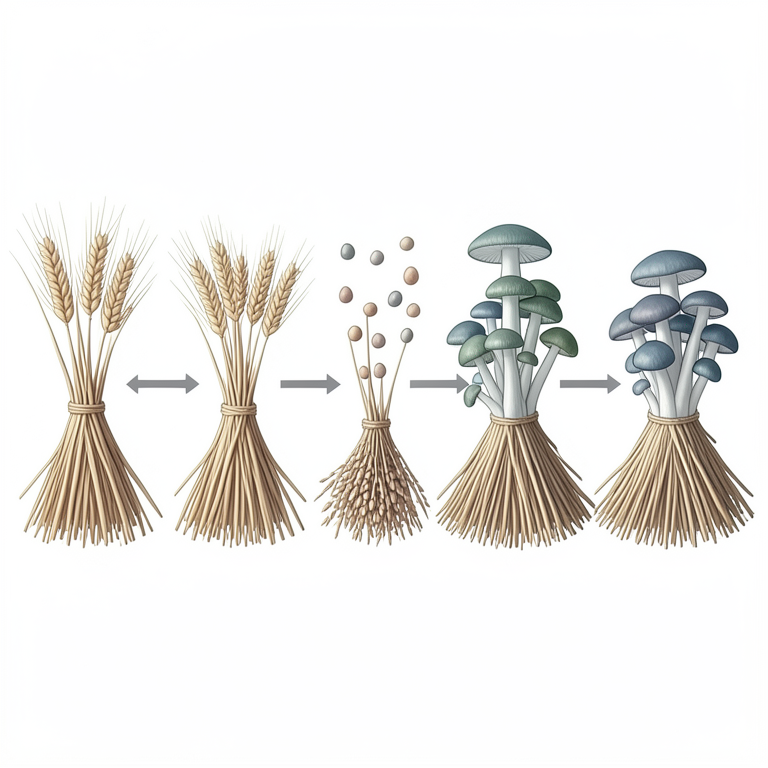
Substrate Comparison Layout
AI-generated conceptual illustration (Oyster mushrooms (Pleurotus ostreatus) growing on various agricultural straws). It explains the idea and does not show study data.
View source evidence ↗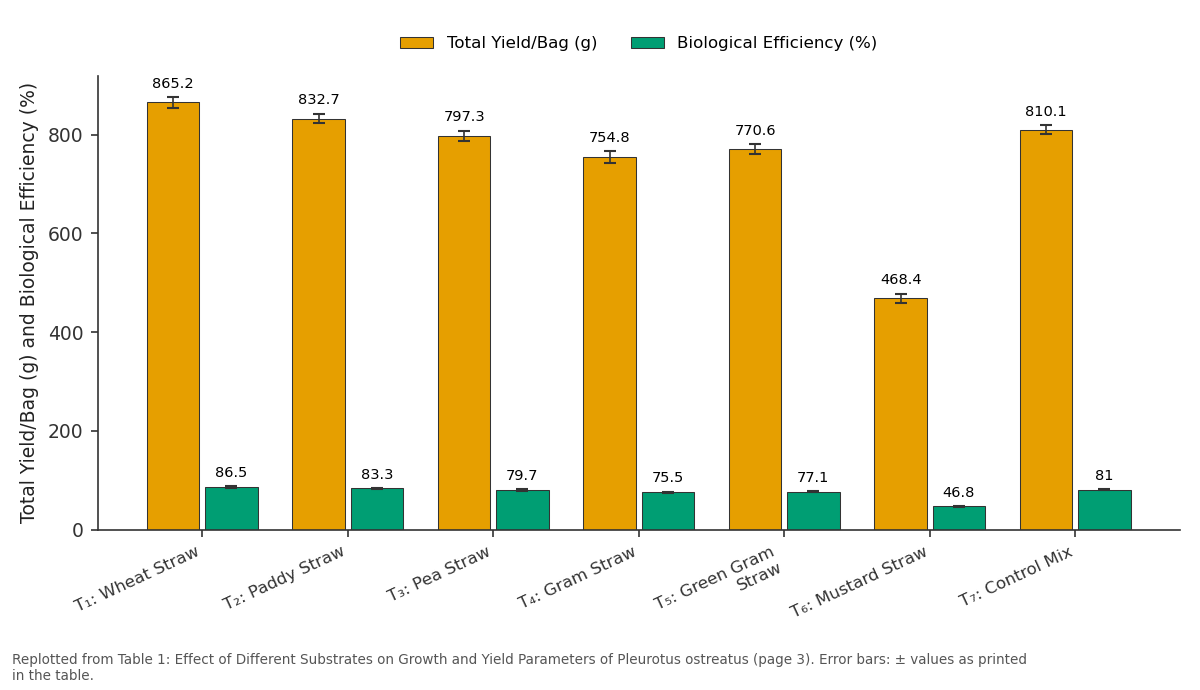
Total Yield/Bag (g) and Biological Efficiency (%): T₁: Wheat Straw vs T₂: Paddy Straw vs T₃: Pea Straw vs T₄: Gram Straw vs T₅: Green Gram Straw
Replotted from Table 1 (page 3) of the original paper. Every bar is the paper's own table value.
View source evidence ↗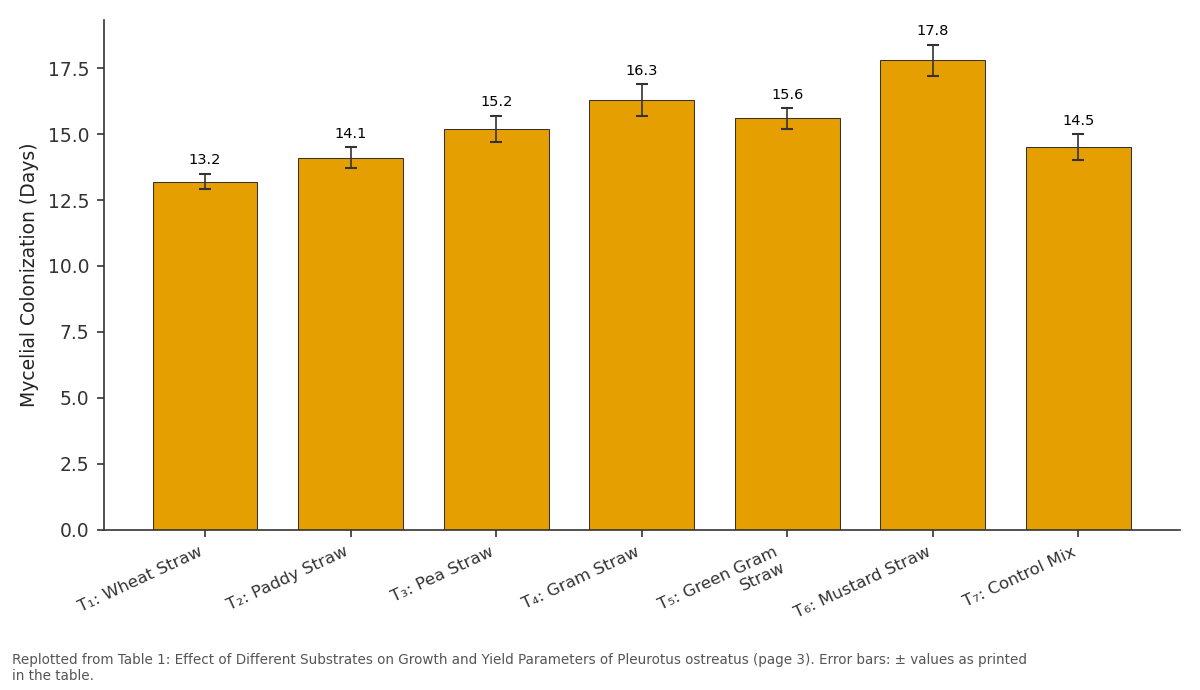
Mycelial Colonization (Days): T₁: Wheat Straw vs T₂: Paddy Straw vs T₃: Pea Straw vs T₄: Gram Straw vs T₅: Green Gram Straw
Replotted from Table 1 (page 3) of the original paper. Every bar is the paper's own table value.
View source evidence ↗Figures & tables
From the original paper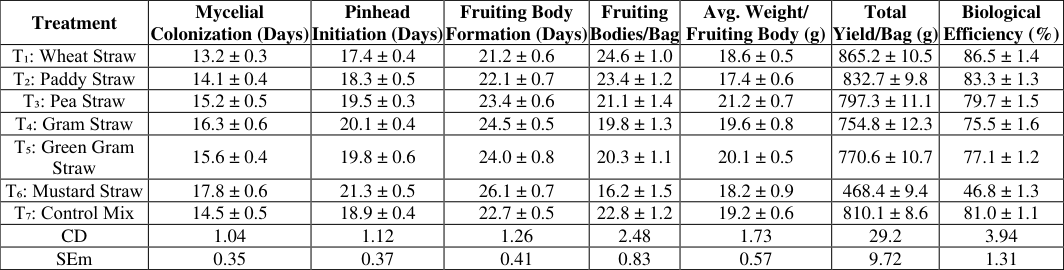 Table 1
Introduction
Mushroom cultivation has gained remarkable momentum in recent years as a sustainable and profitable agro-industry across many parts of the world. This surge in popularity is largely due to its multiple benefits-such as the effective utilization of agricultural waste, the provision of a protein-rich and low-fat food source, and its potential to generate rural employment with low investment and infrastructure requirements (Chang & Miles, 2004) [4] . Among the different edible mushrooms, Pleurotus ostreatus, commonly known as the oyster mushroom, stands out due to its ease of cultivation, ability to grow on a wide range of substrates, rapid mycelial colonization, short cropping cycle, and relatively high biological efficiency (Patil et al., 2010) [15] . A critical factor influencing the success of mushroom cultivation is the choice of substrate. Oyster mushrooms are saprophytic fungi, and their growth and productivity are significantly affected by the nutritional and physical properties of the substrate used. Various lignocellulosic materials-typically agro-residues-are employed as substrates, such as wheat straw, paddy straw, gram straw, pea husk, and other legume residues (Shah et al., 2004; Sarker et al., 2007) [17,16] . These agricultural by-products are composed of different levels of cellulose, hemicellulose, and lignin, which influence the availability of nutrients for fungal metabolism and mycelial expansion (Girmay et al., 2016) [6] . The biodegradation of these The substrate not only serves as a nutritional base but also provides structural support and maintains appropriate aeration and moisture levels essential for fungal growth. Selecting a suitable substrate is especially important in lowresource settings where growers rely on locally available materials. Therefore, identifying the most effective substrate from common agro-wastes can improve productivity and resource efficiency in mushroom farming. Therefore, present study was undertaken to assess the impact of different agricultural straws-namely wheat straw, paddy straw, gram straw, pea straw, green gram straw, and mustard straw-on the growth behavior and yield performance of Pleurotus ostreatus under natural room temperature conditions. By using these commonly available crop residues, this research aims to determine the most suitable substrate for small-scale oyster mushroom cultivation, thereby promoting sustainable waste management and rural entrepreneurship.
Materials and Methods
Materials and Methods
Location and Environmental Conditions
The experimental trial was carried out at the Mushroom Research Laboratory, Department of Agriculture, Shivalik College of Engineering, Dehradun under controlled ambient environmental settings suitable for oyster mushroom cultivation. The average room temperature during the study ranged between 24.5 °C and 28.5 °C, with a relative humidity of 70-80%, which are considered ideal conditions for the mycelial growth and fruiting of Pleurotus ostreatus.
The laboratory was kept well-ventilated, and the lighting conditions were maintained naturally to replicate real-world low-input growing environments.
Experimental Layout and Design
The experiment was structured using a Randomized Block Design (RBD) to reduce environmental variability and ensure statistical accuracy. A total of seven treatments (substrate types) were tested, and each treatment was replicated five times, resulting in 35 experimental bags. Each bag consisted of a specific substrate inoculated with mushroom spawn. The blocks were arranged in a way to minimize the influence of light, airflow, and temperature gradients within the laboratory.
Treatment Details
The seven treatment groups consisted of different agroresidue-based substrates as T₁ -Wheat straw, T₂ -Paddy straw, T₃ -Pea straw, T₄ -Gram straw, T₅ -Green gram straw, T₆ -Mustard straw and T₇ -Control (a uniform mixture of all six above substrates in equal proportion). Each substrate was selected based on local availability, biodegradability, and known nutritional potential for mushroom cultivation.
Substrate Processing and Spawn Inoculation
The agro-wastes used as substrates were air-dried and chopped manually into small pieces measuring approximately 3 to 5 centimeters in length to facilitate easy handling and enhance mycelial penetration. These chopped substrates were soaked in clean water for 12 hours to increase their moisture content and soften the fibers for better colonization. Following soaking, the substrates were allowed to drain and then pasteurized for one hour to eliminate any unwanted microbial contaminants. Once cooled to room temperature, the substrates were inoculated with spawn of Pleurotus ostreatus at a rate of 5% (w/w) of the wet substrate weight, using wheat grain-based spawn. The inoculated substrates were tightly packed into 1kilogram capacity transparent polythene bags with small air vents to allow gas exchange. These bags were incubated in a dark room on metal racks in an upright position to maintain uniformity and prevent contamination during the colonization period.
Data Collection and Observational Parameters
During the course of the experiment, the following growth and yield parameters were recorded systematically. Obtained by dividing total harvested weight by the number of mushrooms. Total fresh yield per bag (g): Cumulative fresh weight of mushrooms harvested per bag.
Number of days for complete mycelial colonization:
Biological Efficiency (BE%) is a standard parameter used in mushroom cultivation to evaluate how efficiently a substrate is converted into mushroom yield. It is expressed as a percentage and provides a direct measure of productivity in relation to the initial dry weight of the substrate.
Statistical Analysis
All quantitative data collected from the experimental treatments were subjected to statistical evaluation using Analysis of Variance (ANOVA) appropriate for the Randomized Block Design. The level of significance was tested at 5% probability (p<0.05) to determine the differences among treatment means. The statistical analysis was performed using the OPSTAT software, a statistical tool commonly used in agricultural research. Wherever necessary, critical differences (CD) were computed to compare the means of significantly differing treatments.
Results and Discussion
The performance of Pleurotus ostreatus cultivated on different agro-waste-based substrates was evaluated in terms of growth behavior and yield performance. The recorded parameters included days for mycelial colonization, pinhead initiation, fruiting body formation, number of fruiting bodies, average fruiting body weight, total yield per bag, and biological efficiency (BE%). Significant differences were observed among the treatments, indicating that the type of substrate had a marked influence on both the vegetative and reproductive phases of mushroom development.
Mycelial Colonization
It revealed from table-1 that wheat straw (T₁) recorded the shortest colonization period (13.2 days), followed by paddy straw (14.1 days) and control mix (14.5 days). The longest colonization time was observed in mustard straw (17.8 days), possibly due to the presence of anti-fungal secondary metabolites such as glucosinolates that inhibit rapid mycelial spread. Similar findings have been reported by Jandaik and Goyal (1995) [8] and Girmay et al. (2016) [7] , emphasizing wheat straw as a superior substrate for rapid colonization.
Pinhead Initiation
It depicted from table-1 that early pinning was observed in wheat and paddy straw substrates (17.4 and 18.3 days, respectively), suggesting favorable conditions for primordia initiation due to their optimal lignocellulosic composition. Delayed pinning in mustard straw (21.3 days) indicates suboptimal substrate quality for reproductive initiation.
Fruiting Body Formation
It depicted from table-1 fruiting body emergence followed the trend of colonization and pinning. The shortest time to harvest was in wheat straw (21.2 days), while mustard straw took the longest (26.1 days). The structural compactness and nutrient content of wheat and paddy straw are likely contributors to earlier fruiting. These results align with Shah et al. (2004) [17] and Sarker et al. (2007) [16] , who demonstrated faster fruiting in cereal straw substrates.
Number of Fruiting Bodies
It depicted from table-1 the highest number of fruiting bodies per bag was recorded in wheat straw (24.6), followed by paddy straw (23.4), while mustard straw produced the least (16.2). Higher fruiting count reflects better substrate porosity and mycelial vigor, leading to greater reproductive output.
Average Fruiting Body Weight
It depicted from table-1 pea straw (T₃) and green gram straw (T₅) had slightly fewer fruiting bodies, they exhibited higher average individual weights (21.2 g and 20.1 g, respectively), indicating more energy directed into fewer, larger mushrooms. This may reflect better moisture retention or nutrient availability in legume-based residues.
Total Yield and Biological Efficiency
It depicted from table-1 wheat straw (T₁) led in terms of total yield (865.2 g/bag) and biological efficiency (86.5%), followed closely by paddy straw (832.7 g, 83.3%) and control mix (810.1 g, 81.0%). Mustard straw resulted in the lowest yield (468.4 g) and BE (46.8%). These results affirm the suitability of cereal straws for efficient substrate-tobiomass conversion. Similar trends were noted by Biswas et al. (2008) [3] , Mahajan and Sharma (2010) [11] , and Alam et al. (2007) [2] . The findings highlight that wheat straw is the most effective substrate for oyster mushroom cultivation under ambient room conditions, offering superior yield, faster growth, and high biological efficiency. Paddy straw and the mixed control substrate also showed promise. In contrast, mustard straw is less favorable, possibly due to chemical inhibitors or poor substrate texture. Leguminous straws like pea and gram performed moderately and may benefit from supplementation or blending with cereal residues.
Summary and Conclusion:
The study assessed the impact of various agro-waste substrates on the growth performance and yield of Pleurotus ostreatus under ambient environmental conditions. Seven substrate treatments-including individual cereal and legume straws along with a mixed control-were evaluated using a randomized block design with five replications. Growth parameters such as days to mycelial colonization, pinhead initiation, fruiting body formation, total number of fruiting bodies, average weight of individual fruiting bodies, total yield per bag, and biological efficiency (BE%) were meticulously recorded. It concluded that Mycelial colonization was fastest on wheat straw (13.2 days), followed closely by paddy straw and the control mix. The slowest colonization occurred on mustard straw (17.8 days), likely due to inhibitory compounds like glucosinolates. This suggests that cereal-based substrates provide a more favorable environment for rapid vegetative growth of the fungus. In terms of pinhead initiation and fruiting body development, wheat straw again outperformed other substrates, indicating its high efficiency in supporting the reproductive phase of the mushroom. Mustard straw significantly lagged in both parameters, highlighting its unsuitability for productive cultivation. It also concluded that the number of fruiting bodies was highest on wheat straw (24.6 per bag), reflecting a direct correlation with faster colonization and earlier pinhead formation. Although pea and green gram straw produced fewer fruiting bodies, they demonstrated the heaviest individual mushrooms, suggesting better energy allocation per fruiting structure. These legume-based substrates may have contributed higher protein or moisture content, enhancing fruit body size. It evident from results, when comparing total yield and biological efficiency, wheat straw led with 865.2 g yield per bag and 86.5% BE, followed by paddy straw and the control mix. In contrast, mustard straw had the lowest yield (468.4 g) and BE (46.8%), confirming its poor performance as a substrate. These findings are consistent with previous studies that highlight the superior performance of cereal straws in oyster mushroom production. The experimental results confirm that the type of substrate plays a critical role in determining the growth rate, fruiting behavior, and overall productivity of Pleurotus ostreatus. Wheat straw emerged as the most effective substrate, delivering the highest yield and biological efficiency while supporting rapid colonization and early fruiting. Paddy straw and the equal mixture of all substrates (control mix) also performed well and can serve as viable alternatives, especially when wheat straw is not readily available. Though legume-based straws like pea and green gram did not support high numbers of fruiting bodies, their contribution to fruit body size and weight was notable. These could be considered in combination with cereal straws to improve mushroom quality. On the other hand, mustard straw was found to be the least suitable substrate due to delayed colonization, lower yields, and significantly reduced biological efficiency. Overall, this study reinforces the importance of substrate selection in oyster mushroom cultivation and recommends the use of locally available, nutrient-rich, and easily decomposable materials such as wheat and paddy straw for optimal results. Future research could focus on substrate enrichment strategies, microbial supplementation, and integration of legume residues in specific ratios to enhance both yield and mushroom quality.
Recommendations
The evaluation of Pleurotus ostreatus cultivation on various agro-waste substrates has led to practical recommendations that can significantly enhance mushroom productivity. Among the tested materials, wheat straw emerged as the most efficient substrate. It not only achieved the highest biological efficiency (86.5%) but also showed rapid colonization and the highest yield per cultivation bag (865.2 g). Given these outstanding results, wheat straw is strongly suggested as the preferred substrate for large-scale or commercial mushroom production, especially in regions where it is readily accessible. For locations where wheat straw is either limited or expensive, alternative options such as paddy straw or a balanced mixture of all tested straws also performed effectively. These alternatives can be utilized to maintain reasonable yields when wheat straw is unavailable. In contrast, mustard straw showed unsatisfactory outcomes across multiple parameters including a low yield, slower colonization, and reduced biological efficiency (46.8%). Due to these shortcomings, its use as a standalone substrate is not advisable. If used, it must undergo proper pretreatment or be combined in small quantities with other higher-performing substrates to minimize its negative effects. Additionally, substrates derived from leguminous crops like pea, gram, and green gram did not yield the highest quantities but were notable for producing larger fruiting bodies. This characteristic suggests their potential value in improving the quality and possibly the nutritional profile of the mushrooms. Therefore, combining legume straws with cereal-based substrates may help enhance the appearance and marketability of the final produce.
Since all tested substrates are essentially agricultural residues available after harvest, farmers should prioritize those that are locally abundant, easy to handle, and economically feasible. This selection strategy can help lower production costs while promoting greater adoption of mushroom farming among rural communities. To further optimize performance, especially with lowefficiency substrates, future research should focus on enriching those using organic additives or microbial inoculants. Additions like cow dung slurry, gypsum, or beneficial fungi such as Trichoderma spp. have the potential to improve colonization and yield significantly. Ultimately, promoting mushroom cultivation through the use of agricultural waste not only offers an efficient way to recycle farm residues but also supports environmentally responsible farming practices. It can help reduce stubble burning and its associated pollution while providing rural populations with an additional income source. Wheat straw should be highlighted as a highly effective substrate, and legume straws may be incorporated to improve the product's overall quality. However, the use of mustard straw should be approached with caution unless suitably processed. Continued research into composting methods and nutrient fortification can play a key role in making mushroom farming more productive and sustainable in the long term.
Figures and tables from the paper
| Treatment | Mycelial Colonization (Days) | Pinhead Initiation (Days) | Fruiting Body Formation (Days) | Fruiting Bodies/Bag | Avg. Weight/ Fruiting Body (g) | Total Yield/Bag (g) | Biological Efficiency (%) |
|---|---|---|---|---|---|---|---|
| T₁: Wheat Straw | 13.2 ± 0.3 | 17.4 ± 0.4 | 21.2 ± 0.6 | 24.6 ± 1.0 | 18.6 ± 0.5 | 865.2 ± 10.5 | 86.5 ± 1.4 |
| T₂: Paddy Straw | 14.1 ± 0.4 | 18.3 ± 0.5 | 22.1 ± 0.7 | 23.4 ± 1.2 | 17.4 ± 0.6 | 832.7 ± 9.8 | 83.3 ± 1.3 |
| T₃: Pea Straw | 15.2 ± 0.5 | 19.5 ± 0.3 | 23.4 ± 0.6 | 21.1 ± 1.4 | 21.2 ± 0.7 | 797.3 ± 11.1 | 79.7 ± 1.5 |
| T₄: Gram Straw | 16.3 ± 0.6 | 20.1 ± 0.4 | 24.5 ± 0.5 | 19.8 ± 1.3 | 19.6 ± 0.8 | 754.8 ± 12.3 | 75.5 ± 1.6 |
| T₅: Green Gram Straw | 15.6 ± 0.4 | 19.8 ± 0.6 | 24.0 ± 0.8 | 20.3 ± 1.1 | 20.1 ± 0.5 | 770.6 ± 10.7 | 77.1 ± 1.2 |
| T₆: Mustard Straw | 17.8 ± 0.6 | 21.3 ± 0.5 | 26.1 ± 0.7 | 16.2 ± 1.5 | 18.2 ± 0.9 | 468.4 ± 9.4 | 46.8 ± 1.3 |
| T₇: Control Mix | 14.5 ± 0.5 | 18.9 ± 0.4 | 22.7 ± 0.5 | 22.8 ± 1.2 | 19.2 ± 0.6 | 810.1 ± 8.6 | 81.0 ± 1.1 |
| CD | 1.04 | 1.12 | 1.26 | 2.48 | 1.73 | 29.2 | 3.94 |
| SEm | 0.35 | 0.37 | 0.41 | 0.83 | 0.57 | 9.72 | 1.31 |
Table text extracted from the original PDF; superscript letters are shown inline. The original table image is below.
View original table image
References
21 in the original paper- Akinyele BJ. Cultivation of Pleurotus tuber-regium on different substrates. Pak J Nutr. 2007;6(6):606-609.
- Alam N, Amin R, Khan A, Ara I. Nutritional analysis of cultivated mushrooms in Bangladesh. Mycobiology. 2007;35(3):149-153.
- Biswas A, Datta M, Roy R. Cultivation of oyster mushroom on different substrates. Environ Ecol. 2008;26(1):121-123.
- Chang ST, Miles PG. Mushrooms: Cultivation, nutritional value, medicinal effect, and environmental impact. Boca Raton: CRC Press; 2004.
- Deepalakshmi K, Mirunalini S. Pleurotus ostreatus: An oyster mushroom with nutritional and medicinal properties. J Biochem Technol. 2014;5(2):718-726.
- Girmay Z, Gorems W, Birhanu G, Sori W. Growth and yield performance of oyster mushroom (Pleurotus ostreatus) on different substrates. AMB Express. 2016;6(1):1-7.
- Girmay Z, Gorems W, Birhanu G, Sori W. Growth and yield performance of oyster mushroom (Pleurotus ostreatus) on different substrates. AMB Express. 2016;6:87.
- Jandaik CL, Goyal SP. Farm residues and mushroom cultivation. Indian Farming. 1995;45:17-19.
- Kumar S, Sharma VP. Evaluation of some supplementing materials for production of Pleurotus sajor-caju. Indian J Mushrooms. 2009;27:37-40.
- Lamraoui G, Tefiani C, Maouedj A, et al. Promoting yield and oyster mushroom cycle production by using date kernel and wheat straw mixture as a cultivation substrate. BioResources. 2025;20(3):7421-7434.
- Mahajan MP, Sharma VP. Evaluation of different substrates and supplements on the yield of Pleurotus ostreatus. Mushroom Res. 2010;19(1):13-17.
- Manan FAA, Webb C. Use of agricultural waste as mushroom substrate: A review. J Environ Biol. 2018;39:741-749.
- Olaniyan SA, Hussein JB, Oke MO, Akinwande BA, Workneh TS, Maziya Dixon BB, et al. Evaluating cassava peel based substrates on the yield and nutritional quality of oyster mushroom (Pleurotus ostreatus). Discov Food. 2025;5:80.
- Pandey M, Ghosh SK. Impact of various substrates on oyster mushroom yield. Int J Curr Microbiol Appl Sci. 2017;6(11):1060-1066.
- Patil SS, Ahmed SA, Telang SM, Baig MMV. The nutritional value of Pleurotus ostreatus (Jacq.: Fr.) Kumm cultivated on different lignocellulosic agrowastes. Innov Rom Food Biotechnol. 2010;7:6676.
- Sarker NC, Rahman MH, Ahmed MU. Performance of different substrates on the growth and yield of oyster mushroom (Pleurotus ostreatus). J Agric Rural Dev. 2007;5(1-2):121-126.
- Shah ZA, Ashraf M, Ishtiaq MC. Comparative study on cultivation and yield performance of oyster mushroom (Pleurotus ostreatus) on different substrates (wheat straw, leaves, sawdust). Pak J Nutr. 2004;3(3):158-160.
- Sharma K, Gautam N. Biodegradation of agricultural waste by Pleurotus species for mushroom production. Indian J Microbiol. 2008;48:323-329.
- Sharma VP, Kumar S. Substrate utilization of Pleurotus spp. on different agro-wastes. Mushroom Res. 2005;14(2):72-75.
- Singh M, Vijay B, Kamal S, Wakchaure GC. Mushroom cultivation for rural development. Solan: National Research Centre for Mushrooms; 2011.
- Upadhyay RC, Verma RN, Sharma SR. Oyster mushroom production: Status and prospects. Solan: National Research Centre for Mushrooms; 2002.