
Research article · 2025 · Full text
International Journal of Geography Geology and EnvironmentEchoes of the Monsoon: Ancient Indian techniques for predicting Rainfall
Volume 7(7) · Pages 54–60 · DOI: 10.22271/27067483.2025.v7.i7a.386 ↗
Research areasFlood Risk Assessment and Management
Abstract
Author-writtenThe practice of predicting weather conditions in India can be traced back to ancient times. The Upanishads, one of the earliest texts dated at 3000 BCE, have numerous references to the processes involving cloud formation and rain. There is a considerable amount of discussion about the processes of cloud formation and rain. There are different techniques used in astrometeorology for predicting rainfall, Aryabhata and Varahamihira discovered the scientific principles behind measuring and forecasting rain. Traditional projections rely on systematic annotations and the combination of almanacs, pachangas, climatological and astral indicators, flora, fauna, insects, and accumulated data over an extended period. Ancient Indians devised highly sophisticated methods for forecasting monsoon rainfall by closely observing astronomical events, animal behaviour, and changes in local weather conditions. Passed down through generations of farmers, sages, and astrologers, these traditional techniques provided meaningful insights into the timing and nature of the approaching rainy season. A rich tradition of meteorological practices draws from a blend of spiritual, astrological, and scientific knowledge that has evolved over millennia. These are undocumented and passed on from generation. In the past centuries, people did not have the luxury of automated weather forecasting machines. But these methods of forecasting systems were grounded in ancient wisdom and practices based on people’s accumulated experience, calculating rainfall, issuing early warnings, and various aspects of climate moods. This article aims to explore and document traditional methods of forecasting rainfall and interpreting environmental patterns, with a focus on enhancing community-level resilience.
Summary
Source-checkedPlain-language reading of the full paper, prepared with AI and checked against the text. Each point links to the authors' own words.
Why it matters
- Weather prediction in India is an ancient practice, with texts like the Upanishads from 3000 BCE describing cloud formation and rain. View evidence ↗
- Accurate rainfall prediction is critical for India because the country's agricultural sector depends heavily on rain. View evidence ↗
- Traditional Indian forecasting uses a combination of astral indicators, almanacs (pachangas), and observations of plants, animals, and insects. View evidence ↗
The question
- The authors aim to document traditional rainfall forecasting methods and environmental pattern interpretation to help improve resilience at the community level. View evidence ↗
What they did
- Traditional prediction is categorized into the Bhoum method, which uses biological signs, and the Antariksh method, which uses atmospheric signals. View evidence ↗
- The Panchang system relies on five components: Tithi (lunar day), Vaar (weekday), Nakshatra (constellation), Yoga, and Karana. View evidence ↗
What they found
- A study of eight folklore beliefs from Bhadali Vakyo in Saurashtra found that seven of them were valid for predicting rainfall. View evidence ↗
- A regression analysis based on wind direction on Akshaytrutiya day among farmers in seven Saurashtra districts reported a predictability of 95%. View evidence ↗
- Evaluation of astrological chart forecasts in Gujarat showed varying accuracy, from 37% in 2008 to 71.3% in 2010, with an average skill score of 58.8%. View evidence ↗
- The abundant flowering of the Cassia fistula (Golden Shower Tree) is used as a biological indicator that the monsoon will begin in approximately 45 days. View evidence ↗
- Between 1996 and 2003 in Junagadh, the predicted monsoon onset based on Amaltas flowering differed from the actual date by 3 to 7 days. View evidence ↗
- In traditional animal behavior indicators, a crow crying at night is interpreted as a sign of drought. View evidence ↗
- Restless ear-flapping in goats is traditionally viewed as an indicator of incessant rain. View evidence ↗
- A halo around the moon is used as a non-biological indicator of high atmospheric moisture. View evidence ↗
What it means
- The authors conclude that combining traditional ecological knowledge with modern tools can create a more adaptive and comprehensive forecasting system. View evidence ↗
- Challenges facing indigenous forecasting include poor documentation, ineffective knowledge transfer, and a lack of coordinated studies to verify reliability. View evidence ↗
Visual summary
1 visualsIllustrations explain the paper; they do not show study data.
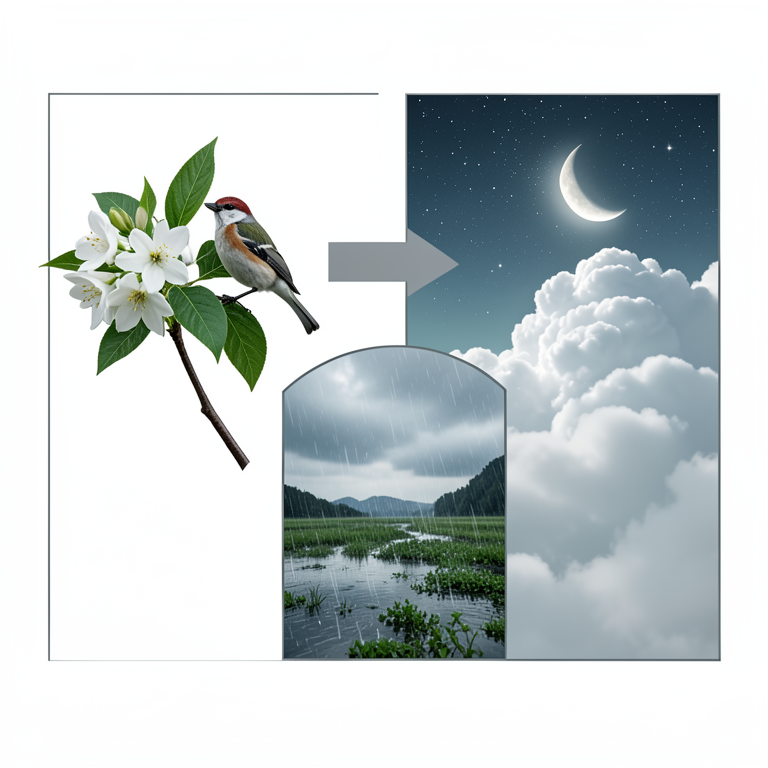
Traditional Forecasting Framework
AI-generated conceptual illustration (Indian flora, fauna, and the night sky). It explains the idea and does not show study data.
View source evidence ↗Figures & tables
From the original paper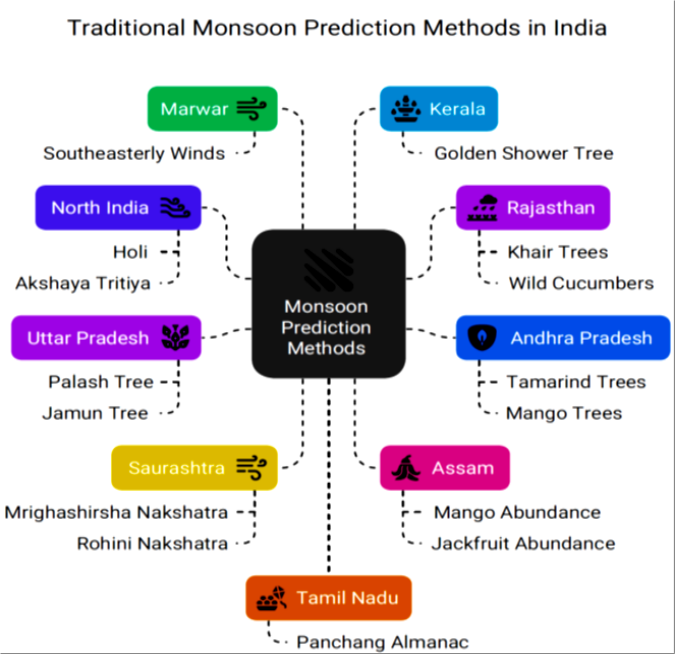 Figure 1
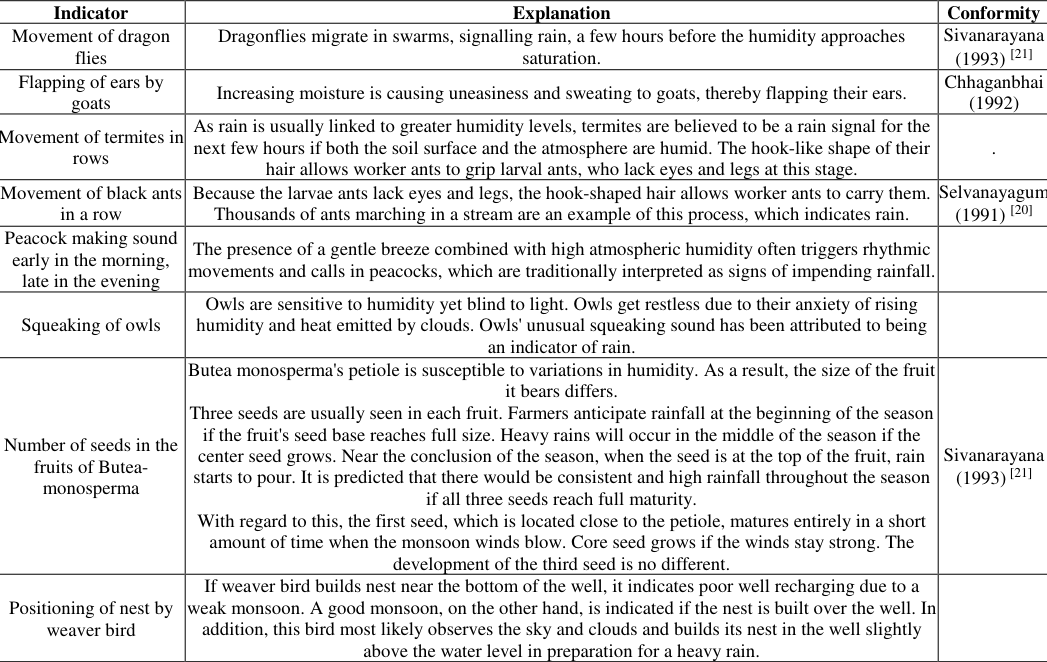 Table 2
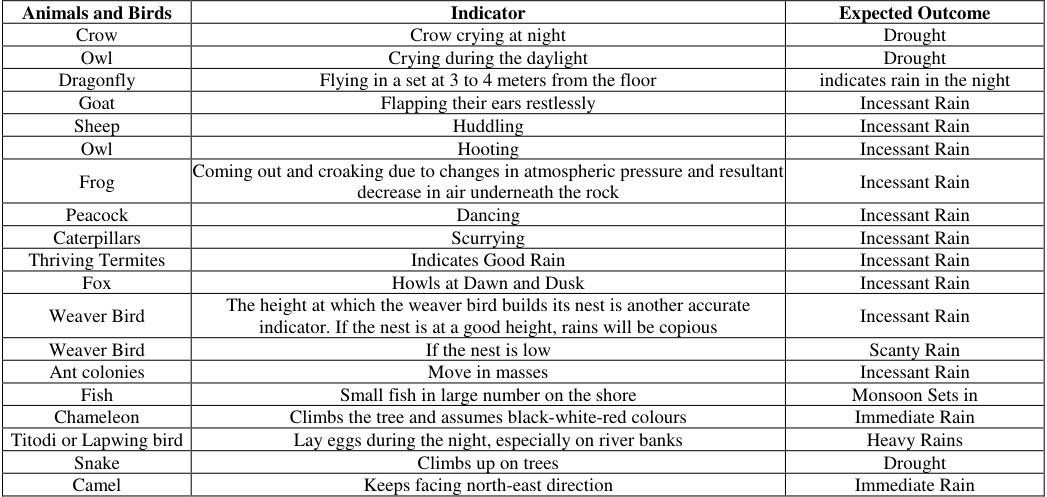 Table 3
Introduction
Indian civilization has, through the ages, relied on an amalgamation of astrological knowledge, cloud sightings, wind patterns and environmental indicators to predict rainfall millions of years before the concept of astrology was developed in the West. The texts form the basis of understanding like Rig Veda and Upanishads talk about the dynamics of cloud formation and precipitation. Chanakya (3rd century BCE) provided an insight into the rainfall patterns and early weather prediction activities. In his masterpiece work Brihat Samhita (around 6th century CE), Varahamihira explained methods to predict rain and also provided a unit called Adhaka to quantify rainfall (Sivaprakasam & Kanakasabai, 2009) [22] . He observed that the clouds formed during the first half of the month of Chaitra (April) are responsible of rainfall in late Ashwin (September) and those formed during the later part of Chaitra would lead to rainfall in early Kartika (October). Parashara, another scholar came up with another forecasting technique using the position of the sun and the moon. Such knowledge has been in public and agricultural use since the Vedanga Jyotisha period (c. 14001300 BCE) published as the Panchang, a classical Hindu astrological almanac. Varahamihira's renowned work, the Brihat-Samhita, written around 500 B.C.E., offers clear evidence of the advanced understanding of atmospheric dynamics in ancient India (Iyengar, 2006) [8] . It recognized that rainfall originates from the sun (Adityat Jayate Vrishti) and highlighted the vital role of monsoon rains in ensuring agricultural prosperity and food security. Another study by Parmar et al. (2025) [15] discusses the geographically appropriate ancient water resources management practices for conserving, reviving, and expanding water resources through the old wisdom for the benefit of all. Ancient Indian works contain numerous mentions regarding the monsoon and the severe famines due to its failure. Texts such as Yaska's Nirukta, Valmiki's Ramayana, the Jataka tales of Buddhist literature, and Chanakya's Arthashastra reflect this concern. Kalidasa's epic Meghdoot poetically captures the arrival and journey of the monsoon cloud across central India. Even Kautilya's Arthashastra, dating back to the 3rd century B.C., documents the variability of rainfall and its direct influence on India's economy-highlighting the ancient recognition of climate's impact on livelihoods. India's agriculture heavily relies on rainfall, making accurate rainfall prediction crucial for the country's agricultural sector. There is a wealth of traditional knowledge about the changing patterns of rainfall, as rain-fed agriculture has been practiced for many centuries in India. Weather has always fascinated us as a natural phenomenon, influencing our daily routines and shaping significant events throughout history. Weather prediction has evolved significantly, progressing from ancient civilizations observing celestial patterns to contemporary meteorologists utilizing cuttingedge technologies. Other methods based on numerous regional Panchangs and almanacs have been traditionally used to predict rainfall, using a combination of both biological signs (known as the Bhoum method) and nonbiological or atmospheric signals (the Antariksh method). These were used in order to measure and predict climatic behavior, especially at the time of sowing crops. Previously, when there was no such technology available, farmers used to predict weather phenomena based on their natural, cultural, and social phenomena (Waiwai and Malsale, 2013) [28] . Bhonde, K. et al. (2022) [12] revealed that there is a scientific base to the observations, which were done probably consistently across centuries to develop this science, which is evident from the very accurate calculations depicted in various scriptures and used regularly in the Tithi calculation and the Yearly Panchangs, which are published across the country. Using this traditional wisdom with scientific knowledge, we conclude that the Panchang-based system is a highly accurate system of forecasting, which can give more accurate results for longer durations in the future. Unique indigenous weather forecasting signs show variable degrees of recognition, in large part encouraged through their discovered accuracy and consistency. The challenges going through indigenous information weather forecasting consist of insufficient documentation of the knowledge and a terrible information transfer system, a lack of coordinated studies to investigate its accuracy and reliability. It performs a major function in local livelihoods and is important to assisting nearby efforts to forecast and make experience of seasonal weather situations at the local degree. The challenge beforehand is finding ways of integrating indigenous climate forecasting with the clinical climate forecasting structures.
Types and sources of predicting rainfall
Farmers across India access unique weather statistics. those consist of the onset of rainfall, the period of the cropping season, and the anticipated rainfall quantity and distribution. Meteorological and astrological indigenous weather forecasting signs consist of the path and energy of winds, big name-moon alignment, obvious movement of stars, route of the moon crescent, forms of clouds, temperature situations, lightning, thunder, and coloration of the sky and rainbow to forecast the following rainy season. Egeru (2012) [5] also notes that farmers normally use a wide array of indicators to predict the weather in their local area, such as vegetation, animal and insect activity, meteorological and astrological signs. Changes in the behavior of birds, insects and other creatures coupled with atmospheric signs are often construed as weather forecasting. Such things as the color of the sky, the halos around the sun or moon, and the migration patterns of birds are all typically cited as a part of local ecological knowledge system. A historical person, a 10th or 11th-century scholar in Saurashtra region, Bhadali wrote verses about ten important atmospheric signs which he called the ethereal embryos of rain. These were cloud shapes, wind direction, lightning, variations in the sky color, rumbling noises, thunder, dew formation, snow, rainbow, and rings of light around heavenly bodies like the sun and the moon. These he determined as ten major variables affecting the development of rainfall. Bhadali system also factored in the interaction of these factors with the configuration of planetary and stellar bodies during the course of the lunar year and it is based on this system that rainfall patterns during each month of the lunar year was interpreted. Moreover, Adhvaryu (1974) [1] and Trivedi (1986) [23] have collected a huge number of traditional beliefs (approximately 500) connected with atmospheric and biological indicators of rainfall which illustrates the richness and complexity of indigenous meteorological knowledge throughout the Indian subcontinent. Kanani et al. (2005) [30] studied eight beliefs based on folklores from Bhadali Vakyo in Saurashtra and discovered that out of eight beliefs, seven had been observed valid in the prediction of rainfall. The study on wind path on Akshaytrutiya day and rainfall observations from farmers of seven districts of Saurashtra. They advanced a regression equation among rainfall prediction because the based variable and 4 independent variables because the direction of wind and the number of farmers suggested by the largest variety of farmers, the direction of wind and the quantity of farmers said with the aid of the second one biggest quantity of farmers on Akshaytrutiya reported by using the number of farmers from Saurashtra. The predictability reported was 95%.
Fig 1:
Different areas in India have different traditional practices of rainfall prediction (Pisharoty, 1993 [14] ; Kanani and Pastakia, 1999) [10] .
Panchang and Nakshtras
here is big traditional information of the variability of rainfall patterns, on the grounds that rain-fed cultivation has been done for several centuries in India. The periods utilized by the farmer are, however, not weeks or months but soreferred to as 'nakshatras'-which might be 13-or 14-day intervals based on the solar calendar. The phrase panchang includes two Sanskrit phrases: panch, or five, and ang, that means components. The five parts of a panchang are 1) Tithi or lunar day, 2) Vaar or weekday, 3) Nakshatra or constellation 4) Yoga, or the time for the duration of which the joint motion of the solar and moon covers a constellation, and 5) Karana, or half of a lunar day or half Tithi. Panchang predictions are executed the use of some located regulations. The panchang offers calculations of Nakshatra based totally on 3 parameters, i.e., astronomy, mathematics, and astrology. those permits found out people to predict fortnightly common rainfall. A Hindu year is a lunar year, with each fourth year having thirteen months to modify with Earth's natural 12 months. various stars, planets, and constellations in the sky are divided into 27 components called Nakshatras. each Nakshatra can't be placed effortlessly like a zodiac signal, as it's far a part of the sky as seen from a specific point on the planet. because the moon enters each Nakshatra (just like the moon entering a particular zodiac signal), the same prevails at that time of the year. Of the 27 Nakshatras, 9 are in the course of monsoon, as a result referred to as monsoon nakshatras. Although, initially, this artwork of rainfall forecasting changed into practiced through some professionals like Garga, Parasara, Narada, Devala, Vashistha, Bhrugu, Druhina, Rajputra, Kashyapa, Varahmihir, and so on. Later, in light of cautious remark overlaying extra areas, the quantity of experts elevated, and evidently, the thumb regulations also multiplied in number. Many of those regulations had been passed down via the generations, and that they had been included into neighbourhood panchang and folklores or proverbs (Ramanathan, 1987) [16] . its miles believed that the village astrologers are accurate for predicting climate situations, that's exceedingly reliable. The maximum critical thing regarding our ancient scripture is that the future climate of the coming year collectively may be predicted (Angchok et al., 2004) [2] . According to Iyengar (2009) [9] , yr-to-year variant of Indian rains is delineated qualitatively in our historic Sanskrit texts. It has left its imprints in all varieties of literature, beginning from the Rigveda. Vedic traditions had a group of statistics that "we can know quite we are able to tell." they may be typically installed, dispersed, agreed upon, and tested a number of the neighbourhood, unique livelihood and aid-based groups (Santha et al., 2010) [18] . The classical Hindu astrological almanac called Panchangam, organized for public use from the Vedanga Jyotishyam period (1,400 BC-1,300 BC) (Sivaprakasam & Kanakasabai, 2009) [22] , will be the best exemplification of ancient conventional texts that employ theoretical techniques. The prediction of immediate rain from surrounding phenomena has also been given (Vaidya, 2016) [31] . In Saurashtra, farmers accept as true with that drought takes place if "the speed of wind is low at some point of the Margashirsha constellation, observed by way of the absence of excessive warmth during the Rohini (Kanani et al., 2004) [10] . Using astrological concepts Varshneya et al. (2002) [26] designed an almanac called Nakshatra-Varsha to determine the date of monsoon arrival, withdrawal and distribution of rainfall over five areas in Maharashtra. Varshneya et al. (2008) [25] later came up with the Monsoon Research Almanac which was giving daily rainfall predictions in different districts of Gujarat. This was done by drawing astrological charts (kundalis) when the sun entered each Nakshatra peculiar to each district. When these forecasts were evaluated against performance on a binary basis, it was found that the level of accuracy varied across years--37 percent in 2008, 71.3 percent in 2010--and yielded an average skill score of 58.8 percent across the state (Vaidya, 2013) [32] . Additional comparative studies were made by comparing Panchangam based predictions with the observed rainfall data made available by the India Meteorological Department (IMD) (Misra et al., 2002) [13] . Further, De et al. (2004) [4] also observed that there are certain Nakshatras which significantly affect the variability and distribution of rainfall.
Non-bio indicators
Non-biological indicators are those inanimate objects or atmospheric phenomena which show perceptible changes with changes in the environmental conditions. Through close monitoring of such natural variations communities have been in a position to predict the current and future weather patterns. These are the old weather prediction techniques which have been commonly used and have been taught over generations mixed with cultural sayings and local folklore. Some of these indicators were described and classified by Ravi et al. (2008) [17] . In another related research, Vaidya and Kale (2014) [24] observed seventeen different atmospheric signals that are used to predict rainfall in Barshi area of Solapur district in Maharashtra. These were visual clues, namely: rain-bearing clouds, the reddish tint in the eastern sky just before the sun comes out and the same color in the west right after the sun sets. Other signs that were mentioned include sudden squalls, certain directions of wind, rumbling of the clouds, lightning and gusty wind. Other phenomena that would announce this would be the sighting of halos around the sun or the moon, trace rain, the occurrence of rainbows, and elevated humidity or haze. Interestingly, the biological factors like behavior of ants carrying eggs and movement of flying insects like patang were also marked as the additional signals by the study. Collectively, these observations were the foundation of predicting rain patterns through empirical environmental knowledge. Various atmospheric phenomena have traditionally been observed and interpreted as non-biological indicators of impending rainfall, forming a key part of indigenous forecasting practices under what is known as the Antariksh method. These indicators are primarily based on visual and meteorological cues occurring in the sky and atmosphere. For example, the appearance of a halo around the moon is widely considered a sign of high atmospheric moisture content. As night progresses, the halo often becomes clearer, indicating a higher probability of rainfall (Verma, 1998) [27] .
Similarly, a pink or reddish sky observed during the evening is attributed to Mie scattering under conditions of elevated humidity and cooler temperatures. This phenomenon is often linked to short-duration but high-intensity rainfall (Sivanarayana, 1993) [21] . Another commonly noted sign is the presence of red-tinted clouds during sunrise or sunset. These are believed to be caused by dark, moisture-laden clouds reflecting longwave radiation, suggesting a likelihood of rain in the near term (Selvanayagum, 1991) [20] . Directional cues also play a role in traditional forecasts. For instance, slow-moving clouds observed in the north-western sky are typically associated with the southwest monsoon, a major rain-bearing system in India (Gupta, 1993) [7] . Additionally, the presence of northerly winds accompanied by dense cloud cover is considered indicative of the northeast monsoon, which also brings significant rainfall to specific regions (Selvanayagum, 1991) [20] . These natural non-bio indicators, embedded in local ecological knowledge, have guided rural communities for centuries in anticipating seasonal changes, particularly in areas with limited access to modern meteorological infrastructure.
Bio indicators
Mishra (1998) [13] found that bio-indicators are those living beings/biotic agents that alternate their behaviour with any change in the surrounding environment or climate. Observations on the behaviour of particular birds and animals have also been used as signs of rain, as reported by means of Savalia et al. (1991) [19] and Golakia (1992) [6] . The biological signs of monsoon have additionally been nicely documented and are notably utilized by neighborhood professionals. Kanani et al. (1995) [29] documented numerous tree species which have been used as indicators of monsoon by means of local communities. for example, the plant Cassia fistula flowers in abundance 45 days before the onset of the monsoon. Pisharoty (1993) [14] mentioned that the tree Amaltas, or golden shower tree (Cassia fistula), is a completely unique indicator of rain. It bears bunches of golden yellow plant life in abundance approximately 45 days earlier than the onset of monsoon. Kanani et al. (2005) [30] found that there was a difference of 3 to 7 days among the actual date of onset of monsoon and that expected at Junagadh primarily based on flowering of Amaltas all through 1996-2003. the appearance of correct foliage of Darbha grass and the Pipal tree (Ficus religiosa) suggests an good enough monsoon. however accurate foliage of Bael (Aegle marmelos) and Khejro (Prosopis cineraria) shows drought situations. Observations at the behaviour of specific birds and animals have also been used as signs of rain, as stated with the aid of Savalia et al. (1991) [19] and Golakia (1992) [6] . Sighting chatura (dragonfly) method that monsoon is over Table 2: Natural bio-indicators (Bhoum method) for rain forecasting (Ravi et al., 2008) [17] Indicator Explanation Conformity Movement of dragon flies Dragonflies migrate in swarms, signalling rain, a few hours before the humidity approaches saturation.
Sivanarayana (1993) [21] Flapping of ears by goats Increasing moisture is causing uneasiness and sweating to goats, thereby flapping their ears. Chhaganbhai (1992)
Movement of termites in rows
As rain is usually linked to greater humidity levels, termites are believed to be a rain signal for the next few hours if both the soil surface and the atmosphere are humid. The hook-like shape of their hair allows worker ants to grip larval ants, who lack eyes and legs at this stage.
Movement of black ants in a row
Because the larvae ants lack eyes and legs, the hook-shaped hair allows worker ants to carry them. Thousands of ants marching in a stream are an example of this process, which indicates rain.
Selvanayagum (1991) [20] Peacock making sound early in the morning, late in the evening
The presence of a gentle breeze combined with high atmospheric humidity often triggers rhythmic movements and calls in peacocks, which are traditionally interpreted as signs of impending rainfall.
Squeaking of owls
Owls are sensitive to humidity yet blind to light. Owls get restless due to their anxiety of rising humidity and heat emitted by clouds. Owls' unusual squeaking sound has been attributed to being an indicator of rain.
Number of seeds in the fruits of Buteamonosperma Butea monosperma's petiole is susceptible to variations in humidity. As a result, the size of the fruit it bears differs. Three seeds are usually seen in each fruit. Farmers anticipate rainfall at the beginning of the season if the fruit's seed base reaches full size. Heavy rains will occur in the middle of the season if the center seed grows. Near the conclusion of the season, when the seed is at the top of the fruit, rain starts to pour. It is predicted that there would be consistent and high rainfall throughout the season if all three seeds reach full maturity. With regard to this, the first seed, which is located close to the petiole, matures entirely in a short amount of time when the monsoon winds blow. Core seed grows if the winds stay strong. The development of the third seed is no different.
Sivanarayana (1993) [21] Positioning of nest by weaver bird
If weaver bird builds nest near the bottom of the well, it indicates poor well recharging due to a weak monsoon. A good monsoon, on the other hand, is indicated if the nest is built over the well. In addition, this bird most likely observes the sky and clouds and builds its nest in the well slightly above the water level in preparation for a heavy rain.
Table 3:
The behaviour of animals and birds on the commencement of monsoon (Pisharoty, 1993 [14] ; Kanani and Pastakia, 1999 Santha, 2010) [18] Animals It is well known that there are also number of plant and floral species, whose phenological variations have been observed to indicate the impending arrival of the monsoon, as documented by Pisharoty (1993) [14] and Kanani and Pastakia (1999) [10] . With differences in flowering, fruiting and leaf growth cycles, these species have traditionally been relied on by local communities to predict rainfall, and based on this predict agricultural activities. A wide range of flowering plants and fruit-bearing trees have been traditionally observed across different regions of India to predict the arrival and quality of the monsoon. In Melghat, for instance, the blooming of a local flower known as Bahava is believed to occur approximately 40 days before the onset of the monsoon. Similarly, the abundant flowering of the Golden Shower Tree (Cassia fistula) is observed nearly 45 days prior to the monsoon's arrival. An excessive mango yield has been associated with the likelihood of flooding, indicating extremely heavy rainfall. The presence of jackfruit, on the other hand, is considered a positive sign, often linked with a good rice harvest and a favourable monsoon.
Tamarind trees and Palash trees are also watched for their foliage and blooming patterns, respectively-both of which are traditionally interpreted as indicators of good monsoon conditions. The ripening of Jamun fruit is taken as a signal that rainfall is imminent. Conversely, the widespread sprouting of wild cucumbers and the bushy growth of Khair trees are seen as signs of potential drought. Additional floral cues include the flowering of mango trees in January, which is considered a good omen for the upcoming monsoon season. The emergence of new shoots on Ebony trees, as well as the profuse flowering of Bamboo, are also viewed as indicators of ample rainfall. The development of large buds on Night Flowering Jasmine and the initial blooming of plants such as Kodoma and Thummi are interpreted similarly. Moreover, good foliage observed on Mahuda trees, Ber plants, and Darbha grass are all considered reliable signs that a strong and well-distributed monsoon is likely.
Conclusion
The value of ancient weather forecasting systems must not be underrated. Across India's various climatic zones, traditional knowledge-preserved through ancient texts, oral traditions, and community practices-offers understanding and region-specific understanding of weather and monsoon behaviour.
In the face of increasing climate variability and unpredictability, it is more important than ever to revisit and reassess these traditional systems alongside contemporary scientific methods. Although modern meteorology has made remarkable progress through technological advancements such as satellites, radar systems, and computer modeling, traditional methods-based on generations of careful observation of astronomical events, animal behaviour, and ecological indications-hold practical relevance at the local level. These methods are often more reachable to rural communities and embedded in the cultural and agricultural practices of the region. Incorporating traditional ecological knowledge with modern meteorological tools can help create a more complete, reorganized, and adaptive forecasting structure. This interaction can serve as an influential model for sustainable climate resilience, adding the wisdom of the past to the innovations of the present.
Figures and tables from the paper
| Animals and Birds | Indicator | Expected Outcome |
|---|---|---|
| Crow | Crow crying at night | Drought |
| Owl | Crying during the daylight | Drought |
| Dragonfly | Flying in a set at 3 to 4 meters from the floor | indicates rain in the night |
| Goat | Flapping their ears restlessly | Incessant Rain |
| Sheep | Huddling | Incessant Rain |
| Owl | Hooting | Incessant Rain |
| Frog | Coming out and croaking due to changes in atmospheric pressure and resultant decrease in air underneath the rock | Incessant Rain |
| Peacock | Dancing | Incessant Rain |
| Caterpillars | Scurrying | Incessant Rain |
| Thriving Termites | Indicates Good Rain | Incessant Rain |
| Fox | Howls at Dawn and Dusk | Incessant Rain |
| Weaver Bird | The height at which the weaver bird builds its nest is another accurate indicator. If the nest is at a good height, rains will be copious | Incessant Rain |
| Weaver Bird | If the nest is low | Scanty Rain |
| Ant colonies | Move in masses | Incessant Rain |
| Fish | Small fish in large number on the shore | Monsoon Sets in |
| Chameleon | Climbs the tree and assumes black-white-red colours | Immediate Rain |
| Titodi or Lapwing bird | Lay eggs during the night, especially on river banks | Heavy Rains |
| Snake | Climbs up on trees | Drought |
| Camel | Keeps facing north-east direction | Immediate Rain |
Table text extracted from the original PDF; superscript letters are shown inline. The original table image is below.
View original table image
References
32 in the original paper- Adhvaryu R. Prachin Varsha Vignan. Ahmedabad, Gujarat: Gujarat Loksahitya Academy, 1974.
- Angchok D, Dubey VK. Traditional method of rainfall prediction through Almanacs in Ladakh. Indian Journal of Traditional Knowledge. 2006 Jan;5(1):145-150.
- Chhaganbhai CK. Forecasting Rain Ants. Honey Bee. 1992;3(3-4):16.
- De US, Joshi UR, Prakasa Rao GS. Nakshatram based rainfall climatology. Mausam. 2004;55(2):305.
- Egeru A. Role of indigenous knowledge of climate change adaptation: a case study of the Teso Sub Region, Eastern Uganda. Indian Journal of Traditional Knowledge. 2012;11(2):217-224.
- Golakia BA. Proverbs for predicting the moods of Monsoon. Honey Bee. 1992;3(1):12.
- Gupta SL. Traditional Agricultural Knowledge and its Rationality in Kharwar Community of Varanasi District (U.P.) [PhD Thesis]. Varanasi: Department of Extension Education, BHU; 1993.
- Iyengar RN. Description of rainfall variability in BrhatSamhita of Varaha-mihira. Asian Journal of the Geological Society of India. 2006, 68(3).
- Iyengar RN. Monsoon rainfall cycles as depicted in ancient Sanskrit text. Asian Agri-History. 2009;97(3).
- Kanani PR, Pastakia A. Everything is Written in the Sky!: Participatory Meteorological Assessment and Prediction Based on Traditional Beliefs and Indicators in Saurashtra. FiubiosJournal Asia and International Bioethics. 1999;9:170-6.
- Kanani PR, Malavia DD, Savaliya VJ. Validation of Traditional Meteorological Principles in Saurashtra, India. Paper presented at: Conference Proceedings' Bridging Scales and epistemologies: Linking Local Knowledge and Global Science in Multi-Scale Assessments. 2004, 17-20; Alexandria, Egypt.
- Kanchan A Bhonde, et al. Assessment of Accuracy of Indian Almanac for Daily Rainfall Prediction. Indian Journal of Science and Technology. 2022;15(32):15481560. https://doi.org/10.17485/IJST/v15i32.1743
- Mishra SK, Dubey VK, Pandey RC. Rain forecasting in Indian almanacs (Panchangs): A case for making Krishi-Panchang. Asian Agri-Hist. 2002;6(1):29-42.
- Pisharoty PR. Plant that predicts Monsoon. Honey Bee. 1993;4(4):12.
- Parmar K, Joshi J, Bhatt B. Exploring the Structures of Water Resource Management in Ancient India: A Geographical Perspective. Journal of Geography, Environment and Earth Science International. 2025;29(5):16-27. https://doi.org/10.9734/jgeesi/2025/v29i5891
- Ramanathan AS. Contribution to weather science in Ancient India, V-Principles of forecasting rainfall in Ancient India (Long range). Indian j. hist. sci. 1987;22(3):175-190.
- Ravi SK, Pochaiah M, Murthy VRK, Ramakrishna YS. Indigenous Rain Forecasting in Andhra Pradesh. Hyderabad: Central Research Institute for Dryland Agriculture; 2008. 67.
- Santha SD, Fraunholz B, Unnithan C. A societal knowledge management system: harnessing indigenous wisdom to build sustainable predictors for adaptation to climate change. The international journal of climate change: impacts and responses. 2010;2(1):51.
- Savalia VJ, Kher AO, Kanani PR, Munshi MA. Pashu Pakshini Cheshta ne Adhare Megh ne Endhan. Narmada Kisan Parivar Patra (Gujarati). 1991, 8.
- Selvanayagum M. Some of the Traditional Beliefs Currently in Vogue at Kovilpatti. Honey Bee. 1991, 2(2). IIM, Ahmedabad.
- Sivanarayana G. Indigenous Technical Knowledge and its Communication Pattern in East Godavari District of Andhra Pradesh [PhD Thesis]. Varanasi: Department of Extension Education, BHU, 1993.
- Sivaprakasam S, Kanakasabai V. Traditional almanac predicted rainfall -A case study. Indian J. Traditional Knowledge. 2009;8(4):621-625.
- Trivedi JN. Bhadali Vakyo. Ahmedabad, Gujarat: Pub. Sastu Sahitya, 1986.
- Vaidya VB, Kale N. Review of Vedic Rain Forecasting and Rain Induction Science and Technology. Bharatiya Bouddhik Sampada. 2014;43:22-43.
- Varshneya MC, et al. Validation of Astrometeorological Rainfall forecast for Gujarat. J. Agrometeorol. 2008;10:345-348.
- Varshneya MC, et al. Nakshatra-varsha almanac prepared for Maharashtra. Mr. Vijay Bhat. 2002, 1-22.
- Verma LR. A Glimpse of Indigenous Technology Knowledge for Watershed Management in Upper North-West Himalayas of India. In: Negi A, Sharma PN, editors. WATMATEC. Solan, H.P.: YSP University of Horticulture and Forestry. 1998, 1-97. and PWMTA, Netherlands/ FAO (UN), Katmandu, Nepal.
- Waiwai M, Malsale P. National Workshop on Traditional Knowledge of Weather and Climate. Vanuatu Meteorology and Geo-Science Dept. Rep. 2013, 48.
- Al-Kanani HJ, Booth JG. Magnetic field induced transitions in Mn5Si3. Journal of magnetism and magnetic materials. 1995 Feb 1;140:1539-40.
- Kanani M, Moorman AF, Cook AC, Webb S, Brown NA, Lamers WH, Anderson RH. Development of the atrioventricular valves: clinicomorphological correlations. The Annals of thoracic surgery. 2005 May 1;79(5):1797-804.
- Vaidya MV, Collins CM, Sodickson DK, Brown R, Wiggins GC, Lattanzi R. Dependence of and field patterns of surface coils on the electrical properties of the sample and the MR operating frequency. Concepts in Magnetic Resonance Part B: Magnetic Resonance Engineering. 2016 Feb;46(1):25-40.
- Vaidya AJ. Epistemic responsibility and critical thinking. Metaphilosophy. 2013 Jul;44(4):533-56.