
Research article · 2025 · Full text
International Journal of Agriculture and Food SciencePerformance of insecticides with different pH and TDS level of water against leafhopper Empoasca Kerri Pruthi on greengram
Volume 7(8) · Pages 26–30 · DOI: 10.33545/2664844x.2025.v7.i8a.589 ↗
Research areasAgricultural Practices and Plant GeneticsAgricultural pest management studiesAgricultural Science and Fertilization
Abstract
Author-writtenAn experiment entitled “Performance of insecticides with different pH and TDS level of water against major insect pests of greengram” was conducted during kharif 2024-25 at Seed Technology Research Unit, Dr. Panjabrao Deshmukh Krishi Vidyapeeth, Akola to study the effect of water pH, TDS and Electrical conductivity on bio efficacy of insecticides against major pests of greengram. The experiment was laid out in Factorial Randomized Block Design (FRBD) with three replications and nine treatments. The treatment details of the experiment, spraying insecticides with Acidic, Neutral and Alkaline water. The respective TDS and Electrical conductivity of Acidic, Neutral and Alkaline water were (358 ppm), (531 ppm), (691 ppm) and (0.53 dS/m), (0.83 dS/m), (1.08 dS/m). The population of leafhopper observed lowest in the treatment of Quinalphos25% EC followed by Spinetoram 11.7% SC and Chlorantraniliprole 18.5% SC. Among water pH levels, the population of leafhopper was lowest in the treatment of Acidic water (7 pH) it was at par with Neutral water (7pH) and maximum population was recorded in Alkaline water (9 pH). In interaction effect, insecticides in acidic and neutral water more effective for management of leafhopper.
Summary
Source-checkedPlain-language reading of the full paper, prepared with AI and checked against the text. Each point links to the authors' own words.
Why it matters
- Green gram (mung bean) is the third most significant pulse crop in India, following pigeon pea and chickpea. View evidence ↗
- Major pests like jassids and whiteflies damage green gram by sucking sap, transmitting diseases, and hindering photosynthesis, which leads to yield losses. View evidence ↗
- The pH of water used for spraying is critical because it affects the chemical stability and ionization of insecticides, potentially causing them to break down through hydrolysis. View evidence ↗
The question
- The study aimed to evaluate how different water pH, Total Dissolved Solids (TDS), and Electrical Conductivity (EC) levels affect the bio-efficacy of insecticides against green gram pests. View evidence ↗
What they did
- The research was a field experiment conducted during the 2024-25 Kharif season in Akola, Maharashtra, using a Factorial Randomized Block Design with nine treatments and three replications. View evidence ↗
- Bio-efficacy was measured by recording leafhopper populations 24 hours before spraying and then at 1, 3, 7, and 14 days after two separate spray applications. View evidence ↗
What they found
- After the first spray, Quinalphos 25% EC was the most effective at 1 day after spray (DAS), with 4.18 leafhoppers per 3 leaves, compared to 7.66 for Chlorantraniliprole 18.5% SC. View evidence ↗
- Following the first spray, acidic water (5.15 leafhoppers/3 leaves) and neutral water (6.06 leafhoppers/3 leaves) were significantly more effective at reducing leafhopper populations than alkaline water (7.86 leafhoppers/3 leaves). View evidence ↗
- After the second spray, Quinalphos 25% EC remained the most effective insecticide with a mean population of 3.88 leafhoppers per 3 leaves, while Chlorantraniliprole 18.5% SC was the least effective (5.96 leafhoppers/3 leaves). View evidence ↗
- For the second spray, acidic water (4.10 leafhoppers/3 leaves) and neutral water (4.77 leafhoppers/3 leaves) were more effective than alkaline water (5.83 leafhoppers/3 leaves). View evidence ↗
- At 1 DAS after the second spray, the combination of Quinalphos 25% EC in acidic water was most effective (3.58 leafhoppers/3 leaves), whereas Chlorantraniliprole 18.5% SC in alkaline water was the least effective (9.47 leafhoppers/3 leaves). View evidence ↗
What it means
- The authors conclude that alkaline water pH reduces the effectiveness of insecticides by causing them to break down. View evidence ↗
- The authors recommend adjusting spray water to a lower pH level to prevent insecticide degradation and maintain efficacy. View evidence ↗
Visual summary
1 visualsIllustrations explain the paper; they do not show study data.
Effect of pH on Insecticide Stability
AI-generated conceptual illustration (Greengram plants and leafhoppers (Empoasca kerri pruthi)). It explains the idea and does not show study data.
View source evidence ↗Figures & tables
From the original paper Table 1
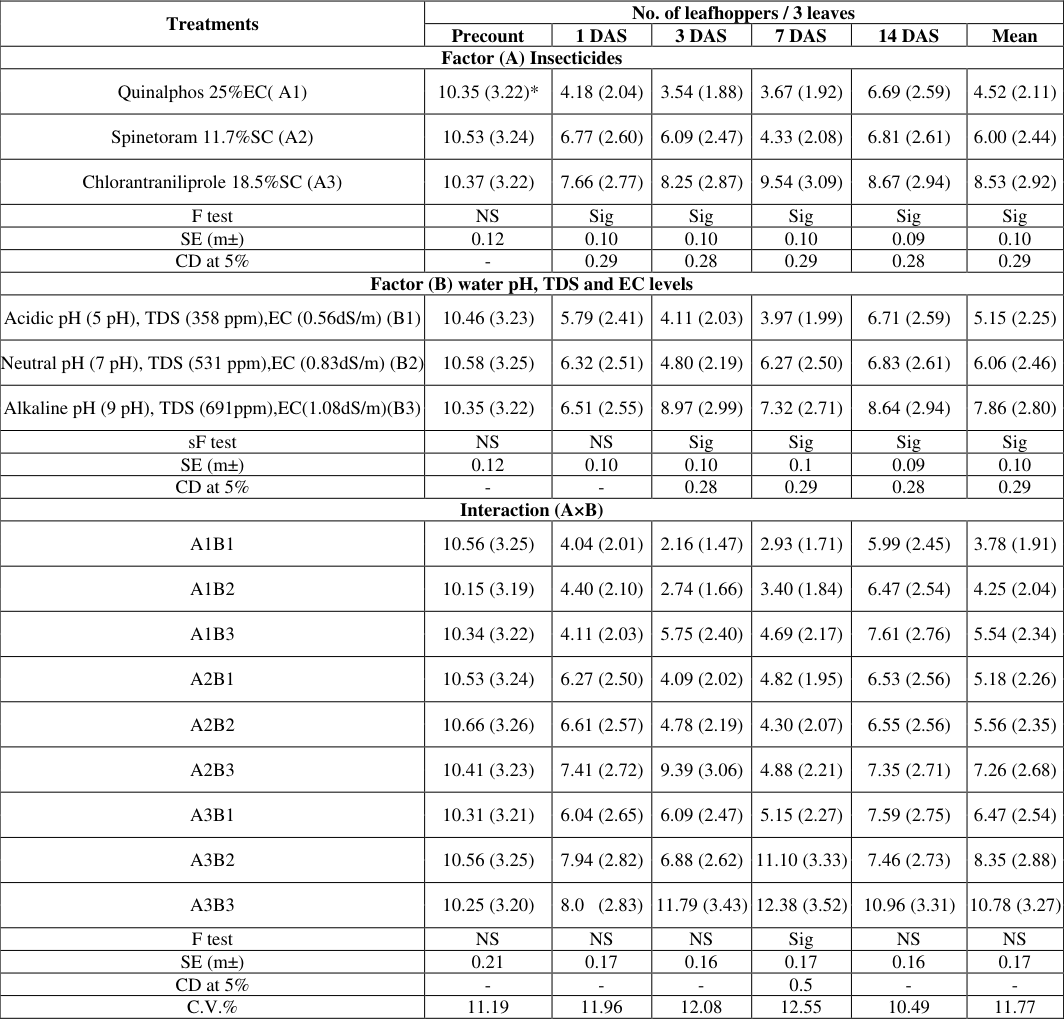 Table 2
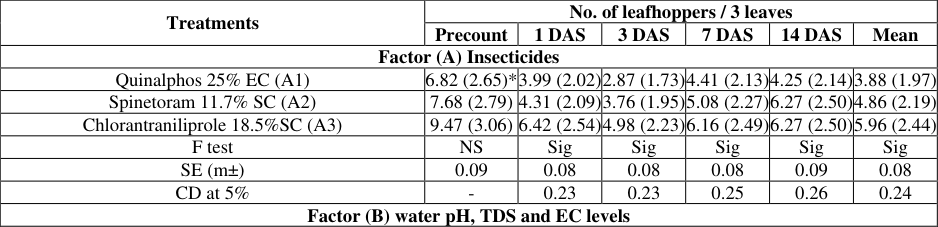 Table 3
Introduction
Mung bean (Synonyms: golden bean or green gram), Vigna radiata (Linn.) Wilczek (Family: Leguminosae, Subfamily: Papilionaceae) is the third most important pulse crop of India after chickpea and pigeon pea. India alone accounts for 65% of its world acreage and 54% of the production (Singh and Singh, 2014). Green gram is an important source of easily digestible high-quality protein for vegetarians and sick persons. The composition of mature mung bean seeds per 100 g edible portion is water 9.1 g, energy 347 kcal, fat 1.2 g, carbohydrate 62.6 g, dietary fibre 16.3 g (Swaminathan et al., 2012) [10] . In India, nearly 60 species of insect pests have been recorded from mung bean but only some cause economic damage and are more common in large areas. It is attacked by different species of insect pests but sucking insect pests (aphid, jassid, leafhopper and whitefly) is of major importance (Islam et al., 2008) [3] . The major insect pests infesting the crop are whitefly (Bemisia tabaci), jassid (Empoasca kerri), thrips (Caliothrips indicus), pod borers (Maruca vitrata). These insect pests not only reduce the vigour of the plant by sucking the sap but also transmit diseases and affect photosynthesis as well (Sachan et al., 1994) and ultimately yield losses. The annual yield loss due to the insect pests has been estimated at 30% in mung bean and urdbean (Tamang et al., 2017) [11] . When a pesticide is combined with water its efficacy may decrease. Water pH play a pivotal role in determining the chemical stability of insecticides. The ionization state of the active ingredient can be impacted by water pH variations. Pesticide molecules break due to a chemical process called hydrolysis, releasing individual ions that recombine with other ions. As a result new combinations lack of miticidal or insecticidal qualities, target pests may take them up, which could reduce the efficacy of the pesticide application as a whole. For instance, certain insecticides may degrade more rapidly in alkaline conditions or may become less toxic at extreme pH levels. (Raymond, 2016) [7] .
International Journal of Agriculture and Food Science https://www.agriculturaljournals.com
Water pH affects the efficacy of insecticides used for management of leafhopper in cotton (Pawar et al., 2022) [5] .
The quality of water affects the efficacy of insecticides. The chemicals KOH and citric acid were used to change the pH of the water to the proper requirement level. The pH of the field water was 7.4 and it changed to a different level for every 500 lit of water. Field water was treated with 0.26 ml of citric acid, 0.05 ml of citric acid and 0.64 ml of KOH for pH ranges of 5 pH, 7 pH, and 9 pH, respectively. The TDS and EC of 5 pH, 7 pH, 9 pH water was (358 ppm), (531 ppm), (691 ppm) and (0.53 dS/m), (0.83 dS/m), (1.08 dS/m) respectively. To determine the bio-efficacy of insecticides at three water pH levels, two sprays were taken against leafhopper population. Five plants were randomly selected from each plot and tied with tags, while plants located at border were avoided for observations. The observations recorded at 24 hours before the application of spray and post-treatment observations were recorded at 1, 3, 7 and 14 days after spray. This field collected data on population of leafhopper was subjected to square root transformation before analysis. The square root transformed data was analyzed statistically for its significance by following ANOVA technique for Factorial Randomized Block Design (FRBD) statistical design and analyzed using OPSTAT software.
Results and Discussion
The leafhopper infestation was noticed during first and second spraying and the observations of nymphs and adults of leafhopper were recorded.
First Spraying
The population of leafhopper was recorded before and after first spraying and is presented in Table 2.
| Treatments | No. of leafhoppers / 3 leaves | — | — | — | — | — |
|---|---|---|---|---|---|---|
| Precount | 1 DAS | 3 DAS | 7 DAS | 14 DAS | Mean | |
| Factor (A) Insecticides | ||||||
| Quinalphos 25%EC( A1) | 10.35 (3.22)* | 4.18 (2.04) | 3.54 (1.88) | 3.67 (1.92) | 6.69 (2.59) | 4.52 (2.11) |
| Spinetoram 11.7%SC (A2) | 10.53 (3.24) | 6.77 (2.60) | 6.09 (2.47) | 4.33 (2.08) | 6.81 (2.61) | 6.00 (2.44) |
| Chlorantraniliprole 18.5%SC (A3) | 10.37 (3.22) | 7.66 (2.77) | 8.25 (2.87) | 9.54 (3.09) | 8.67 (2.94) | 8.53 (2.92) |
| F test | NS | Sig | Sig | Sig | Sig | Sig |
| SE (m±) | 0.12 | 0.10 | 0.10 | 0.10 | 0.09 | 0.10 |
| CD at 5% | - | 0.29 | 0.28 | 0.29 | 0.28 | 0.29 |
| Factor (B) water pH, TDS and EC levels | ||||||
| Acidic pH (5 pH), TDS (358 ppm),EC (0.56dS/m) (B1) | 10.46 (3.23) | 5.79 (2.41) | 4.11 (2.03) | 3.97 (1.99) | 6.71 (2.59) | 5.15 (2.25) |
| Neutral pH (7 pH), TDS (531 ppm),EC (0.83dS/m) (B2) | 10.58 (3.25) | 6.32 (2.51) | 4.80 (2.19) | 6.27 (2.50) | 6.83 (2.61) | 6.06 (2.46) |
| Alkaline pH (9 pH), TDS (691ppm),EC(1.08dS/m)(B3) | 10.35 (3.22) | 6.51 (2.55) | 8.97 (2.99) | 7.32 (2.71) | 8.64 (2.94) | 7.86 (2.80) |
| sF test | NS | NS | Sig | Sig | Sig | Sig |
| SE (m±) | 0.12 | 0.10 | 0.10 | 0.1 | 0.09 | 0.10 |
| CD at 5% | - | - | 0.28 | 0.29 | 0.28 | 0.29 |
| Interaction (A×B) | ||||||
| A1B1 | 10.56 (3.25) | 4.04 (2.01) | 2.16 (1.47) | 2.93 (1.71) | 5.99 (2.45) | 3.78 (1.91) |
| A1B2 | 10.15 (3.19) | 4.40 (2.10) | 2.74 (1.66) | 3.40 (1.84) | 6.47 (2.54) | 4.25 (2.04) |
| A1B3 | 10.34 (3.22) | 4.11 (2.03) | 5.75 (2.40) | 4.69 (2.17) | 7.61 (2.76) | 5.54 (2.34) |
| A2B1 | 10.53 (3.24) | 6.27 (2.50) | 4.09 (2.02) | 4.82 (1.95) | 6.53 (2.56) | 5.18 (2.26) |
| A2B2 | 10.66 (3.26) | 6.61 (2.57) | 4.78 (2.19) | 4.30 (2.07) | 6.55 (2.56) | 5.56 (2.35) |
| A2B3 | 10.41 (3.23) | 7.41 (2.72) | 9.39 (3.06) | 4.88 (2.21) | 7.35 (2.71) | 7.26 (2.68) |
| A3B1 | 10.31 (3.21) | 6.04 (2.65) | 6.09 (2.47) | 5.15 (2.27) | 7.59 (2.75) | 6.47 (2.54) |
| A3B2 | 10.56 (3.25) | 7.94 (2.82) | 6.88 (2.62) | 11.10 (3.33) | 7.46 (2.73) | 8.35 (2.88) |
| A3B3 | 10.25 (3.20) | 8.0 (2.83) | 11.79 (3.43) | 12.38 (3.52) | 10.96 (3.31) | 10.78 (3.27) |
| F test | NS | NS | NS | Sig | NS | NS |
| SE (m±) | 0.21 | 0.17 | 0.16 | 0.17 | 0.16 | 0.17 |
| CD at 5% | - | - | - | 0.5 | - | - |
| C.V.% | 11.19 | 11.96 | 12.08 | 12.55 | 10.49 | 11.77 |
Table text extracted from the original PDF; superscript letters are shown inline. The original table image is below.
View original table image
Factor (A), (Insecticides)
The data of leafhopper recorded one day before spray was non-significant showing uniform distribution in all experimental treatment plots. On 1 DAS, the population of leafhopper was significantly lowest in the treatment of Quinalphos 25% EC (4.18/3 leaves) and it was followed by Spinetoram 11.7% SC (6.77/3 leaves) and significantly highest population was observed in Chlorantraniliprole 18.5% SC (7.66/3 leaves). Similarly, On 3 DAS, the lowest number of leafhopper was found in the treatment of Quinalphos 25% EC (3.54/ 3 leaves) and it was followed by Spinetoram 11.7% SC (6.09/ 3 leaves) and Significantly highest population was observed in Chlorantraniliprole 18.5% SC (8.25/3 leaves). On 7 DAS, the lowest number of leafhopper was found in the treatment of Quinalphos 25% EC (3.67/ 3 leaves), and it was followed by Spinetoram 11.7% SC (4.33/3 leaves) which was at par with Quinalphos 25% EC. The plots treated with Chlorantraniliprole 18.5% SC recorded maximum leafhopper population (9.54/3 leaves). Similarly, On 14 DAS Quinalphos 25% EC (6.69/3 leaves) recorded minimum leafhoppers and it was followed by Spinetoram 11.7% SC (6.81/ 3 leaves) which was at par with Quinalphos 25% EC. The plots treated with Chlorantraniliprole 18.5% SC (8.67/3 leaves) recorded maximum leafhopper population. The mean data after first spraying reported that, the leafhoppers were effectively managed by Quinalphos 25% EC (4.52/3 leaves). The next best treatments was Spinetoram 11.7% SC (6.00/ 3 leaves) and the maximum population of leafhopper was found in Chlorantraniliprole 18.5% SC (8.53/3 leaves).
Factor (B), (Water pH, TDS and EC levels)
The population of leafhopper recorded one day before spray and 1 DAS was non-significant On 3 DAS, the lowest number of leafhopper was found in the treatment of acidic water (4.11/3 leaves) followed by neutral water (4.80/3 leaves) which was at par with acidic water. The highest population of leafhopper was observed in alkaline water (8.97/3leaves) similarly, on 14 DAS, the leafhopper population was less in the treatment of acidic water (6.71/3 leaves) followed by neutral water (6.83/3 leaves) which was at par with acidic water. The population was more in alkaline water (8.64/3 leaves), neutral water was found at par with acidic water. On 7 DAS, the lowest number of leafhopper was found in the treatment of acidic water (3.97/3 leaves) followed by Neutral water (6.27 /3 leaves). The highest population of leafhopper was noticed in alkaline pH (7.32/3 leaves). The mean data of leafhopper population after treatment application showed significantly that the spray solution having acidic water (5.15/3 leaves) and neutral water (6.06/3 leaves) which was at par with acidic water and were effective in reducing leafhopper population than alkaline water (7.86/3 leaves).
Interaction Effect (Insecticides x Water pH, TDS and EC levels)
The interaction of Factor (A) and Factor (B) observations of leafhopper showed that the precount, 1, 3 and 14 DAS were non-significant. The interaction showed significant differences on 7 DAS. On 7 DAS, the treatment Quinalphos25% EC in acidic water showed minimum population of leafhopper (2.93/3 leaves) and it was at par with Quinalphos 25% EC in neutral water (3.40
Second Spraying
The data recorded on population of leafhopper before and after second spraying are presented in Table 3.
| Treatments | No. of leafhoppers / 3 leaves | — | — | — | — | — |
|---|---|---|---|---|---|---|
| Precount | 1 DAS | 3 DAS | 7 DAS | 14 DAS | Mean | |
| Factor (A) Insecticides | ||||||
| Quinalphos 25% EC (A1) | 6.82 (2.65)* | 3.99 (2.02) | 2.87 (1.73) | 4.41 (2.13) | 4.25 (2.14) | 3.88 (1.97) |
| Spinetoram 11.7% SC (A2) | 7.68 (2.79) | 4.31 (2.09) | 3.76 (1.95) | 5.08 (2.27) | 6.27 (2.50) | 4.86 (2.19) |
| Chlorantraniliprole 18.5%SC (A3) | 9.47 (3.06) | 6.42 (2.54) | 4.98 (2.23) | 6.16 (2.49) | 6.27 (2.50) | 5.96 (2.44) |
| F test | NS | Sig | Sig | Sig | Sig | Sig |
| SE (m±) | 0.09 | 0.08 | 0.08 | 0.08 | 0.09 | 0.08 |
| CD at 5% | - | 0.23 | 0.23 | 0.25 | 0.26 | 0.24 |
| Factor (B) water pH, TDS and EC levels |
Table text extracted from the original PDF; superscript letters are shown inline. The original table image is below.
View original table image
Factor (A), (Insecticides)
The pre-count of leafhopper population was non-significant showing uniform distribution in all experimental treatment plots On 1 DAS, the lowest number of leafhoppers was significantly found in the treatment of Quinalphos 25% EC (3.99/3 leaves), followed by Spinetoram 11.7% SC (4.31/3 leaves) which was at par with Quinalphos 25% EC.The plots treated with Chlorantraniliprole 18.5% SC recorded maximum leafhopper population (6.42/3 leaves). Similar trend was observed on 3 and 7 DAS.
On 14 DAS, the leafhopper population was significantly reduced in Quinalphos 25% EC (4.25/3 leaves). It was followed by Spinetoram 11.7% SC (6.27/3 leaves) and Chlorantraniliprole 18.5% SC (6.27/3 leaves). The mean data significantly revealed Quinalphos 25% EC (3.88/3 leaves) was most effective against leafhopper than other treatments. The next better treatement was Spinetoram 11.7% SC (4.86/3 leaves) which was at par with Quinalphos 25% EC and Chlorantraniliprole 18.5% SC (5.96/3 leaves) recorded more population as compared to other insecticides.
Factor (B), (Water pH, TDS and EC levels)
The population of leafhopper before spray was nonsignificant showing uniform distribution in all experimental treatment plots. On 1 DAS the incidence was lowest in the treatment of acidic pH (4.11/3 leaves) and it was followed by Neutral water (4.46 /3 leaves) which was at par with acidic water. The population was found highest in alkaline water (6.15 /3 leaves).likewise on 3 and 14 DAS, the leafhopper was minimum in acidic and neutral water which were at par with each other and maximum in alkaline water. On 7 DAS, the lowest number of leafhopper was found in the treatment of acidic water (4.22/3 leaves) followed by Neutral water (5.59/3 leaves).The highest population of leafhopper was noticed in alkaline water (5.84/3 leaves). The mean data significantly showed that, the acidic spray solution (4.10/3 leaves) reduced leafhopper most effectively, followed by neutral (4.77/3 leaves) which was at par with acidic spray solution and the highest population of leafhopper was noticed in alkaline (5.83/3 leaves) spray solution.
Interaction Effect (Insecticides x Water pH, TDS and EC levels)
The interaction of Factor (A) and Factor (B) showed non-significant differences on one day before spray, 3, 7 and 14 DAS The significant interaction was observed on 1 DAS, the interaction effect of Quinalphos 25% EC in acidic water (3.58/3 leaves) was most effective against population of leafhopper and at par with Quinalphos 25% EC DC in neutral water (3.93/3 leaves), Spinetoram 11.7% SC in acidic water (4.14/3 leaves), Spinetoram 11.7% SC in neutral water (4.26/3 leaves) and Quinalphos 25% EC in alkaline water (4.46/3 leaves),Spinetoram 11.7% SC in alkaline water (4.52/3 leaves),Chlorantraniliprole 18.5% SC in acidic water (4.60/3 leaves), Chlorantraniliprole 18.5% SC in neutral water (5.20/3 leaves) The least effective interaction was Chlorantraniliprole 18.5% SC in alkaline water (9.47/3 leaves).
Similarly, the mean data indicated that the leafhopper was effectively managed by spraying Quinalphos 25% EC in acidic water(3.28 /3 leaves), Quinalphos 25% EC in neutral (3.9 /3 leaves), Spinetoram 11.7% SC in acidic water (4.14 /3 leaves), Quinalphos 25% EC in alkaline water (4.47 /3 leaves), Spinetoram 11.7% SC in neutral water (4.82/3 leaves), Chlorantraniliprole 18.5% SC in acidic water (4.87 /3 leaves), Spinetoram 11.7% SC in alkaline water (5.6 /3 leaves), Chlorantraniliprole 18.5% SC in neutral water(5.6 /3 leaves) and Chlorantraniliprole 18.5% SC in alkaline water(7.42 /3 leaves). The present findings are similar with the studies of Prajapati et al. (2003) Studied the evaluation of different insecticide against major insect pests of mung bean. Results of field experiments revealed that among the treatments evaluated (profenofos at 0.1%, endosulfan at 0.07%, quinalphos at 0.04%, fenvalerate at 0.04%, acephate at 0.075%, dimethoate at 0.03%, alanycarb at 0.06%), monocrotophos 0.04% and dimethoate 0.03% were significantly superior in reducing jassid (Empoasca kerri) population and increasing grain yields. Similarly, Meena et al. (2020) [4] reported that in case of greengram leafhopper, imidacloprid17.8%SL was most effective. Next best treatment, thiamethoxam 25 WG (0.5g/l) and Quinalphos 25% EC, were most effective treatment with maximum population reduction obtained after 7 days of application of second spray. Raymond (2016) [7] , insecticides are typically more susceptible to alkaline hydrolysis than fungicides or regulators of plant development. The chemical groups of organophosphate (like acephate and chlorpyrifos), carbamate (like methiocarb), and pyrethroid (like bifenthrin, cyfluthrin, and fluvalinate) contain insecticide active components that are especially susceptible to alkaline hydrolysis or "high" pH solutions. Similarly, Hock (2012) [2] suggested that, alkaline water supplying for spraying pesticide, especially if the pH is 8 or greater, is sensitive to hydrolysis, lower the pH of the water in the spray tank. A pH in the range 4-6 is recommended for most pesticide sprays. The pH can be adjusted to the 4-6 pH range using adjuvant that are marketed as buffering agents. Also Abdel-Hafez. (2015) [1] Studied Physico-chemical properties [salinity%, TDS mg/L, ECms and pH] of four water quality. Results reveled that insecticides particularly organophosphates and carbamates, undergo chemical breakdown in alkaline water (pH>7). So that salinity and pH in spray water can diminish the effectiveness of insecticides. These findings line up with research by Pawar et al. (2022) [5] , which found that the population of leafhoppers was lowest under acidic water conditions (5 pH) and highest under alkaline water treatment (9 pH). In terms of the interaction impact, insecticides in neutral or acidic water worked better than those in alkaline water to control leafhopper population.
Conclusion
The effectiveness of insecticides used to control the insect pests of green gram is influenced by the pH level of water. If the spray mixture has an alkaline pH, it can lead to the breakdown of insecticides, reducing their effectiveness. Therefore, it is recommended to adjust the pH to a lower level to minimize the risk of degradation and maintain the efficacy of insecticide.
Acknowledgement
The authors are grateful to Department of Entomology and Seed Technology Research Unit, Dr. PDKV, Akola, MS, India for providing all the necessary facilities for conducting the present research work.
Figures and tables from the paper
| Tr. No | Factor (A) Insecticides | Tr. No | Factor (B) water pH,TDS,EC levels |
|---|---|---|---|
| A1 | Quinalphos 25%EC @30 ml per 10 litre of water | B1 | Acidic pH (5 pH),TDS (358 ppm), EC (0.56dS/m) |
| A2 | Spinetoram 11.7%SC @8.54 ml per 10 litre of water | B2 | Neutral pH (7 pH), TDS (531 ppm), EC (0.83dS/m) |
| A3 | Chlorantraniliprole 18.5% SC@ 3.24 ml per 10 litre of water. | B3 | Alkaline pH (9 pH), TDS (691 ppm), EC (1.08dS/m) |
Table text extracted from the original PDF; superscript letters are shown inline. The original table image is below.
View original table image
References
11 in the original paper- Hafez AHF. The effect of water quality on insecticides stability. Egypt Acad J Biol Sci F Toxicol Pest Control. 2015;7(1):15-23.
- Hock WK. Effect of pH on pesticide stability and efficacy. Pesticide Safety Education Program (PSEP). Cornell University; 2012. Available from: http://psep.cce.cornell.edu/facts-slides-self/facts/genpeapp-ph
- Islam MS, Latif MA, Ali M, Hossain MS. Population dynamics of whitefly on some recommended mungbean varieties in Bangladesh and its impact on incidence of mungbean yellow mosaic virus disease and yield. Int J Sustain Agril Tech. 2008;5(4):41-46.
- Meena RK, Meena RK, Singh U, Meena ML, Meena BL, Anokhe A. Evaluation of insecticides against leaf hopper Empoasca kerri Pruthi in green gram; 2020.
- Pawar AA, Bhede BV, Tupe AP. Effect of water pH on bioefficacy of different insecticides against leaf hopper Amrasca biguttula biguttula Ishida on Bt cotton. Pharma Innov J. 2022;11(12):2610-2615.
- Prajapati BG, Dodia DA, Tikka SBS. Evaluation of different insecticides against major pests of mung bean; 2003.
- Raymond AC. Effects of pH on pesticides. 2016. Available from: https://doczz.net/doc/9005757/pdf-- effects-of-pH-on-pesticides
- Sachan JN, Yadava CP, Katti G. Insect pest management in pulse crop. In: Dhaliwal GS, Arora R, editors. Agricultural Insect Pest Management. New Delhi: Common Wealth Publishers; 1994, p. 465-469.
- Singh SK, Singh PS. Screening of mungbean (Vigna radiata) genotypes against major insects. Curr Adv Agric Sci. 2014;6(1):85-87.
- Swaminathan R, Singh K, Nepalia V. Insect-pests of green gram Vigna radiata (L.) Wilczek and their management. Agric Sci. 2012;252:1-978.
- Tamang S, Venkatarao P, Chaterjee M, Chakraborty G. Population dynamics of major insect pests of mung bean [Vigna radiata (L.) Wilczek] and correlation with abiotic factors under Terai agroclimatic zone of West Bengal. Bioscan. 2017;12(2):893-987.