
Research article · 2025 · Full text
International Journal of Geography Geology and EnvironmentFamily forms and reproductive behaviour: A comparative study of nuclear and extended households in Morogoro region
Volume 7(7) · Pages 16–21 · DOI: 10.22271/27067483.2025.v7.i7a.380 ↗
Research areasAging, Elder Care, and Social Issues
Abstract
Author-writtenFamily structure has long been thought to influence reproductive behaviour. Extended family households (including multiple generations or relatives) are often presumed to encourage higher fertility than nuclear households (a couple and their children). However, socio-economic factors such as education and income may confound this relationship. This study examines the number of children in nuclear versus extended family households in Morogoro Region, Tanzania, controlling for demographic factors. The study analysed survey data on 319 married women (234 in nuclear families, 85 in extended families) from Morogoro Region. Researcher compared mean number of children between nuclear and extended households and applied multivariate regression controlling for age, education level, and occupation. Nuclear and extended family households showed no significant difference in mean number of children (4.65 versus 4.96, p>0.2). After controlling for age and socio-demographic covariates, the effect of family type on number of children remained statistically non-significant. Instead, education emerged as a significant predictor: women with secondary education had about 0.56 fewer children than those with only primary education (p<0.05). Older age was associated with slightly more children (p<0.01). Occupational differences (e.g. farmers versus formally employed) showed expected fertility patterns but were not statistically significant in this sample. In Morogoro, extended family households do not have significantly more children than nuclear households once education, age, and related factors are taken into account. The findings suggest that broader socio-economic characteristics, particularly women’s education, play a more decisive role in reproductive behaviour than family form per se. Programmes aiming to influence fertility should prioritize female education and economic empowerment across all family structures.
Summary
Source-checkedPlain-language reading of the full paper, prepared with AI and checked against the text. Each point links to the authors' own words.
Why it matters
- It is often assumed that extended family households, which include multiple generations or relatives, encourage higher fertility compared to nuclear households consisting of a couple and their children. View evidence ↗
- Factors such as a woman's education and the economic status of the household strongly influence fertility, which can complicate direct comparisons between different family structures. View evidence ↗
The question
- The study aims to compare the number of children in nuclear versus extended family households in the Morogoro Region of Tanzania, while controlling for age, education, and occupation. View evidence ↗
What they did
- The analysis was based on a sample of 319 married women, with 234 in nuclear families and 85 in extended families. View evidence ↗
- The primary outcome measured was the total number of living children born to each respondent. View evidence ↗
- The researcher used descriptive analyses and Welch's t-tests to compare the mean number of children between the two family types. View evidence ↗
- A multiple linear regression was performed to control for age, education level, and occupation when analyzing the effect of family type on the number of children. View evidence ↗
What they found
- There was no statistically significant difference in the mean number of children between nuclear families (4.65) and extended families (4.96), with a p-value of 0.238. View evidence ↗
- After controlling for age and socio-demographic factors, the effect of family type remained non-significant (p = 0.118), with extended-family women having approximately 0.35 more children on average. View evidence ↗
- Education was a significant predictor of fertility; women with secondary education had 0.555 fewer children on average than those with only primary education (p = 0.042). View evidence ↗
- Age was positively associated with the number of children, with each additional year of age corresponding to an increase of approximately 0.045 children (p = 0.001). View evidence ↗
- While not statistically significant, occupational trends showed that women in business or formal employment tended to have fewer children than those working as farmers. View evidence ↗
What it means
- The authors conclude that education and economic empowerment are the primary drivers for reducing fertility, regardless of whether a woman lives in a nuclear or extended family. View evidence ↗
- The authors recommend that fertility-reduction policies prioritize female education, employment opportunities, and reproductive health access over attempts to change family structure norms. View evidence ↗
- The study's cross-sectional design means causality cannot be established; it is possible that having many children leads to an extended family setup rather than the other way around. View evidence ↗
- The findings are specific to the Morogoro Region and may not be generalizable to all parts of Tanzania. View evidence ↗
Visual summary
2 visualsIllustrations explain the paper; charts are replotted from the paper's own table values.
Determinants of Fertility
AI-generated conceptual illustration (Tanzanian women in rural Morogoro households). It explains the idea and does not show study data.
View source evidence ↗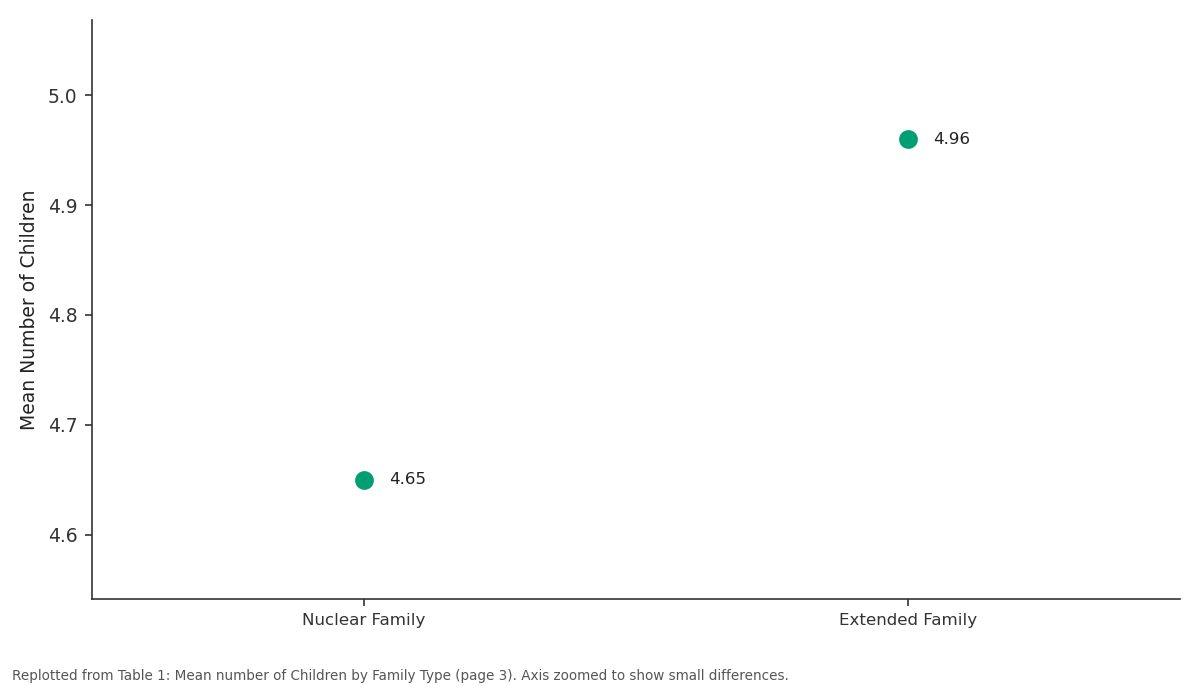
Mean Number of Children: Nuclear Family vs Extended Family
Replotted from Table 1 (page 3) of the original paper. Every bar is the paper's own table value.
View source evidence ↗Figures & tables
From the original paper Table 1
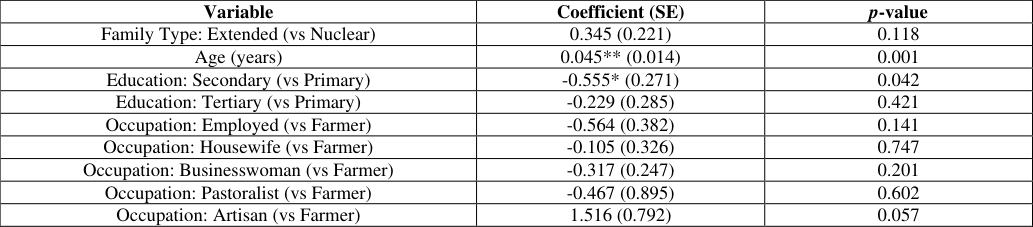 Table 2
Introduction
Household family structure varies widely and is typically classified as nuclear (parents and their children) or extended (including additional kin such as grandparents, aunts/uncles, or other relatives) [1] . Extended family households remain very common in many African settings. For example, in Tanzania nearly half of households can be categorized as extended family households (46.9%), roughly equal to the proportion of nuclear family households [1] . These family forms are more than just living arrangements; they reflect social systems that may shape reproductive norms and behaviours. Historically, the prevalence of extended versus nuclear families has been linked with different reproductive outcomes. In Western countries during the 20 th century demographic transition, a shift from extended, traditional family systems to smaller nuclear families coincided with a marked decrease in fertility rates [2] . A similar pattern has been observed in parts of sub-Saharan Africa undergoing social change: as urbanization and modernization progress, extended family households are becoming less common, and fertility levels have declined [3] . This suggests that extended family systems have often supported higher fertility, whereas nuclear family systems are associated with lower fertility in modern contexts. One reason extended families have been thought to encourage higher fertility is that they provide a wider kin network to share child-rearing responsibilities and economic costs. Indeed, demographers note that the extended family system can sustain a high demand for children, because children "belong" to the wider family and the costs of raising them are distributed among kin [4] . The classic intergenerational wealth-flow theory posits that in traditional extended households, wealth and support flow from younger members to older ones, making large numbers of children economically advantageous to parents +. By contrast, in a nuclear family setting, parents bear the costs of children directly and may thus opt for fewer children [5] . These theoretical perspectives imply that, all else equal, extended/joint family structures would tend to have higher fertility than nuclear families. However, family structure alone does not determine reproductive behaviour; social and economic characteristics of the family often covary with structure. Extended family households are more prevalent in rural, agrarian communities that historically have higher fertility rates, whereas nuclear families are more common in urban and highly educated populations that tend to have fewer children 1 . Crucially, women's education and household economic status strongly influence fertility outcomes, which may confound simple comparisons of family types. Data from sub-Saharan Africa consistently show that bettereducated women have fewer children on average [6] . In Tanzania, for instance, women with no formal education have about six children on average, whereas those with at least secondary education have under four [7] . Similarly, wealthier households and those in the top social strata exhibit substantially lower fertility (e.g., women in the highest wealth quintile average 3.7 children) [8] . These patterns reflect the pervasive impact of education, income, and related factors on reproductive behaviour across all family forms. Given these considerations, it is important to control for key demographic variables when assessing the relationship between family form and fertility. Without adjusting for factors like education, age, or income, any observed difference in number of children between nuclear and extended households might simply reflect differences in these underlying characteristics. Prior studies have suggested that once socio-economic variables are held constant, the direct effect of family structure on fertility can diminish or disappear 1 . In other words, extended-family households may not inherently produce more children if the parents in those households have similar education levels and economic opportunities as those in nuclear households. To date, there has been limited empirical research focusing on how family form relates to reproductive behaviour in specific contexts of Tanzania. Morogoro Region offers a pertinent case study with its mix of rural and urban populations and both nuclear and extended family arrangements. Understanding whether extended households in this region still correspond to larger family size (after accounting for education and other factors) is valuable for both demographic theory and policy. This study therefore aims to compare the number of children in nuclear versus extended family households in Morogoro, while controlling for women's age, education attainment, and occupation. By using recent survey data and focusing on a single cultural setting, researcher seek to clarify whether family structure per se has a significant association with reproductive behaviour in the contemporary Tanzanian context. The findings will shed light on the interplay between family systems and fertility and help identify whether interventions should target cultural family norms or rather the socioeconomic determinants that underlie fertility differentials across family forms.
Materials and Methods
This study is a comparative cross-sectional analysis using survey data from married women in Morogoro Region, Tanzania. The dataset contains individual-level information on family type, demographic characteristics, and reproductive history. The study focused on two categories of family forms as defined in the survey: Nuclear Family (a household consisting of a woman, her spouse, and their children) and Extended Family (a household where the woman lives with her spouse/children plus other relatives, such as parents, in-laws, or other kin). Although the dataset also included a category for "Single Parent Family," researcher restricted analysis to married women in nuclear or extended families in line with study's comparative focus on those two family forms. The sample analysed consisted of 319 women (234 in nuclear families and 85 in extended families). The primary outcome variable is Number of Children, defined as the total number of living children born by the respondent. This was treated as a count/continuous variable.
The key independent variable is Family Type (Extended vs. Nuclear household). Researcher included several control variables selected based on their known influence on fertility: the woman's Age (in years), categorized Level of Education (Primary, Secondary, or Tertiary education), and Occupation. Occupation was recorded as a categorical variable with six groups (Farmer, Employed Worker, Housewife, Businesswoman/trader, Pastoralist, Artisan). These factors serve as proxies for socio-economic status and exposure to modernization, which could confound any relationship between family structure and number of children.
Researcher first conducted descriptive analyses to compare the mean number of children in nuclear versus extended family households. An independent-samples t-test (Welch's t-test, allowing for unequal variances) was used to test the difference in mean number of children between the two groups. Researcher checked the distribution of the outcome and homogeneity of variances; although the number of children is a count variable, in this sample it approximated a discrete distribution with sufficient variance, and the large sample size lends robustness to the t-test.
Next, to account for potential confounders, researcher performed a multiple linear regression analysis. The regression model included family type (extended versus nuclear) as a dummy variable and controlled for age (continuous), education level (entered as indicator variables for Secondary and Tertiary, with Primary as reference), and occupation (entered as indicator variables for each category with the most common category-Farmer-as the reference group). This model effectively provides an Analysis of Covariance (ANCOVA)-like comparison of family types adjusting for other factors. The suitability of a linear model was assessed: residual diagnostics indicated no severe departures from normality or homoscedasticity, and multicollinearity was minimal (variance inflation factors < 2). Researcher also considered a Poisson regression (given the count nature of the outcome), but an over-dispersion test indicated that a linear model with robust inference was adequate and more straightforward for interpreting mean differences.
All statistical tests were two-tailed with a significance level of p<0.05. Researcher report regression coefficients with standard errors and p-values. Data analysis was conducted using Python's stats models library (for regression) and SciPy (for t-test). Results are presented in tables. Table 1 summarizes the sample size and average number of children by family type. Table 2 presents the coefficients from the multivariate regression. Researcher additionally report the ttest statistic and regression model fit in the text.
| Variable | Coefficient (SE) | p-value |
|---|---|---|
| Family Type: Extended (vs Nuclear) | 0.345 (0.221) | 0.118 |
| Age (years) | 0.045** (0.014) | 0.001 |
| Education: Secondary (vs Primary) | -0.555* (0.271) | 0.042 |
| Education: Tertiary (vs Primary) | -0.229 (0.285) | 0.421 |
| Occupation: Employed (vs Farmer) | -0.564 (0.382) | 0.141 |
| Occupation: Housewife (vs Farmer) | -0.105 (0.326) | 0.747 |
| Occupation: Businesswoman (vs Farmer) | -0.317 (0.247) | 0.201 |
| Occupation: Pastoralist (vs Farmer) | -0.467 (0.895) | 0.602 |
| Occupation: Artisan (vs Farmer) | 1.516 (0.792) | 0.057 |
Table text extracted from the original PDF; superscript letters are shown inline. The original table image is below.
View original table image
| Family Type | N | Mean Number of Children | Median Number of Children | Standard Deviation |
|---|---|---|---|---|
| Nuclear Family | 234 | 4.65 | 5 | 1.59 |
| Extended Family | 85 | 4.96 | 5 | 2.22 |
Table text extracted from the original PDF; superscript letters are shown inline. The original table image is below.
View original table image
Results
Table 1 shows a comparable average number of children, women in nuclear families had a mean of 4.65 children (Standard Deviation = 1.59), while those in extended families had a mean of 4.96 children (Standard Deviation = 2.22). Extended households on average reported slightly more children, but this raw difference was small (about 0.3 children) and did not reach statistical significance (Welch's t test: t =-1.19, p = 0.238). In other words, there is no significant difference in the number of children between nuclear and extended family forms in this sample. Researcher noted that the variance in number of children was somewhat higher among extended-family women, as reflected in a larger standard deviation (2.22 versus 1.59), indicating more heterogeneity in extended households' reproductive outcomes. The median number of children was 5 in both groups (median = 5 for nuclear, 5 for extended), and the full range spanned from 1 up to 10 children in both family types. Thus, descriptively, both family forms included women with small and large family sizes, and the typical family size (~5 children) was similar between them. Importantly, women's education level emerged as a significant determinant of fertility. Holding other factors constant, women with secondary education had 0.555 fewer children on average compared to those with only primary education (p = 0.042). The coefficient for tertiary education was also negative (-0.229) but not statistically significant (p = 0.421), suggesting that in this sample, the major drop in fertility was associated with completing secondary schooling, while tertiary education did not show an additional significant reduction (possibly due to the smaller number of tertiary-educated women). The general pattern aligns with expectations: higher education is associated with smaller family size. Women's age showed a positive association with number of children (B = 0.045 per year, p = 0.001). This indicates that each additional year of age corresponded to an increase of about 0.045 in the number of children, after controlling for other factors. In practical terms, a 10-year older woman would have about 0.45 more children on average, reflecting the accumulation of births over the reproductive lifespan. This age effect is unsurprising, as older women have had more time to bear children; our inclusion of age in the model essentially adjusts for the fact that extended-family women were on average about the same age as nuclearfamily women (mean age 42 years in both groups), so age differences did not drive the family type comparison. The occupation variables did not reach statistical significance at the 0.05 level, but they revealed some interesting directional effects. Using Farmer as the reference category (since farming was the most common occupation, especially among nuclear families), researcher found that women in formal employment or business tended to have fewer children than farmers, whereas housewives and pastoralists had fertility similar to (or slightly lower than) farmers. Specifically, the coefficient for Employed Worker was-0.564 (meaning employed women had about 0.56 fewer children than farmers, on average), and for Businesswoman was-0.317, though neither was statistically significant (p = 0.14 and 0.20, respectively). Housewives had virtually no difference from farmers (B =-0.105, p = 0.747). Pastoralists (a very small subgroup) showed a non-significant negative coefficient (-0.467, p = 0.602). The one occupation category with a positive coefficient was Artisan (+1.516 children compared to farmers), which nearly achieved significance (p = 0.057); however, this result should be interpreted cautiously given the very small number of artisan women (only 5 cases) in the sample. Notably, when using Farmer as baseline, all other occupations except Artisan showed negative coefficients, consistent with the notion that rural agrarian women (and those not engaged in formal employment) tend to have more children, whereas those in waged jobs or commerce tend to have fewer. Though these occupation effects were not statistically robust in this dataset, their direction aligns with broader socio-economic fertility patterns.
Discussion
Findings of this study indicate that there is no significant difference in the number of children between nuclear and extended household forms in Morogoro Region when controlling for demographic factors. This result is somewhat surprising in light of the traditional view that extended families encourage higher fertility than nuclear families. In many societies, extended or joint family systems have been associated with pronatalist norms and greater support for childbearing [4] . Prior demographic research often assumed that the presence of additional kin in an extended household would facilitate having more children, by diffusing childrearing costs and responsibilities across the family network [4] . Indeed, extended family solidarity can reduce the direct economic burden of each child on the biological parents, theoretically allowing or even encouraging couples to have a larger number of children [4] . Despite this theoretical expectation of higher fertility in extended families, empirical analysis did not find a statistically higher number of children among extended-family households compared to nuclear families in the Morogoro sample. One possible explanation is that the influence of family structure on fertility is mediated by socio-economic factors.
In this study, once researcher accounted for women's education, occupation, and age, the difference between extended and nuclear families essentially disappeared. This suggests that the raw (unadjusted) difference-which was small and non-significant to begin with-may have been driven by the characteristics of the people in those households rather than the family structure itself. Extendedfamily households in Morogoro may differ from nuclear households in subtle ways (for example, in this study, women in extended households had slightly higher rates of tertiary education and were more likely to engage in small business than those in nuclear households). These factors can counteract any pronatalist effect of the extended family setting. These results align with other studies that have found family-structure effects to diminish after controlling for education and wealth. For instance, research on polygynous versus monogamous families in Africa has shown that higher fertility or poor child outcomes seen in polygynous (extended) families were largely explained by the lower education and socio-economic status of those households, rather than polygyny itself 1 . Similarly, in this study, extended-family women did not have more children once researcher accounted for education levels. It appears that educational attainment provided by modernization empowers women to make reproductive choices independently of traditional family pressures, thereby levelling the playing field between extended and nuclear contexts.
This study underscores the central role of female education in shaping reproductive behaviour. Researcher observed that women with at least a secondary education had significantly fewer children than those with only primary schooling, regardless of family type. This finding is consistent with a large body of evidence from sub-Saharan Africa and beyond. Better-educated women tend to marry later, desire smaller families, and utilize contraception more effectively, all of which contribute to lower fertility [9,6] . In Tanzania nationally, the fertility difference by education is strikingwomen with secondary or higher education have around 2-3 fewer children than those with no education [7] . The study results mirror this pattern within Morogoro Region. Education likely enhances women's autonomy and exposure to ideas favouring family planning, enabling them to resist pronatalist social pressures. This dynamic was evident even within extended families: an interesting qualitative insight from other research is that if an educated woman lives in an extended household, she may be better able to negotiate or assert her reproductive preferences. For example, a study in India found that a mother-in-law's desired number of grandchildren strongly influenced the woman's fertility preferences, but when the woman had more education than her mother-in-law, she preferred fewer children despite that pressure [10] . In other words, education can buffer women against familial demands for more children. Although that study was in a different cultural context, the underlying principle is relevant-in extended families, educated women may implement their lower fertility preferences, mitigating the potential for higher fertility that extended kin might encourage. Study findings in Morogoro align with this idea: extended-family women in our sample who had secondary or tertiary education did not end up with large families; their education level, rather than the family format, was the dominating factor. Another important consideration is economic and occupational influences on fertility, which again tend to cut across family structure lines. While occupation effects in the study regression were not statistically robust, the directional trends supported known patterns: women in formal employment and business had fewer children on average than women engaged in subsistence farming or not employed outside the home. This reflects the opportunity costs of childbearing-when women work for pay or run businesses, having many children can be economically constraining, whereas in agrarian settings children's labour can be seen as adding value to the household 8 . In sub-Saharan Africa, the wealthiest and urban segments of society have completed a greater portion of the fertility transition, with average family sizes much lower than among poorer, rural populations [8,1] . The study findings hinted at this divide as well: for example, "Employed workers" and "businesswomen" in the study sample averaged around 4.2-4.6 children, compared to 4.9 for farmers and 6.4 among the few artisans. Although these differences were not statistically significant due to the sample size, they are in line with the broader socioeconomic fertility differentials documented in Tanzania and other countries 8 . The extended versus nuclear distinction, in a sense, becomes less meaningful when one considers that an extended family household can also be economically better-off or include educated members-such a household may then exhibit fertility behaviour akin to a nuclear family of similar status. In modern Tanzania, extended family living arrangements can occur even among educated urban dwellers (for example, a couple might live with a relative for economic or cultural reasons), without implying a traditional high-fertility mindset.
It is also worth noting that overall fertility levels have been declining in Tanzania in recent decades, a trend that likely affects both nuclear and extended families. The total fertility rate (TFR) for Tanzania has fallen from about 6.2 in the early 1990s to about 5.2 in 2015-16 [11] . This decline has been partly attributed to increased use of family planning and changing reproductive preferences across society [11] . As fertility norms shift toward smaller desired families nationally, extended families in contemporary contexts may no longer insist on very large numbers of children. In other words, the cultural gap between extended and nuclear families might be narrowing as the entire population moves through the fertility transition. Extended-family households today might support and practice family planning nearly as much as nuclear families do. Qualitative evidence from Africa suggests a complex interplay: traditional kin networks and values still support high fertility ideals, while modern influences (education, media, economic change) are "disruptors" that lead to lower fertility desires [12] . Morogoro Region, which is neither the most remote rural area nor as cosmopolitan as Dares Salaam, may be a setting where these forces balance out. Thus, while extended families historically embodied traditional pronatalist supports, many are now equally exposed to modern reproductive health information and economic incentives for smaller families.
The study finding of no significant fertility difference might indicate that extended-family norms in Morogoro have adapted-couples in extended households may increasingly make fertility decisions similar to those in nuclear households, especially if they share similar education and economic background. Some limitations of this study should be acknowledged. First, the data are cross-sectional, and the number of children reported by each woman is a cumulative count (many respondents were in their forties). Researcher controlled for age to account for different stages of the reproductive life course, but a longitudinal perspective would be needed to observe timing of births in relation to changes in household structure (for example, some women might shift from nuclear to extended living arrangements at different points). Causality cannot be definitively established-it is possible, for instance, that women who have many children later attract or require an extended family setup for support, rather than the extended family causing the high number of children. Second, our analysis is regionspecific. Morogoro's socio-cultural context might not represent all parts of Tanzania. Fertility levels and family system influences vary by region [13] , and the relationship between family form and fertility could differ in more strictly traditional rural regions or in major urban centres. Caution is warranted in generalizing these findings beyond similar contexts. Third, researcher did not explicitly measure some factors that could be relevant, such as cultural norms or the influence of specific kin (e.g., mother-in-law influence) within extended households. While researcher discussed qualitatively the role of in-laws, the dataset did not contain variables on fertility decision-making power or preferences of other family members. Including such variables could further illuminate mechanisms-for example, whether women in extended families felt pressure from elders to have (or not have) additional children. Lastly, the "extended family" category in this dataset is broad; it would be interesting to distinguish between different types of extended families as these might have distinct impacts on reproductive behaviour. The study sample size, especially for extended subgroups, limited such granular analysis. Despite these limitations, this study provides valuable insights. The results highlight that education and economic empowerment are pivotal in reducing fertility, regardless of family form. In practical terms, policies aimed at lowering high fertility or supporting family planning in regions like Morogoro should perhaps focus less on changing family structure norms and more on continuing to improve girls' education, women's employment opportunities, and access to reproductive health services in both urban and rural communities. Extended families are a deeply rooted social institution in Tanzania, and they confer benefits like mutual support and childcare. The study findings suggest that maintaining these traditional family support systems need not be at odds with achieving demographic goals such as smaller family sizes. When women in extended households are educated and informed, they appear as likely as their nuclear-family counterparts to implement fertility control if they desire. This is an encouraging indication that the "extendedness" of a family is not a barrier to fertility decline in and of itself-what matters more are the resources and knowledge that women have.
Conclusion
This comparative study of nuclear and extended households in Morogoro Region found no inherent fertility difference between the two-family forms. Once key factors like age, education, and income (occupation) are taken into account, extended-family households do not show higher reproductive output than nuclear families. The historical association of extended kin networks with high fertility is not an iron law; it can be moderated by socio-economic development. The study results reinforce that women's education is a powerful determinant of reproductive behaviour-educated women tend to have fewer children, whether they live in a nuclear unit or an extended family. Consequently, efforts to influence fertility and support reproductive health should prioritize raising educational attainment and economic opportunities for women, as well as ensuring access to family planning for all, rather than focusing narrowly on family structure. In the context of Tanzania's ongoing fertility decline, extended and nuclear families alike are moving towards smaller family norms.
Traditional family structures can coexist with modern lowfertility norms when women are empowered. Further research, especially qualitative and longitudinal studies, could deepen the understanding of decision-making dynamics within extended families. Nonetheless, the evidence from Morogoro suggests that family form alone is not destiny when it comes to reproductive behaviour-what counts most are the resources, education, and choices of individuals within those families.
References
12 in the original paper- Manyama W. Dynamics in family patterns in Tanzania: the case of Kijitonyama Ward, Kinondoni District, Dar es Salaam region, Tanzania. J Sociol Soc Work. 2017;5(1):68-79.
- Haregu TN, Beguy D, Ezeh A. Changing family structure and fertility in sub-Saharan Africa. Afr Popul Health Res Cent. 2015.
- Shapiro D, Hinde A. On the pace of fertility decline in sub-Saharan Africa. Demogr Res. 2017;37:1327-1338.
- Veleti K. Family structure and its effective influence on fertility. J Hum Ecol. 2001;12(5):387-90.
- Pradhan E. The relationship between women's education and fertility. World Bank Invest Health. 2015.
- Ministry of Health, Community Development, Gender, Elderly and Children (MoHCDGEC) [Tanzania Mainland], Ministry of Health (MoH) [Zanzibar], National Bureau of Statistics (NBS), Office of the Chief Government Statistician (OCGS), ICF. Tanzania Demographic and Health Survey and Malaria Indicator Survey 2022: Summary Report. Dodoma (TZ) and Rockville (MD): MoHCDGEC, MoH, NBS, OCGS, ICF; 2022.
- Corker J, Rossier C, Zan ML. Fertility among better-off women in sub-Saharan Africa. Demogr Res. 2022;46:849-864.
- Schoumaker B, Sanchez-Paez DA. Female education and fertility stalls in sub-Saharan Africa. IUSSP Online News Mag. 2024.
- Kumar A, Bordone V, Muttarak R. Like mother (-inlaw) like daughter? Influence of the older generation's fertility behaviours on women's desired family size in Bihar, India. Eur J Popul. 2016;32(5):629-660.
- Japhet B. Is Tanzania's unmet need for contraceptives at crisis levels? Why does Tanzania have a low uptake of reproductive health services despite continued investment? PesaCheck (Fact Check Rep). 2018.
- Church AC, Ibitoye M, Chettri S, Casterline JB. Traditional supports and contemporary disrupters of high fertility desires in sub-Saharan Africa: a scoping review. Reprod Health. 2023;20(1):86.
- Ministry of Health, Community Development, Gender, Elderly and Children (MoHCDGEC) [Tanzania Mainland], Ministry of Health (MoH) [Zanzibar], National Bureau of Statistics (NBS), Office of the Chief Government Statistician (OCGS), ICF. 2015-16 TDHSMIS Key Findings. Rockville (MD): MoHCDGEC, MoH, NBS, OCGS, ICF; 2016.