
Research article · 2025 · Full text
International Journal of Agriculture and Food ScienceAgri-business innovation in India: SWOC analysis of institutional incubators
Volume 7(7) · Pages 362–367 · DOI: 10.33545/2664844x.2025.v7.i7e.529 ↗
Research areasInnovation and Socioeconomic Development
Abstract
Author-writtenInnovation is the backbone of agro-entrepreneurship, as it creates new opportunities and offers higher profits for entrepreneurs. For the development of entrepreneurship in the agriculture sector, there is a need to improve agribusiness at a faster rate than on-farm production. The Agri-Business Incubator (ABI) serves as a hub where entrepreneurs are supported with agricultural technology, business consulting, networking with management experts, access to venture capital, infrastructure, and other essential facilities to help them establish their own agri-business ventures. Over 500 agri-tech projects have been launched in India (Start-up India, 2020). This study was conducted in two states—Kerala and Tamil Nadu. The Agri-Business Incubators in these states, which are affiliated with the State Agricultural Universities (SAUs) and Research Institutes under the Indian Council of Agricultural Research (ICAR), were selected for analysis. Two Agribusiness Incubators each from Kerala and Tamil Nadu were purposively chosen for the study. The paper aims to analyze the Strengths, Weaknesses, Opportunities, and Challenges (SWOC) of these Agri-Business Incubators. Based on a review of existing literature, expert opinions, and focused group discussions with ABI officials, the relevant items were generated, and results were obtained accordingly.
Summary
Source-checkedPlain-language reading of the full paper, prepared with AI and checked against the text. Each point links to the authors' own words.
Why it matters
- Innovation is essential for agro-entrepreneurship because it generates new opportunities and increases profitability for entrepreneurs. View evidence ↗
- To develop agricultural entrepreneurship, agribusiness must grow more quickly than traditional on-farm production. View evidence ↗
- Agri-Business Incubators (ABIs) act as hubs providing technology, consulting, networking, capital, and infrastructure to help entrepreneurs start agri-business ventures. View evidence ↗
The question
- The study aims to analyze the Strengths, Weaknesses, Opportunities, and Challenges (SWOC) of selected Agri-Business Incubators in India. View evidence ↗
What they did
- The study purposively selected two Agri-Business Incubators from each of two Indian states: Kerala and Tamil Nadu. View evidence ↗
- The sample consisted of 20 ABI officials, with five officials interviewed from each of the four selected incubators. View evidence ↗
- SWOC assessments were conducted using open-ended questionnaires, literature reviews, expert opinions, and focused group discussions with officials. View evidence ↗
What they found
- For the KAU-ABI, the primary strengths were capacity building programs and product development and refinement, both rated by 100% of respondents. View evidence ↗
- The most significant weaknesses of the KAU-ABI were a shortage of funds and a lack of public publicity regarding facilities, both cited by 100% of respondents. View evidence ↗
- The TIC-CTCRI's strongest asset was its focus on increasing the value of tuber crops, identified by 80% of respondents. View evidence ↗
- The primary weakness of the TIC-CTCRI was a low enrollment of incubatees, reported by 100% of respondents. View evidence ↗
- The NABARD-MABIF's top strengths were business development support and various schemes (IPFC, CBBO, CCF), both rated at 100%. View evidence ↗
- The NABARD-MABIF faced critical challenges in facility maintenance and high breakdown costs, both cited by 100% of respondents. View evidence ↗
- The SBI-ABI's main weaknesses were a lack of awareness about the incubator and the non-availability of dedicated labs and facilities, both rated at 100%. View evidence ↗
- The SBI-ABI's most significant challenges were limited funds, low manpower, and difficult follow-up, each cited by 80% of respondents. View evidence ↗
What it means
- The authors conclude that the SWOC data provides valuable insights into specific areas where these incubators can be improved. View evidence ↗
- The authors note that differences in incubator policies, funding, and the mindset of agripreneurs across districts may influence the results. View evidence ↗
Visual summary
3 visualsIllustrations explain the paper; charts are replotted from the paper's own table values.
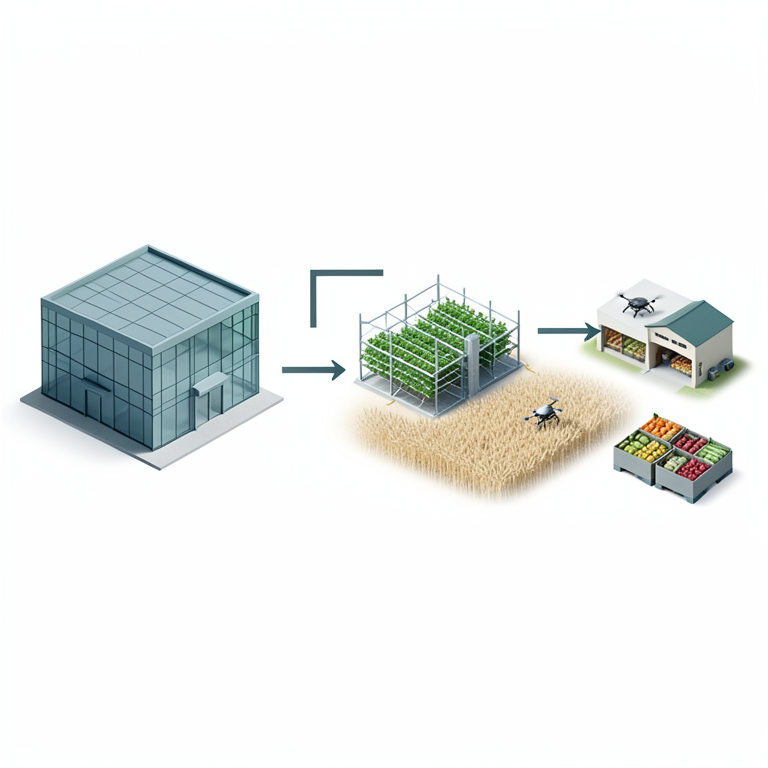
ABI Ecosystem Concept
AI-generated conceptual illustration (Agricultural technology hub and farm startups). It explains the idea and does not show study data.
View source evidence ↗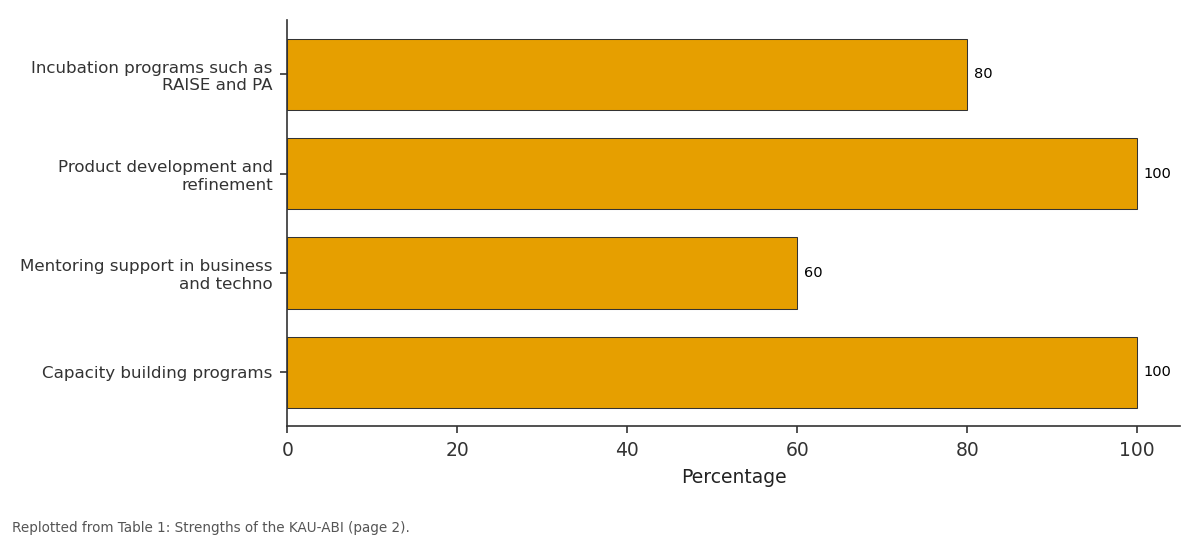
Percentage: Incubation programs... vs Product development and... vs Mentoring support in... vs Capacity building...
Replotted from Table 1 (page 2) of the original paper. Every bar is the paper's own table value.
View source evidence ↗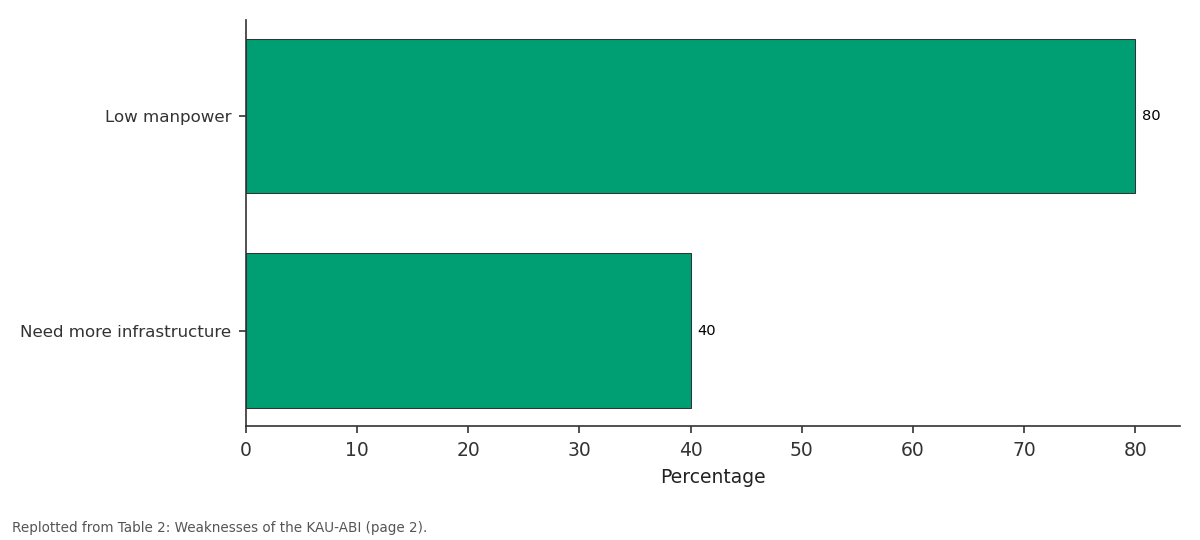
Percentage: Low manpower vs Need more infrastructure
Replotted from Table 2 (page 2) of the original paper. Every bar is the paper's own table value.
View source evidence ↗Figures & tables
From the original paper Table 1
 Table 2
 Table 3
 Table 4
 Table 5
 Table 6
 Table 7
 Table 8
 Table 9
 Table 10
 Table 11
 Table 12
 Table 13
 Table 14
 Table 15
 Table 16
Introduction
Innovation is the backbone of agro-entrepreneurship, as it brings new opportunities and higher profits for entrepreneurs. To foster the development of entrepreneurship in the agriculture sector, there is a need to accelerate the growth of agribusiness more rapidly than on-farm production. In response to the need for a system that is both dynamic and flexible and one that provides necessary support is Agri-Business Incubators (ABIs) which offers opportunities to go beyond traditional farming and engage in more impactful mechanisms of economic contribution. An Agri-Business Incubator (ABI) is a location where entrepreneurs are supported with agricultural technologies, business consulting, networking with management experts, venture capital access, infrastructure, and other essential services to help them establish their own agri-business ventures. Additionally, ABIs open up new possibilities for product localization and foster entrepreneurship and leadership, which are vital for the growth of emerging economies. Over 500 agri-tech projects have been launched in India (Start-up India, 2020). The concept of incubation has gained global popularity due to its potential to create an environment conducive to entrepreneurial development (Mahmood et al., 2015) [9] . Agribusiness incubators are often regarded as the "magic bullet" that can prevent the failure of agricultural ventures and facilitate their successful integration into the economy. For these reasons, the concept of ABIs remains highly relevant and significant. This paper aims to analyze the Strengths, Weaknesses, Opportunities, and Challenges (SWOC) of Agri-Business Incubators (ABIs).
From Kerala, the Agri-Business Incubator (ABI) of Kerala Agricultural University (KAU) at Thrissur and the Technology Incubation Centre (TIC) of the Central Tuber Crops Research Institute (CTCRI) at Thiruvananthapuram under ICAR were selected, out of the six ABIs in the state. From Tamil Nadu, out of the nine ABIs, the Madurai Agri-Business Incubation Forum (MABIF) of NABARD at Madurai under Tamil Nadu Agricultural University (TNAU), and the Agri-Business Incubator of the ICAR-Sugarcane Breeding Institute at Coimbatore were selected. Thus, a total of four ABIs one each under SAU and ICAR from each state were included in the study. The respondents were ABI officials, with data collected from five officials at each incubator. Therefore, a total of 20 officials from the two states constituted the sample for the study.
Using an open-ended questionnaire, the SWOC (Strengths, Weaknesses, Opportunities, and Challenges) of each incubator was assessed. As each ABI has unique strengths and weaknesses, the officials were personally interviewed to gather in-depth insights. Similarly, each ABI faces distinct opportunities and challenges as it strives to enhance its incubation services for agripreneurs. Appropriate statistical tools were used for data interpretation and result generation.
Results and Discussion
Results and Discussion
SWOC ANALYSIS OF THE ABIs
As revealed by the ranking of the strengths, weaknesses, opportunities and challenges/constraints based on the response score given by the officials working in the ABIs are furnished in the tables given below. Training & hands on experience on processing machine 5 100 4.
SWOC analysis of KAU-ABI
Marketing assistance 2 40 5.
It is concluded from the table 3 that the most important opportunities available at KAU-ABI is both food analysis, food microbiology and quality control lab inside the incubator (100%) and training and hands on experience on processing machine (100%) which scored equal percent. It is then followed by product standardization (60%) and Marketing assistance (40%) that were ranked as the next major opportunities available at the KAU-ABI. Finally, financial support (20%) was ranked as another opportunity available at the KAU-ABI. International networking needs improvement 1 20
| Sl. No. | KAU-ABI | Frequency | Percentage |
|---|---|---|---|
| 1. | Food analysis, food microbiology and quality control lab inside the incubator | 5 | 100 |
| 2. | Product standardization | 3 | 60 |
| 3. | Training & hands on experience on processing machine | 5 | 100 |
| 4. | Marketing assistance | 2 | 40 |
| 5. | Financial support | 1 | 20 |
Table text extracted from the original PDF; superscript letters are shown inline. The original table image is below.
View original table image
It could be seen from Table 4 that, the major challenge/ constraint faced by KAU-ABI is shortage of separate fund (80%). The next major challenge/ constraint faced was other than government grant not much financial support through other investors (80%) followed by grant providing schemes takes much time for grant giving to start-ups selected (40%) and need new technology machineries (40%) were another major challenge/ constraint faced by KAU-ABI.
| Sl. No. | KAU-ABI | Frequency | Percentage |
|---|---|---|---|
| 1. | Other than government grant not much financial support through other investors. | 3 | 60 |
| 2. | Shortage of separate fund for R&D | 4 | 80 |
| 3. | Grant providing schemes takes much time for grant giving to start-ups selected | 2 | 40 |
| 4. | Need new technology machineries | 2 | 40 |
| 5. | International networking needs improvement | 1 | 20 |
Table text extracted from the original PDF; superscript letters are shown inline. The original table image is below.
View original table image
International networking needs improvement got 20.00 percent and ranked as the least challenge/ constraint faced by KAU-ABI. Enrolment of incubatees is less 5 100 3.
SWOC analysis of TIC-CTCRI
Limited assistance by technical experts 3 60
4.
ABI may have strict admission criteria, which can make it challenging for some aspiring entrepreneurs to gain entry 2 40
5.
ABI typically provide shared resources, there may be competition among start-ups for access to land, equipment, or other facilities 3 60
On perusal of Table 6, high weakness of TIC-CTCRI is enrolment of incubatees is less (100%). Followed by the next weaknesses that is ABI typically provide shared resources, there may be competition among start-ups for access to land, equipment, or other facilities (60%) and limited assistance by technical experts (60%). Then narrow focus -only tuber crops are promoted and ABI may have strict admission criteria, which can make it challenging for some aspiring entrepreneurs to gain entry also got equal percent 40.00 percent were the least major weaknesses mentioned by the TIC-CTCRI. Opportunities for convergence with public and private sector agencies are high 2 40
| Sl. No. | TIC-CTCRI | Frequency | Percentage |
|---|---|---|---|
| 1. | Narrow focus - Only tuber crops are promoted | 2 | 40 |
| 2. | Enrolment of incubatees is less | 5 | 100 |
| 3. | Limited assistance by technical experts | 3 | 60 |
| 4. | ABI may have strict admission criteria, which can make it challenging for some aspiring entrepreneurs to gain entry | 2 | 40 |
| 5. | ABI typically provide shared resources, there may be competition among start-ups for access to land, equipment, or other facilities | 3 | 60 |
Table text extracted from the original PDF; superscript letters are shown inline. The original table image is below.
View original table image
2.
To capture international market -Tropical tuber crops are primary or secondary staples in Sub-Saharan Africa, Industrial crops in South East Asia 3 60
3.
Helps in business development for youths 3 60 4.
Technology commercialisation is high 2 40 5.
Scope for tuber crops exploitation and product diversification 5 100
It could be seen from the table 7, scope for tuber crops exploitation and product diversification had high level (100%) opportunity available in TIC-CTCRI. It is followed by helps in business development for youths (60%) and to capture international market -tropical tuber crops are primary or secondary staples in sub-Saharan Africa, industrial crops in South East Asia (60%) both had same percent and ranked as the next major weaknesses of the TIC-CTCRI. Opportunities for convergence with public and private sector agencies are high (40%) and technology commercialisation is high (40%) were mentioned as the least major opportunity available in TIC-CTCRI. Conversion of idea into product is difficult 1 20 3.
| Sl. No. | TIC-CTCRI | Frequency | Percentage |
|---|---|---|---|
| 1. | Opportunities for convergence with public and private sector agencies are high | 2 | 40 |
| 2. | To capture international market - Tropical tuber crops are primary or secondary staples in Sub-Saharan Africa, Industrial crops in South East Asia | 3 | 60 |
| 3. | Helps in business development for youths | 3 | 60 |
| 4. | Technology commercialisation is high | 2 | 40 |
| 5. | Scope for tuber crops exploitation and product diversification | 5 | 100 |
Table text extracted from the original PDF; superscript letters are shown inline. The original table image is below.
View original table image
Tropical tubers are used primarily for consumption and limited no of products available 3 60 4.
Income generation is decreasing 3 60 5.
Regulatory hurdles and market volatility 2 40
It could be seen from the table 8, the most important challenge/ constraint faced by the TIC-CTCRI was lack of infrastructure (100%). Tropical tubers are used primarily for consumption and limited no of products available and income generation is decreasing, both got 60.00 percent and ranked as the next major challenge/ constraint faced by the TIC-CTCRI. It is followed by regulatory hurdles and market volatility (40%) and conversion of idea into product is difficult (20%) were the least major challenge/ constraint faced by the TIC-CTCRI. More capacity building programme and trainings 4 80
| Sl. No. | TIC-CTCRI | Frequency | Percentage |
|---|---|---|---|
| 1. | Lack of Infrastructure | 5 | 100 |
| 2. | Conversion of idea into product is difficult | 1 | 20 |
| 3. | Tropical tubers are used primarily for consumption and limited no of products available | 3 | 60 |
| 4. | Income generation is decreasing | 3 | 60 |
| 5. | Regulatory hurdles and market volatility | 2 | 40 |
Table text extracted from the original PDF; superscript letters are shown inline. The original table image is below.
View original table image
SWOC analysis of NABARD-MABIF
The results of the Table 9, reveals that the most important strengths of the NABARD-MABIF were various schemes including IPFC, CBBO, CCF (100%) and business development support (100%) provided to the incubatees. Followed by networking, mentoring and more capacity building programme and trainings that got 80.00 percent and were the next major strengths of NABARD-MABIF. Finally, high level of convergence got 20 percent and is regarded as another major strength of NABARD-MABIF. Limited access to modern technologies 1 20 5.
| Sl. No. | NABARD-MABIF | Frequency | Percentage |
|---|---|---|---|
| 1. | Networking and mentoring | 4 | 80 |
| 2. | Various schemes including IPFC, CBBO, CCF | 5 | 100 |
| 3. | Business development support | 5 | 100 |
| 4. | High level of convergence | 2 | 40 |
| 5. | More capacity building programme and trainings | 4 | 80 |
Table text extracted from the original PDF; superscript letters are shown inline. The original table image is below.
View original table image
Lack of commitment among workers 1 20
From the table 10, the most important weaknesses of the NABARD-MABIF was it involves huge cost of modern technologies (100%) and follow-up is inadequate (80%). It is followed by complex export procedure that had 40.00 percent. Then both limited access to modern technologies and lack of commitment among workers had 20.00 percent and was the least weaknesses of NABARD-MABIF. In-house production centre 5 100 2.
| Sl. No. | NABARD-MABIF | Frequency | Percentage |
|---|---|---|---|
| 1. | Huge cost of modern technologies | 5 | 100 |
| 2. | Follow-up is inadequate | 4 | 80 |
| 3. | Complex export procedure | 2 | 40 |
| 4. | Limited access to modern technologies | 1 | 20 |
| 5. | Lack of commitment among workers | 1 | 20 |
Table text extracted from the original PDF; superscript letters are shown inline. The original table image is below.
View original table image
In-house food-testing centre 5 100 3.
Provides visibility for products 2 40 4.
Increasing market span and export opportunities 4 80 5.
More employment generations 5 100
From the table 11, it can be found that almost equal percentage (100%) and the most important of opportunities available in the NABARD-MABIF were in-house production centre, in-house food-testing centre and more employment generations. Followed by increasing market span and export opportunities got 80.00 percent was another major opportunity available in the NABARD-MABIF. Finally, another major opportunity available in the NABARD-MABIF was that it provides visibility for products (40%). Technical consultancy services and networking 5 100 5.
| Sl. No. | NABARD-MABIF | Frequency | Percentage |
|---|---|---|---|
| 1. | In-house production centre | 5 | 100 |
| 2. | In-house food-testing centre | 5 | 100 |
| 3. | Provides visibility for products | 2 | 40 |
| 4. | Increasing market span and export opportunities | 4 | 80 |
| 5. | More employment generations | 5 | 100 |
Table text extracted from the original PDF; superscript letters are shown inline. The original table image is below.
View original table image
Sugarcane is given more focus 5 100
Table 13 results show that, the most important strengths of the SBI-ABI were assistance for patent filling for innovative process & products (100%), technical consultancy services and networking (100%), sugarcane is given more focus (100%) and sugarcane based novel and commercialized products (100%). Followed by mentoring and capacity building programmes that got 40.00 percent. Less experts on the sector 2 40
| Sl. No. | SBI-KAU | Frequency | Percentage |
|---|---|---|---|
| 1. | Sugarcane based novel and commercialized products | 5 | 100 |
| 2. | Mentoring and capacity building programmes | 2 | 40 |
| 3. | Assistance for patent filling for innovative process & products | 5 | 100 |
| 4. | Technical consultancy services and networking | 5 | 100 |
| 5. | Sugarcane is given more focus | 5 | 100 |
Table text extracted from the original PDF; superscript letters are shown inline. The original table image is below.
View original table image
From the table 14, the major weaknesses of the SBI-ABI were both non availability of dedicated labs and facilities (100%) and lack of awareness about ABI (100%). The next major weaknesses were less collaboration and capital investments (40%) and less experts on the sector (40%) that had same percent. Finally, follow-up is inadequate had 20.00 percent and is considered as the least weakness of SBI-ABI. Limited funds 4 80
| Sl. No. | SBI-KAU | Frequency | Percentage |
|---|---|---|---|
| 1. | Non availability of dedicated labs and facilities | 5 | 100 |
| 2. | Follow-up is inadequate | 1 | 20 |
| 3. | Lack of awareness about ABI | 5 | 100 |
| 4. | Less collaboration and capital investments | 2 | 40 |
| 5. | Less experts on the sector | 2 | 40 |
Table text extracted from the original PDF; superscript letters are shown inline. The original table image is below.
View original table image
Table 16 shows, the most important challenges/ constraints faced by SBI-ABI were low manpower, follow-up is difficult and limited funds that got 80 percent. It is followed by lack of necessary infrastructure for research and testing that got 60.00 percent and the least challenges/ constraints faced by SBI-ABI was non availability of venture capital which had 40.00 percent of responses.
| Sl. No. | SBI-KAU | Frequency | Percentage |
|---|---|---|---|
| 1. | Non availability of venture capital | 2 | 40 |
| 2. | Lack of necessary infrastructure for research and testing | 3 | 60 |
| 3. | Low manpower | 4 | 80 |
| 4. | Follow-up is difficult | 4 | 80 |
| 5. | Limited funds | 4 | 80 |
Table text extracted from the original PDF; superscript letters are shown inline. The original table image is below.
View original table image
Conclusion
This research evaluates the strengths, weaknesses, opportunities and challenges/constraints of each ABIs that is selected for the study. The SWOC of KAU-ABI include product development and refinement, less publicity among public about incubation facilities, food analysis and quality control laboratory inside the incubator and shortage of separate fund for R&D. While the SWOC of TIC-CTCRI include tuber crops are more focused for increasing the value, enrolment of incubatees is less, scope for tuber crops exploitation and product diversification and lack of infrastructure. The SWOC of NABARD-MABIF include various schemes including IPFC, CBBO, CCF, huge cost of modern technologies, in-house production centre, breakdown cost is more. The SWOC of SBI-ABI include sugarcane based novel and commercialized products, nonavailability of dedicated labs and facilities, incubation and technology promotion, low manpower. This data is useful to know the places of improvement for the incubators. However, there are differences in the mindset of agripreneurs in each district, funding and policies of each incubator.
Acknowledgement
International Journal of Agriculture and Food Science https://www.agriculturaljournals.com
Figures and tables from the paper
| Sl. No. | KAU-ABI | Frequency | Percentage |
|---|---|---|---|
| 1. | Incubation programs such as RAISE and PACE | 4 | 80 |
| 2. | Product development and refinement | 5 | 100 |
| 3. | Mentoring support in business and technology plans | 3 | 60 |
| 4. | Capacity building programs | 5 | 100 |
| 5. | Entrepreneurship cum skill development | 4 | 80 |
Table text extracted from the original PDF; superscript letters are shown inline. The original table image is below.
View original table image
| Sl. No. | KAU-ABI | Frequency | Percentage |
|---|---|---|---|
| 1. | Facility for all areas of agriculture not available at single incubator | 3 | 60 |
| 2. | Low manpower | 4 | 80 |
| 3. | Less publicity among public about incubation facilities | 5 | 100 |
| 4. | Need more infrastructure | 2 | 40 |
| 5. | Shortage of fund | 5 | 100 |
Table text extracted from the original PDF; superscript letters are shown inline. The original table image is below.
View original table image
| Sl. No. | TIC-CTCRI | Frequency | Percentage |
|---|---|---|---|
| 1. | Tuber crops are more focused for increasing its value | 4 | 80 |
| 2. | Can support business development, including training on financial management, marketing, and business planning. | 2 | 40 |
| 3. | Can provide start-ups with access to shared resources, such as land, equipment, and facilities. | 3 | 60 |
| 4. | Have a network of experienced mentors, advisors, and industry experts who can provide guidance on farming practices, market trends, and business development | 3 | 60 |
| 5. | Convergence - Collaborating with three organizations for establishing Satellite Incubation Centres (SIC) | 2 | 40 |
Table text extracted from the original PDF; superscript letters are shown inline. The original table image is below.
View original table image
| Sl. No. | NABARD-MABIF | Frequency | Percentage |
|---|---|---|---|
| 1. | Unfavourable Government Policies | 3 | 60 |
| 2. | Breakdown cost is more | 5 | 100 |
| 3. | Lack of technological back up | 2 | 40 |
| 4. | To reach out the agripreneurs from farming society | 2 | 40 |
| 5. | Facility maintenance is a problem | 5 | 100 |
Table text extracted from the original PDF; superscript letters are shown inline. The original table image is below.
View original table image
| Sl. No. | SBI-KAU | Frequency | Percentage |
|---|---|---|---|
| 1. | Quality testing of samples | 5 | 100 |
| 2. | Export opportunities | 2 | 40 |
| 3. | Niche area and Less market competition | 4 | 80 |
| 4. | Incubation and technology promotion | 5 | 100 |
| 5. | Pilot scale facility | 5 | 100 |
Table text extracted from the original PDF; superscript letters are shown inline. The original table image is below.
View original table image
References
14 in the original paper- Agrifood Consultancy International (ACI), Economic Transformation Group (ETG). Agribusiness Incubators Assessment Report. Bethesda (MD): InfoDev; 2011.
- The World Bank Group. Agribusiness incubation trainee manual. Washington (DC): The World Bank Group; 2013.
- Alareeni B, Hamdan A, Hamdan R, Shoaib HM. Marketing and entrepreneurship: challenges and opportunities. J Strateg Mark. 2022:1-8.
- Al-Mubaraki H, Busler M. Sustainable development through the inclusion of business incubators: a SWOT analysis. World Sustain Dev Outlook. 2010:51-63.
- Bose SC, Kiran R, Goyal D. Critical success factors of agri-business incubators and their impact on business. Custos Agronegocio. 2019;15(1):352-78.
- Dan M, Goia SI. Challenges for entrepreneurs amidst the COVID-19 crisis. New Trends Sustain Bus Consum. 2020:602.
- Food and Agriculture Organization (FAO). The future of food and agriculture: trends and challenges [Internet]. Rome: FAO; 2017 [cited 2025 Jul 11]. Available from: https://www.mospi.gov.in/133gross%20domestic-product
- Hackett SM, Dilts DM. A systematic review of business incubation research. J Technol Transfer. 2004;29(1):5582.
- Mahmood N, Jianfeng C, Jamil F, Karmat J, Khan M, Cai Y. Business incubators: boon or boondoggle for SMEs and economic development of Pakistan. Int J u-e Serv Sci Technol. 2015;8(4):147-58.
- NASSCOM. Incubator/Accelerators driving growth of Indian start-up ecosystem. New Delhi: NASSCOM; 2017.
- Regmi S, Naharki K. A SWOT analysis of agribusiness entrepreneurship in Nepal. Food Agribus Manag. 2020;1(2):60-65.
- Startup India. Incubator framework. [cited 2023 Sep 18]. Available from: https://www.startupindia.gov.in/content/sih/en/incubato r-framwork.html
- Thomas B, Sudheer KP, Bonny BP. Performance analysis of agri-enterprises facilitated through KAUAgri business incubators. Curr J Appl Sci Technol. 2021;40(7):30-40.
- Tamil Nadu Agricultural University (TNAU). Agri business incubation forums. [cited 2023 Aug 18]. Available from: https://tnau.ac.in/agri%20businessincubation-forums/