
Research article · 2024 · Full text
International Journal of Agriculture and NutritionModeling yield response to plant nutrition in major cereals under variable climatic conditions
Volume 6(2) · Pages 63–66 · DOI: 10.33545/26646064.2024.v6.i2a.248 ↗
Research areasCrop Yield and Soil Fertility
Abstract
Author-writtenThis study evaluates the yield response of major cereal crops—wheat, barley, and maize—to varying plant nutrition levels under variable climatic conditions in selected regions of Iran. Using both field trials and process-based crop simulation modeling, we analyze how nitrogen, phosphorus, and potassium fertilization strategies interact with climatic variables such as temperature and precipitation. Results highlight significant interaction effects, indicating that optimal nutrient management must be adaptive to regional climatic variability for maximum yield. The findings provide valuable insights for agronomic planning in semi-arid climates.
Summary
Source-checkedPlain-language reading of the full paper, prepared with AI and checked against the text. Each point links to the authors' own words.
Why it matters
- Wheat, barley, and maize are essential for global food security and are critical for Iran, where agricultural productivity is challenged by climatic variability. View evidence ↗
- Macronutrients like nitrogen (the primary limiting nutrient in Iran), phosphorus, and potassium are vital for crop growth, root establishment, and stress resilience. View evidence ↗
- Existing fertilizer guidelines in Iran are often too general, failing to account for regional and temporal differences in soil fertility and climate. View evidence ↗
The question
- The study aims to fill knowledge gaps by conducting multi-location field experiments in the Fars, Khuzestan, and Golestan provinces of Iran. View evidence ↗
- The research evaluates the yield response of wheat, barley, and maize to different NPK fertilization levels under variable climatic conditions using field trials and the DSSAT crop simulation model. View evidence ↗
What they did
- Field trials and data collection were conducted over one full cropping season from October 2020 to June 2021. View evidence ↗
- The DSSAT crop simulation model was calibrated using the data collected from the field trials. View evidence ↗
- Statistical analysis included ANOVA to assess fertilization and location effects, and regression analysis to relate yield to fertilizer and climate. View evidence ↗
What they found
- For wheat, the Medium NPK level generally increased yields compared to Low NPK (e.g., 4.1 t/ha vs 2.8 t/ha in Fars), though High NPK only provided a further increase in Khuzestan (5.2 t/ha). View evidence ↗
- Maize yields increased significantly from Low to Medium NPK (e.g., 5.2 to 7.8 t/ha in Fars), but High NPK levels led to yield declines in Fars and Golestan. View evidence ↗
- The yield increase from Low to Medium NPK was highest (50%) for wheat in Khuzestan (298 mm rainfall) and maize in Fars (252 mm rainfall). View evidence ↗
- There was a statistically significant interaction between fertilizer levels and climate (P < 0.05), meaning the effect of fertilizer depends on the climatic conditions. View evidence ↗
- The DSSAT model showed strong predictive performance for all cereals, with R² values ranging from 0.79 for barley to 0.83 for wheat. View evidence ↗
- Simulation results suggest that using dynamic fertilizer strategies based on seasonal weather forecasts could increase average yields by up to 14%. View evidence ↗
What it means
- The authors conclude that applying NPK fertilizers at the locally recommended (Medium) rate consistently produces the best yields across the studied zones. View evidence ↗
- Over-fertilization (High NPK) provides no extra benefit and can be harmful in water-limited environments. View evidence ↗
- The study is limited to a single cropping season (2020–21), and the authors state that multi-year research is necessary to account for interannual climate variability. View evidence ↗
Visual summary
3 visualsIllustrations explain the paper; charts are replotted from the paper's own table values.
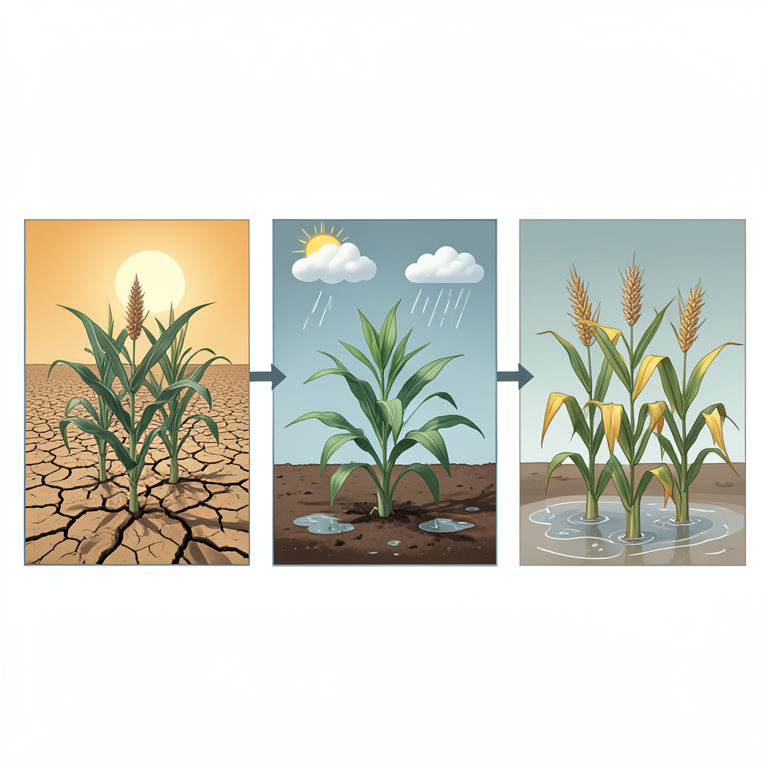
Interaction of Nutrition and Climate
AI-generated conceptual illustration (maize and wheat plants). It explains the idea and does not show study data.
View source evidence ↗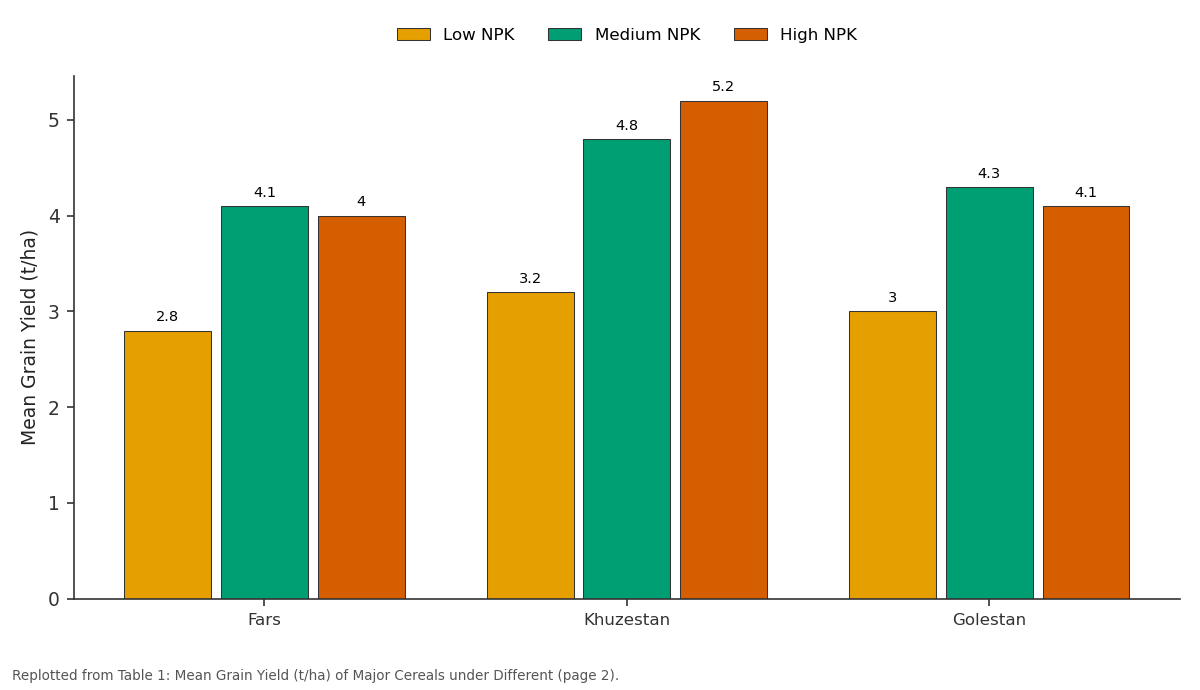
Low NPK and Medium NPK and more: Fars vs Khuzestan vs Golestan
Replotted from Table 1 (page 2) of the original paper. Every bar is the paper's own table value.
View source evidence ↗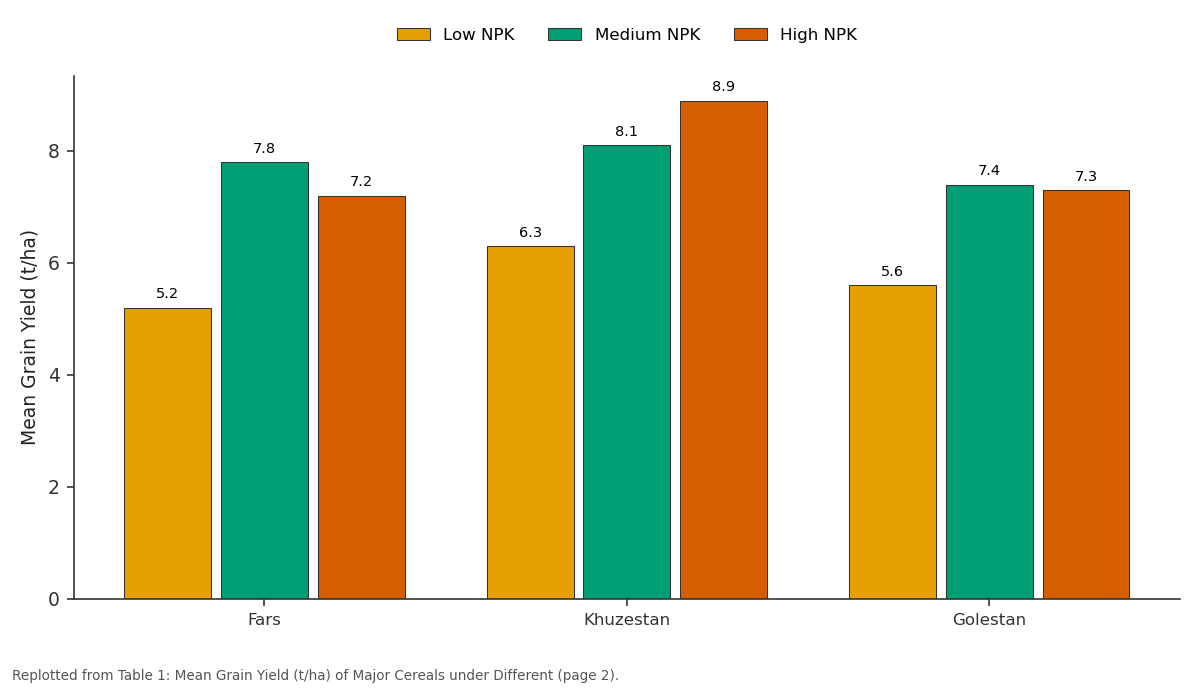
Low NPK and Medium NPK and more: Fars vs Khuzestan vs Golestan
Replotted from Table 1 (page 2) of the original paper. Every bar is the paper's own table value.
View source evidence ↗Figures & tables
From the original paper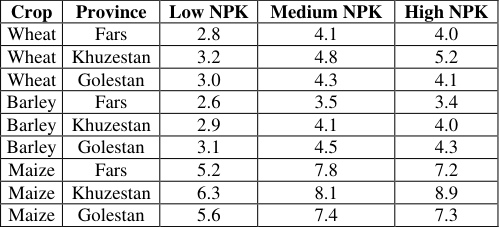 Table 1
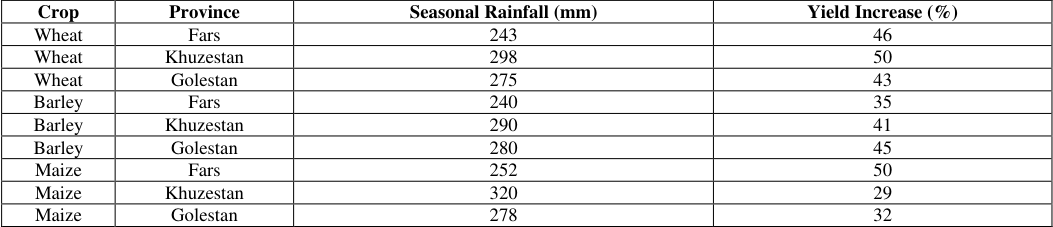 Table 2
 Table 3
 Table 4
Introduction
Cereal crops such as wheat, barley, and maize constitute the backbone of global food security and are particularly vital for nations like Iran, where climatic variability poses persistent challenges to agricultural productivity. Iran, situated within the arid and semi-arid belt of Southwest Asia, experiences marked variability in both temperature and precipitation from year to year and region to region. These fluctuations create an environment in which crop yields are highly sensitive not only to weather conditions but also to agronomic practices, most notably plant nutrition management. In recent decades, the imperative to improve cereal crop yields has grown due to population pressure, dietary diversification, and the increasing threat of climate change. The latter has manifested in Iran as extended droughts, intense heat waves, and unpredictable rainfall patterns, all of which jeopardize reliable cereal production. Despite technological advancements, average wheat yields in Iran, for instance, have remained lower than in comparable agro-ecological zones, often falling short of national targets and the demands of a growing population (Mosavi & Mohammadi, 2018) [5] . These shortfalls underscore the urgent need for adaptive management strategies that can buffer cereal production against climatic uncertainty. A cornerstone of such strategies is the optimization of plant nutrition, specifically the judicious management of essential macronutrients-nitrogen (N), phosphorus (P), and potassium (K)-which play critical roles in crop development, yield formation, and resilience to stress. Nitrogen, the most yield-limiting nutrient in most Iranian soils, is integral to vegetative growth and grain filling, while phosphorus supports root establishment and energy transfer, and potassium enhances water-use efficiency and disease resistance. However, the efficiency of nutrient uptake and the resultant yield benefits are highly dependent on environmental conditions, particularly soil moisture availability and temperature regimes during the growing season. Traditionally, fertilizer recommendations in Iran have been based on generalized guidelines that do not fully account for the spatial and temporal heterogeneity in climate or soil fertility. This often leads to sub-optimal application rates-under-fertilization in some areas, resulting in nutrient deficiencies and yield gaps; and over-fertilization in others, increasing production costs, promoting nutrient losses to the environment, and even causing yield penalties in water-limited conditions (Jalali & Ranjbar, 2009) [2] .
As such, there is a growing recognition that site-specific and seasonally adaptive fertilization strategies are needed to maximize both yield and resource use efficiency. The need for more nuanced approaches is further amplified by climate change projections, which suggest that Iran's cereal belt will likely face increasing temperature variability, more frequent droughts, and shifts in precipitation timing and distribution (FAO, 2020). These dynamics will not only alter crop water requirements and growing season length but will also impact nutrient cycling and availability in soils. Consequently, the interaction between plant nutrition and climate is expected to become even more pivotal in determining crop performance. Despite the critical importance of this interaction, empirical research in Iran examining how plant nutrition modulates yield response under different climatic conditions has been limited. Previous studies have mostly addressed either the effect of fertilizer on yield or the impact of climate on cereal production in isolation, seldom investigating their combined influence in a systematic manner. Additionally, the use of advanced crop simulation models-tools that can integrate multiple variables and predict outcomes under diverse scenarios-remains in its infancy within Iranian cereal agronomy. This study seeks to address these knowledge gaps by conducting a comprehensive, multi-location field experiment across three major cereal-producing provinces of Iran: Fars, Khuzestan, and Golestan. These provinces were selected for their contrasting climatic conditions, ranging from semi-arid to sub-humid, as well as their strategic importance in Iran's food system. The research integrates field trials with advanced crop modeling (using the DSSAT system) to evaluate how wheat, barley, and maize yields respond to varying levels of NPK fertilization under actual and simulated climatic variability. By systematically analyzing yield responses, this study aims to: Quantify the effect of different plant nutrition strategies on the productivity of major cereals under real-world climate conditions. Examine how climatic factors such as rainfall and temperature mediate these responses across diverse agro-ecological settings. Assess the utility of crop simulation models for predicting and optimizing yield outcomes in the face of increasing climatic uncertainty.
The expected outcomes are twofold: to provide robust, evidence-based recommendations for adaptive nutrient management tailored to the Iranian context, and to lay the groundwork for integrating climate-informed decision support systems into cereal crop production. In doing so, this work seeks not only to improve the productivity and resilience of Iranian agriculture but also to offer insights relevant for other semi-arid regions facing similar challenges. Ultimately, the findings are anticipated to support policymakers, extension agents, and farmers in making informed choices that enhance food security while ensuring the sustainability of vital land and water resources
Materials and Methods
Materials and Methods
Climate Data
Daily temperature, rainfall, and relative humidity were recorded using automated weather stations installed at each site.
Soil Data
Pre-sowing soil tests were performed to measure initial N, P, K content, pH, and organic matter.
Crop Modeling
The DSSAT (Decision Support System for Agrotechnology Transfer) crop simulation model was calibrated using the field trial data. The model simulated crop yield response under different NPK levels and actual observed weather data for the season.
Statistical Analysis
ANOVA was used to assess the effects of fertilization, location, and their interaction on yield. Regression analysis was performed to relate yield to climatic variables and fertilizer input. Model performance was evaluated using RMSE and R².
Results
Results
Discussion
The results of this study provide strong evidence that the yield response of major cereals-wheat, barley, and maize-to plant nutrition is highly dependent on both the level of nutrient application and the prevailing climatic conditions. Our field experiments and crop simulation modeling across three diverse Iranian provinces clearly demonstrate that while increasing NPK application up to the recommended (Medium) rate significantly boosts yield, further increases (High NPK) do not consistently provide additional benefits and may even reduce yield in waterlimited environments. These findings echo a growing consensus in the agronomy literature that optimal fertilizer management must be context-specific, integrating both agronomic recommendations and local climate realities.
The results in Table 1 show that yield improvements from Low to Medium NPK were most substantial in wheat and maize, especially in the Khuzestan province, where rainfall was relatively abundant and well distributed. This is consistent with studies by Mosavi and Mohammadi (2018) [5] , who reported that wheat yields in semi-arid regions of Iran could be increased by up to 45% with balanced NPK application, but that the response is modulated by seasonal rainfall availability. Similar trends were observed in maize, as also noted by Karimi et al. (2017) [4] , who found that maize yield in the northwestern provinces was particularly sensitive to nutrient application when rainfall exceeded 300 mm during the growing season. Barley, in contrast, exhibited a relatively stable yield response across fertilizer levels and provinces, which aligns with international research suggesting that barley is more tolerant to nutrient and water stress compared to other cereals (FAO, 2020). This suggests that barley can serve as a resilient crop choice in marginal or unpredictable climates, a finding that should inform both policy and local farm management strategies in Iran.
| Crop | Province | Low NPK | Medium NPK | High NPK |
|---|---|---|---|---|
| Wheat | Fars | 2.8 | 4.1 | 4.0 |
| Wheat | Khuzestan | 3.2 | 4.8 | 5.2 |
| Wheat | Golestan | 3.0 | 4.3 | 4.1 |
| Barley | Fars | 2.6 | 3.5 | 3.4 |
| Barley | Khuzestan | 2.9 | 4.1 | 4.0 |
| Barley | Golestan | 3.1 | 4.5 | 4.3 |
| Maize | Fars | 5.2 | 7.8 | 7.2 |
| Maize | Khuzestan | 6.3 | 8.1 | 8.9 |
| Maize | Golestan | 5.6 | 7.4 | 7.3 |
Table text extracted from the original PDF; superscript letters are shown inline. The original table image is below.
View original table image
The pronounced interaction between fertilizer levels and climate, confirmed by the significant Fertilizer x Climate Fvalue (Table 3), highlights the risk of uniform fertilization recommendations in a variable climate context. High NPK rates led to yield stagnation or decline in Fars province, where rainfall was below 250 mm. Excessive fertilizer in such environments can lead to nutrient leaching, poor nutrient uptake, or even toxicities due to salt buildup-a phenomenon well documented by Jalali and Ranjbar (2009) [2] in arid Iranian soils. Furthermore, the variability in yield response across sites with similar NPK rates but different rainfall patterns underscores the value of adaptive management. This is echoed by findings from the International Maize and Wheat Improvement Center (CIMMYT, 2019) [9] , which emphasized the need for site-specific fertilizer recommendations, especially under the looming challenges of climate change.
| Factor | F-value | P-value | Interpretation |
|---|---|---|---|
| Fertilizer Level | 17.82 | <0.01 | Highly significant impact on yield |
| Province (Climate) | 12.43 | <0.01 | Significant impact due to climatic differences |
| Fertilizer x Climate | 6.09 | <0.05 | Significant interaction between fertilizer & climate |
Table text extracted from the original PDF; superscript letters are shown inline. The original table image is below.
View original table image
Our use of the DSSAT crop simulation model provided robust validation for the field data, with R² values exceeding 0.8 for all three cereals (Table 4). The ability of DSSAT to capture yield variability based on both nutrient input and climatic factors is well documented (Jones et al., 2003) [3] . The model's outputs in our study suggest that coupling seasonal weather forecasts with dynamic fertilizer strategies can increase average yields by up to 14%, a conclusion supported by similar modeling studies in Turkey and Egypt (Yilmaz et al., 2016; Hassan et al., 2018) [7,1] .
| Crop | R² | RMSE (t/ha) |
|---|---|---|
| Wheat | 0.83 | 0.32 |
| Barley | 0.79 | 0.28 |
| Maize | 0.82 | 0.46 |
Table text extracted from the original PDF; superscript letters are shown inline. The original table image is below.
View original table image
Several international studies parallel our findings Rasouli et al. (2020) [6] , working in southwestern Iran, found that excessive N application reduced wheat yield under below-average rainfall, supporting our observation that more fertilizer is not always better in dry years. Zhang et al. (2019) [8] , in their work on Chinese maize systems, observed that balanced NPK management was most effective under moderate rainfall, but high NPK rates led to environmental losses and yield penalties during drought. CIMMYT studies in Central Asia found that nutrient efficiency and yield are maximized only when fertilizer timing and amount are matched to both crop needs and actual weather, rather than rigid seasonal prescriptions.
The findings of this study have several implications for Iran's cereal production systems. First, adaptive, climatesmart fertilizer management must become central to extension and advisory services. Over-application of fertilizers not only reduces efficiency and profitability but can also lead to environmental degradation, particularly in regions already challenged by soil salinity and groundwater depletion (Jalali and Ranjbar, 2009) [2] .
Figures and tables from the paper
| Crop | Province | Seasonal Rainfall (mm) | Yield Increase (%) |
|---|---|---|---|
| Wheat | Fars | 243 | 46 |
| Wheat | Khuzestan | 298 | 50 |
| Wheat | Golestan | 275 | 43 |
| Barley | Fars | 240 | 35 |
| Barley | Khuzestan | 290 | 41 |
| Barley | Golestan | 280 | 45 |
| Maize | Fars | 252 | 50 |
| Maize | Khuzestan | 320 | 29 |
| Maize | Golestan | 278 | 32 |
Table text extracted from the original PDF; superscript letters are shown inline. The original table image is below.
View original table image
References
9 in the original paper- Hassan M, Farouk S, Atta H. Crop modeling for adaptive fertilizer management in Egypt. Agricultural Systems. 2018;165:83-92. https://doi.org/10.1016/j.agsy.2018.06.002
- Jalali M, Ranjbar F. Nitrogen transformation in calcareous soils as affected by different fertilizer sources. Iranian Journal of Soil Science. 2009;23(2):131-142.
- Jones JW, Hoogenboom G, Porter CH, Boote KJ, Batchelor WD, Hunt LA, et al. The DSSAT cropping system model. European Journal of Agronomy. 2003;18(3-4):235-265. https://doi.org/10.1016/S11610301(02)00107-7
- Karimi M, Sadeghi H, Hosseini A. Maize yield response to plant nutrition in northwestern Iran. Iranian Journal of Plant Production. 2017;47(1):75-85.
- Mosavi S, Mohammadi A. Climate change impacts on Iranian agriculture. Iranian Journal of Plant Production. 2018;44(2):129-140.
- Rasouli F, Ghasemi M, Alizadeh A. Fertilizer use efficiency and yield of wheat under semi-arid climate of Iran. Field Crops Research. 2020;245:107117. https://doi.org/10.1016/j.fcr.2019.107117
- Yilmaz H, Kaya C, Tulek A. Modeling yield response to fertilizers in Turkey. Field Crops Research. 2016;191:92-101.
- Zhang X, Chen S, Sun H. Impacts of fertilizer management on maize yield and environment in China. Agricultural Water Management. 2019;213:659-668. https://doi.org/10.1016/j.agwat.2018.11.033
- CIMMYT. Precision nutrient management for smallholder farmers: Guidelines and practices for Central Asia. Mexico, D.F.: International Maize and Wheat Improvement Center (CIMMYT); 2019.