
Research article · 2025 · Full text
International Journal of Agriculture and NutritionPerformance metrics for agri-input customer contact channels in Bangalore zone
Volume 7(7) · Pages 96–99 · DOI: 10.33545/26646064.2025.v7.i7b.244 ↗
Research areasRFID technology advancementsFood Supply Chain TraceabilityInnovation and Socioeconomic Development
Abstract
Author-writtenThe study was conducted among 700 farmers in the Bangalore zone to assess their preference for various communication tools used by agro-input companies for product promotion. Using the Garrett Ranking Method, the research identified that personal selling is the most preferred communication tool, with a score of 635, highlighting the importance of direct interaction, field demonstrations, farmers' meetings, and advisory services in influencing purchase decisions. Advertisements, ranking second with a score of 475, were recognized for their role in reinforcing product visibility through pamphlets, brochures, posters, and banners placed in strategic locations. Direct marketing, including SMS, voice messages, and telephonic calls, ranked third with 315, showing moderate impact due to its limited personal engagement. Other promotional tools like mandi stalls, van campaigns, and company magazines received the lowest preference of 175, serving primarily as supplementary methods. The study concludes that agro-input companies should prioritize personal selling while complementing it with advertisements and selective direct marketing.
Summary
Source-checkedPlain-language reading of the full paper, prepared with AI and checked against the text. Each point links to the authors' own words.
Why it matters
- Agriculture is a primary livelihood for over half of India's population and contributes approximately 15% to the national GDP. View evidence ↗
- Agrochemicals, such as insecticides and bio-pesticides, are essential for protecting crops from pests, diseases, and weeds during growth and storage. View evidence ↗
- Because rural markets rely on relationship-based selling, companies often use personal marketing to build demand among farmers and local influencers. View evidence ↗
The question
- The study aims to evaluate how effective different customer contact methods used by agrochemical companies in the Bangalore zone are regarding engagement, sales, and brand positioning. View evidence ↗
What they did
- A random survey was conducted between 2023 and 2024 involving 700 farmers across the Dharmapuri, Krishnagiri, Mandya, and Chamrajnagar districts of the Bangalore zone. View evidence ↗
- The researchers used the Garrett Ranking Method to analyze survey responses and determine the most preferred communication tools. View evidence ↗
- Data collection involved personal interviews with farmers and retailers, as well as direct field observations of advertisement placements. View evidence ↗
What they found
- Personal selling was the most preferred communication method, achieving the highest Garrett score of 635. View evidence ↗
- Advertising was the second most preferred tool, with a Garrett score of 475. View evidence ↗
- Direct marketing (including SMS and phone calls) ranked third with a Garrett score of 315. View evidence ↗
- Supplementary tools such as mandi stalls, company magazines, and van/bike campaigns were the least preferred, scoring 175. View evidence ↗
- Face-to-face interactions, including field demonstrations and advisory services, are critical in influencing the purchase decisions of farmers. View evidence ↗
- While lacking personal interaction, advertising tools like posters and brochures act as constant visual reminders that reinforce product visibility. View evidence ↗
- Direct marketing is cost-effective and reaches many people quickly, but it is only moderately effective compared to personal selling and traditional ads. View evidence ↗
What it means
- The authors recommend that companies prioritize a personal selling-driven strategy, supplemented by advertising and selective direct marketing, to improve market performance. View evidence ↗
- The study concludes that personalized engagement and practical demonstrations are essential for building farmer trust and confidence in agro-input products. View evidence ↗
Figures & tables
From the original paper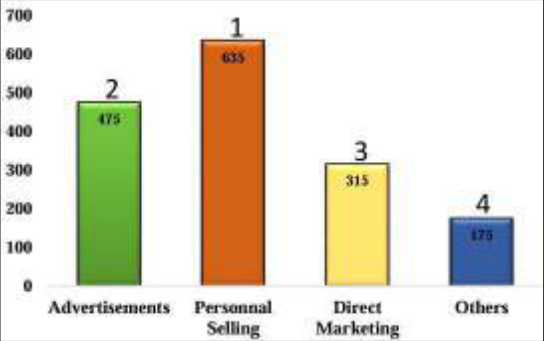 Figure 2
Introduction
India is predominantly an agricultural country, where more than half of its population is directly or indirectly dependent on agriculture for their livelihood, contributing about 15% to the national GDP as per the Central Statistics Organisation (CSO). Agriculture forms the backbone of rural income, making it essential to protect crops against various pests, diseases, and weeds that significantly impact productivity. Consequently, agrochemicalsincluding insecticides, fungicides, herbicides, rodenticides, fumigants, bio-pesticides, and plant growth regulatorshave become indispensable tools for safeguarding crops both in the field and during storage [1] . The agrochemical industry segments its products based on the type of pests they target, with bio-pesticides gaining attention for their eco-friendly and efficient nature. Moreover, since rural markets function on relationship-based selling, companies prefer personal marketing to generate demand at the grassroots level, focusing on farmers, retailers, opinion leaders, and agricultural departments. To achieve this, they employ multiple customer contact mechanisms such as direct mailers, regional print media, television, advertisements on Door darshan, radio, vehicle-based audio promotions, educational films, wall paintings, hoardings, point-of-sale materials, and word-of-mouth marketing through influential farmers and retailers. Hence, considering the diverse methods employed to engage customers, this study is undertaken to evaluate the effectiveness of various customer contact mechanisms used by agrochemical companies in the Bangalore zone, adopting a lead and lag measure approach to understand their impact on customer engagement, sales performance, and long-term brand positioning [2] .
Field observations during promotional activities supported the survey findings. The responses were analyzed using the Garrett Ranking Method to rank the most preferred communication tools.
Garrett Ranking Forumla
Garrett Ranking Forumla
Advertisement
The present study was conducted to evaluate the effectiveness of conventional advertising tools such as pamphlets, brochures, posters, banners, and danglers in creating product awareness among farmers in the Bangalore zone. A structured survey method was adopted by selecting farmers and retailers from various taluks within the zone, focusing on their exposure to different types of agrochemical advertisements. Pamphlets and brochures, containing colourful visuals, product images, and detailed descriptions, were assessed based on their ability to convey information even to illiterate farmers. Posters and banners displayed in public places such as marketplaces, mandis, and near retail outlets were analysed for their visibility and recall value among the target audience. Similarly, danglers placed at retail points and agrochemical shops were examined for their effectiveness as point-of-sale promotional tools influencing purchasing decisions. Data was collected using personal interviews with farmers and retailers, supplemented by observation of advertisement placements in the field. The collected data was analysed to understand the reach, influence, and impact of these conventional advertising mediums on the awareness and buying behaviour of farmers toward agro-input products [3] .
Personal selling
In the personal selling approach, field activities by market development executives-such as farmers' meetings, demonstrations, field days, "seeing and believing" programs, and the involvement of opinion leaders-were analysed to determine their role in educating farmers, building trust, and promoting product adoption. Farmers' meetings provided platforms for interactive learning and feedback, while demonstrations and field days showcased product performance in real-time. Opinion leaders, including progressive farmers and retailers, were studied for their influence on other farmers' purchasing decisions. The data for the study was collected using structured personal interviews with farmers, retailers, and field executives; direct observation of advertisement placements and personal selling activities; and feedback gathered during field events and meetings [4] .
Direct Marketing -Telemarketing
The study involves contacting potential customers directly with the aim of promoting or selling products or services. This approach can be carried out over the telephone or by arranging follow-up meetings in person or through online platforms like video conferencing, often scheduled during the initial call. It may also include pre-recorded promotional messages delivered via automated calling systems. In the agrochemical sector, telemarketing extends to sending product information through text messages (SMS), voice messages, and both incoming and outgoing phone calls to engage with farmers and provide updates on products, offers, or schemes [5] .
Others Mandi Stalls
Mandi stalls function as temporary sales outlets where direct interaction between customers and sellers takes place, often set up during local fairs, exhibitions, jatras, or special agricultural events. These stalls provide a marketplace environment for showcasing agro-input products, agricultural machinery, tools, and equipment. Whether organized in open grounds or indoor exhibition spaces, mandi stalls offer companies the chance to engage directly with farmers, demonstrate product features, and build brand presence within the rural market [6] .
Vehicles and Company Campaign
Van and bike campaigns are mobile promotional activities where company representatives use decorated vehiclesfeaturing product images and key messages-to travel through targeted areas. These campaigns aim to increase visibility and spread awareness among farmers by reaching them directly in their villages or at community gatherings. The mobility of these campaigns allows companies to cover a wide geographic area, ensuring repeated exposure and creating a lasting impression of the product among potential customers. A company magazine serves as more than just a catalog of products and services; it acts as a powerful communication tool that tells the company's story, reinforces its brand image, and nurtures customer loyalty. Through informative articles, success stories, product highlights, and expert advice, the magazine helps build a deeper relationship with the target audience. It supports marketing efforts by providing valuable content that educates farmers, promotes new technologies, and strengthens the company's presence in the competitive market [7] .
Results
The study conducted among 700 farmers in the Bangalore zone aimed to identify the most preferred communication tools used by agro-input companies for product promotion. The analysis, carried out using the Garrett Ranking Method, revealed significant insights into the farmers' preferences for different communication approaches. Among the various tools assessed, personal selling emerged as the most effective and highly preferred communication method, securing the top rank with a Garrett score of 635. This clearly indicates that direct, face-to-face interaction with farmers-through activities such as field demonstrations, field days, farmers' meetings, and direct advisory services by market development executives-plays a pivotal role in influencing farmers' purchase decisions. Personal selling builds trust, allows for immediate clarification of doubts, and provides farmers with practical exposure to the effectiveness of agro-input products, making it the most credible form of promotion in rural markets.
The second most preferred communication tool was advertising, with a Garrett score of 475. Although advertisements do not offer personal interaction, tools such as pamphlets, brochures, posters, banners, and wall paintings serve as constant visual reminders for farmers. These advertising methods help reinforce product visibility and create initial awareness, especially when placed in strategic locations like market yards, retail outlets, and public gathering places. The visual appeal and repetitive exposure make advertisements an important supporting tool in the promotion of agro-inputs. Direct marketing, which includes communication methods like SMS campaigns, voice messages, telephonic calls, and internet-based contact, ranked third with a score of 315. While this method has the advantage of reaching a wide audience quickly and at a relatively low cost, its effectiveness is moderate as compared to personal selling and traditional advertisements. The lack of direct interaction and the occasional perception of telemarketing as intrusive may limit its impact on influencing farmers' buying behaviour. Finally, other promotional tools, including mandi stalls, van and bike campaigns, and company magazines, received the lowest preference with a Garrett score of 175. Although these methods offer additional avenues for product promotion, their reach and effectiveness appear limited when compared to more interactive and direct communication strategies. Mandi stalls and van campaigns serve more as supplementary promotional tools rather than primary channels for engaging with farmers.
Preference of Various Communication tools
Preference of Various Communication tools
Conclusion
The study clearly establishes that among the various communication tools used for promoting agro-input products in the Bangalore zone, personal selling stands out as the most preferred and effective method. Farmers value direct interaction, practical demonstrations, and personalized engagement, which builds trust and confidence in the products being promoted. Personal selling activities such as field demonstrations, farmers' meetings, and field days not only create awareness but also offer farmers firsthand experience of the product's performance, making it a critical factor in their decision-making process. Advertisements, while effective in reinforcing product visibility and creating initial interest, serve best as a supportive tool alongside personal selling efforts. Direct marketing approaches like SMS, voice calls, and telemarketing have limited impact when used in isolation but can complement other strategies when applied effectively. Other promotional tools, including mandi stalls, van campaigns, and company magazines, play a marginal role and are best suited for creating additional touchpoints rather than being the primary mode of communication. Therefore, agro-input companies are recommended to adopt a personal selling-driven communication strategy, supported by advertisements and selective direct marketing, to maximize farmer engagement, enhance product adoption, and improve market performance in the Bangalore region.
Figures and tables from the paper
References
7 in the original paper- Pandey S, Pandey M. Enhancing efficiency of agriinput marketing through ICT applications. 2018;5:135137.
- Senapati P. A study of agricultural inputs marketing in India. Indian Streams Res J. 2014;4(5):1-6.
- Khan F, Ghidode S, Joshi SK. Impact of brand endorsement on farmer's purchasing decision for agricultural inputs: a case of Surguja district of Chhattisgarh. Pharma Innov J. 2022;11(8S):1788-1791.
- Kumar N, Kapoor S. Extensiveness of farmers' buying process of agri-inputs in India: implications for marketing. J Agribus Dev Emerg Econ. 2017;7(1):3551.
- Patel KN, Thakkar MG, Pandya RD. E-retailing of agriinputs: emerging scenario in Indian agriculture. Indian J Ext Educ. 2022;58(3):93-97.
- Krishnamurthy M, Witsoe J. Understanding mandis: market towns and the dynamics of India's urban and rural transformations. London: International Growth Centre, London School of Economics; 2012.
- Yao Y, Tang E, Ying F, Pan X, Xie Y, Huang Z, et al. Mobile agricultural products vending vehicle with autonomous navigation selling on town roads. In: Design Studies and Intelligence Engineering. Amsterdam: IOS Press; 2024. p. 683-693.