
Research article · 2025 · Full text
International Journal of Agriculture and Food ScienceRetention of rural youth in agriculture: Influencing factors and strategic interventions for livelihood security
Volume 7(7) · Pages 201–203 · DOI: 10.33545/2664844x.2025.v7.i7c.512 ↗
Research areasAgricultural Innovations and Practices
Abstract
Author-writtenThe retention of rural youth in agriculture is crucial for ensuring the sustainability of India’s agrarian economy and securing the livelihoods of millions. However, agriculture today faces multifaceted challenges including decreasing landholdings, low profitability, climate risks, and the growing disinterest among youth. This study explores the key factors influencing rural youth in their decision to either continue or abandon agriculture as a livelihood in the Saurashtra region of Gujarat. Using a mixed sampling technique, the study surveyed 240 rural youth across selected talukas of Rajkot and Jamnagar districts, where migration trends are notably high. The findings revealed that landholding size, income level, education, access to agricultural resources, family background, market and risk orientation, and achievement motivation significantly influenced youth decisions. The study also gathered suggestions from youth and stakeholders to improve youth engagement in agriculture. These included improved access to credit and technology, training on modern practices, market linkages, and better recognition of agriculture as a viable career. The study provides practical insights for policymakers, extension agencies, and educational institutions to develop targeted strategies for engaging rural youth in agriculture, thereby ensuring sustainable rural livelihoods.
Summary
Source-checkedPlain-language reading of the full paper, prepared with AI and checked against the text. Each point links to the authors' own words.
Why it matters
- Keeping rural youth engaged in agriculture is essential for the long-term sustainability of India's agrarian economy and the security of millions of livelihoods. View evidence ↗
- The agricultural sector currently faces several challenges, such as shrinking landholdings, low profits, and climate-related risks, which contribute to a lack of interest among young people. View evidence ↗
- Rural youth are moving away from farming because of poor infrastructure, limited profitability, a lack of support services, and the attraction of jobs in cities. View evidence ↗
The question
- The study aims to analyze the institutional, psychological, and socio-economic factors that affect whether rural youth in Gujarat's Saurashtra region continue agriculture as their livelihood. View evidence ↗
- The research also seeks to collect direct suggestions from rural youth to help create policies and programs that make farming a more sustainable and attractive career. View evidence ↗
What they did
- The study used a combination of purposive and random sampling to select the Rajkot and Jamnagar districts in South Saurashtra, chosen specifically for their high migration rates. View evidence ↗
- The study surveyed a total of 240 rural youth who had expressed a desire to leave the agricultural profession. View evidence ↗
- Data were collected using a structured interview schedule that was pre-tested and translated into Gujarati. View evidence ↗
- The researchers analyzed the data using statistical measures including correlation coefficients, regression coefficients, mean, standard deviation, and percentages. View evidence ↗
What they found
- The most critical factor for youth staying in agriculture was high income potential and better market prices, cited by 83.33% of respondents. View evidence ↗
- Access to essential farming inputs, including land, water, seeds, and fertilizers, was the second most influential factor, reported by 80.42% of respondents. View evidence ↗
- Government support, such as loans, subsidies, and crop insurance, was the third most important factor, cited by 75.42% of respondents. View evidence ↗
- When asked for suggestions, 87.50% of youth identified ensuring better market prices and high income potential as the top priority for retaining their interest. View evidence ↗
- Improving irrigation facilities and access to water resources was the second most requested suggestion, mentioned by 83.33% of respondents. View evidence ↗
- The lowest-ranked suggestion was the development of rural infrastructure, such as electricity, storage, and roads, cited by 52.08% of respondents. View evidence ↗
What it means
- The authors conclude that their findings offer practical insights for educational institutions, extension agencies, and policymakers to create targeted strategies to engage rural youth and ensure sustainable livelihoods. View evidence ↗
Visual summary
1 visualsIllustrations explain the paper; charts are replotted from the paper's own table values.
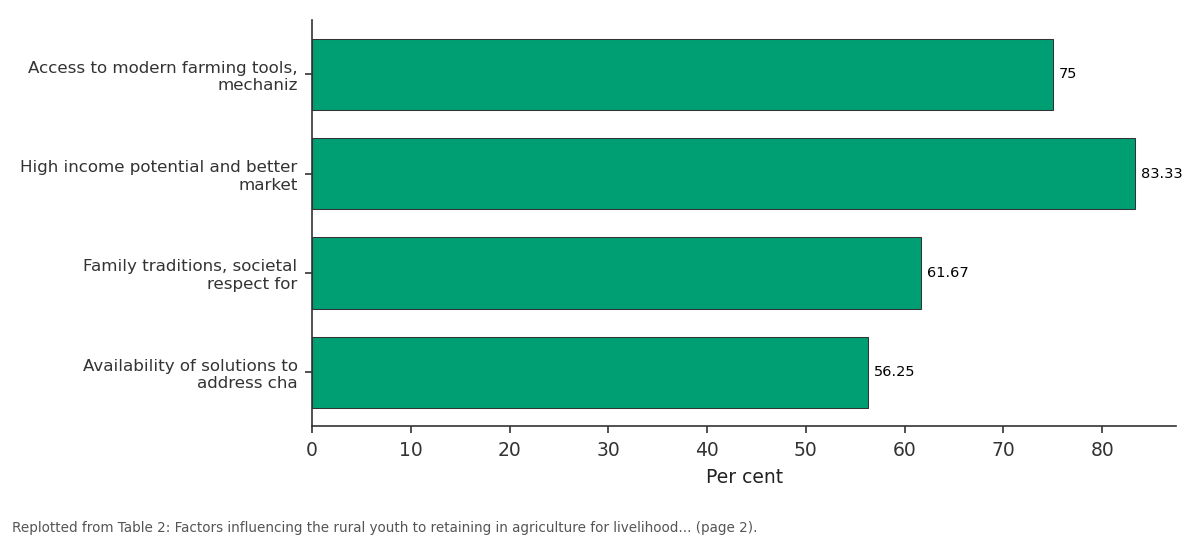
Per cent: Access to modern... vs High income potential... vs Family traditions... vs Availability of...
Replotted from Table 2 (page 2) of the original paper. Every bar is the paper's own table value.
View source evidence ↗Figures & tables
From the original paper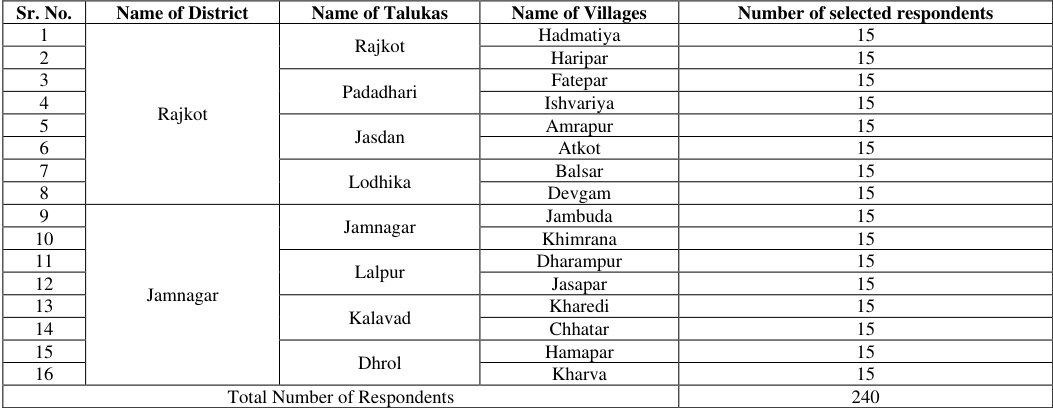 Table 1
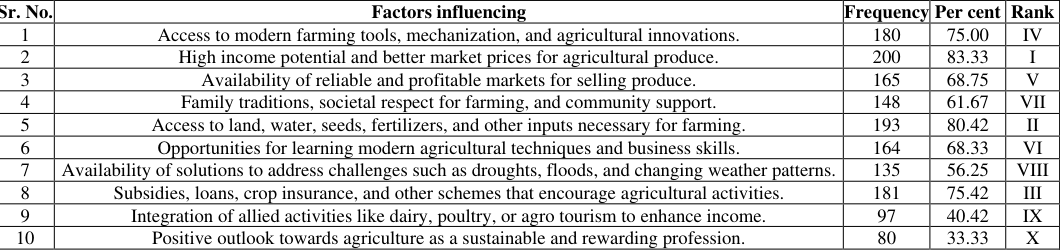 Table 2
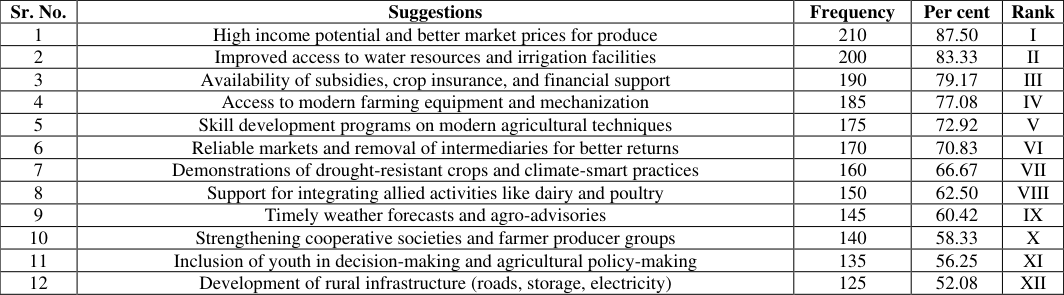 Table 3
Introduction
Agriculture remains the principal livelihood source for a large portion of India's rural population. Despite its importance, the sector is witnessing an alarming decline in youth participation. Rural youth, who once viewed farming as a way of life, are increasingly shifting away due to limited profitability, lack of support services, poor infrastructure, and the lure of urban employment opportunities. This trend poses a serious threat to the sustainability of rural communities and national food security. The future of Indian agriculture heavily depends on the younger generation. With over 65% of the population residing in rural areas and a significant proportion being youth, their engagement in farming is not only vital for productivity but also for innovation and entrepreneurship in agriculture. Various government and institutional efforts, such as skill development initiatives, agristartups, and subsidies, aim to reverse this trend. However, these initiatives often fail to address the ground realities and diverse factors that influence the decision-making process of rural youth. This study aims to identify and analyze the socio-economic, psychological, and institutional factors that influence rural youth in retaining agriculture as a livelihood in the Saurashtra region of Gujarat. It also seeks to gather practical suggestions from youth themselves to inform the design of effective policies and programs that can make agriculture a more attractive and sustainable career path.
Materials and Methodology
The study was conducted in the Saurashtra region of Gujarat, specifically focusing on the retention of youth in agriculture. It utilized an ex post facto research design, where the researcher examines variables that have already occurred. The research adopted a purposive and random sampling technique, selecting Rajkot and Jamnagar districts from South Saurashtra based on high migration rates. Four talukas were randomly chosen from each district, resulting in eight talukas. From each taluka, two villages were randomly selected, totalling 16 villages. In each village, 15 rural youth were chosen as respondents, totalling 240 youth who expressed a desire to leave agriculture as their profession. An interview schedule was developed in accordance with the objectives of the study, pre-tested, and translated into Gujarati. Data were collected using this structured interview schedule, classified, tabulated, analysed, and interpreted to make the findings meaningful. Statistical measures such as percentage, mean, standard deviation, regression coefficient and correlation coefficient were used in the study.
Results and Discussion
Factors Influencing the rural youth to retaining in agriculture for livelihood security For ascertaining the factors influencing the rural youth to retaining in agriculture for livelihood security, the different factors were invited openly from respondents. The frequency was calculated for each factor and converted into percentage and rank was given.
The most significant factors influencing rural youth to retaining in agriculture for livelihood security were ranked based on their importance as perceived by the respondents. High income potential and better market prices for agricultural produce were identified as the most crucial factor, with (83.33 per cent) of respondents ranking it first. Access to essential resources like land, water, seeds, fertilizers, and other inputs was the second most influential factor, reported by (80.42 per cent) of respondents. Subsidies, loans, crop insurance, and supportive government schemes ranked third with (75.42 per cent), while access to modern farming tools, mechanization, and agricultural innovations ranked fourth, supported by (75.00 per cent) of respondents.
Other influential factors included the availability of reliable and profitable markets for selling produce, ranked fifth with (68.75 per cent), followed closely by opportunities for learning modern agricultural techniques and business skills (68.33 per cent), and family traditions and societal respect for farming (61.67 per cent), ranked sixth and seventh, respectively. Addressing challenges posed by climate variability ranked eighth with (56.25 per cent). Less prioritized factors included the integration of allied activities like dairy, poultry, or agro tourism (40.42 per cent), and a positive outlook towards agriculture as a sustainable and rewarding profession (33.33 per cent), which ranked ninth and tenth, respectively. This finding was in conformity with the findings of Anamica and Ravichandran (2013) [1] , Mali et al. (2015) [6] , Bodake (2016) [3] , Radhakrishnan and Arunachalam (2017) [10] , Vihari (2018) [12] , Uikey (2021) [11] and Bisen (2020) [2] .
Suggestions of rural youth to retaining in agriculture for livelihood security
The suggestions from the respondents to retaining in agriculture for livelihood security, were invited openly from respondents. The frequency was calculated for each suggestion and converted into percentage and rank was given.
The suggestions provided by rural youth to retaining their interest in agriculture were ranked based on importance. The top-ranked suggestion, mentioned by (87.50 per cent) of respondents, was to ensure high income potential and better market prices for agricultural produce, highlighting the critical need for profitability in farming. Improved access to water resources and irrigation facilities ranked second (83.33 per cent), reflecting the region's reliance on efficient water management for agricultural success. Subsidies, crop insurance, and financial support were ranked third (79.17 per cent), showcasing the necessity for financial security and risk mitigation mechanisms. Access to modern farming equipment and mechanization was ranked fourth (77.08 per cent), emphasizing the role of technology in increasing productivity and reducing manual labour.
Skill development programs on modern agricultural techniques ranked fifth (72.92 per cent), while reliable markets free from intermediaries for better returns were ranked sixth (70.83 per cent). Demonstrations of droughtresistant crops and climate-smart practices ranked seventh (66.67 per cent), indicating the youth's awareness of climate challenges. Integrating allied activities like dairy and poultry ranked eighth (62.50 per cent), showing interest in diversification for income stability. Timely weather forecasts and agro-advisories was ninth (60.42 per cent), followed by strengthening cooperative societies and farmer producer groups (58.33 per cent) at tenth. Inclusion of youth in agricultural policy-making ranked eleventh (56.25 per cent), and developing rural infrastructure such as roads, storage facilities, and electricity ranked twelfth (52.08 per cent). These suggestions underscore the multifaceted approach required to address economic, technological, and infrastructural needs to retaining rural youth in agriculture. This finding was in conformity with the findings of Hadagali (2013) [4] , Patel and Prajapati (2013) [9] , Lyocks et al. (2013) [5] , Parmar (2015) [8] , Viswanatha et al. (2014) [13] and Maurya et al. (2022) [7] .
Figures and tables from the paper
| Sr. No. | Name of District | Name of Talukas | Name of Villages | Number of selected respondents |
|---|---|---|---|---|
| 1 | Rajkot | Rajkot | Hadmatiya | 15 |
| 2 | Haripar | 15 | ||
| 3 | Padadhari | Fatepar | 15 | |
| 4 | Ishvariya | 15 | ||
| 5 | Jasdan | Amrapur | 15 | |
| 6 | Atkot | 15 | ||
| 7 | Lodhika | Balsar | 15 | |
| 8 | Devgam | 15 | ||
| 9 | Jamnagar | Jamnagar | Jambuda | 15 |
| 10 | Khimrana | 15 | ||
| 11 | Lalpur | Dharampur | 15 | |
| 12 | Jasapar | 15 | ||
| 13 | Kalavad | Kharedi | 15 | |
| 14 | Chhatar | 15 | ||
| 15 | Dhrol | Hamapar | 15 | |
| 16 | Kharva | 15 | ||
| Total Number of Respondents | 240 |
Table text extracted from the original PDF; superscript letters are shown inline. The original table image is below.
View original table image
| Sr. No. | Factors influencing | Frequency | Per cent | Rank |
|---|---|---|---|---|
| 1 | Access to modern farming tools, mechanization, and agricultural innovations. | 180 | 75.00 | IV |
| 2 | High income potential and better market prices for agricultural produce. | 200 | 83.33 | I |
| 3 | Availability of reliable and profitable markets for selling produce. | 165 | 68.75 | V |
| 4 | Family traditions, societal respect for farming, and community support. | 148 | 61.67 | VII |
| 5 | Access to land, water, seeds, fertilizers, and other inputs necessary for farming. | 193 | 80.42 | II |
| 6 | Opportunities for learning modern agricultural techniques and business skills. | 164 | 68.33 | VI |
| 7 | Availability of solutions to address challenges such as droughts, floods, and changing weather patterns. | 135 | 56.25 | VIII |
| 8 | Subsidies, loans, crop insurance, and other schemes that encourage agricultural activities. | 181 | 75.42 | III |
| 9 | Integration of allied activities like dairy, poultry, or agro tourism to enhance income. | 97 | 40.42 | IX |
| 10 | Positive outlook towards agriculture as a sustainable and rewarding profession. | 80 | 33.33 | X |
Table text extracted from the original PDF; superscript letters are shown inline. The original table image is below.
View original table image
| Sr. No. | Suggestions | Frequency | Per cent | Rank |
|---|---|---|---|---|
| 1 | High income potential and better market prices for produce | 210 | 87.50 | I |
| 2 | Improved access to water resources and irrigation facilities | 200 | 83.33 | II |
| 3 | Availability of subsidies, crop insurance, and financial support | 190 | 79.17 | III |
| 4 | Access to modern farming equipment and mechanization | 185 | 77.08 | IV |
| 5 | Skill development programs on modern agricultural techniques | 175 | 72.92 | V |
| 6 | Reliable markets and removal of intermediaries for better returns | 170 | 70.83 | VI |
| 7 | Demonstrations of drought-resistant crops and climate-smart practices | 160 | 66.67 | VII |
| 8 | Support for integrating allied activities like dairy and poultry | 150 | 62.50 | VIII |
| 9 | Timely weather forecasts and agro-advisories | 145 | 60.42 | IX |
| 10 | Strengthening cooperative societies and farmer producer groups | 140 | 58.33 | X |
| 11 | Inclusion of youth in decision-making and agricultural policy-making | 135 | 56.25 | XI |
| 12 | Development of rural infrastructure (roads, storage, electricity) | 125 | 52.08 | XII |
Table text extracted from the original PDF; superscript letters are shown inline. The original table image is below.
View original table image
References
13 in the original paper- Anamika M, Ravichandran V. Perception of farm households on factors influencing the migration of rural youth and its repercussion in agriculture. International Journal of Tropical Agriculture. 2013;31(2):151-156.
- Bisen S. Perception of rural youth towards agriculture as an occupation [MSc thesis]. Jabalpur: Jawaharlal Nehru Krishi Vishwa Vidyalaya; 2020. Unpublished.
- Bodake TA, Nair RG, Shende SS, Rathod MK. Perception of rural youth towards agriculture as an occupation. Bulletin of Environment, Pharmacology and Life Sciences. 2019;8(7):64-70.
- Hadagali V. A study on aspirations and participation of rural youth practicing agriculture and allied activities [MSc thesis]. Bangalore: University of Agricultural Sciences; 2013.
- Lyocks JS, Lyocks SWJ, Kagbu JH. Mobilizing youth for participation in Nigerian Agricultural Transformation Agenda: A grassroots' approach. Journal of Agricultural Extension. 2013;17(2):78-87.
- Mali MD, Tekale VS, Shaikh JJ. Relationship between aspiration and personal, socioeconomic and psychological characteristics of rural youth and constraints faced by rural youth towards selfdevelopment. Agriculture Update. 2015;10(2):100-104.
- Maurya AS, Bhavesh, Mishra A, Malik JS. Migration behaviour of rural youth in Haryana. Indian Journal of Extension Education. 2022;58(3):93-98.
- Parmar VK. A study on aspirations of rural youths towards rural development activities in Sehore District of Madhya Pradesh [MSc thesis]. Gwalior (MP): Rajmata Vijayaraje Scindia Krishi Vishwa Vidyalaya; 2015.
- Patel BK, Prajapati VV. Constraints faced by the rural youth while participating in the rural development activities in Banaskantha district. AGRES -An International e-Journal. 2013;2:159-164.
- Radhakrishnan P, Arunachalam R. Study on factors responsible for shifting of rural youth from agriculture to other occupation. Madras Agricultural Journal. 2017;104:94-97.
- Uikey AS. Factors affecting participation of rural youth in agriculture. Indian Journal of Social Research. 2021;62(1-2):1-6.
- Vihari AM. A study on perception of rural youth towards agriculture as an occupation in Srikakulam District [MSc thesis]. Guntur: Acharya NG Ranga Agricultural University; 2018. Unpublished.
- Viswanatha H, Manjunatha BN, Lakshminarayan MT. Aspirations and problems of rural youth practising agriculture. Mysore Journal of Agricultural Sciences. 2014;48(4):583-588.