
Research article · 2025 · Full text
International Journal of Agriculture and Food ScienceWeed detection and herbicide recommendation using YOLO
Volume 7(7) · Pages 196–200 · DOI: 10.33545/2664844x.2025.v7.i7c.511 ↗
Research areasSmart Agriculture and AI
Abstract
Author-writtenIn modern agriculture, efficient weed management is critical to maximizing crop yield and minimizing environmental impact. Traditional methods of herbicide application often involve uniform spraying across fields, which leads to overuse of chemicals, increased costs, and ecological harm. To address this, our research proposes an intelligent weed detection system that utilizes computer vision and machine learning to identify and count weeds in agricultural fields. The motivation behind this study stems from the existing gap in precision agriculture where real-time, automated weed quantification is limited, and current systems lack adaptability to diverse field conditions. Our proposed methodology involves capturing field images using drones or mobile platforms, preprocessing these images to enhance clarity, and employing a convolutional neural network (CNN)-based model to system's high accuracy in weed detection, achieving an overall classification accuracy of 97.3% thereby offering a scalable and eco- friendly solution for precision weed management.
Summary
Source-checkedPlain-language reading of the full paper, prepared with AI and checked against the text. Each point links to the authors' own words.
Why it matters
- Conventional herbicide application typically uses uniform spraying, which results in chemical overuse, higher costs, and environmental damage. View evidence ↗
- Uncontrolled weed growth reduces crop yields and causes economic losses because weeds compete with crops for nutrients, sunlight, and water. View evidence ↗
- The study is motivated by a lack of adaptable, real-time automated systems for quantifying weeds in precision agriculture. View evidence ↗
The question
- The research aims to develop an intelligent system using machine learning and computer vision to identify and count weeds in agricultural fields. View evidence ↗
What they did
- The system acquires field images using mobile-mounted cameras or drones. View evidence ↗
- Raw images are preprocessed through normalization, resizing, enhancement, and noise removal to improve feature visibility. View evidence ↗
- A deep learning object detection algorithm is employed to classify weeds and localize them using confidence scores and bounding boxes. View evidence ↗
- A rule-based system determines the infestation level (low, medium, or high) based on weed density to recommend herbicide dosages and types. View evidence ↗
What they found
- The YOLOv8 model achieved the highest overall classification accuracy of 97.3%. View evidence ↗
- The YOLOv5 model achieved a classification accuracy of 95.4%. View evidence ↗
- The Faster R-CNN model reached an accuracy of 96.3%. View evidence ↗
- The Retina Net model achieved an accuracy of 96.1%. View evidence ↗
- The SSD model had the lowest accuracy among the compared models at 85.2%. View evidence ↗
What it means
- The authors conclude that the system successfully optimizes chemical use by estimating weed density and classifying species to recommend herbicides. View evidence ↗
- Automated weed detection is concluded to promote sustainable farming and improve yields by reducing manual labor and unnecessary herbicide use. View evidence ↗
- The authors note that the system still faces challenges regarding the need for large datasets and environmental variations like shadows, occlusions, and lighting. View evidence ↗
- Future work will focus on integrating Vision Transformers (ViTs) and YOLOv8 to increase the speed and accuracy of detection. View evidence ↗
Visual summary
2 visualsIllustrations explain the paper; charts are replotted from the paper's own table values.
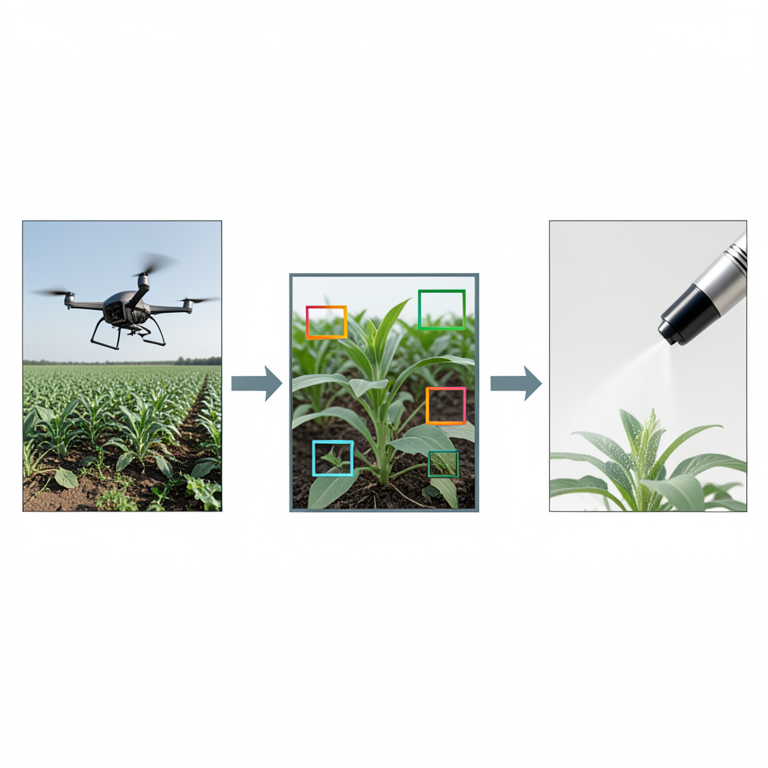
System Workflow
AI-generated conceptual illustration (agricultural field with weeds and a surveillance drone). It explains the idea and does not show study data.
View source evidence ↗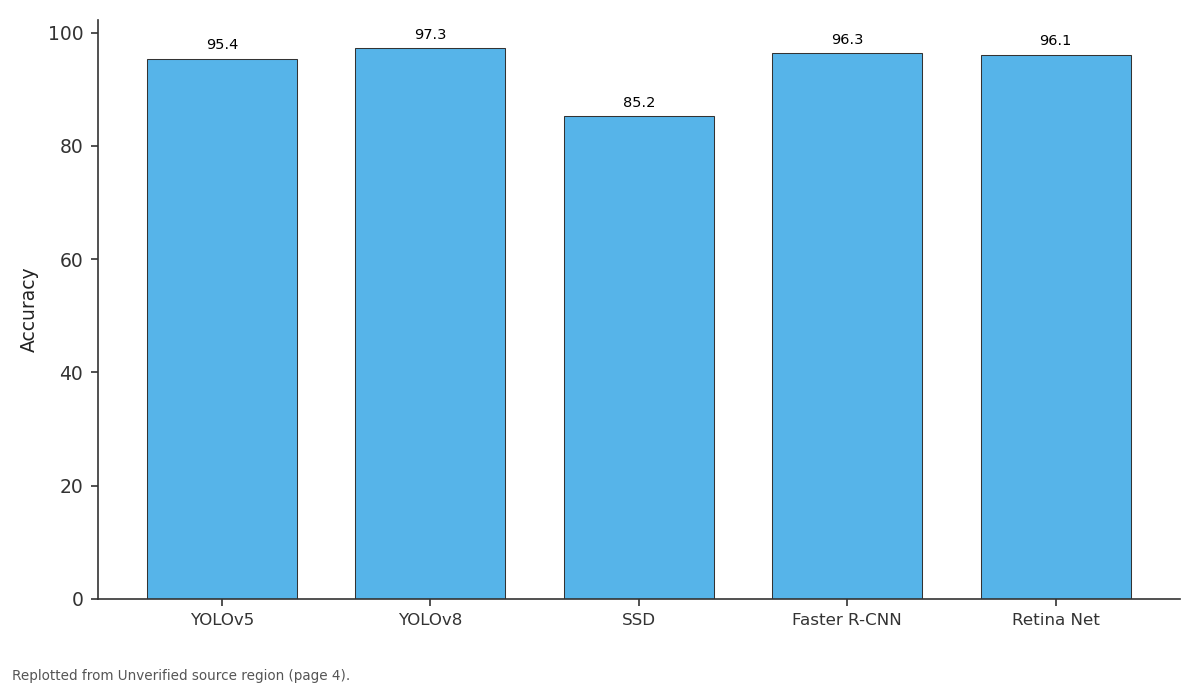
Accuracy: YOLOv5 vs YOLOv8 vs SSD vs Faster R-CNN vs Retina Net
Replotted from a table (page 4) of the original paper. Every bar is the paper's own table value.
View source evidence ↗Introduction
Agriculture remains the backbone of many economies worldwide, especially in developing countries where a significant portion of the population relies on farming for their livelihood. One of the persistent challenges faced by farmers is the uncontrolled growth of weeds, which compete with crops for essential resources such as water, sunlight, and nutrients, ultimately leading to reduced yields and economic losses. Traditional weed control methods, such as blanket herbicide application, not only increase production costs but also contribute to environmental pollution and herbicide resistance. This project introduces a smart weed detection and herbicide recommendation system designed to accurately detect and count weeds. Based on revolutionize weed management practices in the weed count, a decision support system recommends the optimal type and dosage of herbicide, ensuring targeted application. Experimental results demonstrate the agriculture. By leveraging computer vision and machine learning technologies, the system enables precise identification and counting of weeds in the field. Based on this count, it recommends the appropriate type and amount of herbicide, promoting site-specific treatment rather than uniform application. This targeted [4] Dyrmann et al. (2017) developed a fully convolutional neural network (FCN) for pixel-wise weed detection in cereal crops, achieving approach not only reduces herbicide usage and an accuracy of 86.65%. Their work tackled operational costs for farmers but also enhances challenges like occlusions and overlapping crop productivity and sustainability. Economically, the project holds the potential to significantly lower input costs and increase profitability for farmers while contributing to more environmentally responsible farming practices.
Literature Review [1] Huang et al. (2018) designed an image-based weed detection system using shape and texture analysis. Histogram-oriented gradients (HOG) and support vector machines (SVM) were employed to differentiate weeds and crops with an accuracy of 85%. The study demonstrated the effectiveness of classical machine learning in early-stage weed detection.
For future work, the authors suggested incorporating more dynamic environmental conditions and expanding the feature set for improved robustness. [2] Dos Santos et al. (2017) implemented a real-time weed detection method using color segmentation and morphological filtering under field conditions. Their approach plants. Future work was suggested to enhance the model's generalization across different crop types and incorporate temporal data for growth stage-based detection. [5] Olsen et al. (2019) introduced DeepWeeds, a multiclass weed image dataset for training deep learning models, with ResNet-50 achieving 95.7% classification accuracy. Their contribution filled a major dataset gap in agricultural AI. They proposed future enhancements through dataset expansion across different regions and real-time deployment on mobile devices for in-field usage. [6] Ferreira et al. (2017) utilized UAV imagery and SLIC superpixel segmentation with CNNs to detect broadleaf and grass weeds in soybean crops, achieving over 98% accuracy. Their method highlighted the potential of aerial imagery in precision agriculture. For future directions, they advocated for integrating temporal image analysis and environmental data to adapt weed detection across seasons. [7] Haq et al. (2022) proposed an automated efficiently separated crops and weeds based on weed detection system using UAVs and a CNN-hue differences. However, they noted limitations in varying lighting conditions and proposed future enhancements using adaptive color models and integration with UAV platforms for large-scale monitoring. LVQ hybrid model, reaching an impressive 99.44% accuracy. Their work emphasized the strength of combining UAV data with deep learning. As a future step, they suggested developing a mobile-based application for real- [3] Gao et al. (2019) proposed a deep learning-time farmer support and extending the model to based weed identification system using convolutional neural networks (CNNs) for feature extraction. The model achieved 92.5% accuracy on soybean fields and outperformed traditional classification methods. As future work, they recommended extending the model detect herbicide-resistant weed species. [8] Manikandakumar et al. (2022) presented a Particle Swarm Optimization (PSO) tuned CNN for weed classification, achieving over 98% accuracy across two datasets. Their work demonstrated the benefits of optimization to multi-crop scenarios and implementing realtechniques in improving deep learning time weed mapping for precision herbicide application. Performance. Future work includes testing the system in live field environments and integrating it with automated sprayer systems for closed-loop weed management [9] . Nasiri et al. (2022) applied a U-Net based encoder-decoder architecture for pixel-level classification of weeds, soil, and sugar beet, achieving 96.06% accuracy. Their segmentation approach ensured precise herbicide targeting. For future work, the authors suggested adapting the model for multi-spectral images and deploying it on edge computing devices for onsite analysis. [10] Tang et al. (2017) proposed a weed detection system combining K-means feature learning with CNNs, achieving 92.89% accuracy, outperforming standard CNNs. This hybrid approach captured unsupervised features effectively. As future work, they recommended integrating GPS-based localization for geo-tagging weed clusters and expanding training to include early growth stages of crops and weeds.
Proposed Methodology 1. Data Acquisition
Description: Images of the agricultural field are captured using drones or mobile-mounted cameras. These images serve as the primary input for the system. Purpose: To collect real-time, high-resolution visual data that contains both crops and weed patches under natural field conditions.
Image Preprocessing Description:
The raw images undergo preprocessing steps such as resizing, noise removal, normalization, and enhancement. Purpose: To standardize image inputs and improve feature visibility, ensuring better performance by the object detection model.
Description: A deep learning-based object detection algorithm is used to detect and classify weeds within the field images. Each weed is localized with bounding boxes and confidence scores.
Purpose: To accurately identify the location and type of weeds present in the field images.
Weed Count and Density Estimation
Description: The model output is analyzed to count the number of detected weeds and estimate the weed density per image or per field section. Purpose: To quantify weed infestation levels, which is crucial for determining herbicide requirements.
Herbicide Recommendation
Description: Based on weed density, a rule-based system classifies the infestation level (e.g., low, medium, high) and recommends appropriate herbicide types and dosages. Purpose: To ensure precise and efficient use of herbicides, avoiding under-or over-application.
Output Report
Description: The system generates a final report containing the number of weeds detected, their distribution across the field, and the recommended herbicide action. Purpose: To provide actionable insights for farmers, aiding in decision-making for targeted weed control.
Object Detection Aglorithm 1. Bounding Box Format: Each object is represented by (x,y,w,h) (x, y, w, h) (x,y,w,h), where x,yx, yx,y are center coordinates, w,hw, hw,h are width and height.
YOLO Bounding
YOLO Bounding
Future Work
Future enhancements of this study will focus on integrating advanced deep learning models such as Vision Transformers (ViTs) and YOLOv8 for faster and more accurate weed detection, along with attention-based CNN models to improve classification in complex field environments.
Expanding the dataset with high-resolution UAV images from different seasons, crop types, and regions, as well as incorporating multispectral and hyperspectral imaging, will enhance model generalization. Additionally, deploying the model on edge devices or drones for real-time weed classification and herbicide recommendations will reduce reliance on cloud computing, improving speed and efficiency.
To refine weed counting, object detection techniques like Faster R-CNN and YOLO will be implemented for precise estimation. Moreover, an AI-driven decision support system (DSS) will be developed to dynamically adjust herbicide dosage based on weed density, weather conditions, and crop health, ensuring optimal and sustainable chemical usage. Large-scale field trials and real-world validation with agricultural experts and farmers will be conducted to assess the system's practical benefits, making it more scalable and applicable to modern precision agriculture.
References
20 in the original paper- Hari Krishnan G, Rajasenbagam T. A comprehensive survey for weed classification and detection in agriculture lands. J Inf Technol Digit World. 2021 Dec.
- Patel S, Verma R, Meena M. Deep learning-based weed detection in precision agriculture: a review. Int J Comput Vis Agric Technol. 2022 Mar.
- Sharma A, Gupta P. CNN-based weed classification using UAV images for sustainable farming. J Artif Intell Agric. 2022 Jul.
- Kumar R, Singh H. Automated weed identification using deep learning: a comparative analysis. IEEE Trans Comput Agric. 2022 Oct.
- Thomas J, Rao K. Herbicide optimization through weed detection using UAV-based image processing. J Smart Farm Technol. 2023 Jan.
- Das B, Iyer M. Advancements in object detection for weed classification in agricultural fields. Int J Deep Learn Appl Agric. 2023 Apr.
- Wang L, Chen X. Precision agriculture with CNNbased weed classification using UAV images. Agric Data Sci Technol J. 2023 Aug.
- Lopez C, Martinez D. Multispectral imaging and CNN for enhanced weed classification. Trans Smart Agric Syst. 2023 Nov.
- Sinha K, Deshmukh P. AI-based decision support system for weed management. J Mach Learn Agric. 2024 Feb.
- Alok N, Banerjee S. Edge AI for real-time weed detection using UAVs. IEEE J Smart Farm Technol. 2024 May.
- Zhou M, Lin H. Real-time weed detection in crop fields using YOLOv5 architecture. Int J Agric Robot Autom. 2023 Jun.
- Fernandez T, Silva J. Weed identification using deep neural networks on multispectral UAV imagery. J Precis Agric AI. 2023 Apr.
- Prakash V, Natarajan R. Transfer learning-based weed classification for multiple crop types. Appl AI Agric J. 2022 Sep.
- Raj S, Tyagi M. Efficient weed detection using lightweight CNN models on edge devices. J Embedded AI Precis Farm. 2023 Jul.
- Kaur H, Bhatia A. Survey on computer vision-based weed detection techniques in agriculture. J AgriInformatics Mach Learn. 2023 Mar.
- Matsumoto Y, Ito K. Deep learning for real-time herbicide guidance based on weed density estimation. Smart Agric Eng. 2023 Dec.
- Mishra A, Chauhan D. YOLO-based object detection framework for smart weed management. J Autom Precis Farm. 2023 Oct.
- Roy P, Chakraborty M. Improving weed detection accuracy with hybrid CNN-RNN architectures. Int Conf AI Sustain Agric. 2023.
- Vasudevan N, Krish T. Comparative study of SSD and YOLO models for weed detection in rice fields. J AI Appl Crop Monit. 2024 Jan.
- Shenoy R, Venkat S. UAV-based smart weed monitoring system using vision transformers. J NextGen Agric Technol. 2024 Feb.