
Research article · 2025 · Full text
International Journal of Agriculture and Food SciencePrice spread and marketing efficiency of potato marketing in Yamuna Nagar district of Haryana
Volume 7(7) · Pages 128–132 · DOI: 10.33545/2664844x.2025.v7.i7b.506 ↗
Research areasAgricultural Economics and Practices
Abstract
Author-writtenAn efficient marketing system is the prime factor for raising the producer’s share in consumer’s rupee of the farmers and promoting the economic development of a country. The main objective of the study was to examine the existing marketing channels, price spread and marketing efficiency of potato marketing in Yamuna Nagar district of Haryana, India. The district was selected on the basis of highest average triennium production of potato in the state. Survey method was used for the collection of data using well designed survey schedule. The study was focused on 100 potato farmers, 5 commission agents, 5 wholesalers and 7 retailers and super markets. Acharya’s modified method was applied to determine the marketing efficiency of potato. Four major marketing channels were identified in the study were (I) Farmer – Commission agent – Wholesaler – Retailer – Consumer, (II) Farmer – Wholesaler – Retailer – Consumer, (III) Farmer – Retailer – Consumer and (IV) Farmer – Super market – Consumer. The involvement of large number of middlemen was the major reason for the highest price spread in marketing channel I in the supply chain of the potato and producer’s share in consumer’s rupee was highest in marketing channel IV. Marketing efficiency was highest in marketing channel IV. This paper provides the information regarding the adoption of market options for increased benefits to various chain actors and selection of right marketing channel for potato marketing.
Summary
Source-checkedPlain-language reading of the full paper, prepared with AI and checked against the text. Each point links to the authors' own words.
Why it matters
- Potato is the third most significant food crop globally, following rice and wheat. View evidence ↗
- Because potatoes are perishable, they require specialized storage and transport to reach consumers in fresh condition. View evidence ↗
- Extended supply chains involving multiple intermediaries can lead to farmer exploitation and higher costs for consumers. View evidence ↗
The question
- The study aimed to evaluate the marketing channels, price spreads, and overall marketing efficiency for potatoes in the Yamuna Nagar district of Haryana. View evidence ↗
What they did
- Researchers used a multi-stage purposive sampling technique to select the study's districts, blocks, villages, and participants. View evidence ↗
- The sample size included 100 potato farmers, 5 commission agents, 5 wholesalers, and 7 retailers/supermarkets. View evidence ↗
- Marketing efficiency was calculated using Acharya's modified method. View evidence ↗
What they found
- The study identified four primary marketing channels, ranging from a long chain with a commission agent and wholesaler to a direct sale to supermarkets. View evidence ↗
- The price spread was highest in Channel I (₹ 719.77 or 39.07%) and lowest in Channel IV (₹ 487.78 or 28.63%). View evidence ↗
- Farmers received the highest share of the consumer's rupee in Channel IV (71.42%) and the lowest in Channel I (60.92%). View evidence ↗
- Marketing efficiency indices increased from Channel I (1.55) to Channel IV (2.49), indicating Channel IV is the most efficient. View evidence ↗
- In the supermarket channel (IV), farmers incurred a total cost of ₹ 84.94 per quintal, representing 50.44% of that channel's total marketing costs. View evidence ↗
- Even though Channels I and II offered lower shares of the consumer's rupee, many farmers preferred them due to reduced risk and uncertainty. View evidence ↗
What it means
- The authors concluded that the farmer-to-supermarket channel (Channel IV) is the most efficient marketing route for potatoes in the region. View evidence ↗
- The authors recommend providing affordable, well-equipped storage for farmers and promoting direct government purchases to reduce supply chain costs. View evidence ↗
Visual summary
2 visualsIllustrations explain the paper; charts are replotted from the paper's own table values.
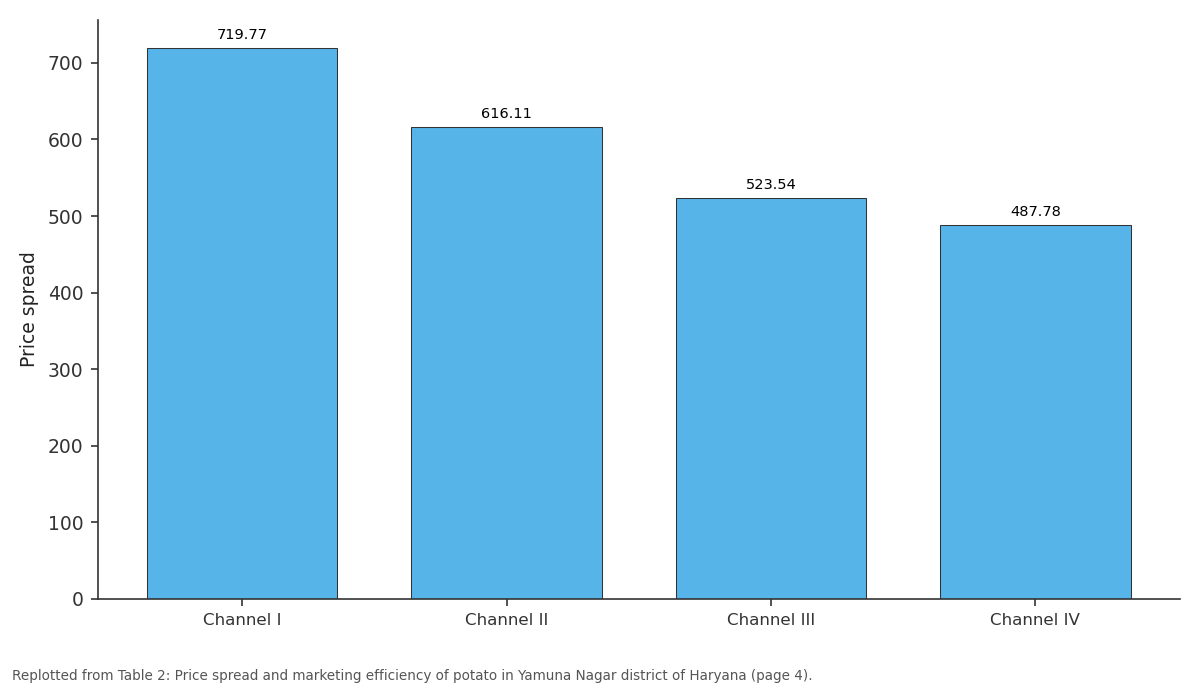
Price spread: Channel I vs Channel II vs Channel III vs Channel IV
Replotted from Table 2 (page 4) of the original paper. Every bar is the paper's own table value.
View source evidence ↗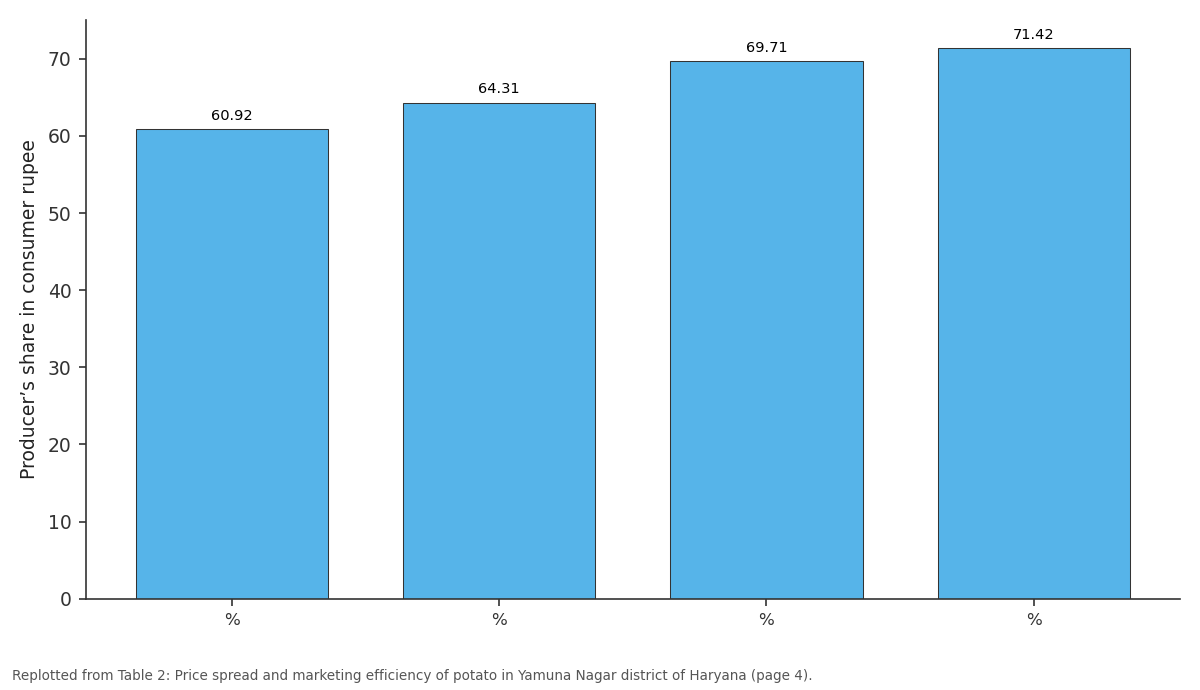
Producer’s share in consumer rupee: % vs % vs % vs %
Replotted from Table 2 (page 4) of the original paper. Every bar is the paper's own table value.
View source evidence ↗Figures & tables
From the original paper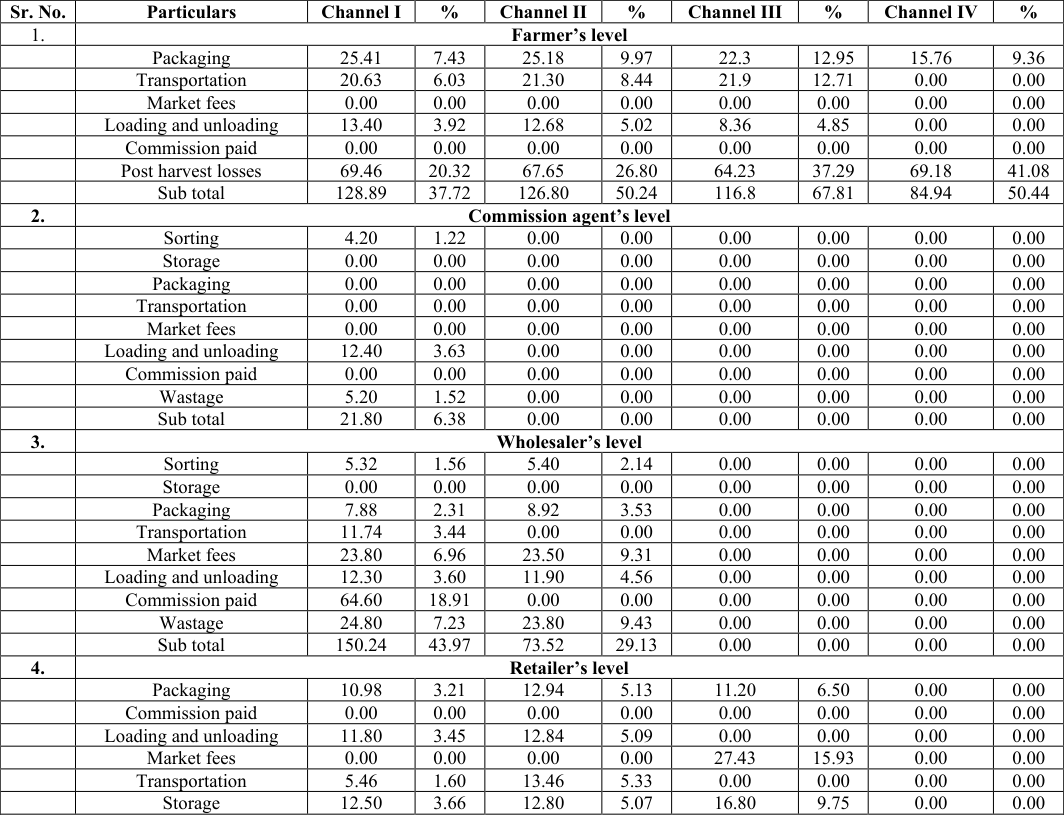 Table 1
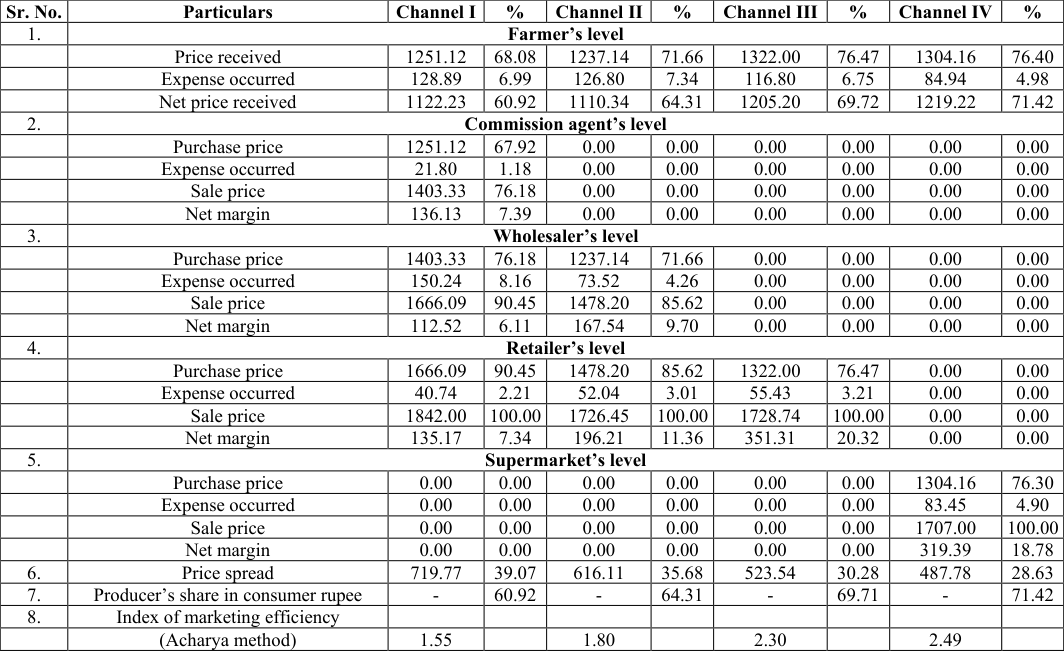 Table 2
Introduction
The potato (Solanum tuberosum) ranks as the world's third most important food crop, after wheat and rice. As this product is perishable in nature there is a need of proper storage and transportation facilities to supply these in fresh form to the consumer (Halder and Pati). A greater proportion of potato is edible as compared to these staple crops and production is also higher per hectare, which along with its nutritional value, emphasizes its importance and describes ongoing expansion in potato production. Potato occupies the largest portion of the vegetable production in the country followed by tomato, onion and brinjal. In Haryana, it is grown mainly in the districts like Ambala, Kurukshetra, Yamuna Nagar, Karnal, Sonepat, Panchkula, Panipat, Rohtak, Jind and Sirsa. The varieties of potato which are mainly grown in Haryana are pukhraj, chipsona, jawahar, chandramukhi, LR etc. The commitment of various stakeholders like growers, traders and supermarkets is required in the development of a sustainable agro-supply chain (Buurma et al. 2000) [3] . The agricultural supply chain system of the country is determined by different sartorial issues like dominance of small/marginal farmers, fragmented supply chains, low level of processing, and inadequacy of marketing infrastructure etc. Long supply chains consist of village traders, commission agents, wholesaler, retailers, cold storage owners in potato markets are the main source of exploitation of farmers which results in the increase in the cost for the consumers (Reddy et al. 2012) [6] . An efficient agricultural marketing system is helpful in disposing the final produce of the growers at reasonable returns, which in turn raises the conditions and living standard of the farmers and agriculture, which directly depends upon efficient agricultural marketing system. The main objectives of the study were to estimate the marketing cost and marketing margins of different middlemen for fresh potato under various marketing channels and to analyze the price spread, marketing efficiency and producer's share in consumer's rupee in various marketing channels.
Materials and Methods
Multi stage purposive sampling technique was used for the selection of districts, blocks, villages and respondents of the study. At first stage of sampling, Kurukshetra was selected purposively based on the highest production of potato in the state. At second stage of sampling two blocks were selected randomly and from each selected block, five villages were selected at random. From each village, ten farmers were randomly selected, thus in total, 50 farmers were selected from each block, making a sample of 100 farmers. For collection of the data, on marketing aspect one main market was selected purposively and the marketing channels of vegetables were scrutinized by selecting a random sample of intermediaries such as wholesalers, commission agents, retailers, supermarkets. Simple and weighted averages and percentage methods were used for tabular analysis. Further analysis for specified objective was done by using various standard statistical tools.
Total cost of marketing
This involves various type of expenditures incurred during movement of the final products from the point of production to the ultimate consumers. These costs vary with the channels through which a particular commodity passes through. Total cost of marketing was computed using the formula:
Where, C = Total cost of marketing Cf = Cost paid by the producer Cm1, Cm2……..Cmn= Cost incurred by different middlemen in the process of buying and selling.
Marketing margin
Margin refers to the difference between the price paid and received by a specific marketing agency, such as wholesaler, retailer or by any combination of marketing agencies. This is the difference between the total payments (cost + purchase price) and receipt (sale price) of the middlemen.
Marketing margin (Ami
Where, Pri = Sale price Ppi = Purchase price, and Cmi= Cost incurred in marketing Price spread Price spread refers to the differences between the price paid by the ultimate consumer and the price received by the producer for an equivalent quantity of the farm produce i.e.
Psd = Pc -Pf
Where, Psd = Price spread Pc = Price paid by the consumer, Pf = Net price received by the farmer Producer's share in consumer's rupee It refers to the share of vegetable producers in consumer's rupee is dynamic and subject to change. It specifies the price received by the vegetable producer and indicated in percentage of rupee paid by the consumers. It is estimated using the formula:
Where, Ps = Producer's share Pf = Farmer's price Pc = Price paid by the consumer
Marketing efficiency
It is a measure of market performance. The movement of goods from producers to the ultimate consumers at the lowest possible cost consistent with the provision of service desired by the consumers id termed as efficient marketing.
The marketing efficiency of different marketing channels was worked out by Acharya's method (Acharya and Agarwal, 2011) [1] .
Where, MME = Modified measure of marketing efficiency FP = Net price received by the farmer MC = Total marketing cost MM = Total net marketing margin
Results and Discussion
The marketing channels are linked with the chains of intermediaries involved at various levels of marketing for smooth distribution of the products. The major marketing channels identified in the study were: Marketing channel I: Farmer -Commission agent -Wholesaler -Retailer -Consumer Marketing channel II: Farmer -Wholesaler -Retailer -Consumer Marketing channel III: Farmer -Retailer -Consumer Marketing channel IV: Farmer -Super market -Consumer
Marketing costs of potato under different marketing channels Marketing channel I (P-APMC-W-R-C)
In this channel the producer on an average incurred a cost of ₹ 128.89 per quintal of potatoes which accounted for 37.72 percent of the total marketing costs. Producer incurred an amount of ₹ 69.46 towards post harvest losses which is the major item of marketing cost and accounted for 20.32 percent of the total marketing costs. The other important items were towards packaging (7.43%), transportation (6.03%) and, loading and unloading charges (3.92%). The commission agent incurred a cost of ₹ 20.80 per quintal of potato which accounted for 6.38 percent of the total marketing costs. The share of loading and unloading, wastage, and sorting was 3.63 percent, 1.52 percent, and 1.22 percent respectively. The wholesaler incurred a cost of ₹ 150.24 per quintal of potatoes which accounted for 43.97 percent of the total marketing costs. The share of commission paid was 18.91 percent of the total marketing costs followed by wastage (7.23%), market fee (6.96%), loading and unloading (3.60%), transportation (3.44%), packaging (2.31%) and sorting (1.56%). The retailer incurred a cost of ₹ 40.74 per quintal of potatoes which accounted for 11.92 percent of the total marketing costs. The share of storage, loading and unloading, packaging, and transportation in the total marketing cost was 3.66 percent, 3.45 percent, 3.21 percent and 1.60 percent respectively. Similar findings were reported by Singh et al. (2018) [7] .
Marketing channel II (P-W-R-C):
In this channel the producer incurred a cost of ₹ 126.80 per quintal of potatoes which accounted for 50.24 percent of the total marketing costs. Producer incurred an amount of ₹ 25.18 towards packaging. The major item of marketing cost was towards post harvest losses was ₹ 67.65 and accounted for 26.80 percent of the total marketing costs. The other important items were transportation (8.44%), loading and unloading charges (5.02%) etc. The wholesaler incurred a cost of ₹ 73.52 per quintal of potatoes which accounted for 29.13 percent of the total marketing costs. The share of wastage was 9.43 percent followed by loading and unloading charges (4.56%), and sorting (2.14%).The retailer incurred a cost of ₹ 52.04 per quintal of potatoes which accounted for 20.62 percent of the total marketing costs. The share of transportation, storage, packaging, and loading and unloading in the total marketing cost was 5.33 percent, 5.07 percent, 5.13 percent and 5.09 percent respectively. Similar findings were reported by Sodhi and Patel (2019) [8] .
Marketing channel III (P-R-C):
In this channel the producer incurred an average cost of ₹ 116.80 per quintal of potatoes (Table 1) which accounted for 67.81 percent of the total marketing costs. The share of post harvest losses was (37.29%), packaging (12.95%), transportation (12.71%), and loading and unloading (4.85%).The retailer incurred a cost of ₹ 55.43 per quintal of potatoes which accounted for 32.18 percent of the total marketing costs. The major share of marketing cost for retailer in channel III was storage and packaging cost which was observed ₹ 16.80 and ₹ 11.20 that accounted for 9.75 percent and 6.50 percent of the total marketing costs. Similar findings were reported by Kumar et al. (2020) [2] .
| Sr. No. | Particulars | Channel I | % | Channel II | % | Channel III | % | Channel IV | % |
|---|---|---|---|---|---|---|---|---|---|
| 1. | Farmer’s level | ||||||||
| Packaging | 25.41 | 7.43 | 25.18 | 9.97 | 22.3 | 12.95 | 15.76 | 9.36 | |
| Transportation | 20.63 | 6.03 | 21.30 | 8.44 | 21.9 | 12.71 | 0.00 | 0.00 | |
| Market fees | 0.00 | 0.00 | 0.00 | 0.00 | 0.00 | 0.00 | 0.00 | 0.00 | |
| Loading and unloading | 13.40 | 3.92 | 12.68 | 5.02 | 8.36 | 4.85 | 0.00 | 0.00 | |
| Commission paid | 0.00 | 0.00 | 0.00 | 0.00 | 0.00 | 0.00 | 0.00 | 0.00 | |
| Post harvest losses | 69.46 | 20.32 | 67.65 | 26.80 | 64.23 | 37.29 | 69.18 | 41.08 | |
| Sub total | 128.89 | 37.72 | 126.80 | 50.24 | 116.8 | 67.81 | 84.94 | 50.44 | |
| 2. | Commission agent’s level | ||||||||
| Sorting | 4.20 | 1.22 | 0.00 | 0.00 | 0.00 | 0.00 | 0.00 | 0.00 | |
| Storage | 0.00 | 0.00 | 0.00 | 0.00 | 0.00 | 0.00 | 0.00 | 0.00 | |
| Packaging | 0.00 | 0.00 | 0.00 | 0.00 | 0.00 | 0.00 | 0.00 | 0.00 | |
| Transportation | 0.00 | 0.00 | 0.00 | 0.00 | 0.00 | 0.00 | 0.00 | 0.00 | |
| Market fees | 0.00 | 0.00 | 0.00 | 0.00 | 0.00 | 0.00 | 0.00 | 0.00 | |
| Loading and unloading | 12.40 | 3.63 | 0.00 | 0.00 | 0.00 | 0.00 | 0.00 | 0.00 | |
| Commission paid | 0.00 | 0.00 | 0.00 | 0.00 | 0.00 | 0.00 | 0.00 | 0.00 | |
| Wastage | 5.20 | 1.52 | 0.00 | 0.00 | 0.00 | 0.00 | 0.00 | 0.00 | |
| Sub total | 21.80 | 6.38 | 0.00 | 0.00 | 0.00 | 0.00 | 0.00 | 0.00 | |
| 3. | Wholesaler’s level | ||||||||
| Sorting | 5.32 | 1.56 | 5.40 | 2.14 | 0.00 | 0.00 | 0.00 | 0.00 | |
| Storage | 0.00 | 0.00 | 0.00 | 0.00 | 0.00 | 0.00 | 0.00 | 0.00 | |
| Packaging | 7.88 | 2.31 | 8.92 | 3.53 | 0.00 | 0.00 | 0.00 | 0.00 | |
| Transportation | 11.74 | 3.44 | 0.00 | 0.00 | 0.00 | 0.00 | 0.00 | 0.00 | |
| Market fees | 23.80 | 6.96 | 23.50 | 9.31 | 0.00 | 0.00 | 0.00 | 0.00 | |
| Loading and unloading | 12.30 | 3.60 | 11.90 | 4.56 | 0.00 | 0.00 | 0.00 | 0.00 | |
| Commission paid | 64.60 | 18.91 | 0.00 | 0.00 | 0.00 | 0.00 | 0.00 | 0.00 | |
| Wastage | 24.80 | 7.23 | 23.80 | 9.43 | 0.00 | 0.00 | 0.00 | 0.00 | |
| Sub total | 150.24 | 43.97 | 73.52 | 29.13 | 0.00 | 0.00 | 0.00 | 0.00 | |
| 4. | Retailer’s level | ||||||||
| Packaging | 10.98 | 3.21 | 12.94 | 5.13 | 11.20 | 6.50 | 0.00 | 0.00 | |
| Commission paid | 0.00 | 0.00 | 0.00 | 0.00 | 0.00 | 0.00 | 0.00 | 0.00 | |
| Loading and unloading | 11.80 | 3.45 | 12.84 | 5.09 | 0.00 | 0.00 | 0.00 | 0.00 | |
| Market fees | 0.00 | 0.00 | 0.00 | 0.00 | 27.43 | 15.93 | 0.00 | 0.00 | |
| Transportation | 5.46 | 1.60 | 13.46 | 5.33 | 0.00 | 0.00 | 0.00 | 0.00 | |
| Storage | 12.50 | 3.66 | 12.80 | 5.07 | 16.80 | 9.75 | 0.00 | 0.00 |
Table text extracted from the original PDF; superscript letters are shown inline. The original table image is below.
View original table image
Marketing channel IV (P-SM-C)
In this channel the producer incurred a total cost of ₹ 84.94 per quintal of potatoes that accounted for 50.44 percent of the total marketing costs occurred in this channel. The major share was of post-harvest losses that accounted for 41.08 percent followed by packaging cost (9.36%). The super markets incurred an average cost of ₹ 83.45 per quintal of potatoes which accounted for 49.55 percent of the total marketing costs in this channel. Transportation accounts for maximum share of 13.53 percent followed by packaging (8.20%), loading and unloading (7.04%), and storage cost (6.05%) in this channel. Hence it can be concluded that in this channel also the producer have to bear the maximum share of the total average marketing costs i.e. 50.44 percent. Similar findings were reported by Sodhi and Patel (2019) [8] ; Kumar et al. (2020) [2] .
Commission agent's level
Commission agent's level
Conclusion
The major marketing channels revealed in the study area were viz; F-APMC-W-R-C, F-W-R-C, F-R-C and F-SM-C. The major marketing costs incurred by the farmers were post harvest losses and packaging while for other marketing intermediaries loading and unloading; market fees, storage cost and commission paid were the major marketing costs. The marketing cost was highest in marketing channel I due to the involvement of large number of market intermediaries and was lowest in marketing channel IV. The price spread was lowest in marketing channel IV as the product was directly sold to the super markets by the farmers and, packaging and unloading services were provided by the super markets to the farmers. The share of producer in consumer's rupee was highest in marketing channel IV and was lowest in marketing channel I. The marketing channel IV was having the highest marketing efficiency and was considered as the most efficient marketing channel among all the prevailing marketing channels in the supply chain of potato in Yamuna Nagar district of Haryana. It is suggested to provide well equipped storage facilities for the farmers at cheaper rates and promote the direct purchase of the produce by the government to minimize the costs in the supply chain of potato.
Figures and tables from the paper
| Sr. No. | Particulars | Channel I | % | Channel II | % | Channel III | % | Channel IV | % |
|---|---|---|---|---|---|---|---|---|---|
| 1. | Farmer’s level | ||||||||
| Price received | 1251.12 | 68.08 | 1237.14 | 71.66 | 1322.00 | 76.47 | 1304.16 | 76.40 | |
| Expense occurred | 128.89 | 6.99 | 126.80 | 7.34 | 116.80 | 6.75 | 84.94 | 4.98 | |
| Net price received | 1122.23 | 60.92 | 1110.34 | 64.31 | 1205.20 | 69.72 | 1219.22 | 71.42 | |
| 2. | Commission agent’s level | ||||||||
| Purchase price | 1251.12 | 67.92 | 0.00 | 0.00 | 0.00 | 0.00 | 0.00 | 0.00 | |
| Expense occurred | 21.80 | 1.18 | 0.00 | 0.00 | 0.00 | 0.00 | 0.00 | 0.00 | |
| Sale price | 1403.33 | 76.18 | 0.00 | 0.00 | 0.00 | 0.00 | 0.00 | 0.00 | |
| Net margin | 136.13 | 7.39 | 0.00 | 0.00 | 0.00 | 0.00 | 0.00 | 0.00 | |
| 3. | Wholesaler’s level | ||||||||
| Purchase price | 1403.33 | 76.18 | 1237.14 | 71.66 | 0.00 | 0.00 | 0.00 | 0.00 | |
| Expense occurred | 150.24 | 8.16 | 73.52 | 4.26 | 0.00 | 0.00 | 0.00 | 0.00 | |
| Sale price | 1666.09 | 90.45 | 1478.20 | 85.62 | 0.00 | 0.00 | 0.00 | 0.00 | |
| Net margin | 112.52 | 6.11 | 167.54 | 9.70 | 0.00 | 0.00 | 0.00 | 0.00 | |
| 4. | Retailer’s level | ||||||||
| Purchase price | 1666.09 | 90.45 | 1478.20 | 85.62 | 1322.00 | 76.47 | 0.00 | 0.00 | |
| Expense occurred | 40.74 | 2.21 | 52.04 | 3.01 | 55.43 | 3.21 | 0.00 | 0.00 | |
| Sale price | 1842.00 | 100.00 | 1726.45 | 100.00 | 1728.74 | 100.00 | 0.00 | 0.00 | |
| Net margin | 135.17 | 7.34 | 196.21 | 11.36 | 351.31 | 20.32 | 0.00 | 0.00 | |
| 5. | Supermarket’s level | ||||||||
| Purchase price | 0.00 | 0.00 | 0.00 | 0.00 | 0.00 | 0.00 | 1304.16 | 76.30 | |
| Expense occurred | 0.00 | 0.00 | 0.00 | 0.00 | 0.00 | 0.00 | 83.45 | 4.90 | |
| Sale price | 0.00 | 0.00 | 0.00 | 0.00 | 0.00 | 0.00 | 1707.00 | 100.00 | |
| Net margin | 0.00 | 0.00 | 0.00 | 0.00 | 0.00 | 0.00 | 319.39 | 18.78 | |
| 6. | Price spread | 719.77 | 39.07 | 616.11 | 35.68 | 523.54 | 30.28 | 487.78 | 28.63 |
| 7. | Producer’s share in consumer rupee | - | 60.92 | - | 64.31 | - | 69.71 | - | 71.42 |
| 8. | Index of marketing efficiency | ||||||||
| (Acharya method) | 1.55 | 1.80 | 2.30 | 2.49 |
Table text extracted from the original PDF; superscript letters are shown inline. The original table image is below.
View original table image
References
7 in the original paper- Kumar R, Kumar N, Bishnoi DK, Malik AK, Kumar P. A study of production and marketing of potato in Kurukshetra district of Haryana. Indian J Econ Dev. 2020;16(2):307-312.
- Buurma ES, Boselie DM. Stakeholder perception analysis for Agri-Supply Chain development. Acta Hortic. 2000;536(75):625-633.
- Halder P, Pati S. A need for paradigm shift to improve supply chain management of fruits and vegetables in India. Asian J Agric Rural Dev. 2011;1(1):11-20.
- Kumar R, Kumar N, Bishnoi DK, Malik AK, Kumar P. A study of production and marketing of potato in Kurukshetra district of Haryana. Indian J Econ Dev. 2020;16(2):307-312.
- Reddy GP, Murthy MRK, Prathari DK, Bhalchakra IV. Supply chains and futures market for potato growers in Uttar Pradesh. In: Supply Chain System in Agricultural Food Security NAARM (conf.spl). 2012. p. 30-53.
- Singh DK, Pandey NK, Kharumnuid P. An economic analysis of marketing of potato from Shimla hills of Himachal Pradesh. Econ Aff. 2018;63(2):419-424.
- Sodhi H, Patel A. Price spread and marketing efficiency of potato marketing channels in Gujarat. An International Refereed, Peer Reviewed and Indexed Quarterly Journal in Science, Agriculture and Engineering. 2019;9(29):41-44.
Cited by 3
From OpenAlex, OpenCitations and reference lists read by Scinovex
- Marketing Performance and Factors Influencing Farmers’ Choice for Agricultural Output Marketing Channels: The Case of Potato (Solanum tuberosum) in India ↗
Jasmeet Kaur, Abinayarajam D., Rakesh Singh · Potato Research · 2026
❝ 2PDF - Digital Pathways to Efficiency: A Multi-Stakeholder Assessment of Sri Lanka’s Marine Fish Supply Chain Logistics ↗
K.P.G.L. Sandaruwan, Robert Jeyakumar Nathan, Shavindya Laksirini Sumanasekara, Thomas Ntangere, Mária Fekete‐Farkas · Logistics · 2026
Background: Studies of fish supply chain efficiency often rely on price spreads or frontier-based measures, which do not fully capture actor-level coordination performance in heterogeneous, informal supply chains. This study addresses this gap by developing a composite Market Efficiency Index (MEI) that integrates financial performance, operational quality, service equity, and relational governance. Methods: The MEI, a multidimensional alternative to frontier-based…
❝ 0PDF - Marketing performance and factors influencing farmers’ choice for agricultural output marketing channels: The case of potato (Solanum tuberosum) in India ↗
Jasmeet Kaur · 2025
❝ 0