
Research article · 2025 · Full text
International Journal of Agriculture and Food ScienceEffect of integrated nutrient management on growth and yield of summer green gram (Vigna radiata L.)
Volume 7(7) · Pages 82–85 · DOI: 10.33545/2664844x.2025.v7.i7b.499 ↗
Research areasAgricultural Science and Fertilization
Abstract
Author-writtenA field experiment was conducted at Agronomy Research Farm of Faculty of Agriculture and Veterinary Science, Mewar University, Gangrar, Chittorgarh (Rajasthan) during kharif 2024 on loamy sand soil, which consisted eleven treatments viz. viz., T0-Control, T1-Seed treatment with Rhizobium at 20 g kg⁻¹ seed, T2-Vermicompost at 2.5 t ha⁻¹, T3-FYM at 5 t ha⁻¹, T4-100% RDF, T5-Rhizobium + Vermicompost at 2.5 t ha⁻¹ + FYM at 5 t ha⁻¹, T6-Rhizobium + FYM at 5 t ha⁻¹, T7-Rhizobium + 100% RDF at 25:50 kg ha⁻¹, T8-Vermicompost at 2.5 t ha⁻¹ + FYM at 5 t ha⁻¹, T9-Vermicompost at 2.5 t ha⁻¹ + 100% RDF at 25:50 kg ha⁻¹ and T10: FYM @ 5 t ha-1 + 50% RDF @ 12.5:25 (N:P) were applied to the green gram var. RC-19. were laid out in randomized block design with three replication. Results clearly showed that application of T9-Vermicompost at 2.5 t ha⁻¹ + 100% RDF at 25:50 kg ha⁻1 which was remained at par with treatment of T5-Rhizobium + Vermicompost at 2.5 t ha⁻¹ + FYM at 5 t ha⁻¹ and superior to all other treatments in respect to significantly increased growth attributes viz. plant height, plant dry matter, number of branches plant-1, number of nodules plant-1, and yield parameters viz. number of pods plant-1, number of seeds pod-1, seed, straw and biological yield over control.
Summary
Source-checkedPlain-language reading of the full paper, prepared with AI and checked against the text. Each point links to the authors' own words.
Why it matters
- Green gram is a significant kharif pulse crop in India, utilized for forage, green manure, and grain. View evidence ↗
- The grain of green gram is nutritionally dense, containing 25% protein, 60.3% carbohydrates, and 1.8% fat on a dry weight basis, while providing iron and calcium. View evidence ↗
- Pulse yields in India are lower than global productivity due to poor seed quality and low inputs on marginal soils, suggesting a need for integrated organic, inorganic, and bio-fertilizer strategies. View evidence ↗
The question
- The study aimed to evaluate how integrated nutrient management affects the growth and yield of summer green gram (Vigna radiata L.). View evidence ↗
What they did
- The experiment was conducted during the 2024 kharif season on loamy sand soil at the Mewar University Agronomy Research Farm in Rajasthan. View evidence ↗
- The study tested eleven treatments, including a control, individual applications of Rhizobium, Vermicompost, and FYM, and various integrated combinations of these with Recommended Dose of Fertilizers (RDF). View evidence ↗
- The experimental treatments were organized using a randomized block design with three replications. View evidence ↗
- Data were collected at harvest and analyzed using statistical methods based on Fisher (1950). View evidence ↗
What they found
- The growth results for T9 were statistically comparable (at par) to T5 (Rhizobium + Vermicompost 2.5 t ha⁻¹ + FYM 5 t ha⁻¹). View evidence ↗
- T9 achieved the highest yields, with a seed yield of 1292.9 kg ha⁻¹, stover yield of 2492.0 kg ha⁻¹, and biological yield of 3784.0 kg ha⁻¹. View evidence ↗
- Integrated nutrient management did not have a statistically significant effect on the test weight or harvest index of the green gram. View evidence ↗
Visual summary
1 visualsIllustrations explain the paper; they do not show study data.
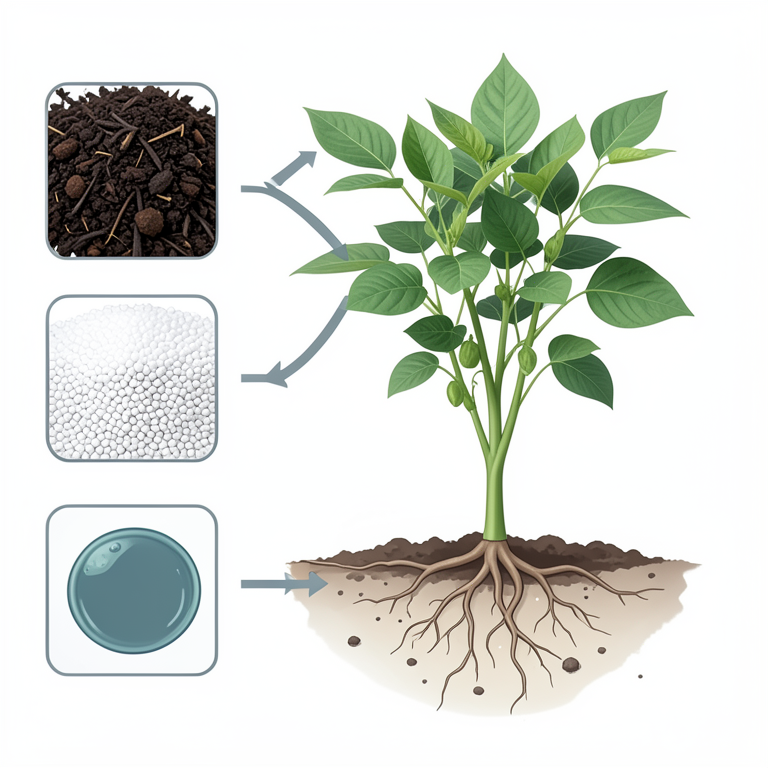
Integrated Nutrient Management Strategy
AI-generated conceptual illustration (summer green gram plants (Vigna radiata L.)). It explains the idea and does not show study data.
View source evidence ↗Figures & tables
From the original paper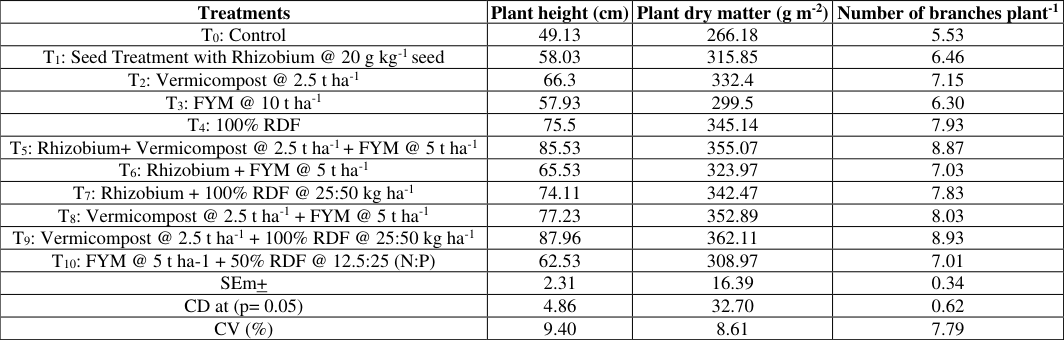 Table 1
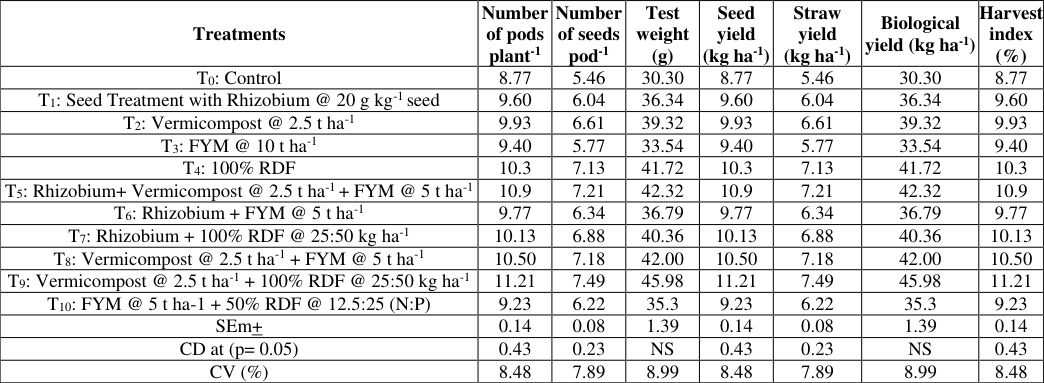 Table 2
Introduction
Green gram (Vigna unguiculata L. Walp), belonging to the family Fabaceae is an important kharif pulse crop grown in India for grain, forage and for green manure purpose. Green gram is grown both for its tender pods and also for its dry seeds used as pulse for culinary purpose. It is a warm season crop, well adapted to many areas of humid tropics and subtropical zones. In India, it is grown widely round the year. Green gram is also called as catch crop due to well adoption in short time when main crop failed with better biological value on dry weight basis. Green gram grain contains 25 percent protein, 1.8 percent fat and 60.3 percent carbohydrates on dry weight basis and it is rich source of calcium and iron. Apart from this, Green gram forms excellent forage and it gives a profused vegetative growth and covers the ground so well that it checks the soil erosion. Green gram pods are good source of protein, fibre, minerals, calcium and vitamins particularly vitamin A and vitamin C. It contains 8 g carbohydrates, 43 g proteins and 0.6 g fat, 2 g fiber per 100 g of edible portion. Tender fruits contain 80 mg calcium, 74 mg phosphorus and 2.5 mg iron per 100 g fresh pod, amino acid profile is particularly high in Green gram which greatly improves the protein quality of pulses (Gopalakrishnan, 2007) [3] . The factors attributed for low yields of pulses in India as compared to the world productivity are non-availability of quality seeds of improved and short duration varieties, growing of pulses under marginal and less fertile soil with low inputs and without pest and disease management, growing of pulses under moisture stress, unscientific post harvest practices and storage under unfavorable conditions. Hence, there is a scope for improving the production potential of this crop by use of organic, inorganic and bio-fertilizers.
Materials and Methods
The field experiments were carried out during kharif season (2024) to study the "Effect of Integrated Nutrient Management on Growth and Yield of Summer Green Gram (Vigna radiata L.)" in randomized block design with 11 treatments and 3 replication at Research Farm, Mewar University-Chittorgarh, Rajasthan. The experimental farm is geographically located at 75°51'44" E longitude, 26°48'35'' N latitude and an altitude of 432 m above International Journal of Agriculture and Food Science https://www.agriculturaljournals.com mean sea level (AMSL). The experimental fields were clay loam and the soil fertility status contained available nitrogen (137.8 kg ha -1 ) by Subia and Asija 1996, available phosphorus (16.3 kg ha -1 ) by Olsen et al. 1954 [7] and available potassium (250.12 kg ha -1 ) by Jackson, 1973 [4] . The organic carbon content was from 0.34-0.38 percent. The weekly mean maximum and minimum temperatures were of temperature during both summers (40.6 º C) and winters (2.7 º C). The mean relative humidity fluctuated from 63.50 to 91 percent during the crop season. The average rainfall is 557 mm per annum, which is mostly received during July to September. The sporadic showers during winters are also common, which are probably observed during this period. The experiments were laid out in randomized block design with three replications and nine treatments. The following treatments were included in the study, T 0-Control, T 1 -Seed treatment with Rhizobium at 20 g kg⁻¹ seed, T 2 -Vermicompost at 2.5 t ha⁻¹, T 3 -FYM at 10 t ha⁻¹, T 4 -100% RDF, T 5 -Rhizobium + Vermicompost at 2.5 t ha⁻¹ + FYM at 5 t ha⁻¹, T 6 -Rhizobium + FYM at 5 t ha⁻¹, T 7 -Rhizobium + 100% RDF at 25:50 kg ha⁻¹, T 8-Vermicompost at 2.5 t ha⁻¹ + FYM at 5 t ha⁻¹, T 9 -Vermicompost at 2.5 t ha⁻¹ + 100% RDF at 25:50 kg ha⁻¹ and T 10 : FYM @ 5 t ha-1 + 50% RDF @ 12.5:25 (N:P). The observation were recorded at harvest was analysed by Statistical methods (Fisher, R.A. 1950.) [2] Results and Discussion It is clear from the result of present study that, integrated nutrient management had significantly affected the growth and yield parameters at harvest of green gram. Application of T 9 -Vermicompost at 2.5 t ha⁻¹ + 100% RDF at 25:50 kg ha⁻ 1 recorded the highest growth attributes like plant height (71.01 cm), dry matter accumulation (362.1 g m -2 ), number of branches plant -1 (22.7) and number of branches plant -1 (13.7) at harvest (Table 1) which was remained at par with T 5 -Rhizobium + Vermicompost at 2.5 t ha⁻¹ + FYM at 5 t ha⁻¹. Plant height and dry matter accumulation increased with the application of T 9 due to increased cell division and cell elongation at higher level of nutrients. The integrated approaches of nutrients (inorganic, organic and biofertilizers) that the plant needs to play an important role in the metabolic processes that take place inside the plant. (Rajput et al. 2009 [8] , Devi et al., 2013 [1] and Tyagi and Singh, 2019) [11] . Further yield attributes and yields like number of pods plant -1 (14.2), number of seeds pod -1 (14.8), seed yield (1292.9 kg ha -1 ), stover yield (2492.0 kg ha -1 kg ha -1 ) and biological yield (3784.0 kg ha -1 ) (Table 2) recorded with the application of T 9 -Vermicompost at 2.5 t ha⁻¹ + 100% RDF at 25:50 kg ha⁻ 1 . However, test weight and harvest index (Singh and Stoskopt, 1971) [9] was found non significant by integrated nutrient management in green gram. Yield components by enhancing cell division, cell elongation process and photosynthetic activity leading to production and accumulation of more carbohydrates and auxins which favours retention of more flowers ultimately leading to more number of reproductive parts plant -1 . Higher plant dry matter recorded under the application of T 9 -Vermicompost at 2.5 t ha⁻¹ + 100% RDF at 25:50 kg ha⁻ 1 which is directly related to yields. Similar results were also reported by Maur et al. (2017) [5] and Muindi et al. (2019) [6] .
| Treatments | Number of pods plant-1 | Number of seeds pod-1 | Test weight (g) | Seed yield (kg ha-1) | Straw yield (kg ha-1) | Biological yield (kg ha-1) | Harvest index (%) |
|---|---|---|---|---|---|---|---|
| T0: Control | 8.77 | 5.46 | 30.30 | 8.77 | 5.46 | 30.30 | 8.77 |
| T1: Seed Treatment with Rhizobium @ 20 g kg-1 seed | 9.60 | 6.04 | 36.34 | 9.60 | 6.04 | 36.34 | 9.60 |
| T2: Vermicompost @ 2.5 t ha-1 | 9.93 | 6.61 | 39.32 | 9.93 | 6.61 | 39.32 | 9.93 |
| T3: FYM @ 10 t ha-1 | 9.40 | 5.77 | 33.54 | 9.40 | 5.77 | 33.54 | 9.40 |
| T4: 100% RDF | 10.3 | 7.13 | 41.72 | 10.3 | 7.13 | 41.72 | 10.3 |
| T5: Rhizobium+ Vermicompost @ 2.5 t ha-1 + FYM @ 5 t ha-1 | 10.9 | 7.21 | 42.32 | 10.9 | 7.21 | 42.32 | 10.9 |
| T6: Rhizobium + FYM @ 5 t ha-1 | 9.77 | 6.34 | 36.79 | 9.77 | 6.34 | 36.79 | 9.77 |
| T7: Rhizobium + 100% RDF @ 25:50 kg ha-1 | 10.13 | 6.88 | 40.36 | 10.13 | 6.88 | 40.36 | 10.13 |
| T8: Vermicompost @ 2.5 t ha-1 + FYM @ 5 t ha-1 | 10.50 | 7.18 | 42.00 | 10.50 | 7.18 | 42.00 | 10.50 |
| T9: Vermicompost @ 2.5 t ha-1 + 100% RDF @ 25:50 kg ha-1 | 11.21 | 7.49 | 45.98 | 11.21 | 7.49 | 45.98 | 11.21 |
| T10: FYM @ 5 t ha-1 + 50% RDF @ 12.5:25 (N:P) | 9.23 | 6.22 | 35.3 | 9.23 | 6.22 | 35.3 | 9.23 |
| SEm+ | 0.14 | 0.08 | 1.39 | 0.14 | 0.08 | 1.39 | 0.14 |
| CD at (p= 0.05) | 0.43 | 0.23 | NS | 0.43 | 0.23 | NS | 0.43 |
| CV (%) | 8.48 | 7.89 | 8.99 | 8.48 | 7.89 | 8.99 | 8.48 |
Table text extracted from the original PDF; superscript letters are shown inline. The original table image is below.
View original table image
| Treatments | Plant height (cm) | Plant dry matter (g m-2) | Number of branches plant-1 |
|---|---|---|---|
| T0: Control | 49.13 | 266.18 | 5.53 |
| T1: Seed Treatment with Rhizobium @ 20 g kg-1 seed | 58.03 | 315.85 | 6.46 |
| T2: Vermicompost @ 2.5 t ha-1 | 66.3 | 332.4 | 7.15 |
| T3: FYM @ 10 t ha-1 | 57.93 | 299.5 | 6.30 |
| T4: 100% RDF | 75.5 | 345.14 | 7.93 |
| T5: Rhizobium+ Vermicompost @ 2.5 t ha-1 + FYM @ 5 t ha-1 | 85.53 | 355.07 | 8.87 |
| T6: Rhizobium + FYM @ 5 t ha-1 | 65.53 | 323.97 | 7.03 |
| T7: Rhizobium + 100% RDF @ 25:50 kg ha-1 | 74.11 | 342.47 | 7.83 |
| T8: Vermicompost @ 2.5 t ha-1 + FYM @ 5 t ha-1 | 77.23 | 352.89 | 8.03 |
| T9: Vermicompost @ 2.5 t ha-1 + 100% RDF @ 25:50 kg ha-1 | 87.96 | 362.11 | 8.93 |
| T10: FYM @ 5 t ha-1 + 50% RDF @ 12.5:25 (N:P) | 62.53 | 308.97 | 7.01 |
| SEm+ | 2.31 | 16.39 | 0.34 |
| CD at (p= 0.05) | 4.86 | 32.70 | 0.62 |
| CV (%) | 9.40 | 8.61 | 7.79 |
Table text extracted from the original PDF; superscript letters are shown inline. The original table image is below.
View original table image
Table 1: Effect of integrated nutrient management on growth attributes of green gram
Treatments
Plant height (cm) Plant dry matter (g m -2 ) Number of branches plant -1 T0: Control 49.13 266.18 5.53 T1: Seed Treatment with Rhizobium @ 20 g kg -1 seed 58.03 315.85 6.46 T2: Vermicompost @ 2.5 t ha -1 66.3 332.4 7.15 T3: FYM @ 10 t ha -1 57.93 299.5 6.30 T4: 100% RDF 75.5 345.14 7.93 T5: Rhizobium+ Vermicompost @ 2.5 t ha -1 + FYM @ 5 t ha -1 85.53 355.07 8.87 T6: Rhizobium + FYM @ 5 t ha -1 65.53 323.97 7.03 T7: Rhizobium + 100% RDF @ 25:50 kg ha -1 74.11 342.47 7.83 T8: Vermicompost @ 2.5 t ha -1 + FYM @ 5 t ha -1 77.23 352.89 8.03 T9: Vermicompost @ 2.5 t ha -1 + 100% RDF @ 25:50 kg ha -1 87.96 362.11 8.93 T10: FYM @ 5 t ha-1 + 50% RDF @ 12.
Conclusion
In light of the results obtained from the present investigation, it may be concluded that the treatments T 9 : Vermicompost @ 2.5 t ha -1 + 100% RDF @ 25:50 kg ha -1 effective in increasing plant height, plant dry matter, number of branches plant -1 , number of pods plant -1 , seed, straw and biological yield of graan gram.
Acknowledgement
AcknowledgmentsA feeling of sincere and heartfelt gratitude envelops me as I draft this acknowledgement. I acknowledge my esteemed Major Advisor, advisory committee, Head, Department of Agronomy, faculty members and non-teaching staff of Department of Agronomy, Mewar University, Chittorgarh for providing me the necessary help and suggestions during the course of the study.
References
11 in the original paper- Devi KN, Singh TB, Athokpam HS, Singh NB, Shamurailatpam D. In uence of, biological and organic manures on nodulation and yield of soybean (Glycine max Merril L.) and soil properties. Australian Journal of Crop Science. 2013;7:1407-415.
- Fisher RA. Statistical methods for research workers. Pub. Oliver and Boyd, Edinburgh, London; 1950.
- Gopalakrishnan TR. Vegetable crops. No. 4. New India Publishing; 2007.
- Jackson ML. Soil chemical analysis. Prentice Hall of India Pvt. Ltd., New Delhi; 1973.
- Maur AK, Naleeni R, Singh D. Effect of organic manures and biofertilizers on growth and yield of table pea. International Journal of Current Microbiology and Applied Sciences. 2017;5(6):906-908.
- Muindi EM, Muindi CM, Ndiso J. The Effects of Combining Farm Yard Manure, Starter Nitrogen, Phosphorus and Zinc on Growth and Yield of Graan grams. Journal of Agriculture and Ecology Research International. 2019, 9(1).
- Olsen SR, Cole CV, Watnable FS, Dean LA. Estimation of available phosphorus in soil by extraction with sodium bicarbonate Circular 939. USDA, Washington, DC, USA. 1954.
- Rajput SC. Effect of integrated nutrient management in French bean. Journal of Agronomy. 2009;39:193-197.
- Singh ID, Stoskopt NC. Harvest index of cereals. Agronomy Journal. 1971;63:224-226.
- Subbiah BV, Asija GL. A rapid procedure for estimation of available nitrogen in soils. Current Science. 1956;25:259-260.
- Tyagi PK, Singh VK. Effect of integrated nutrient management on growth, yield and nutrients uptake of summer black gram (Vigna mungo). Annals of Plant and Soil Research. 2019;21(1):30-35.
Cited by 1
From OpenAlex, OpenCitations and reference lists read by Scinovex
- Effect of integrated nutrient management on growth and productivity, of green gram (Vigna radiata L.) Under the central plain zone of Uttar Pradesh
Aarav Kumar, Ravikesh Kumar Pal, Mandeep Kumar, Arunima . · International Journal of Research in Agronomy · 2026
Greengram (Vigna radiata L. Wilczek) is one of the most important pulse crops cultivated in India because of its high nutritional value, short duration and ability to improve soil fertility through biological nitrogen fixation. However, productivity of green gram remains below its potential due to inadequate nutrient management, low phosphorus availability and declining soil health. Integrated Nutrient Management (INM) has emerged as a sustainable strategy to enhance nutrient-use efficiency, crop productivity and soil fertility. Therefore, a field experiment was conducted during Kharif 2025 at