
Research article · 2025 · Full text
International Journal of Agriculture and Food ScienceThe triple burden: Exploring the impact of climate-stressed agriculture on food availability, nutrient quality and public health
Volume 7(7) · Pages 19–23 · DOI: 10.33545/2664844x.2025.v7.i7a.490 ↗
Research areasAgriculture Sustainability and Environmental Impact
Abstract
Author-writtenClimate-stressed agriculture presents a growing threat to global food systems, intensifying a "triple burden" that encompasses food insecurity, nutrient decline, and deteriorating public health. This paper examines the multifaceted impacts of climate change on agriculture, focusing on how altered agro-climatic conditions disrupt food availability, reduce crop nutrient quality, and pose risks to population health. Rising temperatures, unpredictable precipitation patterns, and extreme weather events have led to significant yield losses, affecting both staple and horticultural crops. These changes compromise the nutritional value of food through reduced protein and micronutrient content and increased post-harvest nutrient losses. Furthermore, the resulting nutritional deficiencies and food insecurity contribute to a rise in diet-related non-communicable diseases and exacerbate existing health disparities, particularly among vulnerable populations. The paper explores the complex feedback loops between agriculture, nutrition, and health, emphasizing the need for integrated responses that consider socioeconomic and policy dimensions. Key mitigation strategies discussed include climate resilient agricultural practices, biofortification, improved storage and distribution systems, and nutrition-sensitive policies. By adopting a systems-based approach and fostering cross-sectoral collaboration, it is possible to build resilient food systems that safeguard both nutritional quality and public health under climate stress.
Summary
Source-checkedPlain-language reading of the full paper, prepared with AI and checked against the text. Each point links to the authors' own words.
Why it matters
- Agricultural systems are highly sensitive to climate, where even minor weather changes can disrupt food availability and soil fertility. View evidence ↗
- Areas dependent on rain-fed agriculture, specifically in Sub-Saharan Africa and South Asia, face higher vulnerability to climate-driven disruptions. View evidence ↗
The question
- The study aims to examine the mechanisms by which climate-stressed agriculture drives the triple burden of food insecurity, nutrient loss, and health decline, while evaluating ways to mitigate these effects. View evidence ↗
What they did
- The author employs a systemic, interdisciplinary review approach to analyze the connections between agriculture, nutrition, and public health. View evidence ↗
What they found
- If current climate trends continue, the global productivity of major crops is projected to decrease by as much as 40% by the 2080s. View evidence ↗
- The Indian subcontinent is expected to see temperature rises of up to 5.4°C by the end of the century, potentially shifting crop zones and increasing pests. View evidence ↗
- Elevated CO₂ and temperatures cause a 'dilution effect' that lowers the levels of protein, iron, and zinc in crops. View evidence ↗
- High temperature and humidity during post-harvest stages lead to spoilage and the loss of essential vitamins, particularly folate and vitamin C. View evidence ↗
- A feedback loop exists where climate-driven malnutrition impairs health, which in turn reduces agricultural labor productivity and deepens poverty. View evidence ↗
What it means
- The author concludes that addressing the triple burden requires moving away from isolated strategies toward an integrated framework linking agriculture, nutrition, and health. View evidence ↗
- The author recommends that policymakers prioritize climate-resilient practices, including regenerative farming, crop diversification, and water-saving irrigation. View evidence ↗
- The author notes a critical need for more real-time data and multidisciplinary research to better understand how climate change impacts food systems at a local level. View evidence ↗
Visual summary
1 visualsIllustrations explain the paper; they do not show study data.
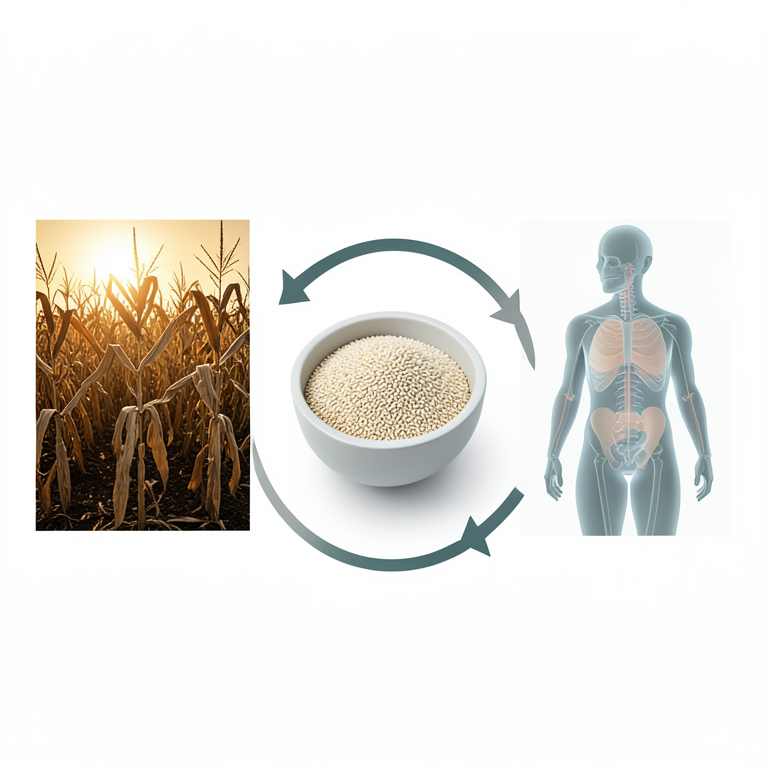
The Triple Burden Feedback Loop
AI-generated conceptual illustration (maize crops, a bowl of grain, and a human silhouette). It explains the idea and does not show study data.
View source evidence ↗Figures & tables
From the original paper Table 1
 Table 2
Introduction
Climate change is a global challenge that increasingly threatens the integrity of agricultural systems and the health and well-being of populations. The concept of the "triple burden"comprising food insecurity, declining nutrient quality, and adverse public health outcomes has gained prominence in the context of climate-stressed agriculture. Agriculture is intrinsically linked to climate, and even slight shifts in weather patterns can significantly disrupt crop growth, soil fertility, and food availability [1] . Food insecurity is intensifying in regions with climate-sensitive agriculture, as temperature anomalies, irregular rainfall, and extreme events such as droughts and floods limit agricultural productivity [2] . At the same time, the nutritional quality of food is declining due to elevated CO₂ concentrations and disrupted plant physiology, which reduce the micronutrient density of major crops like wheat, rice, and maize [3,4] . Public health consequences follow closely behind, as nutrition deficiencies and compromised food safety elevate the prevalence of malnutrition, diet-related non-communicable diseases (NCDs), and foodborne illnesses, particularly in vulnerable populations [5,6] . This paper aims to explore how climate-stressed agriculture contributes to this triple burden and to evaluate mitigation and adaptation strategies. A systemic, interdisciplinary approach is essential to address these challenges at the nexus of agriculture, nutrition, and public health. yields, and impaired soil fertility. For instance, high temperatures can denature enzymes essential for plant growth, while water stress disrupts nutrient transport in plants. Soil salinization from rising sea levels or overirrigation further depletes agricultural productivity. Over time, these disturbances degrade agro-ecosystems, erode resilience, and pose serious threats to long-term food production [7] .
Agro-Climatic Changes and Vulnerable Farming Systems
Regions that rely heavily on rain-fed agriculture such as parts of South Asia and Sub-Saharan Africa are particularly vulnerable to climate shifts. These areas often lack irrigation, crop insurance, or early-warning systems, leaving smallholder farmers at the mercy of fluctuating weather. Compounded by poverty, low literacy, and weak market access, these agro-climatic vulnerabilities exacerbate the risk of food insecurity and income instability. Marginal communities struggle to adapt due to limited access to capital, climate-resilient seeds, and extension services, deepening their exposure to climate shocks [8] .
Impact on Crop Physiology and Yield
Climate extremes alter plant physiology by impairing fundamental processes like photosynthesis, respiration, and nutrient uptake. For instance, heat stress causes stomatal closure in plants, reducing CO₂ absorption and inhibiting growth. Drought restricts root function and leads to wilting and poor flowering. The cumulative effect is a drastic reduction in yield, particularly for climate-sensitive staples such as wheat, rice, and maize. Projections suggest that global productivity of major crops could decline by up to 40 percent by the 2080s if current trends persist [9] .
Regional and Global Trends
The Indian subcontinent is projected to experience temperature increases of up to 5.4°C by the end of the century. This could dramatically shift crop growing zones, shorten growing seasons, and accelerate pest outbreaks. Globally, warmer climates are enabling the spread of invasive pests and diseases into previously unaffected regions. These biotic stressors interact with abiotic conditions, compounding their effects and posing a transboundary threat to global food security [10] .
Food Availability Under Climate Stress 3.1 Yield Reductions and Crop Failure Patterns
Unpredictable climate events such as floods, droughts, and unseasonal rains disrupt sowing and harvesting cycles, leading to widespread crop failures. Staples like rice, wheat, and maize are particularly sensitive to such fluctuations, resulting in volatile food supplies. In some years, simultaneous crop failures across multiple regions-known as synchronized shocks-can destabilize global food markets and trigger sharp price hikes [11] .
Impact on Staple vs. Horticultural Crops
Staple crops generally have longer grown periods and are more sensitive to sustained climate stress, especially during flowering and grain-filling stages. In contrast, horticultural crops (fruits and vegetables) may have shorter cycles and some resilience, but are still vulnerable to heat, water stress, and nutrient imbalances. These conditions compromise not only quantity but also the quality of produce manifesting as lower nutrient density, poor taste, and reduced shelf life [12] .
Disruptions in Food Supply Chains
Climate-induced yield losses are further exacerbated by infrastructural weaknesses, particularly in rural and developing regions. Damaged roads, unreliable power supply, inadequate cold storage, and delayed market access hinder the efficient transportation and distribution of food. Geopolitical instability and inconsistent trade policies can create additional barriers, cause supply chain bottlenecks and increasing post-harvest food loss. These disruptions disproportionately affect remote and vulnerable communities, limiting their access to affordable and nutritious food [13] .
Food Security and Access
Food security is a multidimensional concept including availability, access, utilization, and stability. Climate change compromises each of these dimensions. Rising food prices limit affordability, especially for the poor. Geographic disparities in access mean that rural areas often face chronic shortages. Nutritional utilization is affected when lowquality or spoiled food dominates diets. Furthermore, the increasing unpredictability of weather patterns makes food systems inherently unstable [14] .
Nutrient Quality of Crops in a Changing Climate
The nutritional quality of crops is deteriorating due to multiple climate-induced stressors that affect both pre-and post-harvest stages. Table 1 summarizes the key dimensions of climate-related nutrient changes in crops.
| Aspect | Climate Stressor | Nutritional Impact | Implications | Reference |
|---|---|---|---|---|
| Elevated CO₂ & Temperature | CO₂ fertilization & heat | Lower protein, iron, and zinc due to “dilution effect” | Poor diet quality, micronutrient deficiencies | [15] |
| Biochemical Composition | Heat waves & water scarcity | Decline in protein and minerals; rise in sugars/starches; altered phytochemicals | Reduced taste, shelf life, and nutritional density | [16] |
| Soil Degradation & Mineral Loss | Erosion, salinity, leaching | Decline in nitrogen, phosphorus, and potassium uptake | Nutrient-poor crops, contributing to hidden hunger | [17] |
| Post-Harvest Nutrient Depletion | High temperature & humidity | Vitamin loss (esp. vitamin C and folate); spoilage | Increased waste, reduced nutrient intake in warm regions | [4] |
Table text extracted from the original PDF; superscript letters are shown inline. The original table image is below.
View original table image
Public Health Consequences of Agricultural Disruption
The ripple effects of declining food quality and availability extend directly into the realm of human health. Reduced food quantity and quality Stunting, anemia, compromised maternal/child health Low-income households, women, children [18] Rise in NCDs Shift to ultra-processed foods due to fresh food scarcity Obesity, diabetes, hypertension, heart diseases Urban poor, nutrition-insecure populations [6] Foodborne Illnesses Heat and water scarcity enabling pathogen proliferation Diarrhoea, infections, long-term developmental issues
Rural and peri-urban communities [19] Gendered & Social Vulnerability
Socioeconomic inequalities exacerbated by climate stress
Greater malnutrition, food insecurity among women and elders Pregnant/lactating women, elderly, rural poor [20] 6. Interlinkages and Feedback Loops 6.1 Agriculture-Nutrition-Health Nexus Agriculture is not just a means of food production it shapes diet quality, health outcomes, and economic resilience. Climate-disrupted agriculture reduces access to diverse and nutritious foods, pushing communities toward poor dietary habits and increasing disease burdens. In turn, compromised health reduces agricultural labour productivity, perpetuating a cycle of poverty and malnutrition [21] .
Socioeconomic and Policy Dimensions
Climate change often deepens existing social and economic inequalities. Marginalized groups are least equipped to adapt, yet they face the most severe consequences. Policy fragmentation across sectors-agriculture, health, climate, and social welfare prevents coherent responses. Coordinated, equity-focused policies are essential to address these interconnected challenges holistically [22] .
Feedback Loops: Poverty, Climate, and Health
Poor households lack the financial resources to invest in adaptive technologies or access quality healthcare. When climate events damage crops or disrupt markets, these households are pushed deeper into poverty. Ill-health from undernutrition further diminishes earning potential, trapping them in a vicious cycle of vulnerability and deprivation [23] .
Mitigation and Adaptation Strategies 7.1 Climate-Resilient Agricultural Practices
To reduce vulnerability, farmers must adopt adaptive practices like mixed cropping, agroforestry, zero-tillage, and water-efficient systems such as drip irrigation. Governmentled initiatives like India's National Action Plan on Climate Change (NAPCC) and Pradhan Mantri Krishi Sinchayee Yojana (PMKSY) offer crucial support through infrastructure, awareness, and financial incentives [24] .
Enhancing
Nutritional Quality Through Biofortification Biofortified crops such as iron-rich pearl millet or vitamin A enriched sweet potato offer a scalable solution to combat micronutrient deficiencies. Developed through plant breeding or genetic engineering, these crops can provide critical nutrients without altering food habits or increasing costs significantly [25] .
Strengthening Food Storage and Distribution
Investment in cold storage, refrigerated transport, and digital supply chain systems is essential to reduce post-harvest losses and ensure that nutrient-rich foods reach remote areas. Smart logistics technologies can help optimize food movement even during climate disruptions [26] .
Nutrition-Sensitive Agricultural Policies
Integrating nutrition into agricultural policy involves supporting crops that offer dietary diversity, promoting soil health, and providing subsidies or incentives for nutrientrich food production. Programs like soil health cards and minimum support prices for pulses and millets can align agricultural output with national nutrition goals [27] .
Conclusion and Recommendations
Climate-stressed agriculture presents a complex, systemic challenge that intersects directly with food availability, nutritional integrity, and public health. As this paper has shown, climate change disrupts agro-ecological balance by reducing yields, altering crop nutrient profiles, and threatening the very stability of food systems. These disruptions disproportionately affect vulnerable populations, exacerbating existing inequalities and contributing to a persistent cycle of malnutrition and disease. The decline in essential nutrients such as protein, iron, and zinc combined with increased foodborne illness and rising rates of obesity and non-communicable diseases underscores the gravity of the triple burden that climate change imposes on human health through agriculture. At the same time, this crisis offers a crucial opportunity to rethink how food systems can become more resilient, equitable, and health-promoting. Future interventions must move beyond siloed approaches and adopt an integrated framework that connects agriculture, nutrition, and public health. This will require cross-sectoral coordination, robust governance, and increased investment in climate-adaptive solutions. In conclusion, addressing the triple burden posed by climate-stressed agriculture requires not only scientific innovation but also political will and societal commitment.
Recommendations
A future-proof food system must nourish people and protect the planet simultaneously. By weaving together sustainability, equity, and nutrition into agricultural agendas, the global community can create resilient pathways toward food and health security for all.
Figures and tables from the paper
| Health Concern | Climate Driver | Outcome | Most Vulnerable Groups | Reference |
|---|---|---|---|---|
| Malnutrition & Micronutrient Deficiency | Reduced food quantity and quality | Stunting, anemia, compromised maternal/child health | Low-income households, women, children | [18] |
| Rise in NCDs | Shift to ultra-processed foods due to fresh food scarcity | Obesity, diabetes, hypertension, heart diseases | Urban poor, nutrition-insecure populations | [6] |
| Foodborne Illnesses | Heat and water scarcity enabling pathogen proliferation | Diarrhoea, infections, long-term developmental issues | Rural and peri-urban communities | [19] |
| Gendered & Social Vulnerability | Socioeconomic inequalities exacerbated by climate stress | Greater malnutrition, food insecurity among women and elders | Pregnant/lactating women, elderly, rural poor | [20] |
Table text extracted from the original PDF; superscript letters are shown inline. The original table image is below.
View original table image
References
27 in the original paper- Fanzo J, Schneider K, Wood S. Food insecurity and malnutrition. In: The Oxford Handbook of Food, Politics, and Society. Oxford University Press; 2024. p. 151-170. doi:10.1093/oso/9780197683293.003.0008
- von Braun J. Climate change risks for agriculture, health, and nutrition. In: Handbook of Climate Change and Agroecosystems. Springer; 2020. p. 249-268. doi:10.1007/978-3-030-31125-4_11
- Beach R, Cai Y. Assessing the impacts of climate change on global nutrient availability. In: Antle J, Valentini R, editors. Climate Change and Food Security. Springer; 2020. p. 163-188.
- Sathee L, Adavi SB, Padhan BK, Sinto A, Anand A, Sailo N, et al. Elevated atmospheric CO2 induced changes in nitrogen metabolism and crop quality. In: Climate Change and Crop Stress. Academic Press; 2022. p. 197-214. doi:10.1016/B978-0-12-8160916.00010-9
- Prentice AM. The triple burden of malnutrition in the era of globalization. Ann Nutr Metab. 2023;79(4):268275. doi:10.1159/000529005
- Yílmaz H, Yilmaz A. Hidden hunger in the age of abundance: the nutritional pitfalls of modern staple crops. Food Sci Nutr. 2025;13(4):1-12. doi:10.1002/fsn3.4610
- Vijai C, Wisetsri W, Elayaraja M. Climate change and its impact on agriculture. Int J Agric Sci Vet Med. 2023;11(4):58-66. doi:10.25303/1104ijasvm0108
- Dutta G, Paramanik B, Bhabai B, Layek J, Choudhury A, Dutta S, et al. Climate change impacts and adaptation strategies for agronomic crops. In: Sustainable Agriculture in the Era of Climate Change. Springer; 2024. p. 231-252. doi:10.1007/978-981-997935-6_14
- Rai R. Heat stress in crops: driver of climate change impacting global food supply. In: Heat Stress Tolerance in Crops. Springer; 2020. p. 73-98. doi:10.1007/978981-32-9595-7_5
- Alotaibi MA. Climate change, its impact on crop production, challenges, and possible solutions. Not Bot Horti Agrobo Cluj-Napoca. 2023;51(1):3020. doi:10.15835/nbha51113020
- Hamed R. Crop impacts from compound weather extremes in major breadbaskets under climate change [dissertation]. Wageningen: Wageningen University; 2024. doi:10.5463/thesis.892
- Sharma S. Impact of climate change on food security. J Sci Innovat Nature Earth. 2023;3(3):100-107. doi:10.59436/https://jsiane.com/archives3/3/100
- Feher A, Raicov M, Brad I, Toader CS, Sîrbulescu C, Saleh RB. Food security in a changing climate world. Rev Agric Rural Dev. 2022;1-2:32-38. doi:10.14232/rard.2022.1-2.32-38
- Berhe HM, Kidanu KF. Impact of climate change on crop yield and food accessibility in Sub-Saharan Africa-a Int J Life Sci. 2020;8(2):45-58.
- Soares J, Santos C, Carvalho SMP, Pintado M, Vasconcelos MW. Preserving the nutritional quality of crop plants under a changing climate: importance and strategies. Plant Soil. 2019;443(1-2):1-19. doi:10.1007/s11104-019-04229-0
- Smith MR, Thornton PK, Myers SS. The impact of rising carbon dioxide levels on crop nutrients and human health. Glob Food Secur. 2018;18:1-7.
- Miner GL, Stewart CE, Delgado JA, Ippolito JA, Mason RE, Haley SD, et al. Global change impacts on mineral nutritional quality of cereal grains: coordinated datasets and analyses to advance a systems-based understanding. Field Crops Res. 2024;305:109338. doi:10.1016/j.fcr.2024.109338
- Kundu P, Goel K, Zinta G. Nutritional imbalance in plants under rising atmospheric CO2. In: Advances in Plant Physiology. Academic Press; 2022. p. 151-172. doi:10.1016/B978-0-12-822916-3.00006-8
- Chowdhury SR. Micronutrient deficiency in Indian diet. Indian Sci J Res Eng Manag. 2024;4(2):33586. doi:10.55041/ijsrem33586
- Sun Y. Malnutrition problems caused by vitamin deficiency in African countries. In: Food Security in Africa. CRC Press; 2024. p. 725-740. doi:10.1201/9781003587590-45
- Mehra D, Rael T, Bloem MW. A review of the intersection between climate change, agriculture, health, and nutrition in Africa: costs and programmatic options. Front Sustain Food Syst. 2024;8:1389730. doi:10.3389/fsufs.2024.1389730
- Saxena S, Upadhyay S. From fields to forks: navigating the new climate reality in agriculture and health. In: International Journal of Agriculture and Food Science https://www.agriculturaljournals.com Climate Change Adaptation and Mitigation. Springer; 2024. p. 93-116. doi:10.1007/978-3-031-56564-9_5
- Patterson KP, Jameel Y, Maikuri CP, West PC. Climate-poverty connections: opportunities for synergistic solutions at the intersection of planetary and human well-being. Project Drawdown. 2022 Mar;1-22. doi:10.55789/y2c0k2p2
- Rao CS, Baral K, Chanadana VM, Jagadesh M, Karthik R. Climate change adaptation and mitigation in Indian agriculture. J Agrometeorol. 2024;26(2):2582. doi:10.54386/jam.v26i2.2582
- Mandal O, Krishnamoorthi A, Singh A, Kaur R, Kalaiselvi P, Nageshwar N, et al. Biofortification: enhancing nutritional content in crops through biotechnology and fighting climate change. J Adv Biol Biotechnol. 2024;27(2):710-725. doi:10.9734/jabb/2024/v27i2710
- Kumar M, Boruah A, Sonia H, Padha K. Building agricultural resilience: strategies for climate change adaptation. Int J Environ Climate Change. 2024;14(11):4568-4580. doi:10.9734/ijecc/2024/v14i114568
- Patel J, Kumar GS. Climate resilient agriculture practices-the future of farming. Plant Sci Today. 2023;10(3):1835. doi:10.14719/pst.1835