
Research article · 2025 · Full text
International Journal of Agriculture and Food ScienceEffect of planting date and varietal differences on growth and fruit yield of cucumber in Ogbomoso, Nigeria
Volume 7(6) · Pages 381–387 · DOI: 10.33545/2664844x.2025.v7.i6e.481 ↗
Research areasAdvances in Cucurbitaceae Research
Abstract
Author-writtenProblems of inappropriate planting date and varietal difference are associated with cucumber cultivation in Ogbomoso agro-ecological zone. Field experiments were conducted during the 2013 cropping season at the Teaching and Research Farm, Ladoke Akintola University of Technology, Ogbomoso to determine the effects of planting date on growth and fruit yield of three cucumbers (Cucumis sativus L.) varieties. Three varieties of cucumber (Marketer, Ashley and Poinsett) and three planting dates (May, July and September) were evaluated. The experiment was laid out in a split-split plot design with three replicates. Growth and yield parameters (vine length, fruit girth, total number of fruit and fruit yield) were assessed. Data collected were subjected to analysis of variance and treatment means were compared using Duncan Multiple Range Test (DMRT) at 5% probability level. Main effects of planting time and variety were significant (p≤0.05) on cucumber vine, number of leaves, leaf area, and fruit yield. Longest vine was obtained with marketer (85.53cm) during September planting time (86.94). The leaf area of Poinsett (1046.0 cm2), May planting time (1172.96 cm2) were significantly higher. With respect to fruit yield, the significant yields were obtained with Poinsett (22.64 t/ha) planted in May (27.46 t/ha). Among the interactive effects, Poinsett planted in May had the best values for plant leaf area and fruit yield. It could be concluded that cucumber Poinsett variety performed best when planted in May. It is therefore recommended that cucumber variety Poinsett can be cultivated in this agro-ecological zone.
Summary
Source-checkedPlain-language reading of the full paper, prepared with AI and checked against the text. Each point links to the authors' own words.
Why it matters
- Cucumber is one of the most economically important vegetables grown worldwide. View evidence ↗
- The timing of planting is a critical factor that influences the growth, yield, and nutritional quality of cucumber crops. View evidence ↗
- In the Ogbomoso agro-ecological zone, cucumber cultivation is hindered by issues related to incorrect planting dates and differences between varieties. View evidence ↗
The question
- The study aimed to identify the optimal planting date and cucumber variety to maximize growth and fruit yield in Nigeria. View evidence ↗
What they did
- Field experiments were carried out during the 2013 cropping season at the Ladoke Akintola University of Technology research farm in Ogbomoso. View evidence ↗
- The researchers evaluated three cucumber varieties (Marketer, Ashley, and Poinsett) across three different planting dates: May, July, and September. View evidence ↗
- The study used a split-split plot design with three replicates. View evidence ↗
- The researchers measured growth and yield parameters, including vine length, fruit girth, total fruit number, and overall fruit yield. View evidence ↗
What they found
- The longest vines were associated with the Marketer variety (85.53 cm) and the September planting date (86.94 cm). View evidence ↗
- The highest leaf area was recorded for the Poinsett variety (1046.0 cm²) and for plants sown in May (reaching 1172.96 cm²). View evidence ↗
- Planting in May resulted in the highest fruit yield (27.46 t/ha), whereas September planting produced the lowest yield (13.48 t/ha). View evidence ↗
- The Poinsett variety achieved the highest mean yield (22.64 t/ha), though it was not significantly different from Marketer (22.57 t/ha) or Ashley (21.35 t/ha). View evidence ↗
- The combination of the Poinsett variety and a May planting date produced the best results for both leaf area and fruit yield. View evidence ↗
What it means
- The authors concluded that the Poinsett variety performs best when planted in May in the study location. View evidence ↗
- The authors recommend the cultivation of the Poinsett cucumber variety in the Ogbomoso agro-ecological zone. View evidence ↗
Visual summary
3 visualsIllustrations explain the paper; charts are replotted from the paper's own table values.
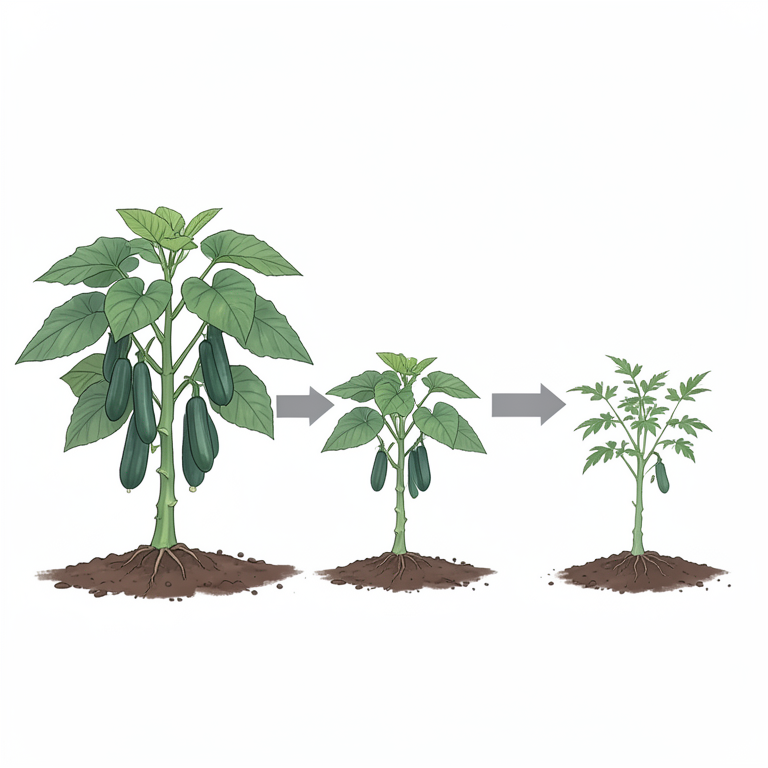
Impact of Planting Date on Yield
AI-generated conceptual illustration (cucumber plants). It explains the idea and does not show study data.
View source evidence ↗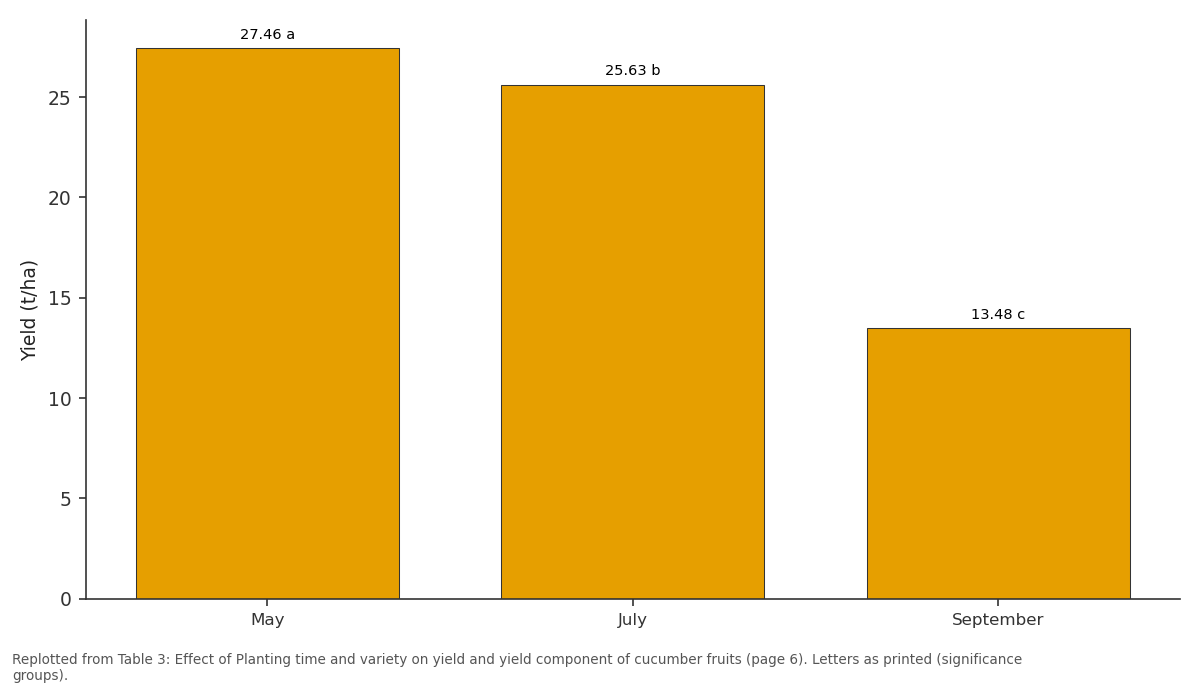
Yield (t/ha): May vs July vs September
Replotted from Table 3 (page 6) of the original paper. Every bar is the paper's own table value.
View source evidence ↗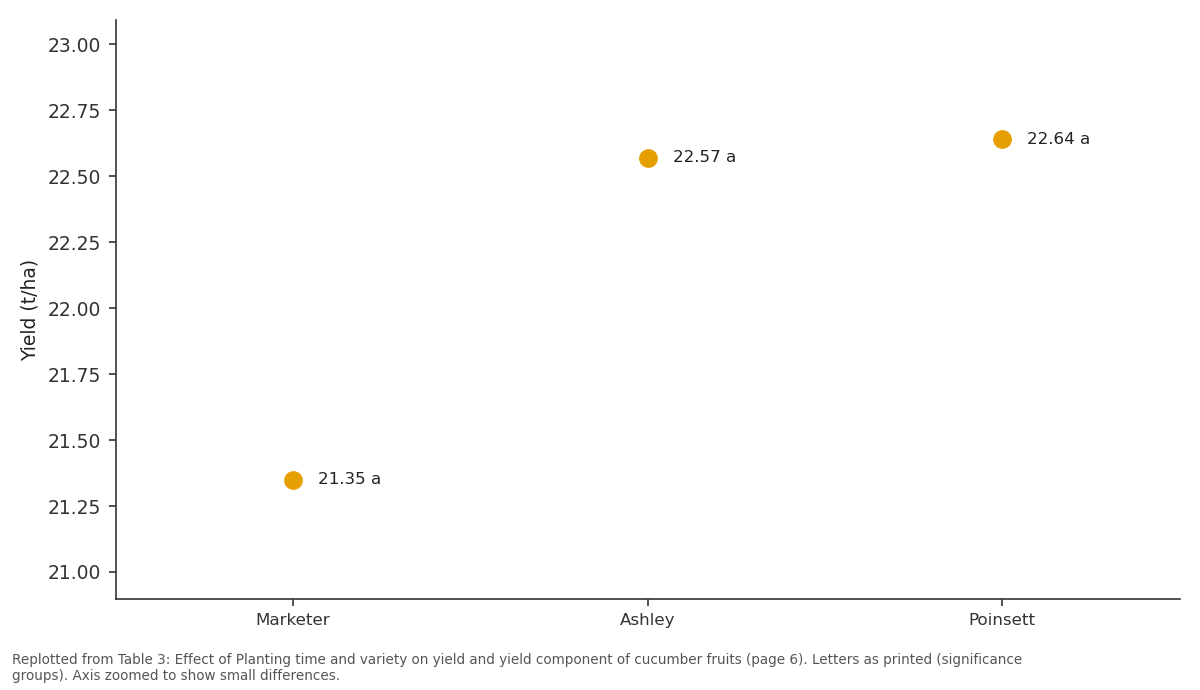
Yield (t/ha): Marketer vs Ashley vs Poinsett
Replotted from Table 3 (page 6) of the original paper. Every bar is the paper's own table value.
View source evidence ↗Figures & tables
From the original paper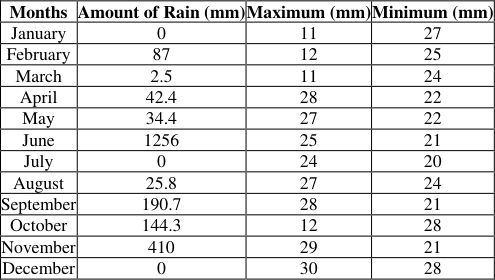 Table 1
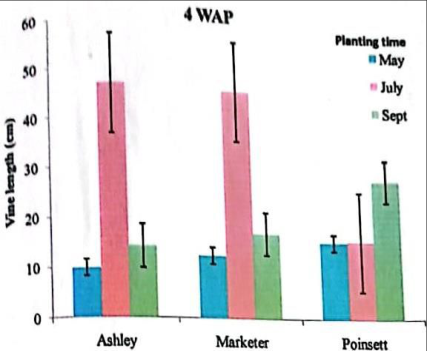 Figure 1
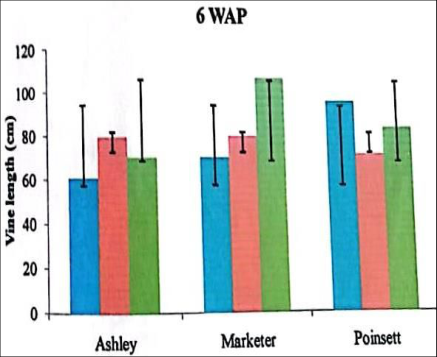 Figure 1
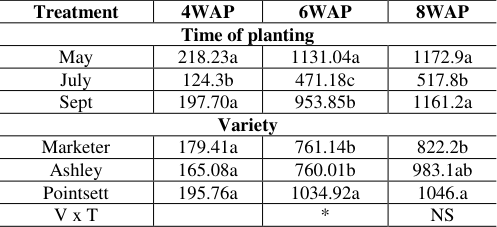 Table 2
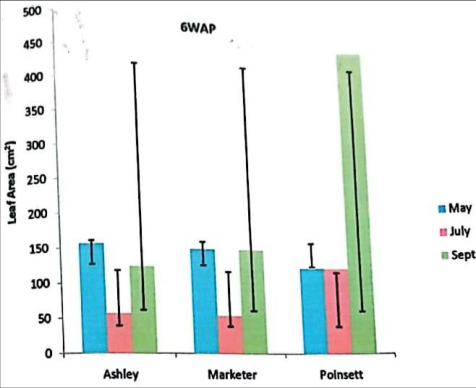 Figure 2
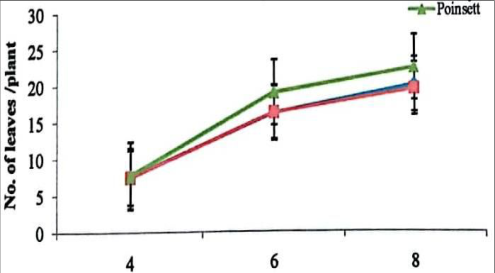 Figure 3
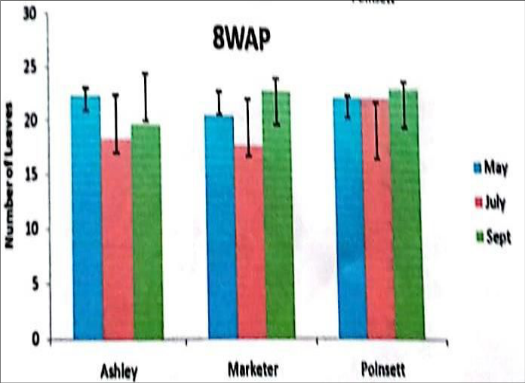 Figure 4
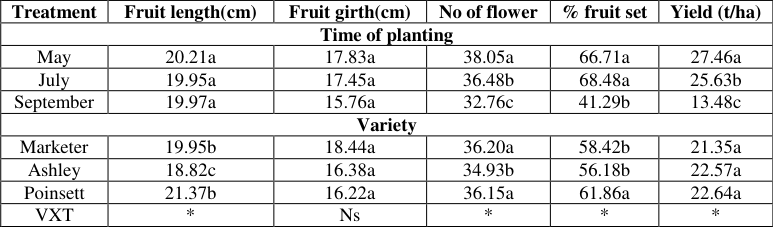 Table 3
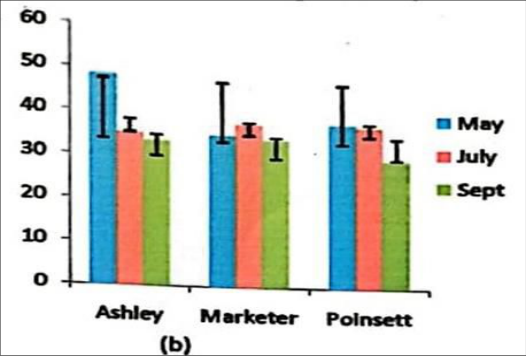 Figure 5
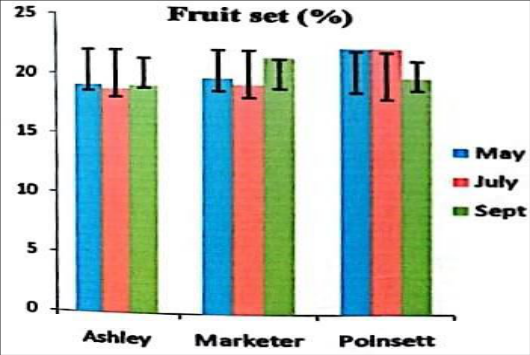 Figure 6
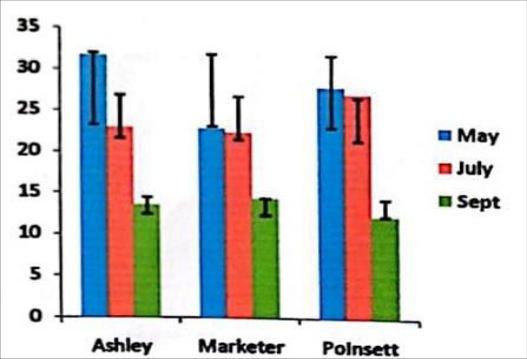 Figure 7
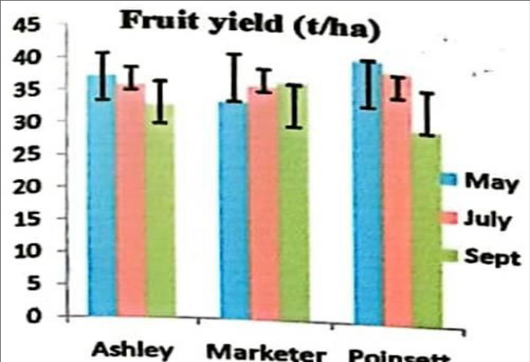 Figure 8
Introduction
Vegetables are the edible portions of plants such as leaves, stems, roots, flowers, seeds, fruits, bulbs, and tubers that are commonly consumed either raw or cooked as part of main meals or salads (Agbagwa and Ndukwu, 2004; Rubatzky and Yamaguchi, 2012) [1,12] . As populations continue to grow in many tropical regions, there is increasing recognition of vegetables as vital sources of essential nutrients that may not be sufficiently available in other dietary staples. Vegetables are rich in oils, carbohydrates, vitamins, and minerals, although their nutritional composition can vary significantly based on species, environmental conditions, soil fertility, and both pre-and post-harvest practices (Gomez, 2017; Ihekoronye and Ngoddy, 1985) [6,7] . Cucumber (Cucumis sativus L.) is a widely cultivated member of the Cucurbitaceae family and ranks among the most economically significant vegetables globally (Staub and Grumet, 2021) [13] . Historical evidence suggests cucumbers have been cultivated for over 5,000 years (Wehner and Guner, 2004) [16] . It is the fourth most important vegetable in Asia, following tomato, cabbage, and onion, and ranks second after tomato in Western Europe (Tatlioglu, 1997; Phu, 1997) [14,11] . Planting time plays a critical role in determining the growth, yield, and nutritional quality of cucumber (Jiang et al., 2021) [8] . Early planting often promotes vigorous vegetative growth and higher fruit yields, largely due to more favorable climatic conditions and reduced exposure to pests and diseases (Jiang et al., 2021) [8] . Timely sowing at the beginning of the rainy season has been shown to enhance fruit set and increase fruit size, as demonstrated by Ali et al. (2022), who observed significantly improved performance compared to delayed planting.
In addition to yield, planting time also affects the nutritional profile of cucumbers (Davis et al., 2020) [3] . Cool growing conditions, typical of earlier planting dates, have been associated with elevated levels of vitamin C and folate, while late planting during hotter periods may lead to nutritional degradation due to environmental stress (Davis et al., 2020; Zhang et al., 2019) [3,17] . Thus, aligning cucumber planting schedules with optimal climatic windows is essential not only for maximizing productivity but also for improving the nutritional value of the crop. As climate patterns shift, understanding the influence of planting time will become increasingly vital for sustainable cucumber production. This study therefore aimed at investigating the appropriate date of planting and varietal difference that could maximally improve cucumber growth and fruit yield in Nigeria. This research work carried out with the main objective of assessing effects of date of planting and variety on growth and fruit yield of three varieties of cucumber.
Materials and Methods
Materials and Methods
Experimental site
Field experiment was conducted between April and September 2013 at the experimental field of the Teaching and Research Farms, Ladoke Akintola University of Technology. Ogbomoso. Ogbomoso lies on latitude 8°10'N and longitude 4°10'E with elevation of 390 m above sea level. The annual rainfall, mean daily maximum and minimum temperature of the experimental site the year of the experiment are shown in Table 1. The aforementioned three-planting time represented early, steady and late rainy period respectively in Ogbomoso agroecological zone. They represented the 3 major time of planting of cucumber by farmers in south western Nigeria.
| Months | Amount of Rain (mm) | Maximum (mm) | Minimum (mm) |
|---|---|---|---|
| January | 0 | 11 | 27 |
| February | 87 | 12 | 25 |
| March | 2.5 | 11 | 24 |
| April | 42.4 | 28 | 22 |
| May | 34.4 | 27 | 22 |
| June | 1256 | 25 | 21 |
| July | 0 | 24 | 20 |
| August | 25.8 | 27 | 24 |
| September | 190.7 | 28 | 21 |
| October | 144.3 | 12 | 28 |
| November | 410 | 29 | 21 |
| December | 0 | 30 | 28 |
Table text extracted from the original PDF; superscript letters are shown inline. The original table image is below.
View original table image
Plot establishment, experimental design, treatment application and crop maintenance
The experimental plots were ploughed and harrowed once each to obtain fine seed bed. At each planting time, the three crop varieties were combined in a Randomized complete block design (RCBD) with 3 replicates. For each planting date, the three-cucumber variety were planted, the gross experimental area was 35 m x 8 m (280 ㎡). A replicate was divided into 9 plots each 3 m x 2 m (6 m) in dimension. The crops were spaced out at 1 m x 0.5 m to give 12 plants/plots and 20,000 plants per hectare. Two manual weeding were carried out at 2 and 5 weeks after planting to maintain weed free plots during experiment, Insect pests were controlled with Cypermethrin at the rate of 40 ml /20 L water. Spraying commences 2 weeks after planting till a week before harvesting. The crops were allowed to grow till maturity.
Data collection
Data were collected on growth parameters and fruit yield.
Data collections commenced at 2 weeks after planting (WAP) and continued every two-week till plants senescence.
Growth parameters
Three tagged plants/plot were assessed for vein length, number of secondary vines, leaf area and number of leaves at 4, 6 and 8 WAP.
This was done by measuring hair length from the base to the tip of the apical bud with a graduated meter ruler.
This was determined by the non-destructive methods, method described by Saxena and Singh, (1985) using the relation: Leaf area=0.75 (length x width), where 0.75 is a constant. Five leaves were assessed per plant and the mean leaf area was determined.
Number of leaves:
This was recorded by visual counting of all fully expanded green leaves per plant at each time of data collection and recorded.
Fruit yield and yield parameters: At harvesting, 6 fruit samples were randomly selected per plot and assessed for the following parameters:
Fruit length (cm): This was measured using meter rule and recorded in (cm).
Fruit diameter (cm): Fruit diameter was measured using veneer caliper to obtain the circumference of the fruit and then deducing the diameter from the formula. πD=0ce whereπ=22/7
International Journal of Agriculture and Food Science https://www.agriculturaljournals.com
D=Diameter
D=Diameter
Number of fruits/plants
This was obtained by summation of all mature fruits taken at different time of data collection.
Mean fruit weight and Fruit yield
This was determined by getting the mean of 12 fruits selected per plot. This was extrapolated to obtained fruit yield ha from the relationship:
Fruit yield (kg/ha) = [Fruit yield per plot (kg) × 10,000 m²] / Plot size (m²)
Statistical analysis
The data collected were subjected to Analysis of Variance (ANOVA) following the Gomez and Gomez (1991) and significant means compared using Duncan's Multiple Range Test (DMRT) at 5% probability level.
Results
Results
Effect of varieties, planting time and their interactions on growth parameters of cucumber Vine Length
The vine length of cucumber (Fig. 1 Planting time had significant effect on the vine length of cucumber except at 8 WAP when the length was similar. At 4 WAP and 6 WAP, cucumber planted in May and September was similar, but the shortest vine length compared to those planted in July. The longest vine length cm) at 4WAP was recorded in July followed by September (19.87 cm) while the least value (12.64 cm) was obtained in May. The longest vine length (67.73 cm) at 6WAP was recorded in July followed by May (61.99 cm) whiles thee least value (57.18 cm) were obtained in September. The longest vine length (86.94 cm) at WAP was recorded September followed by (75.59 cm) May while the least value (77cm) was obtained in July. Interactive effect of planting time and varietal differences on vine length was presented in Figure 1. At 4WAP, it was observed Ashley planted in July had the best interaction mean in (47 cm) followed by Marketer planted in the same month (10 cm). Generally, lowest vine length was observed in May planting time expect Poinsett that had its own in the month of July. At 6 WAP, Marketer variety planted in the month of September had the highest vine length (107 cm) interaction while lowest vine length was observed in Ashley planted in May (61 cm).
Effect of time of planting, variety and their interactions on cucumber leaf area
Time of planting significantly influenced the leaf area especially at 6 WAP (Table 2). Cucumber planted in May had the highest leaf area (218.23 cm 2 ) but not significantly different from those planted in September (197.70cm) at 4 WAP and 8 WAP. May planting time had the highest (1131.04 cm 2 ) at 6 WAP as well. Effect of varieties on leaf area was shown in Table 2, where no significant difference in leaf area of the 3 varieties was observed. Poinsett had the highest leaf area at 4 WAP (197.70 cm 2 ), 6 WAP (1034.92 cm 2 ) and also 8 WAP (1046.0 cm 2 ) while Marketer had the lowest leaf area (822 cm 2 ) at 8 WAP The interaction between time of planting and variety was presented in Figure 2, it was observed that Ashley planted in May (1182 cm 2 ), Marketer planted in May (1062 cm 2 ) and Poinsett planted in July1149 cm 2 ) nearly had the same leaf area with Poinsett planted in May (1149 cm 2 ). Least of the leaf area was observed in Ashley planted in July (112 cm 2 ) and Marketer (152 cm 2 ).
| Treatment | 4WAP | 6WAP | 8WAP |
|---|---|---|---|
| Time of planting | |||
| May | 218.23a | 1131.04a | 1172.9a |
| July | 124.3b | 471.18c | 517.8b |
| Sept | 197.70a | 953.85b | 1161.2a |
| Variety | |||
| Marketer | 179.41a | 761.14b | 822.2b |
| Ashley | 165.08a | 760.01b | 983.1ab |
| Pointsett | 195.76a | 1034.92a | 1046.a |
| V x T | * | NS |
Table text extracted from the original PDF; superscript letters are shown inline. The original table image is below.
View original table image
Effect of time of planting, variety and their interactions on cucumber number of leaves
At 4WAP, July planting time had the highest number of leaves (8.64) but no significantly different from cucumber planted in the month of September and May (7.88 and 6.41 respectively). At 6WAP, cucumber planted in the month of May (19.48) produced the highest while September planting time (15.78) produced the least number of leaves. And also, at 8WAP, September planting time had the highest (22.19) but not significantly different from cucumber planted in May (21.91) as shown in Figure 4. At 4 weeks after planting, the treatment is not significantly different from themselves while at 6 WAP, Poinsett variety (19.89) had the highest number of leaves and the least was recorded in marketer (16.55) but not significantly different from Ashley variety (19.39). The same trend follows at 8 WAP as shown in Figure 3.
Yield and yield components of cucumber fruits Fruit length
Effect of planting time on fruit length of cucumber was shown in Table 3. The planting time was not significantly difference from each other but May planting time had the highest fruit length (20.21cm) while July planting time had the lowest fruit length (19.95cm). The mean varietal effect on cucumber fruit length was shows in Table 3. It was observed that Poinsett variety had the longest (21.37 cm) fruit length while the lowest fruit length was observed Ashley variety (18.82cm).
| Treatment | Fruit length(cm) | Fruit girth(cm) | No of flower | % fruit set | Yield (t/ha) |
|---|---|---|---|---|---|
| Time of planting | |||||
| May | 20.21a | 17.83a | 38.05a | 66.71a | 27.46a |
| July | 19.95a | 17.45a | 36.48b | 68.48a | 25.63b |
| September | 19.97a | 15.76a | 32.76c | 41.29b | 13.48c |
| Variety | |||||
| Marketer | 19.95b | 18.44a | 36.20a | 58.42b | 21.35a |
| Ashley | 18.82c | 16.38a | 34.93b | 56.18b | 22.57a |
| Poinsett | 21.37b | 16.22a | 36.15a | 61.86a | 22.64a |
| VXT | * | Ns | * | * | * |
Table text extracted from the original PDF; superscript letters are shown inline. The original table image is below.
View original table image
Fruit girth
The main effect of variety was shown in Table 3. It was observed that the 3 varieties were not significantly different from each other's, but the best fruit girth was obtained in marketer while the lowest was observed in Poinsett variety. The effect of time of planting on fruit girth of cucumber was shows in table 3. The highest fruit girth was observed in May planting time (17.83cm) while the lowest was served in September planting time (15.76 cm) but not significantly different each other. Interactive effect of time of planting and variety on fruit girth was not significantly different. Interactive effect of fertilizer types and variety on fruit girth was not significantly different.
Number of flowers
The effect of planting time on number of flowers was shown in Table 3. It was observed that May planting time (38.05) gave the best number of flower while September planting time produced the least number of flowers. The effect of mean varieties of cucumber on number of flowers was shown in Table 3. The highest number of flowers was observed in marketer (36.20) but not significantly different from Poinsett while the least number of flowers was observed in Ashley variety (34.93). The interactive effect of time of planting and variety was presented in Figure 5. The highest number of flowers was observed in Ashley planted in May (47.8) while the least was observed in Poinsett planted in September (27.9).
%Fruit set
Effect of time of planting on fruit set was shown in Table 3. July planting time (68.48%) had the highest fruit set but not significantly difference from May planting time (66.71%) while the least was observed in September planting time (41.29%). Effect of mean variety on fruit set was shown in table 2. It was observed that Poinsett (61.86%) had the highest fruit set while Ashley had the least fruit set but not significantly difference from Marketer (58.42%). The interactive effect of time of planting and varietal differences was shown in Figure 6, It was observed that planted in May (23.5%) had the highest but not significantly different from Poinsett planted in (23.4%) while the least was observed in Ashley planted in September.
Yield of cucumber
Effect of planting time on yield of cucumber was shown in Table 3. It was observed that May planting gave the best yield (27.46 t/ha) while the least was observed in September planting time (13.48aha). The mean effect of varieties on yield of cucumber was shown in Table 3. It was observed that Poinsett (22.64 t/ha) gave the best yield but not significantly different from Ashley and Marketer respectively (21.35, 22.57 t/ha). It was observed that Poinsett planted in the month of May (37.7) had the highest number of flower while the least was observed in Poinsett planted in September (27.4).
Discussion
It was observed in this experiment that, cucumber planted in May accumulatively had highest growth and yield parameters values and it had higher number of flowers resulting in higher fruit yield. The high yield experienced during May planting over July and September plantings could be attributed to moderate rainfall at the flowering and fruiting stage of the crop which began in the middle of June/July. Reported that high rainfall during flowering and fruiting can lead to bee's inactivity with subsequent flower abortion with resultant low yield which may have resulted in the yields experienced during the July and September planting. This agrees with the findings of Papadopoulos (1994), who stated that high moisture tend to discourage the activity of bees and resultant h relative humidity which influence water condensing on the plant leaves which may result in the development of pests and diseases. This may be due to proper fruit formation of cucumber planted in May. The results of the experiment shown that Poinsett variety had the highest growth parameter and resulted in higher yield followed by Marketer while Ashley had the least among the varieties. This is as a result of genetic composition of the variety as reported by Eifediyi and Renison (2009) with similar findings in the yield of Ashley variety in their study which could be attributed to the genetic composition and its ability to quickly adapt to their environment. This agreed with the findings of Staub and Bacher (2004) who posited that cucumber yield is influenced by genetic and environmental factors, and as such variable depending upon growing season and region.
Conclusion and Recommendation
The study was conducted to investigate the growth and yield of cucumber on planting date and varietal types. The experiments were carried out between April to November 2013. The experiment was to study the Effect of planting date and varietal differences on growth and fruit yield of cucumber. The result of the experiment was observed that cucumber performs better when planted in May or when planted early at the beginning of the wet season. Poinsett variety is recommended for this planting time in the study area. Hence, the conclusion that can be drawn from this experiment that Poinsett variety among tested varieties planted in May performed best in the location.
Figures and tables from the paper
References
17 in the original paper- Agbagwa IO, Ndukwu BC. Vegetative and reproductive morphology of some Cucurbita L. species in Nigeria. African Journal of Biotechnology. 2004;3(10):546-553.
- Altieri MA, Nicholls CI. Soil fertility management and insect pests: Harmonizing soil and plant health in agroecosystems. Soil and Tillage Research. 2003;72(2):203-211.
- Davis RD, Nguyen LH, Patel S. Environmental effects on the nutritional composition of cucumbers: A comparative study. Plant Nutrition and Crop Science. 2020;39(3):211-219.
- Din M, Khan M, Ayub G. Effect of different levels of NPK fertilizers on the growth and yield of cucumber. Sarhad Journal of Agriculture. 2007;23(3):685-688.
- Eifediyi EK, Remison SU. Growth and yield of cucumber (Cucumis sativus L.) as influenced by farmyard manure and inorganic fertilizer. Journal of Plant Breeding and Crop Science. 2010;2(7):216-220.
- Gomez KA. Statistical procedures for agricultural research. 2nd ed. Oxford: Wiley-Blackwell; 2017.
- Ihekoronye AI, Ngoddy PO. Integrated food science and technology for the tropics. London: Macmillan Publishers, 1985.
- Jiang Y, Zhao X, Liu H. Influence of sowing dates on cucumber yield and pest incidence under temperate conditions. Agricultural Research Advances. 2021;55(1):75-84.
- Letourneau DK. Ecological consequences of pest resistance to Bacillus thuringiensis. Annual Review of Ecology and Systematics. 1996;27(1):167-189.
- Murison RD, Napier DC. Impact of soil amendments on cucumber yield. Journal of Vegetable Science. 2006;12(3):77-84.
- Phu NV. Vegetable production and marketing in Western Europe. Acta Horticulturae. 1997;459:21-28.
- Rubatzky VE, Yamaguchi M. World vegetables: Principles, production, and nutritive values. 3 rd Ed. New York: Springer, 2012.
- Staub JE, Grumet R. Cucumis sativus: Genetic resources and breeding. In: Pandey MK, editor. Vegetable breeding and seed production. London: Academic Press, 2021, p. 85-102.
- Tatlioglu T. Cucumber production in Asia. Acta Horticulturae. 1997;459:19-25.
- Thoa TT. Importance and utilization of cucurbits in Asia. Asian Vegetable Research and Development Center. 1998;7(2):101-105.
- Wehner TC, Guner N. The genes of cucumber. HortScience. 2004;39(6):1057-1059.
- Zhang W, Chen J, Li Q. Impact of thermal stress on micronutrient content in cucumbers. Journal of Plant Physiology and Biochemistry. 2019;102:88-94