
Research article · 2025 · Full text
International Journal of Agriculture and Food ScienceEffects of inorganic fertilizers rates on shoot yield, pod yield and nutritional quality of Telfairia occidentalis in Ogbomoso
Volume 7(6) · Pages 434–438 · DOI: 10.33545/2664844x.2025.v7.i6f.486 ↗
Research areasAdvances in Cucurbitaceae ResearchPacific and Southeast Asian Studies
Abstract
Author-writtenFluted pumpkin (Telfairia occidentalis H.) is cultivated for its edible leaves and seeds, which are high in protein, fats, potassium and iron contents, contributing to a balanced diet of man. However, despite the importance of this crop in human diet, the production is limited by low soil fertility and paucity of information on fertilizer recommendation. Therefore, this study examined the effects of inorganic fertilizer rates on growth, shoot yield and nutritional quality of Telfairia occidentalis in Ogbomoso. The treatments consisted of three fertilizers applied at five rates each namely: N (0, 30, 45, 60 and 75 kgN/ha), P (0, 15, 30, 45 and 60 kg P2O5/ha) and K (0, 15, 30, 45 and 60 kg K2O/ha). The experiment was laid out in a Randomized Complete Block Design (RCBD), replicated thrice. Data were collected on number of leaves, shoot yield, mineral and proximate contents. Data collected were subjected to Analysis of Variance (ANOVA) and treatments means separated using Duncan Multiple Range Test at 5% probability level. The results showed that fertilizers significantly (P=0.05) influenced the growth parameters, shoot yield, mineral and proximate contents of Telfairia occidentalis. Plant treated with 60kg N/ha gave the highest number of leaves (118.00), while control gave the least value (85.00). It was observed that 60kg P2O5/ha recorded the highest number of leaves (83.00) while control gave the least values (76). The application of 45 kg K2O/ha gave the highest number of leaves (98.00), while control had the least (74.00). Plant fertilized with 45 kg N/ha, 60 kg P2O5 and 45 kg K2O/ha produced the highest shoot weight (683.00, 774.90, and 629.10 g/plant, respectively), while plant with no fertilizer application gave the least values. It was also observed that plant treated with 75 kg N, 60 kg P2O5, and 60 kg K2O/ha recorded the highest N (0.39, 0.42 and 0.40 mg/100g), Ca (0.41, 0.37 and 0.53 mg/100g), Mg (0.38, 0.42 and 0.48 mg/100g), CF (1.19, 1.44 and 1.35 mg/100g) and CP (3.79, 4.24 and 3.86 mg/100g) content respectively, while control gave the least values. In conclusion, the applied fertilizers enhanced the growth, shoot yield mineral, and proximate contents of Telfairia occidentalis. The optimum performance of Telfairia occidentalis was obtained at 45kg N, 60 kg P2O5 and 45 kg K2O/ha, therefore these rates are recommended for the optimum production of Telfairia occidentalis in Ogbomoso.
Summary
Source-checkedPlain-language reading of the full paper, prepared with AI and checked against the text. Each point links to the authors' own words.
Why it matters
- Fluted pumpkin (Telfairia occidentalis) is an important crop grown for its seeds and leaves, which provide essential nutrients like protein, fats, iron, and potassium. View evidence ↗
- Crop production is hindered by declining soil fertility, particularly in the Southern Guinea Savanna zone where continuous farming has depleted nutrients. View evidence ↗
- Nitrogen, phosphorus, and potassium are the most common deficient nutrients and are essential for the plant's growth and development. View evidence ↗
The question
- The study aimed to identify the most effective type and rate of inorganic fertilizer to optimize the growth, shoot yield, and nutritional quality of fluted pumpkin in Ogbomoso. View evidence ↗
What they did
- The researchers tested three fertilizers, urea (N), Muriate of potash (K2O), and single superphosphate (P2O5), each at five different application rates. View evidence ↗
- The experiment used a Randomized Complete Block Design with three replicates, utilizing beds of 1.44m² each containing nine plants. View evidence ↗
- Growth and yield data, including leaf count, shoot yield, and pod characteristics, were collected from three tagged plants every four weeks for a total of twelve weeks. View evidence ↗
- Nutritional quality was assessed by oven-drying shoots at 65°C for 48 hours and analyzing them for nitrogen, phosphorus, calcium, and magnesium using specialized laboratory methods. View evidence ↗
What they found
- At 12 weeks after sowing, the application of 60 kg N/ha resulted in the highest number of leaves (117.57) compared to the control (85.43). View evidence ↗
- Nitrogen at 60 kg N/ha maximized shoot weight (683.00 g/plant), pod diameter (58.67 cm/pod), and pod weight (2.30 kg/pod) compared to the control. View evidence ↗
- Phosphorus at 60 kg P2O5/ha gave the highest shoot weight (774.90 g/plant) and pod diameter (62.67 cm/pod), while 30 kg P2O5/ha produced the heaviest pods (4.00 kg/pod). View evidence ↗
- Potassium at 45 kg K2O/ha resulted in the highest shoot weight (629.10 g/plant), pod diameter (64.60 cm/pod), and pod weight (2.97 kg/pod). View evidence ↗
- The highest nutritional values for nitrogen, phosphorus, potassium, calcium, magnesium, crude fiber (1.44%), and crude protein (4.24%) were observed with 60 kg P2O5/ha. View evidence ↗
- Under potassium fertilizer treatments, 60 kg P2O5/ha (likely a typo in text for K2O) produced the highest levels of nutrients, including calcium (0.53%) and crude protein (3.86%). View evidence ↗
What it means
- The authors recommend applying 60 kg/ha of Nitrogen and Phosphorus, and 45-60 kg/ha of Potassium for optimal production of fluted pumpkin in the Ogbomoso area. View evidence ↗
Figures & tables
From the original paper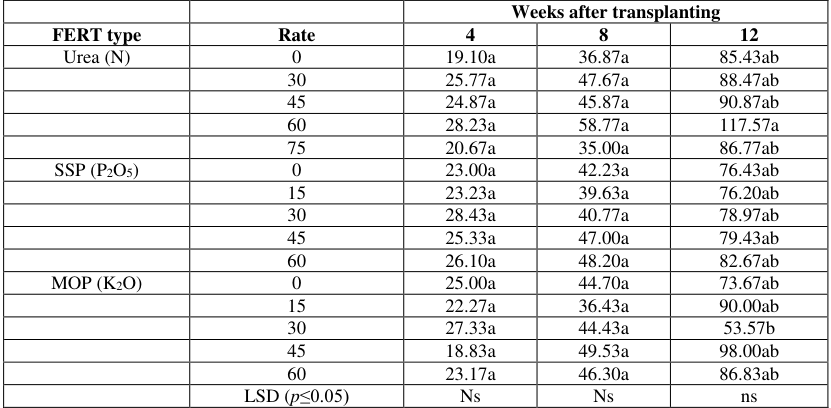 Table 1
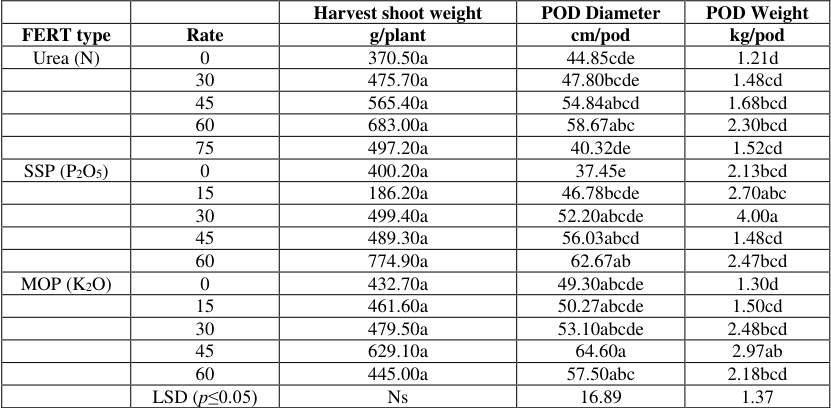 Table 2
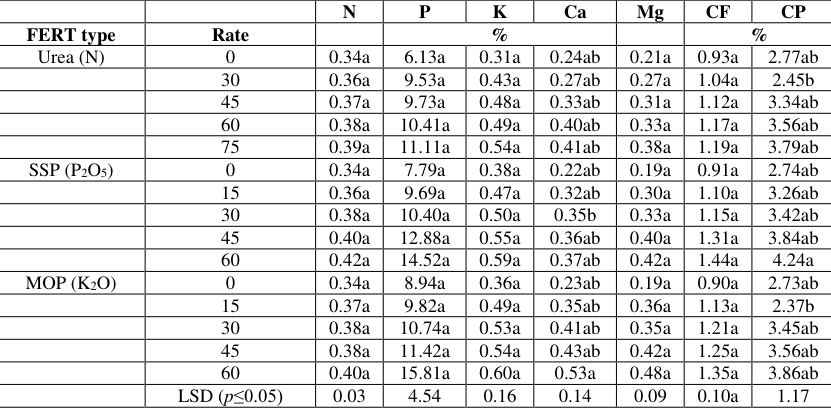 Table 3
Introduction
Fluted pumpkin (Telfairia occidentalis Hook. F.) is a vital indigenous leafy vegetable widely cultivated and consumed in West Africa, particularly in Southern Nigeria. As a creeping perennial vine with large, lobed leaves and long tendrils, it plays a significant role in local diets and rural economies. Traditionally valued for its edible leaves and seeds, recent studies have reinforced its importance as a functional food due to its rich nutritional composition, including essential vitamins, minerals, proteins, and antioxidants (Egbekun et al., 2022; Akinola et al., 2023) [7,4] . In addition to its culinary value, the plant exhibits potential medicinal properties such as anti-inflammatory and hypo-glycemic effects, thus highlighting its relevance in both ethno medicine and modern healthcare (Ibrahim et al., 2024) [8] . Both the leaves and seeds of T. occidentalis are nutritionally distinct. While the leaves are abundant in micronutrients such as iron and calcium, the seeds are rich in protein and fats, making them a high-calorie supplement in local diets (Akinyosoye et al., 2020) [5] . The seed oil also possesses potential for industrial applications, including its use as a source of oleo chemicals. Furthermore, T. occidentalis contributes substantially to income generation among smallholder farmers, especially women, thereby supporting household livelihoods (Oluwole et al., 2020) [12] . Despite its multifaceted importance, the production of T. occidentalis in Nigeria remains constrained by several agronomic challenges, particularly declining soil fertility. In the Southern Guinea Savanna agro-ecological zone, continuous cultivation and shortened fallow periods have led to nutrient depletion and reduced crop productivity (Oluwatoyinbo et al., 2020; Adebayo et al., 2018) [11,1] . Sustainable soil fertility management practices, including the application of organic and inorganic fertilizers, are increasingly being promoted to restore soil health and enhance crop performance (Usman et al., 2021) [13] . Integrated nutrient management approaches, combining mineral fertilizers with organic amendments such as poultry manure, are also gaining prominence in addressing these challenges.
Among essential plant nutrients, nitrogen (N), phosphorus (P), and potassium (K) are most frequently deficient and are critical for vegetative growth, flowering, and fruit development. Nitrogen plays a pivotal role in photosynthesis and protein synthesis and has been shown to enhance leaf yield in T. occidentalis when applied at optimal rates (Lawlor, 2013; Ojeniyi, 2013) [9,10] . While 60 kg N ha⁻¹ is traditionally recommended, higher rates such as 100 kg N ha⁻¹ may be beneficial under intensive vegetable production systems (Adediran et al., 2017) [2] . Phosphorus contributes to root development and metabolic activity, with single superphosphate (SSP) applications at 40-60 kg P₂O₅ ha⁻¹ significantly improving vegetative growth and nutrient use efficiency in cucurbitaceous crops (Adekiya et al., 2019) [3] . Potassium enhances water regulation, photosynthesis, and stress tolerance, with application rates of 60-90 kg K₂O ha⁻¹ recommended for optimal performance (Duan et al., 2022; Zhang et al., 2020) [6,14] . Although chemical fertilizers have demonstrated consistent benefits in improving crop yields, their high costs and inconsistent accessibility limit their use among resourcepoor farmers. Conversely, organic inputs such as poultry manure are more accessible but may be limited in supply and nutrient uniformity. Thus, identifying the most effective fertilizer type and rate remains essential for optimizing yield and nutritional quality of T. occidentalis. Despite its dietary and economic significance, the productivity of T. occidentalis under farmer-managed conditions remains lower than experimental yields, partly due to inadequate fertilization knowledge. This study, therefore, therefore, this study intended to determine the suitable fertilizer type and rate that will give the optimum vegetative growth, shoot yield and nutritional quality of T. occidentalis for the study area.
Materials and Methods
The experiment was conducted at the Teaching and Research Farm, Ladoke Akintola University of Technology, Ogbomoso. Ogbomoso lies on latitude 8 0 10' N and longitude 4 0 10' E with mean annual rainfall of between 1,150mm and 1,250mm. The conventional tillage operations were carried out. The land was cleared and beds were constructed. The experimental land was divided into three replicates, each consisting of fifteen beds to make a total of forty-five beds.
Each bed size was 1.44m 2 (1.2 x 1.2 m) and with 1m between beds and replicates to ease movement during cultural practices. Each bed contained nine plants. The treatment involved three fertilizer types and five rates namely; urea (0, 30, 45, 60 and 75 kg N/ha), Muriate of potash (0, 15, 30, 45 and 60 kg K 2 O/ha), single superphosphate (0, 15, 30, 45 and 60 kg P 2 O 5 /ha). These treatments were applied to the respective plots within each replicate. The experiment was arranged in a Randomized Complete Block Design and replicated three times. Seeds were extracted from the pods and air dried for 24 hours before sowing directly to remove the gelatinous materials around the seeds to aid germination. One seed was sown per stand at a depth of 5cm at a spacing 0.5 x 0.5 m. Application of fertilizer was done one week after sowing by drilling method. Watering was carried out at two days interval till rain set in, and this was done every morning. Manual weeding was carried out at two-week interval starting from four weeks after sowing. Data were collected on three tagged plants starting from four weeks after sowing at four-week interval for twelve weeks. The growth, yield and yield components data collected were; number of leaves/plants, harvested fresh shoot yield, pod diameter, pod weight. Number of leaves/plant was determined by visual observation and directing counting of fully opened leaves. Harvested fresh shoot yield was determined by weighing harvested shoot with sensitive weighing scale. Pod diameter was determined with the use of vernier caliper. Pod weight was determined with the use of weighing scale.
For determination of elemental mineral contents and proximate composition, harvested fluted pumpkin shoot were oven dried to constant weight at 65˚C for 48 hours.
The dried samples were milled and analyzed for Nitrogen (N), using Kjedahl digestion method, Phosphorus (P) using technicon AAI, Calcium (Ca) using flame photometer and magnesium (Mg) by the use of Atomic absorption spectrometer. Iron (Fe), ash content, and crude fiber were alsodetermined by AOAC Method (AOAC, 2012). Data collected were subjected to analysis of variance (ANOVA) using Genstat 12 th edition and treatment means were separated using Duncan Multiple Range Test (DMRT) at 5% probability level.
Results and Discussion
Effect of inorganic fertilizer rates on number of leaves/plant of Telfairia occidentalis: Nitrogen Fertilizer:
Effect of nitrogen fertilizer rates on number of leaves/plant of Telfairia occidentalis is presented in Table 2. Result showed that phosphorus fertilizer had no significant effect on the harvested shoot yield but a significant effect was observed on the pod diameter and pod weight. It was observed that 60 kg P 2 O 5 /ha produced the highest harvested shoot weight (774.90 /plant), pod diameter (62.67 cm/pod) and 30 kg P 2 O 5 /ha recorded the highest pod weight (4.00 kg/pod) while control plant produced the least value (186.20 g/plant, 37.45 cm/pod and 2.13 kg/pod respectively) Potassium Fertilizer: Effect of potassium fertilizer rates on yield and yield components of Telfairia occidentalis is presented in table 2. Result showed that potassium fertilizer had no significant effect on the harvested shoot yield but a significant effect was observed on the pod diameter and pod weight. Plant treated with 45 kg K 2 O/ha gave the highest harvested shoot weight (629.10 g/plant), pod diameter (64.60 cm/pod) and pod weight (2.97 kg/pod) while control plant produced the least value (432.70 g/plant, 49.30 cm/pod and 1.30 kg/pod respectively).
| — | — | Harvest shoot weight | POD Diameter | POD Weight |
|---|---|---|---|---|
| FERT type | Rate | g/plant | cm/pod | kg/pod |
| Urea (N) | 0 | 370.50a | 44.85cde | 1.21d |
| 30 | 475.70a | 47.80bcde | 1.48cd | |
| 45 | 565.40a | 54.84abcd | 1.68bcd | |
| 60 | 683.00a | 58.67abc | 2.30bcd | |
| 75 | 497.20a | 40.32de | 1.52cd | |
| SSP (P2O5) | 0 | 400.20a | 37.45e | 2.13bcd |
| 15 | 186.20a | 46.78bcde | 2.70abc | |
| 30 | 499.40a | 52.20abcde | 4.00a | |
| 45 | 489.30a | 56.03abcd | 1.48cd | |
| 60 | 774.90a | 62.67ab | 2.47bcd | |
| MOP (K2O) | 0 | 432.70a | 49.30abcde | 1.30d |
| 15 | 461.60a | 50.27abcde | 1.50cd | |
| 30 | 479.50a | 53.10abcde | 2.48bcd | |
| 45 | 629.10a | 64.60a | 2.97ab | |
| 60 | 445.00a | 57.50abc | 2.18bcd | |
| LSD (p≤0.05) | Ns | 16.89 | 1.37 |
Table text extracted from the original PDF; superscript letters are shown inline. The original table image is below.
View original table image
Effect of inorganic fertilizer rates on nutritional quality of Telfairia occidentalis
Nitrogen Fertilizer: Effect of nitrogen fertilizer rates on nutritional quality of Telfairia occidentalis is presented in Table 3. Result showed that nitrogen fertilizer had no significant effect on N, P, K, Mg, CF contents but a significant effect was observed on Ca and CP contents. It was observed that 75 kg N/ha produced the highest N(0.39%), P(11.11%), K(0.54%), Ca (0.41%), Mg(0.38%), CF(1.19%), and CP(3.79%) while control plant produced the least values (0.34%, 6.15%, 0.31%, 0.27%, 0.27%, 1.04%, and 2.77% respectively) Phosphorus Fertilizer: Effect of phosphorus fertilizer rates on nutritional quality of Telfairia occidentalis is presented in Table 3. Result showed that phosphorus fertilizer had no significant effect on N, P, K, Mg, CF contents but a significant effect was observed on Ca and CP contents. Result showed that plant treated with 60 kg P 2 O 5 /ha gave the highest N(0.42%), P(14.52%), K(0.59%), Ca (0.37%), Mg(0.42%), CF(1.44%), and CP(4.24%) while control plant produced the least values (0.34%, 7.29%, 0.38%, 0.22%, 0.19%, 0.91%, and 2.74% respectively) Potassium Fertilizer: Effect of potassium fertilizer rates on nutritional quality of Telfairia occidentalis is presented in Table 3. Result showed that nitrogen fertilizer had no significant effect on N, P, K, Mg, CF contents but a significant effect was observed on Ca and CP contents. It was observed that 60 kg P 2 O 5 /ha produced the highest N(0.40%), P(15.81%), K(0.60%), Ca(0.53%), Mg(0.48%), CF(1.35%), and CP(3.86%) while control plant produced the least values (0.34%, 8.94%, 0.36%, 0.23%, 0.19%, 0.90%, and 2.73% respectively).
| — | — | N | P | K | Ca | Mg | CF | CP |
|---|---|---|---|---|---|---|---|---|
| FERT type | Rate | % | % | |||||
| Urea (N) | 0 | 0.34a | 6.13a | 0.31a | 0.24ab | 0.21a | 0.93a | 2.77ab |
| 30 | 0.36a | 9.53a | 0.43a | 0.27ab | 0.27a | 1.04a | 2.45b | |
| 45 | 0.37a | 9.73a | 0.48a | 0.33ab | 0.31a | 1.12a | 3.34ab | |
| 60 | 0.38a | 10.41a | 0.49a | 0.40ab | 0.33a | 1.17a | 3.56ab | |
| 75 | 0.39a | 11.11a | 0.54a | 0.41ab | 0.38a | 1.19a | 3.79ab | |
| SSP (P2O5) | 0 | 0.34a | 7.79a | 0.38a | 0.22ab | 0.19a | 0.91a | 2.74ab |
| 15 | 0.36a | 9.69a | 0.47a | 0.32ab | 0.30a | 1.10a | 3.26ab | |
| 30 | 0.38a | 10.40a | 0.50a | 0.35b | 0.33a | 1.15a | 3.42ab | |
| 45 | 0.40a | 12.88a | 0.55a | 0.36ab | 0.40a | 1.31a | 3.84ab | |
| 60 | 0.42a | 14.52a | 0.59a | 0.37ab | 0.42a | 1.44a | 4.24a | |
| MOP (K2O) | 0 | 0.34a | 8.94a | 0.36a | 0.23ab | 0.19a | 0.90a | 2.73ab |
| 15 | 0.37a | 9.82a | 0.49a | 0.35ab | 0.36a | 1.13a | 2.37b | |
| 30 | 0.38a | 10.74a | 0.53a | 0.41ab | 0.35a | 1.21a | 3.45ab | |
| 45 | 0.38a | 11.42a | 0.54a | 0.43ab | 0.42a | 1.25a | 3.56ab | |
| 60 | 0.40a | 15.81a | 0.60a | 0.53a | 0.48a | 1.35a | 3.86ab | |
| LSD (p≤0.05) | 0.03 | 4.54 | 0.16 | 0.14 | 0.09 | 0.10a | 1.17 |
Table text extracted from the original PDF; superscript letters are shown inline. The original table image is below.
View original table image
Discussion
Discussion
Conclusion and Recommendation
Results from this study showed that all the fertilizers rates tested enhanced the growth, shoot yield and nutritional quality of fluted pumpkin. From the result obtained in this study, it has shown that growth, shoot yield and nutritional quality of fluted pumpkin was influenced by the applied fertilizers rates. Nitrogen at 60 kg/ha, phosphorus at 60 kg P₂O₅/ha, and potassium at 60 kg K₂O/ha optimized leaf production, pod diameter, pod weight and enhanced nutrient content, especially crude protein and calcium. Therefore, for optimal growth, yield, and nutritional quality of Telfairia occidentalis, 60 kg/ha of N and P₂O₅, and 45-60 kg/ha of K₂O could be recommended for production of fluted pumpkin in the study area.
Figures and tables from the paper
| — | — | Weeks after transplanting | — | — |
|---|---|---|---|---|
| FERT type | Rate | 4 | 8 | 12 |
| Urea (N) | 0 | 19.10a | 36.87a | 85.43ab |
| 30 | 25.77a | 47.67a | 88.47ab | |
| 45 | 24.87a | 45.87a | 90.87ab | |
| 60 | 28.23a | 58.77a | 117.57a | |
| 75 | 20.67a | 35.00a | 86.77ab | |
| SSP (P2O5) | 0 | 23.00a | 42.23a | 76.43ab |
| 15 | 23.23a | 39.63a | 76.20ab | |
| 30 | 28.43a | 40.77a | 78.97ab | |
| 45 | 25.33a | 47.00a | 79.43ab | |
| 60 | 26.10a | 48.20a | 82.67ab | |
| MOP (K2O) | 0 | 25.00a | 44.70a | 73.67ab |
| 15 | 22.27a | 36.43a | 90.00ab | |
| 30 | 27.33a | 44.43a | 53.57b | |
| 45 | 18.83a | 49.53a | 98.00ab | |
| 60 | 23.17a | 46.30a | 86.83ab | |
| LSD (p≤0.05) | Ns | Ns | ns |
Table text extracted from the original PDF; superscript letters are shown inline. The original table image is below.
View original table image
References
14 in the original paper- Adebayo AG, Olowookere OS, Adebayo OA. Assessment of soil fertility status and crop yield in the Southern Guinea Savanna agro-ecological zone of Nigeria. Nigerian Journal of Soil Science. 2018;28(1):56-64.
- Adediran JA, Taiwo LB, Akande MO, Oluwatoyinbo FI. Effects of nitrogen fertilizer rates on growth, yield and nutrient uptake of Telfairia occidentalis (fluted pumpkin) in South Western Nigeria. Nigerian Journal of Horticultural Science. 2017;22:1-10.
- Adekiya AO, Agbede TM, Aboyeji CM, Dunsin O, Aremu CO, Akinrinola AF. Growth and nutrient composition of Amaranthus cruentus L. as influenced by poultry manure and phosphorus fertilizer. Scientia Horticulturae. 2019;243:430-6.
- Akinola OA, Olasupo FO, Oboh G. Nutritional and phytochemical properties of Telfairia occidentalis (Hook.f.) leaves: A review. Food Chemistry. 2023;402:134186.
- Akinyosoye FA, Oboh G, Ademiluyi AO. Comparative evaluation of the nutritional and antioxidant properties of Telfairia occidentalis seeds and leaves. Food Chemistry. 2020;311:125969.
- Duan Y, Wang J, Liu H, Chen X. Optimizing potassium application for improved growth and yield of Cucurbitaceae crops. Journal of Plant Nutrition. 2022;45(10):1432-45.
- Egbekun MK, Adebayo OA, Olanipekun BF. Evaluation of growth performance and yield of Telfairia occidentalis under different organic manure applications. Nigerian Journal of Horticultural Science. 2022;27(1):45-53.
- Ibrahim AA, Mohammed AA, Umar AB. Phytochemical screening and in vitro evaluation of the anti-inflammatory and hypoglycemic activities of Telfairia occidentalis leaf extracts. Journal of Ethnopharmacology. 2024;319:116890.
- Lawlor DW. Photosynthesis: Molecular, physiological and environmental processes. Hoboken (NJ): John Wiley and Sons, 2013.
- Ojeniyi SO. Soil fertility management for fluted pumpkin (Telfairia occidentalis) production in Nigeria. Nigerian Journal of Soil Science. 2013;23(1):1-8.
- Oluwatoyinbo FI, Adebayo OA, Olanipekun BF. Impact of continuous cropping on soil fertility and crop yield in the Southern Guinea Savanna of Nigeria. Journal of Sustainable Agriculture and Environment. 2020;19(2):78-85.
- Oluwole OB, Ojo OA, Adebayo OA. Economic analysis of Telfairia occidentalis production among smallholder farmers in Southwest Nigeria. Journal of Agricultural Extension and Rural Development. 2020;12(4):115-122.
- Usman AO, Adebayo OA, Akinola OA. Comparative analysis of organic and inorganic fertilizers on soil nutrient availability and crop performance in the Southern Guinea Savanna. Archives of Agronomy and Soil Science. 2021;67(10):1365-1378.
- Zhang H, Wang L, Chen S. Physiological and molecular mechanisms of leaf senescence in plants. Journal of Integrative Plant Biology. 2020;62(1):10-29.